
Life, 1918-11-07 · page 16 of 36
Life — November 7, 1918 — page 16: what you’re looking at
What you’re looking at
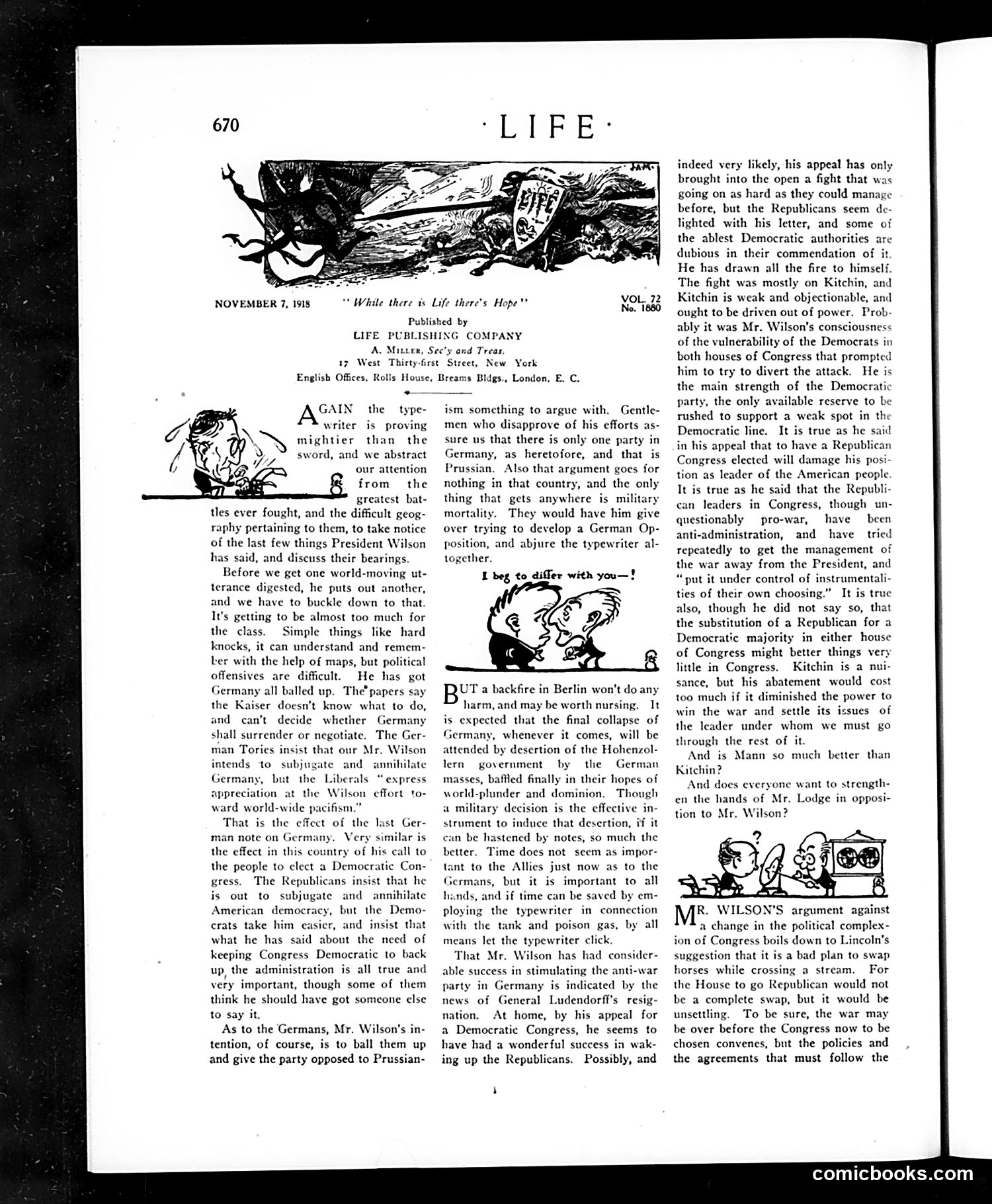
This Life magazine piece satirizes President Wilson's recent diplomatic and political communications during World War I's final weeks. The cartoons and text mock how Wilson's typewriter (his written appeals) affects different audiences unpredictably. The satire targets Wilson's dual strategy: his notes to Germany attempting to foment internal opposition to the Kaiser, and his appeal for Americans to elect a Democratic Congress to support his administration. The author argues both efforts confuse their intended audiences—Germans and Republicans respectively—though perhaps productively. Key figures referenced include **Kitchin** (likely Claude Kitchin, a Democratic congressman facing criticism) and **Ludendorff** (the German general whose resignation the author credits partly to Wilson's anti-war messaging). The joke: Wilson's typewriter proves as powerful as military weapons, inadvertently energizing Republican opposition while potentially weakening German morale—proving unpredictability can serve useful wartime purposes.
📄 Transcribed text from this page (OCR, searchable)
Machine-transcribed from the original scan — historical spelling and the odd misread are preserved.
NOVEMBER 7, 1918 ** While there ts Life there's Hope"” Published by LIFE PUBLISHING A. Minter, See’y an COMPANY Treas, 17 West Thirty-first Street, New York English Offices, Rolls House, Bre AchN the type- writer is proving mightier than the sword, and we abstract our attention from the greatest bat- tles ever fought, and the difficult geog- raphy pertaining to them, to take notice of the last few things President Wilson has said, and discuss their bearings. Before we get one world-moving ut- terance di; ed, he puts out another, and we have to buckle down to that. It's getting to be almost too much for the class. Simple things like hard knocks, it can understand and remem- Ler with the help of maps, but political offensives are difficult. He has got Germany all balled up. The’ papers say the Kaiser doesn’t know what to do, and can’t decide whether Germany shall surrender or negotiate. The Ger- man Tories insist that our Mr. Wilson intends to subjugate and annihilate Germany, but the Liberals “express ppreciation at the Wilson effort to- d world-wide pacifism.” hat is the effect of the last Ger- man note on Germany. Very similar is the effect in this country of his call to the people to clect a Democratic Con- gress. The Republicans insist that he is out to subjugate and annihilate American democ: but the Demo- crats take him easicr, and insist that what he has said about the need of keeping Congress Democratic to back up, the administration is all true and very important, though some of them think he should have got someone else to say it. As to the Germans, Mr. Wilson's in- tention, of course, is to ball them up and give the party opposed to Prussian- Bldgs., London, E. C. ism something to argue with, Gentle- men who disapprove of his efforts as- sure us that there is only one party in Germany, as heretofore, and that is Prussian. Also that argument goes for nothing in that country, and the only thing that gets anywhere is military mortality. They would have him give over trying to develop a German Op- position, and abjure the typewriter al- together. I beg to differ with you—! T a backfire in Berlin won't do any harm, and may be worth nursing. It is expected that the final collapse of Germany, whenever it comes, will be attended by desertion of the Hohenzol- lern government by the German masses, baffled finally in their hopes of world-plunder and dominion. Though a military decision is the effective in- strument to induce that desertion, if it can be hastened by notes, so much the better. Time does not seem as impor- tant to the Allies just now as to the Germans, but it is important to all hands, and if time can be saved by em- ploying the typewriter in connection with the tank and poison gas, by all means let the typewriter click, That Mr. Wilson has had consider- able success in stimulating the anti-war party in Germany is indicated by the news of General Ludendorff's resig- nation. At home, by his appeal for a Democratic Congress, he seems to have had a wonderful success in wak- ing up the Republicans. Possibly, and indeed very likely, his appeal has only brought into the open a fight that was going on as hard as they could manage before, but the Republicans seem de- lighted with his letter, and some of the ablest Democratic authorities are dubious in their commendation of it He has drawn all the fire to himself, The fight was mostly on Kitchin, and Kitchin is weak and objectionable, and ought to be driven out of power. Prob- ably it was Mr. Wilson’s consciousness of the vulnerability of the Democrats in both houses of Congress that prompted him to try to divert the attack. He is the main strength of the Democratic party, the only available reserve to be rushed to support a weak spot in the Democratic line. It is true as he said in his appeal that to have a Republican Congress elected will damage his posi- tion as leader of the American people. It is true as he said that the Republi- can leaders in Congress, though un- questionably pro-war, have been anti-administration, and have tried repeatedly to get the management of the war away from the President, and “put it under control of instrumentali- ties of their own choosing.” It is true also, though he did not say so, that the substitution of a Republican for a Democratic majority in either house of Congress might better things ve: little in Congress. Kitchin is a nui- sance, but his abatement would cost too much if it diminished the power to win the war and settle its issues of the leader under whom we must go through the rest of it. And is Mann so much better than Kitchin? And does everyone want to strength- en the hands of Mr. Lodge in opposi- tion to Mr, Wilson? R. WILSON’S argument against a change in the political complex ion of Congress boils down to Lincoln’ suggestion that it is a bad plan to swap horses while crossing a stream. For the House to go Republican would not be a complete swap, but it would be unsettling. To be sure, the war may be over before the Congress now to be chosen convenes, but the policies and the agreements that must follow the comicbooks.com