
Life, 1918-11-07 · page 6 of 36
Life — November 7, 1918 — page 6: what you’re looking at
What you’re looking at
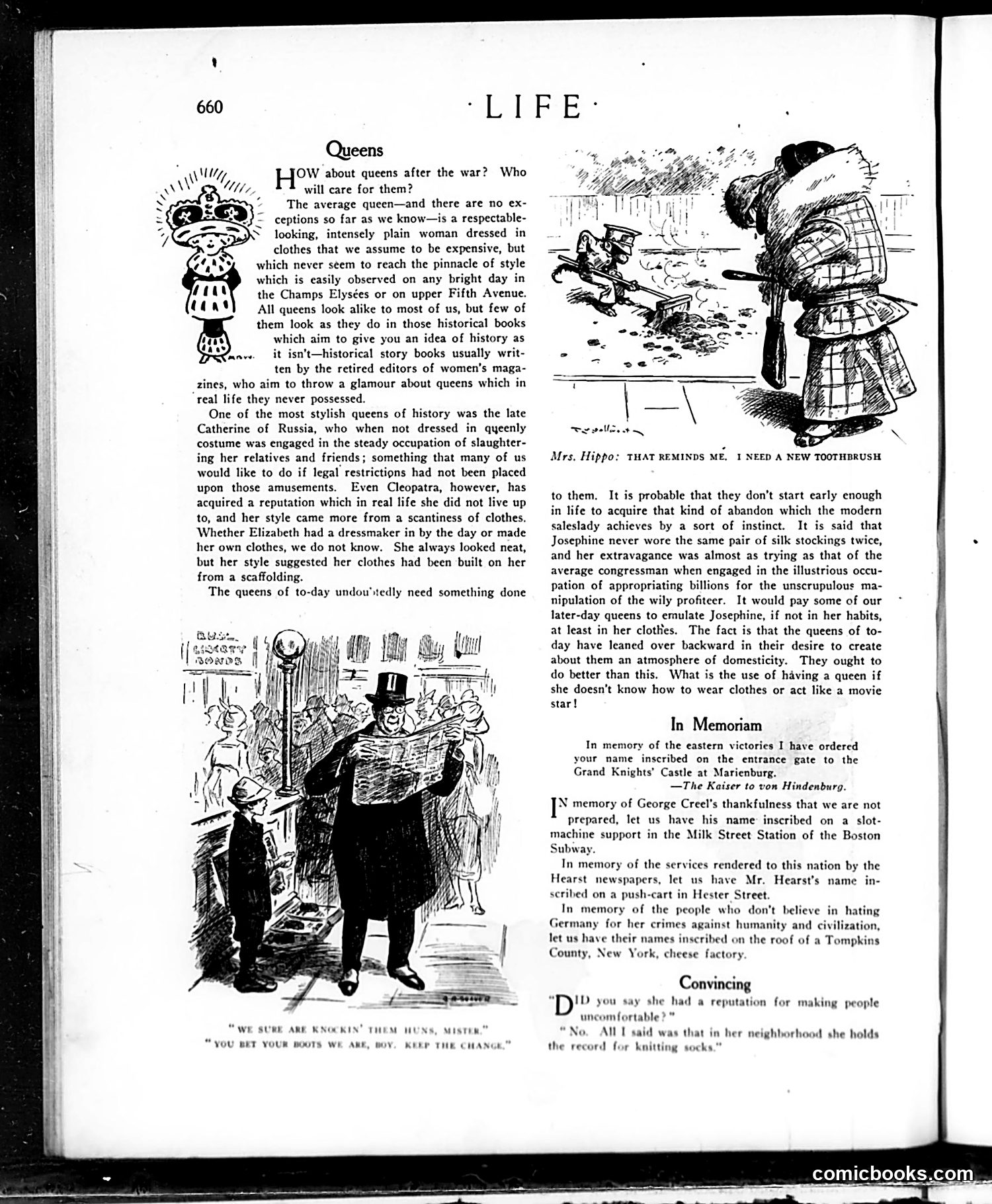
This page contains two distinct satirical pieces: **"Queens" (top section):** A commentary on post-WWI royal women, critiquing their plain appearance and lack of glamour compared to historical queens. The text mocks how modern queens fail to embody the splendor expected of royalty—they dress expensively but plainly, unlike Catherine of Russia or Cleopatra. The satire suggests queens should either dress more elaborately or abandon pretense altogether. The accompanying illustration depicts a street scene, though the specific reference is unclear. **Lower cartoon:** Shows a man in formal dress with children, captioned with working-class dialect ("We sure are knockin' them huns, sister"). This appears to reference WWI patriotism or propaganda, though the exact context requires additional historical knowledge. Both pieces use humor to critique expectations versus reality in the post-war era.
📄 Transcribed text from this page (OCR, searchable)
Machine-transcribed from the original scan — historical spelling and the odd misread are preserved.
pases ey SSS 660 “LIFE Queens OW about queens after the war? Who will care for them? The average queen—and there are no ex- = ceptions so far as we know—is a respectable- S looking, intensely plain woman dressed in clothes that we assume to be expensive, but which never seem to reach the pinnacle of style which is easily observed on any bright day in the Champs Elysées or on upper Fifth Avenue. All queens look alike to most of us, but few of them look as they do in those historical books which aim to give you an idea of history as Sevens it isn't—historical story books usually writ- ten by the retired editors of women’s maga- zines, who aim to throw a glamour about queens which in “real life they never possessed. One of the most stylish queens of history was the late Catherine of Russia, who when not dressed in qyeenly costume was engaged in the steady occupation of slaughter- ing her relatives and friends; something that many of us would like to do if legal restrictions had not been placed upon those amusements. Even Cleopatra, however, has acquired a reputation which in real life she did not live up to, and her style came more from a scantiness of clothes. Whether Elizabeth had a dressmaker in by the day or made her own clothes, we do not know. She always looked neat, but her style suggested her clothes had been built on her from a scaffolding. The queens of to-day undou'itedly need something done “WE SURE ARE KNOCKIN’ THEM HUNS, MisteR.” “YOU BET YOUR BOOTS WK ARE, BOY, KEEP THE CHANGE Mrs, Hippo: THAT REMINDS ME. 1 NEED A NEW TOOTHBRUSH to them. It is probable that they don’t start early enough in life to acquire that kind of abandon which the modern saleslady achieves by a sort of instinct. It is said that Josephine never wore the same pair of silk stockings twice, and her extravagance was almost as trying as that of the average congressman when engaged in the illustrious occu- pation of appropriating billions for the unscrupulous ma- nipulation of the wily profiteer. It would pay some of our later-day queens to emulate Josephine, if not in her habits, at least in her clothes. The fact is that the queens of to- day have leaned over backward in their desire to create about them an atmosphere of domesticity. They ought to do better than this. What is the use of having a queen if she doesn’t know how to wear clothes or act like a movie star! In Memoriam In memory of the eastern victories I have ordered your name inscribed on the entrance gate to the Grand Knights’ Castle at Marienburg. —The Kaiser to von Hindenburg. memory of George Creel’s thankfulness that we are not prepared, let us have his name inscribed on a slot- machine support in the Milk Street Station of the Boston Subway. In memory of the services rendered to this nation by the Hearst newspapers, let us have Mr. Hearst’s name in- scribed on a push-cart in Hester Street. In memory of the people who don't believe in hating Germany for her crimes against humanity and civilization, let us have their names inscribed on the roof of a Tompkins County, New York, cheese factory Convincing “D)'P you say she had a reputation for making people uncomfortable? No. All I said was that in her neighborhood she holds the record for knitting socks.”