
Life, 1918-11-07 · page 11 of 36
Life — November 7, 1918 — page 11: what you’re looking at
What you’re looking at
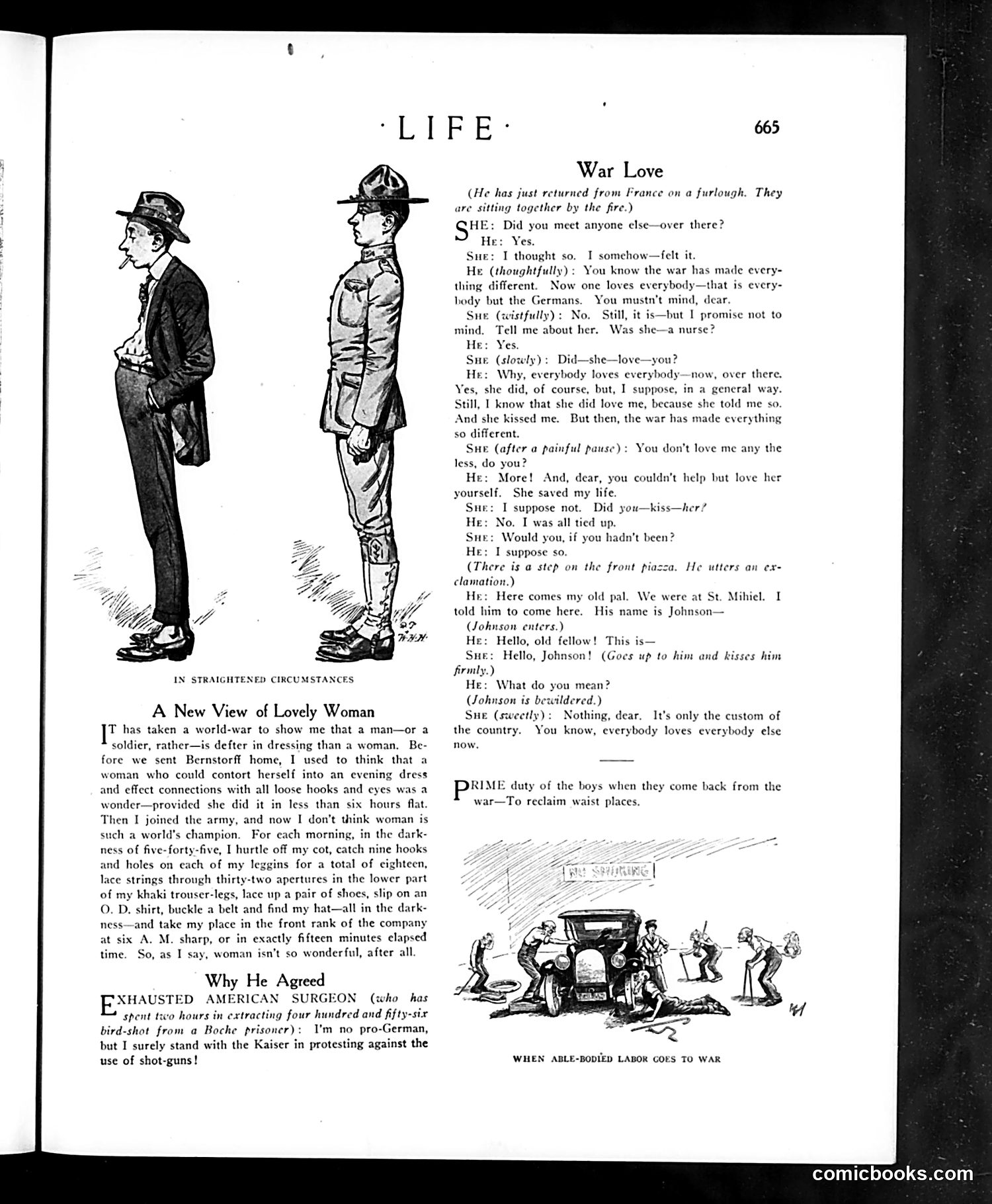
This page contains three satirical pieces about World War I and gender roles: **"War Love"** presents a dialogue between a soldier and woman discussing romance during wartime. The humor plays on how warfare supposedly changes social norms—she kisses him freely ("custom of the country"), which would have been scandalous pre-war behavior. **"A New View of Lovely Woman"** mocks the author's previous assumptions about women's delicacy. He describes the physical effort of military dressing (hooks, laces, equipment), suggesting women are now recognized as capable and hardy—equal to soldiers' demands. **"Why He Agreed"** shows an exhausted American surgeon refusing pro-German sympathies after extreme service, implying moral clarity through suffering. The illustrations depict soldiers in various states, emphasizing the physical transformation war demands of both men and women.
📄 Transcribed text from this page (OCR, searchable)
Machine-transcribed from the original scan — historical spelling and the odd misread are preserved.
IN STRAIGHTENED CIRCUMSTANCES, A New View of Lovely Woman T has taken a world-war to show me that a man—or a soldier, rather—is defter in dressing than a woman. Be- fore we sent Bernstorff home, I used to think that a woman who could contort herself into an evening dress and effect connections with all loose hooks and cyes was a wonder—provided she did it in less than six hours fla Then I joined the army, and now I don’t think woman is such a world’s champion. For each morning, in the dark- ness of five-forty-five, I hurtle off my cot, catch nine hoo! and holes on each of my leggins for a total of eighteen, lace strings through thirty-two apertures in the lower part of my khaki trouser-legs, lace up a pair of shoes, slip on an O. D. shirt, buckle a belt and find my hat—all in the ness—and take my place in the front rank of the company at six A. M. sharp, or in exactly fifteen minutes elapsed time. So, as I say, woman isn’t so wonderful, after all Why He Agreed XHAUSTED AMERICAN SURGEON (who has spent two hours in extracting four hundred and fifty-six bird-shot from a Boche prisoner): I'm no pro-German, but I surely stand with the Kaiser in protesting against the use of shot-guns! (He has just returned from France on a furlough. They ig together by the fire.) Did you meet anyone else—over there? Yes. Sue: I thought so. I somehow—felt it. He (thoughtfully): You know the war has made every- Now one loves everybody—that is every- You mustn't mind, dear. thing different. hody but the Germans. Sue (wistfully): No. Still, it is—but 1 promise not to mind, Tell me about her. Was she—a nurse? He: Yes. Sue (slowly): Did—she—love—you? He: Why, everybody loves everybody—now, over there. Yes, she did, of course, but, I suppose, in a general way. Still, I know that she did love me, because she told me so. And she kissed me. But then, the war has made everything so different. Sue (after a painful pause): less, do you? He: More! And, dear, you couldn't help but love her yourself. She saved my life. Sue: I suppose not. Did you—kiss—her? He: No. I was all tied up, Sue: Would you, if you hadn't been? HE: I suppose so. (There is a step on the front pic clamation.) He: Here comes my old p We were at St. Mihiel. I told him to come here. His name is Johnson— (Johnson enters.) Hello, old fellow! This is— Hello, Johnson! (Goes up to him and kisses him You don’t love me any the . He utters an ex- -) What do you mean? (Johnson is bewildered.) Sue (sweetly): Nothing, dear. It's only the custom of the country. You know, everybody loves everybody else now. PRIME duty of the boys when they come back from the war—To reclaim waist places. WHEN ABLE-BODIED LABOR GOES TO WAR comicbooks.com