
Life, 1918-11-07 · page 20 of 36
Life — November 7, 1918 — page 20: what you’re looking at
What you’re looking at
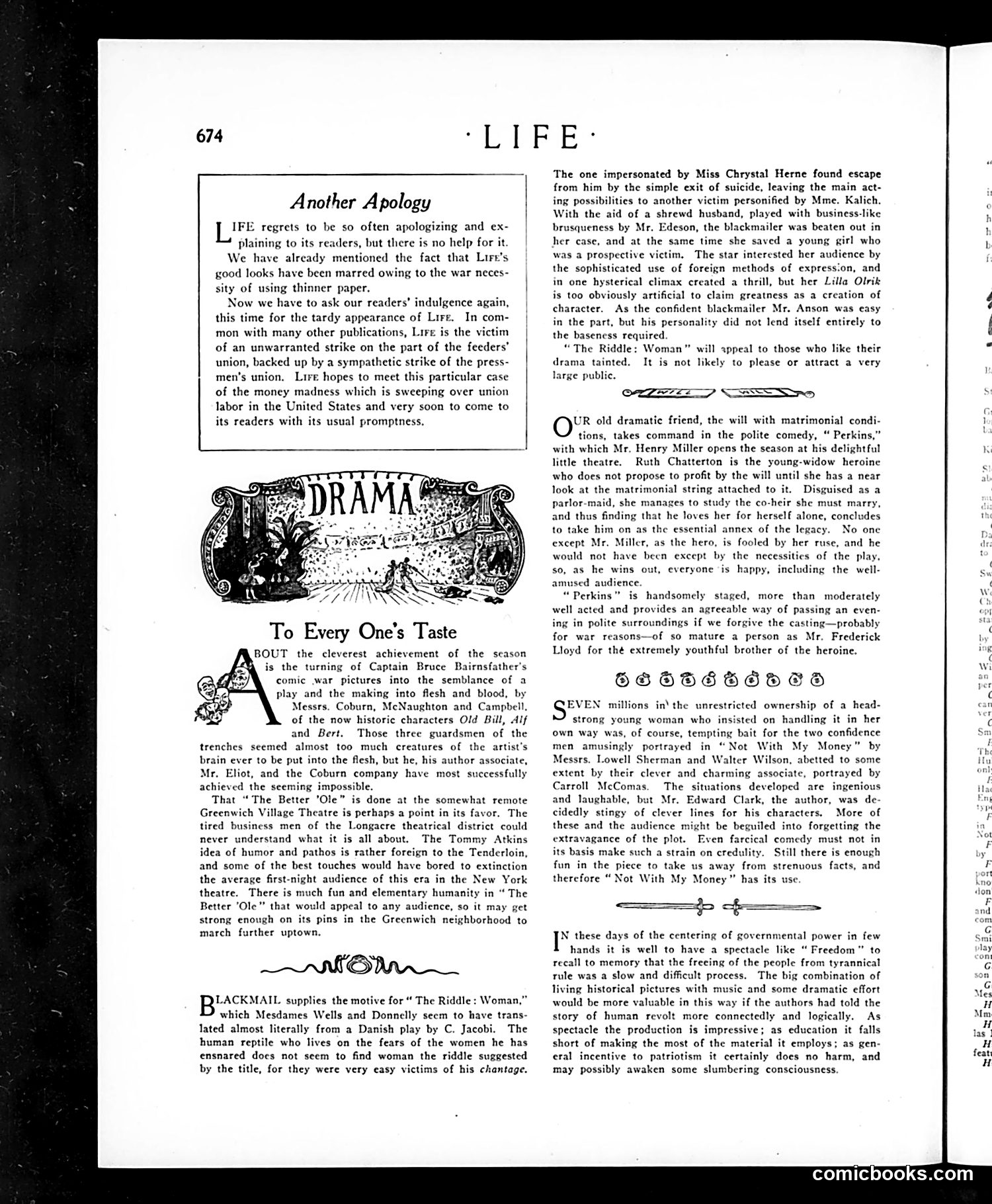
This page contains theater reviews and commentary. Key elements: **"Another Apology"** (top left): Life apologizes for quality issues due to WWI paper shortages and publishing delays caused by union strikes in the printing industry—framed as "money madness" sweeping labor unions. **Theater Reviews**: The bulk discusses three plays: - **"The Better 'Ole"**: Adapts cartoonist Bruce Bairnsfather's WWI trench humor into theater, featuring characters "Old Bill, Alf and Bert." The reviewer notes its "Tommy Atkins" (British soldier) humor may be too sophisticated for mainstream Broadway audiences but suits Greenwich Village tastes. - **"The Riddle: Woman"**: A blackmail drama adapted from Danish playwright C. Jacobi, featuring actresses Chrystal Herne and Mme. Kalich. The reviewer criticizes the performances as overly artificial despite dramatic moments. - **"Perkins"**: A comedy starring Ruth Chatterton and Henry Miller involving a will with matrimonial conditions. The satire is gentle—critiquing theatrical pretension and audience sophistication rather than politics directly.
📄 Transcribed text from this page (OCR, searchable)
Machine-transcribed from the original scan — historical spelling and the odd misread are preserved.
“LUPE Another Apology IFE regrets to be so often apologizing and ex- plaining to its readers, but there is no help for it. We have already mentioned the fact that Lire’s good looks have been marred owing to the war neces sity of using thinner paper. Now we have to ask our readers’ indulgence again, this time for the tardy appearance of Lire. In com- mon with many other publications, Lire is the victim of an unwarranted strike on the part of the feeders’ union, backed up by a sympathetic strike of the press- men’s union. Lire hopes to meet this particular case of the money madness which is sweeping over union labor in the United States and very soon to come to its readers with its usual promptness, To Every One’s Taste BOUT the cleverest achievement of the season is the turning of Captain Bruce Bairnsfather's comic war pictures into the semblance of a play and the making into flesh and blood, by Messrs. Coburn, McNaughton and Campbell, of the now historic characters Old Bill, Alf and Bert. Those three guardsmen of the trenches seemed almost too much creatures of the artist's brain ever to be put into the flesh, but he, his author associate, Mr. Eliot, and the Coburn company have most successfully achieved the seeming impossible. That “The Better ‘Ole” is done at the somewhat remote Greenwich Village Theatre is perhaps a point in its favor. The tired business men of the Longacre theatrical district could never understand what it is all about, The Tommy Atkins idea of humor and pathos is rather foreign to the Tenderloin, and some of the best touches would have bored to extinction the average first-night audience of this era in the New York theatre. There is much fun and elementary humanity in “ The Better ‘Ole” that would appeal to any audience, so it may get strong enough on its pins in the Greenwich neighborhood to march further uptown. ~~ntOmwn_. LACKMAIL supplies the motive for “ The Riddle: Woman,” which Mesdames Wells and Donnelly secm to have trans- lated almost literally from a Danish play by C. Jacobi. The human reptile who lives on the fears of the women he has ensnared docs not seem to find woman the riddle suggested by the title, for they were very easy victims of his chantage. The one impersonated by Miss Chrystal Herne found escape from him by the simple exit of suicide, leaving the main act- ing possibilities to another victim personified by Mme. Kalich. With the aid of a shrewd husband, played with business-like brusqueness by Mr. Edeson, the blackmailer was beaten out in her case, and at the same time she saved a young girl who was a prospective victim. The star interested her audience by the sophisticated use of foreign methods of expression, and in one hysterical climax created a thrill, but her Lilla Olrik is too obviously artificial to claim greatness as a creation of character. As the confident blackmailer Mr. Anson was easy in the part, but his personality did not lend itself entirely to the baseness required. “The Riddle: Woman” will appeal to those who like their drama tainted. It is not likely to please or attract a very large public. UR old dramatic friend, the will with matrimonial condi- tions, takes command in the polite comedy, “ Perkins,” with which Mr. Henry Miller opens the season at his delightful little theatre. Ruth Chatterton is the young-widow heroine who does not propose to profit by the will until she has a near look at the matrimonial string attached to it. Disguised as a parlor-maid, she manages to study the co-heir she must marry and thus finding that he loves her for herself alone, concludes to take him on as the essential annex of the legacy. No one except Mr. Miller, as the hero, is fooled by her ruse, and he would not have been except by the necessities of the play, so, as he wins out, everyone is happy, including the well- amused audience. “Perkins” is handsomely staged, more than moderately well acted and provides an agreeable way of passing an even- ing in polite surroundings if we forgive the casting—probably for war reasons—of so mature a person as Mr. Frederick Lloyd for thé extremely youthful brother of the heroine. (ORG RORORGRCROROROMO) EVEN millions in’ the unrestricted ownership of a head- strong young woman who insisted on handling it in her own way was, of course, tempting bait for the two confidence men amusingly portrayed in “Not With My Money” by Messrs. Lowell Sherman and Walter Wilson, abetted to some extent by their clever and charming associate, portrayed by Carroll McComas. The situations developed are ingenious and laughable, but Mr. Edward Clark, the author, was de- cidedly stingy of clever lines for his characters. More of these and the audience might be beguiled into forgetting the extravagance of the plot. Even farcical comedy must not in its basis make such a strain on credulity. Still there is enough fun in the piece to take us away from strenuous facts, and therefore “Not With My Money” has its use. I these days of the centering of governmental power in few hands it is well to have a spectacle like “ Freedom” to recall to memory that the freeing of the people from tyrannical rule was a slow and difficult process. The big combination of living historical pictures with music and some dramatic effort would be more valuable in this way if the authors had told the story of human revolt more connectedly and logically. As spectacle the production is impressive; as education it falls short of making the most of the material it employs; as gen- eral incentive to patriotism it certainly does no harm, and may possibly awaken some slumbering consciousness. comicbooks.com ‘