
Life, 1918-11-07 · page 17 of 36
Life — November 7, 1918 — page 17: what you’re looking at
What you’re looking at
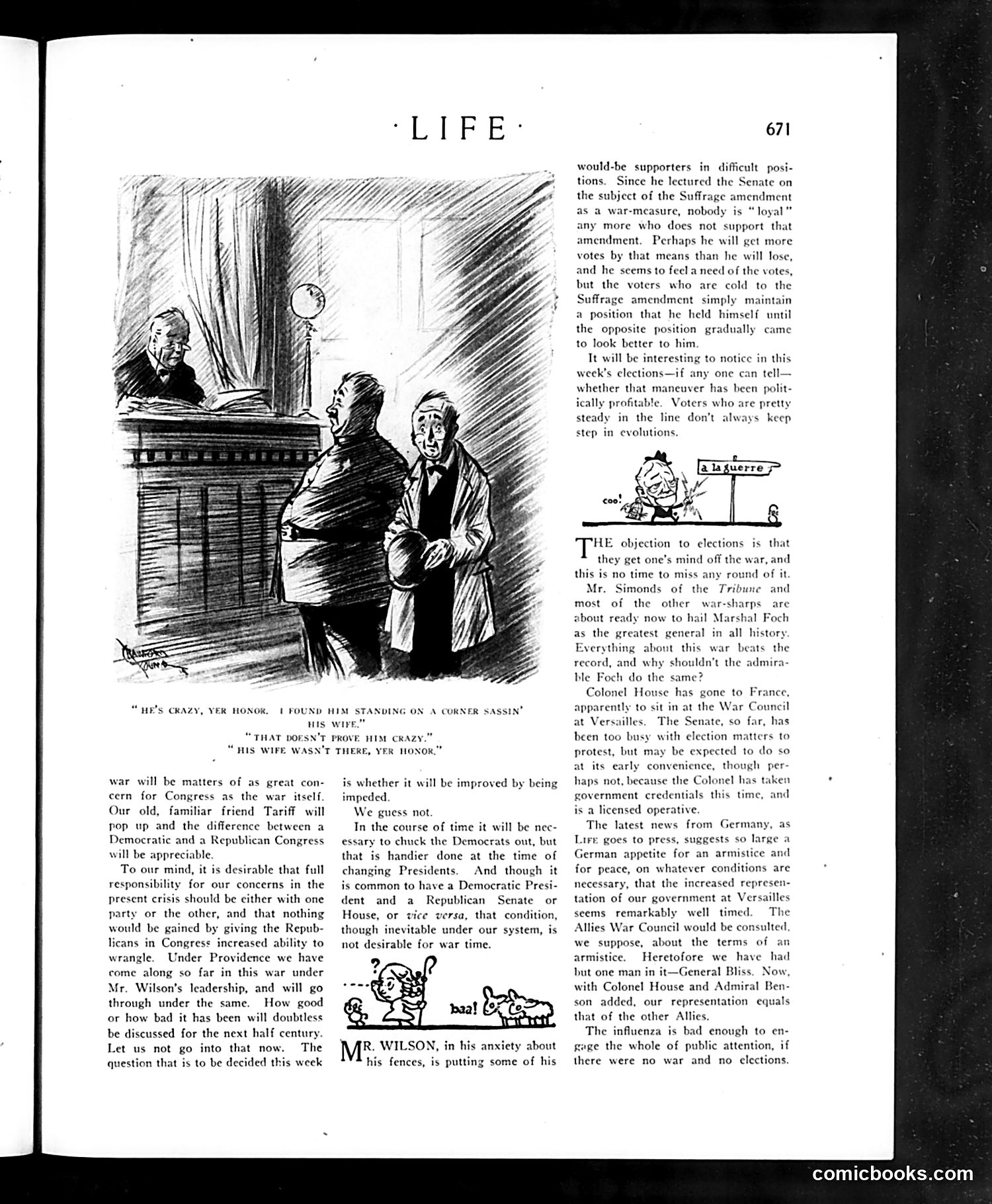
The main cartoon depicts a judge hearing a case where a man was found "standing on a corner sassin' his wife." The humor lies in the judge's response: finding a man arguing with his absent wife doesn't prove he's crazy—it's normal behavior. This is domestic satire mocking marital disputes. The accompanying text discusses upcoming elections during World War I, criticizing their timing as a distraction from the war effort. The author argues for unified government control rather than split Democratic-Republican leadership during wartime. The piece specifically references President Wilson's recent push for women's suffrage as a "war-measure," noting this has alienated voters previously neutral on the issue. The commentary questions whether Wilson's political maneuvering will gain or lose votes. The article also mentions Colonel House attending the War Council at Versailles and discusses Marshal Foch's military reputation, placing this during late-stage WWI negotiations (likely 1918).
📄 Transcribed text from this page (OCR, searchable)
Machine-transcribed from the original scan — historical spelling and the odd misread are preserved.
“HE'S CRAZY, YER HONOR. 1 FOUND HIM STANDING ON A CORNER SASSIN? His wire.” “THAT DOESN'T PROVE HIM CRAZY.” “HIS WIFE WASN'T THER war will be matters of as great con- cern for Congress as the war itself. Our old, familiar friend Tariff will pop up and the difference between a Democratic and a Republican Congress will be appreciable. To our mind, it is desirable that full responsibility for our concerns in the present crisis should be cither with one party or the other, and that nothing would be gained by giving the Repub- licans in Congress increased ability to wrangle. Under Providence we have come along so far in this war under Mr. Wilson’s leadership, and will go through under the same. How good or how bad it has been will doubtless be discussed for the next half century. Let us not go into that now. The question that is to be decided this week YER HONOR,” is whether it will be improved by being peded. We guess not. In the course of time it will be nec- essary to chuck the Democrats out, but that is handier done at the time of changing Presidents. And though it is common to have a Democratic Presi- dent and a Republican Senate or House, or vice versa, that condition, though inevitable under our system, is not desirable for war time. R. WILSON, his fences, is putting some of his in his anxiety about 671 would-be supporters in difficult posi- tions. Since he lectured the Senate on the subject of the Suffrage amendment as a war-measure, nobody is “loyal” any more who does not support that amendment. Perhaps he will get more votes by that means than he will lose, and he scems to feel a need of the votes, but the voters who are cold to the Suffrage amendment simply maintain a position that he held himself until the opposite position gradually came to look better to him. It will be interesting to notice in this week's clections—if any one can tell— whether that maneuver has been polit- ically profitable. Voters who are pretty steady in the line don’t always keep step in evolutions. HE objection to elections is that they get one’s mind off the war, and this is no time to miss any round of it Mr. Simonds of the Tribune and most of the other about ready now to hail Marshal Foch war-sl are the greatest general in all history Everything about this war beats the record, and why shouldn't the admira- ble Foch do the same? Colonel House has gone to apparently to sit in at the War Council at Versailles. The Senate, so far, has been too busy with el protest, but may be expected to do so at its early convenience, though per- haps not, because the Colonel has taken government credentials this time, and is a licensed operative. The latest news from Germany, as Lire goes to press, suggests so large a German appetite for an armistice and for peace, on whatever conditions are necessary, that the increased represen- tation of our government at Versailles seems remarkably well timed. The Allies War Council would be consulted. we suppose, about the terms of an armistice. Heretofore we have had but one man in it—General Bliss. Now, with Colonel House and Admiral Ben- son added, our representation equals that of the other Allies. The influenza is bad enough to en- sige the whole of public attention, if there were no war and no elections. ance, jon matters to comicbooks.com