
Life, 1918-11-07 · page 12 of 36
Life — November 7, 1918 — page 12: what you’re looking at
What you’re looking at
This story satirizes early 20th-century American business culture and class anxiety. Henry Kapps, a wealthy businessman, advertises a $25,000 annual salary position—an extraordinarily high wage for the era. Applicants eagerly apply, but when told the salary, each refuses, fearing the job is genuinely too demanding or dangerous to be worth it at any price. The punchline emerges when Kapps encounters a young man he previously fired for incompetence ten years earlier. This man accepts the position without hesitation, unaware of its true nature. The cartoon mocks both employer deception and working-class desperation: the "right man" is simply someone so financially desperate or naive he'll accept exploitative terms without question.
📄 Transcribed text from this page (OCR, searchable)
Machine-transcribed from the original scan — historical spelling and the odd misread are preserved.
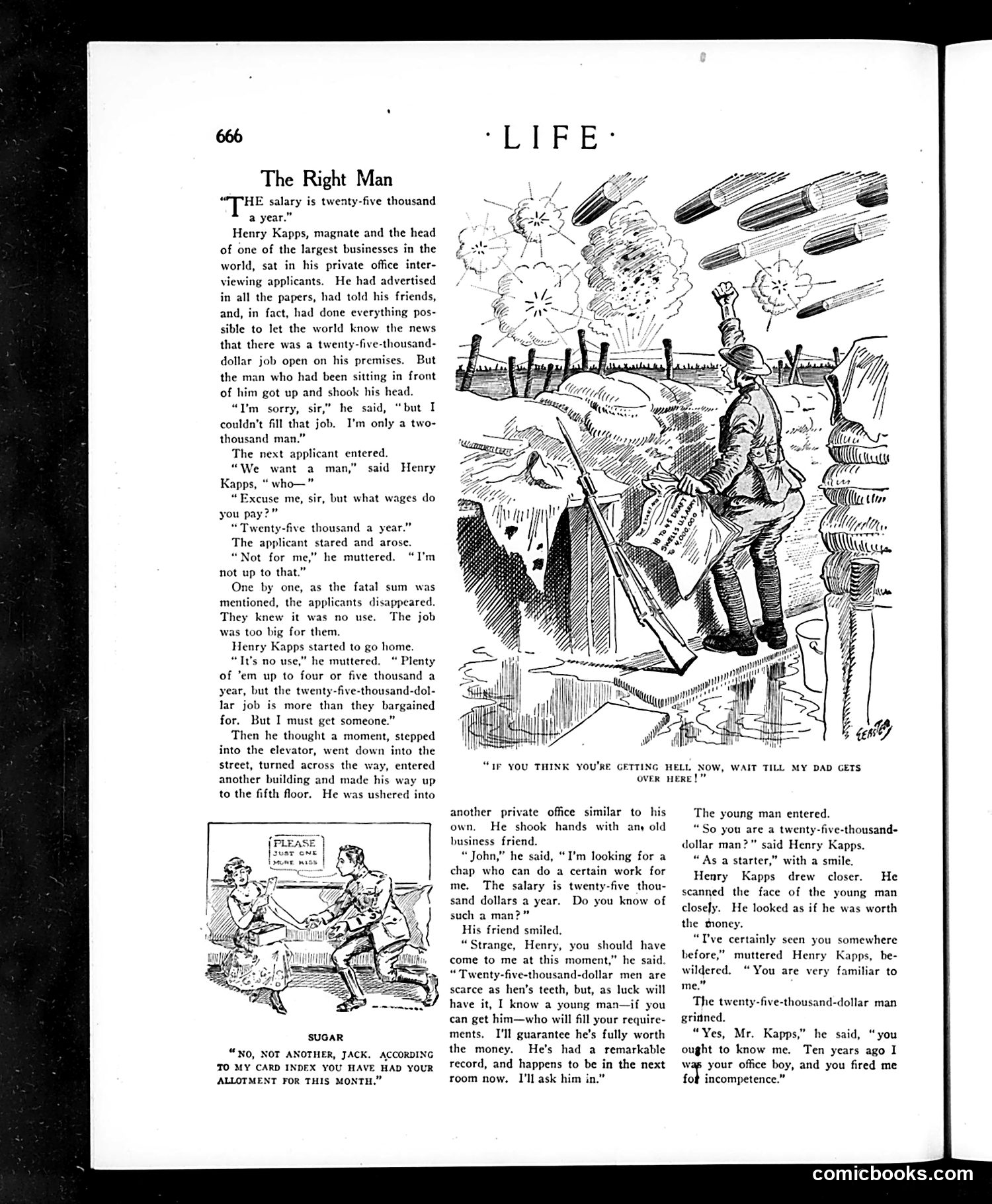
666 The Right Man “THE salary is twenty-five thousand a year.” Henry Kapps, magnate and the head of one of the largest businesses in the world, sat in his private office inter- viewing applicants. He had advertised in all the papers, had told his friends, and, in fact, had done everything pos- sible to let the world know the news that there was a twenty-five-thousand- dollar job open on his premises. But the man who had been sitting in front of him got up and shook his head. “I'm sorry, sir,” he said, “but I couldn't fill that job. I’m only a two- thousand man.” The next applicant entered. “We want a man,” said Henry Kapps, “ who—” “Excuse me, sir, but what wages do you pay?” “Twenty-five thousand a year.” The applicant stared and arose. “Not for me,” he muttered. “I'm not up to that.” One by one, as the f. sum was mentioned, the applicants disappeared. They knew it was no use. The job was too big for them. Henry Kapps started to go home. “Tt's no use,” he muttered. “ Plenty of ’em up to four or five thousand a year, but the twenty-five-thousand-dol- lar job is more than they bargained for. But I must get someone.” Then he thought a moment, stepped into the elevator, went down into the Street, turned across the way, entered another building and made his way up to the fifth floor. He was ushered into “NO, NOT ANOTHER, JACK. ACCORDING TO MY CARD INDEX YOU HAVE HAD YOUR ALLOTMENT FOR THIS MONTH.” a, Yael yy UNE, Filles Oe 4 “IF YOU THINK YOU'RE GETTING HELL OW, WAIT TILL MY DAD GETS OVER HERE! another private office similar to his own. He shook hands with any old business friend. “John,” he said, “I’m looking for a chap who can do a certain work for me. The salary is twenty-five thou- sand dollars a year. Do you know of such a man?” His friend smile “Strange, Henry, you should have come to me at this moment,” he said. “ Twenty-five-thousand-dollar men are scarce as hen’s teeth, but, as luck will have it, I know a young man—if you can get him—who will fill your require- ments. I'll guarantee he’s fully worth the money. He's had a remarkable record, and happens to be in the next room now. I'll ask him in.” The young man entered. “So you are a twenty-five-thousand- dollar man?” said Henry Kapps. “As a starter,” with a smile, Henry Kapps drew He scanned the face of the young man closely. He looked as if he was worth the money. “T’'ve certainly seen you somewhere before,” muttered Henry Kapps, be- wildered. “You are very familiar to me.” closer. The twenty-five-thousand-dollar man grinned. “Yes, Mr. Kapps,” he said, “you ought to know me. Ten years ago I your office boy, and you fired me incompetence.” comicbooks.com