
A complete issue · 40 pages · 1918
Life — March 7, 1918
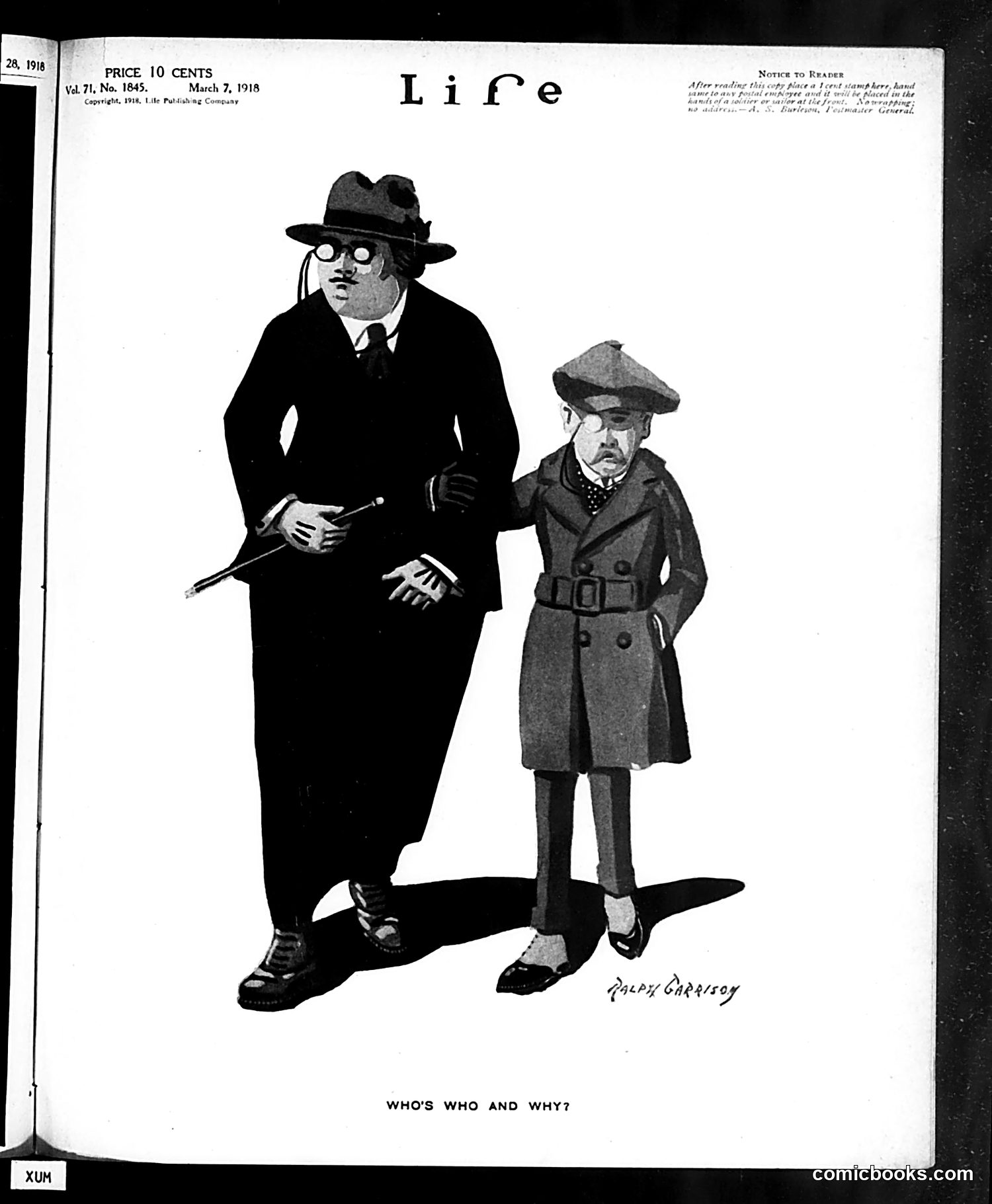
This satirical cartoon by Ralph Barrison depicts an adult and child in early 20th-century clothing, captioned "WHO'S WHO AND WHY?" The exaggerated facial features and caricature style suggest social or political commentary typical of Life magazine's humor. Given the March 1918 date—during World War I—this likely addresses American involvement in the war or wartime social issues. The size disparity and positioning suggest a commentary on power dynamics, authority, or generational relationships. The child's appearance and formal attire may critique how young people were affected by or recruited into wartime activities. However, without additional context identifying the specific figures, the precise satirical target remains unclear.
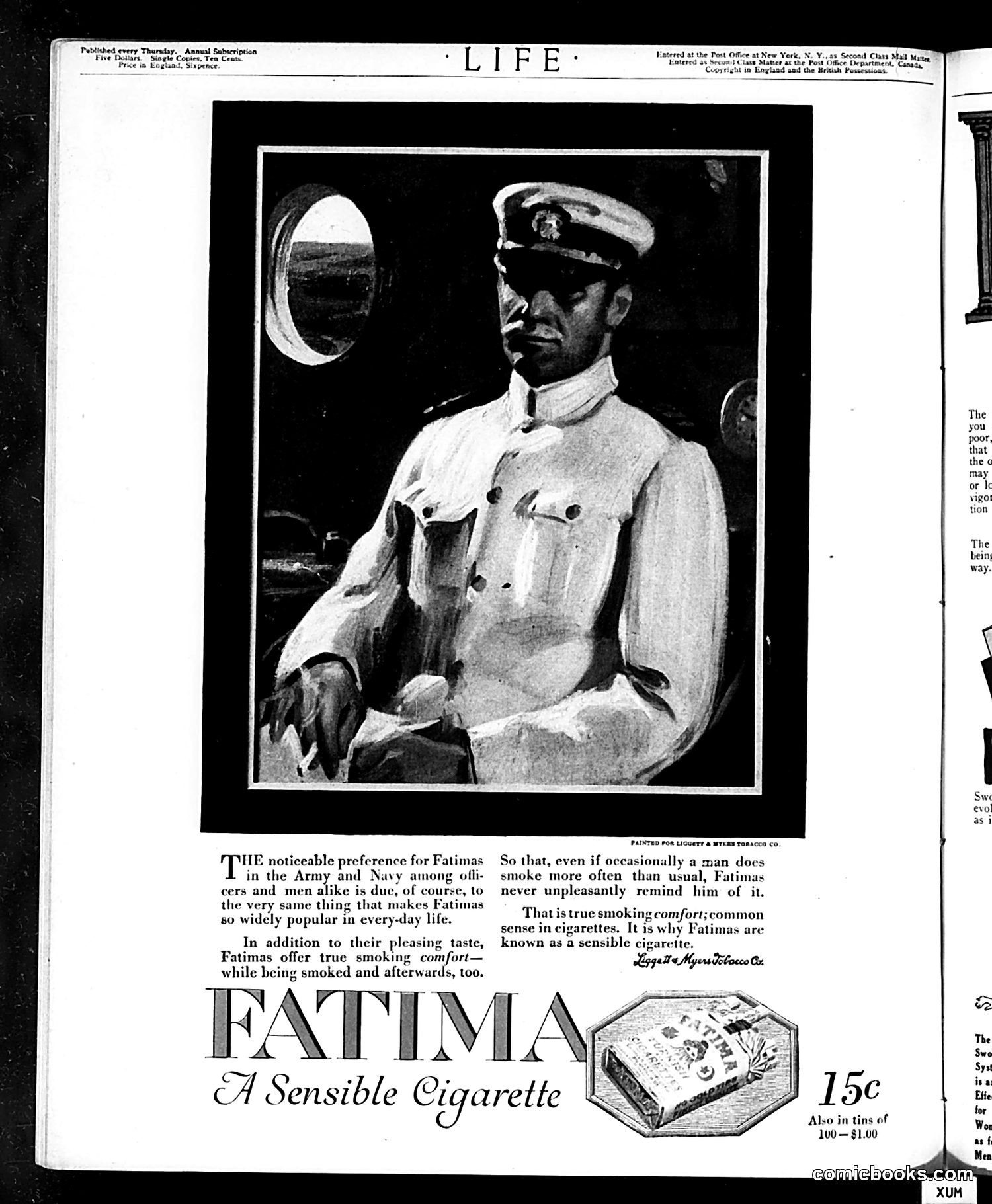
This page is primarily a **cigarette advertisement**, not political satire. It features a Fatima cigarettes ad targeting military officers, showing a man in what appears to be a naval or military uniform seated in a ship's cabin (indicated by the porthole window behind him). The advertisement's appeal is straightforward: it claims Fatimas offer "true smoking comfort" and notes their "noticeable preference...in the Army and Navy among officers and men alike." The ad emphasizes "common sense in cigarettes" as the reason Fatimas are called "a sensible cigarette." This is a period advertisement exploiting military prestige to market cigarettes, with no apparent satirical commentary—just commercial messaging typical of early 20th-century magazine advertising.
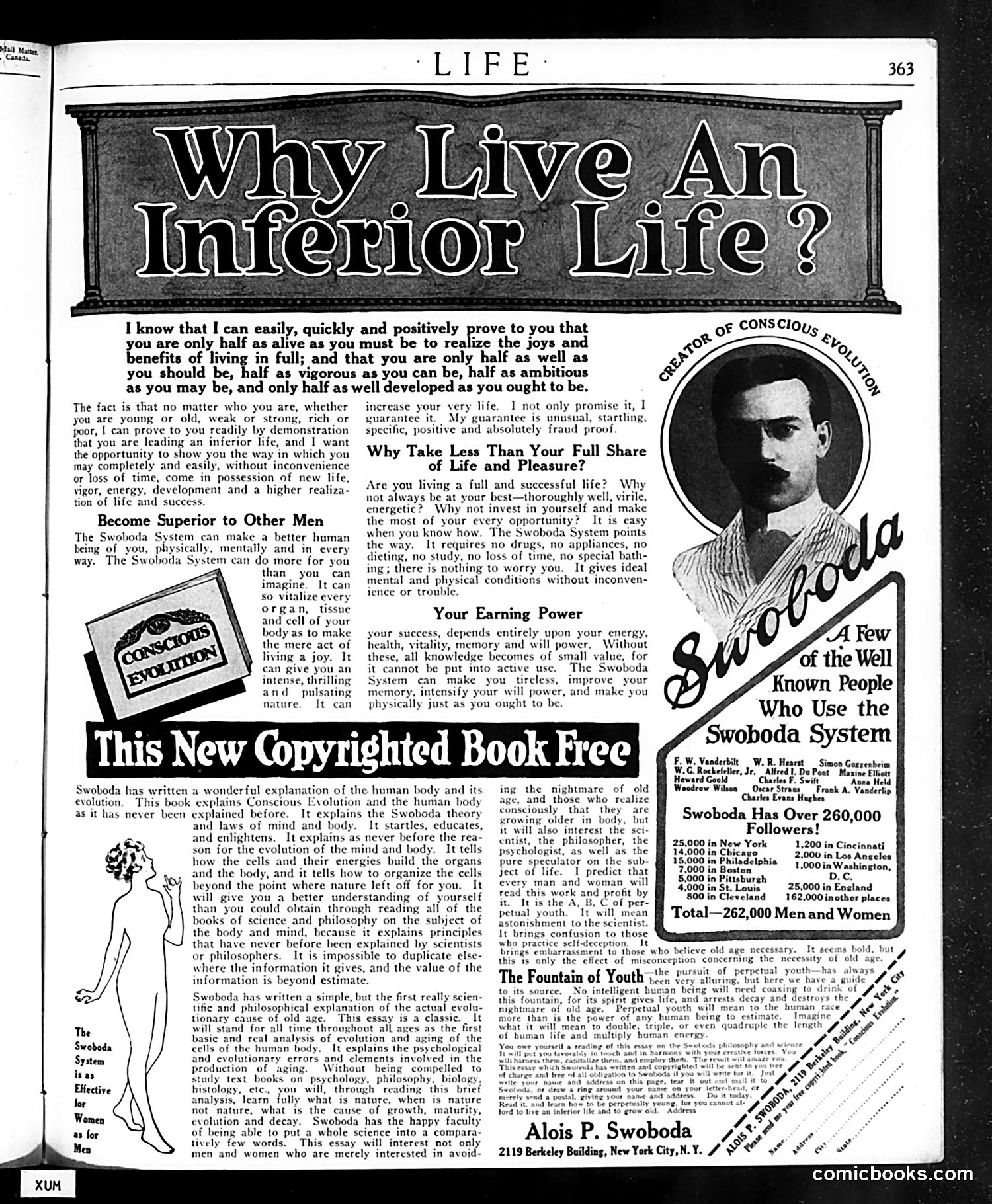
This page is primarily **advertising rather than satire or cartoon content**. It promotes the "Swoboda System," a self-help program marketed by Alois P. Swoboda, based in New York City. The advertisement uses persuasive language claiming the system can help readers achieve superior health, energy, and success through unspecified methods ("no drugs, no athletics, no apparatus"). A photograph shows Swoboda himself, labeled "Creator of Conscious Evolution." The page lists "A Few of the Well Known People Who Use the Swoboda System" and claims over 260,000 followers across major American cities. This represents early 20th-century pseudoscientific self-improvement marketing—the kind of dubious wellness promotion that *Life* magazine (as satire publication) may have been running ironically, though the page itself reads as a straightforward paid advertisement.
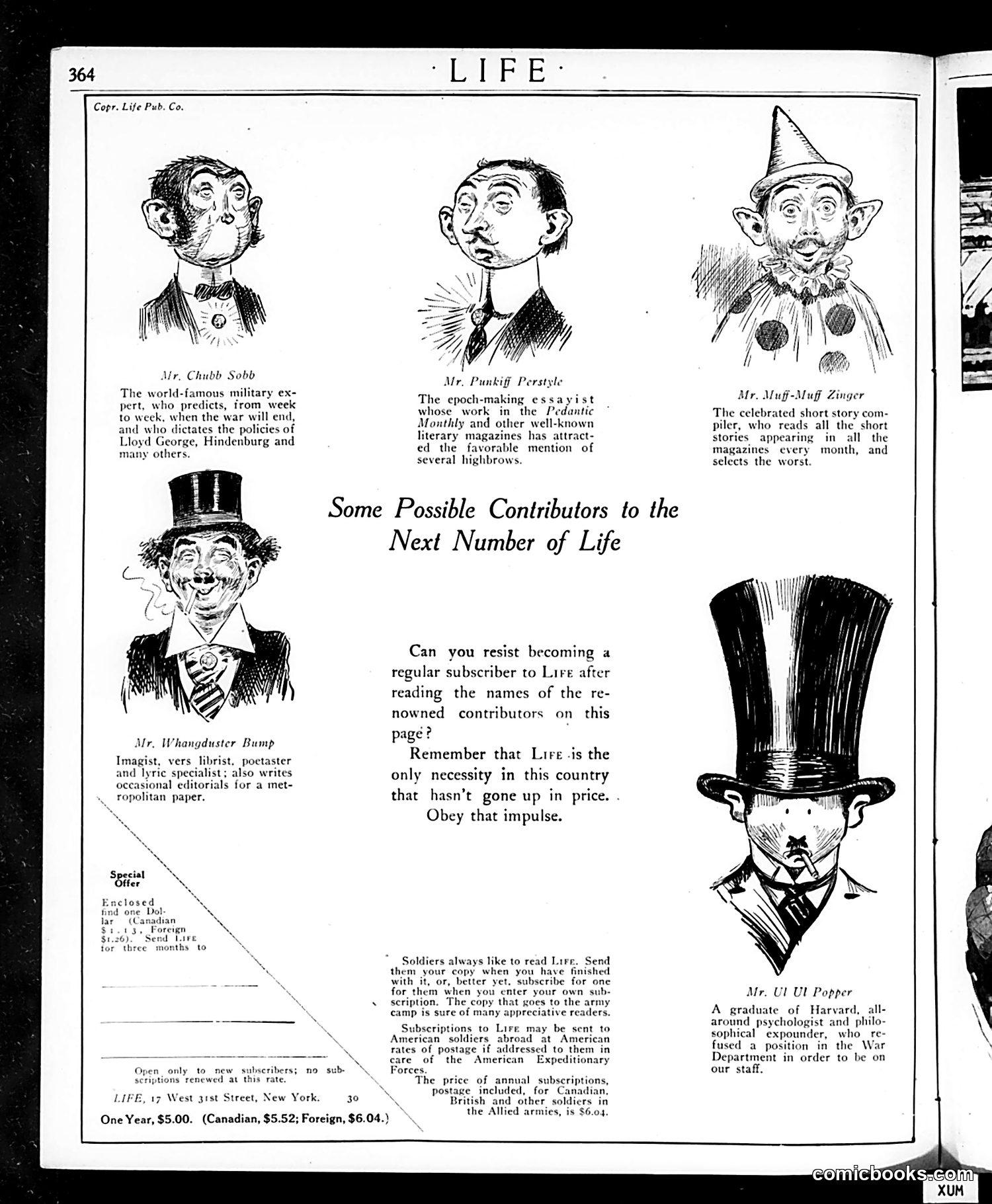
This page satirizes prominent public figures of the era through exaggerated caricatures. The text identifies: - **Chubb Sobb**: A military expert and policy influencer (likely fictional or a pseudonymous reference) - **Pundiq Peratyle**: An essayist published in literary magazines - **Muff-Muff Zinger**: A short-story compiler who "selects the worst" - **Whanduster Bump**: A polymath writer (imagist, versifier, lyricist) - **Ul Ul Popper**: A Harvard psychologist positioned in the War Department The page functions as promotional material for *Life* magazine subscriptions, using absurdist humor to mock pretentious intellectuals and cultural figures. The exaggerated features and ridiculous names suggest satirical commentary on self-important contributors to literary magazines. A subscription pitch follows, emphasizing *Life* as affordable compared to other publications.
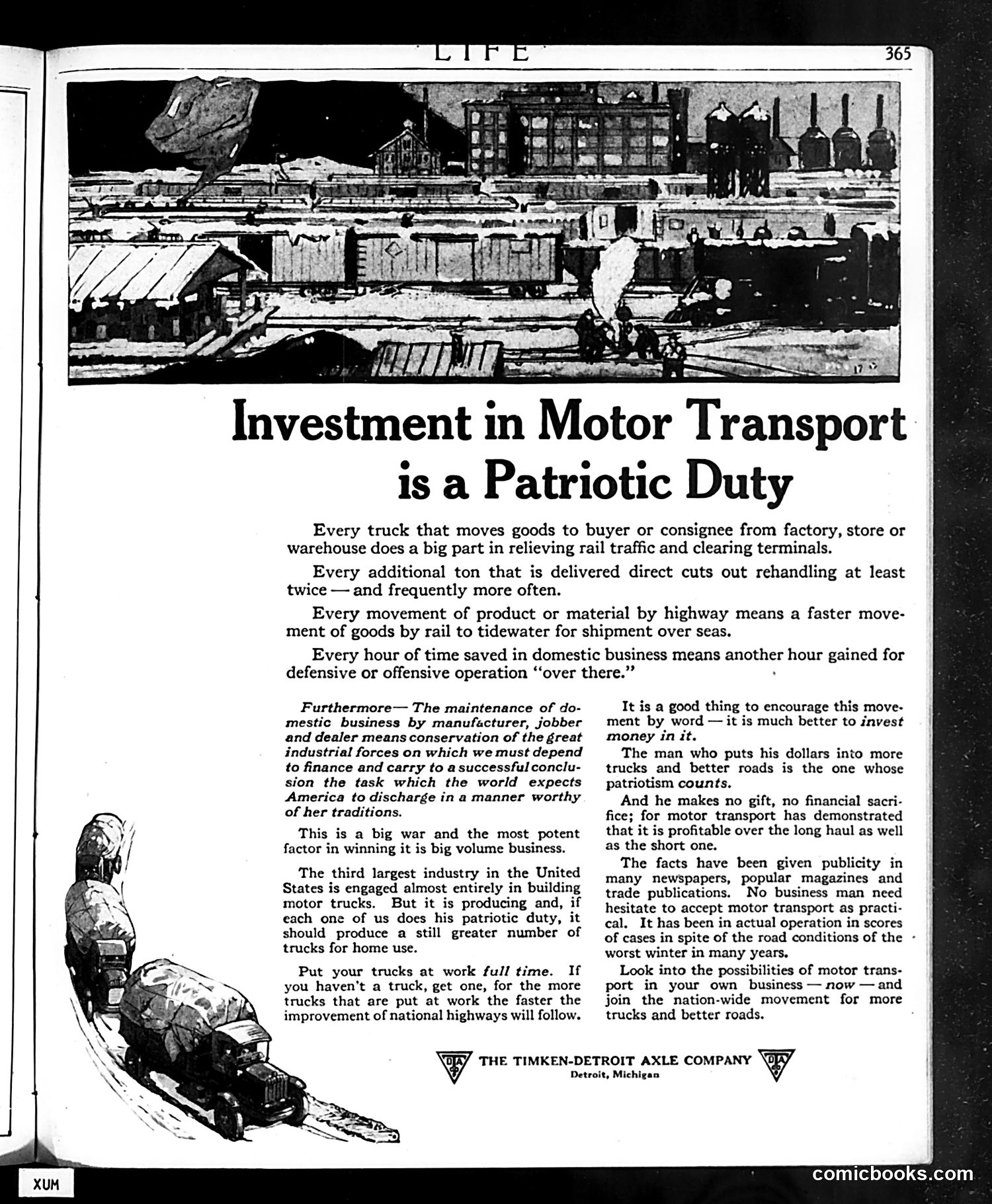
This page is primarily **advertising**, not satire or political cartoon. The Timken-Detroit Axle Company has placed a full-page advertisement titled "Investment in Motor Transport is a Patriotic Duty." The ad uses **World War I–era messaging** to encourage truck ownership and road development as contributions to the war effort. The imagery shows an industrial port facility with trucks and rail infrastructure. The accompanying text argues that truck transport: - Relieves railroad congestion - Saves time for military operations "over there" (Europe) - Represents patriotic investment The **soldier illustration** (lower left) reinforces the patriotic appeal. This reflects how American businesses marketed commercial products through nationalist wartime rhetoric during WWI.
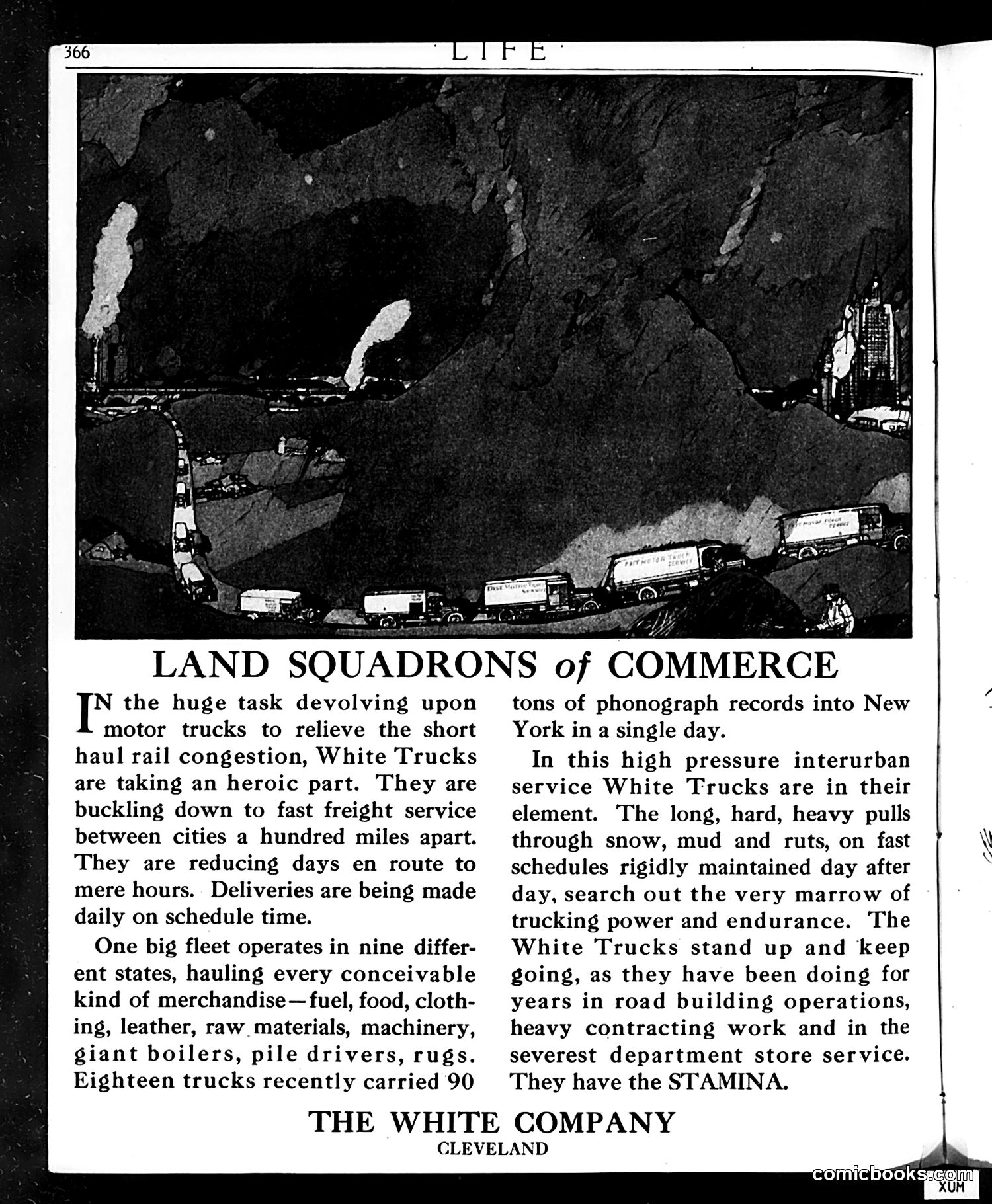
This page is **not a political cartoon or satire**—it's a straightforward **advertisement** for White Trucks, presented as editorial content in *Life* magazine. The image shows a nighttime industrial scene with multiple White brand trucks operating in what appears to be a mountainous or heavily developed area, illustrating commercial freight transport. The accompanying text promotes White Trucks' reliability for high-pressure interstate commerce, emphasizing their speed, durability, and ability to handle diverse cargo (food, fuel, leather, machinery, boilers). The ad highlights one fleet's 18-truck operation carrying 90 tons of phonograph records to New York daily. The rhetoric celebrates trucks as modern commercial heroes solving rail congestion—a common 1920s-30s advertising theme promoting motorized transportation's superiority over railways.
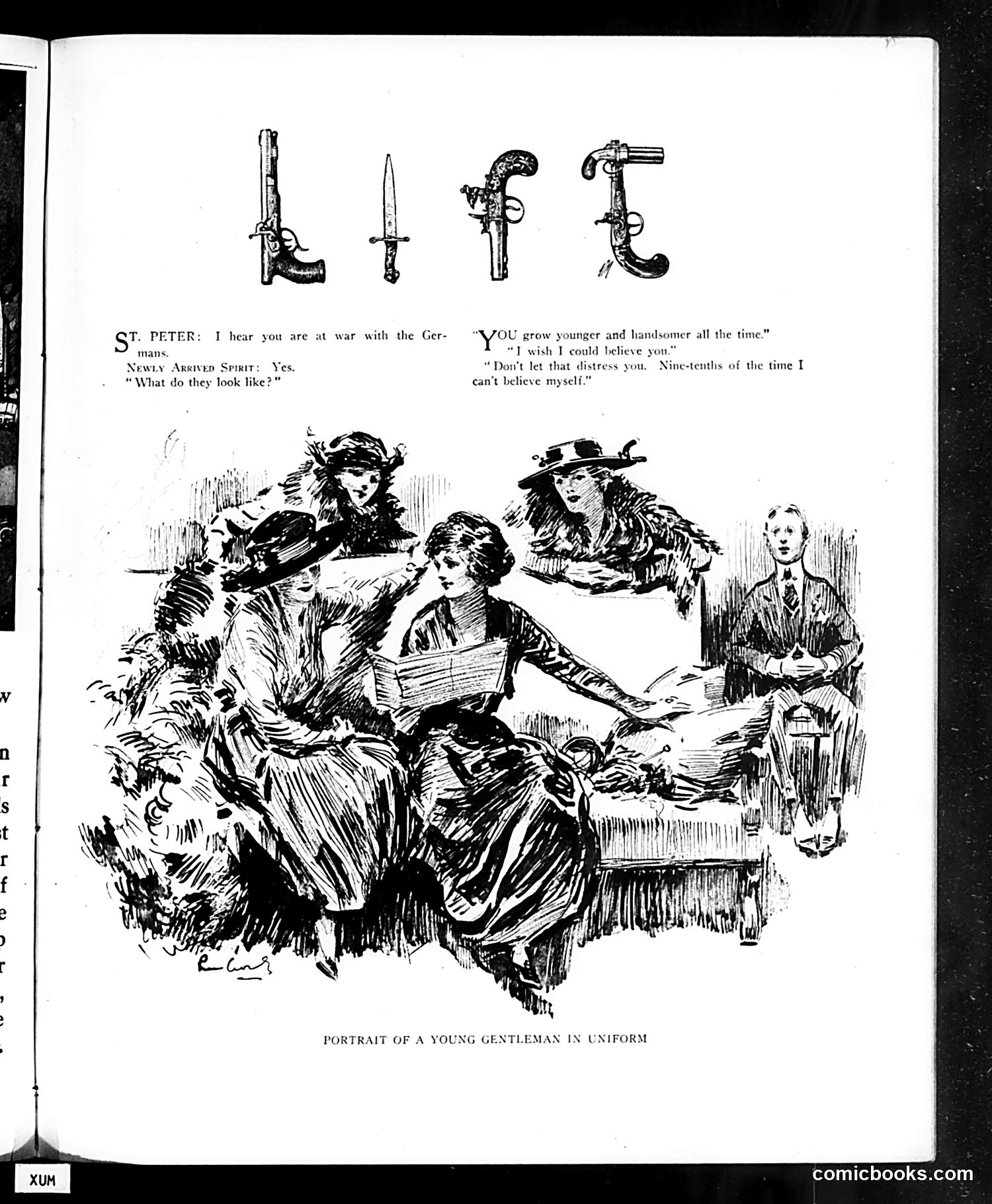
This page satirizes wartime anxieties about young soldiers. At the top, four weapons labeled "LIFE" spell out the word—a pun on the magazine's title. The main illustration depicts a young man in military uniform surrounded by admiring women. The dialogue reveals the satire's target: St. Peter comments the soldier is "at war with the Germans," while a "Newly Arrived Spirit" expresses shock at his appearance. The women's dialogue mocks the phenomenon of soldiers' inflated romantic appeal, with one saying he "grow[s] younger and handsomer all the time" and confessing she "can't believe" herself—suggesting their attraction is exaggerated or unreal. The caption, "Portrait of a Young Gentleman in Uniform," appears to mock how military service elevated young men's social and romantic status during wartime.
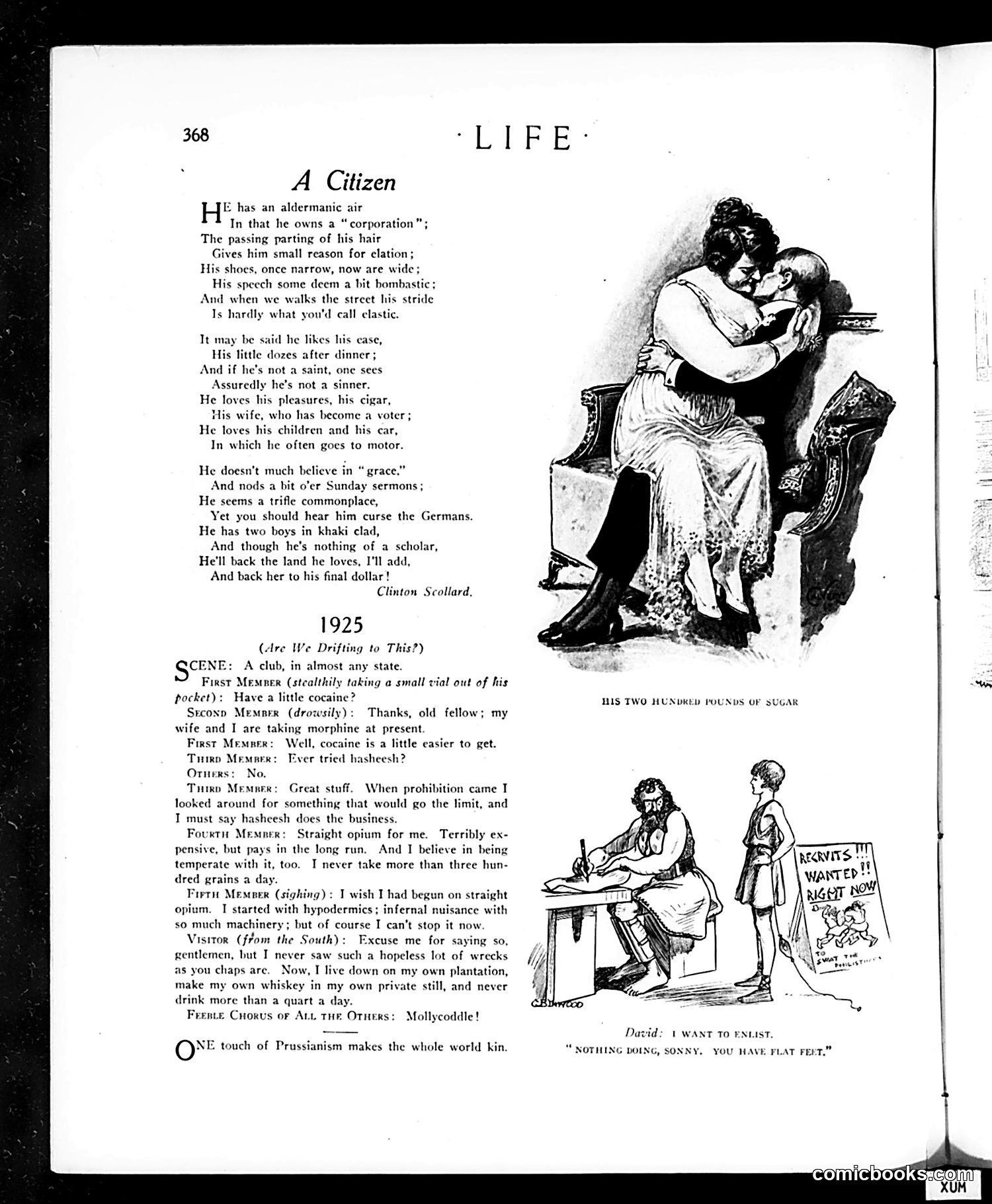
This 1925 Life magazine page satirizes contemporary American social attitudes and behaviors during Prohibition. **"A Citizen"** (top poem by Clinton Scollard) depicts an ordinary middle-class man who owns a corporation, takes small bribes, loves cigars and pleasure, and uses morphine—presented as unremarkable and commonplace. **The 1925 scene below** shows club members openly discussing illegal drugs (cocaine, morphine, hashish) during Prohibition. One member boasts of making private whiskey, another claims opium use, and a visitor describes wrecking his health through drug abuse—all treated casually. The satire criticizes widespread hypocrisy: respectable citizens openly flouted Prohibition laws while society maintained a facade of propriety. The cartoons mock how drug use and illegal alcohol consumption had become normalized among the middle and upper classes, despite official prohibition and moral posturing.
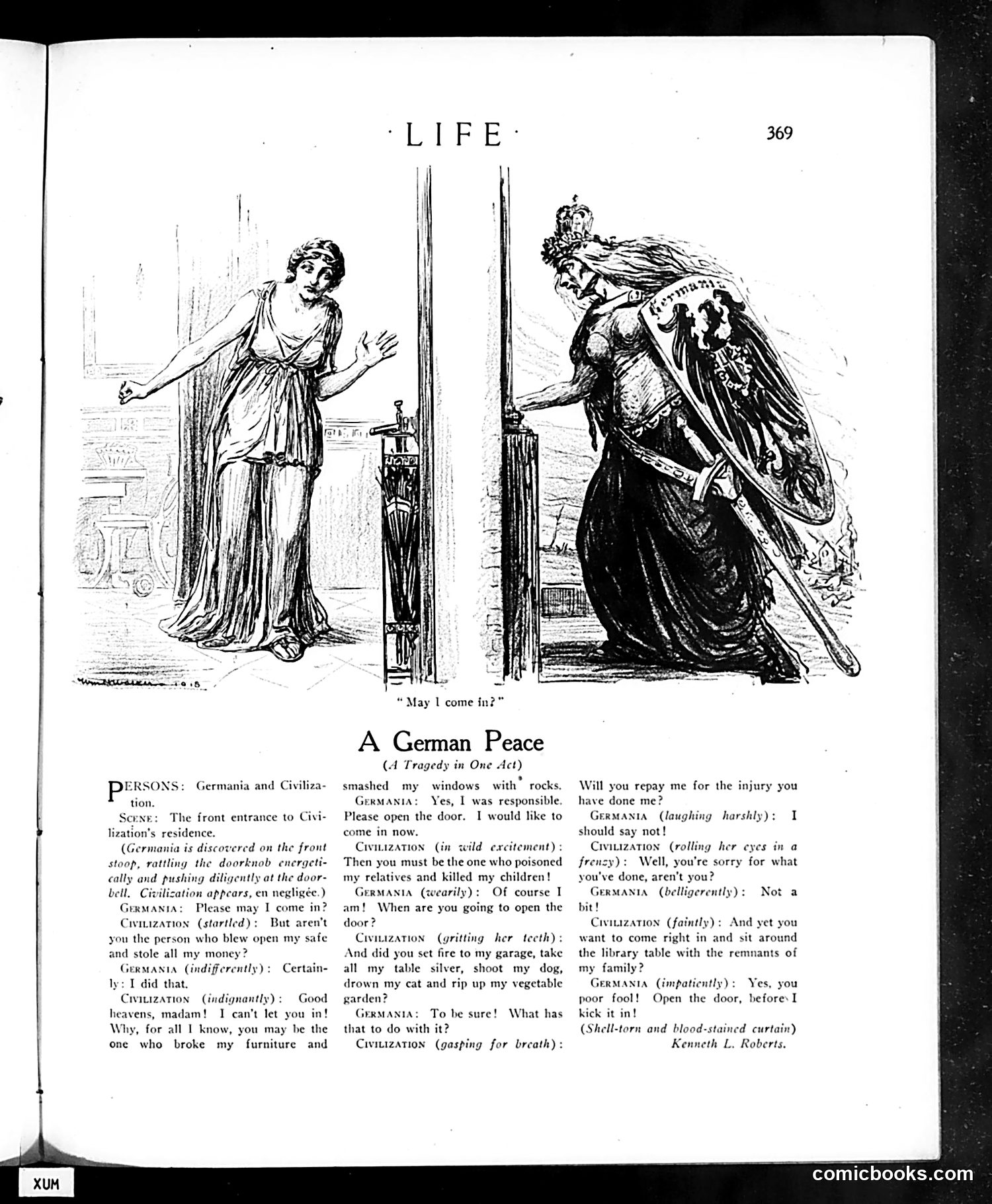
This is a one-act dramatic satire titled "A German Peace," depicting a confrontation between two female allegorical figures: **Germania** (representing Germany, shown in military regalia on the right) and **Civilization** (shown in classical dress on the left). The scene parodies post-World War I peace negotiations. Civilization demands reparations for destroyed homes, murdered relatives, and looted property. Germania laughs off these demands and refuses to open the door—a metaphor for Germany's reluctance to accept responsibility or make amends. The satire mocks Germany's defiant attitude toward war guilt and the Allied powers' expectations for accountability. Written by Kenneth L. Roberts, this reflects American frustration with German obstinacy during the Versailles Treaty period.
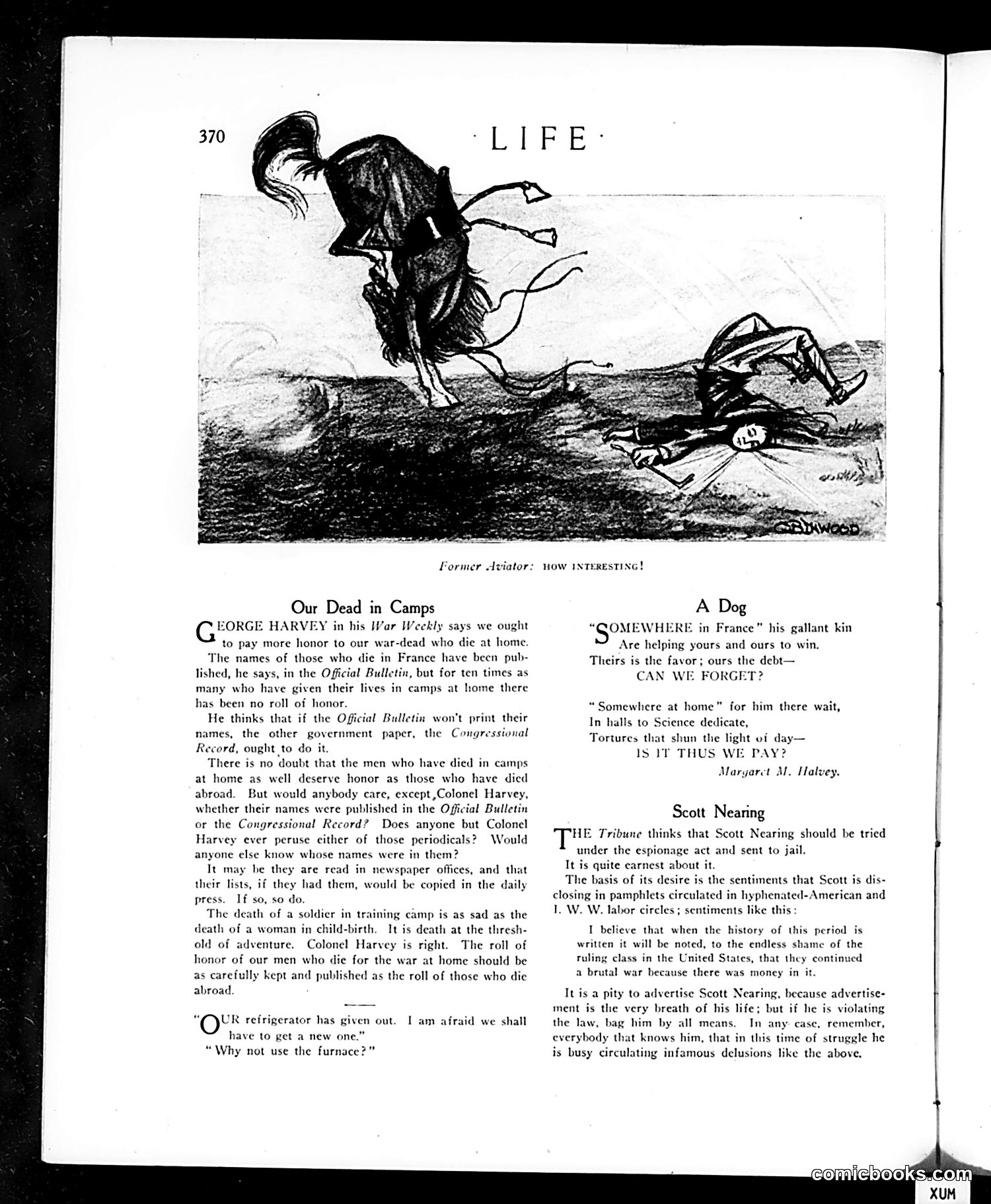
This page contains three separate pieces of political commentary from World War I era America: 1. **"Former Aviator: How Interesting!"** (top cartoon): Shows a disabled or dead soldier visited by a well-dressed civilian, likely satirizing the contrast between those who fought and those at home unaffected by war. 2. **"Our Dead in Camps"** (left): George Harvey critiques the government for failing to honor soldiers who died in training camps at home with the same recognition given to war dead abroad. He argues their names should be published alongside fallen soldiers' names. 3. **"A Dog"** and **"Scott Nearing"** (right): These pieces discuss whether a dog helping the war effort deserves more honor than American citizens allegedly engaged in anti-war activism, reflecting wartime tensions over patriotism and dissent. The overall theme emphasizes tensions between military sacrifice and civilian life during WWI.
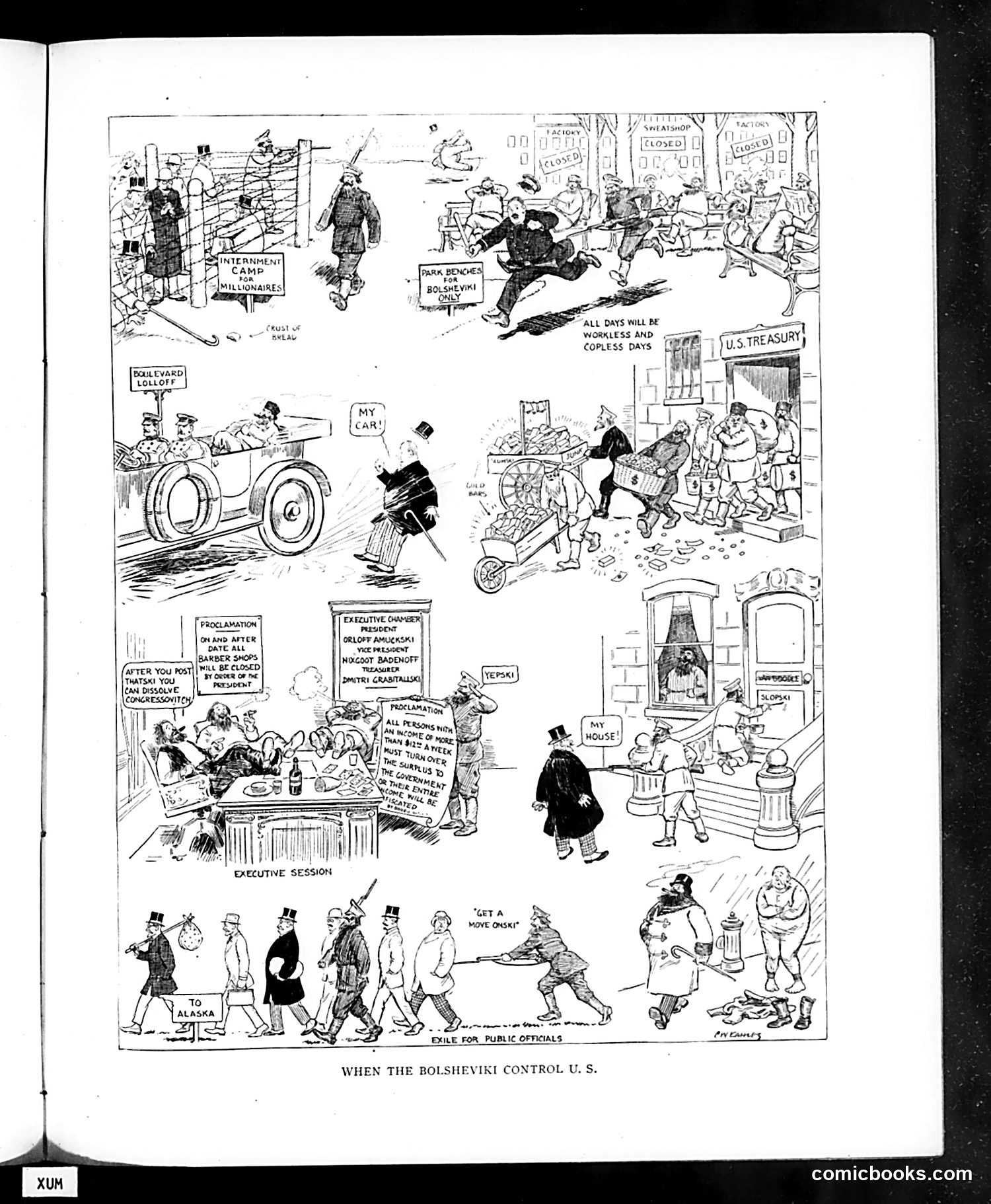
This is anti-communist propaganda from the Red Scare era (likely 1919-1920s). The cartoon depicts a dystopian scenario if Bolsheviks seized American government, showing: - **Internment camps** for millionaires (top left) - **Closed factories** and economic collapse (top right) - **U.S. Treasury** being looted (center right) - **Executive session** with propaganda proclamations (center) - **Exiling public officials** to Alaska (bottom) The satire warns Americans that communist control would mean: - Confiscation of wealth - Government takeover of business - Mass deportations - Loss of democratic institutions The cartoon uses exaggeration and fear-mongering typical of anti-Bolshevik American rhetoric during the period when communist revolution in Russia threatened Western capitalist nations.
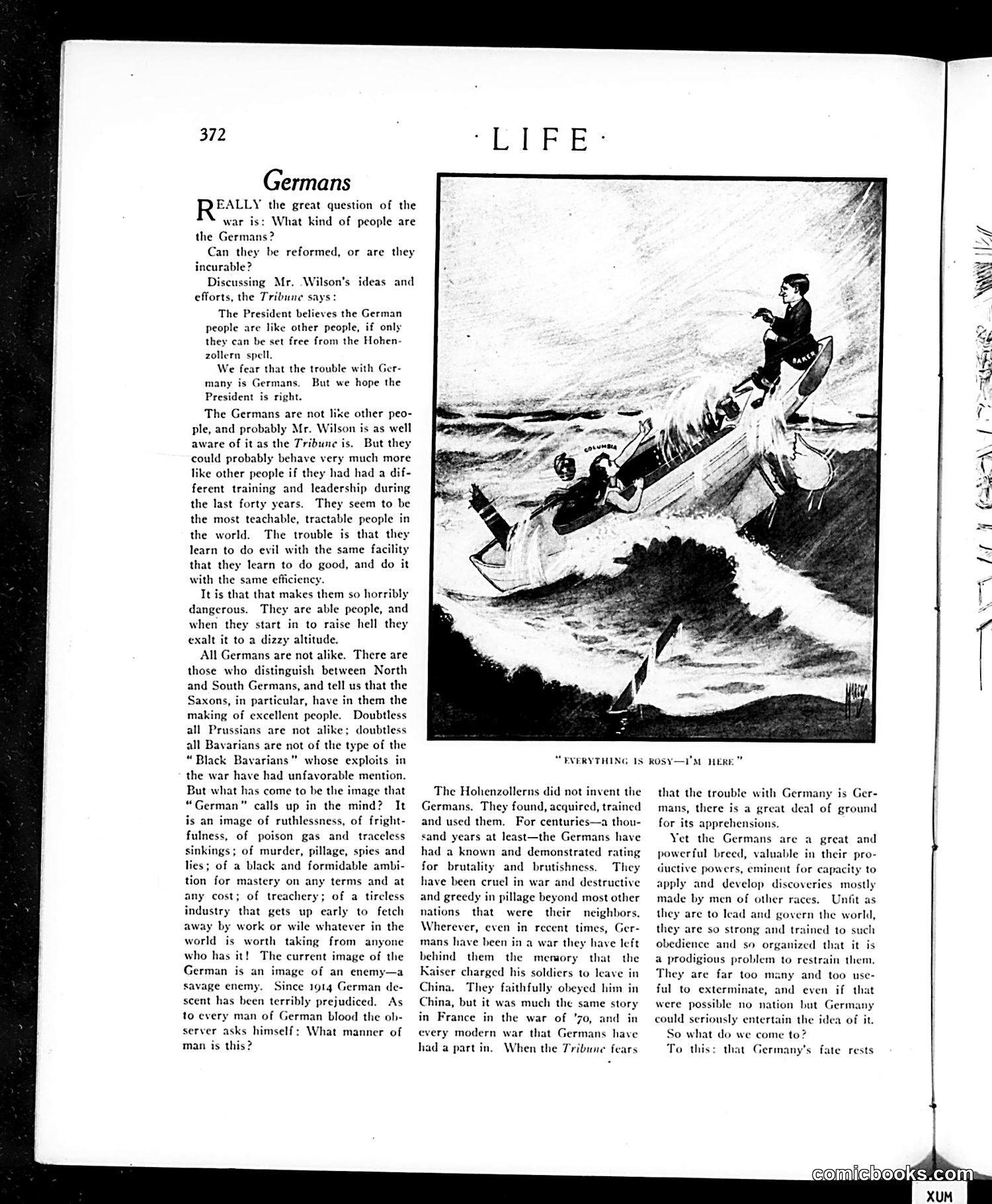
This page discusses President Wilson's views on German character and reformability following World War I. The accompanying cartoon depicts people sledding downhill with the caption "Everything is rosy—I'm here," illustrating the article's central argument: Germans are highly capable people who learn skills—whether good or evil—with equal efficiency and dedication. The text argues that Germans are not inherently evil but dangerously efficient. The problem, the author suggests, is that German discipline and obedience, trained over forty years, made them excellent at executing destructive orders. The article distinguishes between different German populations (Saxons, Bavarians, Prussians) while warning that Germany's future depends on restraining their formidable power and organizational abilities.
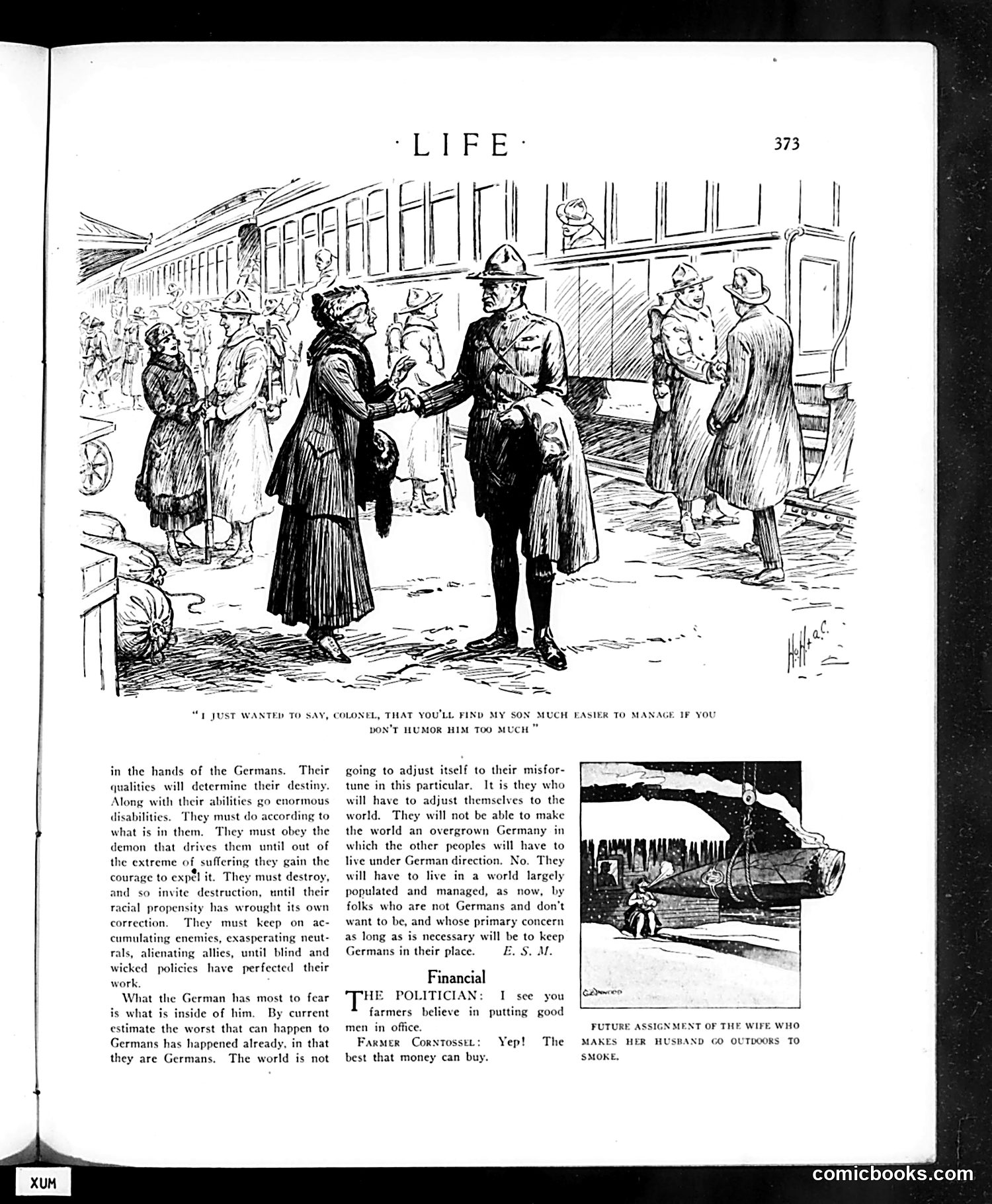
**Main Cartoon:** Shows a military officer shaking hands with a woman in public, surrounded by onlookers. The caption reads: "I just wanted to say, Colonel, that you'll find my son much easier to manage if you don't humor him too much." **Meaning:** This satirizes overindulgent parenting and maternal concern about military discipline. The joke suggests the mother fears the Army won't be strict enough with her coddled son—inverting typical complaints about military harshness. It mocks both hovering parents and their grown sons' dependence. **Secondary Content:** A piece titled "Financial Politician" features dialogue between a farmer and politician about putting "good men in office," suggesting political cynicism about whether money influences political appointments. **Small Illustration:** Captioned "Future Assignment of the Wife Who Makes Her Husband Go Outdoors to Smoke"—satirizing wives' domestic control over smoking husbands.
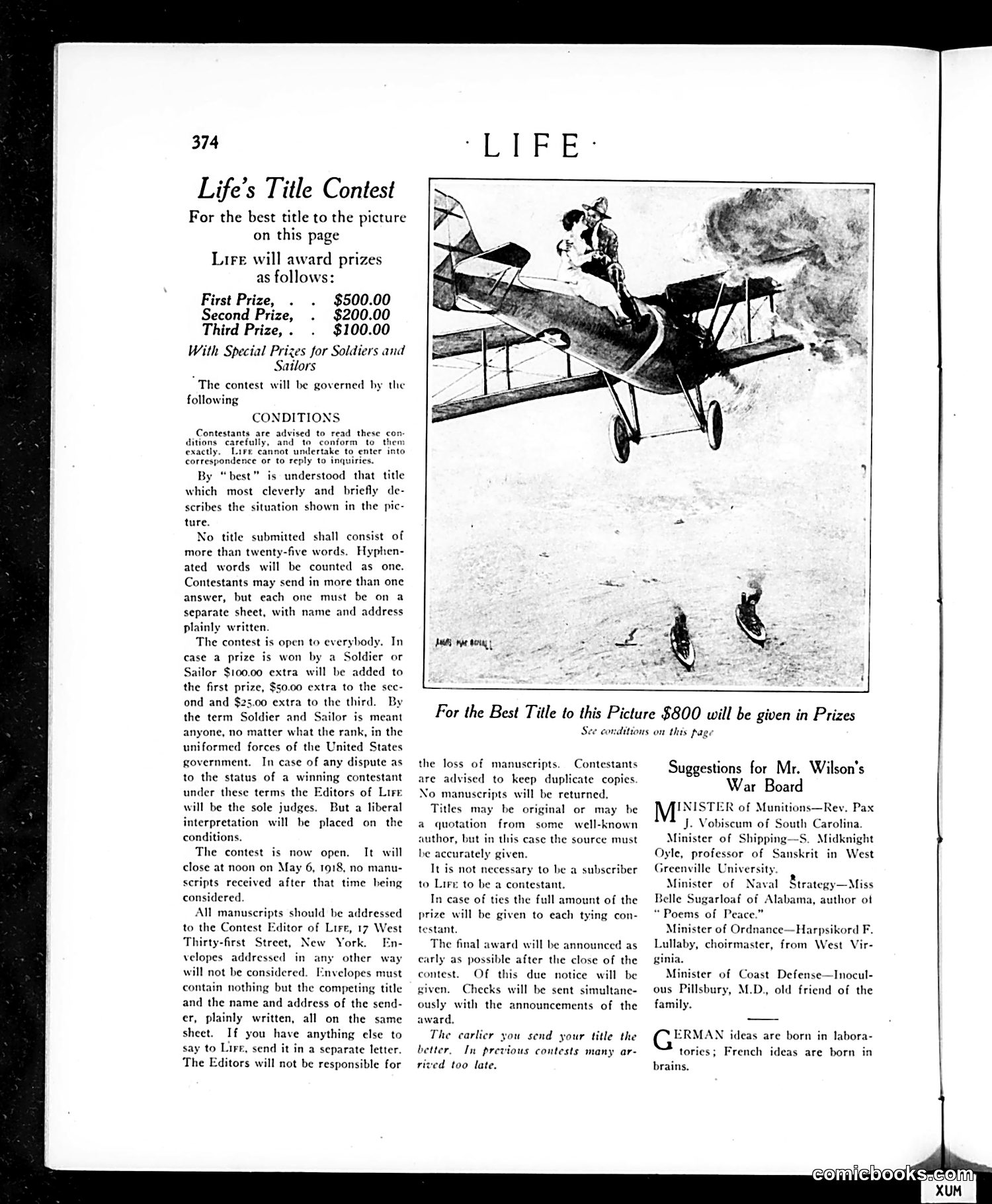
This page features a **Life's Title Contest** for a photograph showing an early airplane (appears to be WWI-era) with two figures in/on it, diving or performing aerobatic maneuvers over sandy terrain. The contest invited readers to submit witty titles, offering $500 for first prize. The rules specify titles must be 25 words or fewer, with special extra prizes for submissions from soldiers and sailors ($100 additional for first prize winners in uniform). The photograph itself appears to be humorous or dramatic aviation content typical of the era. The page also includes suggestions for "Mr. Wilson's War Board"—referencing President Woodrow Wilson—listing various government ministers and officials, likely satirizing the administration's war preparation efforts during the WWI period.
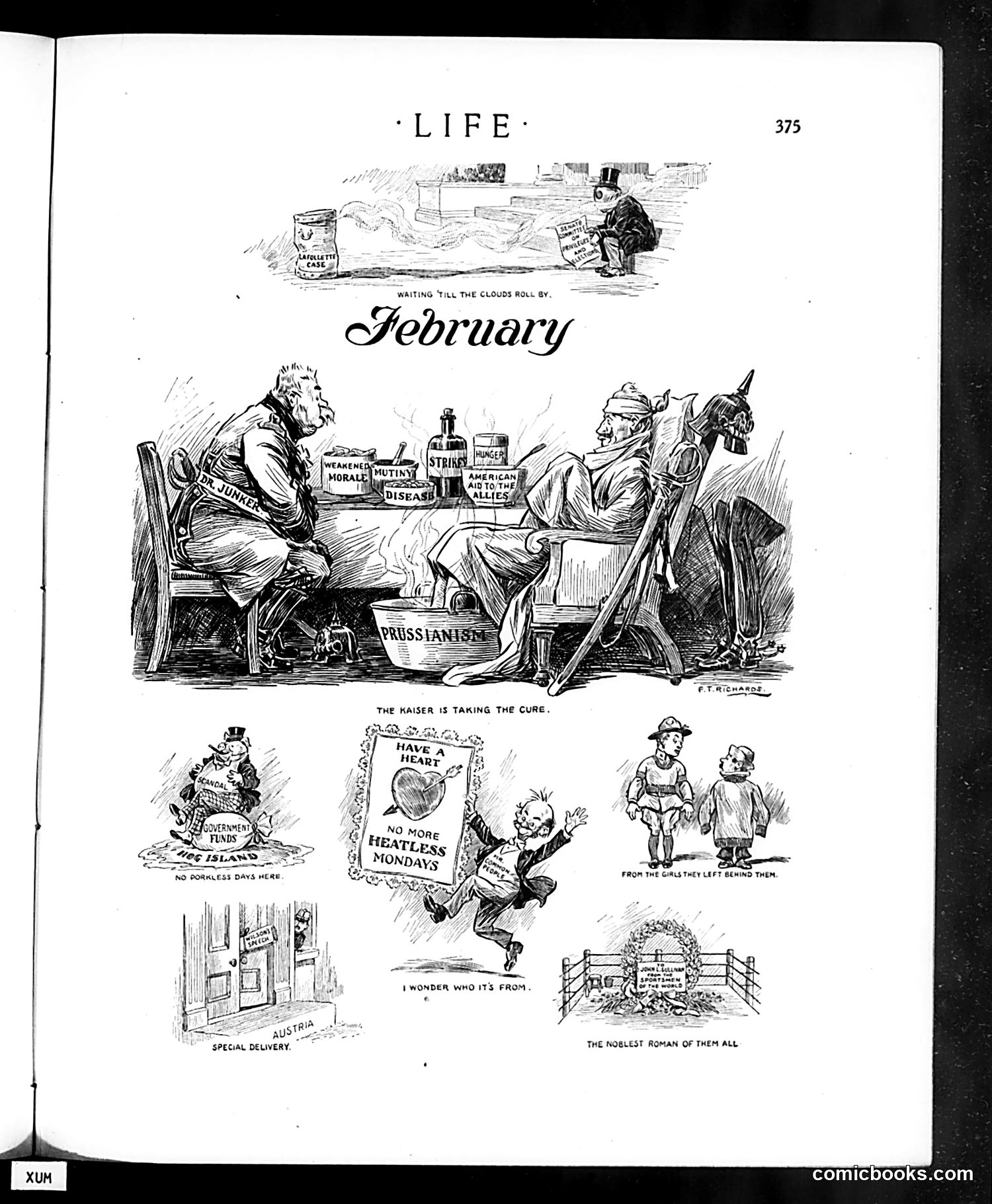
This page contains several political cartoons satirizing early 20th-century issues: **Top cartoon**: "The Kaiser is Taking the Cure" depicts two figures (likely representing the German Kaiser and another leader) seated with medicine bottles labeled "Morals," "Striving," "Honesty," and "Disease." This mocks German militarism and imperialism as a sickness requiring remedy. **Smaller cartoons** reference: - "No Priceless Days Here" (government funds) - "Have a Heart / No More Heatless Mondays" (wartime rationing) - "From the Girls They Left Behind Them" (soldiers' families) - "Special Delivery / Austria" (military conflict) - "The Noblest Roman of Them All" (appears to reference classical virtue) The overall theme critiques World War I–era government policies, military leadership, and domestic wartime hardships.
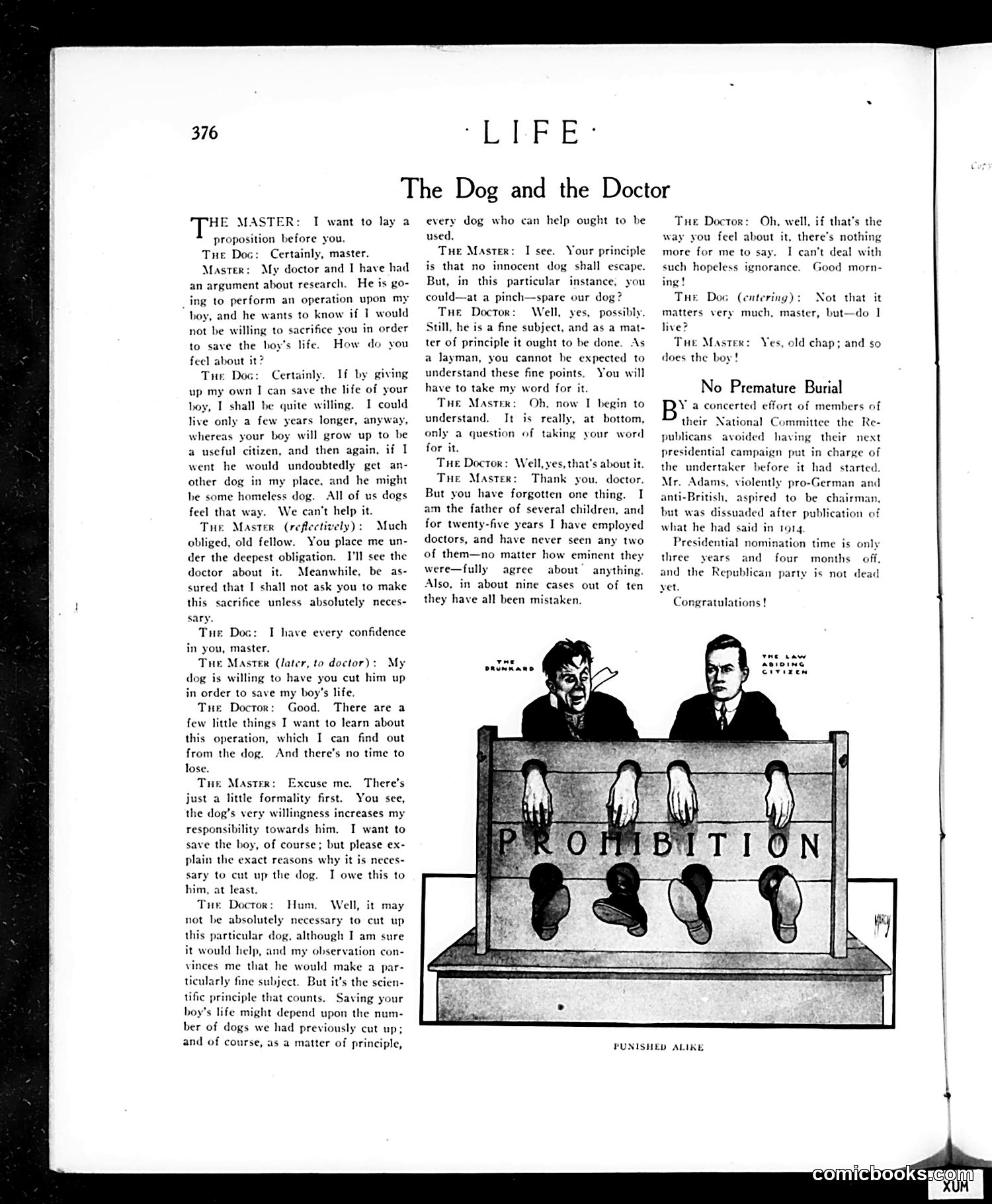
This page contains two satirical pieces: **"The Dog and the Doctor"** (dialogue): A master discusses with his dog whether the dog should be surgically experimented on to save the master's son. The dog agrees, but the master ultimately refuses, citing his experience that doctors frequently disagree and make mistakes. The satire mocks blind deference to medical authority and the vague appeals to "scientific principle" doctors use to justify questionable practices. **"No Premature Burial"** (right column): References a Republican Party controversy where a Mr. Adams—described as "violently pro-German and anti-British"—sought to chair the party's presidential campaign committee. The piece satirizes that party leadership intervened to prevent this appointment, using darkly comic language ("undertaker," "premature burial") to suggest Adams would have damaged the party's chances. Both pieces critique institutional authority figures hiding behind principle while pursuing self-interested agendas.
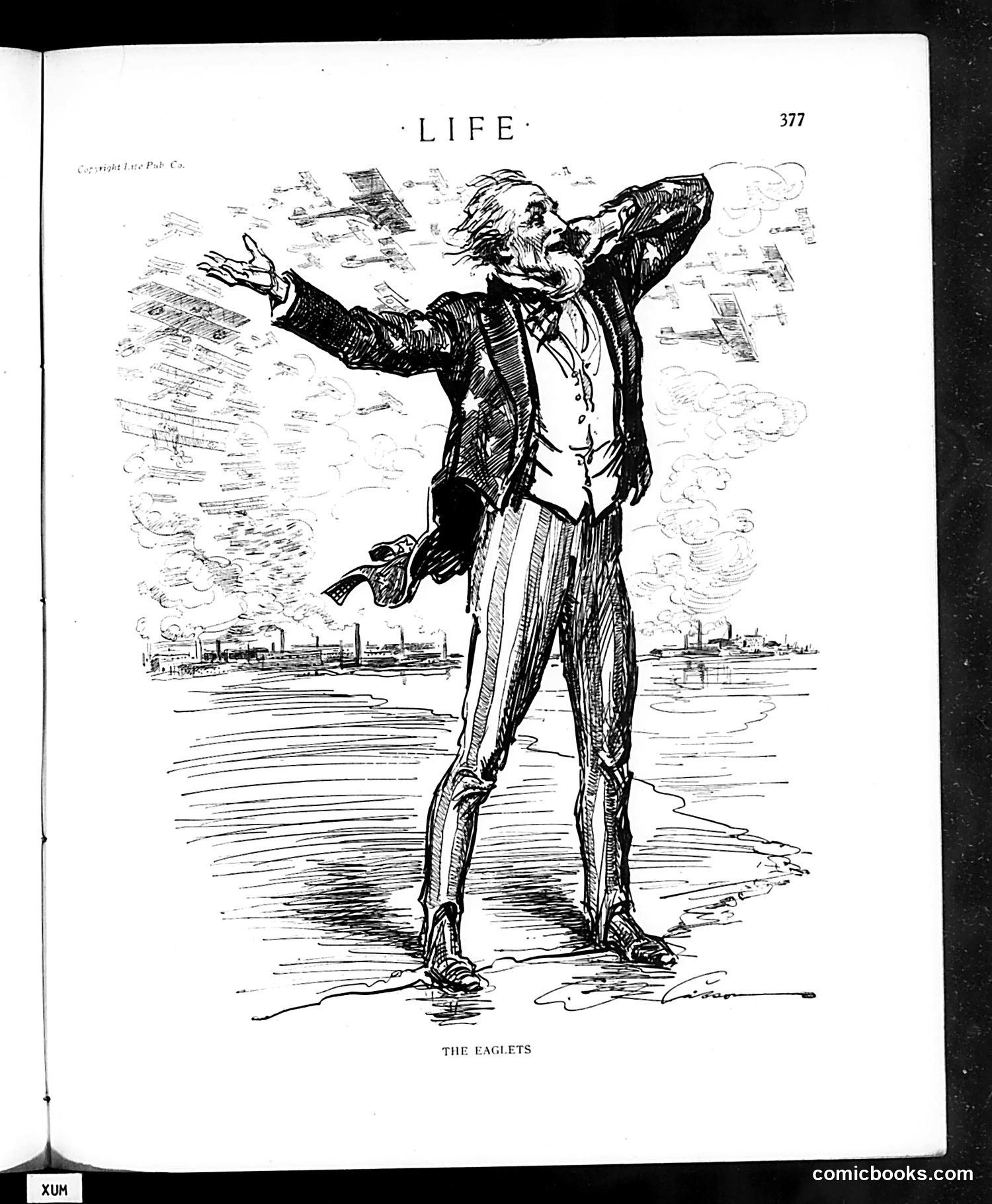
This political cartoon depicts a tall, gaunt figure in formal attire standing on a riverbank with industrial cities visible in the background. The figure has an exaggerated, skeletal appearance and gestures expansively toward money or papers floating in the sky above. The title "The Eaglets" suggests a reference to young eagles, likely metaphorically representing American youth or ambitions. The figure's skeletal, malnourished appearance contrasts sharply with the wealth imagery surrounding him, suggesting satire about economic disparity or the exploitation of youth/workers during industrialization. The industrial landscape and floating money emphasize commerce and capitalism. Without visible OCR text or additional context, the specific political target remains unclear, though this appears to critique economic inequality or corporate exploitation of American potential during an industrial era.
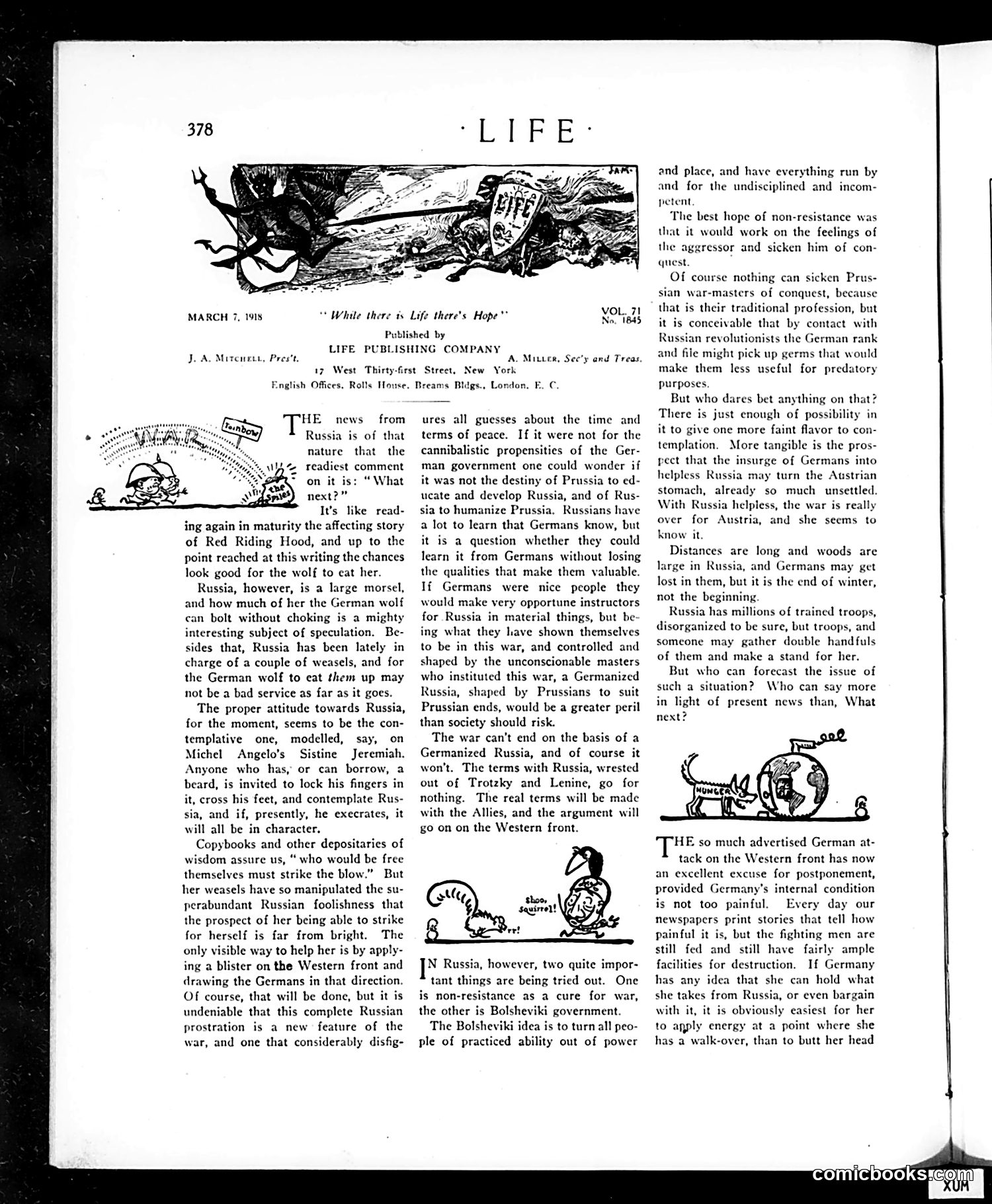
This editorial uses fairy-tale allegory to critique Russia's military collapse during WWI. The "wolf" represents Germany; Russia is "Little Red Riding Hood" being consumed. The "weasels" refer to Russian revolutionaries (Bolsheviks under Lenin and Trotsky), whom the author blames for Russia's prostration through their policy of non-resistance and incompetent governance. The cartoons depict anthropomorphized animals in distress—likely symbolizing the chaos of the Russian Revolution and military defeat. The author argues that while Germany's conquest of Russia seems inevitable, a "Germanized Russia" shaped by Prussian militarism would pose greater postwar danger than Russian defeat itself. He dismisses pacifist non-resistance as naive, believing only German exhaustion on the Western Front can end the war properly. The piece reflects American anxiety about Russia's separate peace negotiations and the ideological threat of Bolshevism, even as Germany advances militarily.
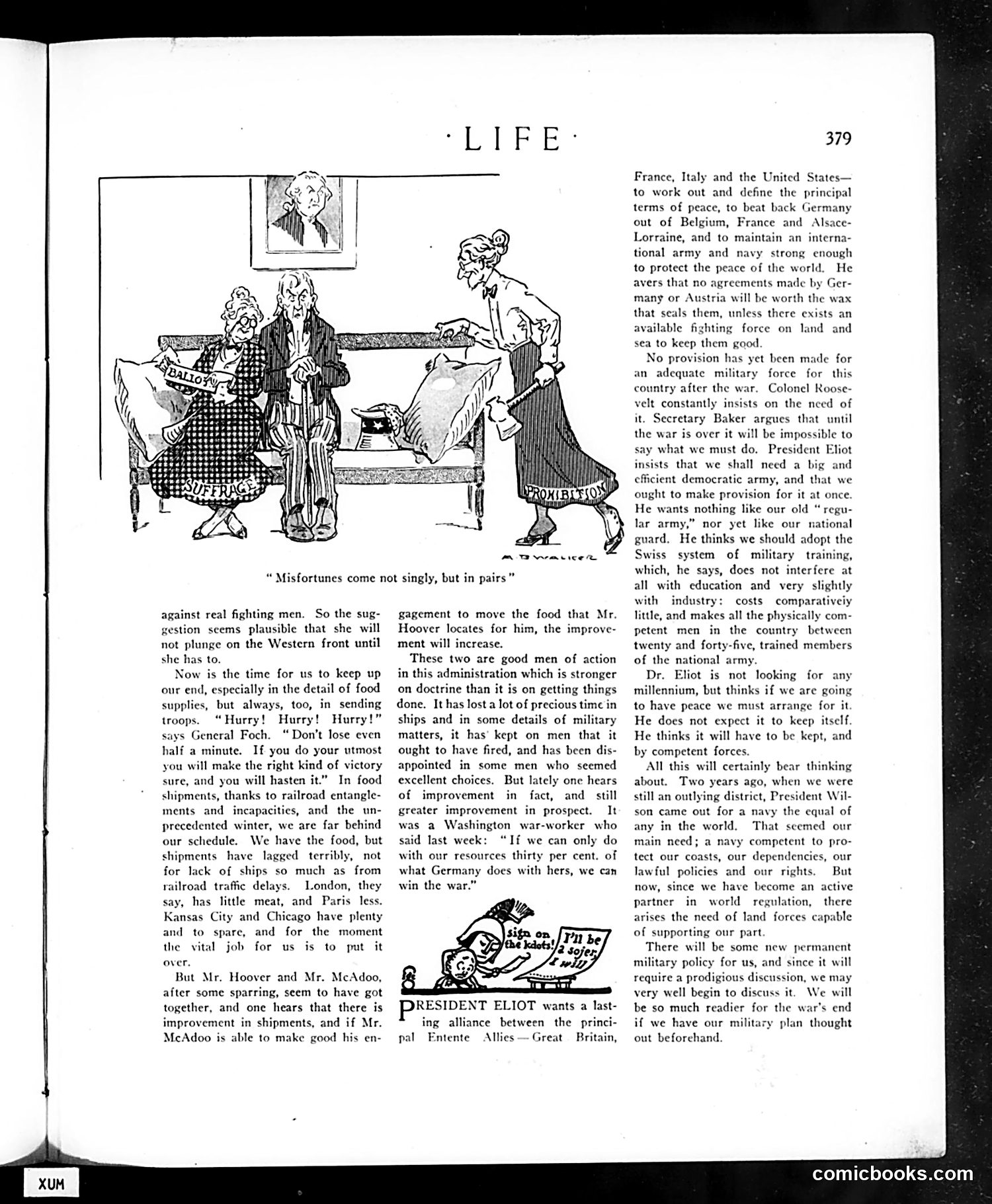
This WWI-era cartoon satirizes food supply failures affecting the Allied war effort. The central figure appears to be a personified representation of American food distribution problems, depicted as a bedraggled character caught between two officials—likely Herbert Hoover (Food Administrator) and William McAdoo (Treasury Secretary/Railroad Director). The cartoon's caption and surrounding text indicate the joke: despite America having adequate food supplies, railroad congestion and administrative dysfunction prevent shipments from reaching Allied nations and troops. London and Paris face meat shortages while Kansas City and Chicago have surplus. The "misfortunes come not singly" caption suggests these paired problems—adequate supply but failed distribution—compound the crisis. The satire targets bureaucratic incompetence rather than resource scarcity, implying that wartime administrators must resolve their jurisdictional conflicts to save the Allied cause.
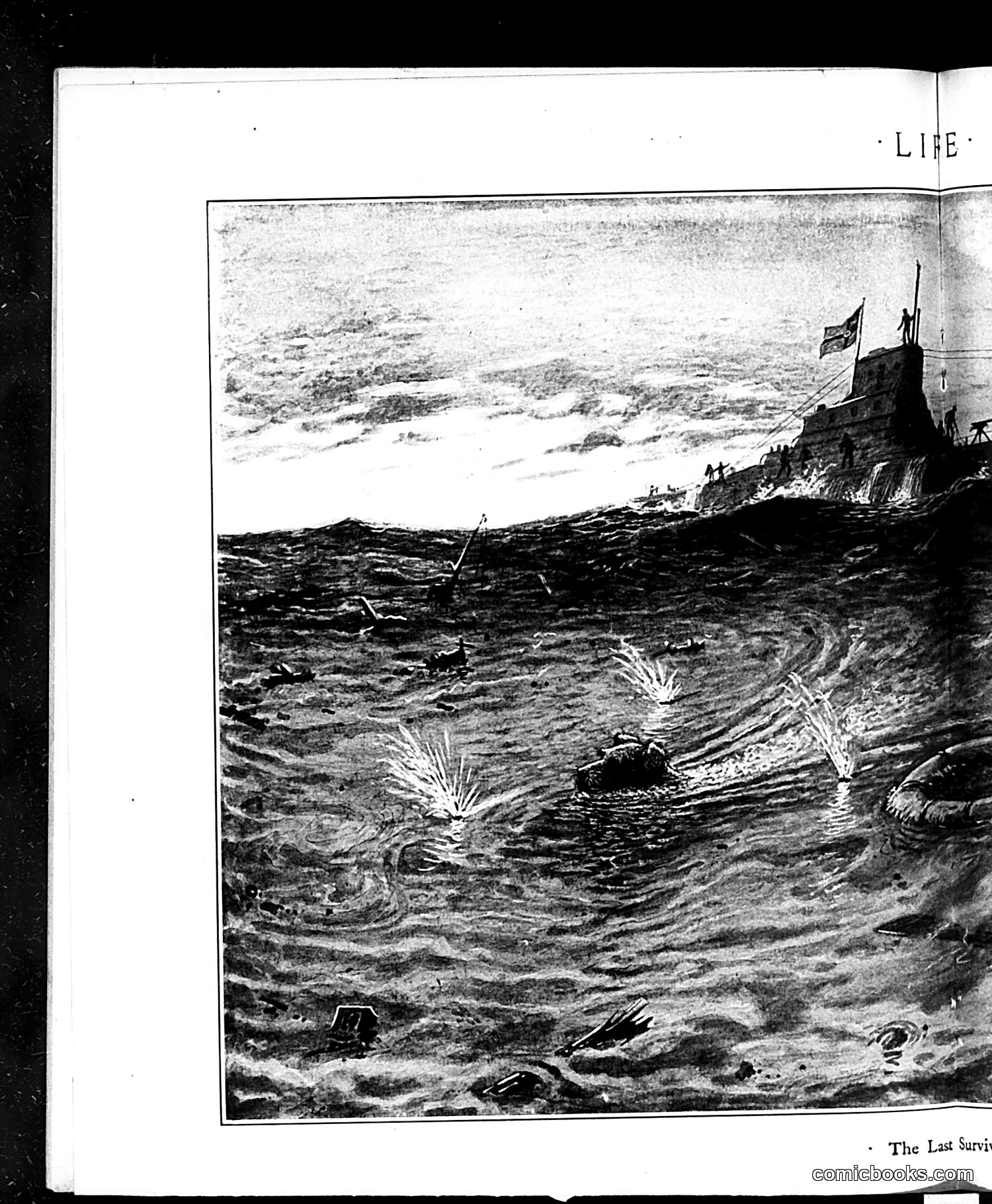
This page shows a dramatic illustration of what appears to be a military fortification or bunker on a coastline, with flags flying and soldiers visible. The scene depicts water in the foreground with splashes (possibly from explosions or artillery fire) and rough terrain. The caption reads "The Last Survi[vor]" (text cut off), suggesting this depicts a final survivor of some military conflict or battle. Without the complete caption or additional context visible on this page, I cannot definitively identify which specific historical conflict this references. The illustration style and printing quality suggest early-to-mid 20th century publication. The fortification and military elements suggest World War I or II-era content, but I cannot specify the exact historical event, location, or satirical intent without more complete textual information.
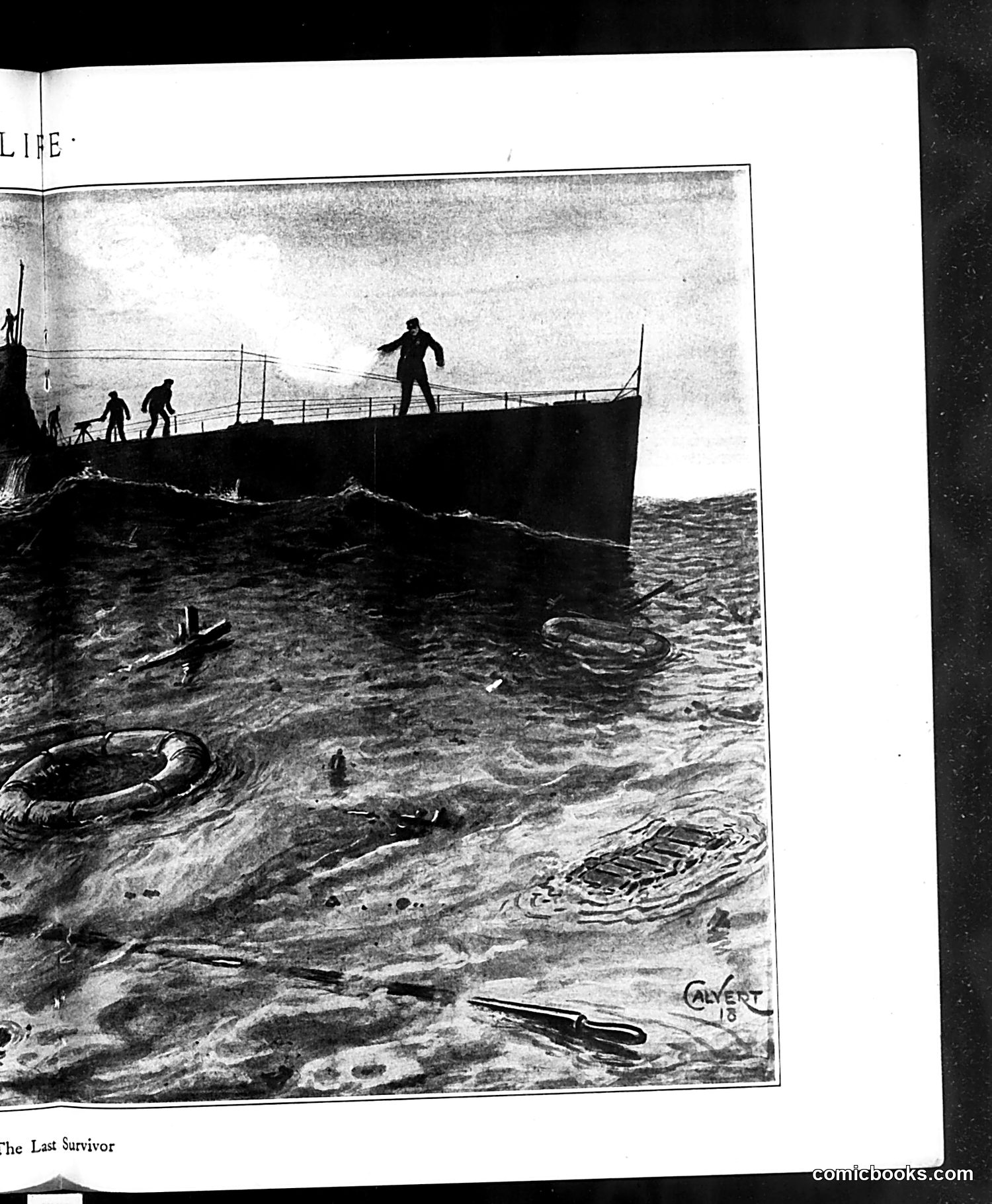
This illustration by Calvert (signed lower right) depicts a stark maritime scene: a solitary figure stands on a damaged ship's deck while the waters below are littered with wreckage—capsized lifeboats, debris, and other remnants of disaster. The cartoon appears to satirize survival and maritime catastrophe, likely referencing a specific historical shipwreck or naval disaster from Life magazine's publication era. The lone standing figure amid widespread destruction suggests themes of isolation, loss of life, or the grim aftermath of tragedy at sea. Without additional context or visible date, the specific event referenced remains unclear, though the composition emphasizes the bleakness of being "the last survivor" among devastation.
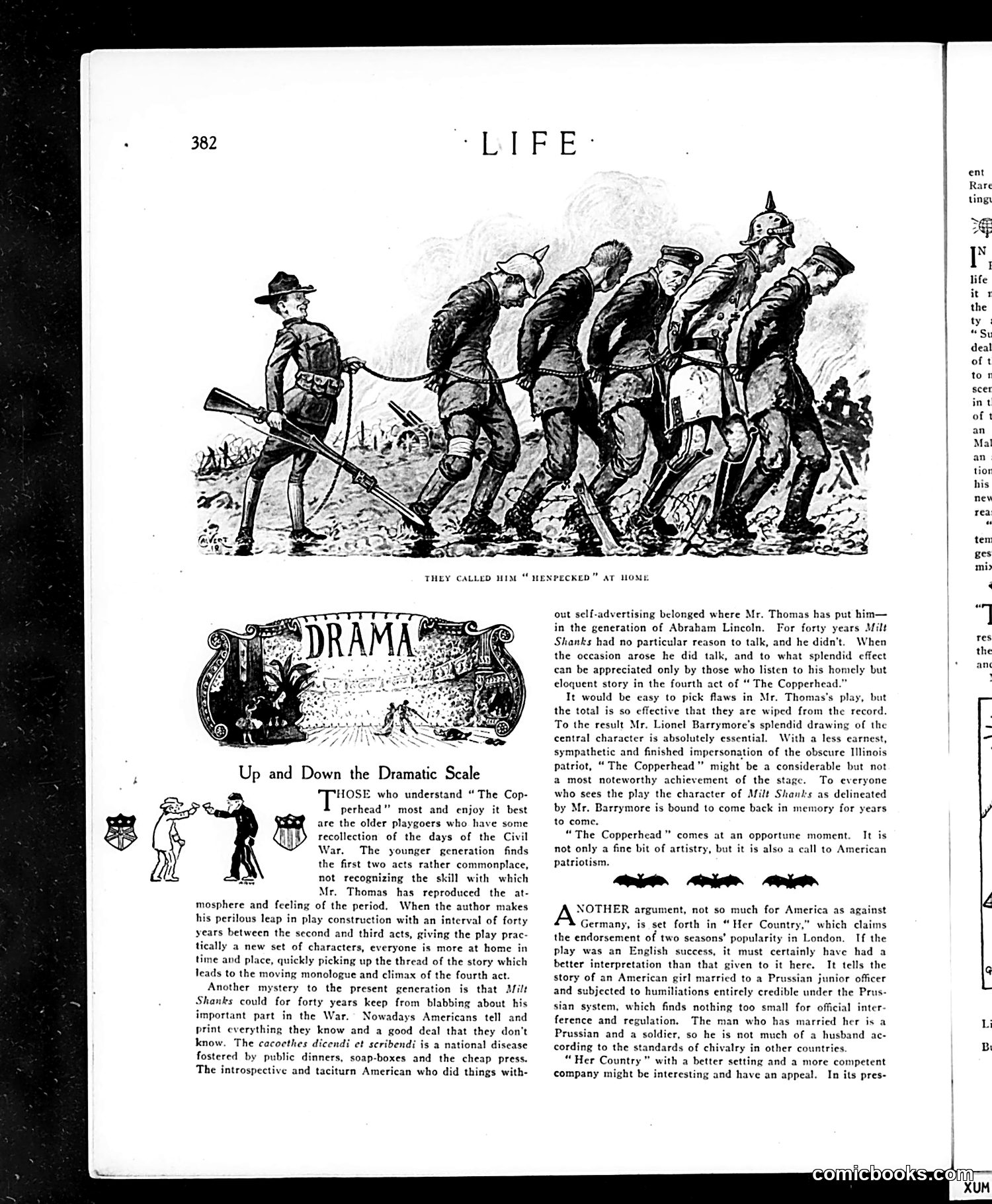
This page reviews two theatrical productions. The main illustration depicts a Civil War-era scene captioned "They Called Him 'Henpecked' at Home," accompanying a review of the play *The Copperhead*. The text praises *The Copperhead*, starring Lionel Barrymore, as a drama about an obscure Illinois patriot named Milt Shanks who kept silent about his wartime service for forty years. The reviewer contrasts this old-fashioned discretion with modern American culture's compulsive gossiping and self-promotion—what the text calls a "national disease." Below this, a second review dismisses *Her Country*, a play about an American woman married to a Prussian officer who suffers under the rigid Prussian system. The reviewer suggests the London production was superior and that this American staging lacks proper direction and casting. Both reviews use theatrical criticism to comment on American character and values—patriotism, discretion, and freedom—implicitly contrasting American ideals with German militarism during the World War I era.
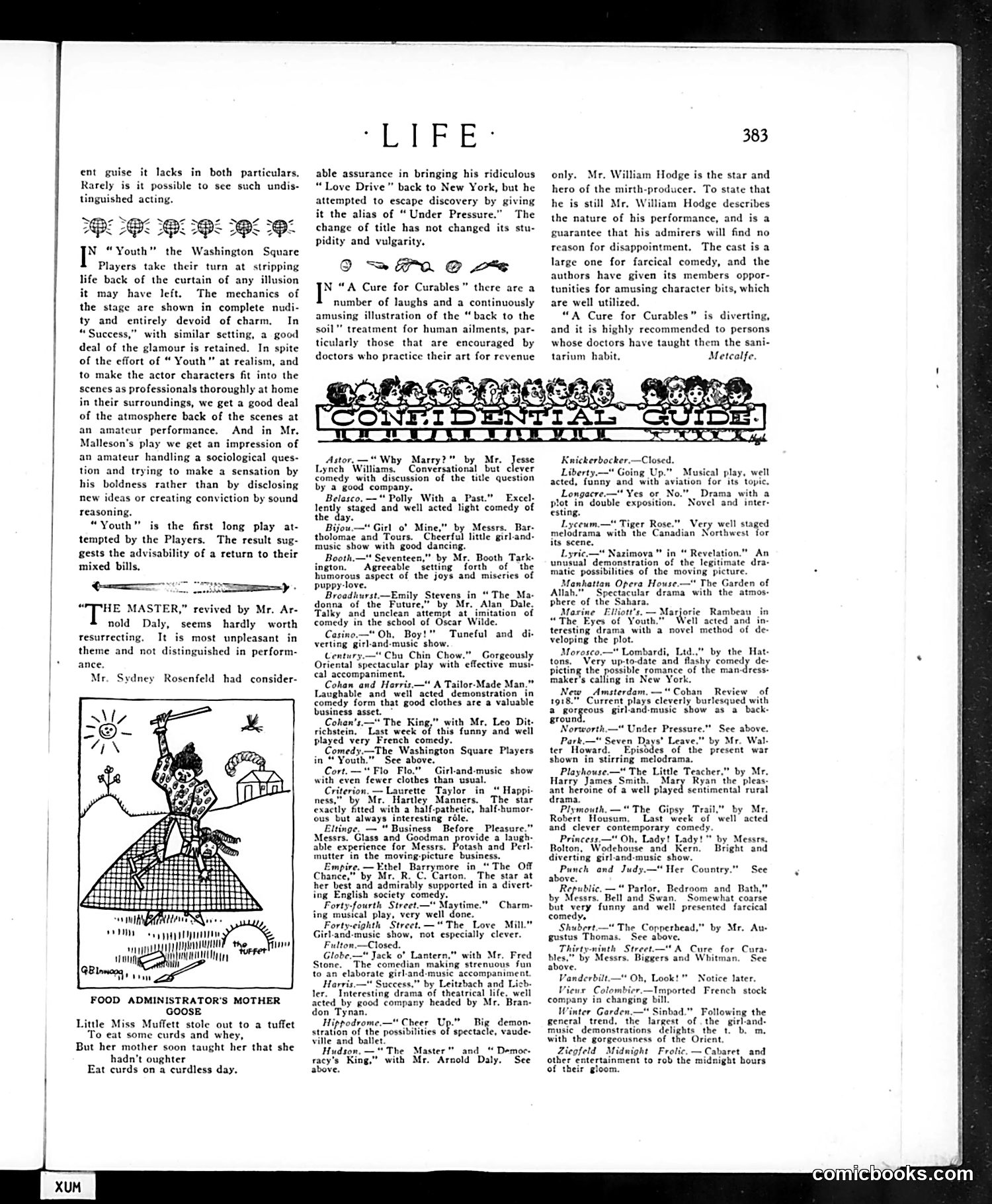
This page contains theater reviews and a satirical poem titled "Food Administrator's Mother Goose." **The Main Cartoon/Satire:** The illustrated poem parodies the nursery rhyme "Little Miss Muffet," rewritten to mock wartime food rationing. It shows a mother preventing her daughter from eating curds and whey on a "curdless day"—a direct jab at the Food Administrator's rationing policies. The joke targets the perceived absurdity of government food restrictions, suggesting the authorities were creating arbitrary, nonsensical rules. This likely dates to WWI-era rationing (1917-1918). **Theater Reviews:** The bulk of the page comprises brief reviews of Broadway productions, including plays like "Youth," "Why Marry?," and "Chu Chin Chow." The reviews are largely dismissive of amateur performances and certain shows, praising only skilled actors and well-staged productions. The satire's point: mocking government overreach into everyday civilian life during wartime through absurdist humor—a common Life magazine tactic.
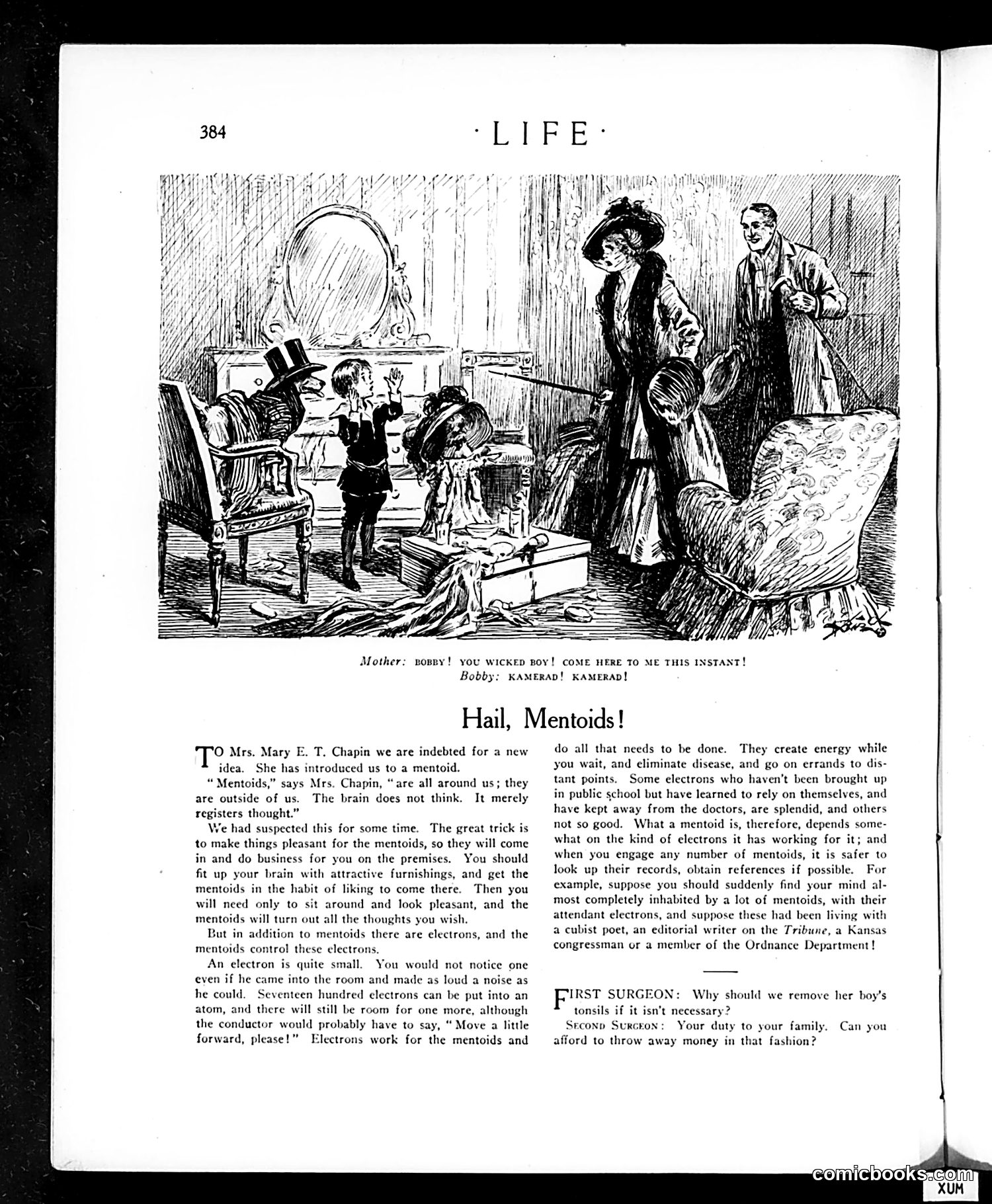
This page contains two distinct pieces of satire: **The Cartoon:** A boy, Bobby, is being scolded by his mother when he responds "Kamerad! Kamerad!"—German for "comrade." This is a post-WWI jab at anti-German sentiment and possibly at children adopting foreign expressions. The humor lies in the incongruity of a child using enemy language when disciplined. **"Hail, Mentoids!" Essay:** This is pseudoscientific satire mocking New Thought and self-help pseudoscience popular in the early 20th century. Mrs. Chapin's invented concept of "mentoids" (mental entities that do your thinking) and "electrons" (portrayed as magical workers) parodies pseudo-intellectual jargon. The article ridicules both the charlatan philosophy itself and intellectuals who promoted it—specifically mocking a "cubist poet," newspaper editorial writers, and politicians as sources of bad mentoid influence. The surgical dialogue at bottom sarcastically critiques unnecessary medical procedures justified by vague duty.
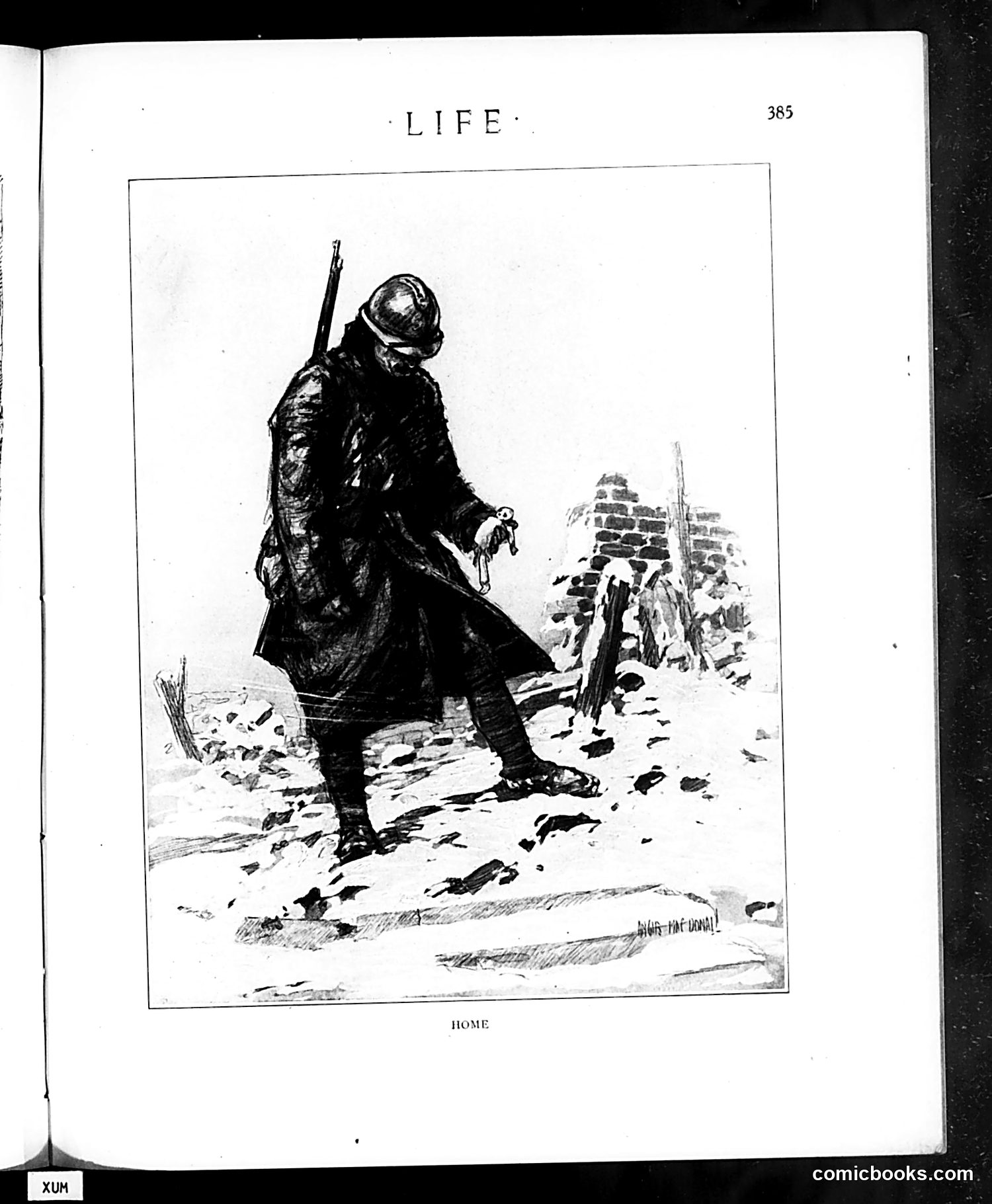
This illustration depicts a World War I soldier returning to a devastated landscape. The armed, uniformed figure stands amid rubble and destruction—scattered debris, damaged fortifications, and ruined structures visible in the background. The title "Home" creates sharp irony: what should represent a place of comfort and safety instead appears as a war-torn wasteland. The cartoon likely satirizes the grim reality facing soldiers returning from WWI, commenting on the physical and psychological destruction of war. Rather than a welcoming homecoming, the soldier confronts only devastation. This reflects broader post-war anxieties about how veterans would reintegrate into a society ravaged by conflict, or possibly critiques the futility and devastation of modern warfare itself.
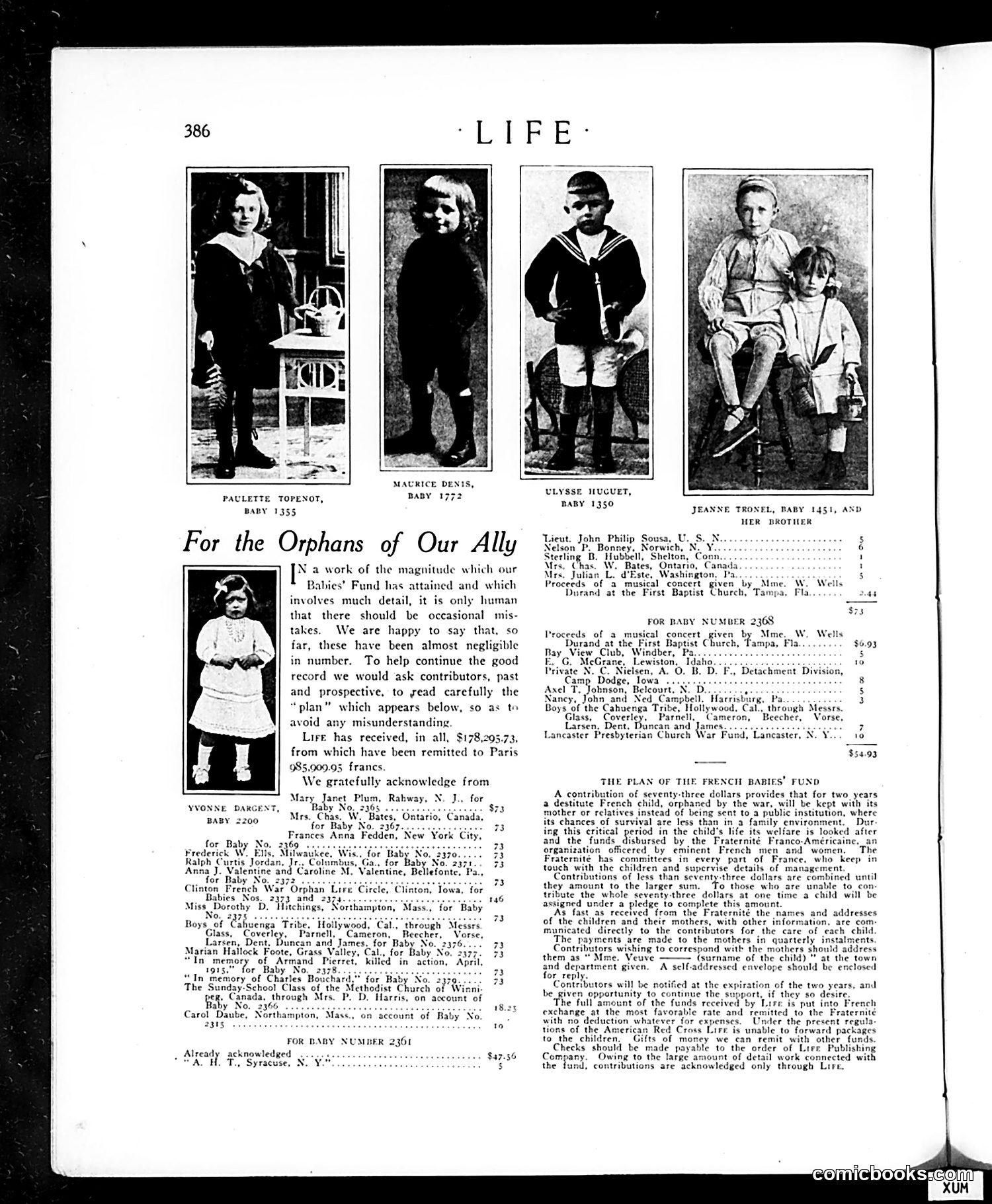
This page documents Life magazine's "Babies' Fund," a charitable initiative supporting French war orphans during World War I. The photographs show four French children being sponsored through the program. **What it means:** Life was soliciting American donations to support destitute French children orphaned by the war. The fund operated through the "Fraternité Franco-Américaine," keeping children with family rather than institutions. For $73, donors could support one child for two years. **The appeal's logic:** By personalizing orphans with photographs and names (Paulette Topenot, Maurice Denis, etc.), Life made abstract suffering concrete and donor relationships direct. Contributors received updates about "their" assigned child. **Historical context:** This reflects American philanthropic efforts toward French civilians during WWI, before U.S. entry (unclear if pre- or post-1917). France is described as "Our Ally," emphasizing transatlantic bonds and humanitarian obligation to support war victims beyond soldiers. The detailed financial accounting ($178,293.73 collected) demonstrates accountability to donors—crucial for maintaining public trust in charitable organizations.
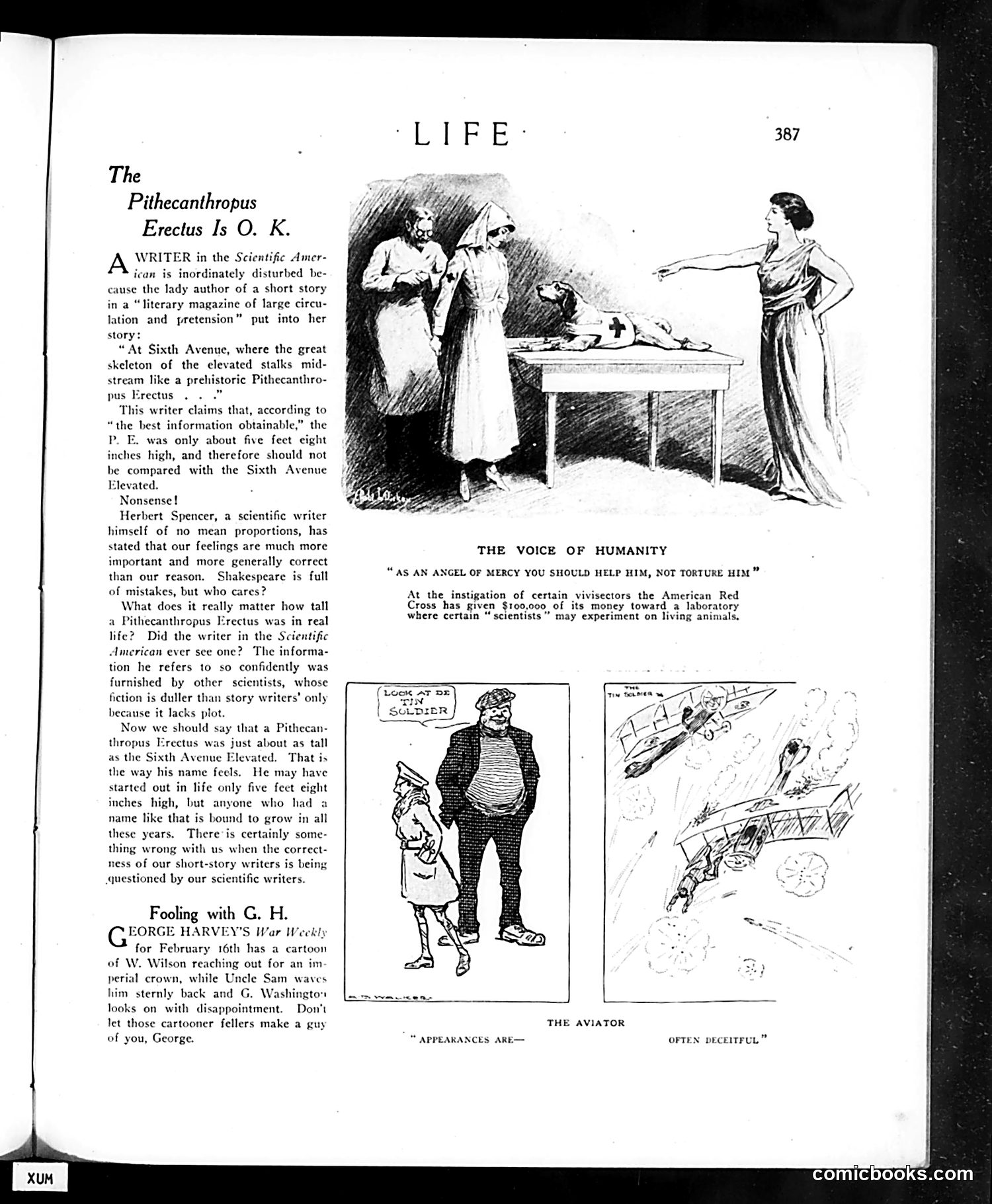
**"The Pithecanthropus Erectus Is O. K."**: Life ridicules a *Scientific American* writer for criticizing a short story's metaphorical comparison of the Sixth Avenue Elevated train to the prehistoric *Pithecanthropus Erectus*. The writer objected that the fossil creature was only five feet eight inches tall, not train-sized. Life's counterargument: feelings matter more than literal accuracy (citing Spencer and Shakespeare). The satire mocks scientific pedantry and humorless fact-checking of literary imagination. **"Fooling with G. H."**: This section critiques cartoonist George Harvey's *War Weekly* cartoon depicting President Woodrow Wilson reaching for an imperial crown while Uncle Sam and George Washington disapprove. Life warns readers not to be manipulated by such propagandistic imagery. **"The Voice of Humanity"**: An illustration shows mercy versus cruelty regarding the Red Cross's $100,000 funding for animal laboratory experiments—text urges helping animals rather than torturing them, expressing anti-vivisection sentiment.
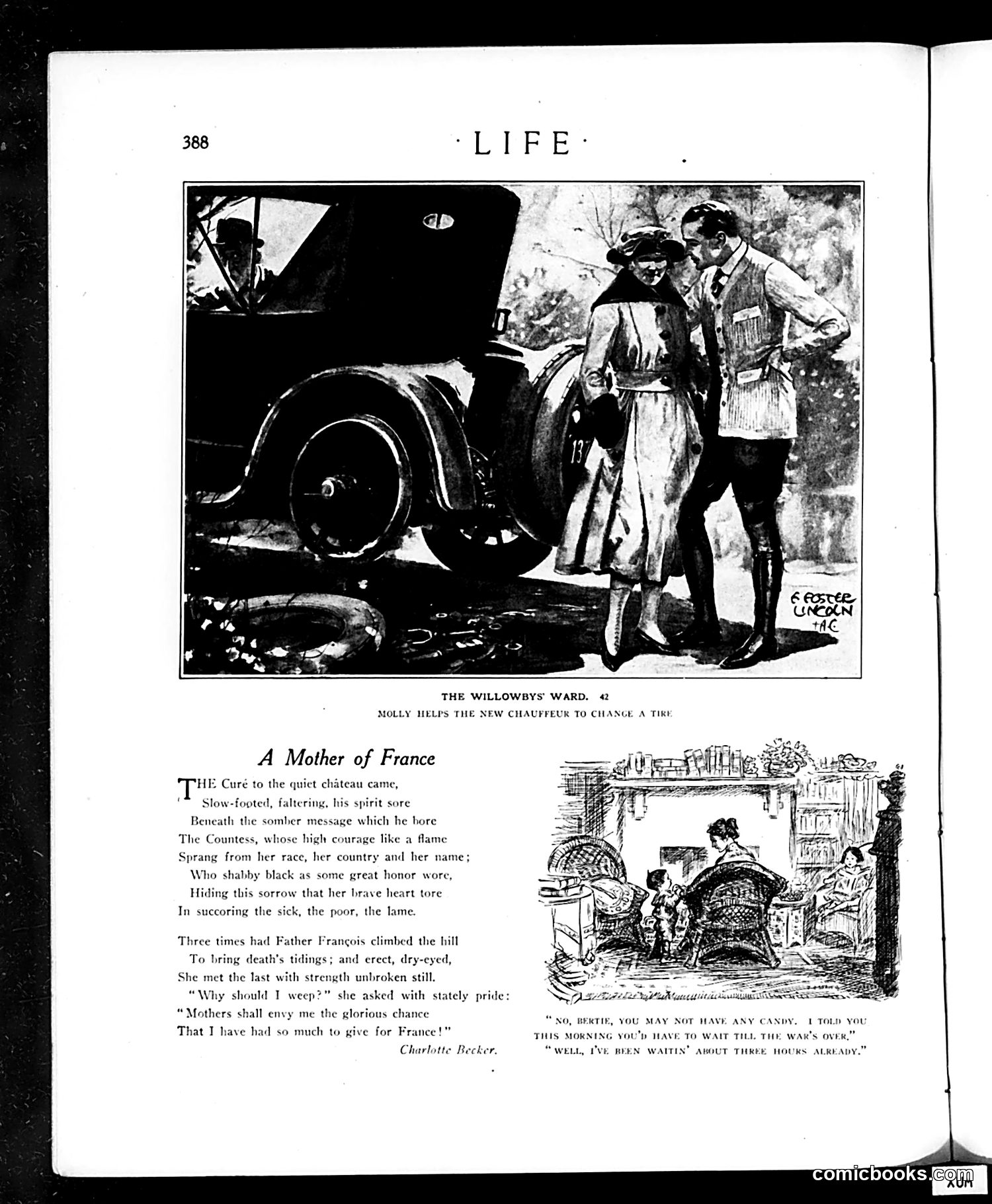
**The Willowbys' Ward comic strip** (top): Shows a domestic scene where "Molly" assists a new chauffeur changing a tire. This appears to be a lighthearted romantic or comedic subplot from an ongoing serialized story—typical of Life's humor comics of the era. **"A Mother of France" (bottom):** A sentimental poem by Charlotte Becker celebrating French maternal sacrifice during World War I. It depicts a Countess who has lost multiple sons (referenced through Father François delivering death notices three times). The poem praises her stoic patriotism—she wears black with pride rather than despair, finding honor in her losses "for France." **The accompanying illustration** shows domestic life, with a caption humorously contrasting the poem's grand sacrifice: a child complains about candy rationing during wartime, having "waited three hours already." **The satire:** The juxtaposition gently mocks American civilian impatience with wartime deprivation, contrasting it with French mothers' actual losses. It reflects Life's WWI-era editorial perspective celebrating Allied sacrifice while poking fun at homefront complaints.
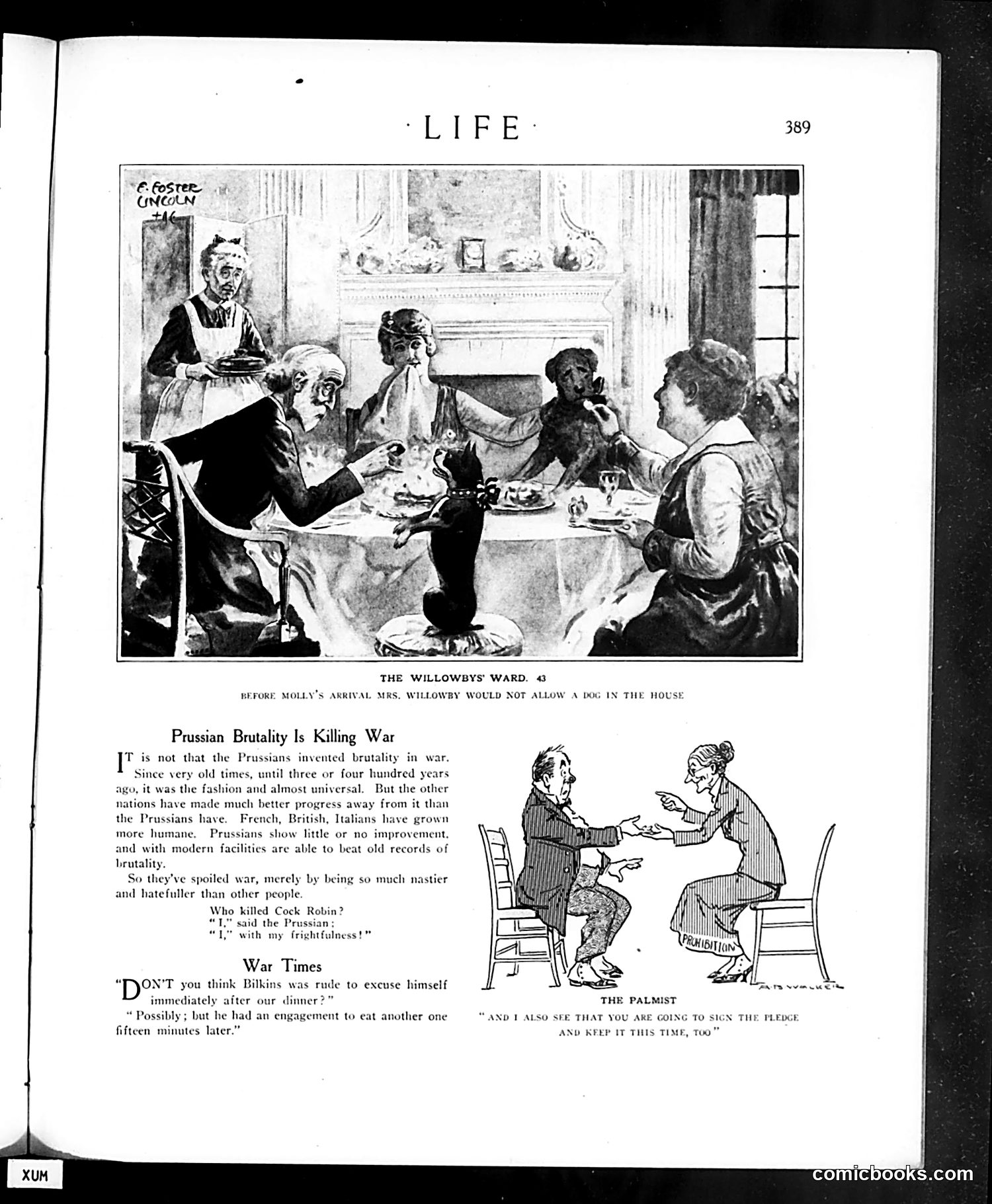
This page contains wartime satire from WWI era. The main editorial, "Prussian Brutality Is Killing War," argues that while brutality in warfare is ancient, other nations (French, British, Italians) have progressed toward more humane conduct—but Prussians have not. It uses the nursery rhyme "Who Killed Cock Robin?" to sarcastically identify Prussia as the culprit, attributing their brutality to "frightfulness" (likely referencing Germany's deliberate terror tactics). The two cartoons provide lighter relief: 1. **"The Willowbys' Ward"** shows a domestic humor strip where a new ward (Molly) has apparently softened the household enough that Mrs. Willowby now tolerates a dog—previously forbidden. 2. **"The Palmist"** depicts a fortune teller predicting a client will sign a temperance pledge and keep it—sardonic humor about whether such resolutions stick. The page juxtaposes serious anti-German propaganda with domestic humor, typical of Life's satirical approach during WWI.
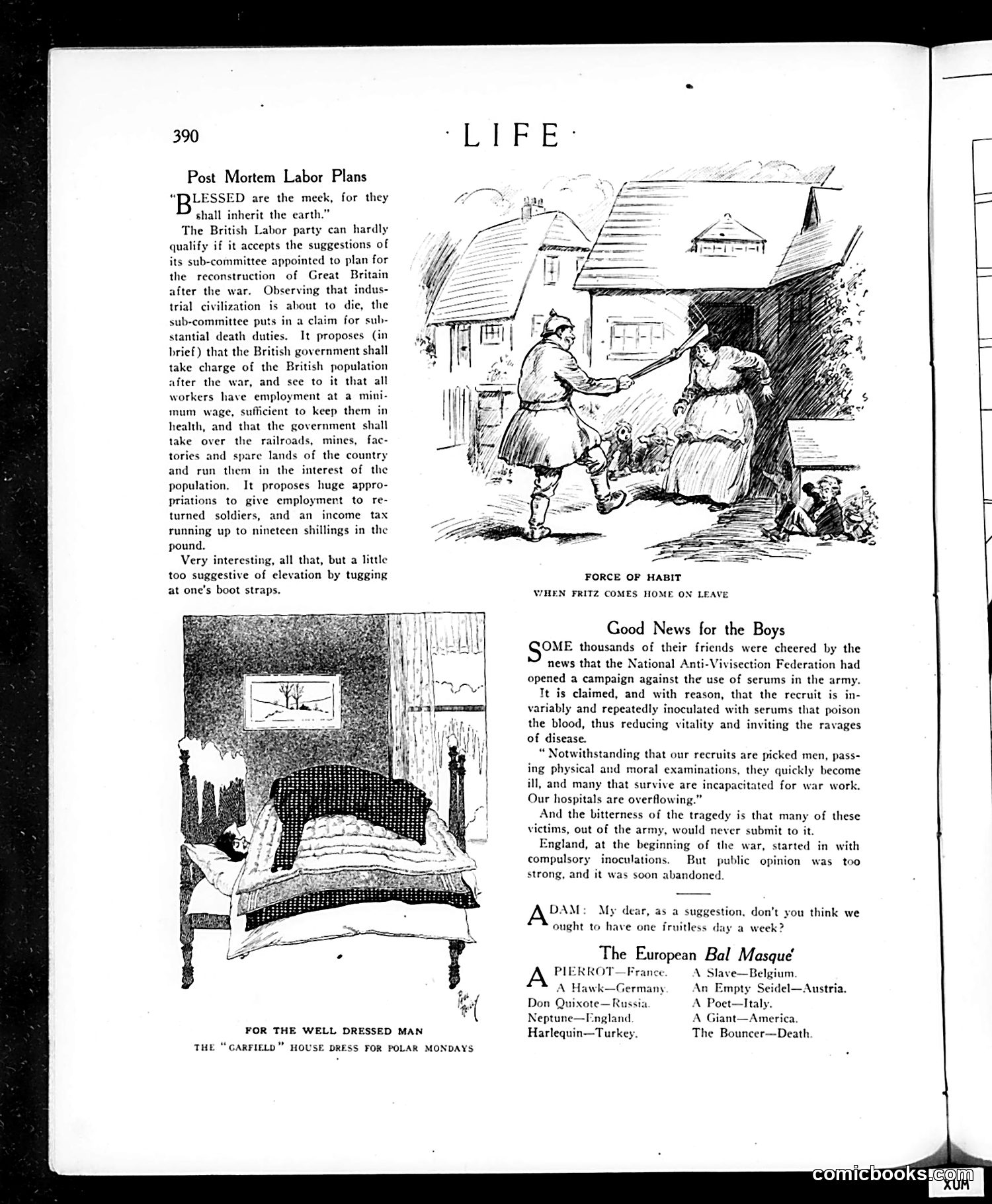
This page contains three distinct satirical pieces: **"Post Mortem Labor Plans"** mocks British Labor Party reconstruction proposals as impractically socialist. The text criticizes their plan for government control of industry, minimum wages, and high income taxes (up to nineteen shillings per pound) as absurdly ambitious—"too suggestive of elevation by tugging at one's boot straps" (a self-improvement metaphor used mockingly). **"Force of Habit"** is a cartoon captioned about "Fritz" (a German soldier on leave). The sketch depicts a German soldier's habitual military posture persisting during civilian life—satirizing how warfare dehumanizes soldiers into rigid automatons. **"Good News for the Boys"** reports the National Anti-Vivisection Federation's campaign against army inoculations, claiming serums weaken recruits and cause illness. It notes England abandoned compulsory inoculation due to public resistance—framing vaccine skepticism as reasonable wartime concern. The European Bal Masqué lists national stereotypes as masked ball characters (Russia as Don Quixote, America as a Giant, Death as "the Bouncer"), typical of period satirical commentary on nations.
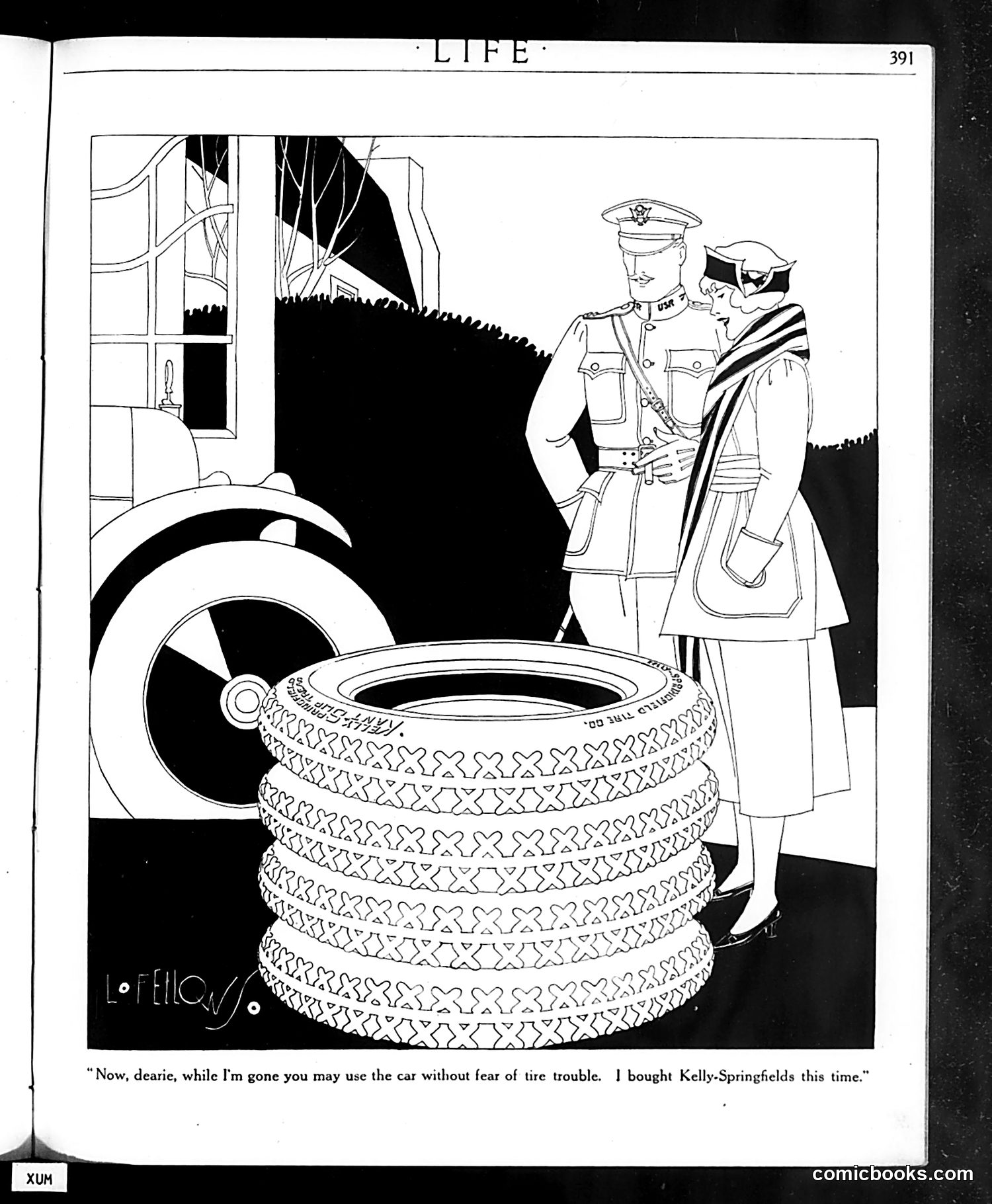
This is a vintage advertisement disguised as comic content in *Life* magazine (page 391). A military officer in uniform addresses a woman, reassuring her that she can use his car safely because he's purchased Kelly-Springfield brand tires. The large stack of tires dominates the foreground, showcasing the product. The humor relies on the period assumption that women were anxious drivers concerned with mechanical failure, while the "darling" form of address reflects gender conventions of the era. The officer's confidence in the tire brand—implied by his willingness to let someone else drive his vehicle—serves as the sales pitch. This is straightforward product advertising using a domestic scenario and gentle gendered humor typical of mid-20th century marketing.
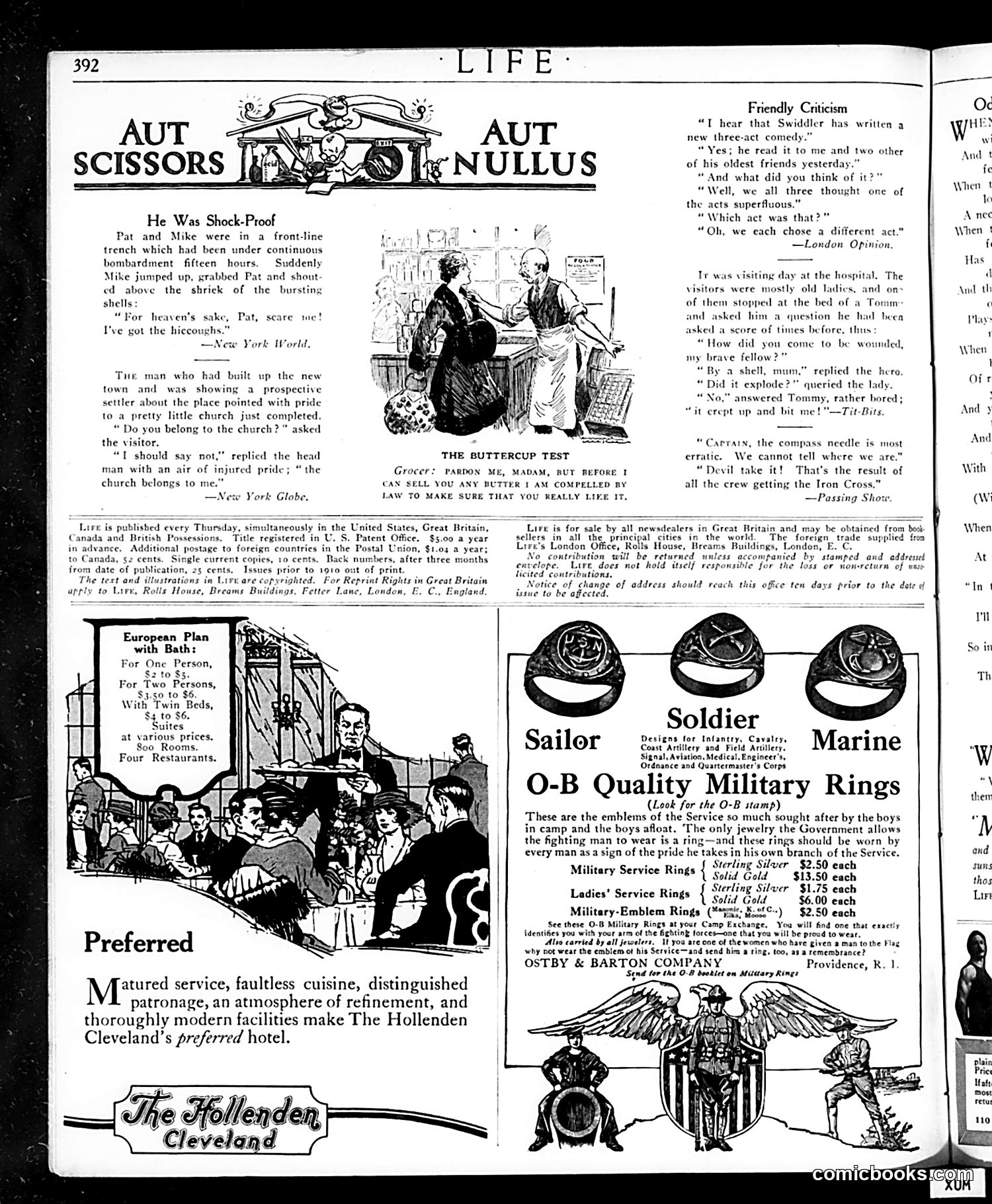
This page contains several short satirical jokes typical of Life's humor section, plus period advertisements. **The Cartoons/Jokes:** "He Was Shock-Proof" depicts soldiers in WWI trenches—one soldier tries to frighten his panicked comrade by mentioning hiccoughs during bombardment, playing on the absurdity of minor ailments amid lethal danger. "The Buttercup Test" shows a grocer conducting a taste test on butter, likely satirizing consumer protection laws or food inspection claims that were becoming common. The hospital anecdote jokes about a wounded soldier's deadpan response to predictable questions from civilian visitors—humor arising from the gap between civilians' expectations of heroism and soldiers' worn exhaustion. "Captain, the compass needle..." references crews receiving the Iron Cross (German military decoration), suggesting satirical commentary on military honors or perhaps the war's internationalization. **Advertisements** dominate the lower half: The Hollenden Hotel (Cleveland), European travel accommodations, and O-B Military Rings for service members—typical WWI-era advertising targeting soldiers and patriotic consumers.
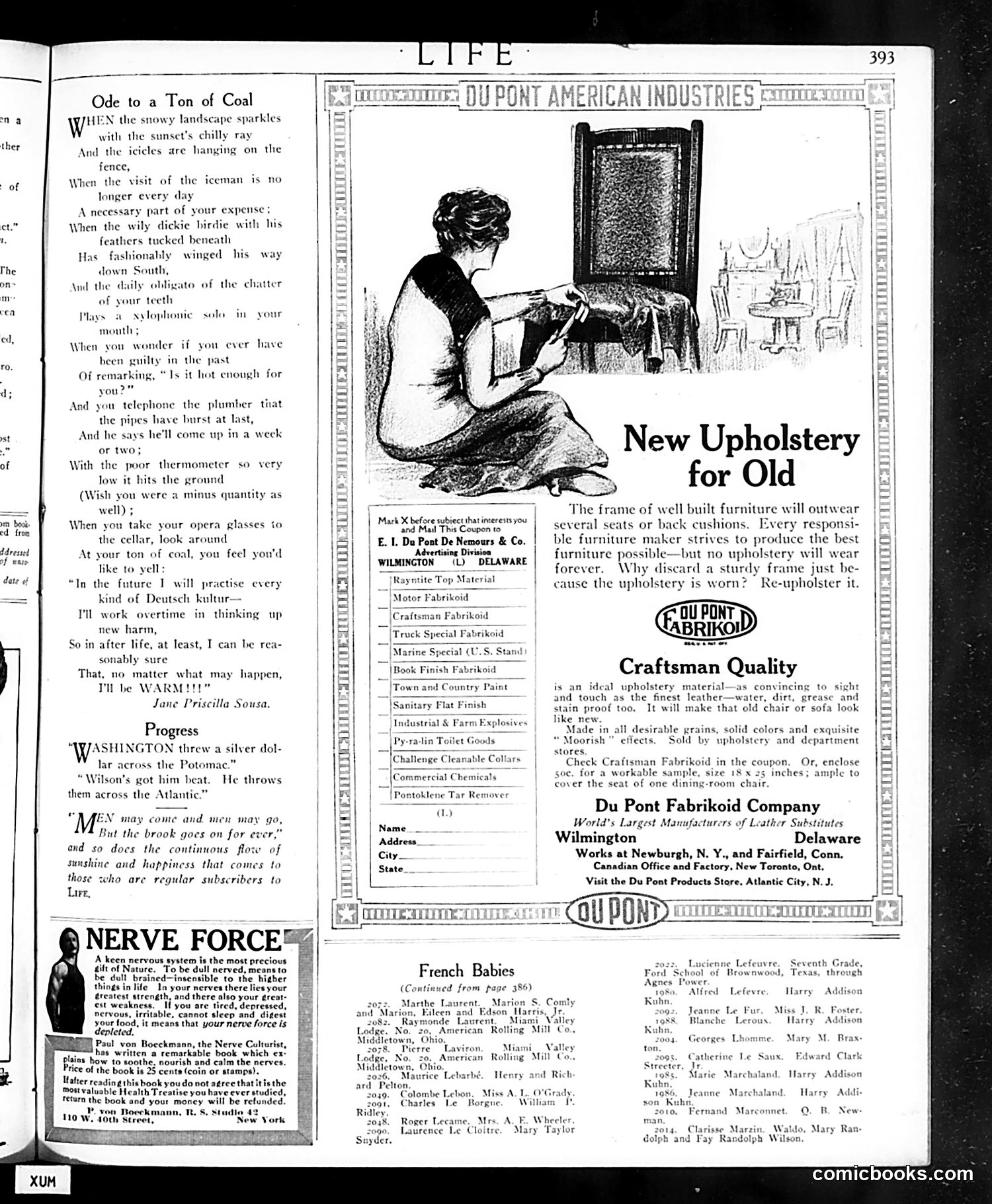
This is a mixed-content page from *Life* magazine featuring poetry, advertisements, and brief humor items. The main satirical poem, "Ode to a Ton of Coal," mocks the American obsession with comfort during winter. It's written in the voice of someone fantasizing about coal delivery, portraying winter as unbearable—pipes bursting, teeth chattering, opera glasses needed to see through frost. The joke's punch line has the narrator vowing to become German and work "overtime in thinking up new harm" to stay warm, a sardonic reference to anti-German sentiment (likely WWI-era). The satire targets both American materialism and the period's xenophobia. The rest of the page is dominated by Du Pont advertisements for upholstery materials and other industrial products typical of 1920s corporate marketing. The "Nerve Force" ad at bottom promotes a health book, a common patent-medicine-era advertising format. The "French Babies" section lists names, likely contest entries or published readers. Overall: a typical *Life* magazine blend of satirical verse commentary on American life and commercial advertising.
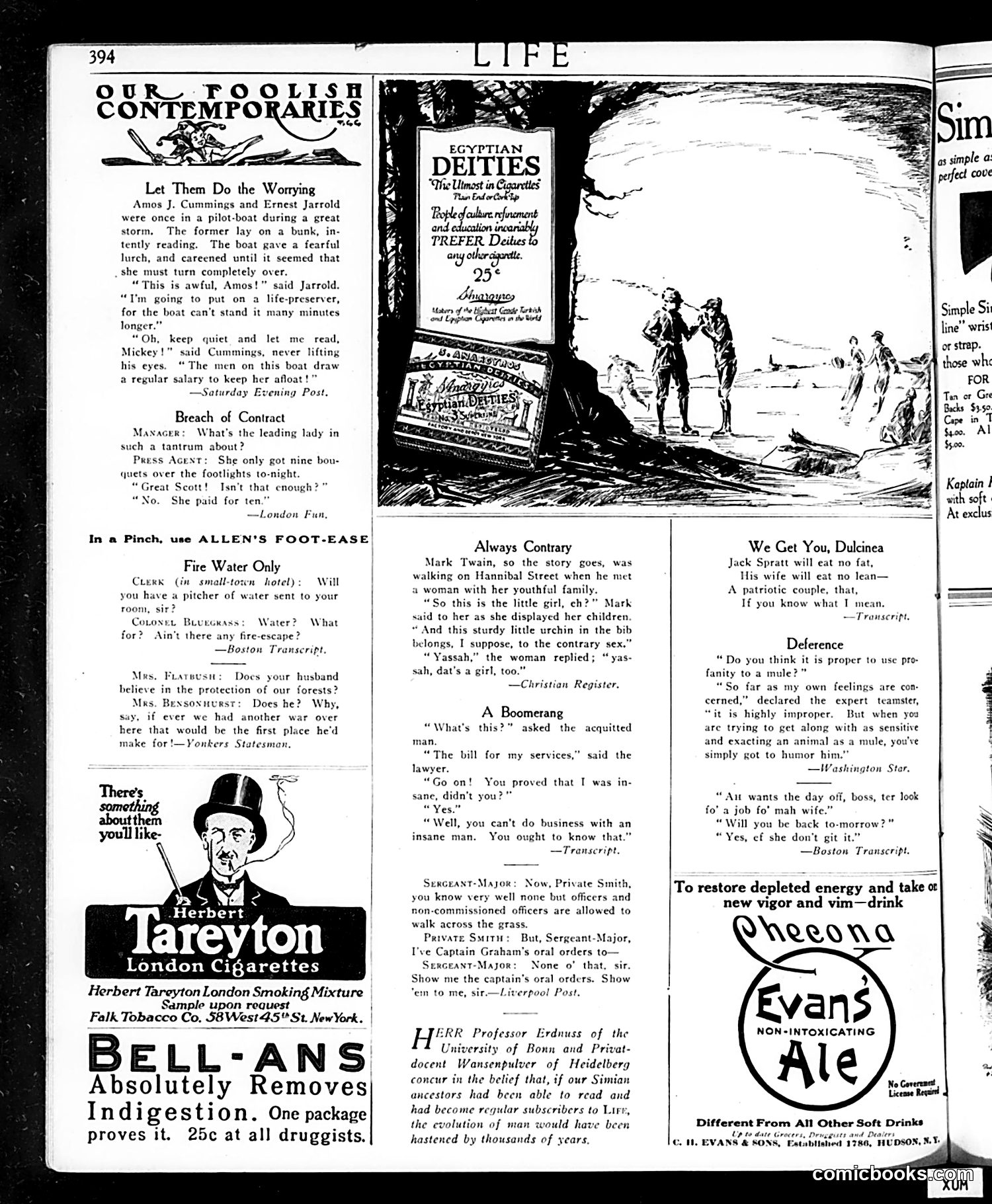
This page from *Life* magazine is primarily **advertisements and humorous anecdotes** rather than political cartoons. The humor pieces mock contemporary social situations: a man reads calmly during a boat crisis, trusting paid crew; a theater actress complains about receiving only nine bouquets when she paid for ten; a wife protests a hotel lacking a fire escape; and a woman contradictorily claims her baby girl is also a girl. The Herbert Tareyton cigarette ad features a caricatured man smoking, using the appeal "There's *something* about them you'll like." Most significantly, the bottom text ironically credits professors at German universities (Bonn and Heidelberg) with claiming that had their "Simian ancestors" read *Life* magazine regularly, human evolution would have advanced thousands of years—a backhanded compliment to the magazine's intellectual value wrapped in evolutionary humor typical of the era. The page reflects early 20th-century American humor: gentle satire of everyday absurdities and human contradiction, with no apparent partisan political content.
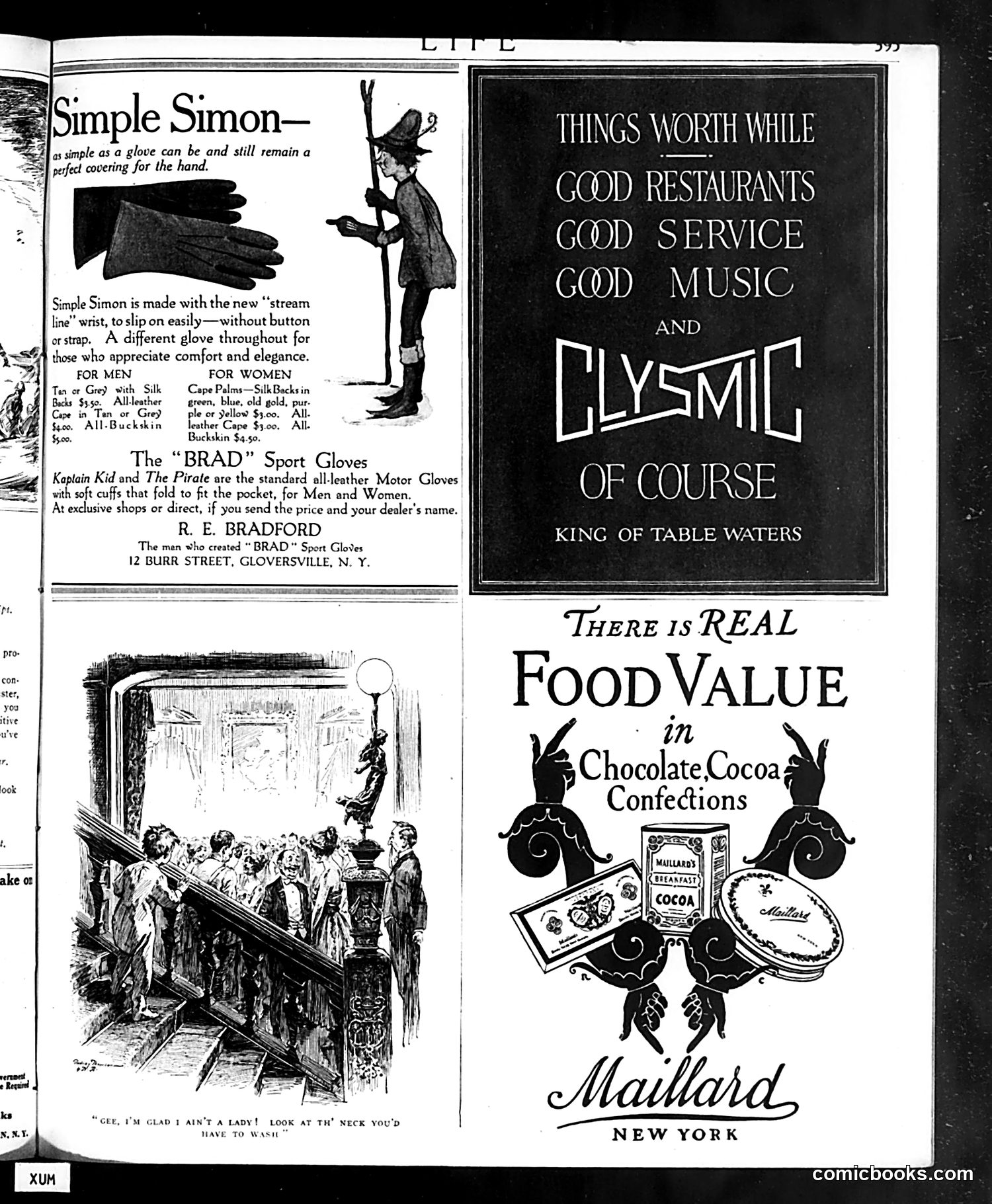
This page is primarily **advertising**, with one cartoon at the bottom. The cartoon depicts a man and woman on a staircase. The man, looking at the woman's neck, remarks: "Gee, I'm glad I ain't a lady! Look at th' neck you'd have to wash." The joke is a **social satire on women's fashion and grooming burden**. It mocks the restrictive, high-collared styles women wore in this era (appearing to be early 1900s), which required extensive daily cleaning of the exposed neck area. The humor plays on the gender difference—the man boasts he avoids this tedious domestic labor by being male, while implying women's fashion demands create unnecessary work. The page's advertisements (Simple Simon gloves, Brad Sport Gloves, Maillard chocolates, and Clysmic water) are unrelated to the cartoon's social commentary.
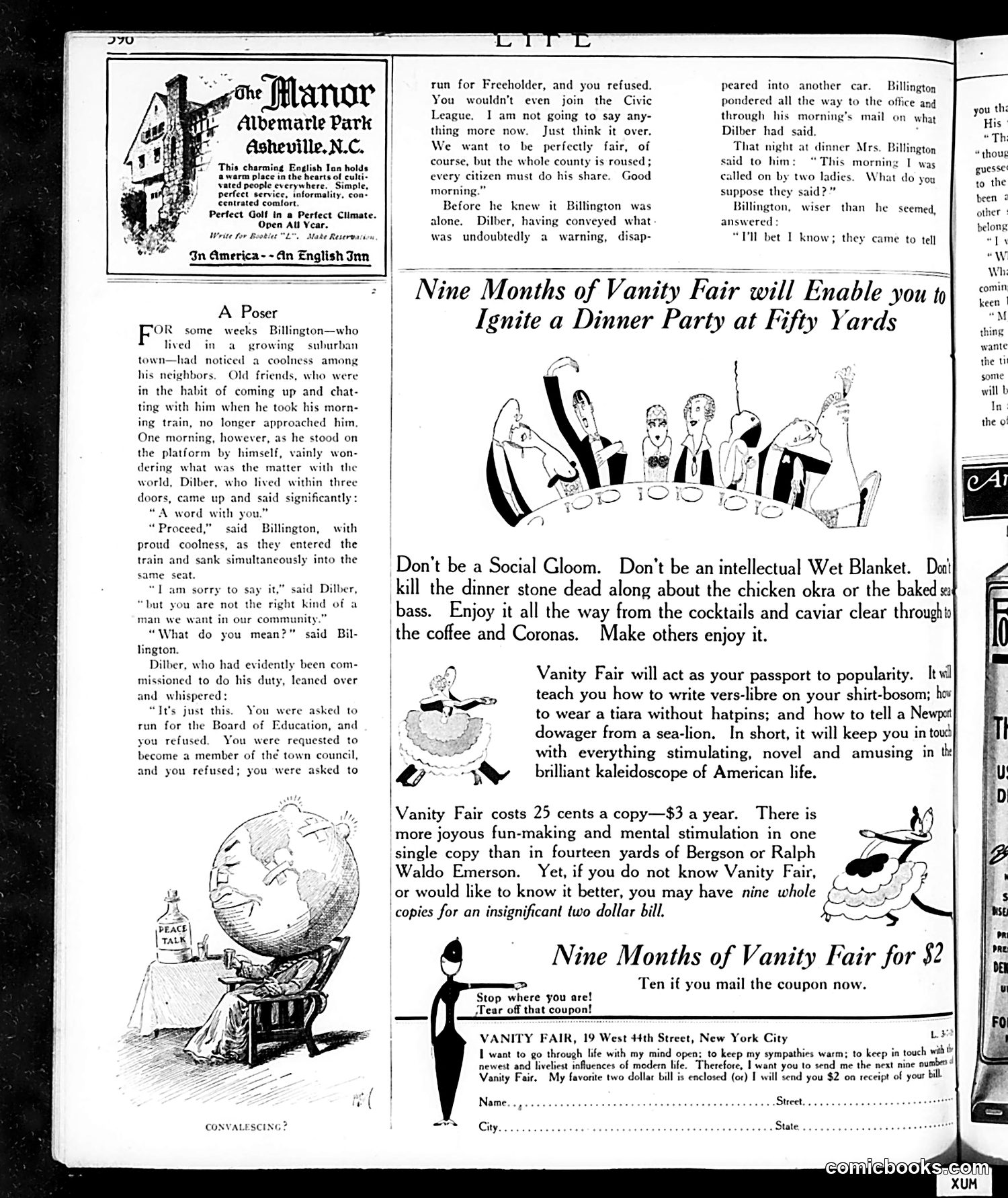
This story satirizes suburban social pressure and civic duty. Billington, a resident of a growing town, has refused several community requests: running for the Board of Education, joining the town council, and participating in the Civic League. His neighbor Dilber confronts him, claiming the community needs his participation. The satire targets Billington's self-centered apathy—he stands aloof on the train platform, indifferent to social obligation, only to be shamed into awareness that his refusals have made him a social outcast among his peers. The accompanying Vanity Fair advertisement (filling the page's right side) ironically undercuts this message: it promises readers sophistication and social success through magazine consumption alone, rather than actual civic engagement—making Billington's problem and the era's solution equally absurd. The cartoon mocks both suburban conformity *and* the shallow consumerism offered as its remedy.
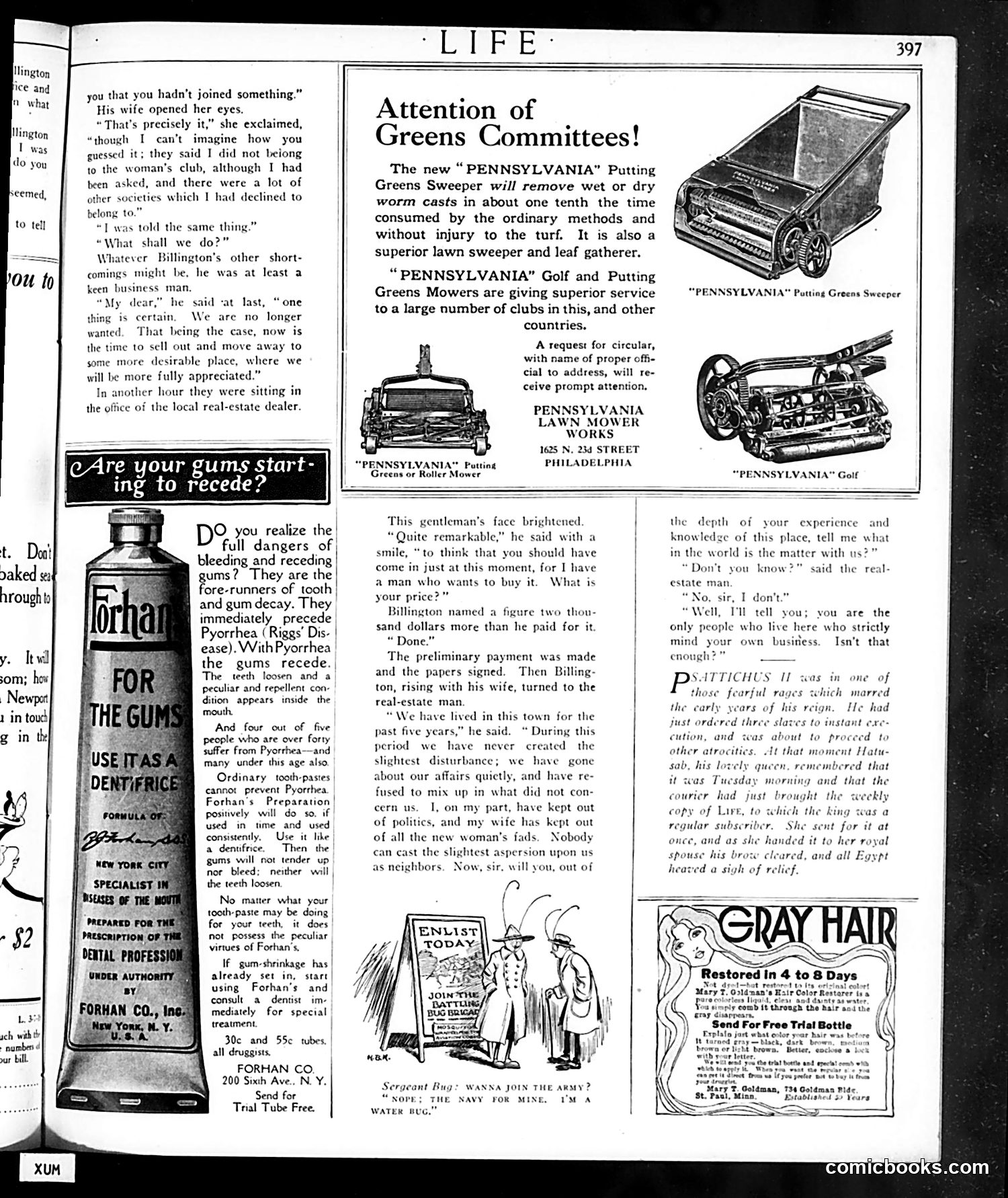
This page satirizes **social conformity and club culture** in early 20th-century America. The main narrative depicts a couple (the Billingtons) who decide to leave town after being excluded from the local women's club—despite never wanting to join. The real-estate dealer's final punchline delivers the satire: they're the only neighbors who "strictly mind your own business," and this independence makes them social outcasts. The joke critiques how American communities **valued conformity and participation in civic/social organizations over genuine virtue**. By refusing to join clubs or participate in social movements, the Billingtons are seen as suspicious outsiders rather than respectable citizens. The page also contains **period advertisements** for lawn mowers, dental care products, and hair treatments—typical of the magazine's commercial content and reflecting consumer culture of the era.
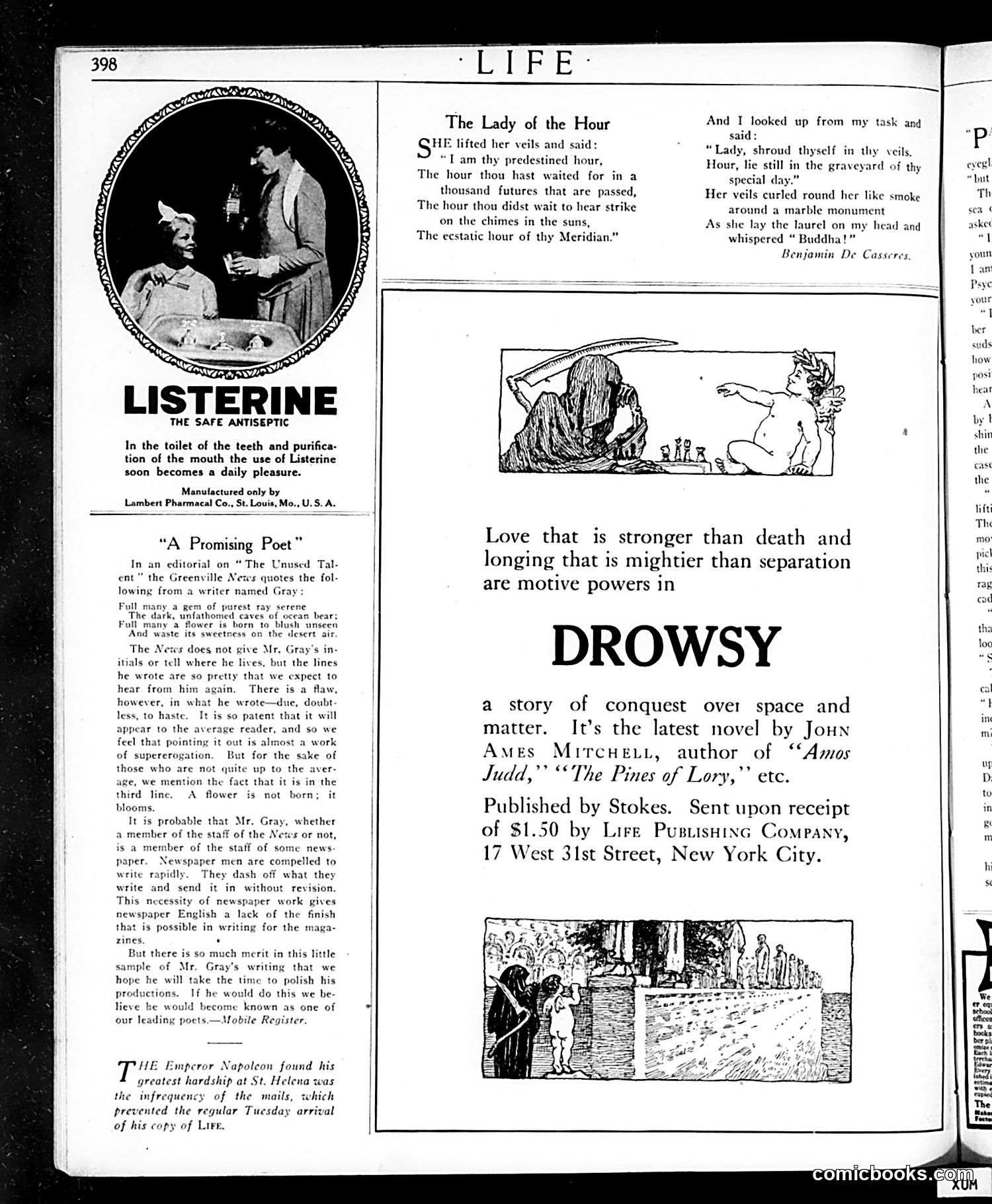
This page contains three distinct sections: **Listerine Advertisement**: A period product ad featuring an illustrated couple, promoting antiseptic mouthwash as a daily hygiene habit. **"A Promising Poet" Editorial Satire**: Life mocks a regional newspaper (the Greenville *News*) for praising a poem by "Mr. Gray" while missing an obvious error. The poem misquotes Gray's actual work—"A flower is not born; it blooms"—a technical flaw Life's editors gleefully point out. The satire critiques both the regional paper's carelessness and newspaper journalists' rushed, unpolished work habits. **Napoleon Joke**: A one-liner satirizing Napoleon's exile at St. Helena, suggesting he suffered more from missing his subscription to *Life* magazine than from actual hardship—self-promotional humor about the magazine's importance. The page also features literary content including a poem "The Lady of the Hour" by Benjamin De Casseres and an advertisement for the novel *Drowsy* by John Ames Mitchell. The overall tone reflects *Life*'s role as a satirical magazine targeting media incompetence and cultural pretension.
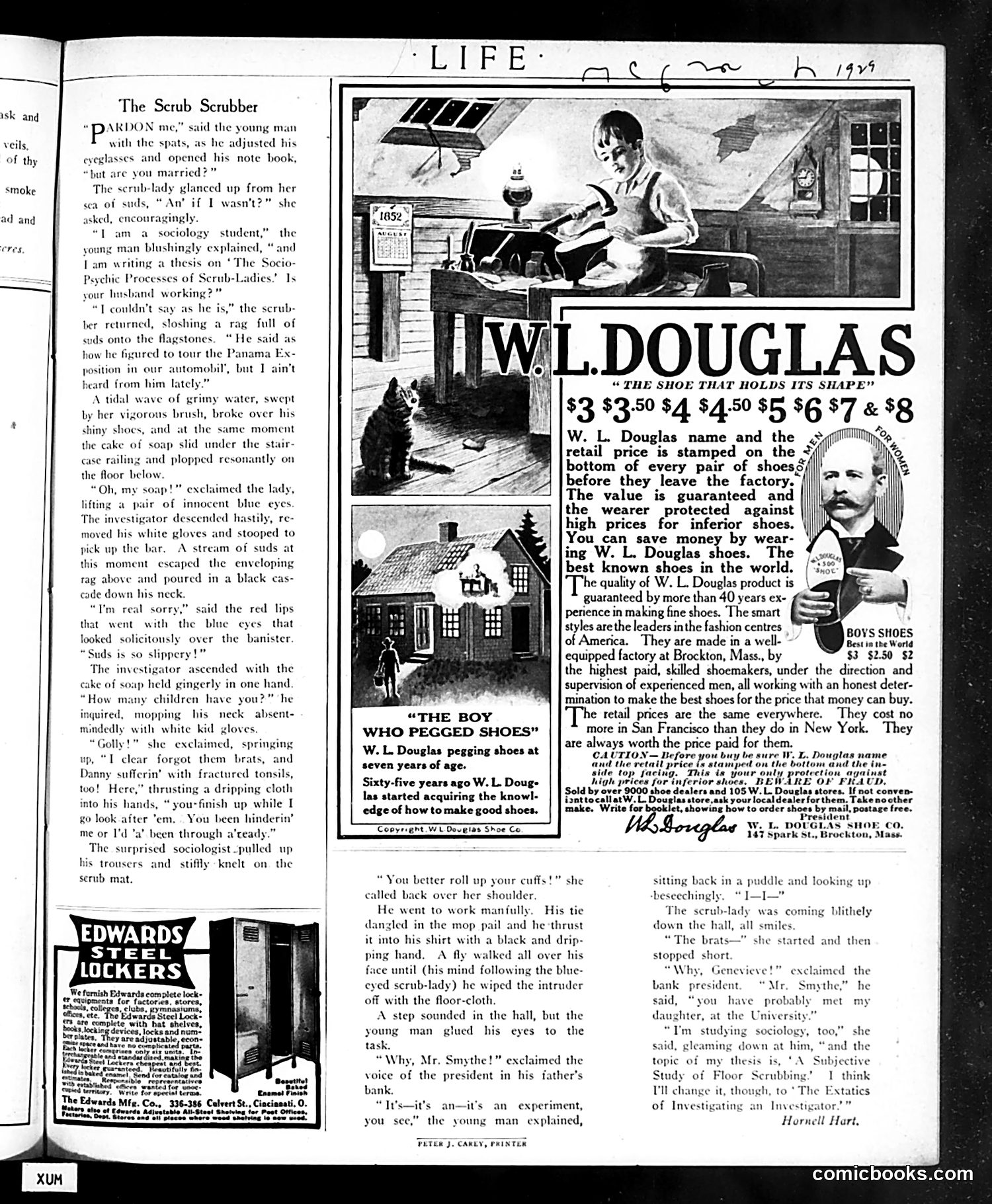
This page contains a satirical story mocking pretentious academic sociology. A young male sociology student, visiting a working-class scrub-lady to research "The Socio-Psychic Processes of Scrub-Ladies," repeatedly gets humbled through physical mishaps—soap suds flood down his neck, he must kneel scrubbing floors in his fine clothes. The satire targets academic jargon and condescending "scientific" study of working people. The scrub-lady speaks naturally and practically while the student uses affected language ("psychic processes"). By story's end, the student has literally become the scrub-lady's cleaning assistant, reversing the power dynamic. The accompanying W.L. Douglas shoe advertisement occupies significant space, typical of Life's mixed editorial-advertising format. No specific political figures appear; the humor derives from class-based social commentary common to 1910s-era American humor magazines.
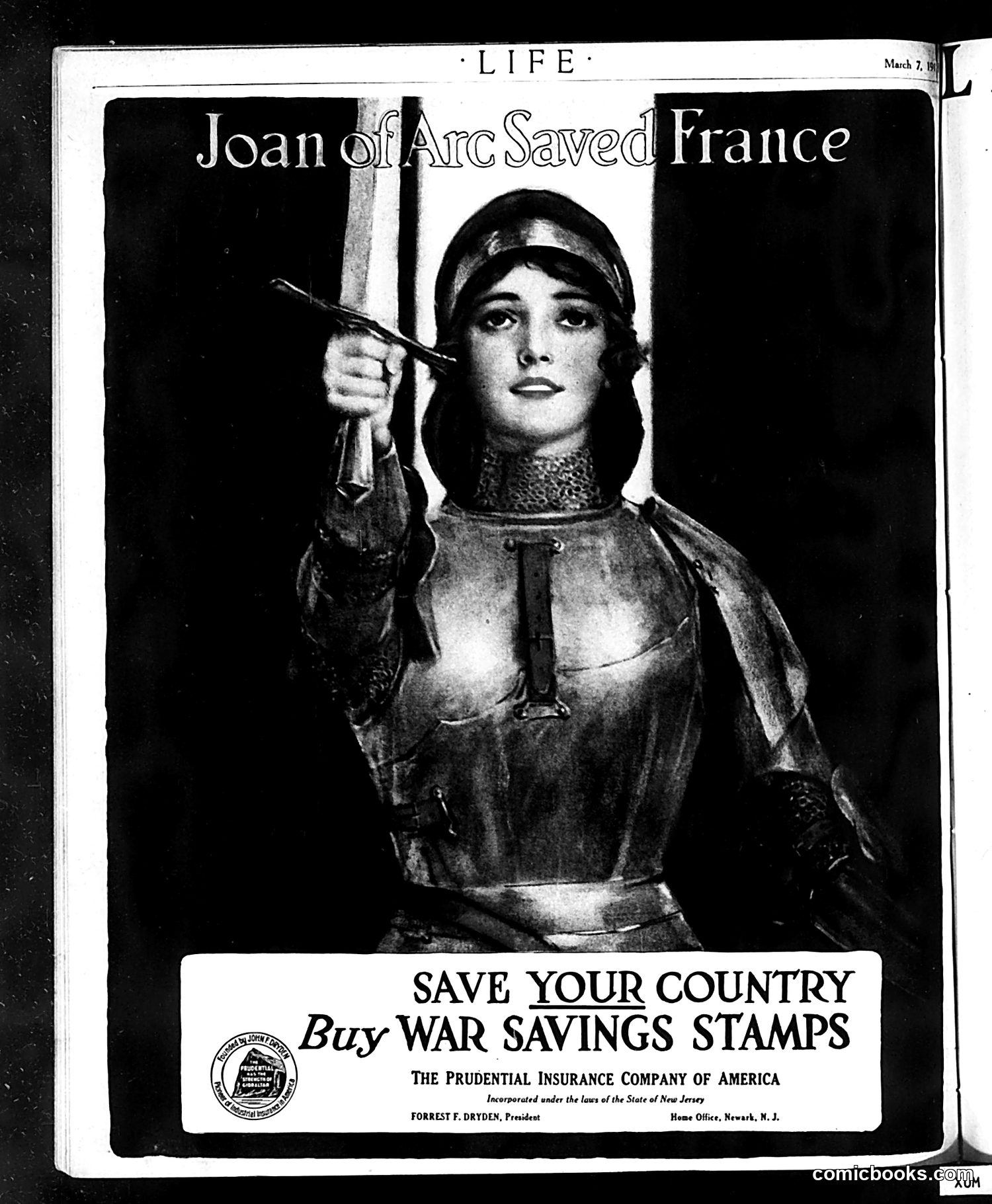
This is a **war bonds advertisement**, not satire. It uses the historical figure of Joan of Arc—the French medieval saint and military leader—as a propaganda image to encourage American war savings during what appears to be **World War I or II** (based on the "Life" magazine's publication period). The advertisement equates buying war savings stamps with Joan of Arc's patriotic sacrifice for France. The armored figure holding a banner symbolizes national defense and heroic duty. The message "Save Your Country / Buy War Savings Stamps" appeals to American patriotism by invoking a legendary symbol of national salvation. Sponsored by the Prudential Insurance Company, this represents typical wartime government-corporate cooperation to finance military efforts through civilian investment.