
Life, 1918-03-07 · page 30 of 40
Life — March 7, 1918 — page 30: what you’re looking at
What you’re looking at
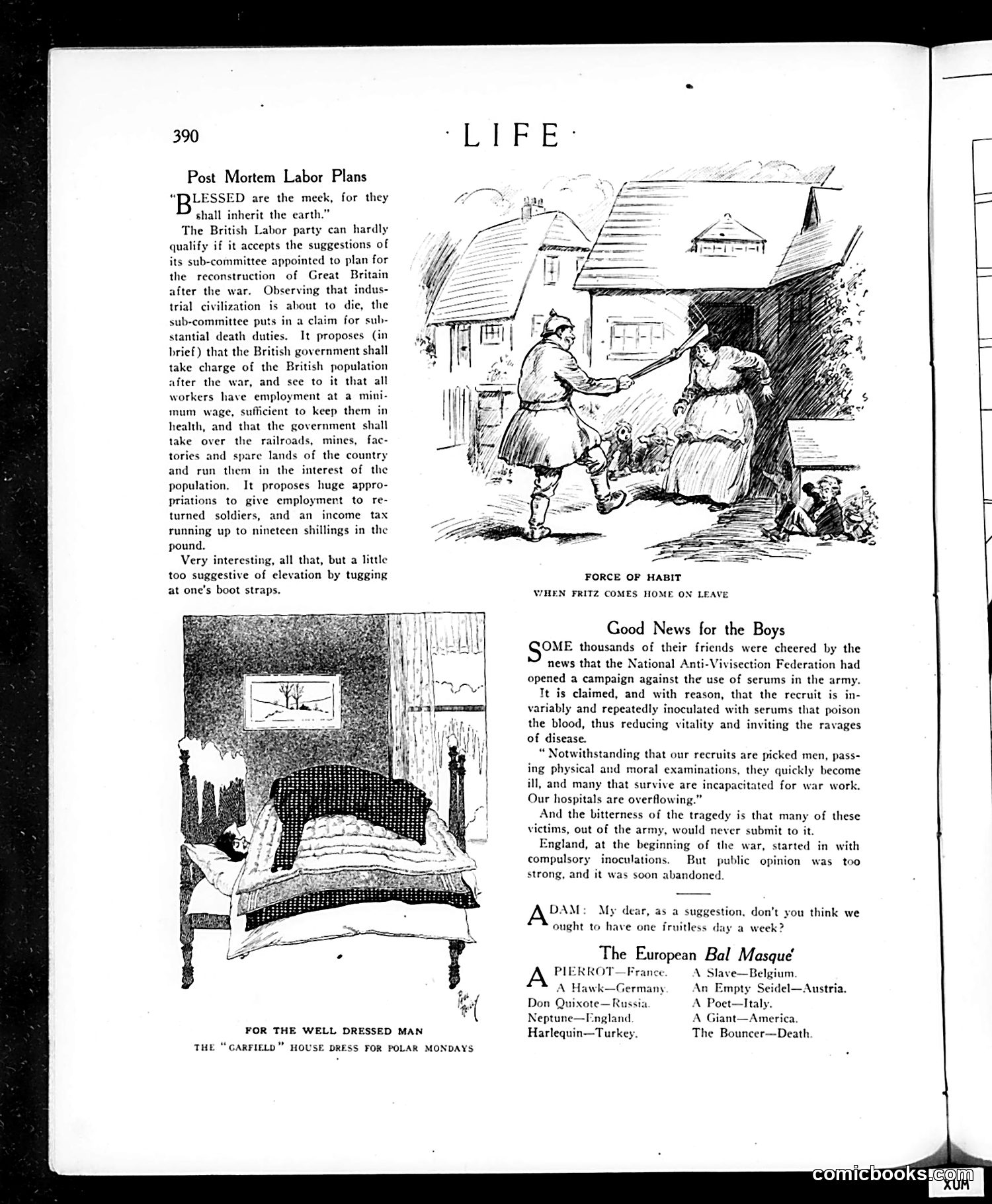
This page contains three distinct satirical pieces: **"Post Mortem Labor Plans"** mocks British Labor Party reconstruction proposals as impractically socialist. The text criticizes their plan for government control of industry, minimum wages, and high income taxes (up to nineteen shillings per pound) as absurdly ambitious—"too suggestive of elevation by tugging at one's boot straps" (a self-improvement metaphor used mockingly). **"Force of Habit"** is a cartoon captioned about "Fritz" (a German soldier on leave). The sketch depicts a German soldier's habitual military posture persisting during civilian life—satirizing how warfare dehumanizes soldiers into rigid automatons. **"Good News for the Boys"** reports the National Anti-Vivisection Federation's campaign against army inoculations, claiming serums weaken recruits and cause illness. It notes England abandoned compulsory inoculation due to public resistance—framing vaccine skepticism as reasonable wartime concern. The European Bal Masqué lists national stereotypes as masked ball characters (Russia as Don Quixote, America as a Giant, Death as "the Bouncer"), typical of period satirical commentary on nations.
📄 Transcribed text from this page (OCR, searchable)
Machine-transcribed from the original scan — historical spelling and the odd misread are preserved.
390 Post Mortem Labor Plans "BrEseeD are the meek, for they shall inherit the earth.” The British Labor party can hardly qualify if it accepts the suggestions of its sub-committee appointed to plan for the reconstruction of Great Britain after the war. Observing that indus- trial civilization is about to die, the sub-committee puts in a claim for sub- stantial death duties. It proposes (in brief) that the British government shall take charge of the British population after the war, and see to it that all workers have employment at a mini- mum wage, sufficient to keep them in health, and that the government shall take over the railroads, mines, fac- tories and spare lands of the country and run them in the interest of the population. It proposes huge appro- priations to give employmert to re- turned soldiers, and an income ta running up to nineteen shillings in the pound. Very interesting, all that, but a little too suggestive of elevation by tugging at one’s boot straps. FORCE OF HABIT WHEN FRITZ COMES HOME ON LEAVE FOR THE WELL DRESSED MAN Harlequin—Turkey. THE “GARFIELD” HOUSE DRESS FOR POLAR MONDAYS Good News for the Boys OME thousands of their friends were cheered by the news that the National Anti-Vivisection Federation had opened a campaign against the use of serums in the army. It is claimed, and with reason, that the recruit is in- variably and repeatedly inoculated with serums that poison the blood, thus reducing vitality and inviting the ravages of disease. “Notwithstanding that our recruits are picked men, pass- ing physical and moral examinations, they quickly become ill, and many that survive are incapacitated for war work. Our hospitals are overflowing.” And the bitterness of the tragedy is that many of these victims, out of the army, would never submit to it. England, at the beginning of the war, started in with compulsory inoculations. But public opinion was too strong, and it was soon abandoned. DAM: My dear, a suggestion, don’t you think we ought to have one fruitless day a week? The European Bal Masque’ PIERKOT—France \ Slave—Belgium. A Hawk—Germany. An Empty Seidel—Austria. Don Quixote—Russia \ Poet—Italy. Neptune—England A Giant—America, The Bouncer—Death T — a Sl