
Life, 1918-03-07 · page 19 of 40
Life — March 7, 1918 — page 19: what you’re looking at
What you’re looking at
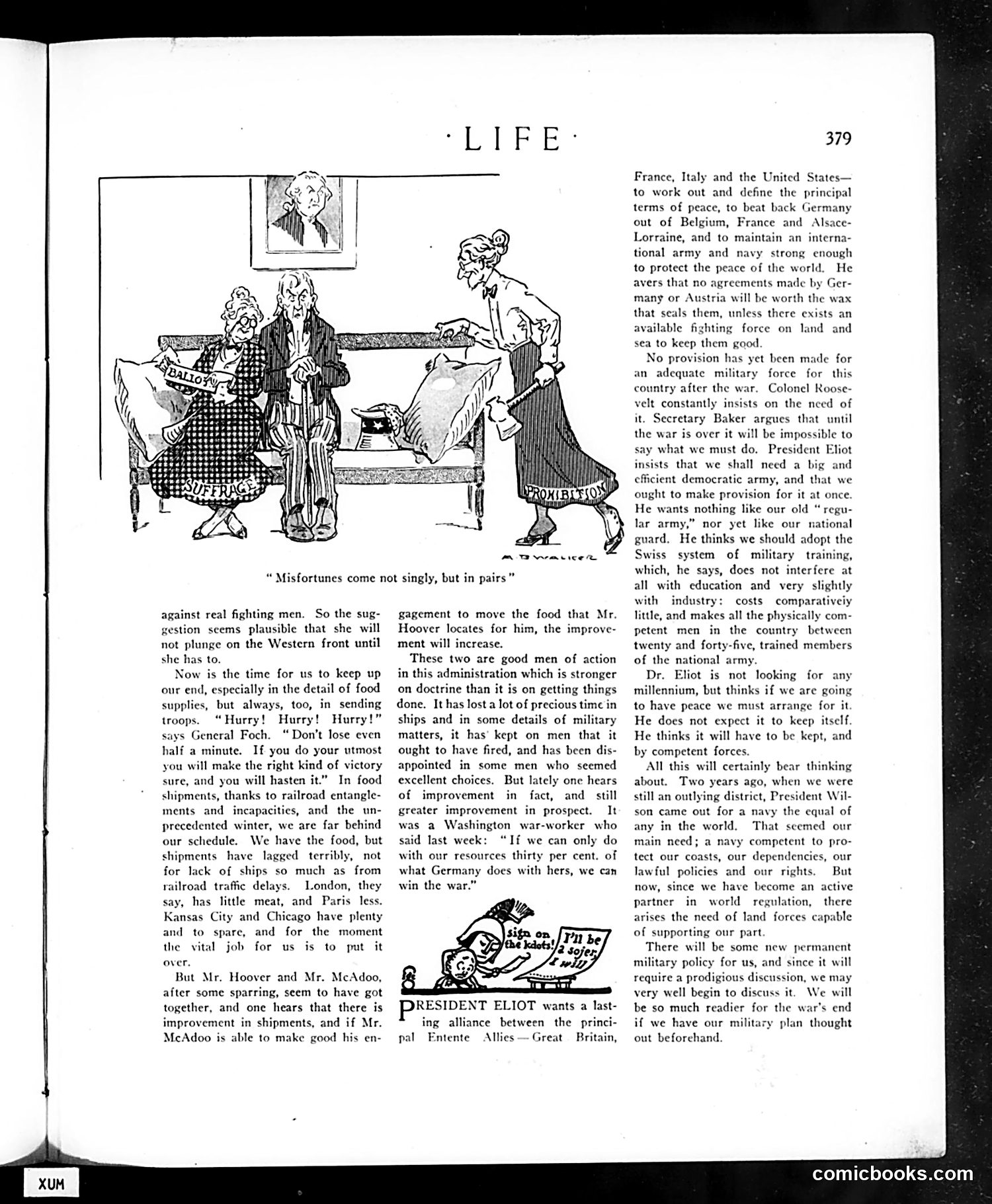
This WWI-era cartoon satirizes food supply failures affecting the Allied war effort. The central figure appears to be a personified representation of American food distribution problems, depicted as a bedraggled character caught between two officials—likely Herbert Hoover (Food Administrator) and William McAdoo (Treasury Secretary/Railroad Director). The cartoon's caption and surrounding text indicate the joke: despite America having adequate food supplies, railroad congestion and administrative dysfunction prevent shipments from reaching Allied nations and troops. London and Paris face meat shortages while Kansas City and Chicago have surplus. The "misfortunes come not singly" caption suggests these paired problems—adequate supply but failed distribution—compound the crisis. The satire targets bureaucratic incompetence rather than resource scarcity, implying that wartime administrators must resolve their jurisdictional conflicts to save the Allied cause.
📄 Transcribed text from this page (OCR, searchable)
Machine-transcribed from the original scan — historical spelling and the odd misread are preserved.
HUIS HN e | “ Misfortunes come not singly, but in pairs” against real fighting men. So the sug- gestion seems plausible that she will not plunge on the Western front until she has to. Now is the time for us to keep up our end, especially in the detail of food ys, too, in sending troops. “Hurry! Hurry! Hurry!” ys General Foch. “Don’t lose even half a minute. If you do your utmost you will make the right kind of victory sure, and you will hasten it.” In food shipments, thanks to railroad entangle- ments and in cities, and the un- precedented winter, we are far behind our schedule. We have the food, but shipments have lagged terribly, not for lack of ships so much as from railroad traffic delays. London, they say, has little meat, and Paris less. Kansas City and Chicago have plenty and to and for the the for us is to over. But Mr. Hoover and Mr. McAdoo, after some sparring, seem to have got together, and one hears that there is improvement in shipments, and if Mr. McAdoo is able to make good his en- supplies, but alw: moment put it spare, vital job gagement to move the food that Mr. Hoover locates for him, the improve- ment will increase. These two are good men of action in this administration which is stronger on doctrine than it is on getting things done. It has lost a lot of precious time in ships and in some details of military matters, it has’ kept on men that it ought to have fired, and has been dis- appointed in some men who seemed excellent choices. But lately one hears of improvement in fact, and_ still greater improvement in prospect. It was a Washington war-worker who said last week: “If we can only do with our resources thirty per cent. of what Germany does with hers, we can win the war.” RESIDENT ELIOT wants a last- ing alliance between the princi- pal Entente Allies —Great Britain, 379 France, Italy and the United States— to work out and define the principa terms of peace, to beat back Germ: out of Belgium, France and Alsac Lorraine, and to maintain an interna tional army and navy strong enough to protect the peace of the world. He avers that no agreements made by Ger- many or Austria will be worth the wax that seals them, unless there exists an available fighting force on land and sea to keep them good. No provision has yet been made for an adequate military force for this country after the war. Colonel Roose- velt constantly insists on the need of it. Secretary Baker argues that until the war is over it will be impossible to y what we must do. President Eliot insists that we shall need a big and efficient democratic army, and that we ought to make provision for it at once. He wants nothing like our old “ regu- lar army,” nor yet like our national guard, He thinks we should adopt the Swiss system of military training, which, he says, does not interfere at all with education and very slightly with industry: costs comparativeiy little, and makes all the physically com- petent men in the country between twenty and forty-five, trained members of the national army. Dr. Eliot is not looking for any millennium, but thinks if we are going to have peace we must arrange for it He does not expect it to keep itself. He thinks it will have to be kept, and by competent forces. All this will certainly bear thinking about. Two years ago, when we were still an outlying district, President Wil- son came out for a navy the equal of any in the world. That scemed our main need; a navy competent to pro- tect our coasts, our dependencies, our lawful policies and our rights. But now, since we have become an active partner in world regulation, there arises the need of land forces capable of supporting our part There will be some new permanent military policy for us, and since it will require a prodigious discussion, we may very well begin to discuss it. We will be so much readier for the war's end if we have our mili plan thought out beforehand. comicbooks.com