
Life, 1918-03-07 · page 38 of 40
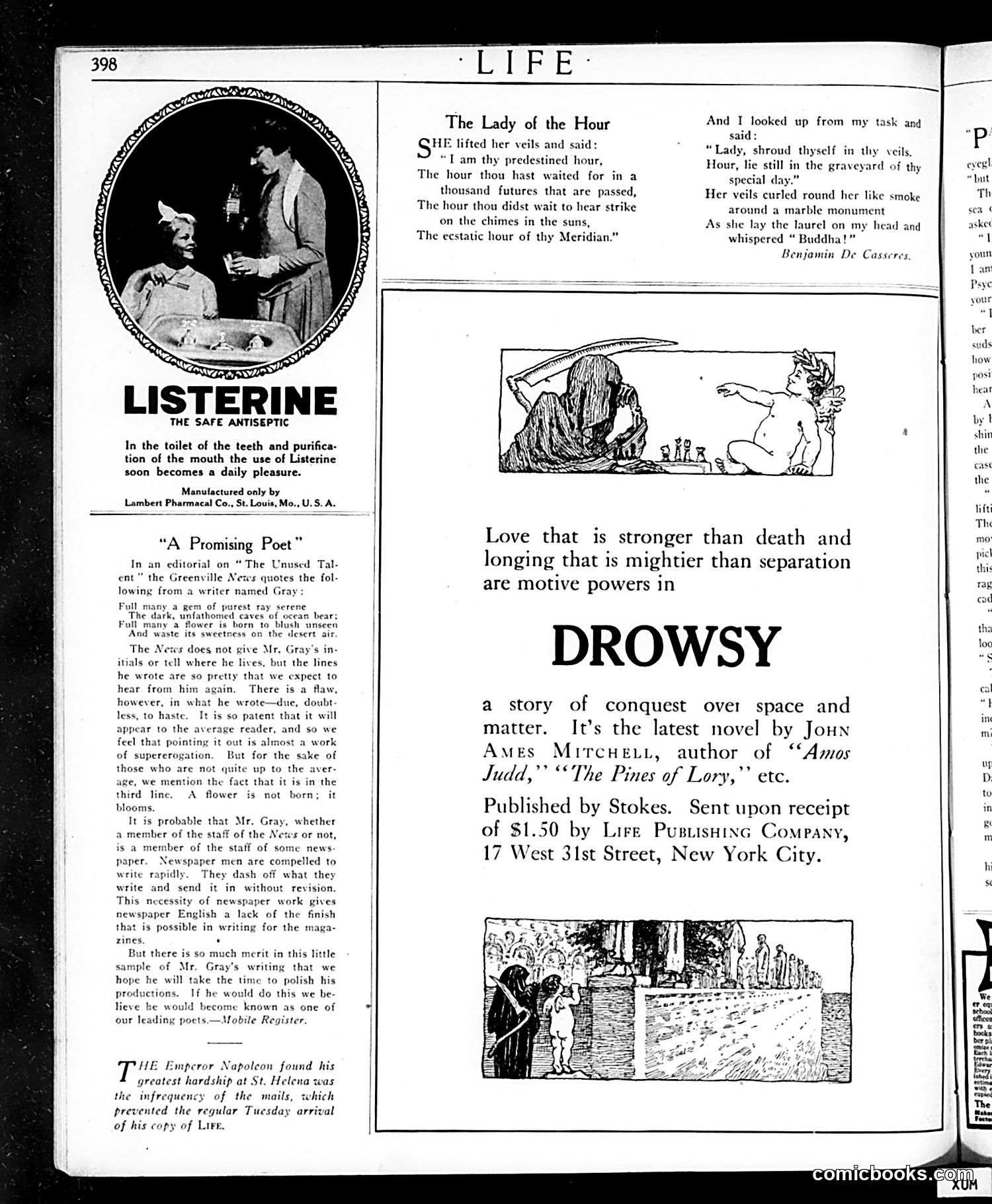
Life — March 7, 1918 — page 38: what you’re looking at
What you’re looking at
This page contains three distinct sections: **Listerine Advertisement**: A period product ad featuring an illustrated couple, promoting antiseptic mouthwash as a daily hygiene habit. **"A Promising Poet" Editorial Satire**: Life mocks a regional newspaper (the Greenville *News*) for praising a poem by "Mr. Gray" while missing an obvious error. The poem misquotes Gray's actual work—"A flower is not born; it blooms"—a technical flaw Life's editors gleefully point out. The satire critiques both the regional paper's carelessness and newspaper journalists' rushed, unpolished work habits. **Napoleon Joke**: A one-liner satirizing Napoleon's exile at St. Helena, suggesting he suffered more from missing his subscription to *Life* magazine than from actual hardship—self-promotional humor about the magazine's importance. The page also features literary content including a poem "The Lady of the Hour" by Benjamin De Casseres and an advertisement for the novel *Drowsy* by John Ames Mitchell. The overall tone reflects *Life*'s role as a satirical magazine targeting media incompetence and cultural pretension.
📄 Transcribed text from this page (OCR, searchable)
Machine-transcribed from the original scan — historical spelling and the odd misread are preserved.
LISTERINE THE SAFE ANTISEPTIC In the toilet of the teeth and purifica- tion of the mouth the use of Listerine soon becomes a daily pleasure. Manulactured only by Lambert Pharmacal Co., St. Louis, Mo., U.S. A. “A Promising Poet” In an editorial on “ The Unused Tal- ent” the Greenville NV quotes the fol- lowing from a writer named Gray: a gem of purest raj K, unfathomed caves of ocean bear; ny a flower born to blush unseen waste its sw ess on the desert air. The News does not give Mr. Gray's in- itials or tell where he lives, but the lines he wrote are so pretty that we expect to hear from him again. There flaw, however, in what he wrote—due, doubt less, to haste. It is so patent that it will appear to the average reader, and so we feel that poi is almost a work of superero; for the sake of those who are not ite up to the aver- we mention the fact that it is in the ird line. A flower is not born; it blooms. It is probable that Mr. Gray, whether a member of the staf of the News or not, is a member of the staff of some news- paper. Newspaper men are compelled to write rapidly. They dash off what they write and send it in without revision. This necessity of newspaper work gives newspaper English a lack of the finish that is possible in writing for the maga- zines. . But there is so much merit in this little sample of Mr. Gray’s writing that we hope he will take the time to polish his productions. If he would do this we be- lieve he would become known as one of our leading poets.—Mobile Register HE Emperor Napoleon found his greatest hardship at St. Helena was the infrequency of the mails, which prevented the regular Tuesday arrival of his copy of Lire. ell BE The Lady of the Hour HE lifted her veils and said: “Tam thy predestined hour, The hour thou hast waited for in a thousand futures that are passed, The hour thou didst wait to hear strike on the chimes in the suns, The ecstatic hour of thy Meridian.” And I looked up from my task and said: “Lady, shroud thyself in thy veils, Hour, lie still in the graveyard of thy special day.” Her veils curled round her like smoke around a marble monument As she lay the laurel on my head and whispered “ Buddha!” Benjamin De Casseres. Love that is stronger than death and longing that is mightier than separation are motive powers in DROWSY a story of conquest over space and matter. It’s the latest novel by Joun Ames Mircueut, author of “Asvos Judd,” “The Pines of Lory,”’ etc. Published by Stokes. Sent upon receipt of $1.50 by Lire PustisHinc Company, 17 West 31st Street, New York City. iP eyes! “but Th sea | asket youn how post heat A by! shin the the We 3 3 FREES pF fi 2 FF F273}