
Life, 1918-03-07 · page 18 of 40
Life — March 7, 1918 — page 18: what you’re looking at
What you’re looking at
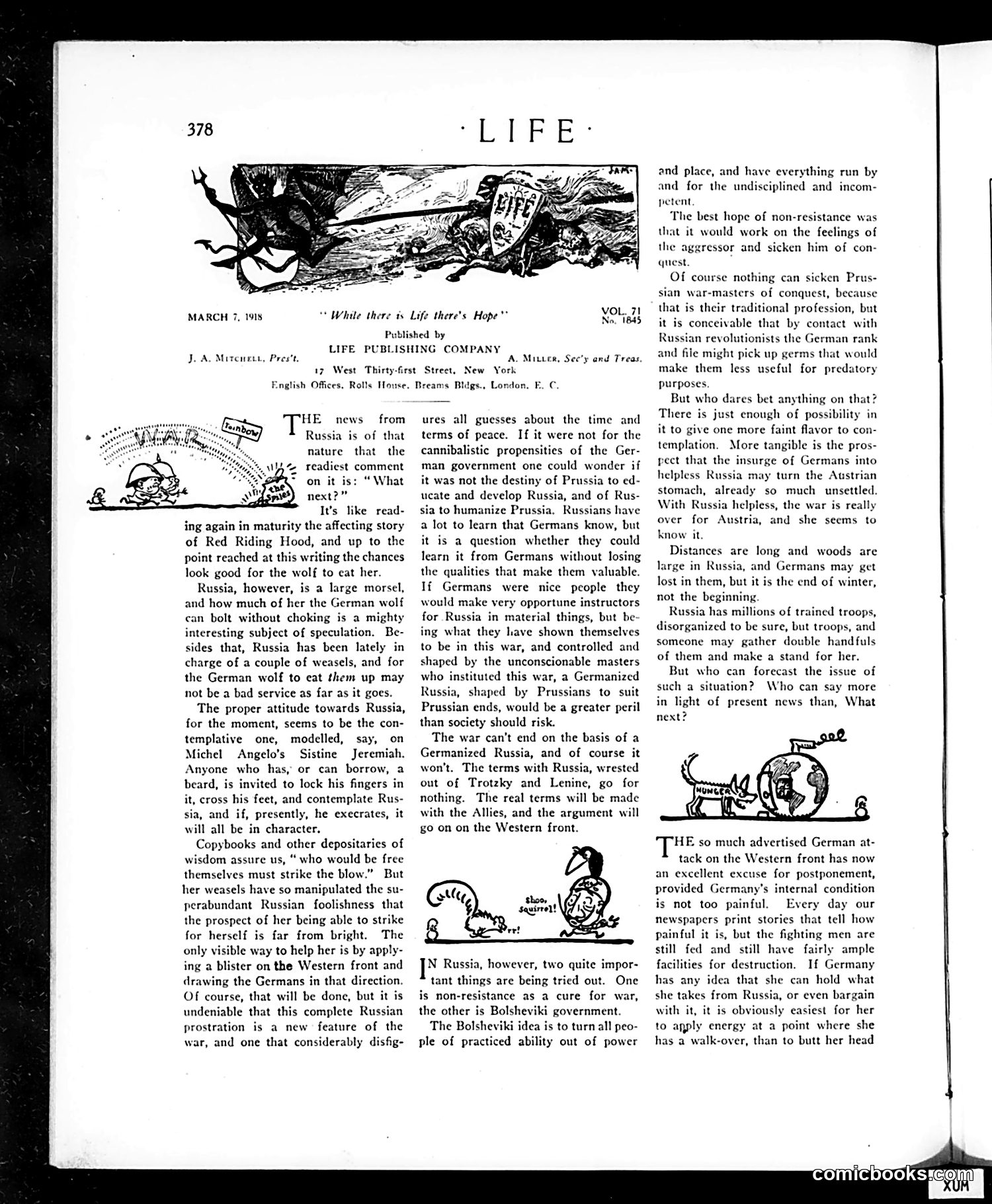
This editorial uses fairy-tale allegory to critique Russia's military collapse during WWI. The "wolf" represents Germany; Russia is "Little Red Riding Hood" being consumed. The "weasels" refer to Russian revolutionaries (Bolsheviks under Lenin and Trotsky), whom the author blames for Russia's prostration through their policy of non-resistance and incompetent governance. The cartoons depict anthropomorphized animals in distress—likely symbolizing the chaos of the Russian Revolution and military defeat. The author argues that while Germany's conquest of Russia seems inevitable, a "Germanized Russia" shaped by Prussian militarism would pose greater postwar danger than Russian defeat itself. He dismisses pacifist non-resistance as naive, believing only German exhaustion on the Western Front can end the war properly. The piece reflects American anxiety about Russia's separate peace negotiations and the ideological threat of Bolshevism, even as Germany advances militarily.
📄 Transcribed text from this page (OCR, searchable)
Machine-transcribed from the original scan — historical spelling and the odd misread are preserved.
MARCH 7, 1918 “* While there ts Life there's Hope** VOL. 7! No, 1845 Published by LIFE PUBLISHING COMPANY J. A. Mutewete, Pres't, A. Miter, Sec’y and Treas. 17 West Thirty-first Street, New York English Offices, Rolls House. Breams Bligs., London. F.C HE from Russia is of that nature that the readiest comment on it is: “ What next?” It's like read- ing again in maturity the affecting story of Red Riding Hood, and up to the point reached at this writing the chances look good for the wolf to cat her. Russia, however, is a large morsel, and how much of her the German wolf can bolt without choking is a mighty interesting subject of speculation. Be- sides that, Russia has been lately in charge of a couple of weasels, and for the German wolf to eat them up may not be a bad service as far as it goes. The proper attitude towards Russia, for the moment, scems to be the con- templative one, modelled, say, on Michel Angelo’s Sistine Jeremiah. Anyone who has, or can borrow, a beard, is ited to lock his fingers in it, cross his feet, and contemplate Rus: sia, and if, presently, he execrates, it will all be in character. Copybooks and other depositaries of wisdom assure us, “ who would be free themselves must strike the blow.” But her weasels have so manipulated the su- perabundant Russian foolishness that the prospect of her being able to strike for herself is far from bright. The only visible way to help her is by apply- ing a blister on the Western front and drawing the Germans in that direction. Of course, that will be done, but it is undeniable that this complete Russian prostration is a new feature of the war, and one that considerably disfig- news ures all guesses about the time and terms of peace. If it were not for the cannibalistic propensities of the Ger- man government one could wonder if it was not the destiny of Prussia to ed- ucate and develop Russia, and of Rus- sia to humanize Prussia. Russians have a lot to learn that Germans know, but it is a question whether they could learn it from Germans without losing the qualities that make them valuable. If Germans were nice people they would make very opportune instructors for Russia in material things, but be- ing what they have shown themselves to be in this war, and controlled and shaped by the unconscionable masters who instituted this war, a Germanized Russia, shaped by Prussians to suit Prussian ends, would be a greater peril than society should risk. The war can’t end on the basis of a Germanized Russia, and of course it won't. The terms with Russia, wrested out of Trotzky and Lenine, go for nothing. The real terms will be made with the Allies, and the argument will go on on the Western front. N Russia, however, two quite impor- tant things are being tried out. One is non-resistance as a cure for war, the other is Bolsheviki government. The Bolsheviki idea is to turn all peo- ple of practiced ability out of power and place, and have everything run by and for the undisciplined and incom- petent The best hope of non-resistance was that it would work on the feelings of the aggressor and sicken him of con- quest. Of course nothing can sicken Prus- sian war-masters of conquest, because that is their traditional profession, but it is conceivable that by contact with Russian revolutionists the German rank and file might pick up germs that would make them less useful for predatory purposes. But who dares bet anything on that? There is just enough of possibility in it to give one more faint flavor to con- templation. More tangible is the pros- pect that the insurge of Germans into helpless Russia may turn the Austrian stomach, already so much unsettled. With Russia helpless, the war is really over for Austria, and she seems to know it. Distances are long and woods are large in Russia, and Germans may get lost in them, but it is the end of winter, not the beginning. Russia has millions of trained troops, disorganized to be sure, but troops, and someone may her double handfuls of them and make a stand for her. But who can forecast the issue of such a situation? Who can say more in light of present news than, What next? 'HE so much advertised German at- tack on the Western front has now an excellent excuse for postponement, provided Germany's internal condition is not too painful. Every day our newspapers print stories that tell how painful it is, but the fighting men are still fed and still have fairly ample facilities for destruction. If Germany has any idea that she can hold what she takes from Russia, or even bargain with it, it is obviously easiest for her to apply energy at a point where she has a walk-over, than to butt her head