
Life, 1918-03-07 · page 12 of 40
Life — March 7, 1918 — page 12: what you’re looking at
What you’re looking at
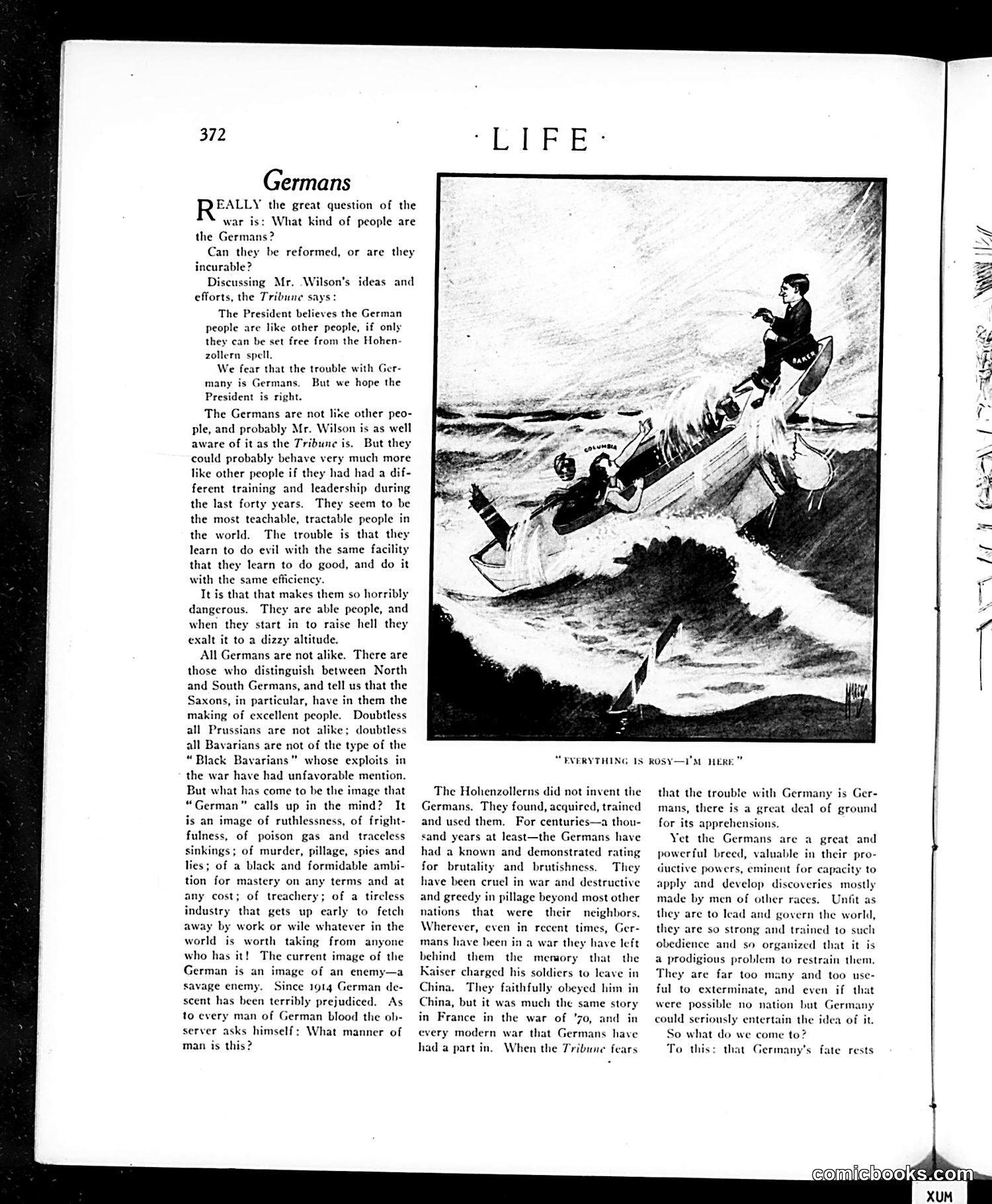
This page discusses President Wilson's views on German character and reformability following World War I. The accompanying cartoon depicts people sledding downhill with the caption "Everything is rosy—I'm here," illustrating the article's central argument: Germans are highly capable people who learn skills—whether good or evil—with equal efficiency and dedication. The text argues that Germans are not inherently evil but dangerously efficient. The problem, the author suggests, is that German discipline and obedience, trained over forty years, made them excellent at executing destructive orders. The article distinguishes between different German populations (Saxons, Bavarians, Prussians) while warning that Germany's future depends on restraining their formidable power and organizational abilities.
📄 Transcribed text from this page (OCR, searchable)
Machine-transcribed from the original scan — historical spelling and the odd misread are preserved.
Germans ALLY the great question of the war is: What kind of people are the Germans? Can they be reformed, or are they incurable? Discussing Mr. Wilson's ideas and efforts, the Tribune says: The President believes the German people are like other people, if only they can be set free from the Hohen- zollern spell. We fear that the trouble with Ger- many is Germans, But we hope the President is right. The Germans are not lixe other peo- ple, and probably Mr. Wilson is as well aware of it as the Tribune is. But they could probably behave very much more like other people if they had had a dif- ferent training and leadership during the last forty years. They seem to be the most teachable, tractable people in the world. The trouble is that they learn to do evil with the same facility that they learn to do good, and do it with the same efficiency. It is that that makes them so horribly dangerous. They are able people, and when they start in to raise hell they exalt it to a dizzy altitude. All Germans are not alike. There are those who distinguish between North and South Germans, and tell us that the Saxons, in particular, have in them the making of excellent people. Doubtless all Prussians are not alike; doubtless all Bavarians are not of the type of the “Black Bayarians” whose exploits in the war have had unfavorable mention. But what has come to be the image that “German” calls up in the mind? It is an image of ruthlessness, of fright- fulness, of poison gas and traceless sinkings; of murder, pillage, spies and lies; of a black and formidable ambi- tion for mastery on any terms and at any cost; of treachery; of a tircless industry that gets up early to fetch away by work or wile whatever in the world is worth taking from anyone who has it! The current image of the German is an image of an enemy—a savage enemy. Since 1914 German de- scent has been terribly prejudiced. As to every man of German blood the ob- server asks himself: What manner of man is this? “EVERYTHING IS ROSY—I'M HERE” The Hohenzollerns did not invent the Germans. They found, acquired, trained and used them. For centuries—a thou- sand years at least—the Germans have had a known and demonstrated rating for brutality and brutishness. They have been cruel in war and destructive and greedy in pillage beyond most other nations that were their neighbors, Wherever, even in recent times, Ger- mans have been in a war they have left behind them the memory that the Kaiser charged his soldiers to leave in ina. They faithfully obeyed him in China, but it was much the same story in France in the war of '70, and in every modern war that Germans have had a part in. When the Tribune fears that the trouble with Germany is Ger- mans, there is a great deal of ground for its apprehensions. Yet the Germans are a great and powerful breed, valuable in their pro- ductive powers, eminent for capacity to apply and develop discoveries mostly made by men of other races. Unfit as they are to lead and govern the world, they are so strong and trained to such obedience and so organized that it is a prodigious problem to restrain them, They are far too many and too use- ful to exterminate, and even if that were possible no nation but Germany could seriously entertain the idea of it. So what do we come to? To this: that Germany’s fate rests gy