
Life, 1918-03-07 · page 22 of 40
Life — March 7, 1918 — page 22: what you’re looking at
What you’re looking at
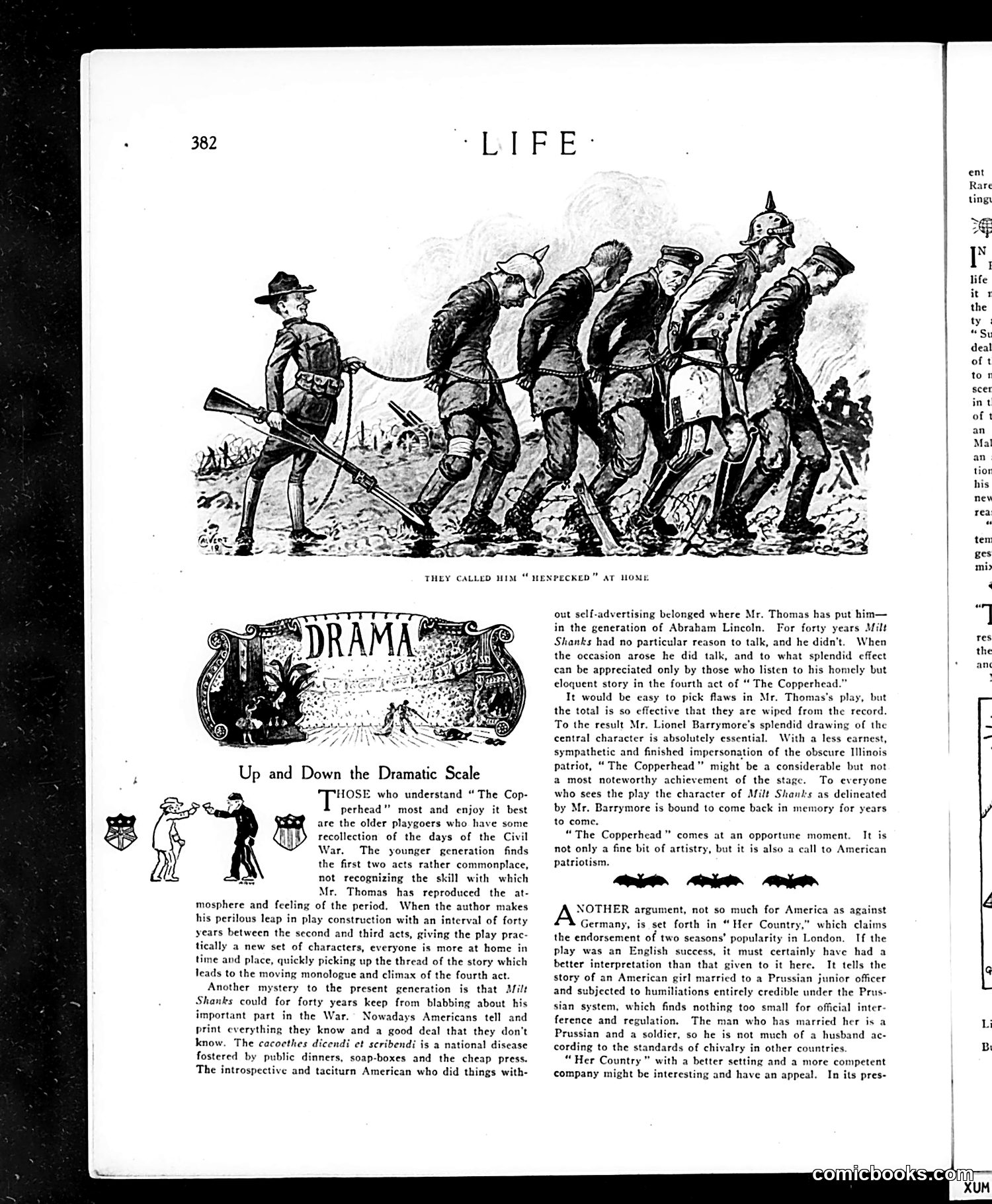
This page reviews two theatrical productions. The main illustration depicts a Civil War-era scene captioned "They Called Him 'Henpecked' at Home," accompanying a review of the play *The Copperhead*. The text praises *The Copperhead*, starring Lionel Barrymore, as a drama about an obscure Illinois patriot named Milt Shanks who kept silent about his wartime service for forty years. The reviewer contrasts this old-fashioned discretion with modern American culture's compulsive gossiping and self-promotion—what the text calls a "national disease." Below this, a second review dismisses *Her Country*, a play about an American woman married to a Prussian officer who suffers under the rigid Prussian system. The reviewer suggests the London production was superior and that this American staging lacks proper direction and casting. Both reviews use theatrical criticism to comment on American character and values—patriotism, discretion, and freedom—implicitly contrasting American ideals with German militarism during the World War I era.
📄 Transcribed text from this page (OCR, searchable)
Machine-transcribed from the original scan — historical spelling and the odd misread are preserved.
Up and Down the Dramatic Scale HOSE who understand “ The Cop- perhead"” most and enjoy it best are the older playgoers who have some recollection of the days of the Civil War. The younger generation finds the first two acts rather commonplace, not recognizing the skill with which Mr. Thomas has reproduced the at- mosphere and feeling of the period. When the author makes his perilous leap in play construction with an interval of forty years between the second and third acts, giving the play prac- tically a new set of characters, everyone is more at home in time and place, quickly picking up the thread of the story which leads to the moving monologue and climax of the fourth act. Another mystery to the present generation is that Afilt Shanks could for forty years keep from blabbing about his important part in the War. Nowadays Americans tell and print everything they know and a good deal that they don't know. The cacoethes dicendi et scribendi is a national disease fostered by public dinners, soap-boxes and the cheap press. The introspective and taciturn American who did things with- out self-advertising belonged where Mr. Thomas has put him— in the generation of Abraham Lincoln. For forty years Milt Shanks had no particular reason to talk, and he didn't. When the occasion arose he did talk, and to what splendid effect can be appreciated only by those who listen to his homely but eloquent story in the fourth act of “ The Copperhead. It would be easy to pick flaws in Mr. Thomas's play, but the total is so effective that they are wiped from the record. To the result Mr. Lionel Barrymore's splendid drawing of the central character is absolutely essential. With a less earnest sympathetic and finished impersonation of the obscure Illinois patriot, “The Copperhead” might be a considerable but not & most noteworthy achievement of the st To everyone who sees the play the character of Milt Shanks as delineated by Mr. Barrymore is bound to come back in memory for years to come. “The Copperhead comes at an opportune moment. It is not only a fine bit of artistry, but it is also a call to American Patriotism. Sel Ange Onigiy OTHER argument, not so much for America as against Germany, is set forth in “Her Country,” which claims the endorsement of two seasons’ popularity in London. If the play was an English success, it must certainly have had a better interpretation than that given to it here. It tells the story of an American girl married to a Prussian junior officer and subjected to humiliations entirely credible under the Prus- sian system, which finds nothing too small for official inter- ference and regulation. The man who has married her is a Prussian and a soldier, so he is not much of a husband ac- cording to the standards of chivalry in other countries. “Her Country” with a better setting and a more competent company might be interesting and have an appeal. In its pres- ent Rare ting. % the an