
Life, 1918-03-07 · page 10 of 40
Life — March 7, 1918 — page 10: what you’re looking at
What you’re looking at
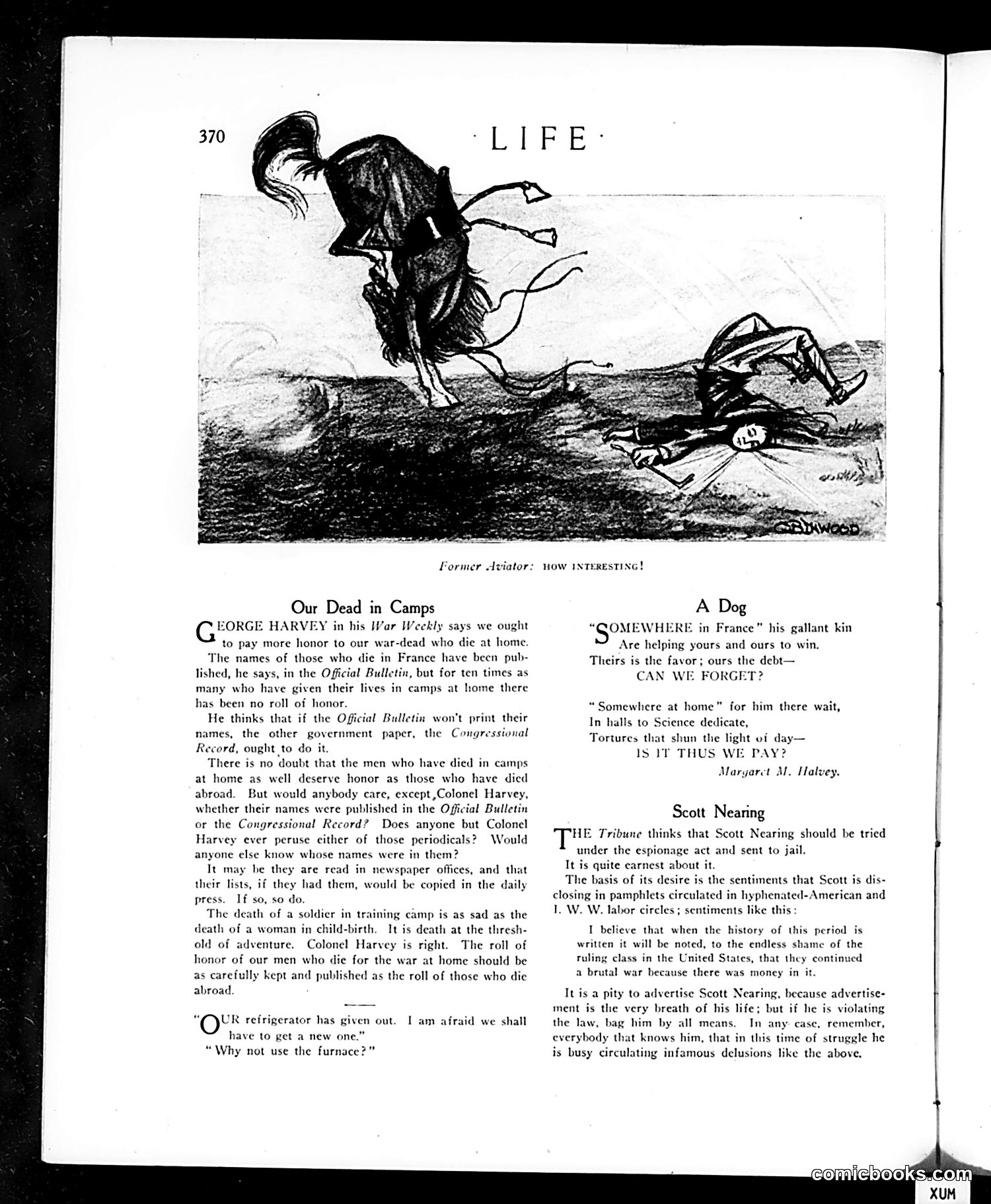
This page contains three separate pieces of political commentary from World War I era America: 1. **"Former Aviator: How Interesting!"** (top cartoon): Shows a disabled or dead soldier visited by a well-dressed civilian, likely satirizing the contrast between those who fought and those at home unaffected by war. 2. **"Our Dead in Camps"** (left): George Harvey critiques the government for failing to honor soldiers who died in training camps at home with the same recognition given to war dead abroad. He argues their names should be published alongside fallen soldiers' names. 3. **"A Dog"** and **"Scott Nearing"** (right): These pieces discuss whether a dog helping the war effort deserves more honor than American citizens allegedly engaged in anti-war activism, reflecting wartime tensions over patriotism and dissent. The overall theme emphasizes tensions between military sacrifice and civilian life during WWI.
📄 Transcribed text from this page (OCR, searchable)
Machine-transcribed from the original scan — historical spelling and the odd misread are preserved.
Our Dead in Camps EORGE HARV. in his War Weekl: to pay more honor to our war-dead who die at home. The names of those who die in France have been pub- lished, he says, in the Official Bulletin, but for ten times as many who have given their lives in camps at home there s we ought has been no roll of honor. He thinks that if the Official Bulletin won't print their names, the other government paper, the Congressional Record, ought to do it. There is no doubt that the men who have died in camps at home as well deserve honor as those who have died abroad. But would anybody care, except Colonel Harvey, whether their names were published in the Official Bulletin or the Congressional Record? Does anyone but Colonel Harvey ever peruse cither of those periodicals? Would anyone else know whose names were in them? It may he they are read in newspaper offices, and that their lists, if they had them, would be copied in the daily If so, so do. ath of a soldier in training camp is as sad as the death of a woman in child-birth. It is death at the thresh- old of adventure. Colonel Harvey is right. The roll of honor of our men who die for the war at home should be as carefully kept and published as the roll of those who dic press. The ¢ abroad. UR refrigerator has given out. I am afraid we shall have to get a new one.” “Why not use the furnace?” MOW INTERESTING! Former Aviator: A Dog “QOMEWHERE in France” his gallant kin Are helping yours and ours to win. Theirs is the or; ours the debt— 2 FORGET? W “Somewhere at home” for him there wait, In halls to Science dedicate, Tortures that shun the light of day— IS JT THUS WE PAY? Maryarct M. Halvey. Scott Nearing HE Tribune thinks that Scott Nearing should be tried under the espionage act and sent to jail. It is quite carnest about it. The basis of its desire is the sentiments that Scott is dis- closing in pamphlets circulated in hyphenated-American and I. W. W. labor circles; sentiments like this: I believe that when the history of this period is written it will be noted, to the endless shame of the ruling class in the United States, that they continued a brutal war because there was money in it. It is a pity to advertise Scott Nearing, because advertise- ment is the very breath of his life; but if he is violating the law, bag him by all means. In any: case, remember, everybody that knows him, that in this time of struggle he is busy circulating infamous delusions like the above.