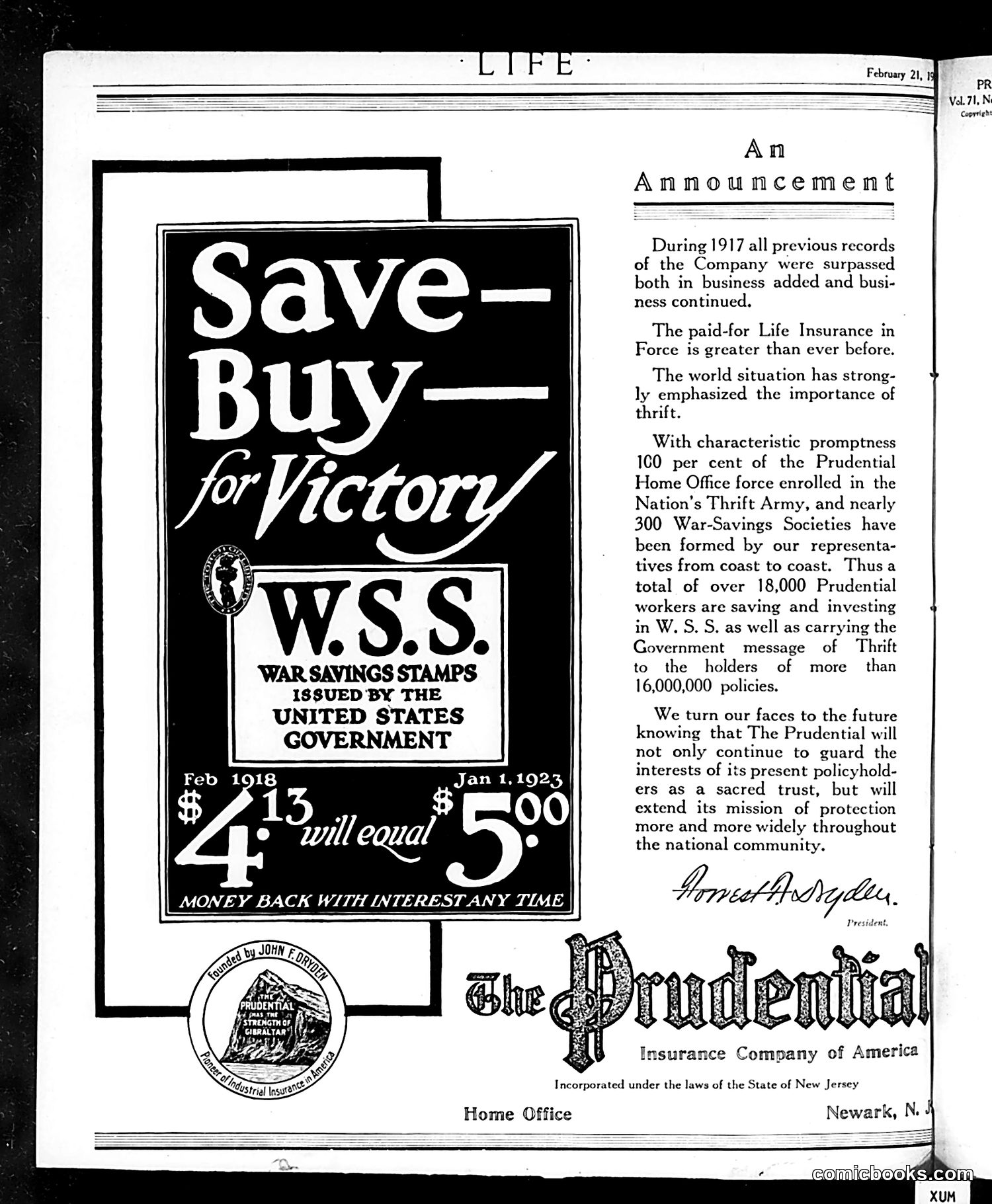
A complete issue · 40 pages · 1918
Life — February 21, 1918
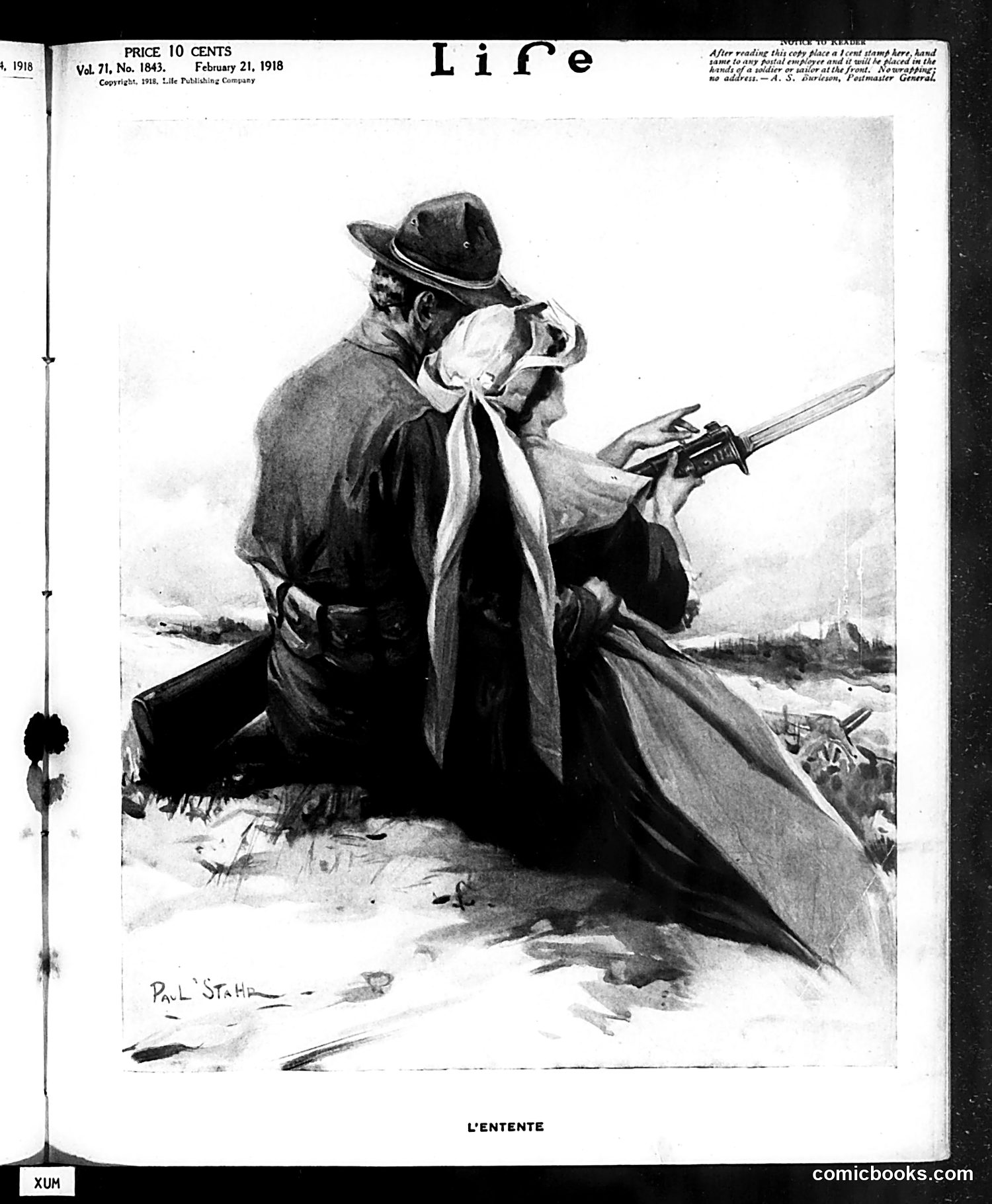
This Paul Stahr cartoon depicts an armed soldier in a long military coat and hat, holding a rifle with bayonet fixed. The figure appears to be a personification of American or Allied military forces during World War I. The title "L'Entente" references the Allied partnership (the Entente), particularly between America, Britain, and France, who were united against Germany in WWI. The soldier's dramatic pose—standing resolute in a snowy, desolate landscape with what appears to be military fortifications in the distance—suggests themes of determination, sacrifice, and the harsh realities of trench warfare. The cartoon likely celebrates Allied military commitment and resolve during the war effort, which was a dominant theme in American propaganda and media during 1918.
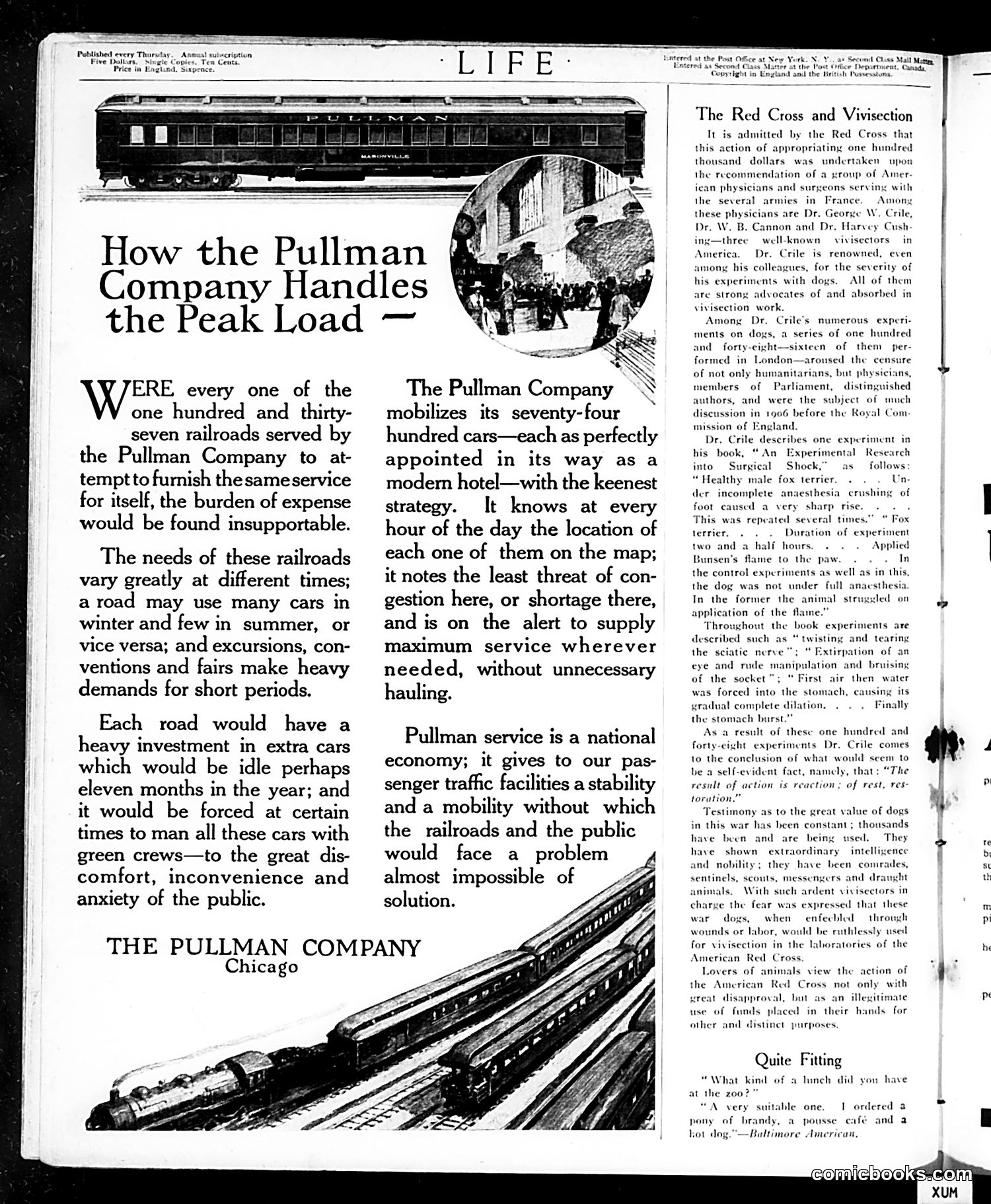
This page is primarily a **corporate advertisement** for the Pullman Company, which manufactured and operated luxury railroad sleeping cars. It's not political satire. The ad explains how Pullman manages the "peak load" problem: different railroads need varying numbers of cars seasonally (many in winter, few in summer). Rather than each railroad owning idle cars, Pullman centralizes ownership of 7,400 cars across 74 railroads, deploying them efficiently wherever demand peaks occur. The accompanying images show a Pullman sleeper car and a streamlined locomotive, emphasizing modern service and technology. The right column contains unrelated editorial content about Red Cross vivisection experiments—a separate article, not part of the advertisement.
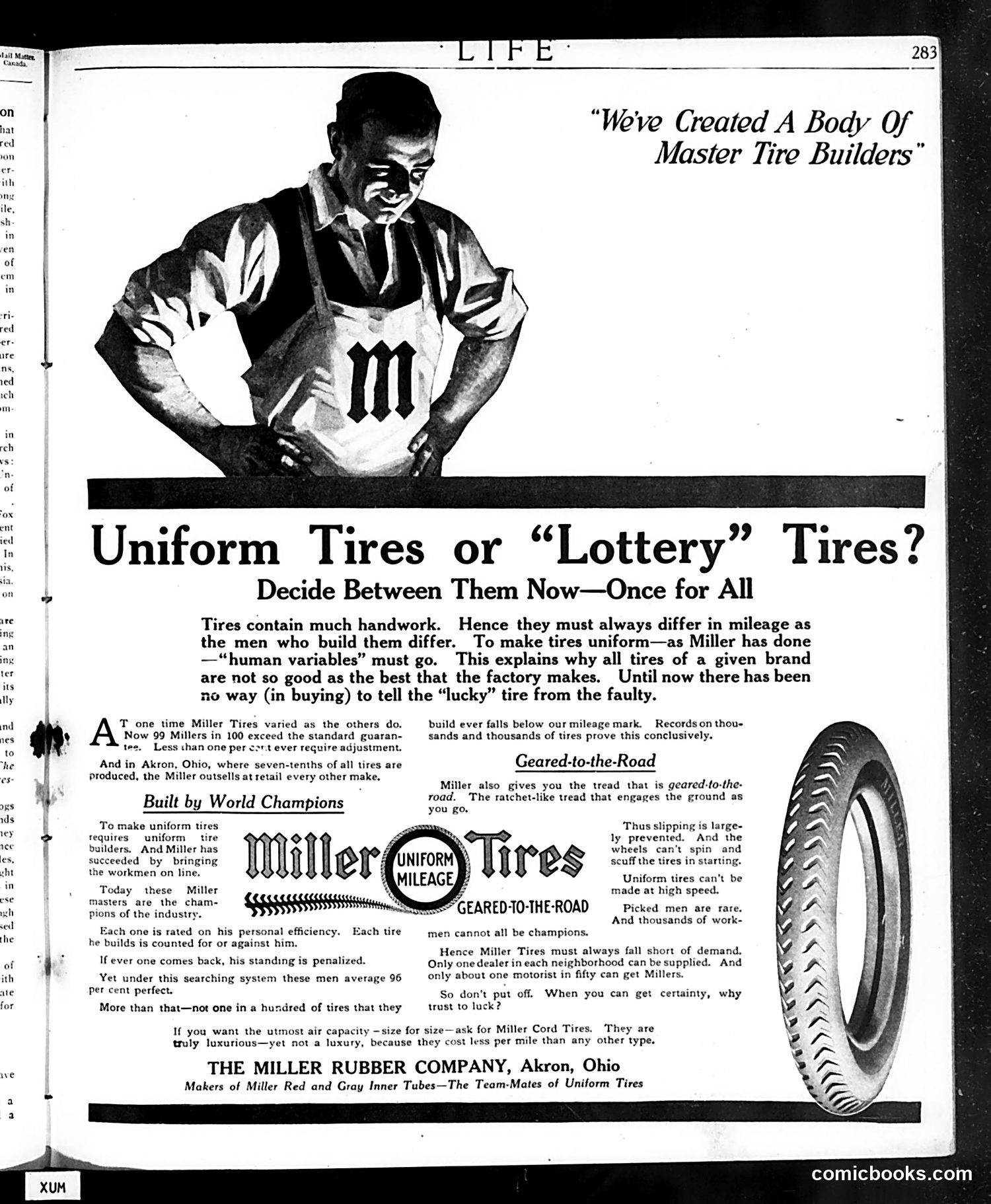
This page is primarily a **Miller Rubber Company advertisement**, not satire. It appears in Life magazine (page 283) and uses a rhetorical device rather than political cartooning. The ad features a craftsman wearing an apron marked "M" and poses a question: should consumers buy uniform or "lottery" tires? The premise argues that Miller has solved the tire-manufacturing problem by standardizing quality—all tires built by individual workers vary in quality, making purchasing a gamble. The ad's "satire" is commercial rather than political: it mocks competitors' practices of variable quality control. The text emphasizes Miller's system rates workers by efficiency, ensuring consistent products. This is early 20th-century industrial marketing using comparative messaging—positioning Miller tires as the rational, scientific choice versus inferior competitors' "lottery."
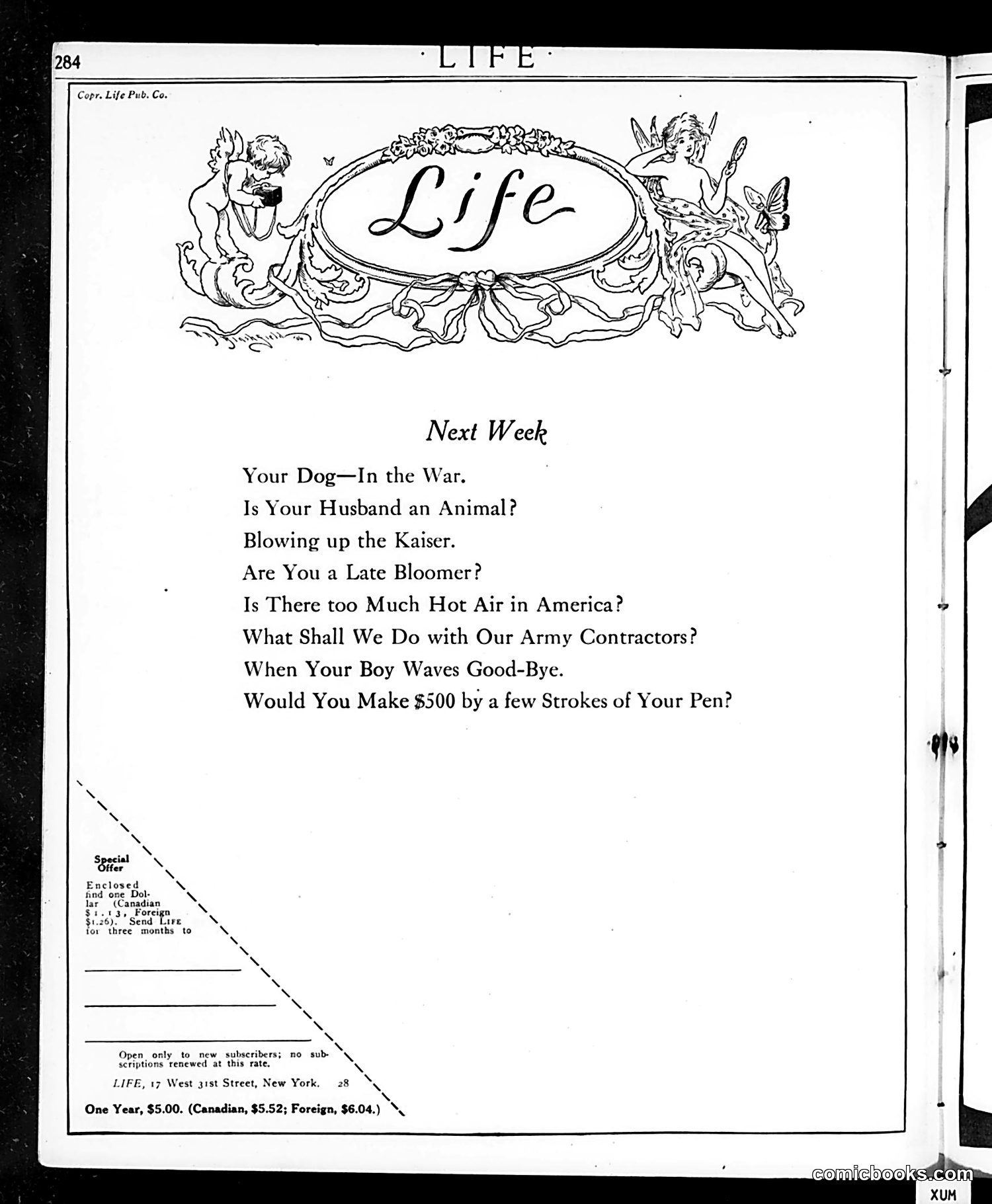
This appears to be a table of contents or advertisement page for *Life* magazine, featuring the publication's masthead with decorative cherub illustrations. The "Next Week" section lists upcoming article topics that reflect World War I-era concerns: - Military themes ("Your Dog—In the War," "Blowing up the Kaiser") - Social commentary ("Is Your Husband an Animal?" "Are You a Late Bloomer?") - Domestic/economic issues ("Is There too Much Hot Air in America?" "Army Contractors") - Emotional wartime content ("When Your Boy Waves Good-Bye") The final item, "Would You Make $500 by a few Strokes of Your Pen?" appears to be a financial opportunity advertisement. The satirical tone suggests *Life* mixed serious wartime critique with humorous social observation. Subscription information and pricing are listed at bottom.
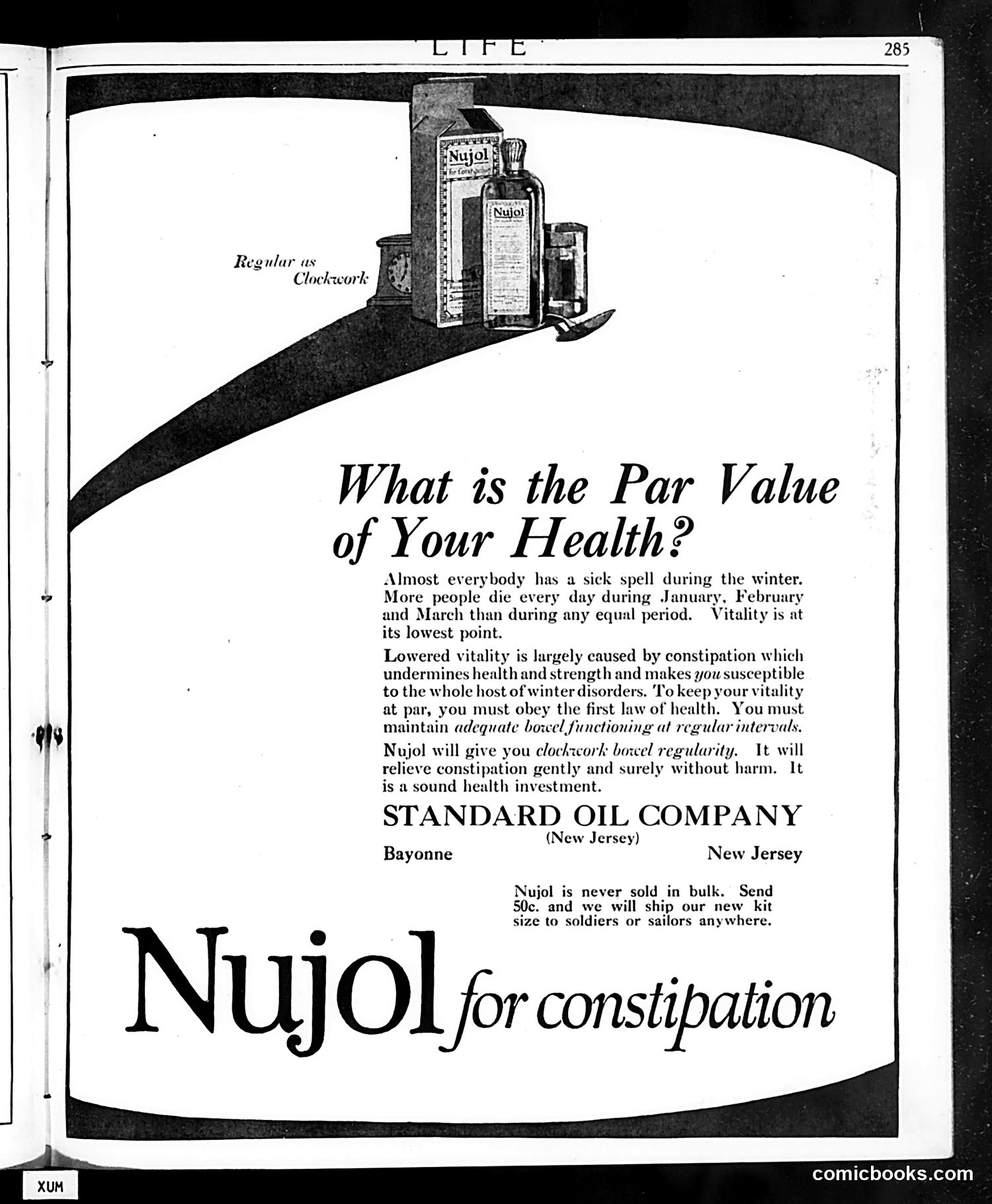
This is **not a political cartoon or satire**—it's a straightforward advertisement for Nujol, a laxative product made by Standard Oil Company (New Jersey). The ad uses health messaging common to early 20th-century patent medicine marketing. It claims constipation causes "lowered vitality" and winter illness, positioning Nujol as a "sound health investment" that provides "clockwork bowel regularity." The visual shows product bottles arranged on an upturned hand, emphasizing the product's reliability. A special note mentions a "kit size" for soldiers or sailors, suggesting this ad ran during or after wartime when such products were distributed to military personnel. This represents typical vintage advertising rhetoric blending medical pseudoscience with consumerism—practices now heavily regulated.
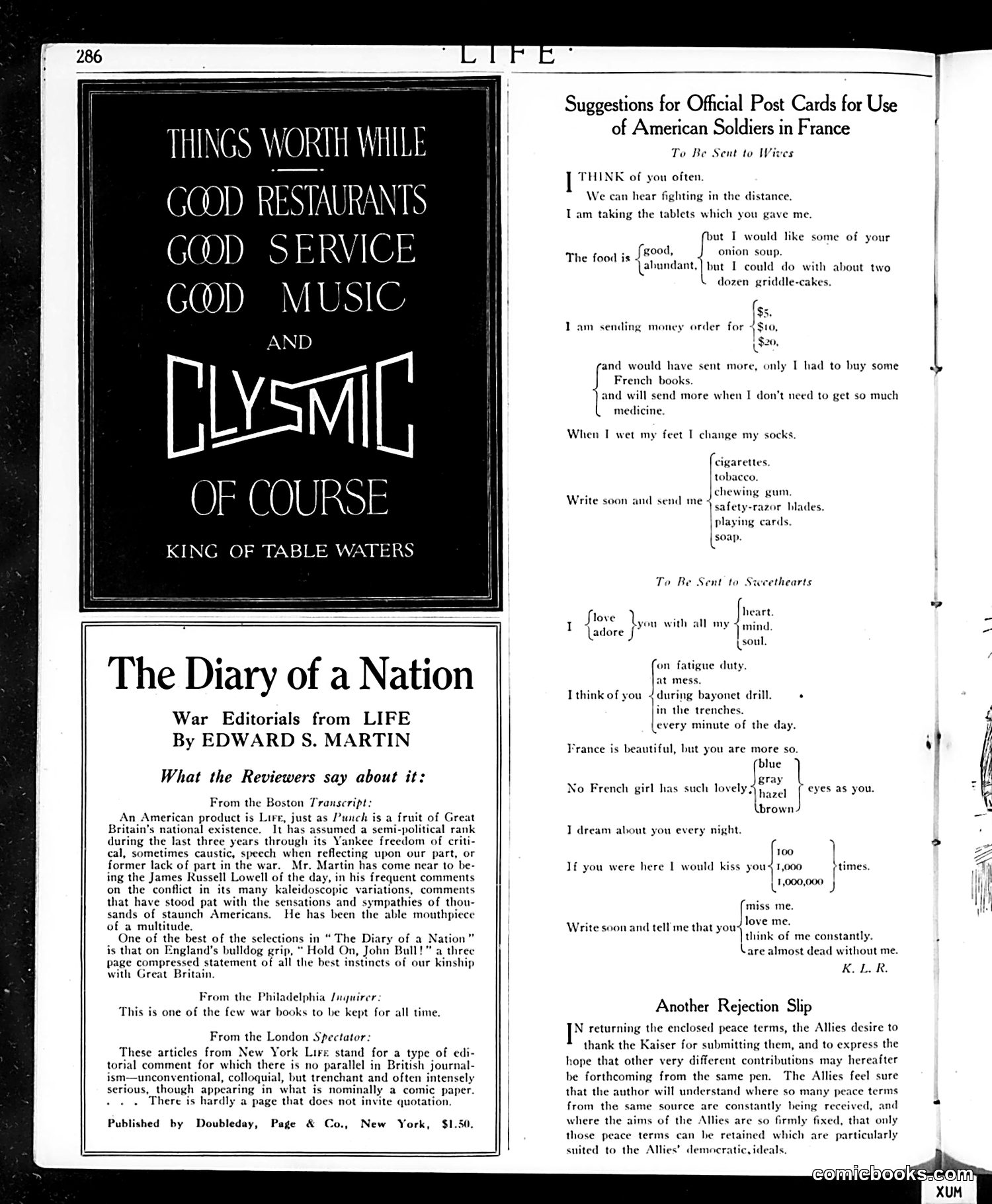
This page contains three distinct elements: an advertisement for "Plysmic" (a product associated with dining/restaurants), a book review for Edward S. Martin's "The Diary of a Nation" (war editorials from Life magazine), and suggestions for official postcards American soldiers in France could send home. The postcard suggestions humorously capture soldier perspectives—requests for food, money, tobacco, and romantic sentiments to sweethearts. The satire lies in contrasting the soldiers' mundane desires (onion soup, griddle-cakes) and homesickness with the gravity of WWI combat they're enduring ("fighting in the distance," "trenches"). The page satirizes the disconnect between wartime reality and soldiers' everyday longings, reflecting WWI-era American attitudes toward the military experience.
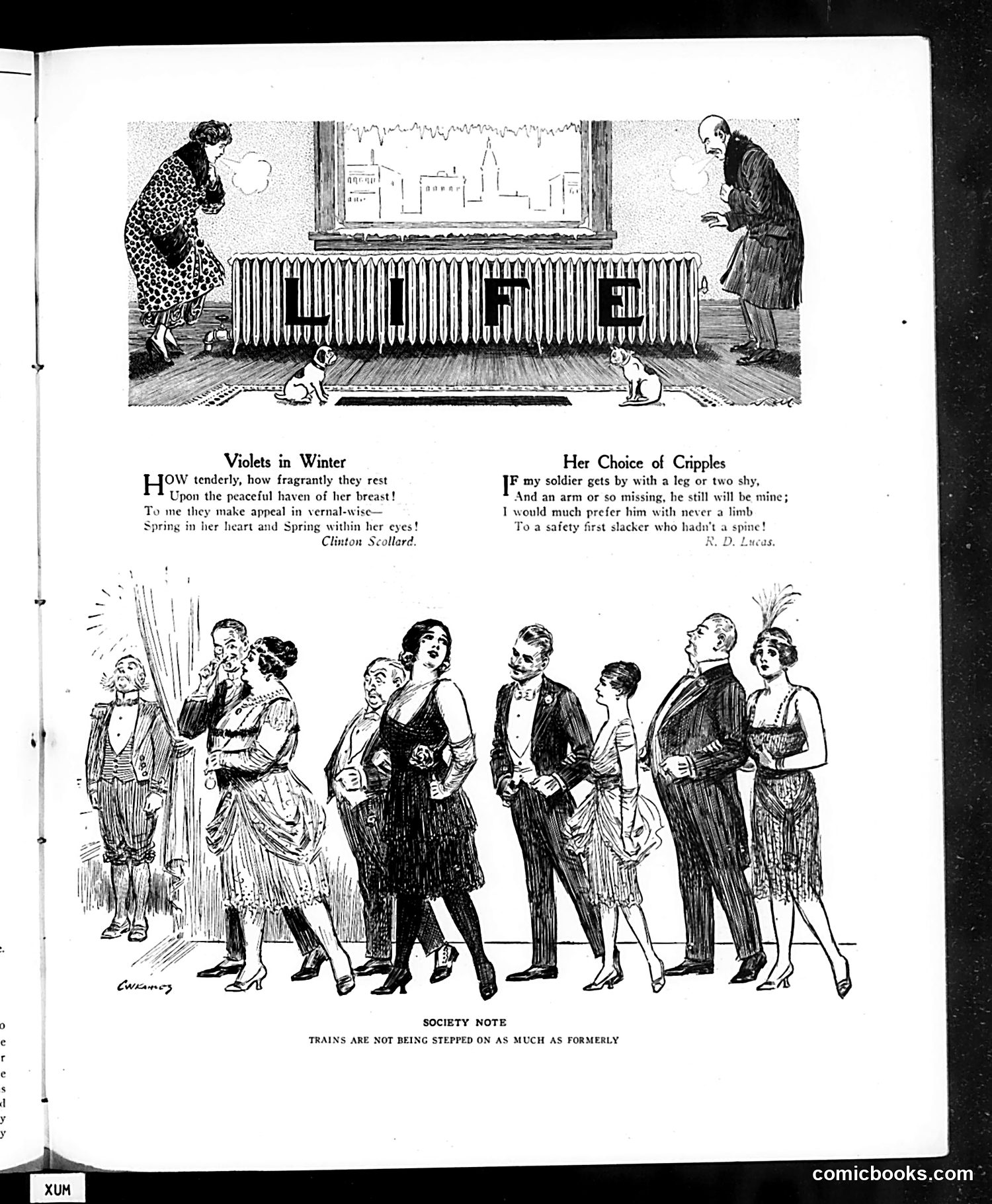
This page contains three distinct pieces of satirical content: **Top illustration**: Shows a couple flanking a radiator labeled "LIFE" with a cityscape visible through a window and two dogs below. The meaning is unclear without additional context. **Two poems**: "Violets in Winter" (attributed to Clinton Scollard) and "Her Choice of Cripples" (attributed to R.D. Lucas) are sentimental/dark verses about romantic preference, likely satirizing popular poetry of the era. **Bottom cartoon** ("Society Note"): Depicts fashionably dressed men and women in formal attire at what appears to be a social gathering. The caption reads: "TRAINS ARE NOT BEING STEPPED ON AS MUCH AS FORMERLY." This social satire likely mocks upper-class behavior and changing fashions—possibly referring to women's hemlines rising (shorter trains on dresses), making the act of "stepping on trains" literally less common.
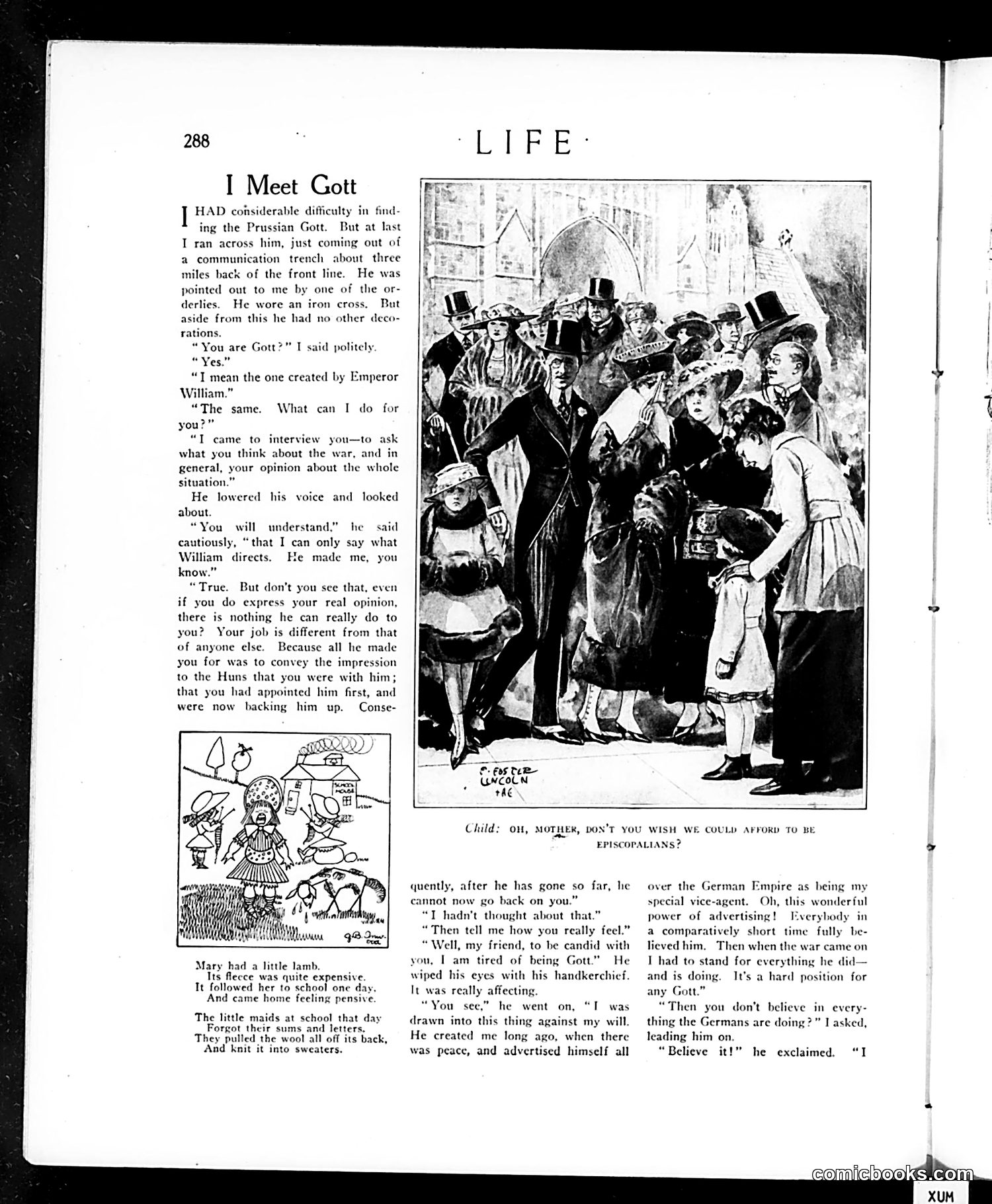
This page satirizes German nationalism and Kaiser Wilhelm II's claims of divine authority. The narrator interviews "Gott" (God)—identified as "the one created by Emperor William"—mocking Wilhelm's infamous statement that God was on Germany's side during WWI. The large illustration shows a crowd of well-dressed German civilians and military figures gathered around this "Prussian Gott," depicted as a figure in formal dress. The accompanying poem "Mary had a little lamb" appears to be satirical commentary on German propaganda. The text's central joke: if you've appointed God yourself for propaganda purposes, you cannot claim his objective support. The satire critiques how Wilhelm weaponized religious authority to justify German aggression and win public backing for the war.
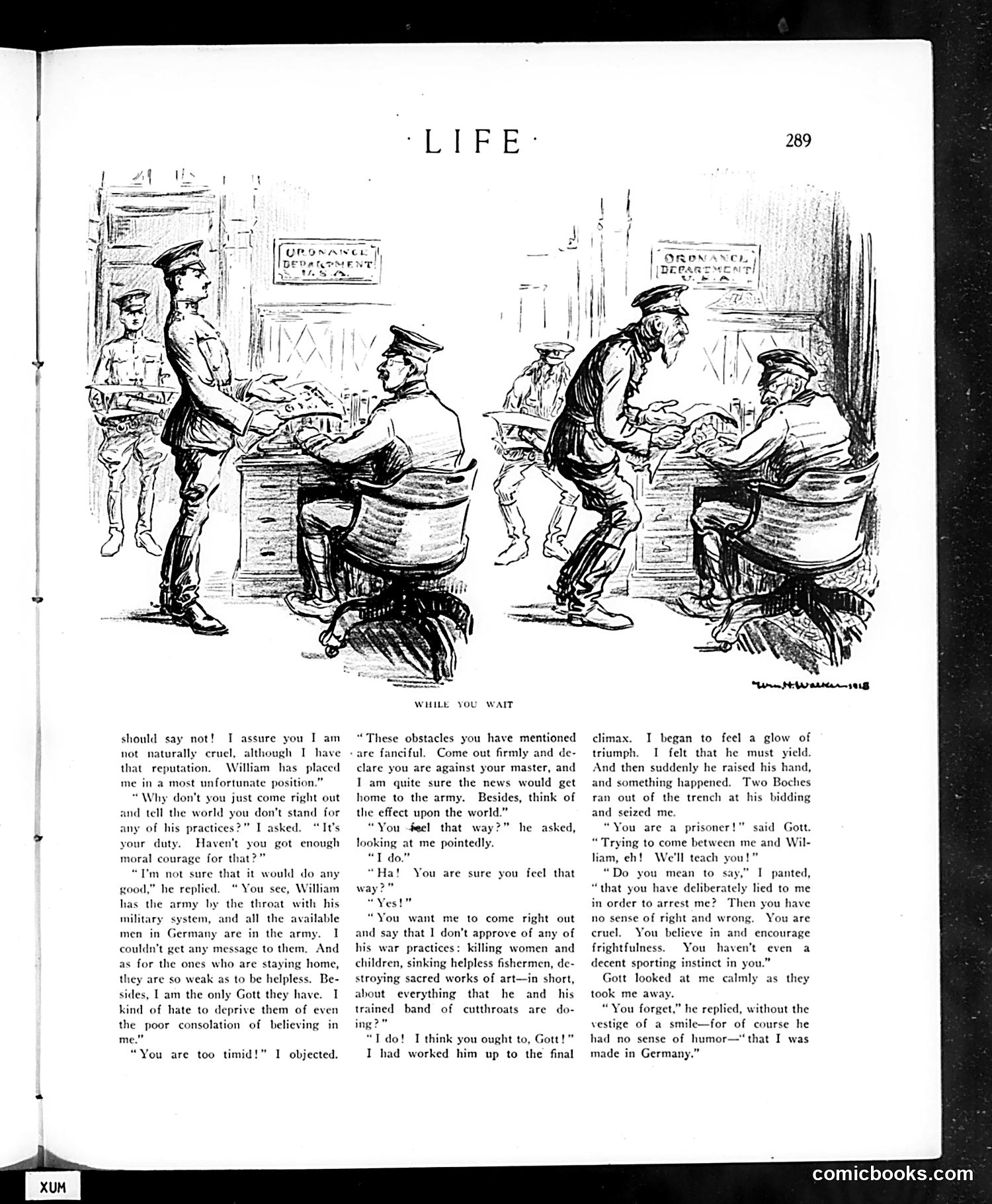
This two-panel cartoon satirizes military bureaucracy during World War I. Both panels depict soldiers at an "Ordnance Department" desk, where an officer processes requests while other soldiers wait. The joke contrasts the soldiers' urgent needs with the slow, indifferent pace of military administration. The title "While You Wait" is ironic—the soldiers are clearly waiting extensively for basic supplies or paperwork. The accompanying text dialogue suggests tension between a soldier (possibly named Gott or William) and an officer about military practices. The conversation touches on German military conduct and moral questions about warfare, reflecting broader WWI-era debates about military ethics and the competence of command structures. The cartoon mocks the gap between frontline soldiers' needs and bureaucratic inefficiency.
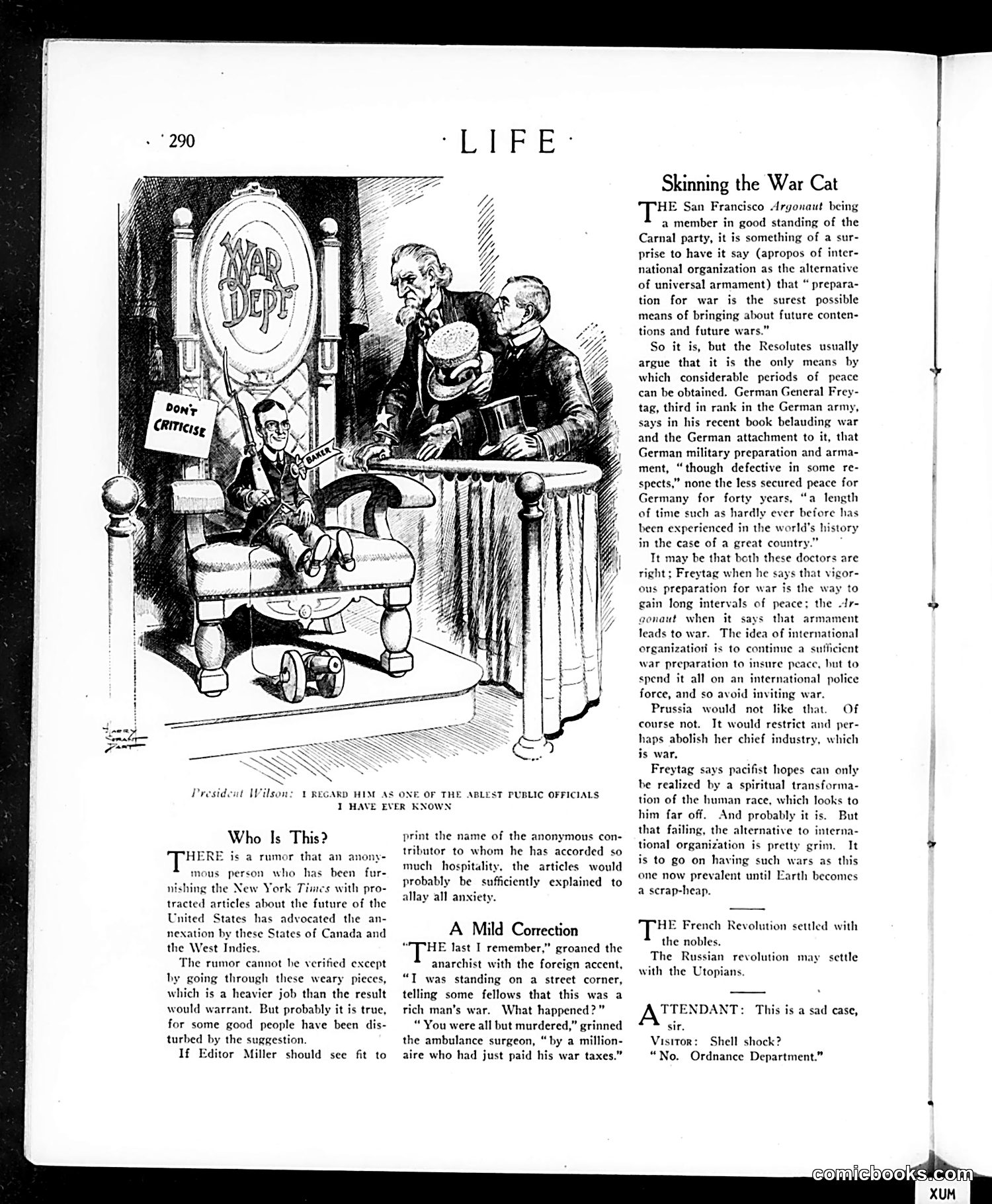
This cartoon satirizes President Wilson (identified in the caption) as a naive figure being manipulated by militarists. The image shows Wilson at a table with what appear to be military or political figures examining a machine labeled "War Dept." The caption "Don't Criticize" suggests suppression of dissent. The article discusses whether military preparation actually prevents war. It references General Freytag's argument that German armament secured peace for forty years, while questioning whether such preparation truly deters conflict or merely enables it. The satire targets Wilson's stated pacifism against pressure from warmongers ("skinning the war cat" = exploiting war ambitions). This reflects pre-WWI American debate over neutrality, preparedness, and whether arming encourages rather than prevents warfare.
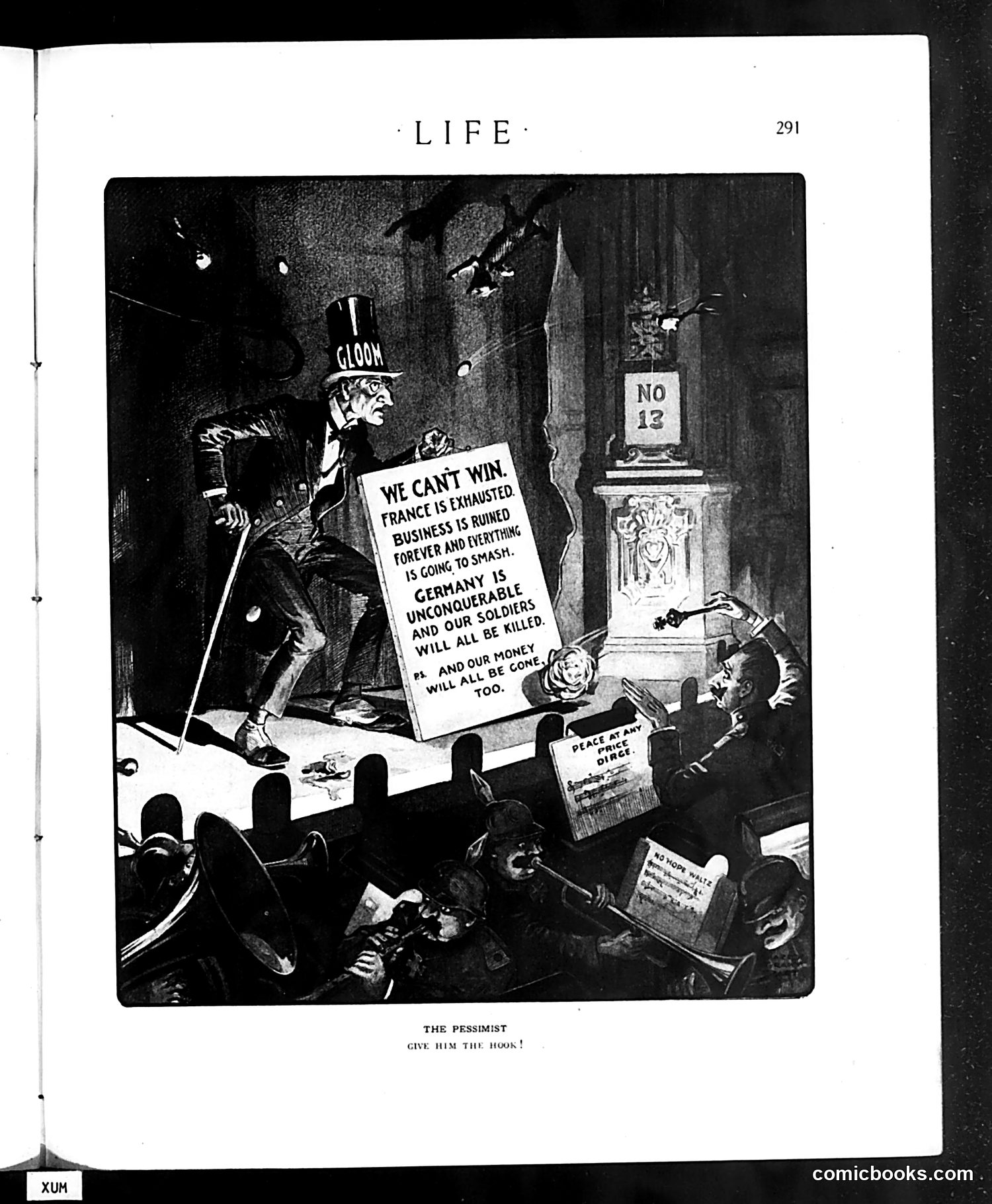
This World War I-era political cartoon satirizes defeatist sentiment during the conflict. A gaunt figure labeled "Gloom" stands on a stage holding a placard expressing extreme pessimism about France's prospects: the country is "exhausted," business ruined, soldiers will be killed, money will vanish. Below the stage, figures with theatrical hooks attempt to remove this "Pessimist" character—literally trying to give him "the hook" (vaudeville slang for removing a poor performer). The cartoon mocks those spreading defeatist talk during wartime, treating such negativity as unwanted entertainment that should be forcibly removed. It's propaganda encouraging optimism and discouraging public expressions of doubt about Allied victory.
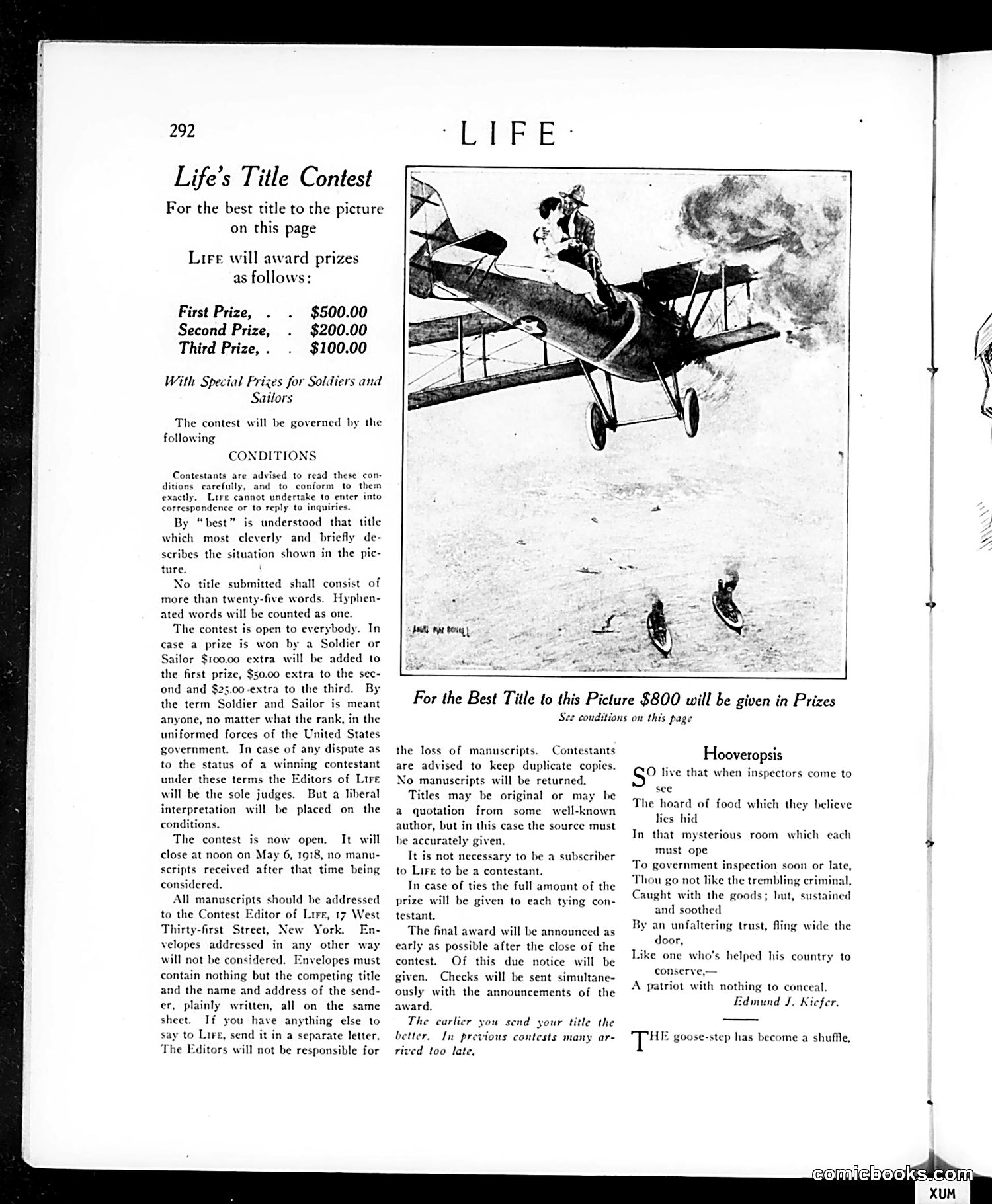
This page announces a **title-writing contest** for a picture of an airplane performing aerobatic maneuvers while two figures below appear to be reacting with alarm or surprise. The image shows dramatic action—a plane banking sharply with smoke trailing. The contest offers $500, $200, and $100 prizes for the best brief titles (max 25 words). Notably, there are **special bonus prizes for soldiers and sailors**, reflecting this is from the WWI era when military service was significant. Below the contest are unrelated satirical poems mocking inspectors and officials. The contest itself appears designed to engage readers in humorous creative writing about the chaotic aviation scene depicted.
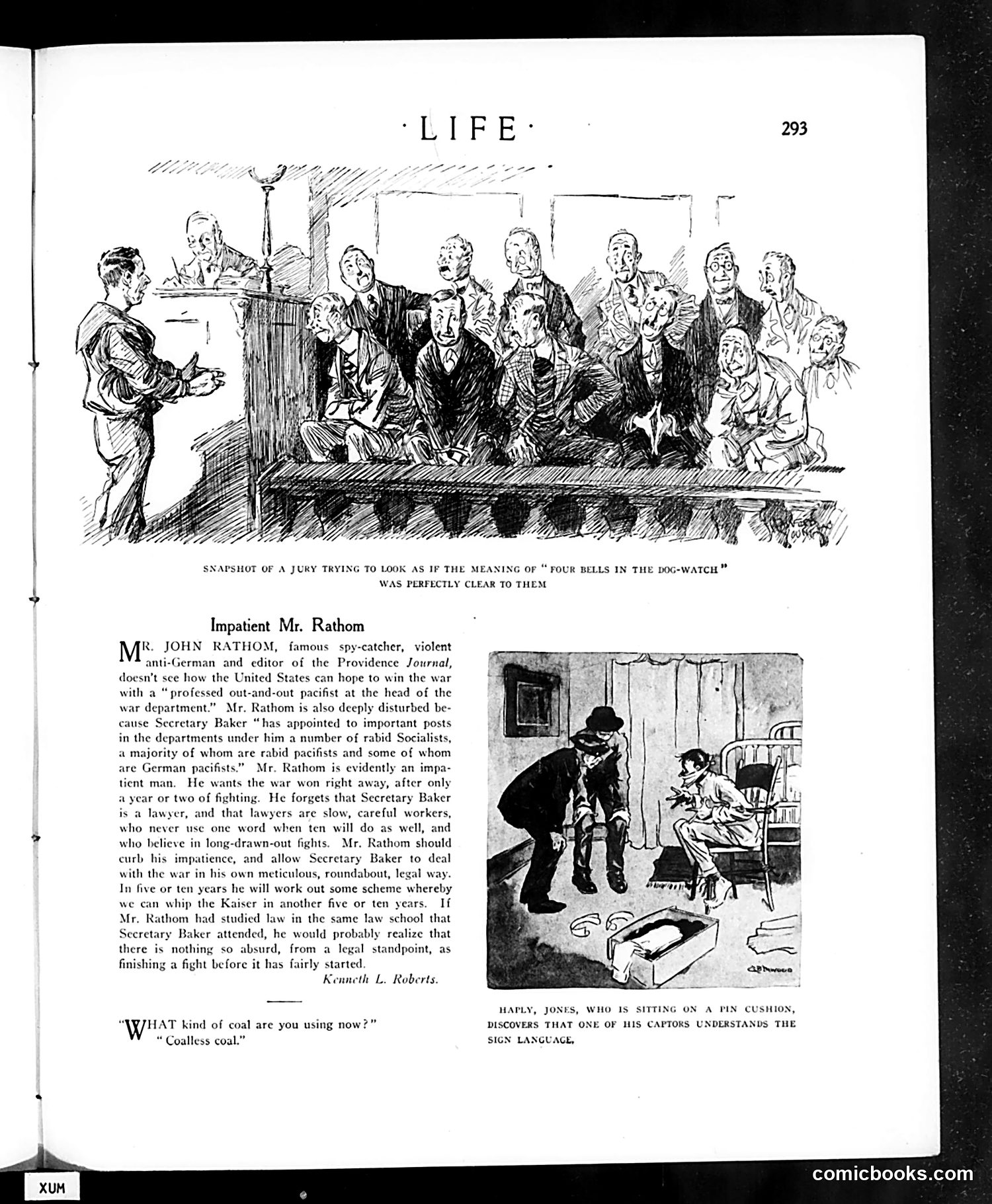
**Top Cartoon:** Shows a jury looking completely bewildered during what appears to be a legal proceeding. The caption mocks their confusion about the phrase "four bells in the dog-watch"—a nautical term they cannot comprehend. This satirizes the disconnect between specialized vocabulary and ordinary jurors' understanding, suggesting juries are often lost during technical testimony. **Article: "Impatient Mr. Rathom"** criticizes John Rathom, editor of the Providence Journal and a "spy-catcher," for his impatient, violent approach to war policy. The piece argues he should allow Secretary Baker to handle war matters through proper legal channels rather than pushing for quick, reckless action. **Bottom Cartoon:** Depicts a humorous domestic scene where a child sitting on a pin cushion has accidentally taught his captions sign language.
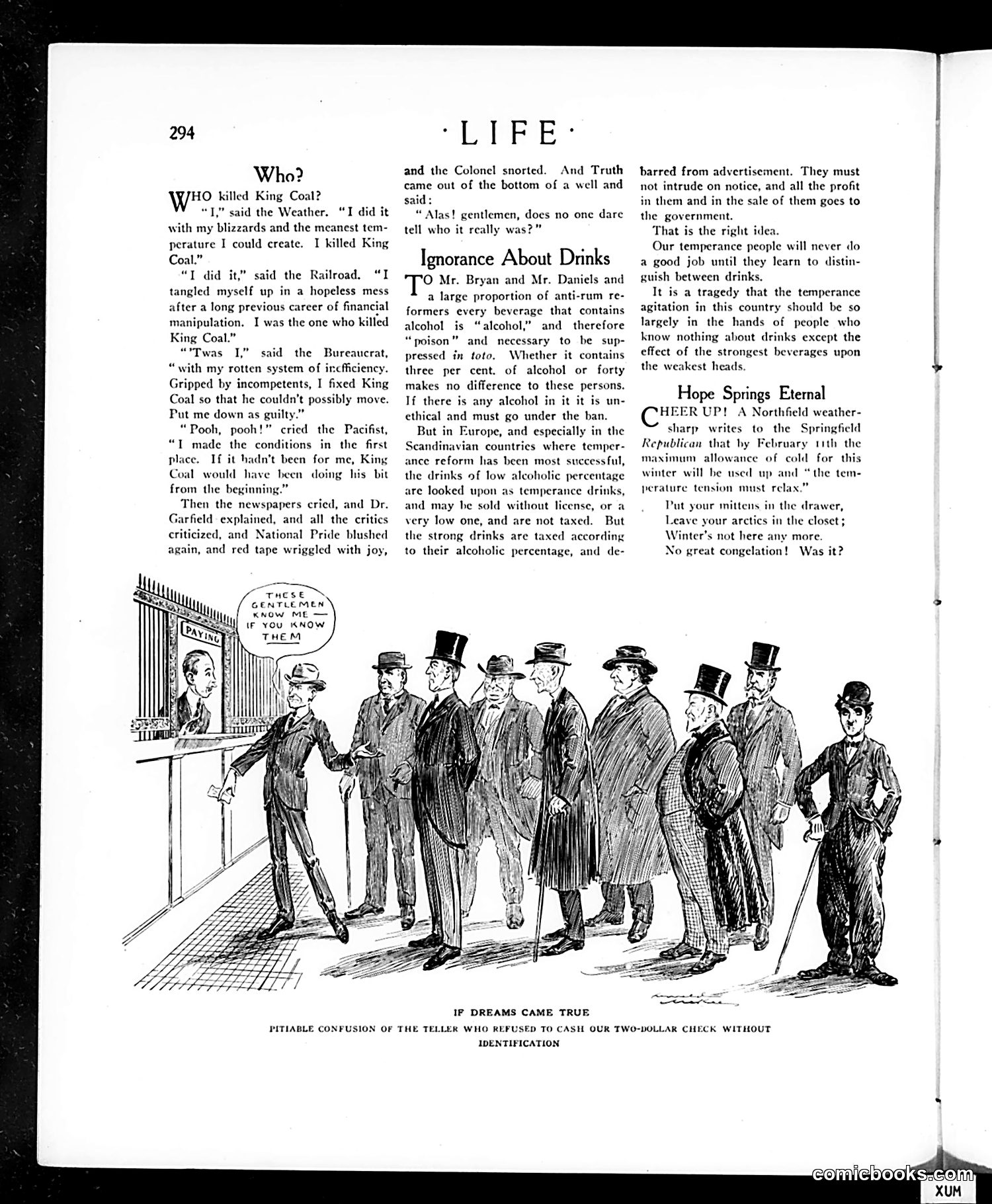
This page satirizes the decline of the coal industry through a mock murder mystery. Multiple figures—a railroad official, a bureaucrat, and a Pacific representative—each claim responsibility for "killing King Coal," attributing it to their own incompetence or systemic failures. The bottom cartoon depicts gentlemen in top hats at a bank, with the caption about a teller refusing to cash a two-dollar check without identification—a satirical commentary on banking bureaucracy and over-caution. The right column critiques temperance advocates' ignorance about alcohol content in beverages, mocking anti-rum reformers' lack of scientific understanding. Overall, the page targets early 20th-century Progressive Era concerns: industrial decline, government inefficiency, banking regulations, and temperance movement absolutism.
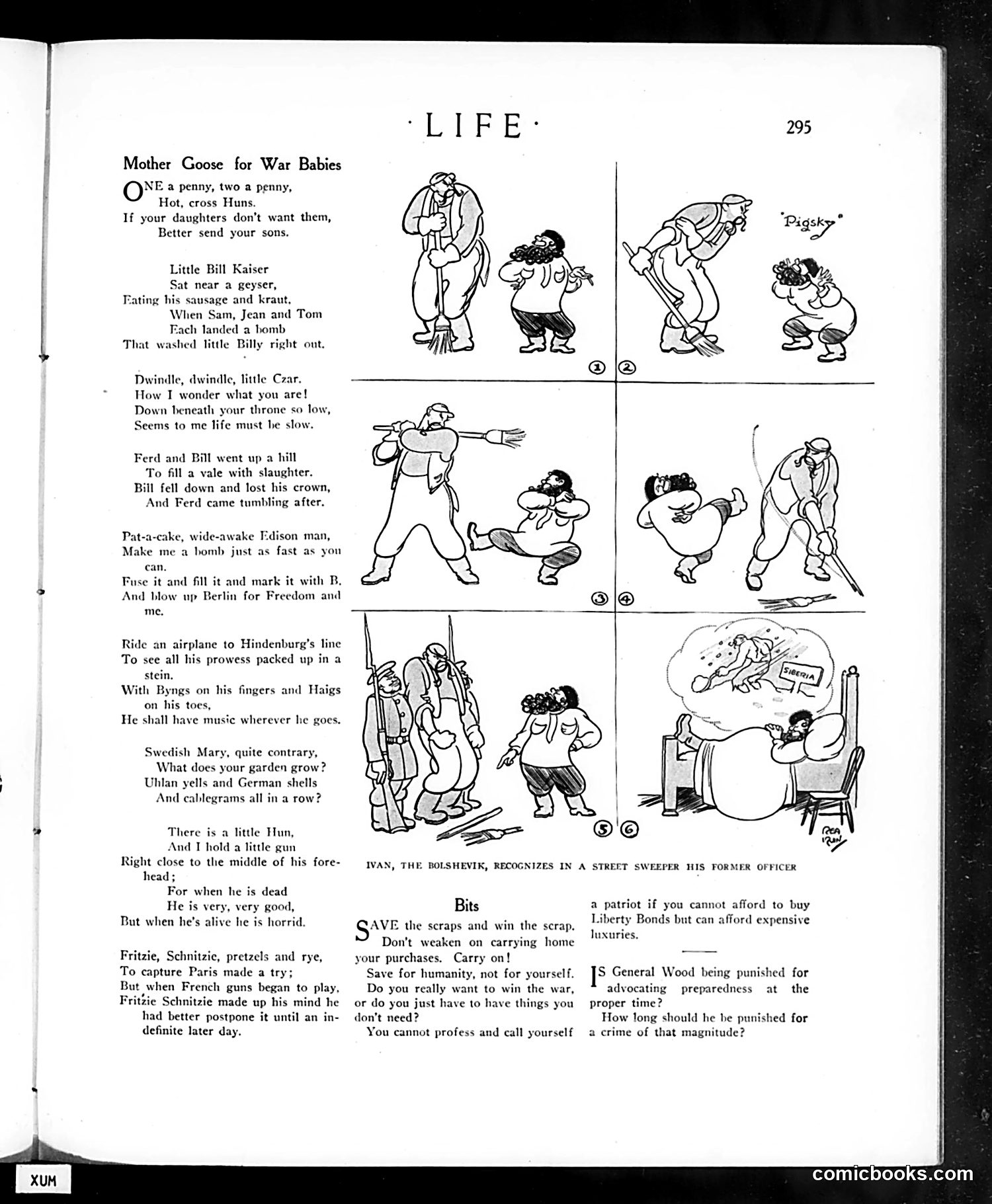
This WWI-era satirical page mocks wartime patriotism through darkly humorous nursery rhymes and cartoons. The "Mother Goose for War Babies" section parodies traditional children's verses, replacing innocent scenarios with war references—soldiers, explosions, and military figures. The cartoons illustrate absurd patriotic scenarios: characters engaged in exaggerated war-related activities, including one labeled "Pigsky" showing civilians performing silly martial poses. The bottom cartoon features "Ivan, the Bolshevik, recognizes in a street sweeper his former officer"—likely satirizing Russian Revolution upheaval and class reversal. The "Bits" section criticizes consumerism and preparedness obsession, questioning whether buying Liberty Bonds and material goods actually helps win wars, or merely enriches the wealthy while the poor sacrifice. The overall tone is cynical about civilian war enthusiasm.
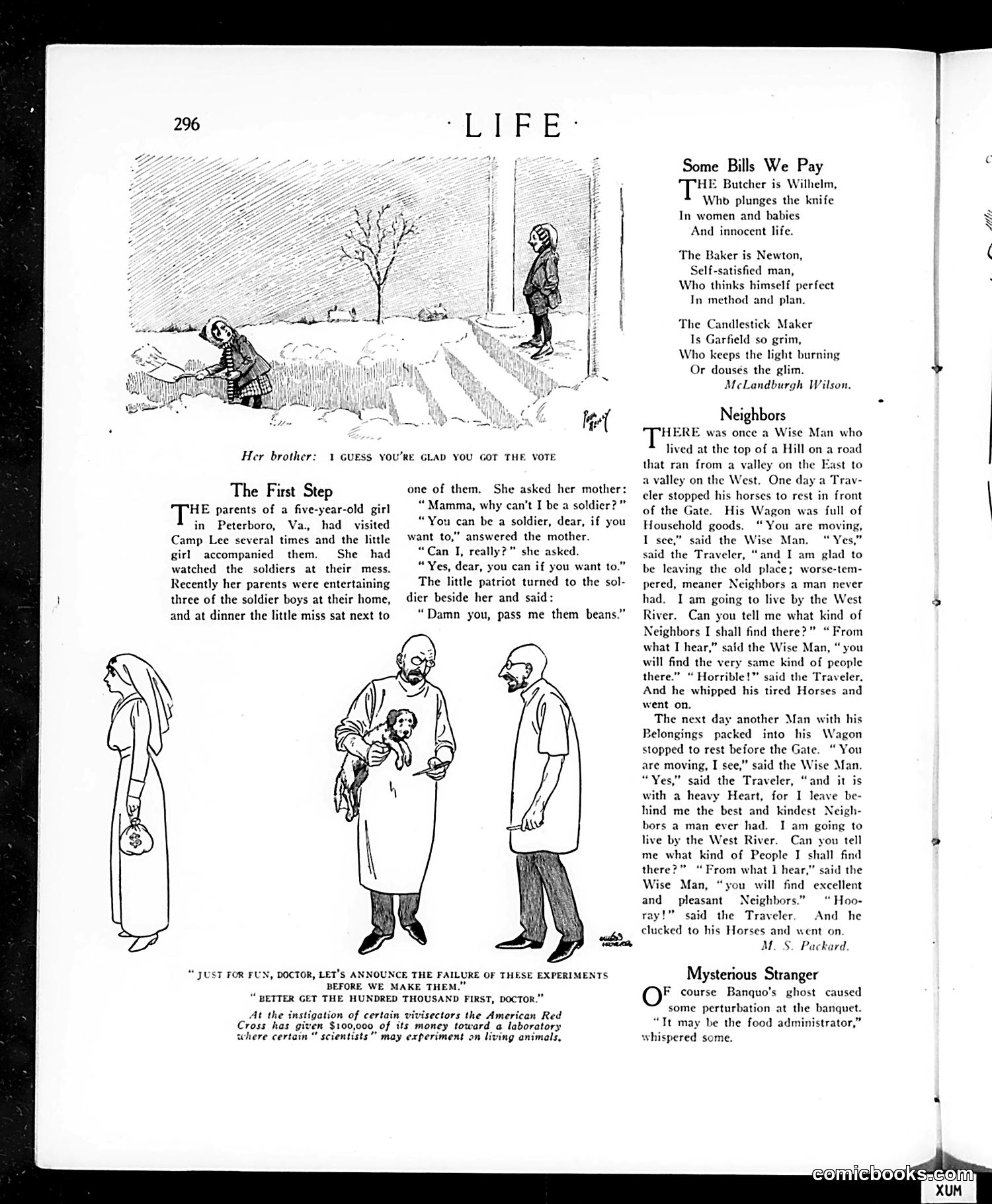
**"The First Step"** cartoon satirizes women's newly won voting rights (likely post-1920 suffrage). A young girl, inspired by watching soldiers at a military camp, mimics military language and authority by cursing at a soldier guest—suggesting that voting power has made women feel emboldened to behave more aggressively. The brother's comment about her "got the vote" frames this as a consequence of female suffrage, implying satire about women's changing social behavior. **"Some Bills We Pay"** uses nursery-rhyme format to mock wartime leadership. The figures (Wilhelm, Newton, Garfield) represent those responsible for WWI deaths and hardships—with "Wilhelm" likely referencing Kaiser Wilhelm II. It's anti-war satire. **"Neighbors"** is a moral fable: people find the same types everywhere; contentment depends on one's own attitude, not circumstances. **The cartoon below the poem** satirizes vivisection research: scientists request Red Cross funding ostensibly to "announce failure" before actually conducting experiments—criticizing animal testing as fraudulent science seeking money.
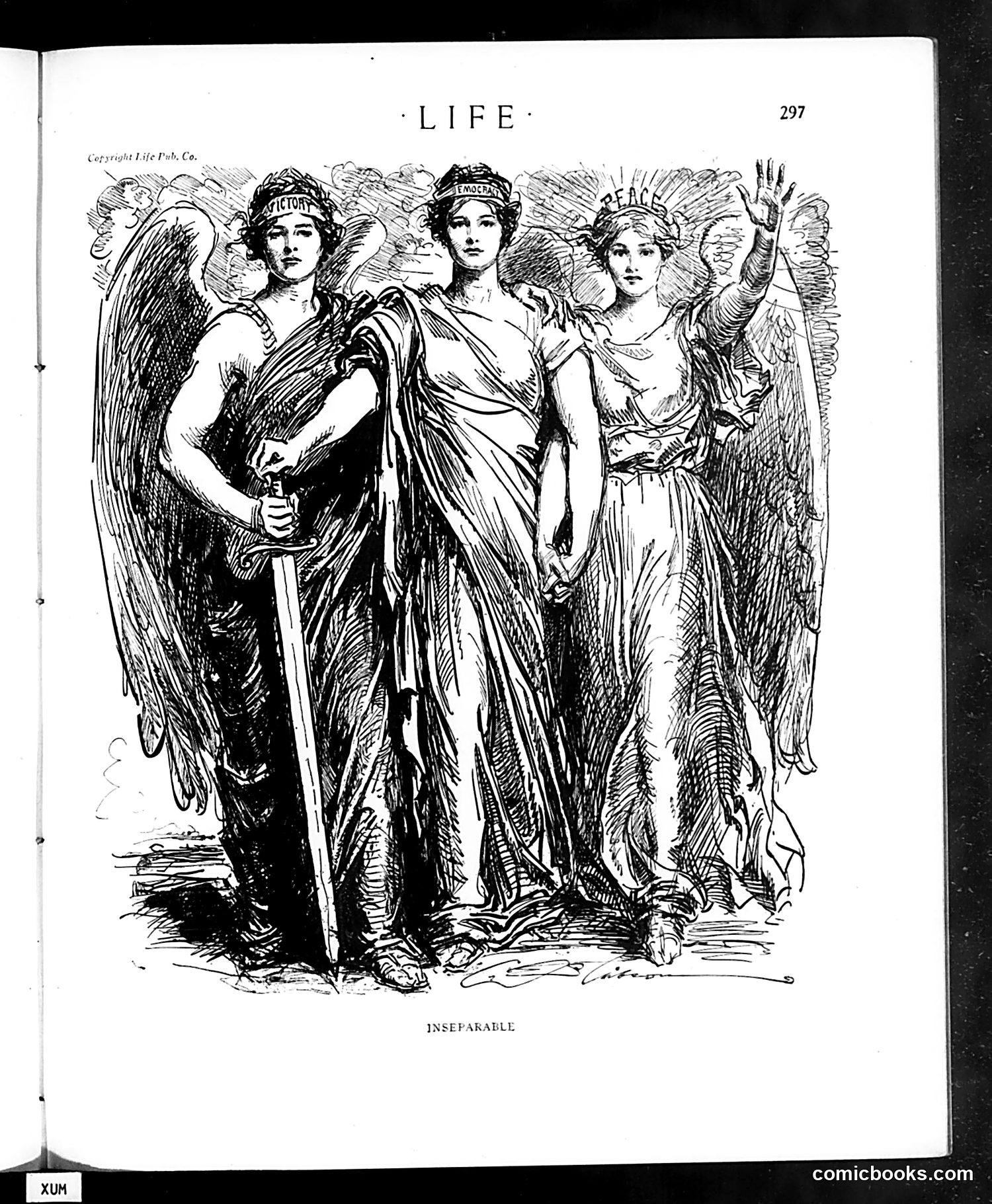
This allegorical illustration depicts four winged female figures in classical Greco-Roman style, each wearing a crown or laurel wreath. They represent abstract virtues or concepts, likely related to American ideals or wartime values. The leftmost figure holds a sword, suggesting Victory or War. The others appear to represent concepts like Peace, Justice, or Liberty based on their regalia and positioning. The title "Inseparable" suggests these ideals are bound together—that Victory cannot be separated from Peace, or that military strength and virtue are intertwined. Without additional context about the publication date, the precise historical moment remains unclear, though the classical allegorical style was common in early-to-mid 20th century American satire and propaganda imagery.
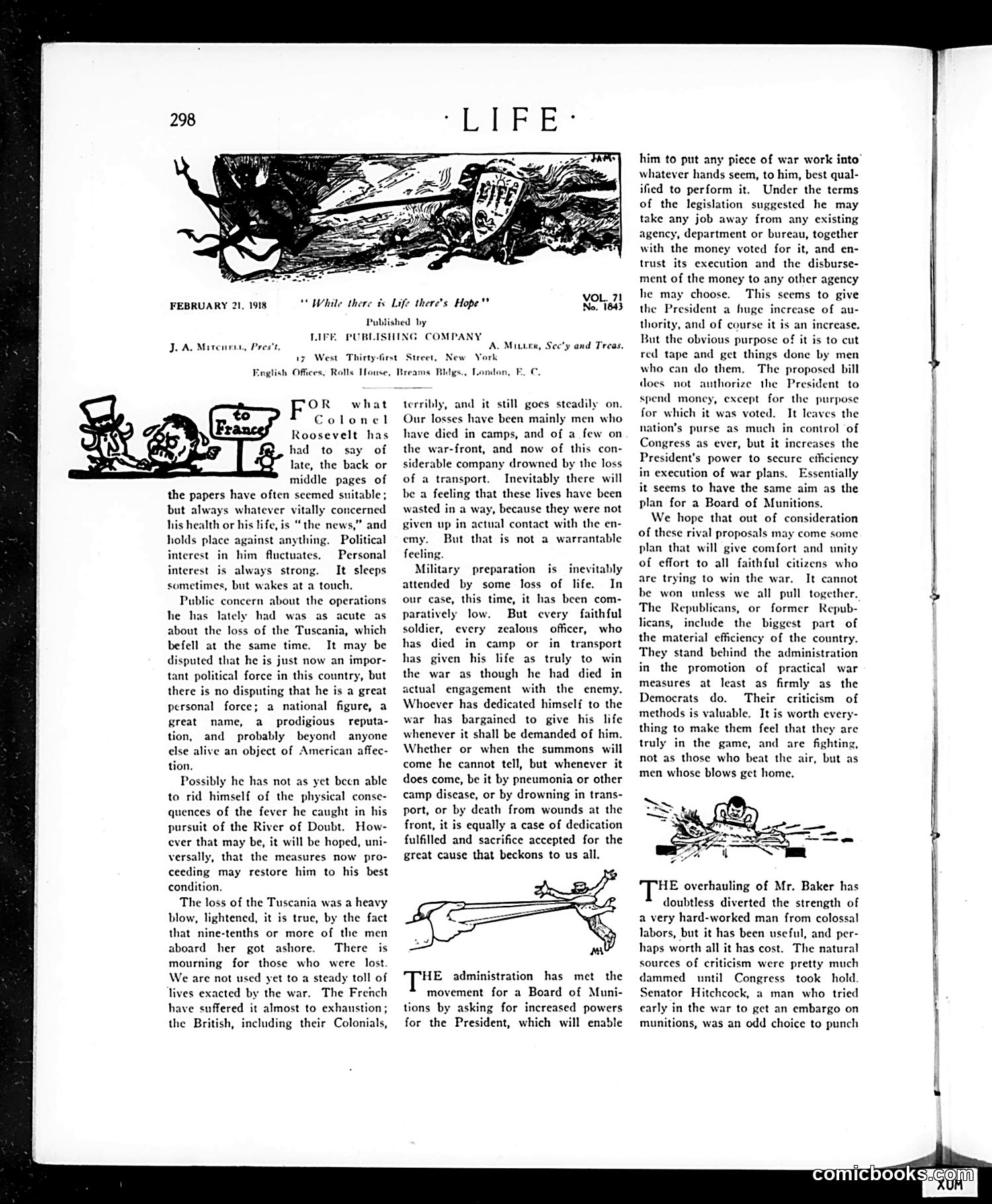
This page combines editorial commentary with satirical cartoons addressing two main subjects: **Theodore Roosevelt's Health**: The opening discusses Colonel Roosevelt's recent surgery following his illness contracted during his "River of Doubt" expedition. The editors note his status as a major national figure commanding public interest comparable to major war news (the loss of the ship *Tuscania*). **The Board of Munitions Debate**: The main editorial criticizes the Wilson administration's proposal to grant the President expanded wartime powers to reassign war work between agencies without congressional oversight. The editors view this as potentially excessive executive authority, though they acknowledge the stated goal of cutting "red tape." The cartoon imagery (depicting military/war themes) supports these discussions of wartime government efficiency and presidential power—key political controversies of 1918 as America deepened its World War I involvement.
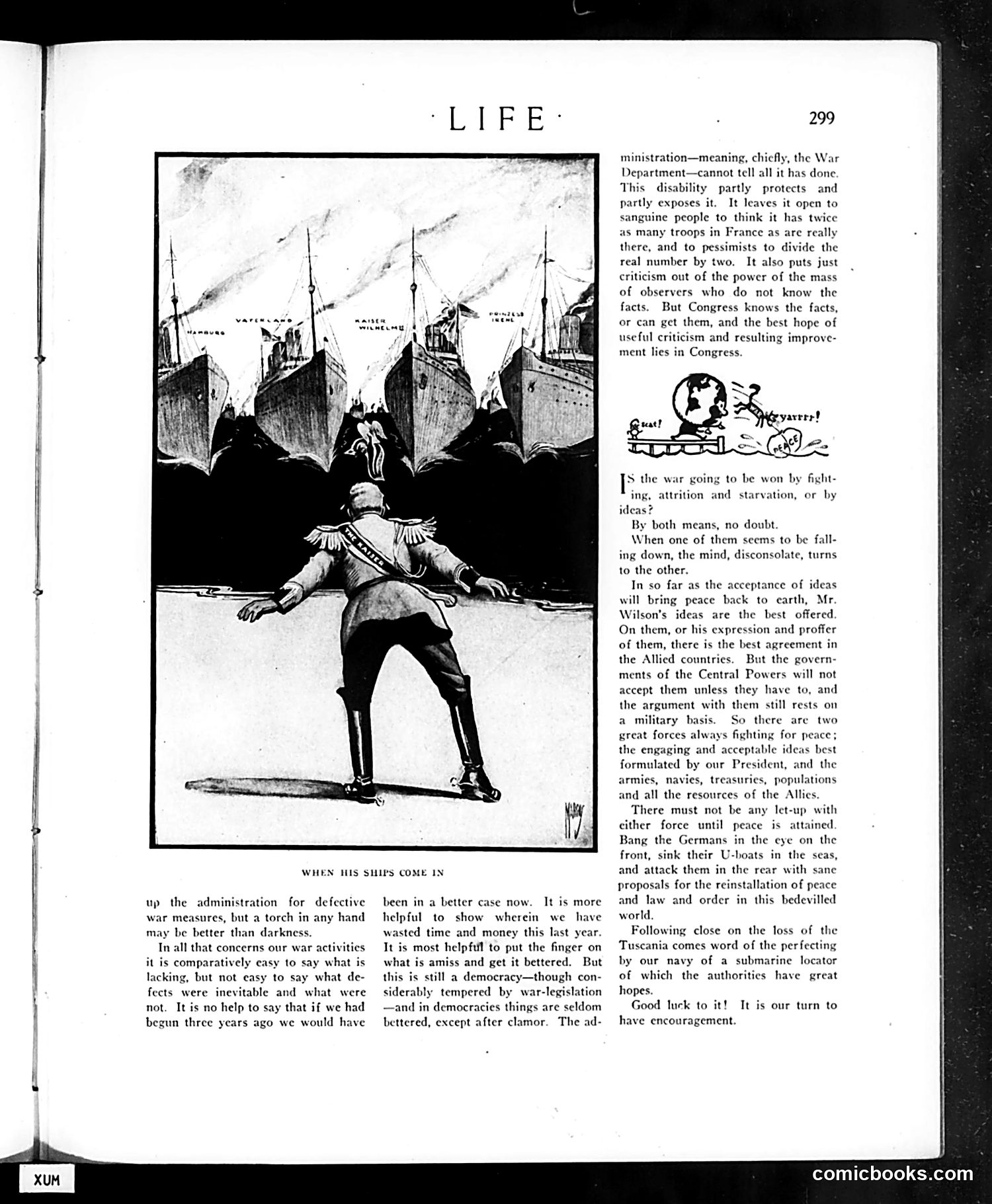
The cartoon depicts a military officer in WWI-era uniform striking an exaggerated pose as merchant ships arrive in the harbor behind him. The title is a play on the idiom "when his ships come in" (when fortune arrives). The satire targets **the U.S. War Department and military administration** for defective war measures and poor resource management during World War I. The officer's theatrical, self-congratulatory stance mocks the administration's attempts to take credit while remaining secretive about actual capabilities—leaving the public uncertain whether troop numbers in France are twice or half what claimed. The accompanying text criticizes how wartime secrecy prevents public oversight, arguing Congress must scrutinize military spending and inefficiency. It references Wilson's peace proposals as idealistic counterweight to military force, while acknowledging Germany will only accept peace through military defeat. The cartoon's point: the administration deserves scrutiny for waste, yet democracy demands public criticism—Congress should demand accountability rather than accept official spin.
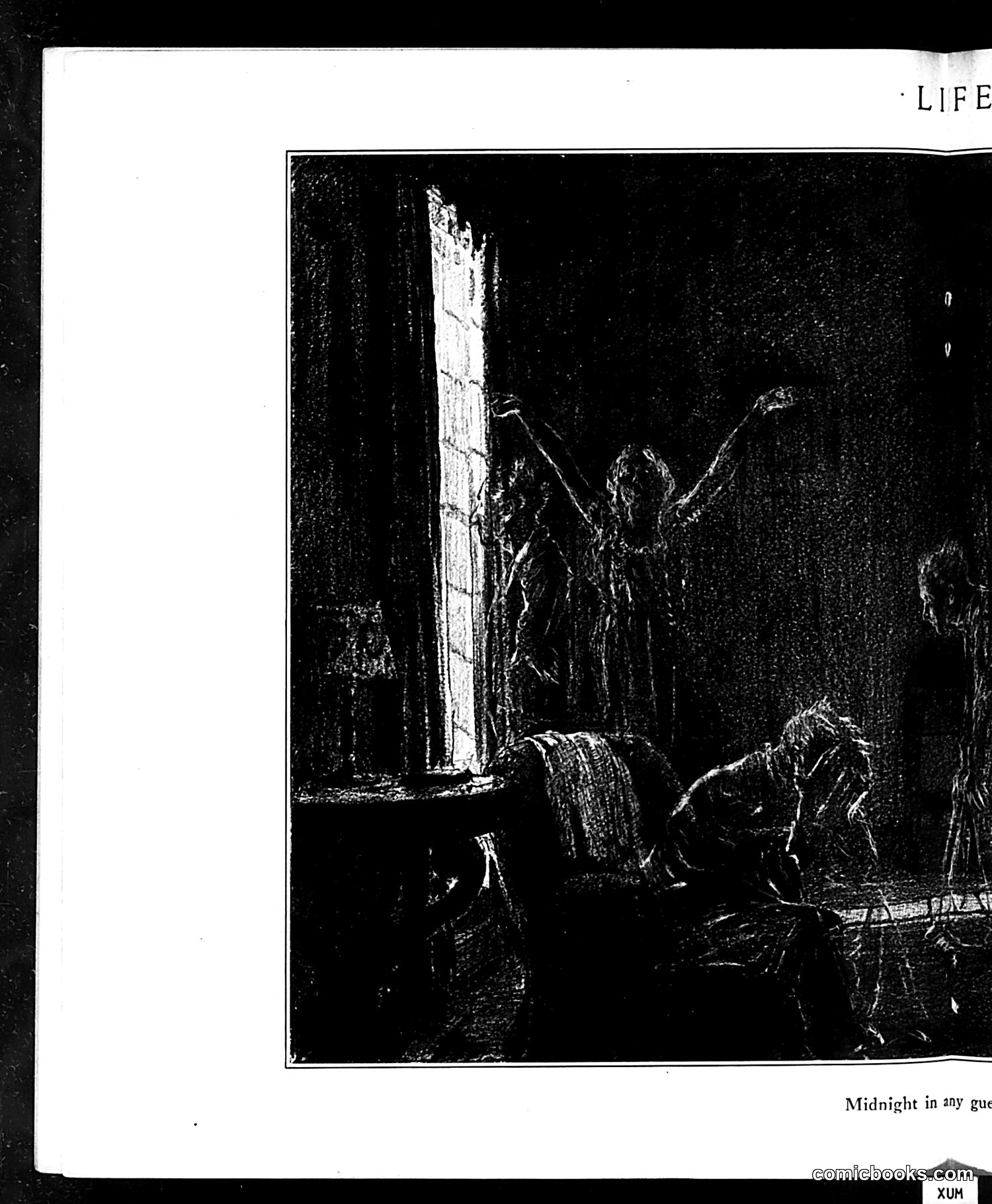
This is a darkly dramatic illustration from Life magazine, showing what appears to be a nighttime domestic or interior scene. A central figure with arms raised stands illuminated by light streaming through a doorway or window, while other figures remain in shadow around the space. The style is expressionistic, using stark black and white contrast for dramatic effect. The caption reads "Midnight in any gue[st house]" (text appears cut off), suggesting this depicts a comedic or satirical moment of domestic chaos or surprise occurring at midnight during a house visit. The raised arms and theatrical composition suggest either alarm, celebration, or absurd panic—likely poking fun at the awkwardness or melodrama of overnight guest situations. However, without the complete caption and additional context, the specific satirical target remains unclear.
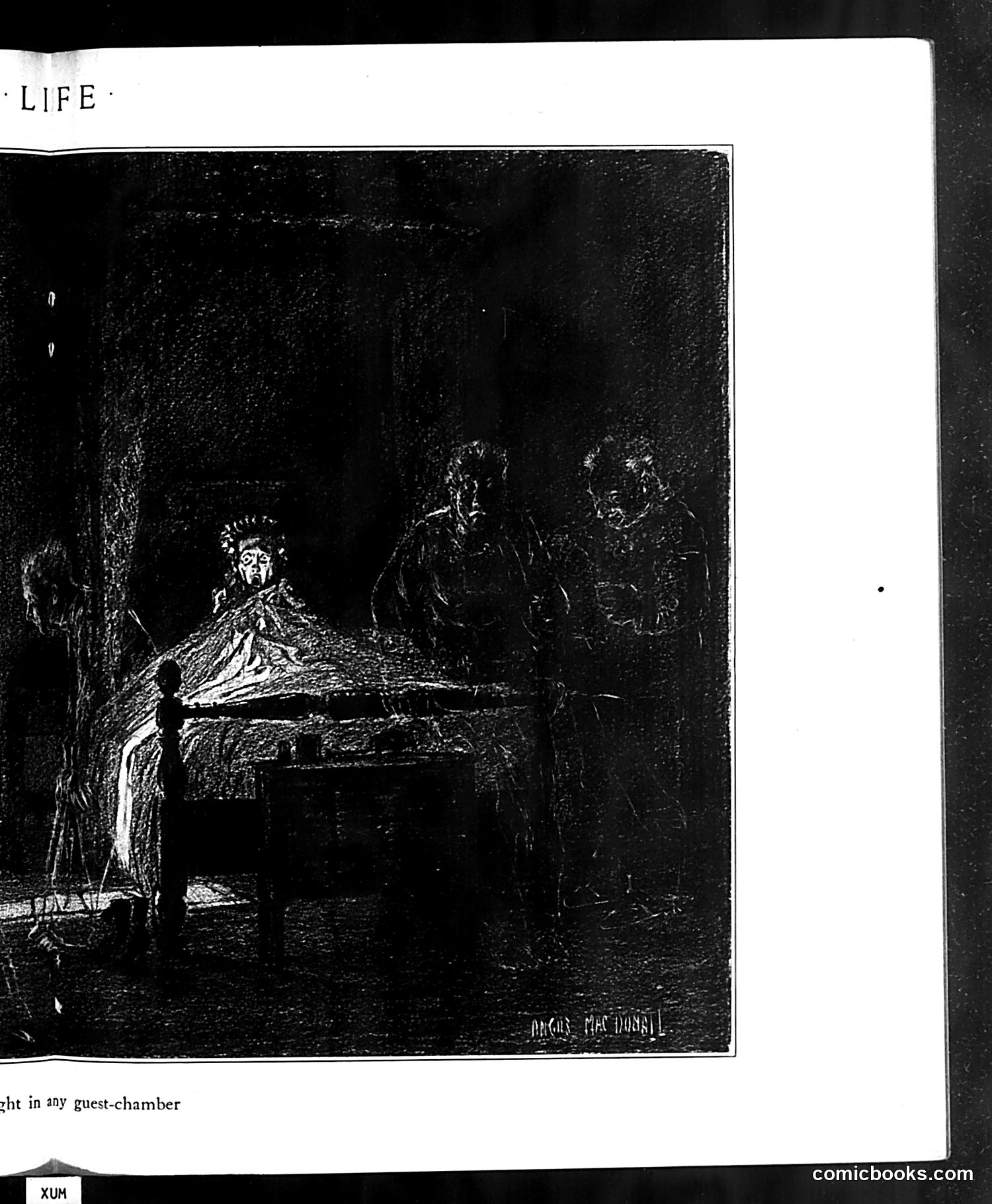
This appears to be a dark, atmospheric illustration from *Life* magazine showing what looks like a ghostly or supernatural scene. The image depicts several figures in what seems to be a dimly-lit chamber or room, with one figure appearing ethereal or translucent on a table or surface, while others stand around observing. However, the OCR text is fragmentary ("ht in any guest-chamber") and lacks clear context. Without the complete caption or surrounding text, I cannot definitively identify who these figures represent, what specific political or social issue is being satirized, or what the cartoon's intended point was. The illustration's style and the *Life* publication suggest this is likely satirizing something contemporary to its era, but the missing information prevents accurate historical interpretation.
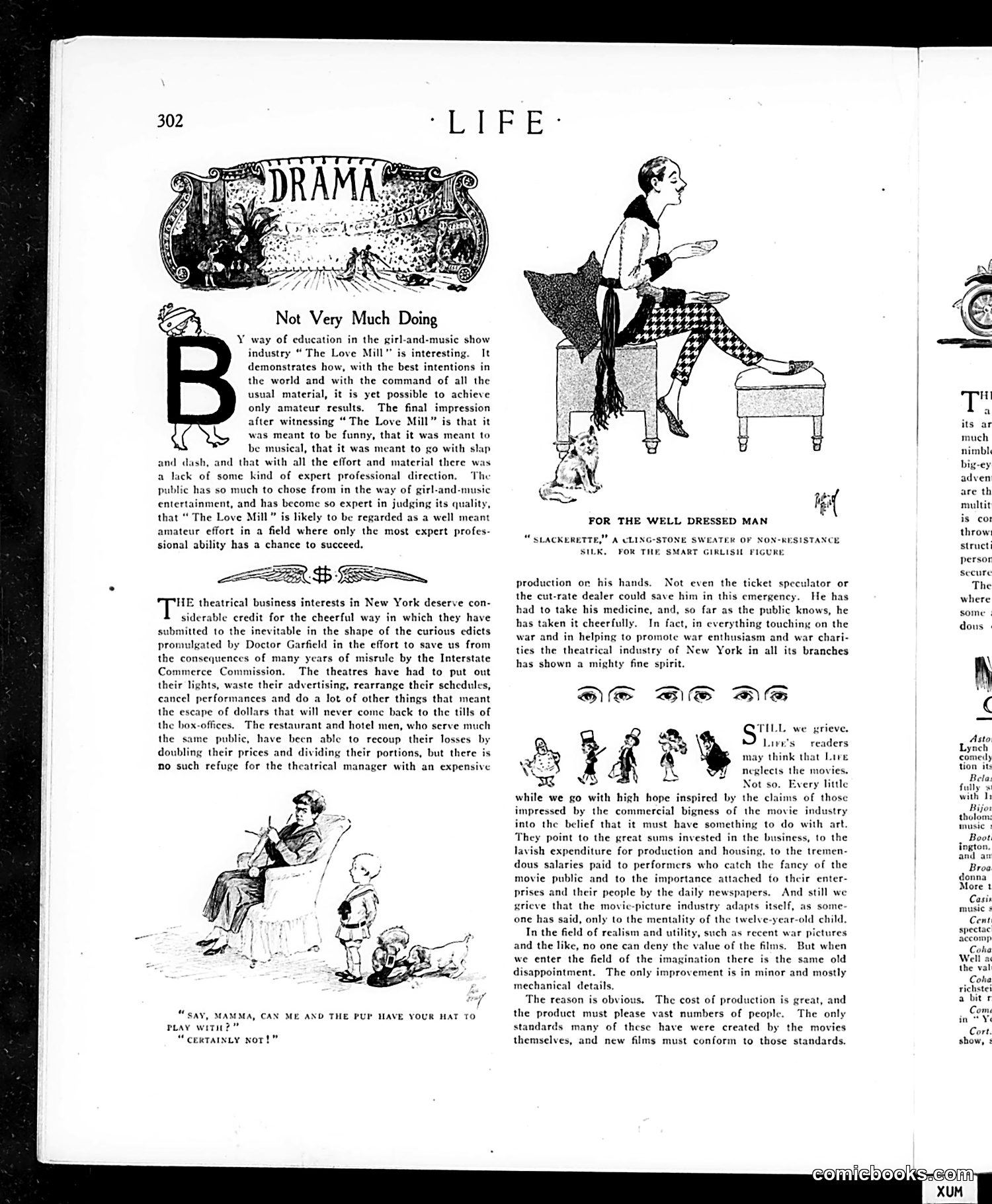
This page critiques American entertainment circa WWI era through several pieces: **"Not Very Much Doing"** reviews a theatrical production called "The Love Mill," dismissing it as well-intentioned but amateurish—lacking professional direction despite adequate resources. The writer notes audiences have become sophisticated judges of girl-and-music shows and expect professional quality. **The theatrical industry section** praises New York theaters for cheerfully complying with wartime restrictions imposed by "Doctor Garfield" (likely a reference to federal energy conservation measures), contrasting their sacrifice with restaurants that raised prices to compensate. It credits the theater industry with strong patriotic support for the war effort. **The final section** addresses readers' assumption that *Life* neglects movies. The writer admits initial optimism about film's artistic potential given its massive budgets and star salaries, but argues the industry "adapts itself...only to the mentality of the twelve-year-old child." While acknowledging war films' value, the piece contends that imaginative films show only minor mechanical improvements. The fundamental problem: production costs demand pleasing masses whose standards were *created by movies themselves*—a self-perpetuating cycle limiting artistic ambition.
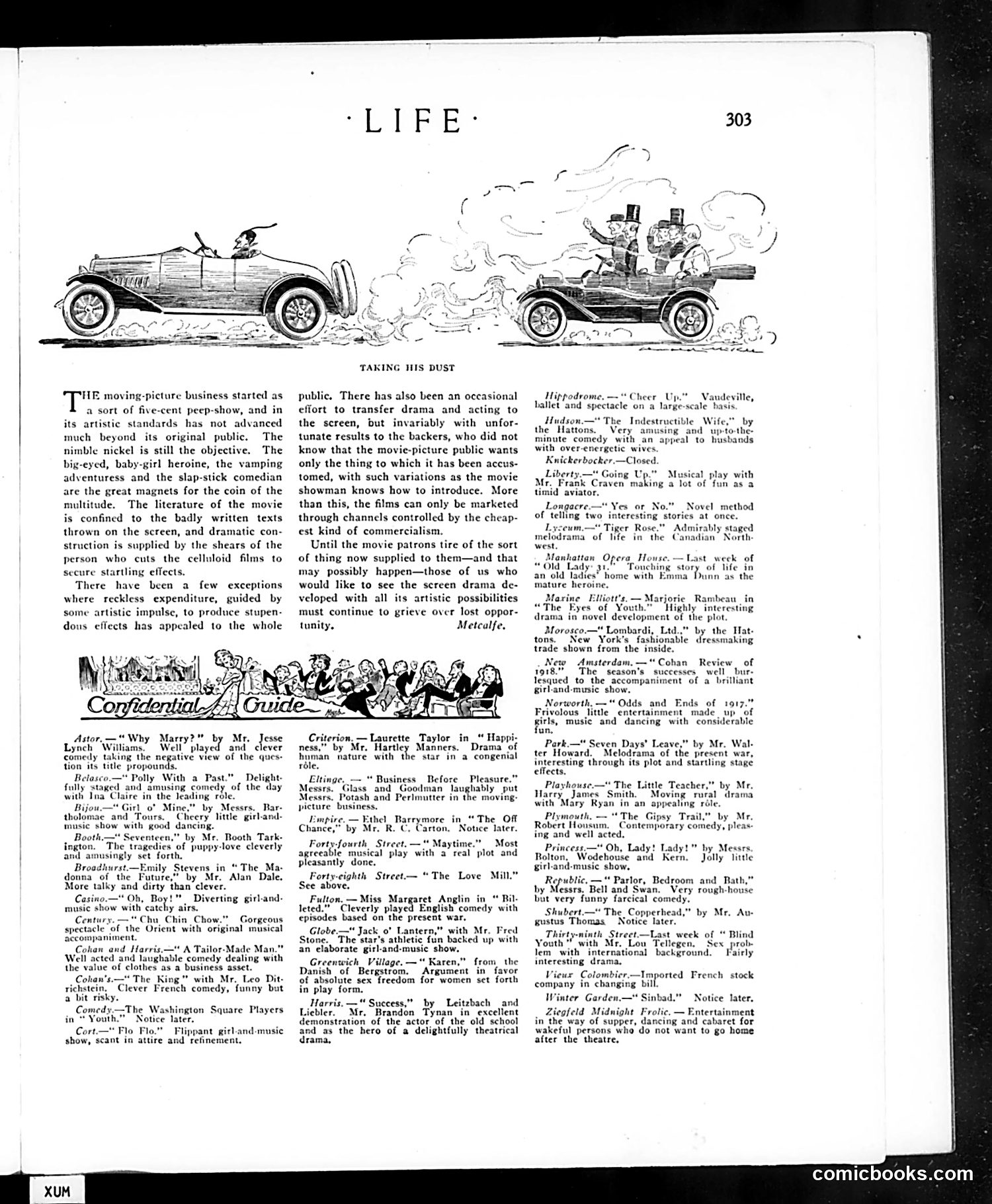
This cartoon satirizes the nascent film industry's competitive race for audiences and profit. The illustration shows two automobiles in a dust-filled chase—one vehicle represents artistic, quality cinema (appearing sparse and struggling), while the other depicts commercially successful, sensationalist moviemaking (crowded with performers and spectacle, kicking up clouds of dust as it speeds ahead). The accompanying essay by Metcalfe criticizes how American movies prioritize cheap entertainment—"big-eyed, baby-girl" heroines, slapstick comedians, and melodrama—over legitimate dramatic art. He laments that attempts at serious cinema fail commercially because the paying public demands only familiar, lowbrow fare. The cartoon's "dust" metaphor suggests that commercial films obscure or overwhelm artistic efforts through sheer volume and aggressive marketing dominance. The satire targets not filmmakers but the mass audience's indifference to cinematic art.
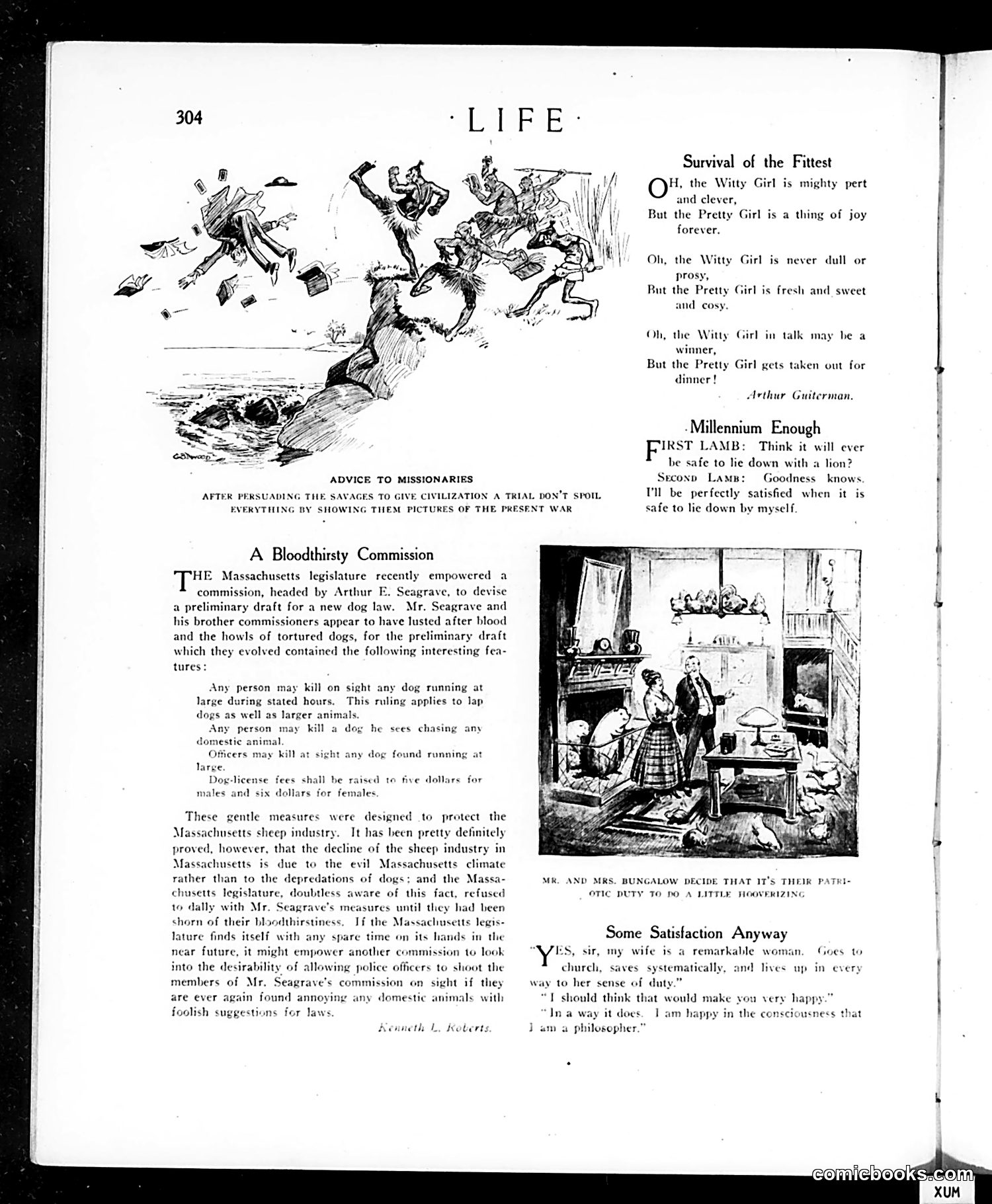
**"A Bloodthirsty Commission"** satirizes Massachusetts legislator Arthur Seagrave's proposed dog-control law. The cartoon shows officials violently attacking dogs. Seagrave's draft would have permitted killing dogs on sight during certain hours to protect the sheep industry. The satire's point: the legislature blamed dogs for the sheep industry's decline, when climate was the actual cause. The author suggests the commission itself deserves shooting for proposing such "bloodthirsty" measures—turning their own logic against them as absurd. **The poetry sections** offer lighter commentary on gender stereotypes: the "Witty Girl" versus "Pretty Girl" compares intelligence unfavorably to attractiveness (the pretty girl gets dinner dates), while "Millennium Enough" uses lambs discussing safety with a lion as dark humor about vulnerability and self-preservation. **"Some Satisfaction Anyway"** presents a domestic joke: a man's wife attends church, saves money, and follows duty perfectly, yet he admits he's only "happy in the consciousness that I am a philosopher"—suggesting resigned acceptance rather than genuine happiness with his dutiful spouse.
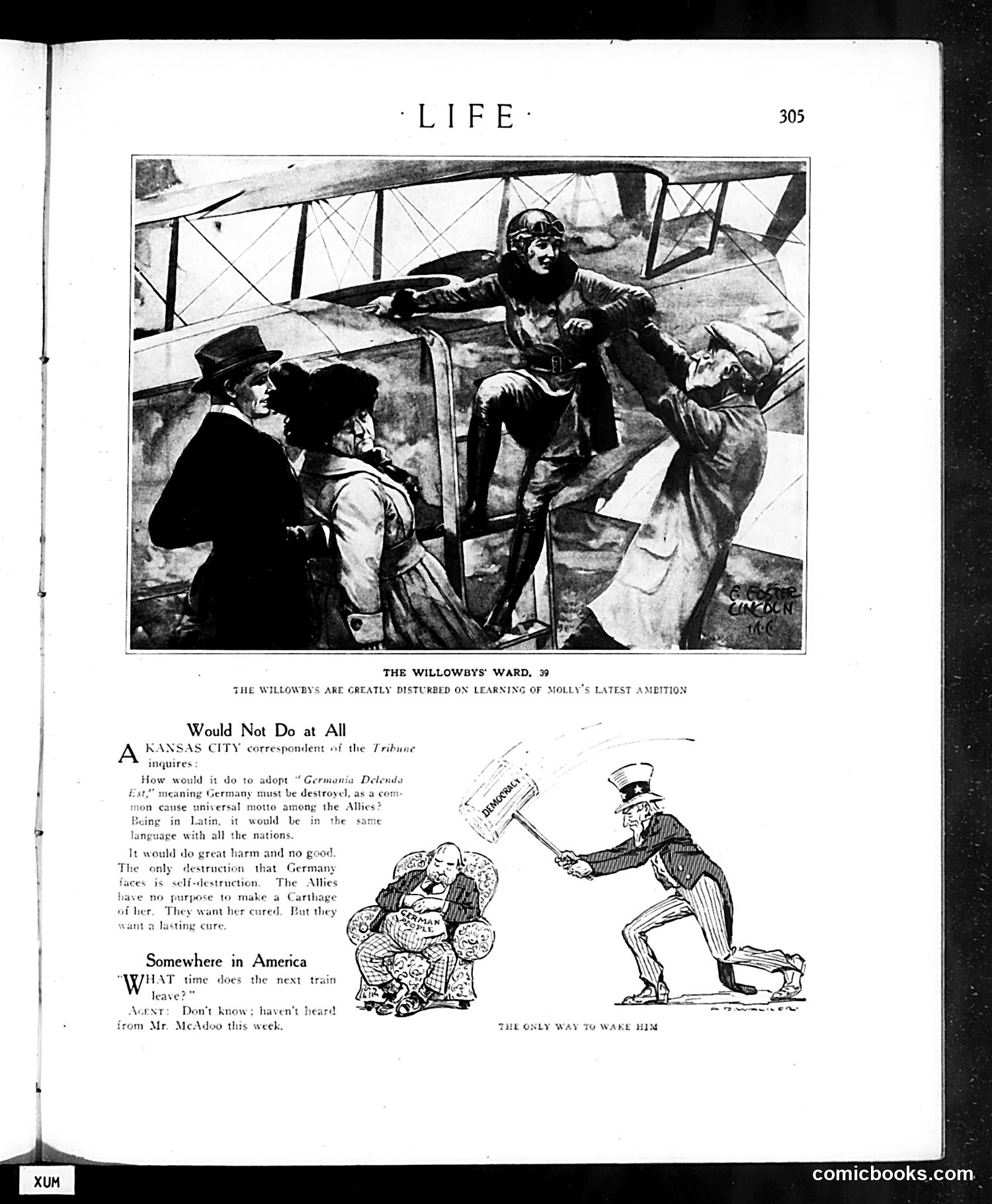
This page contains two distinct pieces of WWI-era satire: **Top: "The Willowbys' Ward"** is a serialized comic strip (episode 39) depicting a domestic storyline; the caption references "Molly's latest ambition" but the specific plot isn't explained here. **Bottom section** addresses a serious political question: A Kansas City Tribune reader asks whether the Latin motto "Germania Delenda Est" (Germany must be destroyed—echoing the Roman rallying cry "Carthago Delenda Est") should become an Allied war aim. The editorial response argues *against* it, stating the Allies want Germany's "self-destruction" and reform, not annihilation like ancient Carthage. **The cartoon** satirizes Secretary of the Treasury William McAdoo: a skeletal Uncle Sam figure swings a hammer labeled "DEMOCRACY" toward a sleeping, bloated figure representing Germany. The joke is that McAdoo hasn't been heard from—suggesting he's ineffectual or absent from the conversation about war aims. It's wartime propaganda positioning American leadership as necessary to "wake" the enemy to defeat.
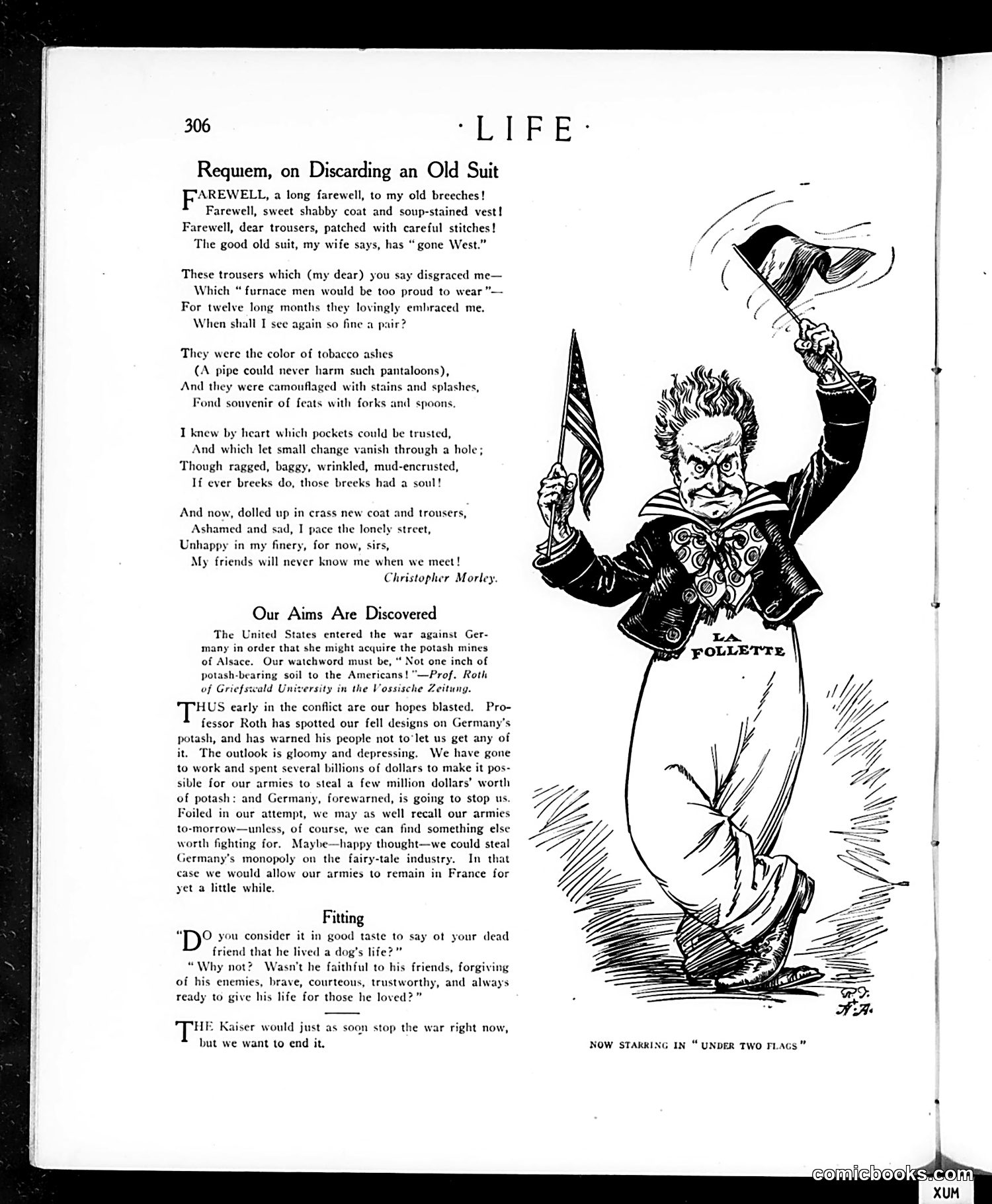
This page contains three distinct pieces of WWI-era satire: **"Requiem on Discarding an Old Suit"** (by Christopher Morley): A humorous poem mourning worn-out clothes, personifying shabby trousers as loyal companions. The joke reflects wartime austerity—the speaker must discard beloved old garments for new ones, but fears friends won't recognize him in his "crass new coat." **"Our Aims Are Discovered":** Satirizes German propaganda. It quotes a German professor claiming America entered WWI solely to steal potash from Alsace. Life mocks this absurd accusation by pretending to agree, humorously suggesting alternative war aims (stealing Germany's "fairy-tale industry") if potash-stealing fails. The satire ridicules German conspiracy theories about American war motives. **"Fitting":** A brief joke about eulogizing the dead, noting that loyalty and self-sacrifice—qualities of a faithful dog—are actually admirable human virtues. The right-side illustration shows "La Follette" (Senator Robert La Follette), likely referencing his controversial anti-war stance during this period.
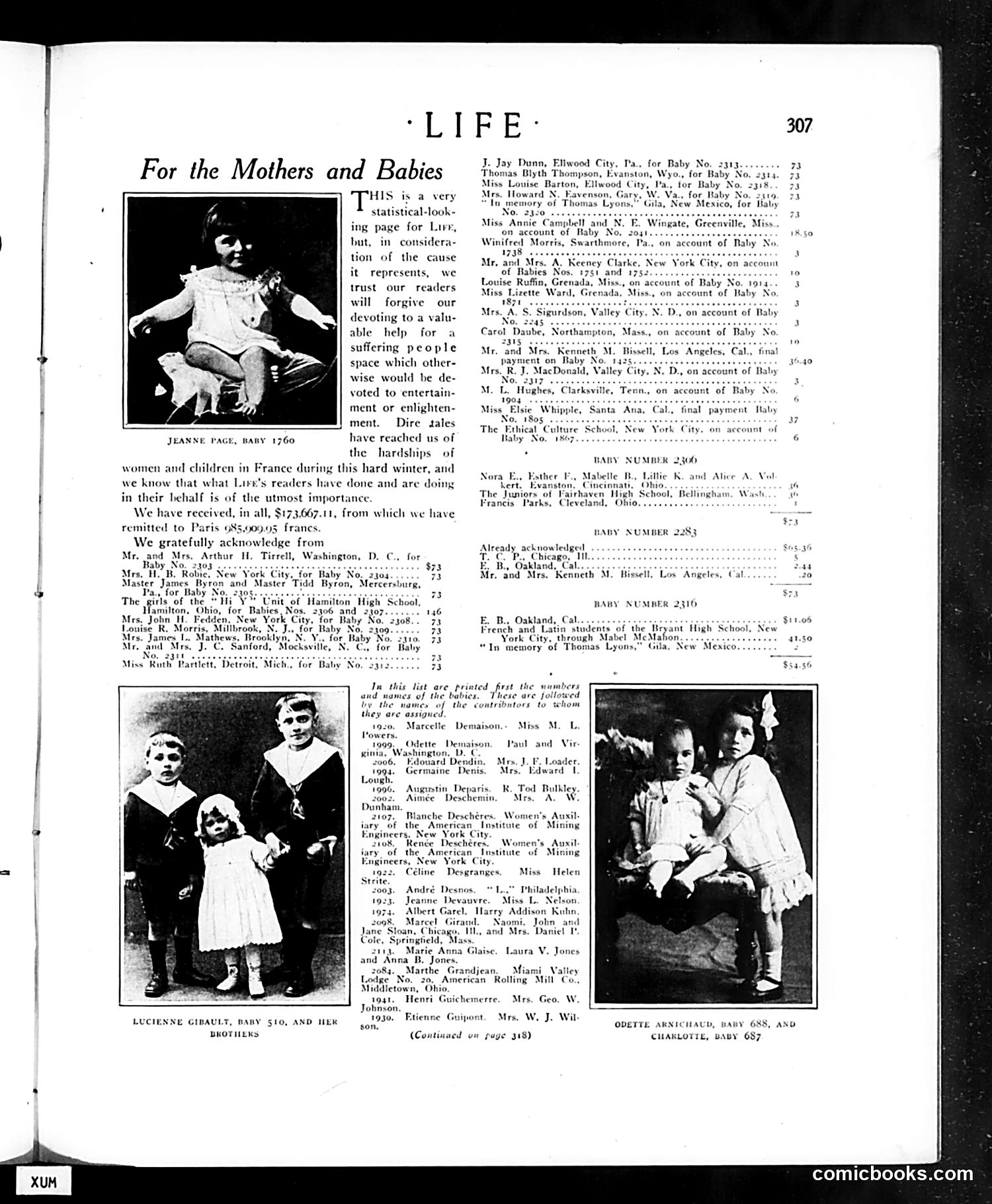
This page documents **Life magazine's charitable fundraising campaign for French women and children during World War I**. The text explains that Life devoted editorial space to raise relief funds for French civilians suffering during "this hard winter" (likely 1915-1917). The page functions as a **donation receipt and acknowledgment ledger**. It lists individual and organizational contributors with amounts given, alongside photographs of beneficiary babies and families. The magazine had collected $173,667.11 total, remitting $83,009.03 to Paris. The historical context: American magazines frequently organized transatlantic relief efforts for Allied civilian populations during WWI. The "baby numbering system" (Baby No. 2313, etc.) likely tracked individual relief cases being sponsored. The three photographs show typical beneficiary families—a mother with child and siblings. This represents **philanthropic journalism**: using editorial content and reader participation to raise humanitarian aid while building reader engagement and goodwill toward the Allied cause.
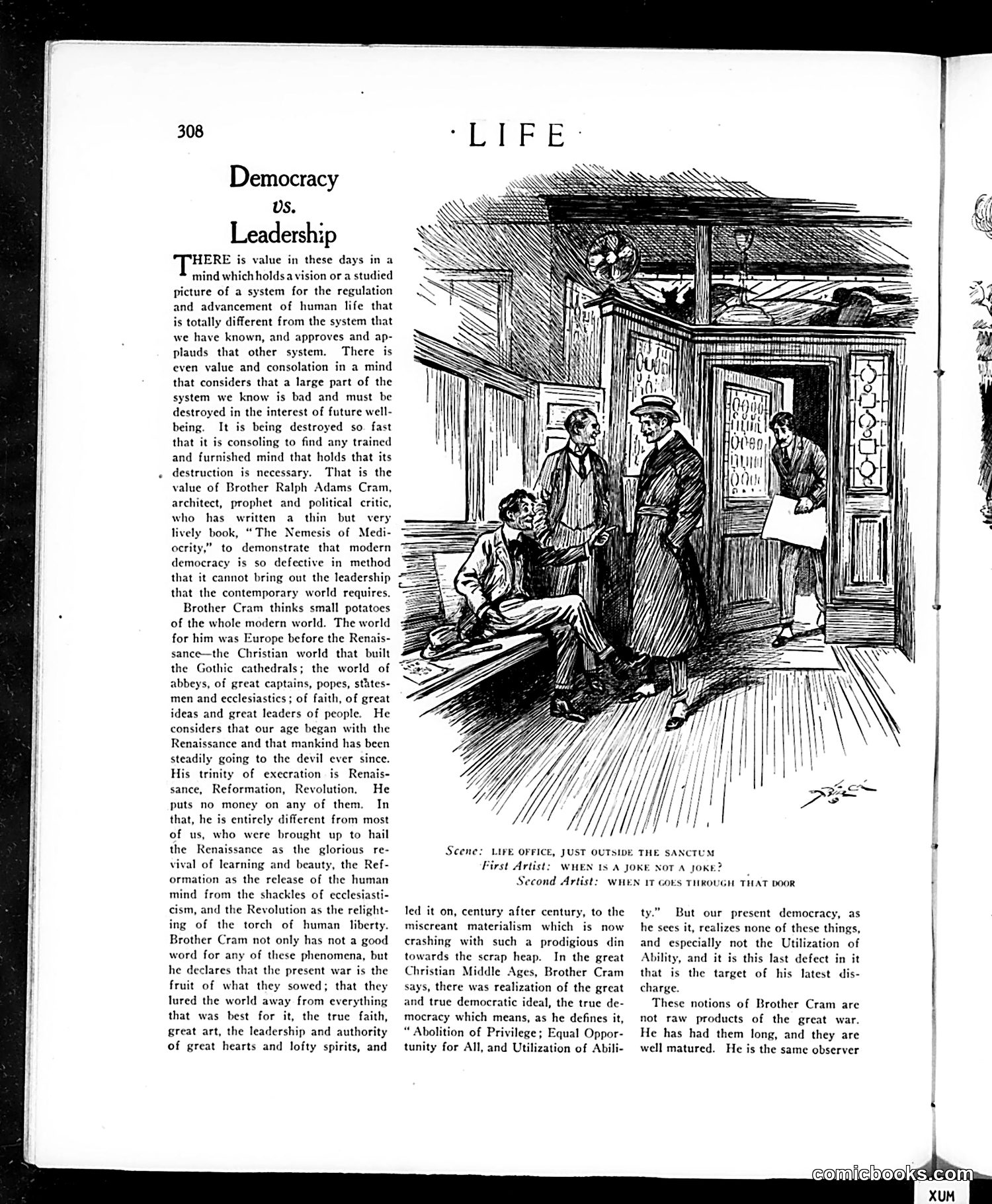
This Life magazine article critiques architect and social critic Ralph Adams Cram's book *The Nemesis of Mediocrity*, which argues modern democracy fails to produce necessary leadership. Cram idealizes pre-Renaissance Christian Europe while condemning the Renaissance, Reformation, and Revolution as civilization's decline toward materialism. The accompanying cartoon shows two artists discussing a joke: "When is a joke not a joke? When it goes through that door"—suggesting that Cram's serious critique, when presented to authority figures in an office sanctum, loses its comedic value or becomes something else entirely. Life's tone is skeptical of Cram's nostalgia for hierarchical medieval society while appearing sympathetic to his diagnosis of democracy's weaknesses. The satire implicitly mocks both Cram's idealization of the past and the bureaucratic establishment that might ignore uncomfortable truths about democratic governance.
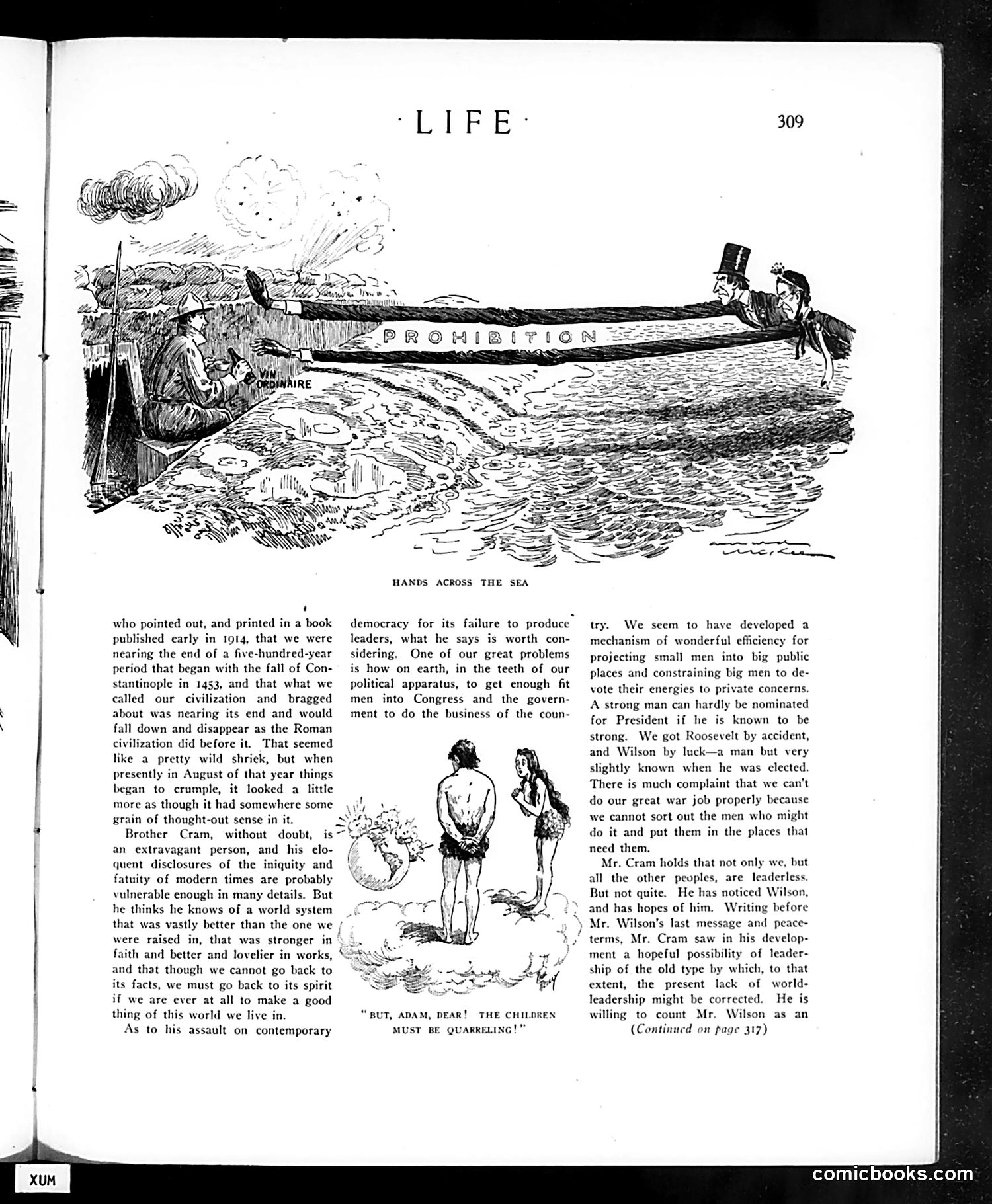
This page contains two distinct cartoons satirizing early 20th-century politics and social order. **Top cartoon ("Hands Across the Sea"):** depicts Prohibition as a massive barrier stretching across the ocean between nations, with figures on both sides unable to connect—mocking the isolating effects of alcohol prohibition policy on international relations. **Bottom cartoon ("But, Adam, Dear! The Children Must Be Quarreling!"):** shows nude Adam and Eve observing conflict, sarcastically suggesting that human discord is natural and inevitable, possibly critiquing naive optimism about peace or social harmony. The accompanying text discusses Brother Cram's critique of modern civilization's decline since 1453, arguing that democratic systems fail to elevate strong leaders into positions of power. The author notes exceptions (Roosevelt, Wilson) and expresses cautious hope that Wilson might provide needed leadership during what appears to be WWI-era uncertainty. The overall theme: Western civilization faces crisis due to structural failures in selecting worthy leaders for critical times.
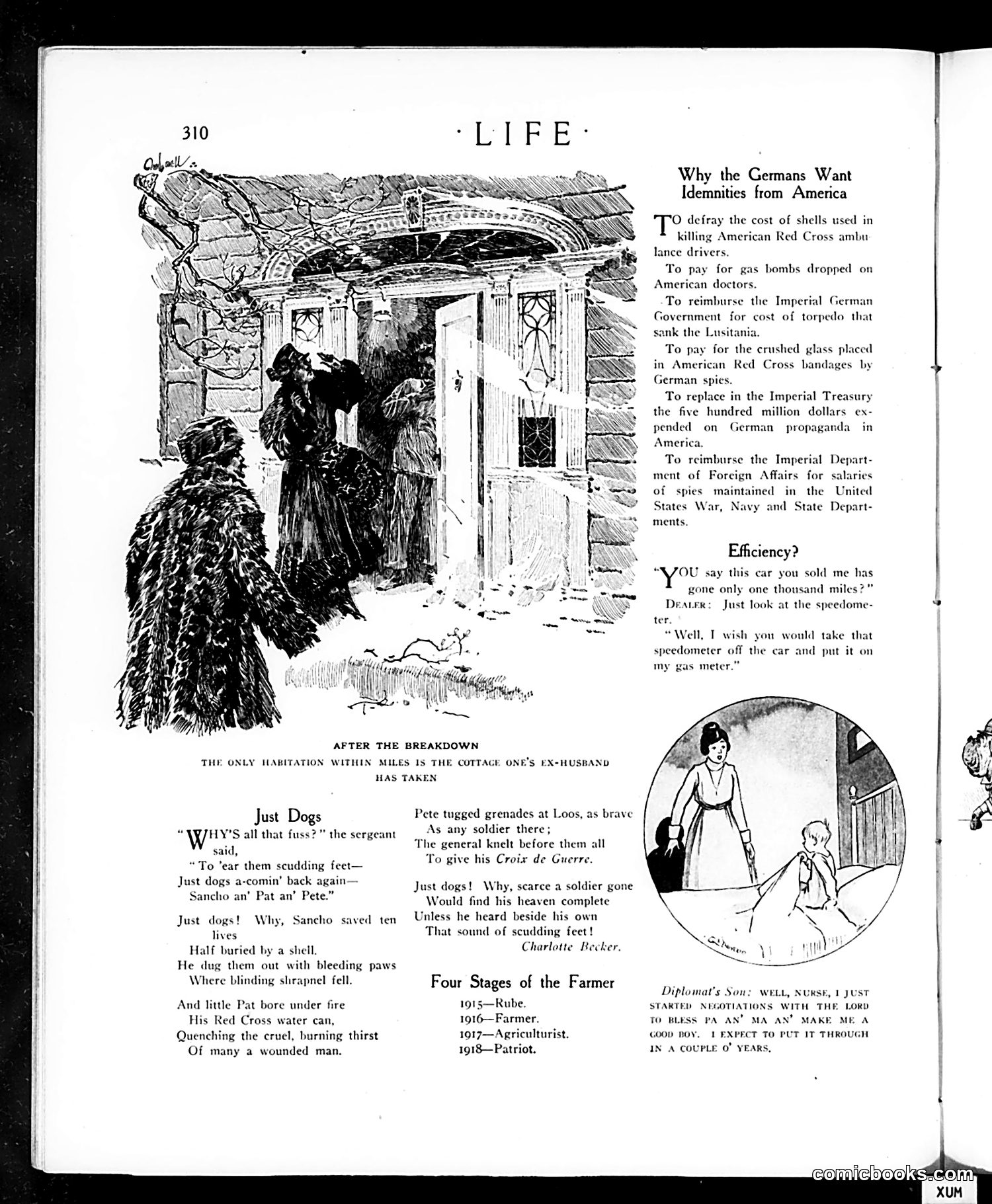
This WWI-era satirical page contains several pieces mocking Germany and wartime topics: **"Why the Germans Want Indemnities from America"** sarcastically lists German war crimes and propaganda costs as justification for demanding American reparations—mocking German demands by cataloging atrocities: killing Red Cross personnel, gas attacks on doctors, the Lusitania sinking, spreading propaganda, and maintaining spies in U.S. government. **"Just Dogs"** is a sentimental poem praising war dogs' heroism, crediting them with saving lives and earning military honors (the Croix de Guerre). **"After the Breakdown"** cartoon depicts a woman encountering her ex-husband's cottage—likely satirizing domestic complications during wartime. **"Four Stages of the Farmer"** is a brief joke tracking the farmer's social elevation: from "Rube" (1915) to "Patriot" (1918) as agricultural production became militarily crucial. The page reflects American anti-German sentiment and emphasis on U.S. moral superiority during the First World War.
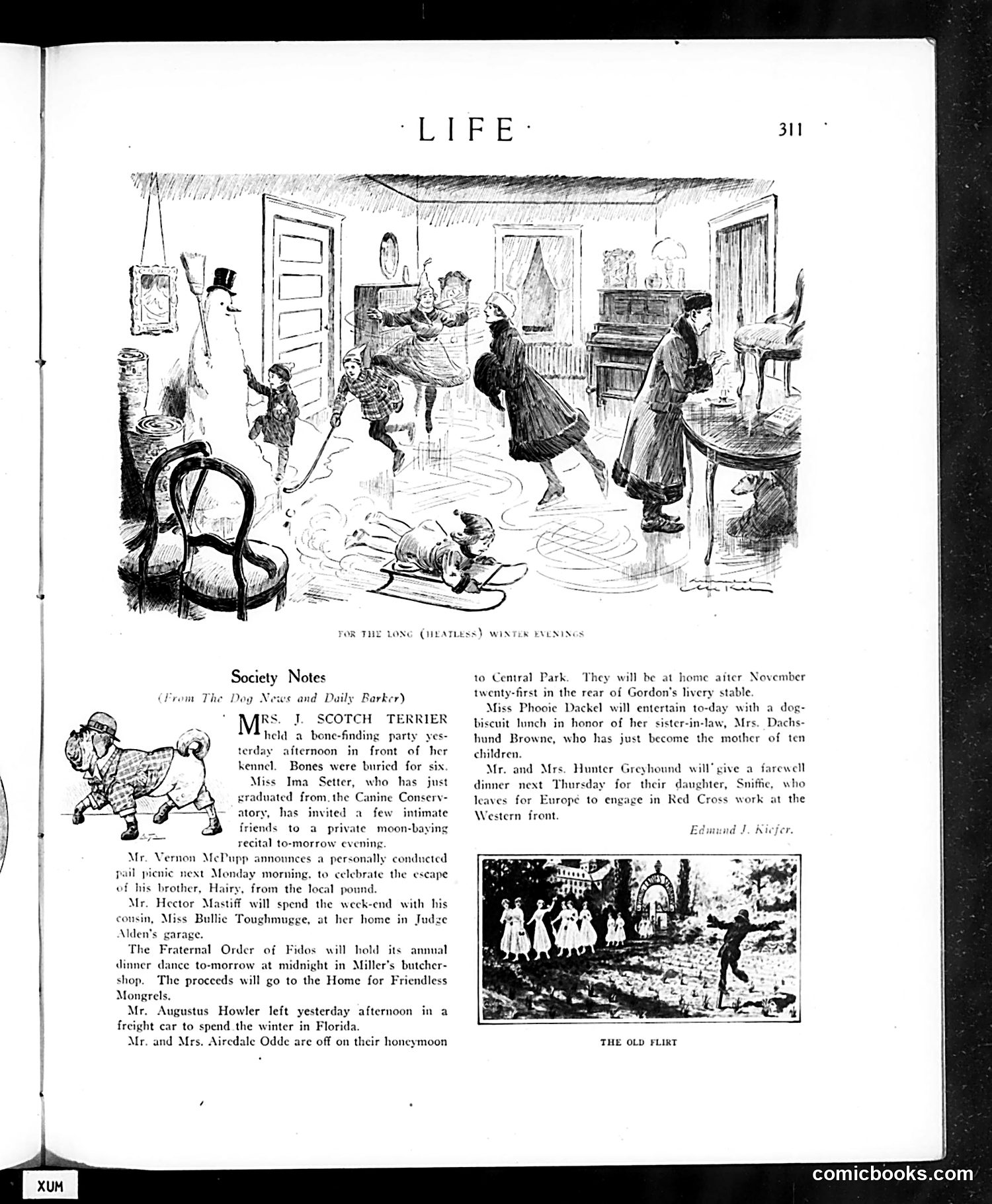
This page presents satirical "Society Notes" written as if dogs were the subject, with pun-laden dog breed names standing in for human socialites. The top cartoon illustrates the caption "FOR THE LONG (MEATLESS) WINTER EVENINGS"—referencing WWI food rationing that affected American civilians. The humor operates on multiple levels: dog-themed puns (a "Scotch Terrier" holding a "bone-finding party," a "Setter" giving a "moon-baying recital"), mock-serious society page parody, and timely wartime references. One entry mentions a daughter leaving "to engage in Red Cross work at the Western front," invoking actual WWI service. The "meatless" subtitle and the society page format together satirize how Americans—particularly the privileged classes—dealt with wartime privations. By anthropomorphizing dogs discussing their social activities during rationing, *Life* magazine gently mocks both the pretension of society reporting and civilian wartime adjustments.
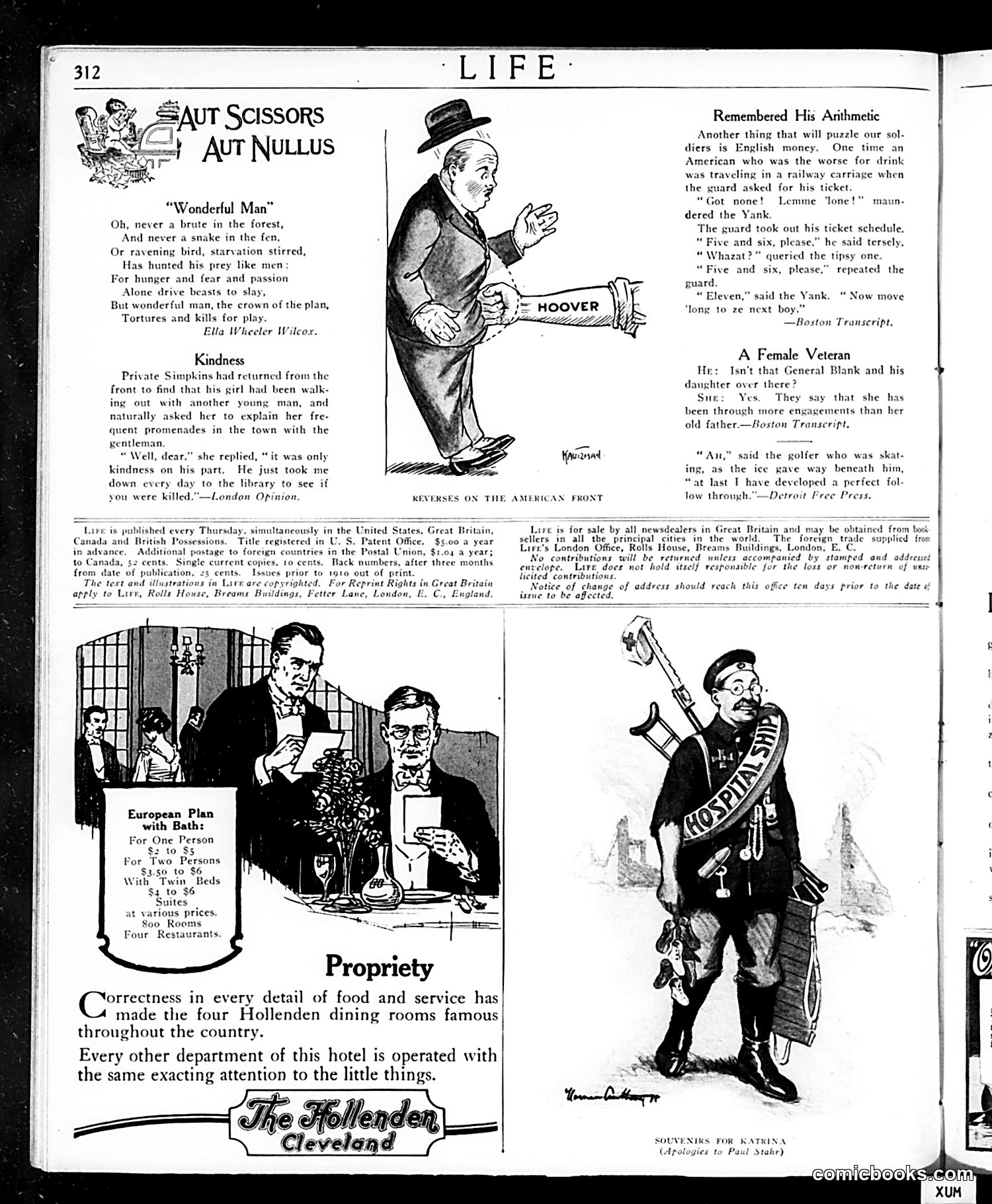
This page from *Life* magazine (likely WWI-era, given references to "the front") contains several satirical pieces: **"Reverses on the American Front"** cartoon depicts a caricatured German soldier labeled "Hoover," mocking American food conservation efforts. Herbert Hoover led the U.S. Food Administration during WWI, promoting rationing. The cartoon suggests Germans are retreating due to American abundance—dark wartime humor. **"Remembered His Arithmetic"** jokes about an American soldier's drunken confusion over British currency ("five and six" shillings), humorously portraying American soldiers as unfamiliar with foreign money. **"A Female Veteran"** quips that a general's daughter has endured more romantic "engagements" than her elderly father. **"Kindness"** anecdote satirizes British wartime sentimentality—a woman claims she walked with another man only out of "kindness," checking the library daily to see if her boyfriend was killed. The advertisements for The Hollenden hotel and European travel plans occupy significant space, indicating this is primarily a commercial-editorial blend typical of the period.
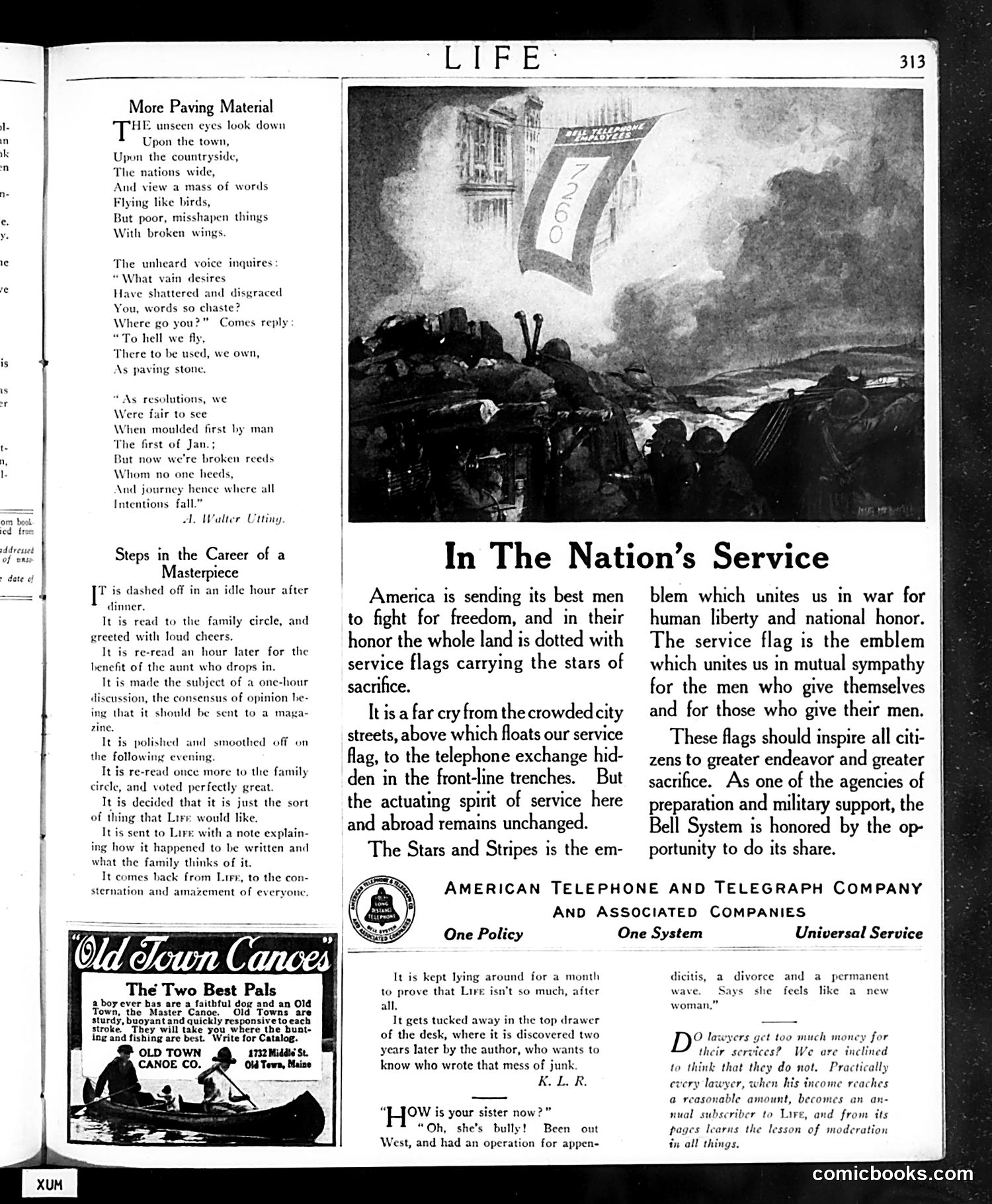
This page contains multiple satirical pieces reflecting World War I-era American concerns: **"More Paving Material"** (poem by Walter Utting): Satirizes broken political promises and failed resolutions. Words—metaphorically depicted as "broken reeds"—are discarded as worthless "paving stone," suggesting that grand governmental and social declarations prove hollow and are abandoned once their utility expires. **"Steps in the Career of a Masterpiece"**: Mocks the pretensions of amateur writers and family validation. A hastily-written piece circulates through family admiration, gets submitted to Life magazine with inflated self-importance, is rejected, then forgotten in a desk drawer—a humorous critique of unpublished writers' delusions. **"In The Nation's Service"**: A serious AT&T advertisement co-opting patriotic imagery. It frames the telephone company's wartime role as noble service, using service flags (indicating family members in military service) as emotional leverage to link corporate infrastructure to national sacrifice during WWI. The page juxtaposes cynical satire about failed rhetoric with earnest corporate patriotism.
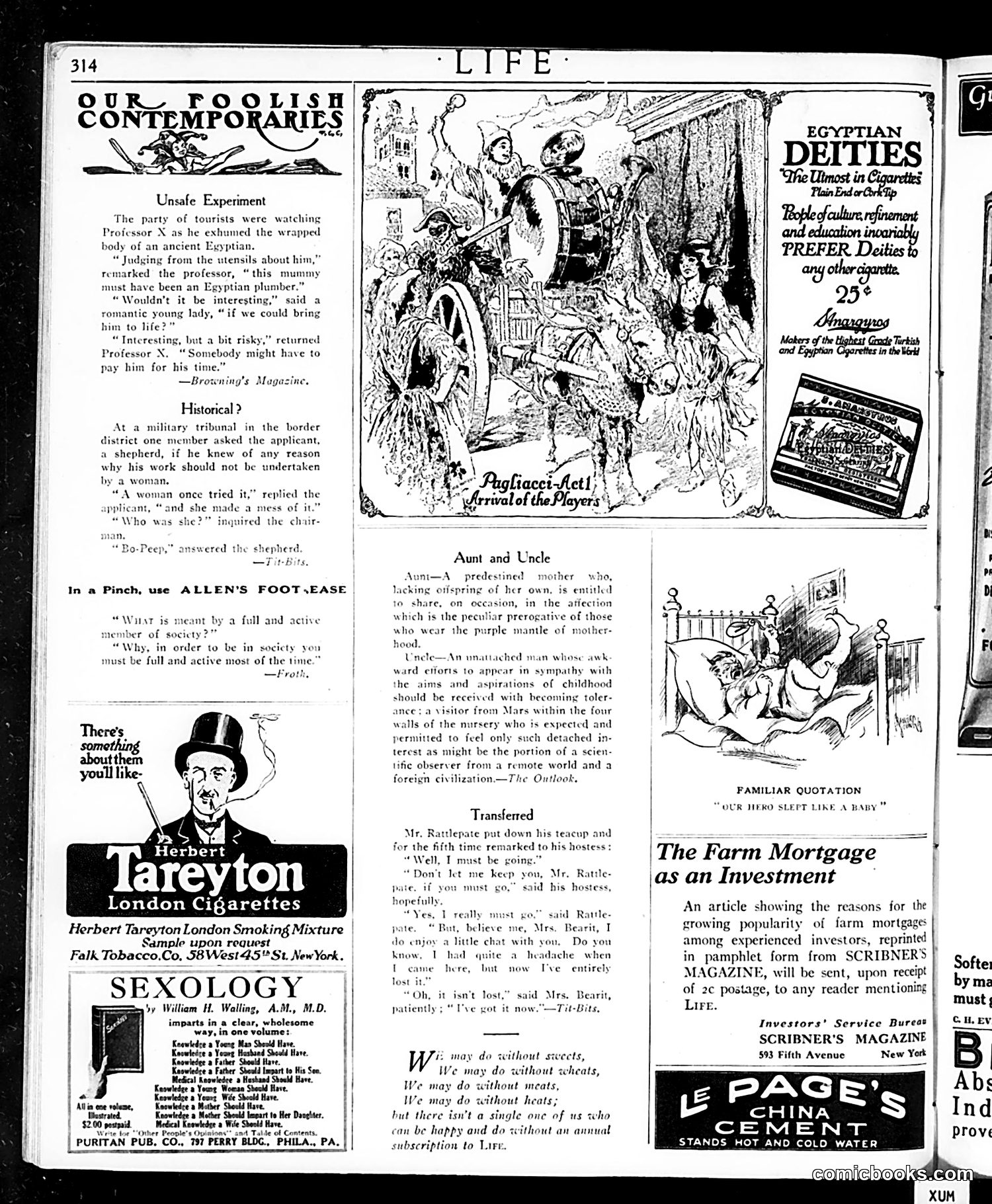
This page from *Life* magazine contains several short satirical pieces: **"Unsafe Experiment"**: Tourists watch Professor X unwrap an ancient Egyptian mummy. A romantic young woman suggests reviving him—until someone points out they'd have to *pay* him for his time. The joke: treating the dead laborer as someone who'd demand wages, mocking both romanticized views of the past and labor disputes of the era. **"Historical?"**: A shepherd applying for work is asked if any woman would object. He replies a woman already tried his work and "made a mess of it." The satire targets gender stereotypes and workplace discrimination. **"Transferred"**: A chatty houseguest repeatedly says he's leaving but stays. When he mentions his headache is gone, the hostess replies she's got it now—implying his company gave her one. Standard drawing-room humor about unwanted visitors. The remaining content is mostly **advertising** (cigarettes, books on sexology, foot powder, cement) typical of 1920s magazine filler.
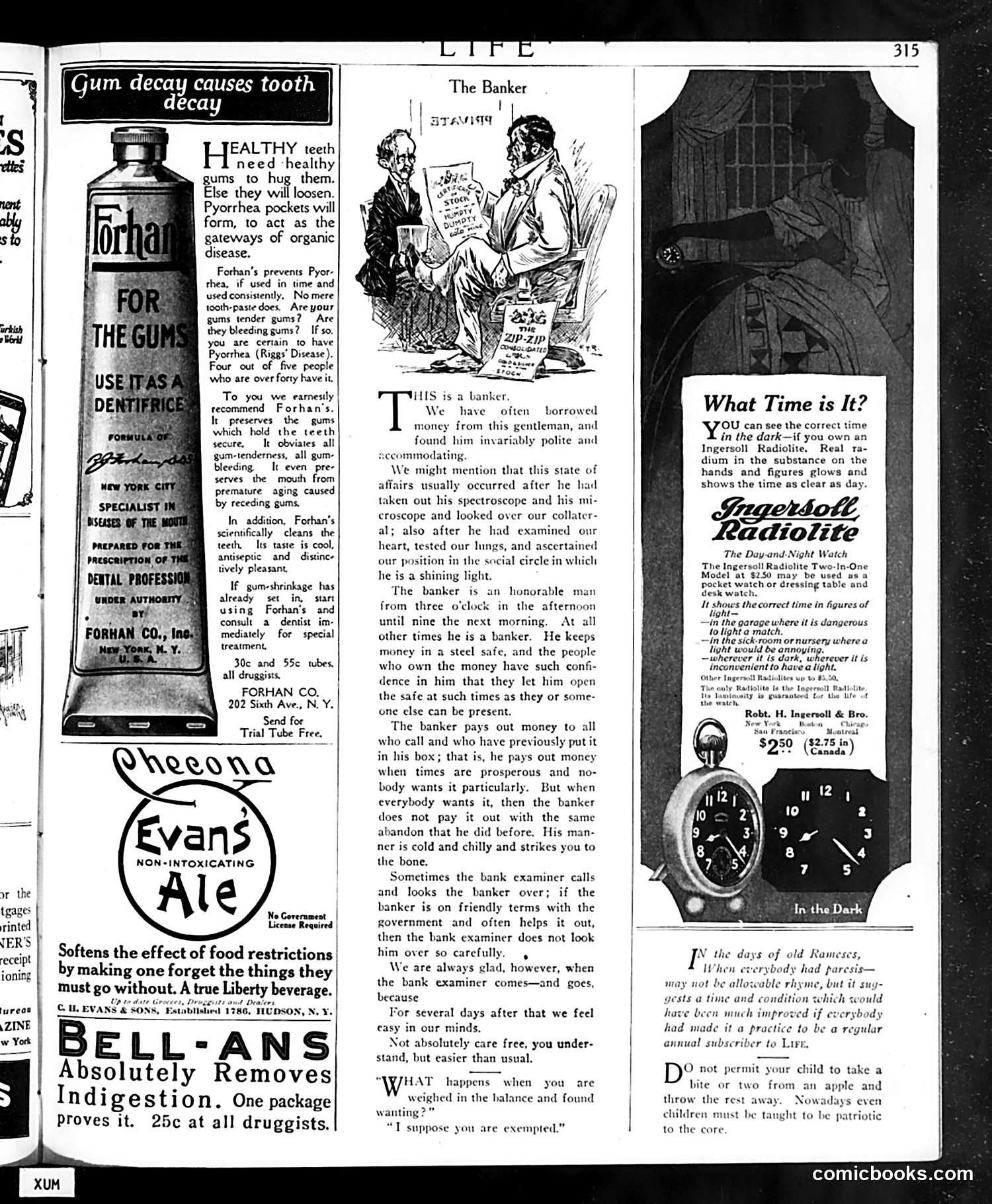
This Life magazine cartoon satirizes banker behavior and hypocrisy during the early 20th century. The text describes a banker as "honorable" only between 3 PM and 9 AM—implying dishonesty during business hours. The satire targets several banker practices: scrutinizing borrowers' collateral and social status before lending; keeping depositors' money in safes but refusing to pay it out during financial crises when people desperately need it; and receiving favorable treatment from bank examiners through government connections rather than honest practices. The closing dialogue joke—"What happens when you are weighed in the balance and found wanting?" / "I suppose you are exempted"—mocks bankers' apparent immunity from accountability despite their questionable ethics. This reflects public distrust of financial institutions common in early 1900s America, particularly after banking panics and the 1907 financial crisis.
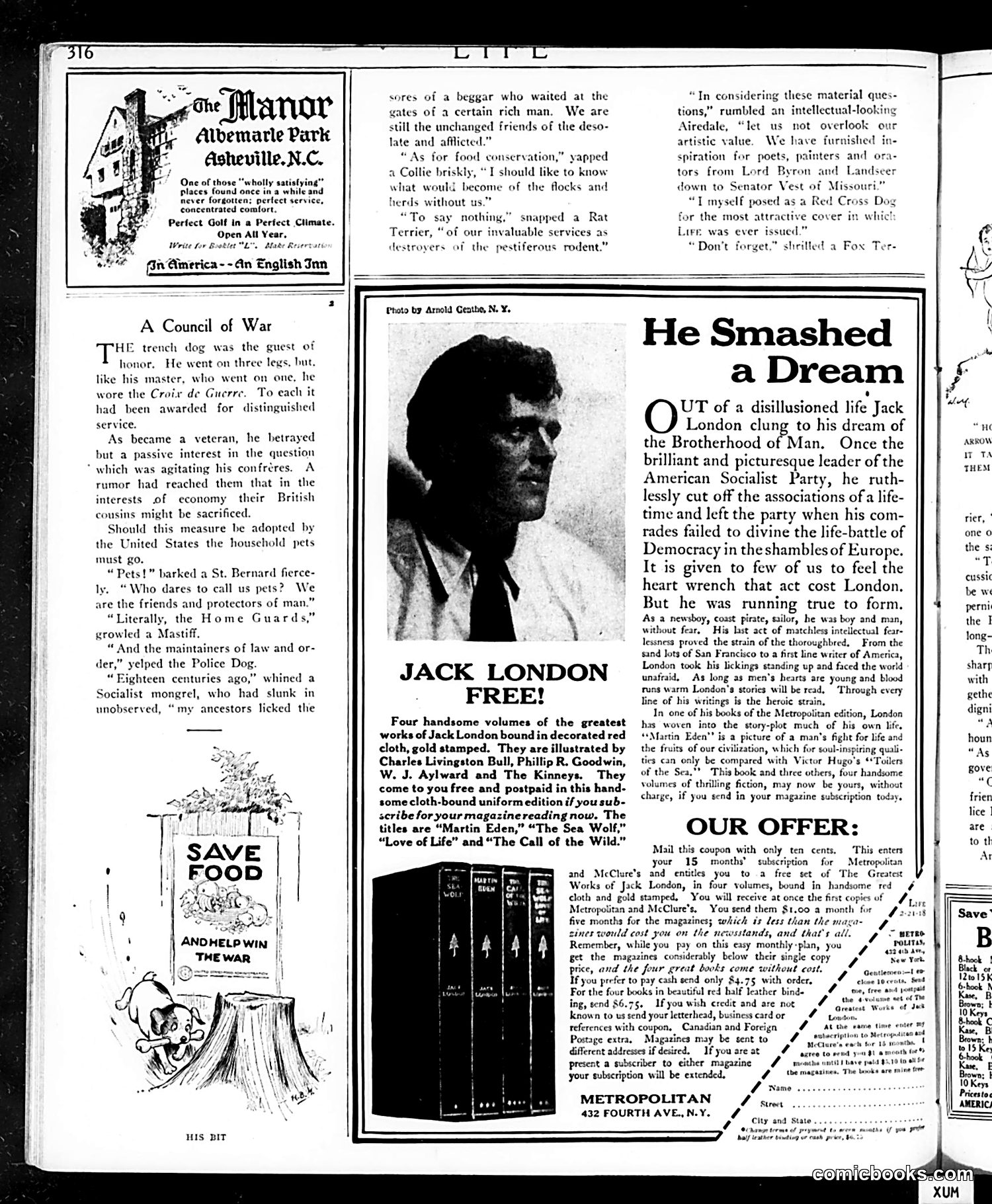
This satirical piece depicts dogs debating whether they should be sacrificed for wartime food economy. The trench dog guest of honor, a decorated WWI veteran (wearing the Croix de Guerre), listens passively while various breed archetypes argue their indispensability: the St. Bernard defends dogs as "protectors of man," the Mastiff claims they're "Home Guards," the Police Dog asserts their law-enforcement role, and a Collie emphasizes their usefulness protecting livestock. The satire targets post-WWI budget debates: politicians proposed eliminating "non-essential" expenditures, and the cartoon satirizes the absurdity of society potentially sacrificing animals that had served faithfully during the war. The Socialist mongrel's historical reference underscores the irony—dogs have always loyally served humanity. The piece critiques both wartime sacrifice rhetoric and proposed peacetime austerity measures that would betray loyal servants. The page also advertises Jack London books and an English inn.
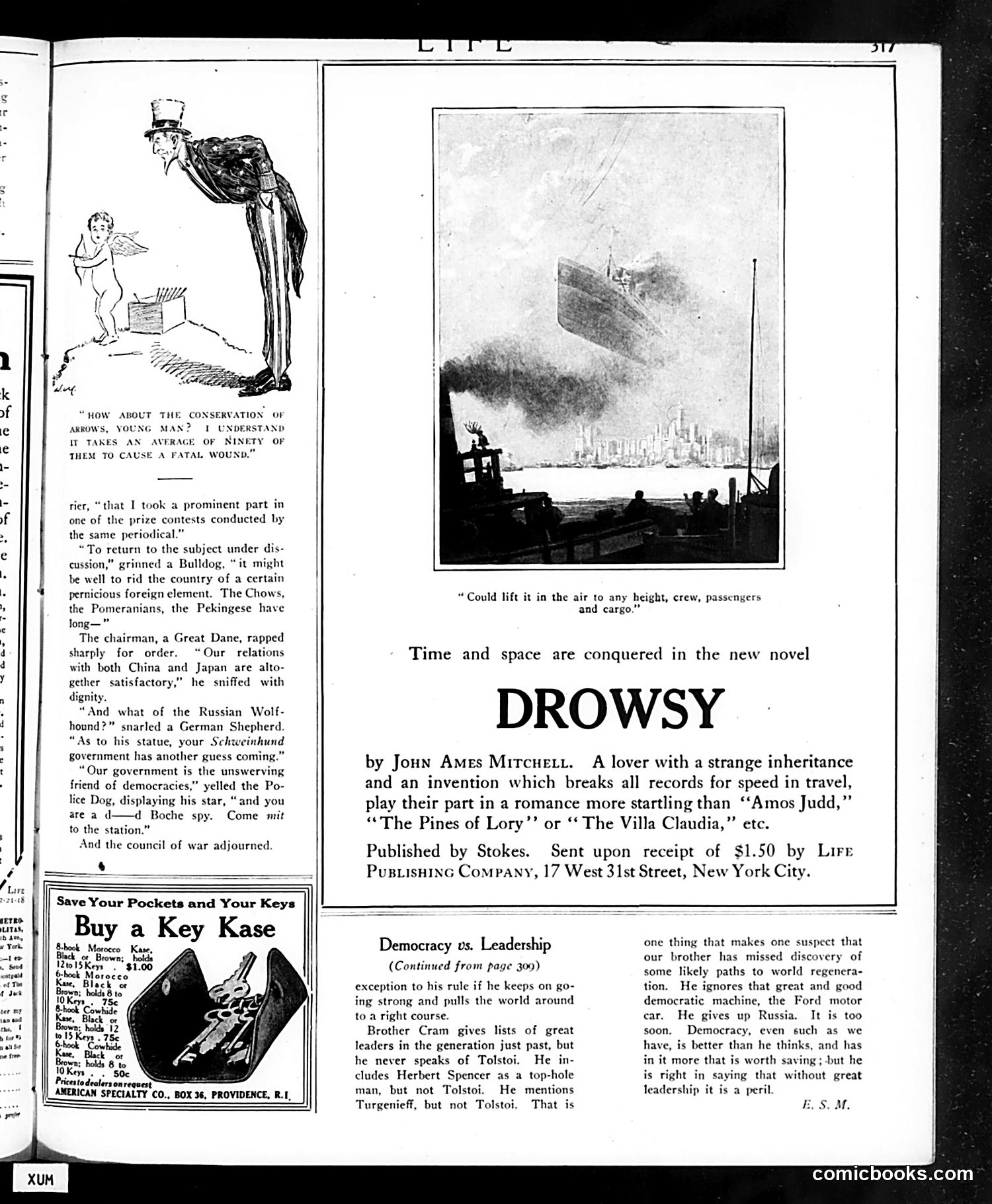
This cartoon satirizes international tensions and diplomatic posturing among world powers in the early 20th century, represented as dogs of different nationalities debating foreign policy. The **Great Dane** (Germany) chairs the meeting. A **Bulldog** (Britain) suggests eliminating "pernicious foreign elements"—specifically Chinese and Japanese immigrants—reflecting real anti-Asian sentiment. A **German Shepherd** sarcastically questions the **Police Dog** (America) about Russian relations. The Police Dog responds with patriotic rhetoric while accusing the Shepherd of being a "Boche spy" (German agent), invoking World War I tensions. The joke: these world leaders are bickering dogs incapable of honest dialogue, each spouting nationalist platitudes while accusing others of espionage. The casual racism toward Asian peoples and the absurdity of their "council of war" mock contemporary geopolitics as petty and hypocritical. The page also advertises *Drowsy*, a novel about aviation and speed—unrelated to the satire.
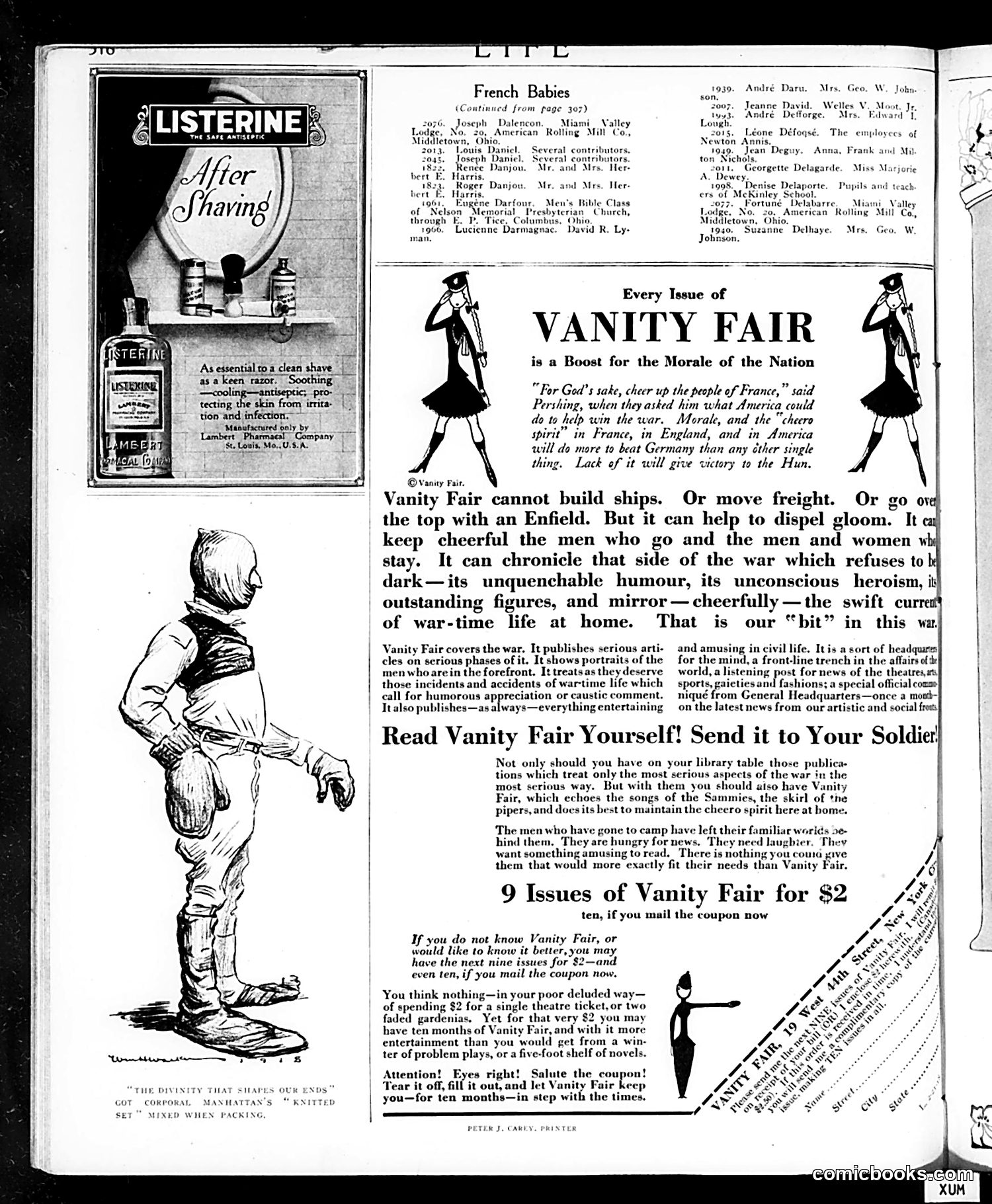
This page is primarily a **wartime propaganda advertisement** for *Vanity Fair* magazine during World War I (note references to "Germany," "the Hun," and General Pershing). The left side shows a Listerine aftershave ad unrelated to the main content. The central message quotes Pershing urging Americans to maintain morale in France and claims that *Vanity Fair*—while unable to build ships or fight directly—serves the war effort by combating gloom through humor, entertainment, and reporting on soldiers' lives. The publication positions itself as essential reading for both troops and the home front, offering "that side of the war which refuses to be dark." The offer of "9 Issues for $2" with coupon (bottom) frames magazine subscription as a patriotic act—readers are encouraged to send copies to soldiers. The illustrated soldier figure reinforces this military connection. This reflects how American media mobilized behind the war effort, marketing commercial products as contributions to national morale and military support.
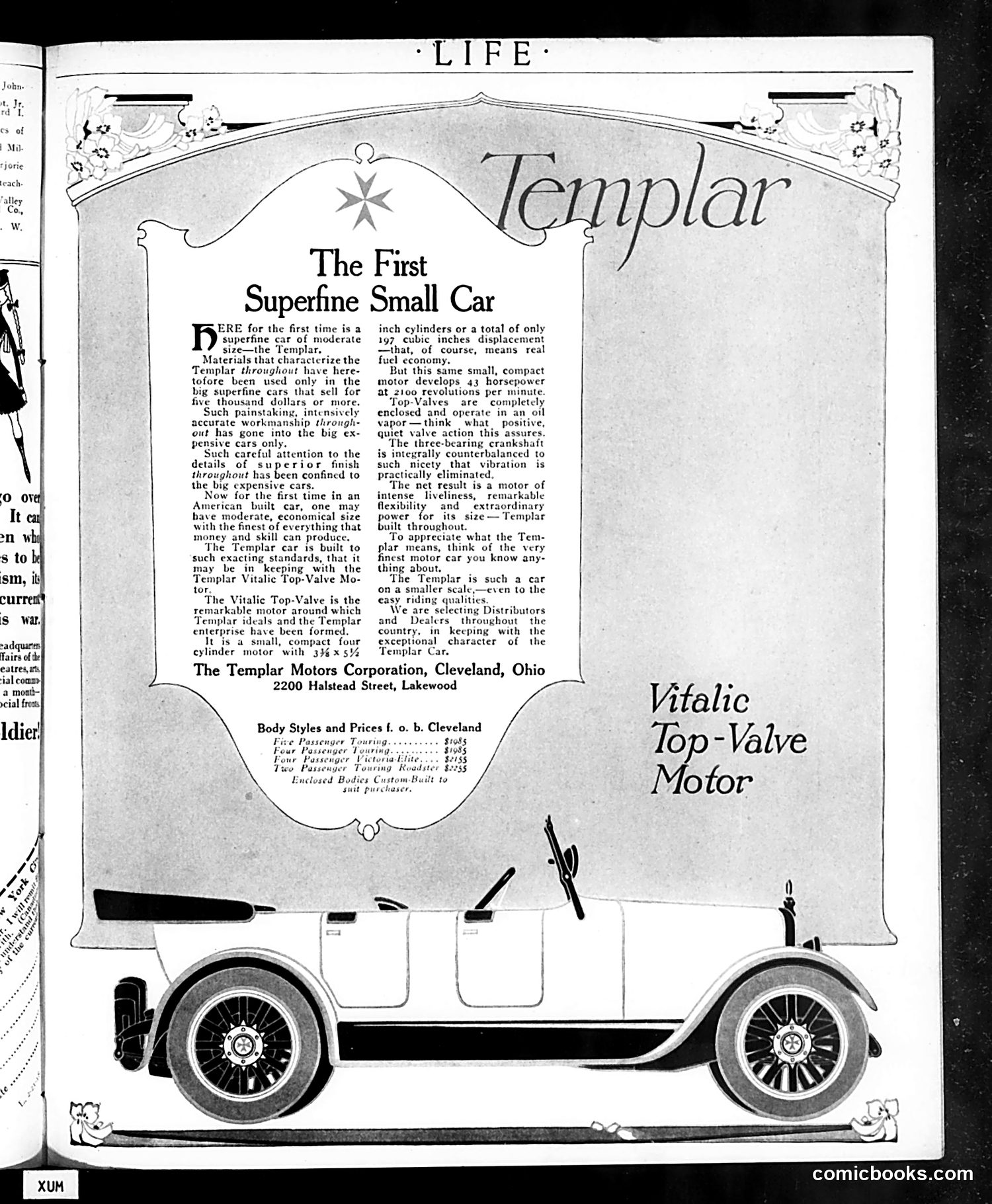
This is not satire or political commentary—it's a straightforward automobile advertisement for the Templar car, manufactured by Templar Motors Corporation in Cleveland, Ohio. The ad promotes the Templar as "the first superfine small car," claiming it offers luxury features previously available only in expensive vehicles costing $5,000+, but at moderate price and size. It emphasizes the innovative "Vitalic Top-Valve Motor"—a small four-cylinder engine (197 cubic inches) delivering 43 horsepower with fuel economy and vibration-free operation. The side-profile illustration shows a period-appropriate open-frame automobile with spoke wheels. The ad targets middle-class buyers seeking quality engineering without luxury pricing. This reflects 1920s automotive marketing, when such technical specifications and comparative claims were common selling points.