
Life, 1918-02-21 · page 22 of 40
Life — February 21, 1918 — page 22: what you’re looking at
What you’re looking at
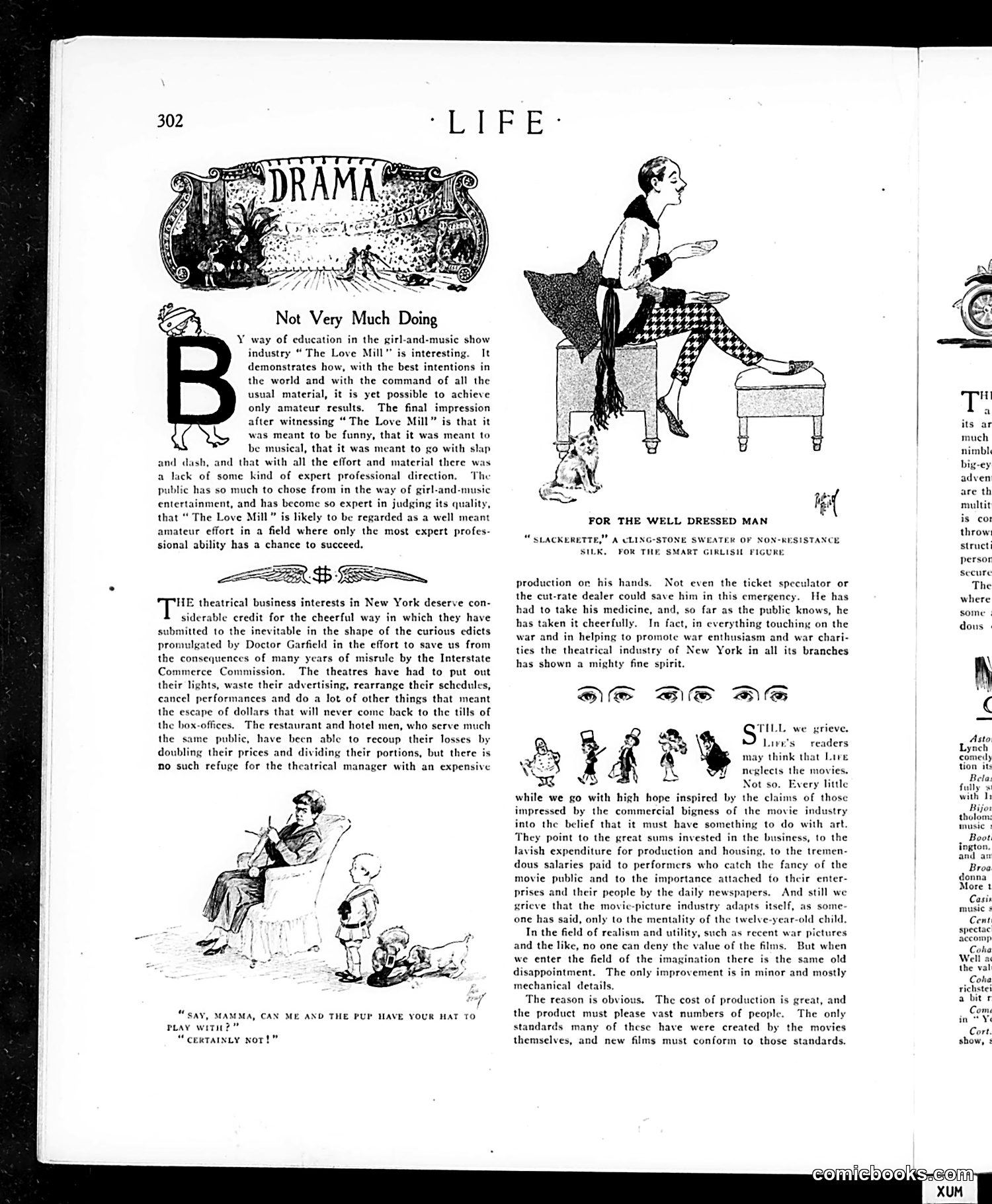
This page critiques American entertainment circa WWI era through several pieces: **"Not Very Much Doing"** reviews a theatrical production called "The Love Mill," dismissing it as well-intentioned but amateurish—lacking professional direction despite adequate resources. The writer notes audiences have become sophisticated judges of girl-and-music shows and expect professional quality. **The theatrical industry section** praises New York theaters for cheerfully complying with wartime restrictions imposed by "Doctor Garfield" (likely a reference to federal energy conservation measures), contrasting their sacrifice with restaurants that raised prices to compensate. It credits the theater industry with strong patriotic support for the war effort. **The final section** addresses readers' assumption that *Life* neglects movies. The writer admits initial optimism about film's artistic potential given its massive budgets and star salaries, but argues the industry "adapts itself...only to the mentality of the twelve-year-old child." While acknowledging war films' value, the piece contends that imaginative films show only minor mechanical improvements. The fundamental problem: production costs demand pleasing masses whose standards were *created by movies themselves*—a self-perpetuating cycle limiting artistic ambition.
📄 Transcribed text from this page (OCR, searchable)
Machine-transcribed from the original scan — historical spelling and the odd misread are preserved.
Not Very Much Doing Y way of education in the girl-and-music show industry “ The Love Mill" is interesting. It demonstrates how, with the best intentions in the world and with the command of all the usual material, it is yet possible to achieve only amateur results. The final impression after witnessing “The Love Mill” is that it ‘was meant to be funny, that it was meant to be musical, that it was meant to go with slap and dash, and that with all the effort and material there was a lack of some kind of expert professional direction. The public has so much to chose from in the way of girl-and-music entertainment, and has become so expert in judging its qualit that “ The Love Mill” is likely to be regarded as a well meant amateur effort in a field where only the most expert profes- sional ability has a chance to succeed. LASS HE theatrical business interests in New York deserve con- siderable credit for the cheerful way in which they have submitted to the inevitable in the shape of the curious edicts promulgated by Doctor Garfield in the effort to save us from the consequences of many years of misrule by the Interstate Commerce Commission. The theatres have had to put out their lights, waste their advertising, rearrange their schedules, cancel performances and do a lot of other things that meant the escape of dollars that will never come back to the tills of the box-offices. The restaurant and hotel men, who serve much the same public, have been able to recoup their losses by doubling their prices and dividing their portions, but there is no such refuge for the theatrical manager with an expensive “SAY, MAMMA, CAN ME AND THE PUP HAVE YOUR MAT TO PLAY with?” “ CERTAINLY Not!” at SLACKERETTE,” A CLING-STONE SWEATER OF NON-RESISTANCE SILK, FOR THE SMART GIRLISH FIGURE FOR THE WELL DRESSED MAN production or his hands. Not even the ticket speculator or the cut-rate dealer could save him in this emergency. He has had to take his medicine, and, so far as the public knows, he has taken it cheerfully. In fact, in everything touching on the war and in helping to promote war enthusiasm and war chari- ties the theatrical industry of New York in all its branches has shown a mighty fine spirit. TILL we grieve. Live's readers think that neglects the movies. Not so. Every little while we go with high hope inspired by the claims of those impressed by the commercial bigness of the movie industry into the belief that it must have something to do with art. They point to the great sums invested in the business, to the lavish expenditure for production and housing, to the tremen- dous salaries paid to performers who catch the fancy of the movie public and to the importance attached to their enter- prises and their people by the And still we grieve that the movie-picture industry adapts itself, as some- one has said, only to the mentality of the twelve-year-old child. In the field of realism and utility, such as recent war pictures and the like, no one can deny the value of the films. But when we enter the field of the imagination there is the same old disappointment. The only improvement is in minor and mostly mechanical details. The reason is obvious. The cost of production is great, and the product must please vast numbers of people. The only standards many of these have were created by the movies themselves, and new films must conform to those standards. ly newspapers, T" a its ar much nimbl big-ey adven are th multit is co throw: structi persor secure The where some dous | Asto Lynch comely tion its all ally with Ih Bijos Boot ington. and as Broa donna More t Casi music Cent spectac Coha Well a the val Coha richstei a bit r