
Life, 1918-02-21 · page 16 of 40
Life — February 21, 1918 — page 16: what you’re looking at
What you’re looking at
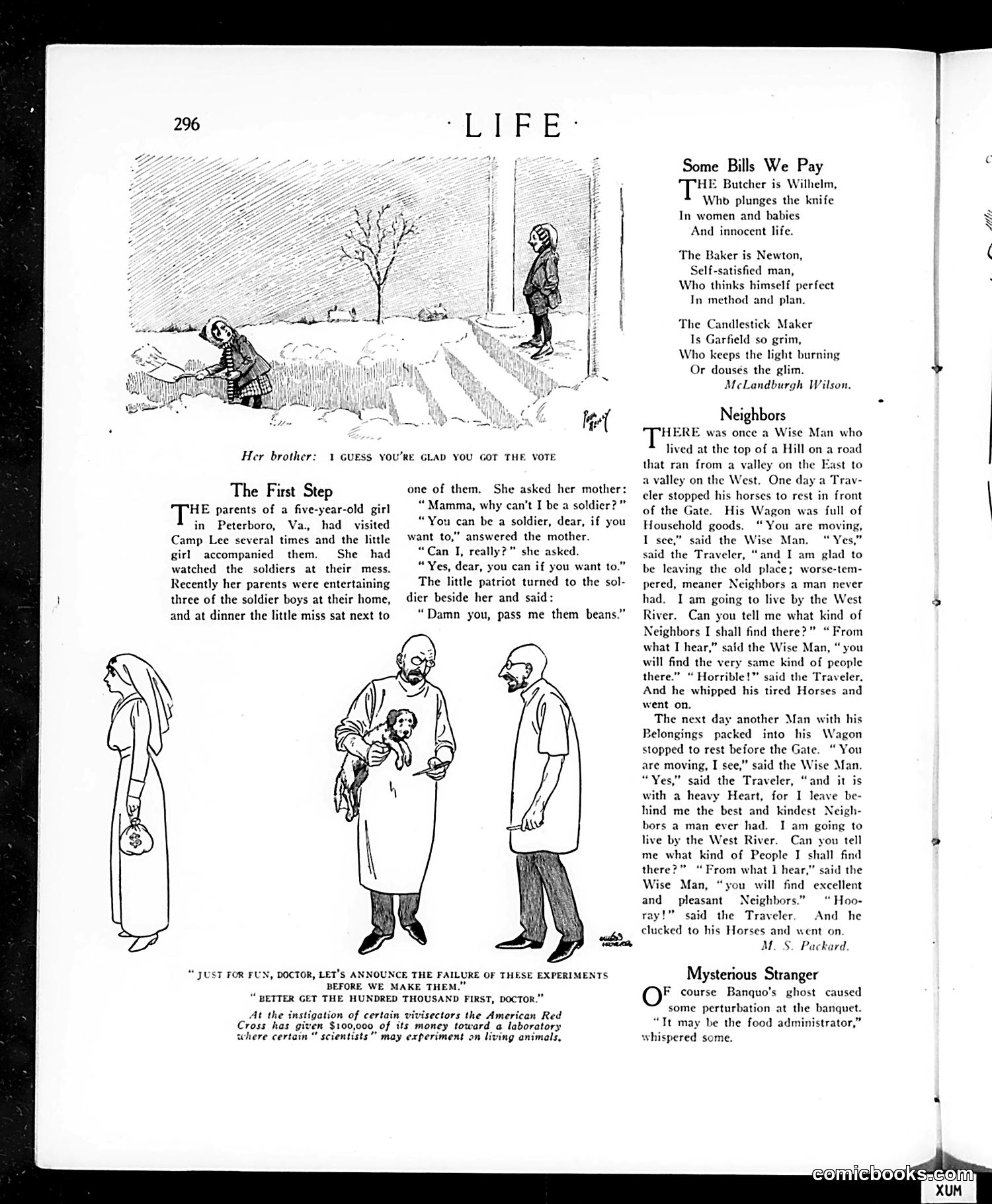
**"The First Step"** cartoon satirizes women's newly won voting rights (likely post-1920 suffrage). A young girl, inspired by watching soldiers at a military camp, mimics military language and authority by cursing at a soldier guest—suggesting that voting power has made women feel emboldened to behave more aggressively. The brother's comment about her "got the vote" frames this as a consequence of female suffrage, implying satire about women's changing social behavior. **"Some Bills We Pay"** uses nursery-rhyme format to mock wartime leadership. The figures (Wilhelm, Newton, Garfield) represent those responsible for WWI deaths and hardships—with "Wilhelm" likely referencing Kaiser Wilhelm II. It's anti-war satire. **"Neighbors"** is a moral fable: people find the same types everywhere; contentment depends on one's own attitude, not circumstances. **The cartoon below the poem** satirizes vivisection research: scientists request Red Cross funding ostensibly to "announce failure" before actually conducting experiments—criticizing animal testing as fraudulent science seeking money.
📄 Transcribed text from this page (OCR, searchable)
Machine-transcribed from the original scan — historical spelling and the odd misread are preserved.
Her brother: 1 GUESS YOU’RE GLAD YOU GOT THE VOTE The First Step spe parents of a five-year-old girl in Peterboro, Va., had visited Camp Lee several times and the little girl accompanied them. She had watched the soldiers at their mess. Recently her parents were entertaining three of the soldier boys at their home, and at dinner the little miss sat next to one of them, She asked her mother: “Mamma, why can’t I be a soldier?” “You can be a soldier, dear, if you want to,” answered the mother. “Can I, really?” she asked. “Yes, dear, you can if you want to.” The little patriot turned to the sol- dier beside her and said: “Damn you, pass me them beans.” “ JUST FOR FUN, DOCTOR, LET'S ANNOUNCE THE FAILURE OF THESE EXPERIMENTS BEFORE WE MAKE THEM.” “ BETTER GET THE HUNDRED THOUSAND FIRST, DOCTOR.” At the instigation of certain vivisectors the American Red Cross has given $100,000 of its money toward a laboratory where certain “ scientists” may experiment on living animals, Some Bills We Pay 'HE Butcher is Wilhelm, Who plunges the knife In women and babies And innocent life. The Baker is Newton, Self-satisfied man, Who thinks himself perfect In method and plan. The Candlestick Maker Is Garfield so grim, Who keeps the light burning Or dousés the glim. McLandburgh Wilson, Neighbors 2 was once a Wise Man who a valley on the West. One cler stopped his horses to rest in front of the Gate. His Wagon was full of Household goods. “ You are moving, I see,” said the Wise Man. “Ye said the Traveler, “and I am glad to be leaving the old place; worse-tem- pered, meaner Neighbors a man never had. I am going to live by the West River. Can you tell me what kind of Neighbors I shall find there?” “From what I hear,” said the Wise Man, “ you will find the very same kind of people there.” “ Horrible!” said the Traveler. And he whipped his tired Horses and went on. The next day another Man with his Belongings packed into his Wagon stopped to rest before the Gate. “ You are moving, I see,” said the Wise Man. “Yes,” said the Traveler, “and it is with a heavy Heart, for I leave be- hind me the best and kindest Neigh- bors a man ever had. I am going to live by the West River. Can you tell it kind of People I shall find “From what I hear,” said the Wise Man, “you will find excellent and pleasant Neighbors.” “ Hoo- ray!" said the Traveler. And he clucked to his Horses and went on. M.S. Packard. Mysterious Stranger OF course Banquo’s ghost caused some perturbation at the banquet. “Tt may be the food administrator,” whispered some. ma. Jae