
Life, 1918-02-21 · page 9 of 40
Life — February 21, 1918 — page 9: what you’re looking at
What you’re looking at
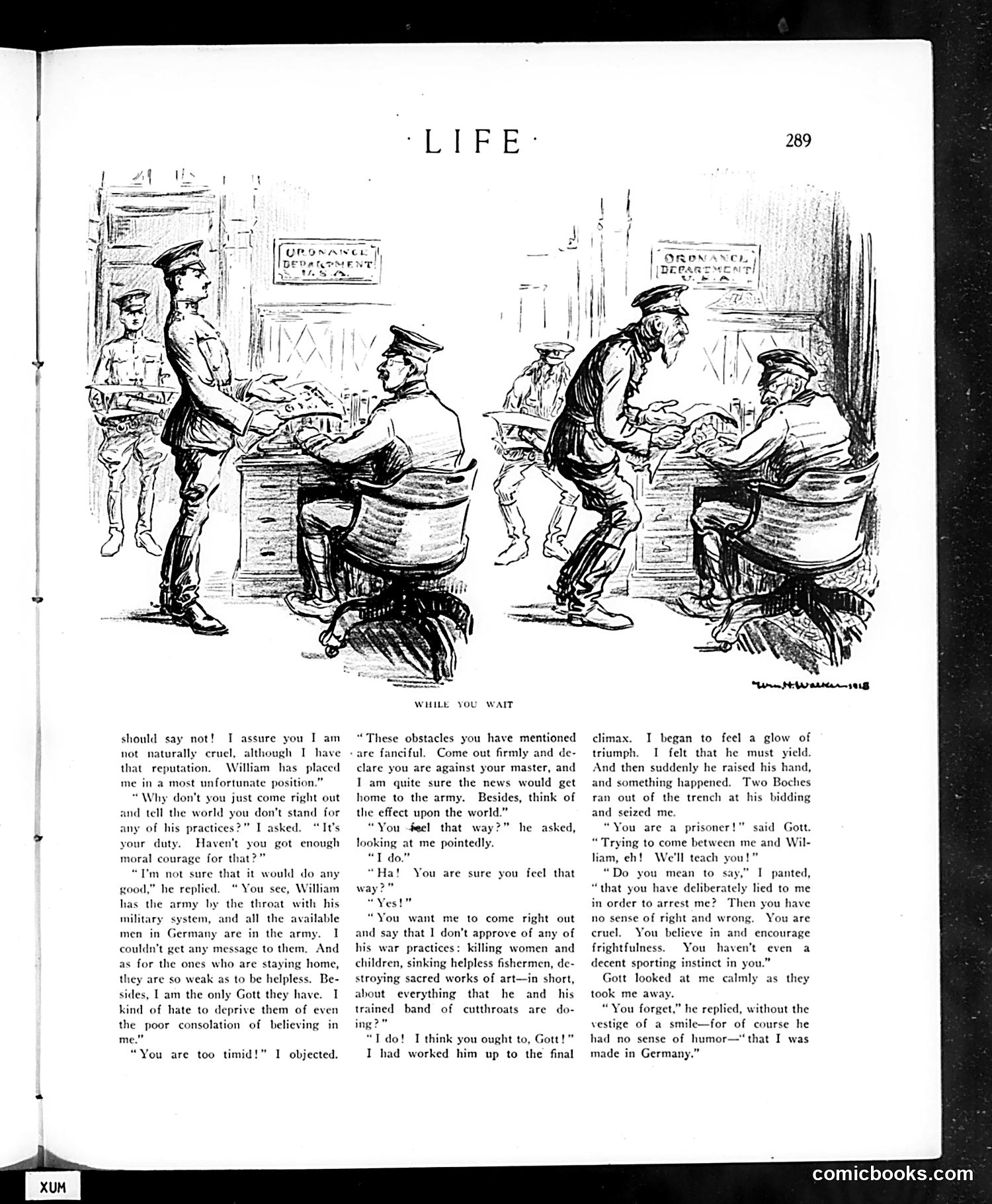
This two-panel cartoon satirizes military bureaucracy during World War I. Both panels depict soldiers at an "Ordnance Department" desk, where an officer processes requests while other soldiers wait. The joke contrasts the soldiers' urgent needs with the slow, indifferent pace of military administration. The title "While You Wait" is ironic—the soldiers are clearly waiting extensively for basic supplies or paperwork. The accompanying text dialogue suggests tension between a soldier (possibly named Gott or William) and an officer about military practices. The conversation touches on German military conduct and moral questions about warfare, reflecting broader WWI-era debates about military ethics and the competence of command structures. The cartoon mocks the gap between frontline soldiers' needs and bureaucratic inefficiency.
📄 Transcribed text from this page (OCR, searchable)
Machine-transcribed from the original scan — historical spelling and the odd misread are preserved.
"ans IT assure you I am I 1 should say not! not naturally cruel, although that reputation. William has me in a most unfortunate position.’ “Why don’t you just come right out and tell the world you don't stand for any of his practices?” I asked. “It’s your duty. Haven't you got enough moral courage for that?” “T'm not sure that it would do any good,” he replied. “You see, William has the army by the throat with his military system, and all the available men in Germany are in the army. I couldn't get any message to them. And as for the ones who are staying home, they are so weak as to be helpless. Be- Lam the only Gott they have. I kind of hate to deprive them of even the poor consolation of believing in mi “You are too timid!” I objected. sare fanciful. WHILE YOU WAIT “These obstacles you have mentioned Come out firmly and de- clare you are against your master, and I am quite sure the news would get home to the army. Besides, think of the effect upon the world.” “You eel that way?” he asked, looking at me pointedly. “T do.” “Ha! You are sure you feel that a0 way? “Yes!” “You want me to come right out and say that 1 don’t approve of any of his war practices: killing women and children, sinking helpless fishermen, de- stroying sacred works of art—in short, about everything that he and_ his trained band of cutthroats are do- ing?” “Ido! I think you ought to, Gott!” I had worked him up to the final 289 climax. I began to feel a glow of triumph. I felt that he must yield. And then suddenly he raised his hand, and something happened. Two Boches ran out of the trench at his bidding and seized me. “You are a prisoner!” said Gott. “Trying to come between me and Wil- liam, eh! We'll teach you!” “Do you mean to say,” I panted, “that you have deliberately lied to me in order to arrest me? Then you have no sense of right and wrong. You are cruel. You believe in and encourage frightfulness. You haven't even a decent sporting instinct in you.” Gott looked at me calmly took me away. You forget,” he replied, without the vestige of a smile—for of course he had no sense of humor—“that I was made in Germany.” s they comicbooks.com