
Life, 1918-02-21 · page 6 of 40
Life — February 21, 1918 — page 6: what you’re looking at
What you’re looking at
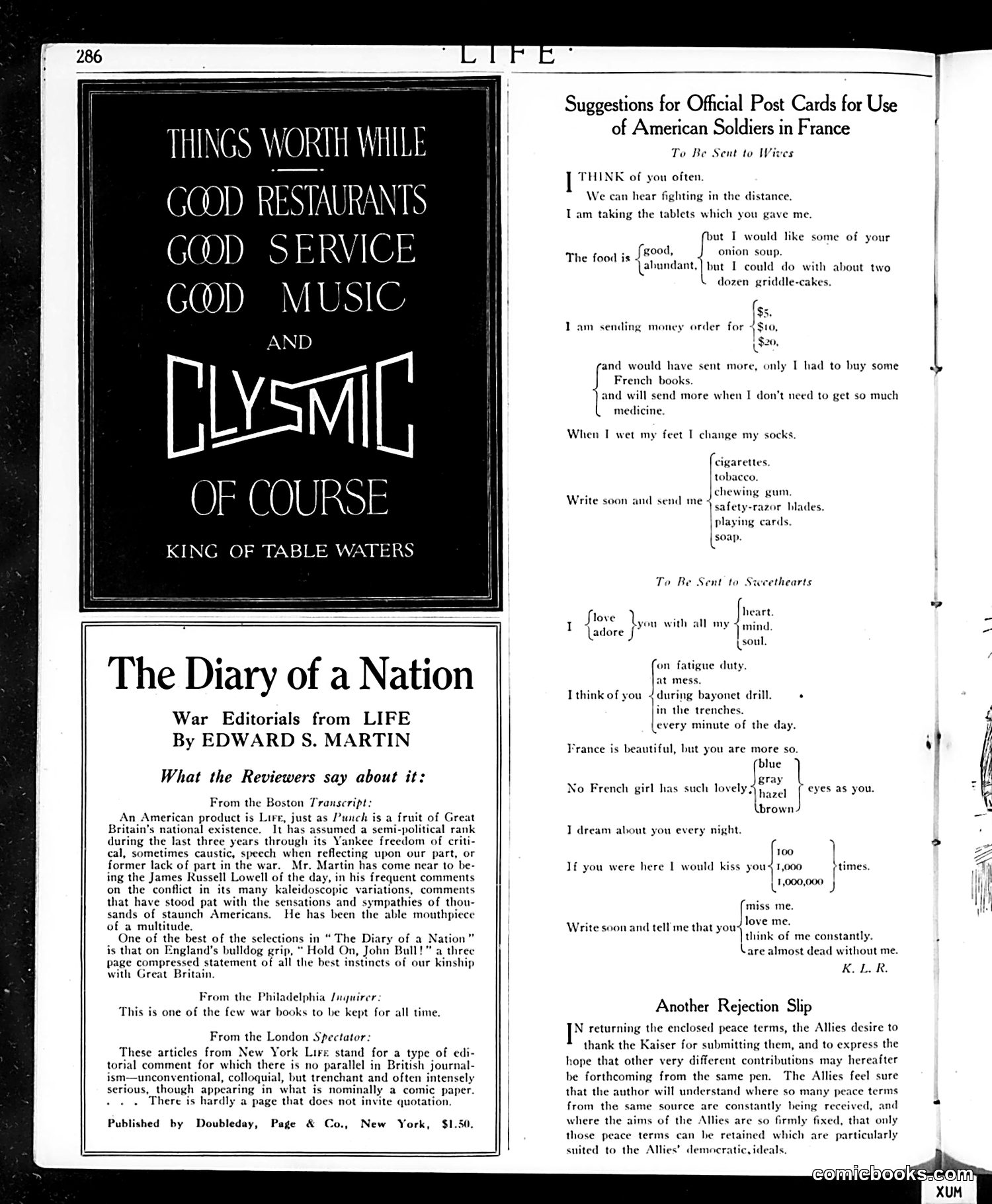
This page contains three distinct elements: an advertisement for "Plysmic" (a product associated with dining/restaurants), a book review for Edward S. Martin's "The Diary of a Nation" (war editorials from Life magazine), and suggestions for official postcards American soldiers in France could send home. The postcard suggestions humorously capture soldier perspectives—requests for food, money, tobacco, and romantic sentiments to sweethearts. The satire lies in contrasting the soldiers' mundane desires (onion soup, griddle-cakes) and homesickness with the gravity of WWI combat they're enduring ("fighting in the distance," "trenches"). The page satirizes the disconnect between wartime reality and soldiers' everyday longings, reflecting WWI-era American attitudes toward the military experience.
📄 Transcribed text from this page (OCR, searchable)
Machine-transcribed from the original scan — historical spelling and the odd misread are preserved.
THINGS WORTH WHILE | GCOD RESTAURANTS SERVICE GMD MUSIC PLySw OF COURSE KING OF TABLE WAT The Diary of a Nation War Editorials from LIFE By EDWARD S. MARTIN What the Reviewers say about it: From the Boston Transcript: An American product is Lire, just as Punch is a fruit of Great Britain’s national existence. It has assumed a semi-political rank during the last three years through its Yankee freedom of criti- cal, sometimes caustic, speech when reflecting upon our part, or former lack of part in the war. Mr. Martin has come near to be- ing the James Russell Lowell of the day, in his frequent comments on the conflict in its many kaleidoscopic variations, comments that have stood pat with the sensations and sympathies of thou- sands of staunch Americans. He has been the able mouthpiece of a multitude. One of the best of the selections in “The Diary of a Nation” is that on England’s bulldog grip, “ Hold On, John Bull!” a three | page compressed statement of all the best instincts of our kinship | with Great Britain From the Philadelphia /uquirer: This is one of the few war books to be kept for all time, From the London Spectator: | These articles from New York Lire stand for a type of edi- torial comment for which there is no parallel in British journal- ism—unconventional, colloquial, but trenchant and often intensely serious, though appearing in what is nominally a comic paper. +. « There is hardly a page that does not invite quotation. | ml Published by Doubleday, Page & Co., New York, $1.50 Suggestions for Official Post Cards for Use of American Soldiers in France To Be Seut to Wives PHINK of you often We can hear figliting in the distance Tam taking the tablets which you gave me. but T would like some of your {good, onion soup. [abundant.} but I could do with about two dozen griddle-cakes. The food is - (ss. Lam sending money order for 4$to, (Se. and would have sent more, only I had to buy some French books. and will send more when I don’t need to get so much medicine. When I wet my feet T change my socks cigarettes. tobacco. wei chewing gum. rite soon a Ml send me 4 ofety-razor Ilades. | playing cards [soap. To Re Sent to Sweethearts heart. I Stove yon with all a p mind. ladore f [oa “ on fatigue duty it mess, Ithink of you {during bayonet drill. + in the trenches. {every minute of the di France is beautiful, but you are more so. blue No French girl has such lovely I eyes as you. lbrown I dream about you every night. 100 | If you were here 1 would kiss you41,000 times 7,000,000, | miss me. love me, Write soon and tell me that you = think of me constantly. Care almost dead without me. K.L.R. Another Rejection Slip I‘ returning the enclosed peace terms, the Allies desire to thank the Kaiser for submitting them, and to express the hope that other very different contributions may hereafter be forthcoming from the same pen. The Allies feel sure that the author will understand where so many peace terms from the same source are constantly being received, and where the ns of the Allies are so firmly fixed, that only those peace terms can be retained which are particularly suited to the Allies’ democratic, ideals, | |