
Life, 1918-02-21 · page 2 of 40
Life — February 21, 1918 — page 2: what you’re looking at
What you’re looking at
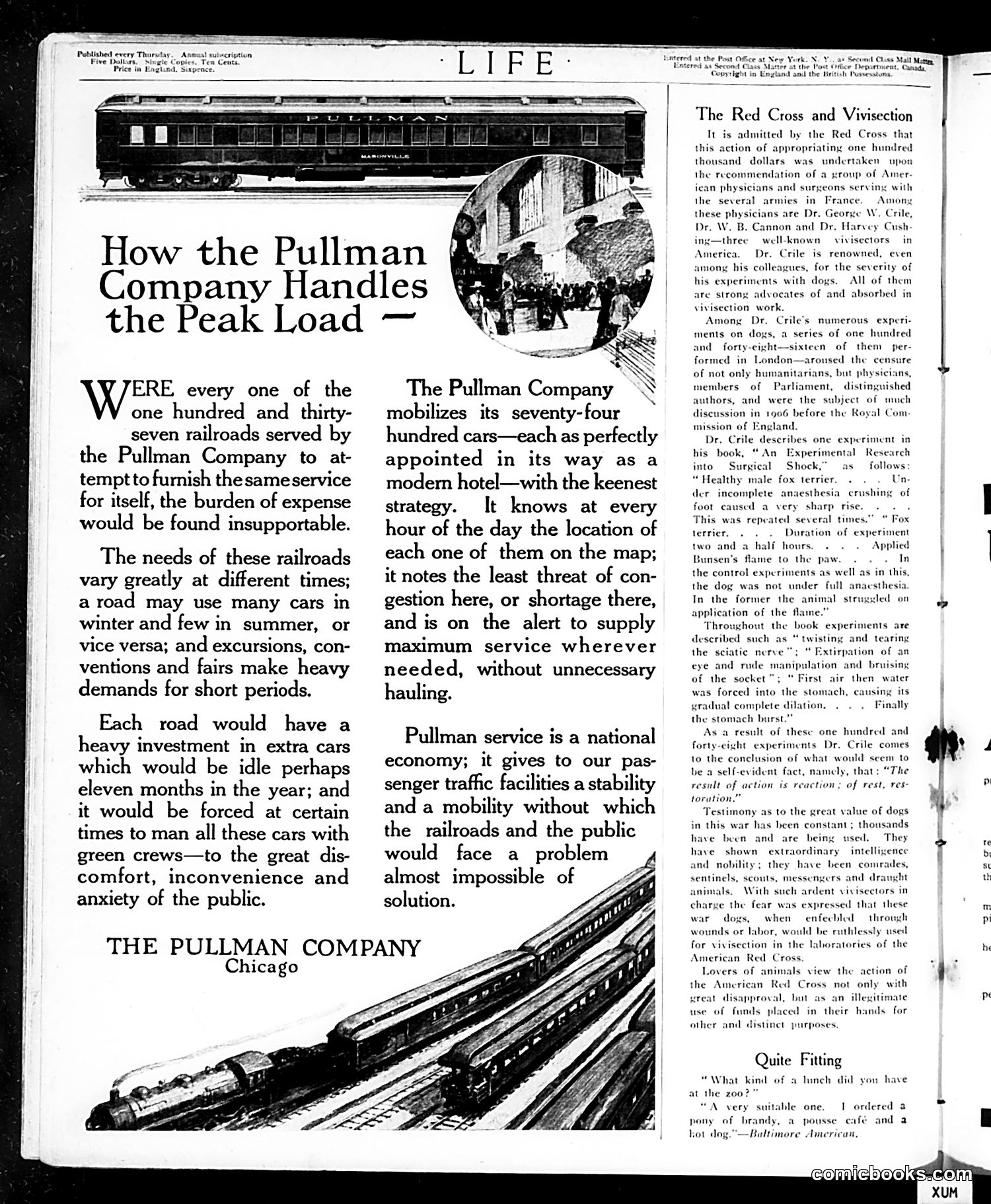
This page is primarily a **corporate advertisement** for the Pullman Company, which manufactured and operated luxury railroad sleeping cars. It's not political satire. The ad explains how Pullman manages the "peak load" problem: different railroads need varying numbers of cars seasonally (many in winter, few in summer). Rather than each railroad owning idle cars, Pullman centralizes ownership of 7,400 cars across 74 railroads, deploying them efficiently wherever demand peaks occur. The accompanying images show a Pullman sleeper car and a streamlined locomotive, emphasizing modern service and technology. The right column contains unrelated editorial content about Red Cross vivisection experiments—a separate article, not part of the advertisement.
📄 Transcribed text from this page (OCR, searchable)
Machine-transcribed from the original scan — historical spelling and the odd misread are preserved.
ERE every one of the one hundred and thirty- seven railroads served by the Pullman Company to at- tempt to furnish the sameservice for itself, the burden of expense would be found insupportable. The needs of these railroads vary greatly at different times; aroad may use many cars in winter and few in summer, or vice versa; and excursions, con- ventions and fairs make heavy demands for short periods. Each road would have a heavy investment in extra cars which would be idle perhaps eleven months in the year; and it would be forced at certain times to man all these cars with green crews—to the great dis- comfort, inconvenience and anxiety of the public. THE PURPA COMPANY hicago Company Handles the Peak Load — SN The Pullman Company mobilizes its seventy-four hundred cars—each as perfectly appointed in its way as a modern hotel—with the keenest It knows at every hour of the day the location of each one of them on the map; it notes the least threat of con- gestion here, or shortage there, and is on the alert to supply maximum service wherever needed, without unnecessary strategy. hauling. Pullman service is a national economy; it gives to our pas- senger traffic facilities a stability and a mobility without which the railroads and the public would face a problem almost impossible of solution. The Red Cross and Vivisection It is admitted by the Red Cross that this action of appropriating one hundred thousand dollars was undertaken upon the recommendation of a xroup of Ay th ican physicians and surg the several armies in France. Among these physici: ree W. Crile, ‘annon and Dr. Harvey Cush well-known viviseetors in Dr. Crile is renowned, even sues, for the severity of th dogs. All of them dvocates of and absorbed in vivisection work. Among Dr. Crile’s numerous. experi- a series of one hundred ments on do; and forty-cigh' formed in Lon sixteen of them per- roused the censure ians, but physicians, ished much of not only humanit: members of Parliament, disti authors, and were the subject ¢ discussion in 1906 before the Royal Com. mission of England. Dr. Crile describes one experiment in ook, “An Experimental Research as follows hi: into Surgical Shock “Healthy male fox terri der incomplete anaesth foot caused a very sharp rise. This was repeated several ti Un crushing of terrier... . Duration of experiment two and a half hours. . . . Applied Bunsen’s flame to the paw. 2. In ell as in this, the control experiments a the dog was not under full at In the former the animal str: application of the flame.” Throughout the book experiments are and. tearing described such as “ twistit the sciatic nerve irpation of an eye and rude mani of the socke! was forced into gradual complet nand bruising a rst air then wa stomach, cau lation, . . Finally the stomach burst As a result of these one hundred and forty-eight experiments Dr. Crile comes to the conclusion of what would seem to be a self-evident fact, namely, that: “The toration.” Testimony as to the great value of dogs in this war has been constant; thousands have been and are being used. They have shown extraordinary intelligence and nobility; they have been comrades, rs and dr: ht sentinels, scouts, 1 animals. With such ardent vivisectors in charge the fear was expressed that these war when enfechled through wounds of labor, would be ruthlessly used for vivisection in the laboratories of the American Red Cross. Lovers of animals view the action of the American Red Cross not only with imate js for t disapproval, but as an ill ar use of funds placed in their other and distinct purposes Quite Fitting “What kind of a lunch did you have at the 200?” “A very suitable one. 1 ordered a pony of brandy, a pousse café and a hot dog."—Bultimore American,