
Life, 1918-02-21 · page 18 of 40
Life — February 21, 1918 — page 18: what you’re looking at
What you’re looking at
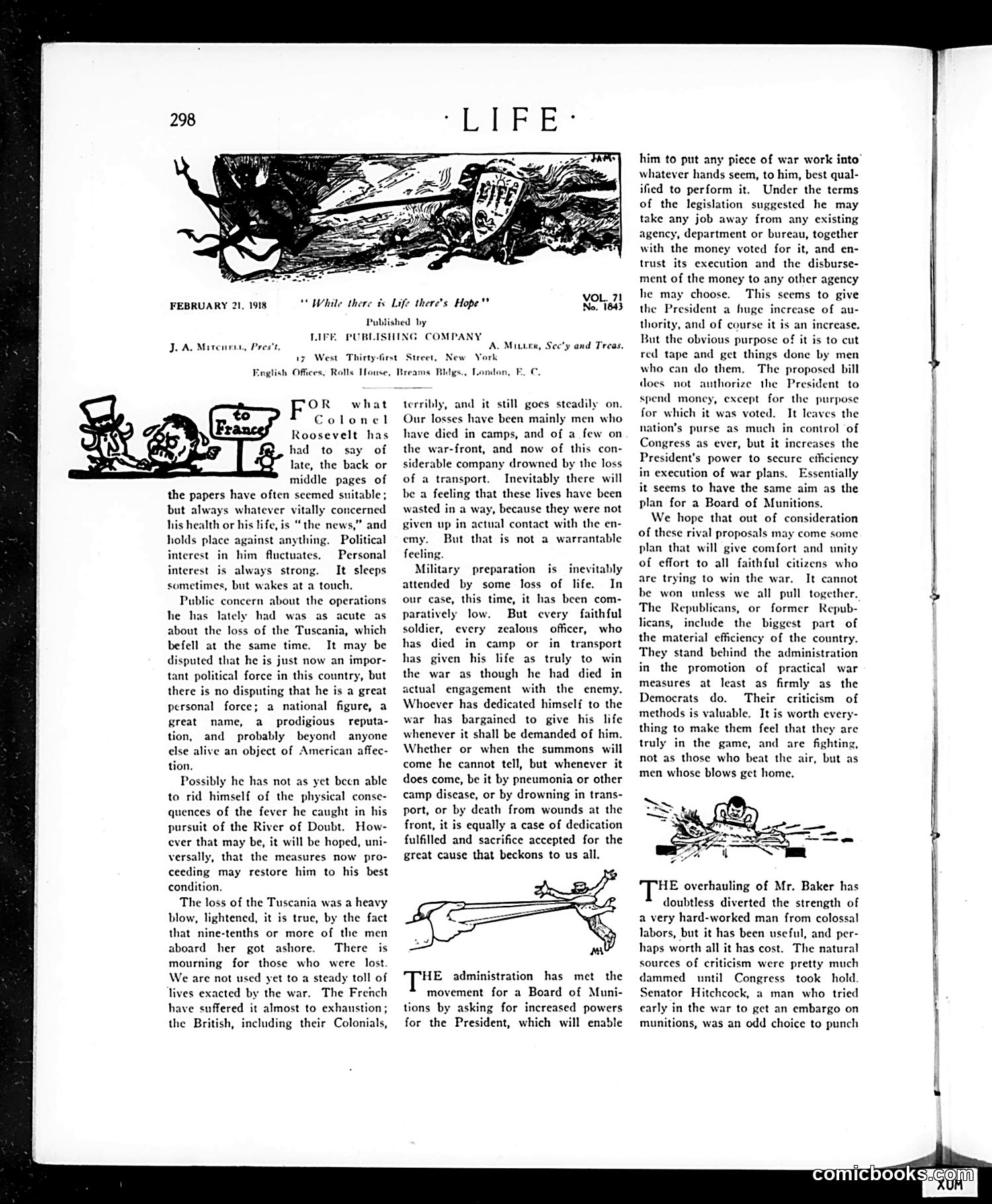
This page combines editorial commentary with satirical cartoons addressing two main subjects: **Theodore Roosevelt's Health**: The opening discusses Colonel Roosevelt's recent surgery following his illness contracted during his "River of Doubt" expedition. The editors note his status as a major national figure commanding public interest comparable to major war news (the loss of the ship *Tuscania*). **The Board of Munitions Debate**: The main editorial criticizes the Wilson administration's proposal to grant the President expanded wartime powers to reassign war work between agencies without congressional oversight. The editors view this as potentially excessive executive authority, though they acknowledge the stated goal of cutting "red tape." The cartoon imagery (depicting military/war themes) supports these discussions of wartime government efficiency and presidential power—key political controversies of 1918 as America deepened its World War I involvement.
📄 Transcribed text from this page (OCR, searchable)
Machine-transcribed from the original scan — historical spelling and the odd misread are preserved.
FEBRUARY 21, 1918 LIFE PUBLISH JL A. Mirenrit, Pres’t, “* While there ts Life there's Hope" VOL. 71 No. 1643 hed by COMPA A. Mitte, Sec’y and Treas. 17 West Thirty-first: Street, New York English Offices, Rolls Honse, F OR what Colonel Roosevelt has had to say of late, the back or middle pages of the papers have often seemed suitable ; but always whatever vitally concerned his health or his life, is “the news,” and holds place against anything. Political interest in him fluctuates, Personal interest is always strong. It sleeps sometimes, but wakes at a touch, Public concern about the operations he has lately had was as acute as about the loss of the Tuscania, which befell at the same time. It may be disputed that he is just now an impor- tant political force in this country, but there is no disputing that he is a great personal force; a national figure, a great name, a_ prodigious reputa- tion, and probably beyond anyone else alive an object of American affec- tion. Possibly he has not as yet been able to rid himself of the physical conse- quences of the fever he caught in his pursuit of the River of Doubt. How- ever that may be, it will be hoped, uni- versally, that the measures now pro- ceeding may restore him to his best condition. The loss of the Tuscania was a heavy blow, lightened, it is true, by the fact that nine-tenths or more of the men aboard her got ashore. There is mourning for those who were lost. We are not used yet to a steady toll of lives exacted by the war. The French have suffered it almost to exhaustion; the British, including their Colonials, Treas Bllgs., Londo ton terribly, and it still goes steadily on. Our losses have been mainly men who have died in camps, and of a few on the war-front, and now of this con- siderable company drowned by the loss of a transport. Inevitably there will be a feeling that these lives have been wasted in a way, because they were not given up in actual contact with the en- emy. But that is not a warrantable feeling. Military preparation is inevitably attended by some loss of life. In our case, this time, it has been com- paratively low. But every faithful soldier, every zealous officer, who has died in camp or in transport has given his life as truly to win the war as though he had died in actual engagement with the enemy. Whoever has dedicated himself to the war has bargained to give his life whenever it shall be demanded of him. Whether or when the summons will come he cannot tell, but whenever it does come, be it by pneumonia or other camp disease, or by drowning in trans- port, or by death from wounds at the front, it is equally a case of dedication fulfilled and sacrifice accepted for the great cause that beckons to us all. HE administration has met the movement for a Board of Muni- tions by asking for increased powers for the President, which will enable him to put any piece of war work into whatever hands seem, to him, best qual- ified to perform it. Under the terms of the legislation suggested he may take any job away from any existing agency, department or bureau, together with the money voted for it, and en- trust its execution and the disburse- ment of the money to any other agency he may choose. This seems to give the President a huge increase of au- thority, and of course it is an increase, But the obvious purpose of it is to cut red tape and get things done by men who can do them, The proposed bill does not authorize the President to spend money, except for the purpose for which it was voted. It leaves the nation’s purse as much in control of Congress as ever, but it increases the President’s power to secure efficiency in execution of war plans. Essentially it seems to have the same aim as the plan for a Board of Munitions. We hope that out of consideration of these rival proposals may come some plan that will give comfort and unity of effort to all faithful citizens who are trying to win the war. It cannot be won unless we all pull together. The Republicans, or former Repub- licans, include the biggest part of the material efficiency of the country. They stand behind the administration in the promotion of practical war measures at least as firmly as the Democrats do. Their criticism of methods is valuable. It is worth every- thing to make them feel that they are truly in the game, and are fighting, not as those who beat the air, but as men whose blows get home. HE overhauling of Mr. Baker has doubtless diverted the strength of a very hard-worked man from colossal labors, but it has been useful, and per- haps worth all it has cost. The natural sources of criticism were pretty much dammed until Congress took hold. Senator Hitchcoc! man who tried early in the war to get an embargo on munitions, was an odd choice to punch | | | SS