
Life, 1918-02-21 · page 19 of 40
Life — February 21, 1918 — page 19: what you’re looking at
What you’re looking at
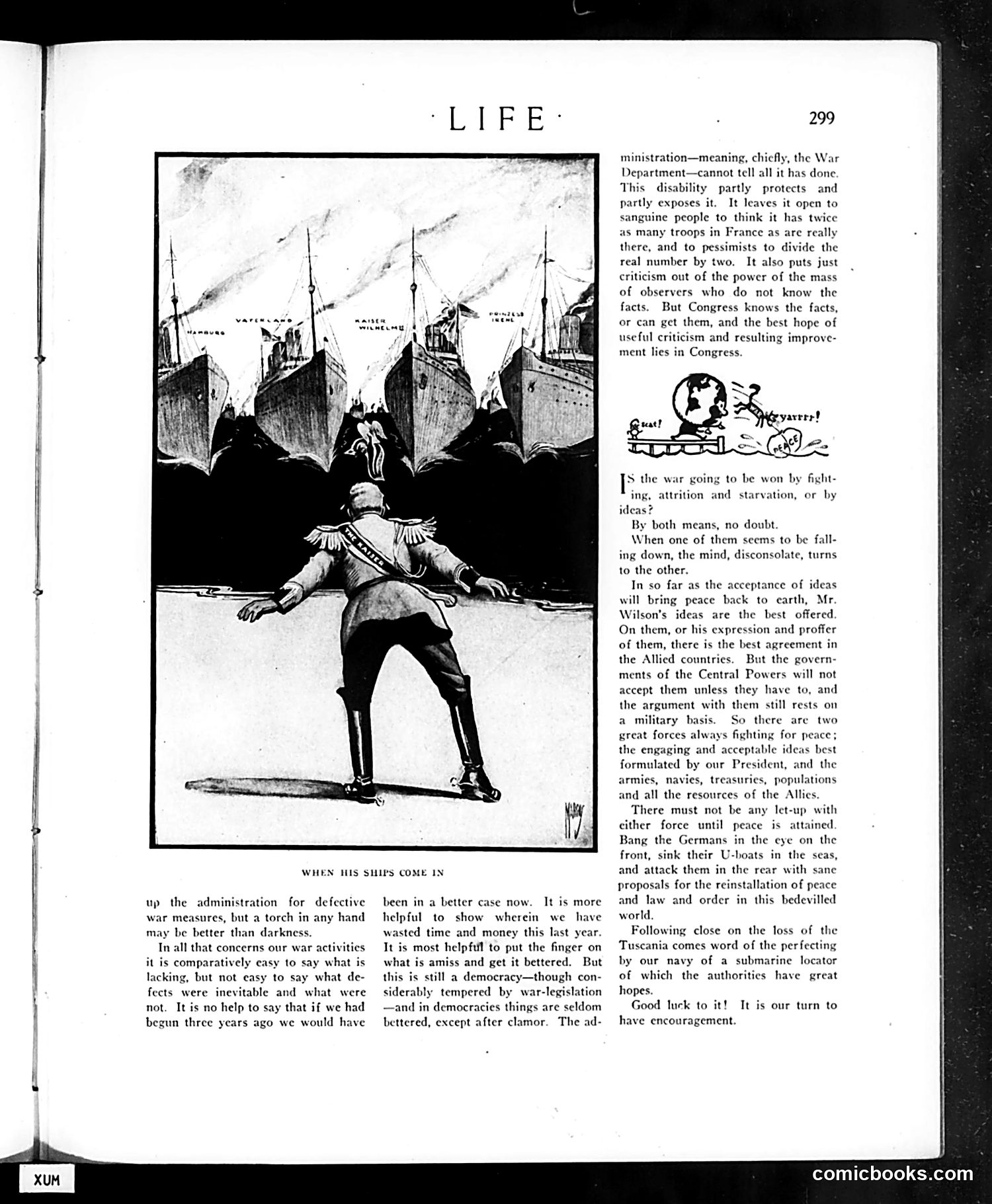
The cartoon depicts a military officer in WWI-era uniform striking an exaggerated pose as merchant ships arrive in the harbor behind him. The title is a play on the idiom "when his ships come in" (when fortune arrives). The satire targets **the U.S. War Department and military administration** for defective war measures and poor resource management during World War I. The officer's theatrical, self-congratulatory stance mocks the administration's attempts to take credit while remaining secretive about actual capabilities—leaving the public uncertain whether troop numbers in France are twice or half what claimed. The accompanying text criticizes how wartime secrecy prevents public oversight, arguing Congress must scrutinize military spending and inefficiency. It references Wilson's peace proposals as idealistic counterweight to military force, while acknowledging Germany will only accept peace through military defeat. The cartoon's point: the administration deserves scrutiny for waste, yet democracy demands public criticism—Congress should demand accountability rather than accept official spin.
📄 Transcribed text from this page (OCR, searchable)
Machine-transcribed from the original scan — historical spelling and the odd misread are preserved.
=o nate Wiemeceng) & WHEN HIS SHIPS COME IN up the administration for defective war measures, but a torch in any hand y be better than darkness. In all that concerns our war activities it is comparatively easy to say what is lacking, but not casy to say what de- fects were inevitable and what were not. It is no help to say that if we had begun three years ago we would have m been in a better case now. It is more helpful to show wherein we wasted time and money this last y It is most helpful to put the finger on what is amiss and get it bettered. But this is still a democracy—though con- siderably tempered by war-legislation —and in democracies things are seldom bettered, except after clamor. The ad- : 299 ministration—meaning, chiefly, the War Department—cannot tell all it has done. This disability partly protects and partly exposes it. It leaves it open to sanguine people to think it has twice as many troops in France as are really there, and to pessimists to divide the real number by two. It also puts just criticism out of the power of the mass of observers who do not know the facts. But Congress knows the facts, or can get them, and the best hope of useful criticism and resulting improve- ment lies in Congress. I the war going to be won by fight- ing, attrition and starvation, or by ideas? By both means, no doubt When one of them seems to be fall- ing down, the mind, disconsolate, turns to the other. In so far as the acceptance of ideas will bring peace back to earth, Mr. Wilson's ideas are the best offered. On them, or his expression and proffer of them, there is the best agreement in the Allied countries. But the govern- ments of the Central Powers will not accept them unless they have to, and the argument with them still rests on a military basis. So there are two great forces always fighting for peace; the engaging and acceptable ideas best formulated by our President, and the armies, navies, treasuries, populations and all the resources of the Allies. There must not be any let-up with cither force until peace is attained. Bang the Germans in the eye on the front, sink their U-boats in the seas, and attack them in the rear with sane proposals for the reinstallation of peace and law and order in this bedevilled world. Following close on the loss of the Tuscania comes word of the perfecting by our navy of a submarine locator of which the authorities have great hopes. Good luck to it! It is our turn to have encouragement. comicbooks.com