
Life, 1918-02-21 · page 28 of 40
Life — February 21, 1918 — page 28: what you’re looking at
What you’re looking at
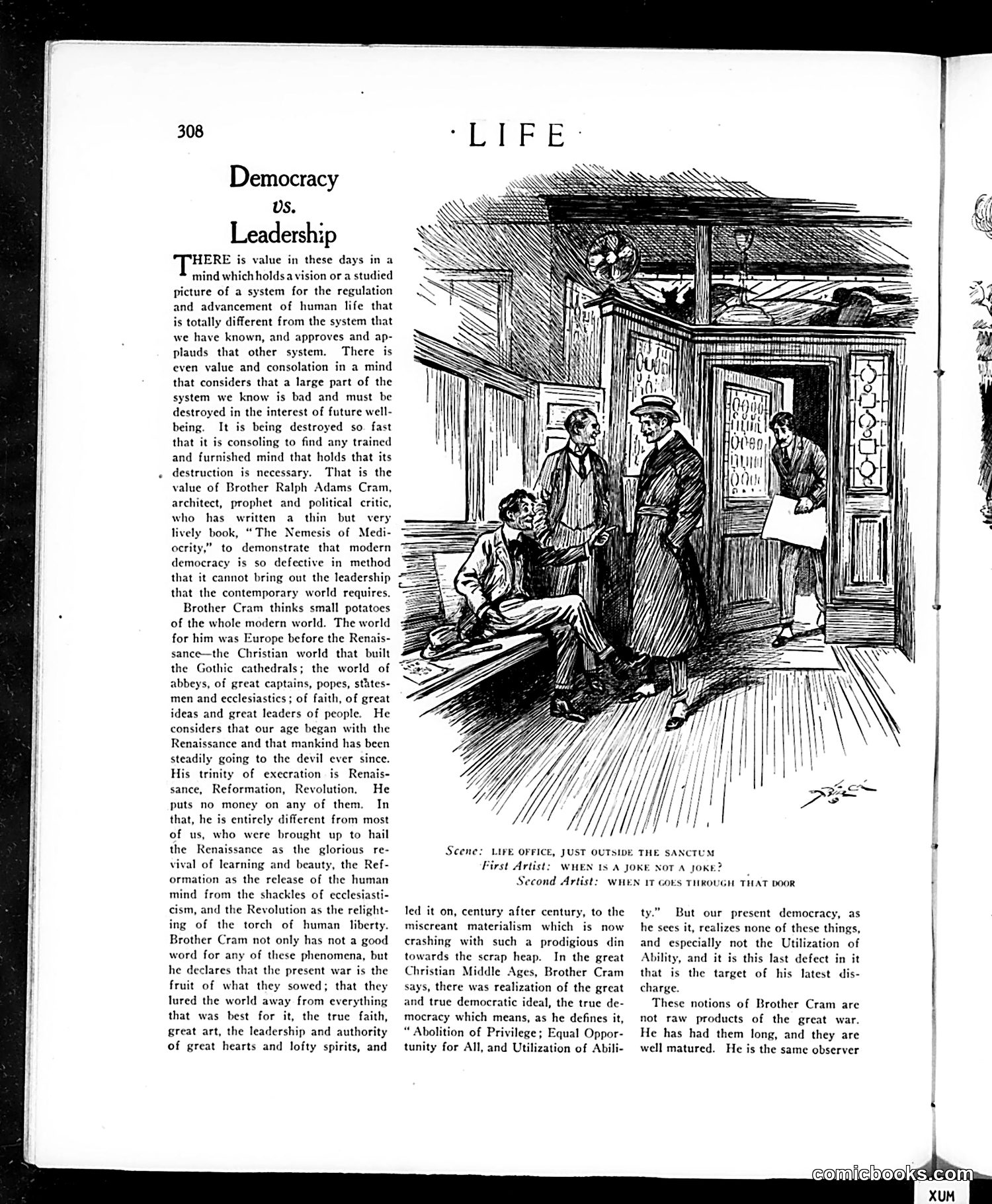
This Life magazine article critiques architect and social critic Ralph Adams Cram's book *The Nemesis of Mediocrity*, which argues modern democracy fails to produce necessary leadership. Cram idealizes pre-Renaissance Christian Europe while condemning the Renaissance, Reformation, and Revolution as civilization's decline toward materialism. The accompanying cartoon shows two artists discussing a joke: "When is a joke not a joke? When it goes through that door"—suggesting that Cram's serious critique, when presented to authority figures in an office sanctum, loses its comedic value or becomes something else entirely. Life's tone is skeptical of Cram's nostalgia for hierarchical medieval society while appearing sympathetic to his diagnosis of democracy's weaknesses. The satire implicitly mocks both Cram's idealization of the past and the bureaucratic establishment that might ignore uncomfortable truths about democratic governance.
📄 Transcribed text from this page (OCR, searchable)
Machine-transcribed from the original scan — historical spelling and the odd misread are preserved.
Democracy vs Leadership HERE is value in these days in a mind which holdsa vision or a studied picture of a system for the regulation and advancement of human life that is totally different from the system that we have known, and approves and ap- plauds that other system. There is even value and consolation in a mind that considers that a large part of the system we know is bad and must be destroyed in the interest of future well- being. It is being destroyed so. fast that it is consoling to find any trained and furnished mind that holds that its destruction is necessary. That is the value of Brother Ralph Adams Cram, architect, prophet and political critic, who has written a thin but very lively book, “The Nemesis of Medi- ocrity,” to demonstrate that modern democracy is so defective in method that it cannot bring out the leadership that the contemporary world requires. Brother Cram thinks small potatoes of the whole modern world. The world for him was Europe before the Renais- sance—the Christian world that built the Gothic cathedrals; the world of abbeys, of great captains, popes, sthtes- men and ecclesiastics ; of faith, of great ideas and great leaders of people. He considers that our age began with the Renaissance and that mankind has been steadily going to the devil ever since. His trinity of execration is Renais- sance, Reformation, Revolution. He puts no money on any of them. In that, he is entirely different from most of us, who were brought up to hail the Renaissance as the glorious re- vival of learning and beauty, the Ref- ormation as the release of the human mind from the shackles of ecclesiasti- cism, and the Revolution as the relight- ing of the torch of human liberty. Brother Cram not only has not a good word for any of these phenomena, but he declares that the present war is the fruit of what they sowed; that they lured the world away from everything that was best for it, the true faith, great art, the leadership and authority of great hearts and lofty spirits, and N SS SSS AG _ Scene: Live OFFICE, JUST OUTSIDE THE SANCTUM First Artist: WHEN 1S A JOKE NOT A JOKE? Second Artist: WHEN IT GOES THROUGH THAT DOOR led it on, century after century, to the miscreant materialism which is now crashing with such a prodigious din towards the scrap heap. In the great Christian Middle Ages, Brother Cram says, there was realization of the great and true democratic ideal, the true de- mocracy which means, as he defines it, “ Abolition of Privilege; Equal Oppor- tunity for All, and Utilization of Abili- ty.” But our present democracy, as he sees it, realizes none of these things, and especially not the Utilization of Ability, and it is this last defect in it that is the target of his latest dis- charge. These notions of Brother Cram are not raw products of the great war. He has had them long, and they are well matured. He is the same observer