
Life, 1918-02-21 · page 26 of 40
Life — February 21, 1918 — page 26: what you’re looking at
What you’re looking at
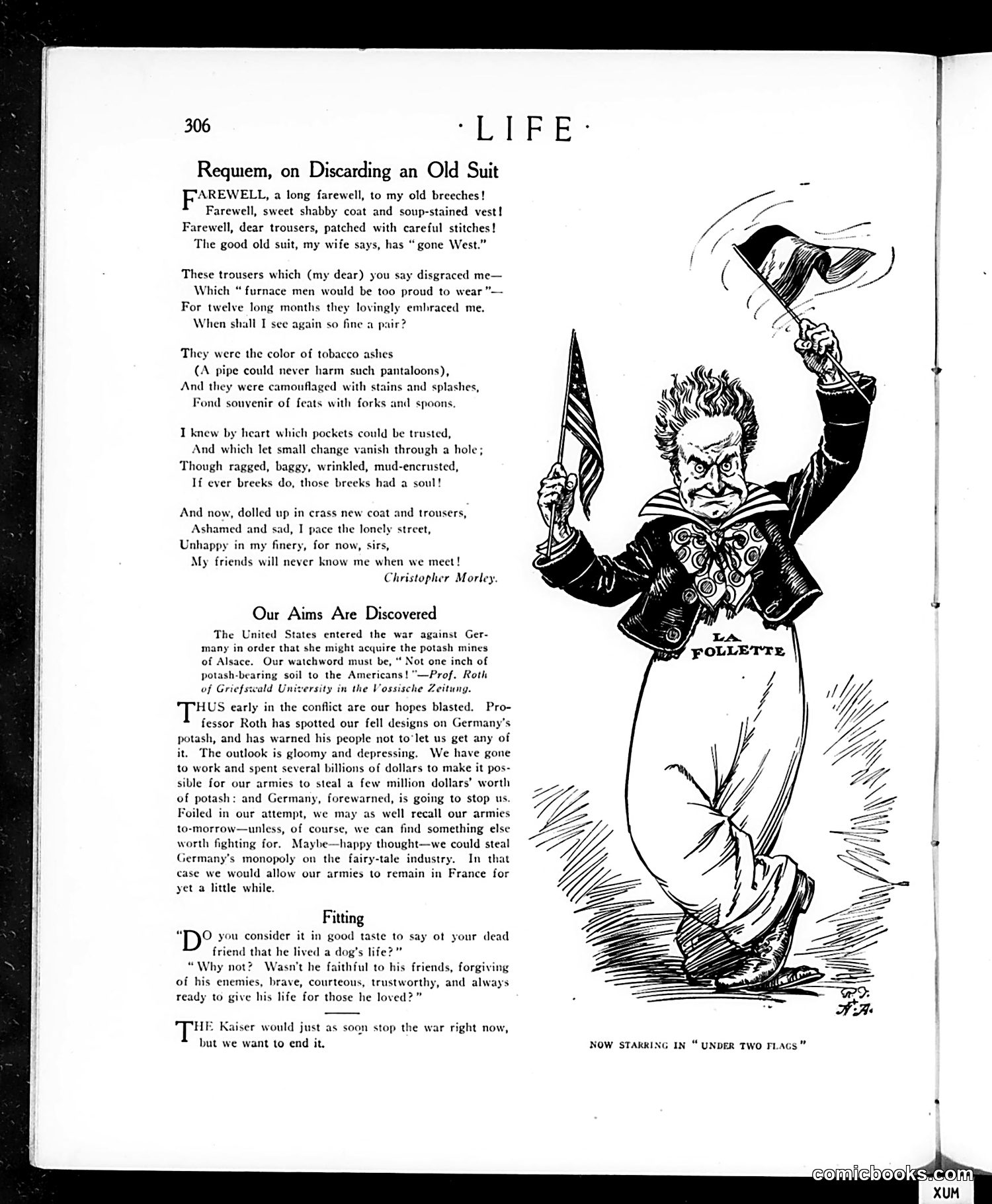
This page contains three distinct pieces of WWI-era satire: **"Requiem on Discarding an Old Suit"** (by Christopher Morley): A humorous poem mourning worn-out clothes, personifying shabby trousers as loyal companions. The joke reflects wartime austerity—the speaker must discard beloved old garments for new ones, but fears friends won't recognize him in his "crass new coat." **"Our Aims Are Discovered":** Satirizes German propaganda. It quotes a German professor claiming America entered WWI solely to steal potash from Alsace. Life mocks this absurd accusation by pretending to agree, humorously suggesting alternative war aims (stealing Germany's "fairy-tale industry") if potash-stealing fails. The satire ridicules German conspiracy theories about American war motives. **"Fitting":** A brief joke about eulogizing the dead, noting that loyalty and self-sacrifice—qualities of a faithful dog—are actually admirable human virtues. The right-side illustration shows "La Follette" (Senator Robert La Follette), likely referencing his controversial anti-war stance during this period.
📄 Transcribed text from this page (OCR, searchable)
Machine-transcribed from the original scan — historical spelling and the odd misread are preserved.
306 LA ESE * Requiem, on Discarding an Old Suit ‘AREWELL, a long farewell, to my old breeches! Farewell, sweet shabby coat and soup-stained vest! Farewell, dear trousers, patched with careful stitches! The good old suit, my wife says, has “gone West. These trousers which (my dear) you say disgraced me— Which “furnace men would be too proud to wear ”"— For twelve long months they lovingly embraced me. When sha 1 I see again so fine a pair? They were the color of tobacco ashes. (A pipe could never harm such pantaloons), And they were camouflaged with stains and splashes, Fond souvenir of feats with forks and spoons, 1 knew by heart which pockets could be trusted, And which let small change vanish through a hole; Though ragged, baggy, wrinkled, mud-encrusted, If ever breeks do, those brecks had a soul! And now, dolled up in crass new coat and trousers, Ashamed and sad, I pace the lonely street, Unhappy in my finery, for now, sirs, My friends will never know me when we meet! Christopher Morley. Our Aims Are Discovered The United States entered the war against Ger- many in order that she might acquire the potash mines of Alsace. Our watchword must be, “ Not one inch of potash-bearing soil to the Americans! "—Prof. Roth of Griefswald University in the Vossische Zeitung. HUS early in the conflict are our hopes blasted. Pro- fessor Roth has spotted our fell designs on Germany's. potash, and has warned his people not to'let us get any of it. The outlook is gloomy and depressing. We have gone to work and spent several billions of dollars to make it pos- sible for our armies to steal a few million dollars’ worth of potash: and Germany, forewarned, is going to stop us. Foiled in our attempt, we may as well recall our armies to-morrow—unless, of course, we can find something else worth fighting for. Maybe—happy thought—we could steal Germany’s monopoly on the fairy-tale industry. In that case we would allow our armies to remain in France for yet a little while. Fitting ‘D° you consider it in good taste to say ot your dead friend that he lived a dog’s life?” “Why not? Wasn't he faithful to his friends, forgiving of his enemies, brave, courteous, trustworthy, and always ready to give his life for those he loved?” HE Kaiser would just as soon stop the war right now, but we want to end it, 3 IN “UNDER TWO FLAGS” =