
Life, 1918-02-21 · page 23 of 40
Life — February 21, 1918 — page 23: what you’re looking at
What you’re looking at
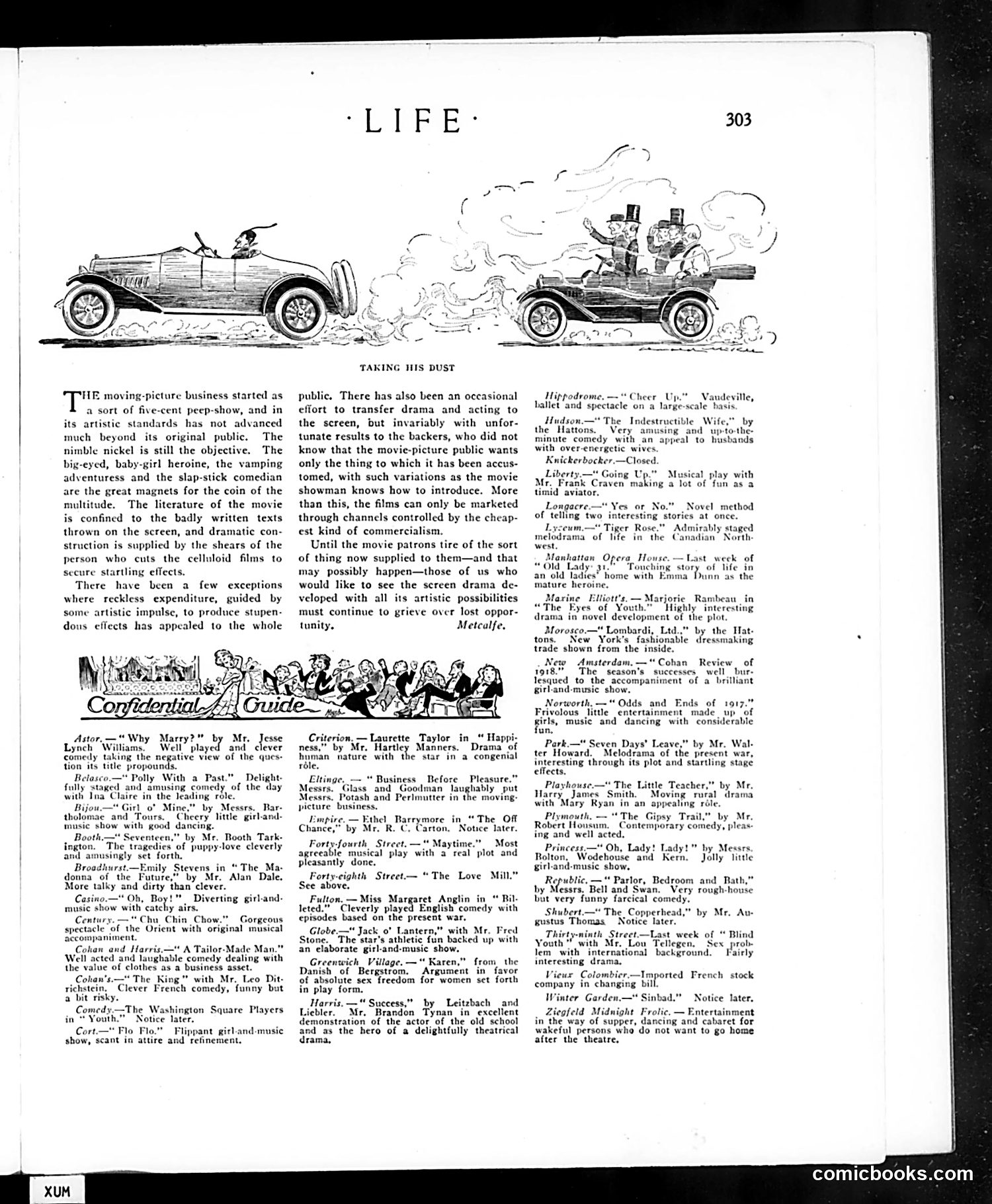
This cartoon satirizes the nascent film industry's competitive race for audiences and profit. The illustration shows two automobiles in a dust-filled chase—one vehicle represents artistic, quality cinema (appearing sparse and struggling), while the other depicts commercially successful, sensationalist moviemaking (crowded with performers and spectacle, kicking up clouds of dust as it speeds ahead). The accompanying essay by Metcalfe criticizes how American movies prioritize cheap entertainment—"big-eyed, baby-girl" heroines, slapstick comedians, and melodrama—over legitimate dramatic art. He laments that attempts at serious cinema fail commercially because the paying public demands only familiar, lowbrow fare. The cartoon's "dust" metaphor suggests that commercial films obscure or overwhelm artistic efforts through sheer volume and aggressive marketing dominance. The satire targets not filmmakers but the mass audience's indifference to cinematic art.
📄 Transcribed text from this page (OCR, searchable)
Machine-transcribed from the original scan — historical spelling and the odd misread are preserved.
HIE moving-picture business started as a sort of five-cent peep-show, and in its artistic standards has not advanced much beyond its original public. The nimble nickel is still the objective. The big-eyed, baby-girl heroine, the vamping adventuress and the slap-stick comedian are the great magnets for the coin of the multitude. The literature of the movie is confined to the badly written texts thrown on the screen, and dramatic con- struction is supplied by the shears of the person who cuts the celluloid films to secure startling effects, There have been a few exceptions where reckless expenditure, guided by some artistic impulse, to produce stupen- dous effects has appealed to the whole TAKING HIS DUST public, There has also been an occasional effort to transfer drama and acting to the screen, but invariably with unfor- tunate results to the backers, who did not know that the movie-picture public wants only the thing to which it has been accus- tomed, with such variations as the movie showman knows how to introduce. More than this, the films can only be marketed through channels controlled by the cheap- est kind of commercialism. Until the movie patrons tire of the sort of thing now supplied to them—and that may possibly happen—those of us who would like to see the screen drama de- veloped with all its artistic possibilities must continue to grieve over lost oppor- tunity. Metcalfe. Why Marry? by Mr. Jesse Lynch Williams. Well play and clever comedy taking the negative view of the ques tion its tithe propounds. Betasco.—" Polly With a Past." Delight: fully staged and amusing comedy of the day with Ina Claire in the leading role. Bijou.—" Girl o? Mine.” by Messrs. Bar- tholomae and Tours. Cheery. little girl-and- music show with good dancing. Booth.—* Seventeen,” by Mr. Booth Tark- ington. The tragedies’ of puppy-love cleverly and amusingly set forth, Broadhurst.—Emily Stevens in “The Ma- donna of the Future,” by Mr. Alan Dale, More talky and dirty than clever. Cesino "Oh, Boy!” Diverting girtand- music show with’ catchy airs, Century. —" Chu Chin Chow." Gorgeous spectacle of the Orient with original musical Accompaniment. Cohan and Harris.—"* A Tailor-Made Man. Well acted and laughable comedy dealing with the value of clothes as a business asset. Cohan’s.—" The King" with Mr. Leo Di richstein. Clever French comedy, funny a bit risky. Comedy. —The Washington Square Players in “Youth.” Notice later, Cort—" Flo Flo.” Flippant_gitl-and-musie show, scant in attire and refinement, XUM Criterion. — Laurette Taylor in“ Happi- ness,” by Mr. Hartley Manners. Drama of human nature with the star role. a congenial “Business Before Pleasure.” Glass and Goodman laughably put Potash and Perlmutter in the moving- business, — Ethel Barrymore in| The Off by Mr. R. C, Carton, Notice later. —" Maytime.”” Most agreeable musical play with a real plot and pleasantly done. Forty-eighth Street— “The Love Mill.” See above, Fulton. — Miss Margaret Anglin in “ Bil- leted.” Cleverly played English comedy with episodes based on the present war, Globe —" Jack, o' Lantern,” with Mr. Fred Stone. The'star’s athletic fin backed up with an elaborate girl-and-music show. Greenwich Village, —“ Karen,” from the Danish of Bergstrom. Argument in favor of absolute sex freedom for women set forth in play form, Harris. —" Success," by Leitzbach and Liebler. Mr. Brandon Tynan in excellent demonstration of the actor of the old school and as the hero of a delightfully theatrical drama, 303 Hippodrome, —“ Cheer Up." Vi lallet and spectacle on a larg Hudson.—* The Indestructible the Hattons. Very amusing minute comedy with an ap; with over-energetic wives. nideville, ge-scale basis fe.” by to-the. sbands Liberty.—" Going Up Mr. Frank Craven maki timid aviator. al play with ga lot of fun as a Novel method ng Stories at once. Tiger Rose.” ably staged ma of Ife in t n North: Manhattan Opera House. —Last week of * Old Lady: 31." ng story of life in an old ladies’ home with Emma Dunn as the mature heroine, Marine Elliott's. — Marjorie Rambeau_ in “The Eyes of Youth. ighly interesting drama in novel development of the plot. Aorosco.—" Lombardi, Ltd.." by the Hat: tons. New York’s fashionable dressmaking trade shown from the inside. New Amsterdam. 1918." The season's lesqued to the accompar girl-and-music show. Norworth.—" Odds and Ends of 1917." Frivolous little entertainment. made up of i music and dancing with considerable un, Park.—" Seven Days’ Leave,” by Mr. Wal- ter Howard. Melodrama of the present war, interesting through its plot and startling stage effects, Playhouse.—" The Little Teacher,” by Mr. Harry James Smith. ~ Moving rural drama with Mary Ryan in an appealing + Plymouth, — “The Gipsy Trai Robert Housum. Contemporary co ing and well acted, Princess.—" Oh, Lady! Lad; Rolton, Wodehouse and Keri girland-music show, Republic, —* Parlor, Bedroom and Bath,” by Messrs. Bell and Swan. Very rough-house but very funny farcical comedy, Shubert.—" The Copperhead,” by Mr. Au- gustus Thomas Notice later. Thirty-ninth Street—Last week of “ Blind Youth * with Mr. Lou Tellegen. Sex prob- lem with international background. Fairly interesting drama, Viewr Colombier —Imported French stock company in changing bill. Winter Garden.— Sinbad.” Notice later. Ziegfeld Midnight Frolic, — Entertainment inthe way of supper, dancing and cabaret for wakeful persons whe do not want to go home after the theatre, “Cohan Review. of uccesses well bur- nent of a brilliant by Messrs Jolly little comicbooks.com