
Life, 1918-02-21 · page 29 of 40
Life — February 21, 1918 — page 29: what you’re looking at
What you’re looking at
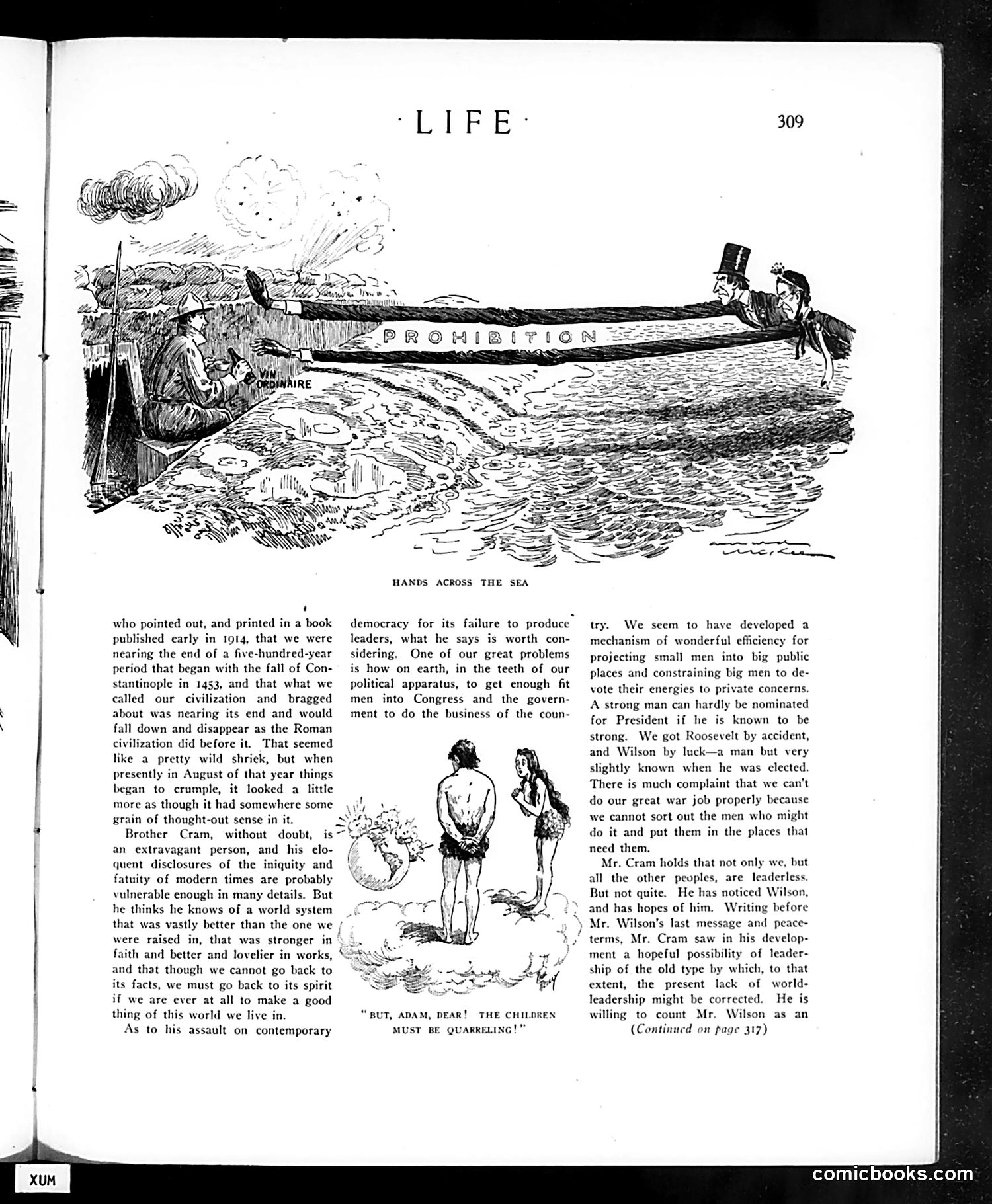
This page contains two distinct cartoons satirizing early 20th-century politics and social order. **Top cartoon ("Hands Across the Sea"):** depicts Prohibition as a massive barrier stretching across the ocean between nations, with figures on both sides unable to connect—mocking the isolating effects of alcohol prohibition policy on international relations. **Bottom cartoon ("But, Adam, Dear! The Children Must Be Quarreling!"):** shows nude Adam and Eve observing conflict, sarcastically suggesting that human discord is natural and inevitable, possibly critiquing naive optimism about peace or social harmony. The accompanying text discusses Brother Cram's critique of modern civilization's decline since 1453, arguing that democratic systems fail to elevate strong leaders into positions of power. The author notes exceptions (Roosevelt, Wilson) and expresses cautious hope that Wilson might provide needed leadership during what appears to be WWI-era uncertainty. The overall theme: Western civilization faces crisis due to structural failures in selecting worthy leaders for critical times.
📄 Transcribed text from this page (OCR, searchable)
Machine-transcribed from the original scan — historical spelling and the odd misread are preserved.
who pointed out, and printed in a book published early in 1914, that we were nearing the end of a five-hundred-year period that began with the fall of Con- stantinople in 1453, and that what we called our civilization and bragged about was nearing its end and would fall down and disappear as the Roman civilization did before it. That seemed like a pretty wild shriek, but when presently in August of that year things began to crumple, it looked a little more as though it had somewhere some grain of thought-out sense in it. Brother Cram, without doubt, is an extravagant person, and his clo- quent disclosures of the iniquity and fatuity of modern times are probably vulnerable enough in many details. But he thinks he knows of a world that was vastly better than the one we were raised in, that was stronger in faith and better and lovelier in works, ‘ and that though we cannot go back to its facts, we must go back to its spirit if we are ever at all to make a good thing of this world we live in. As to his assault on contemporary HANDS ACROSS THE SEA democracy for its failure to produce leaders, what he says is worth con- sidering. One of our great problems is how on earth, in the teeth of our political apparatus, to get enough fit men into Congress and the govern- ment to do the business of the coun- “BUT, ADAM, DEAR! THE CHILDREN MUST BE QUARRELING!” 309 try. We seem to have developed a mechanism of wonderful efficiency for projecting small men into big public places and constraining big men to de- vote their energies to private concerns. A strong man can hardly be nominated for President if he is known to be strong. We got Roosevelt by accident, and Wilson by luck—a man but very slightly known when he was elected. There is much complaint that we can't do our great war job properly because we cannot sort out the men who might do it and put them in the places that need them. Mr. Cram holds that not only we, but all the other peoples, are leaderless. But not quite. He has noticed Wilson, and has hopes of him, Writing before Mr. Wilson's last message and peace- terms, Mr. Cram saw in his develop- ment a hopeful possibility of leader- ship of the old type by which, to that extent, the present lack of world- leadership might be corrected. He is willing to count Mr. Wilson as an (Continued on page 317) comicbooks.com