
A complete issue · 40 pages · 1918
Life — January 3, 1918
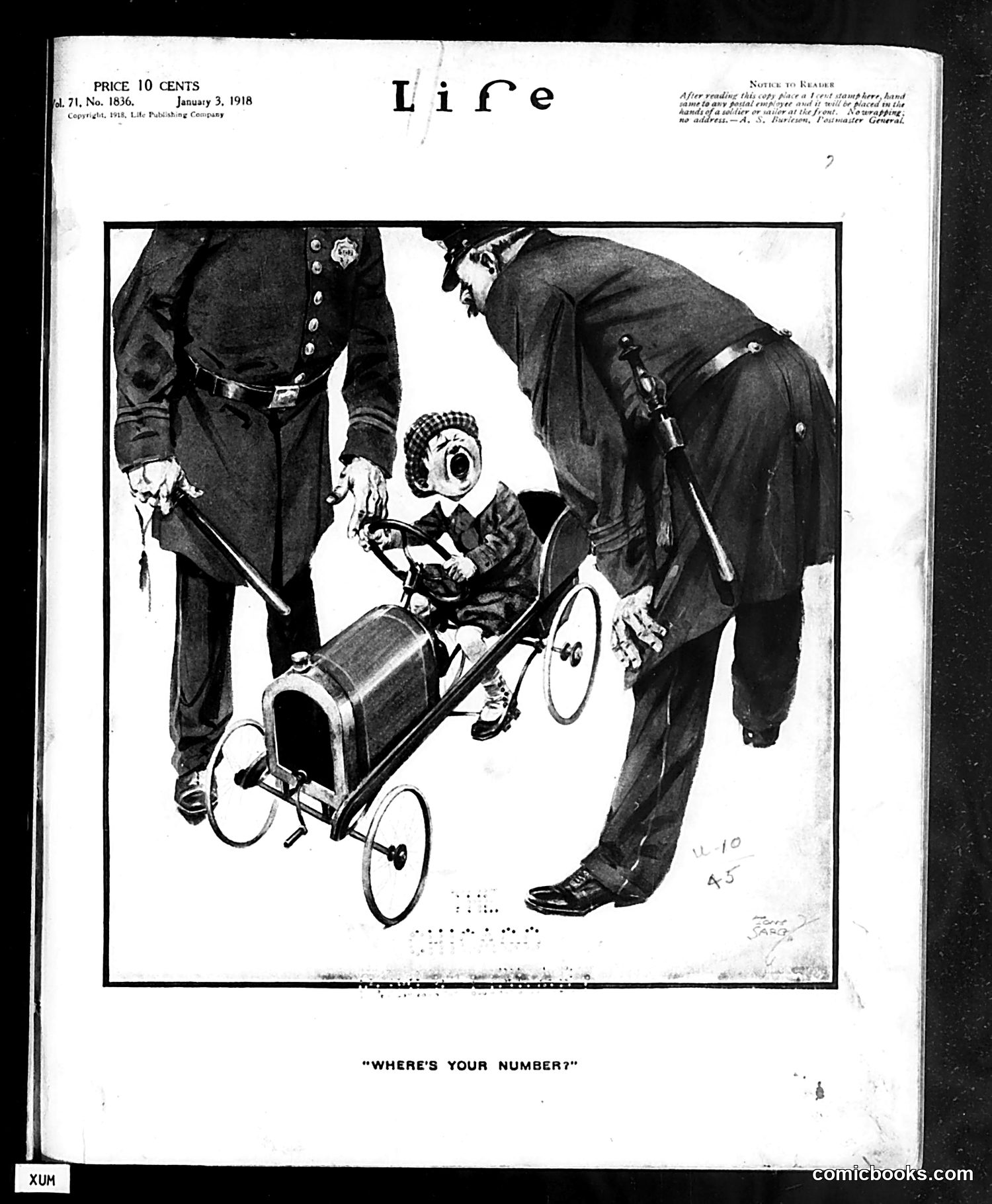
This January 3, 1918 *Life* cartoon satirizes military conscription during World War I. Two uniformed officers tower over a small child in a baby carriage, demanding "Where's your number?"—referring to draft registration numbers required of eligible men. The joke operates on absurdist exaggeration: the officers are so zealously pursuing conscripts that they're checking even an infant, who obviously cannot be drafted. This mocks the aggressive enforcement of the draft and suggests bureaucratic overreach or paranoia about finding enough soldiers for the war effort. The cartoon critiques either the military's desperation for troops or the perceived invasiveness of mandatory conscription policies during America's involvement in WWI.
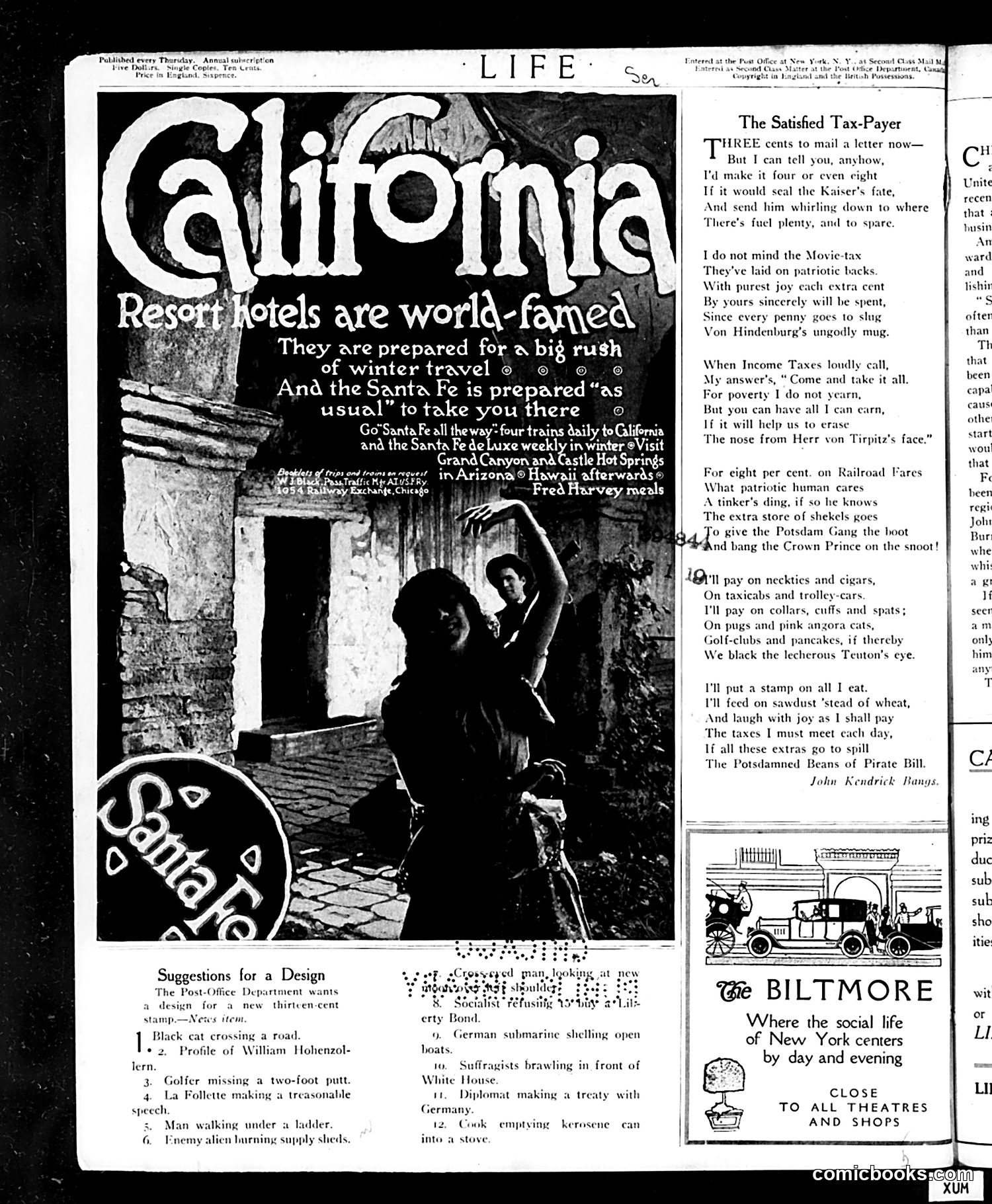
This page is primarily **advertising and light editorial content**, not political satire. The large California Resort Hotels advertisement features a romantic scene of two figures in what appears to be a mission or Spanish colonial setting, promoting winter travel via the Santa Fe railroad. The right column contains "The Satisfied Tax-Payer," a humorous poem by John Kendrick Bangs mocking someone's cheerful acceptance of various taxes and fees—from movie taxes to postal stamps to train fares. The satire is gentle: the speaker claims not to mind these patriotic contributions, listing absurdities (taxing "neckties and cigars," "pink angora cats") to underscore how pervasive taxation has become. The "Suggestions for a Design" section appears to be a separate editorial feature proposing WWI-related imagery for a postage stamp.
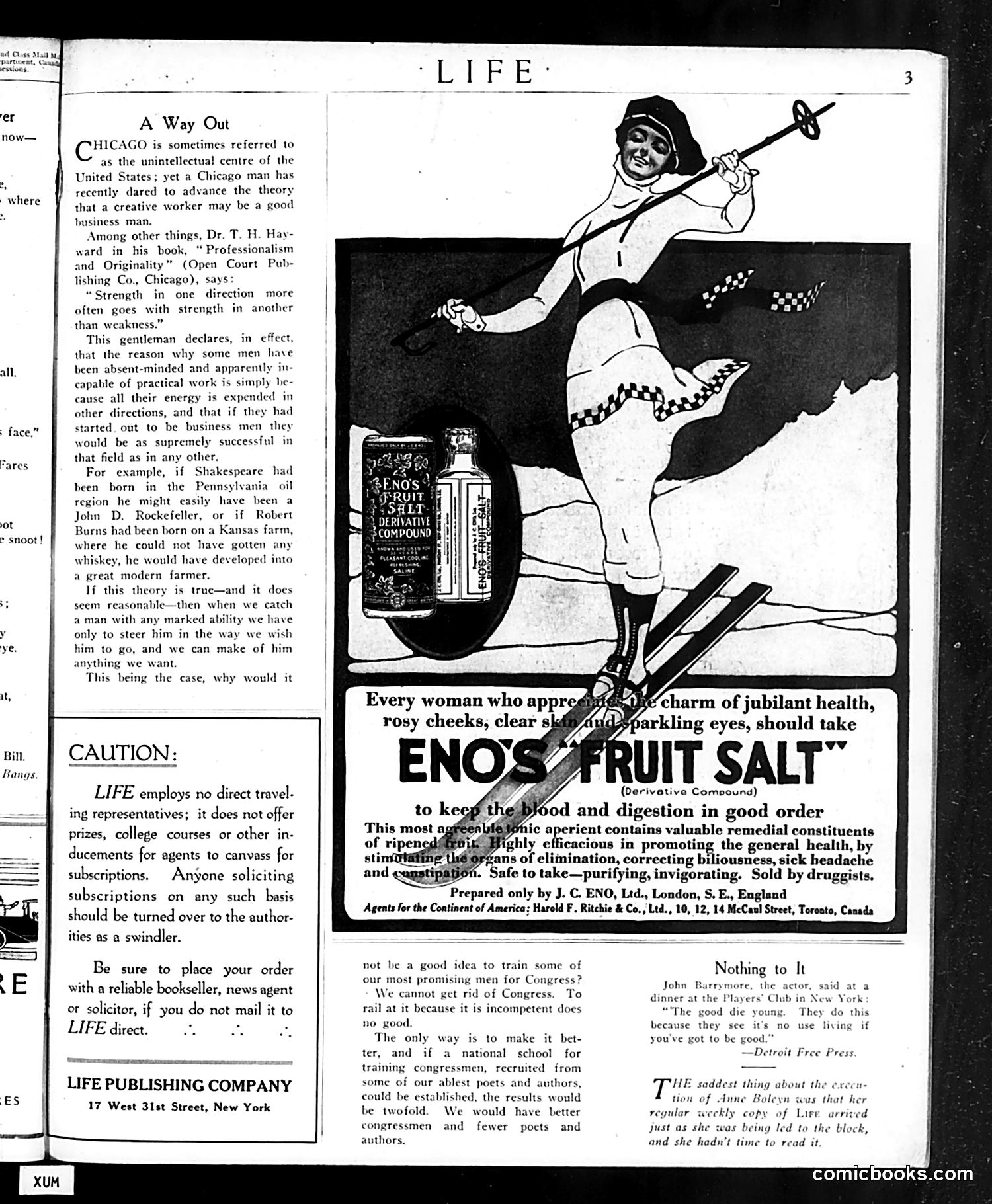
This page is primarily an **advertisement for Enos's Fruit Salt**, a digestive compound marketed to women. The large illustration depicts a woman in early 20th-century athletic wear (bloomers, sailor shirt) wielding a sword or fencing épée, appearing vigorous and healthy. The ad's messaging—promoting "jubilant health, rosy cheeks, clear skin"—reflects period marketing that associated patent medicines with vitality and modernity. The athletic imagery suggests women's emerging participation in sports and active lifestyles. The left column contains editorial content about business aptitude unrelated to the advertisement. The caution box warns readers about subscription fraud, protecting LIFE's circulation. This represents typical early 20th-century magazine advertising practices mixing health claims with lifestyle aspirations.
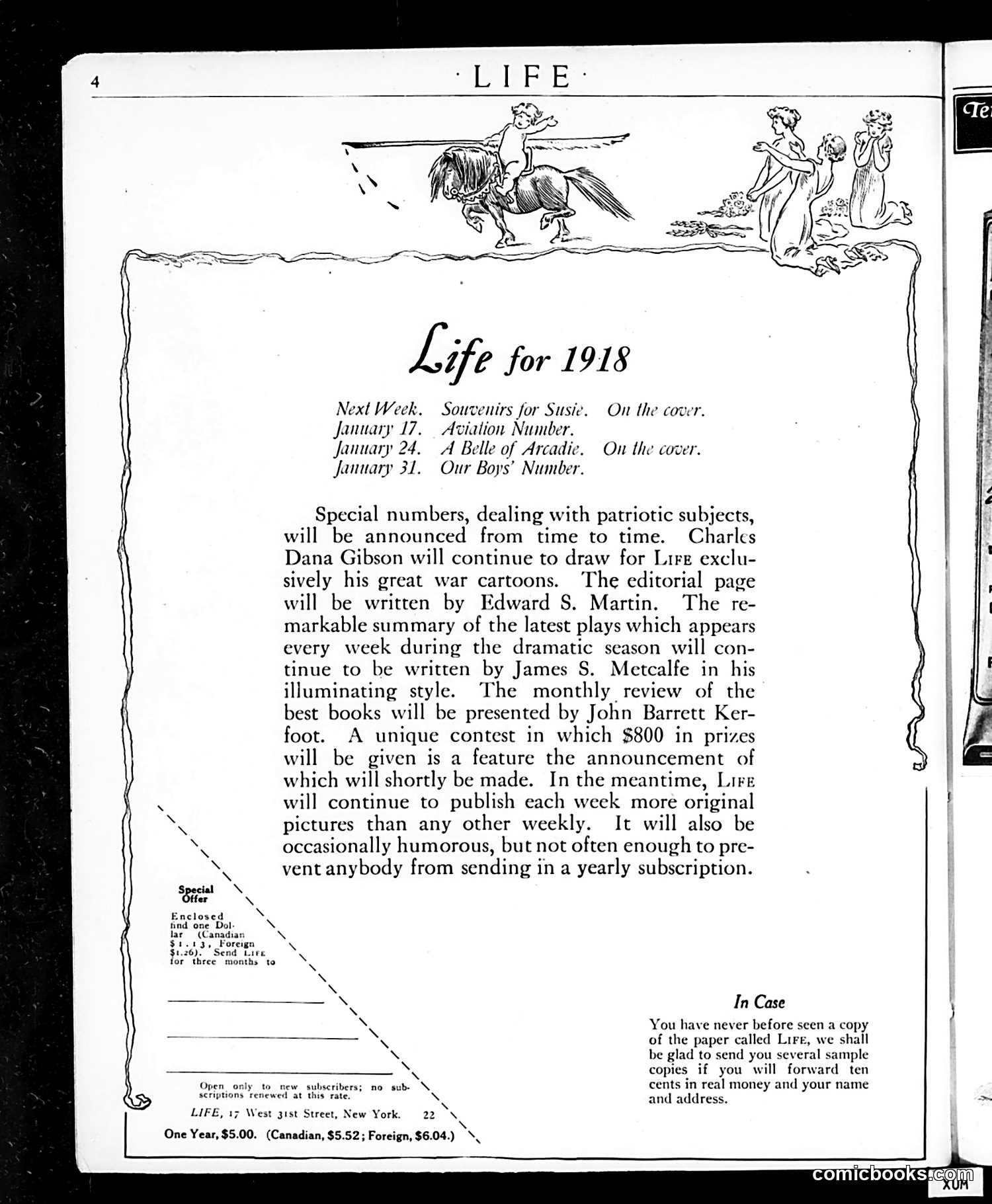
This page is primarily **promotional content** for *Life* magazine's upcoming 1918 issues rather than a standalone cartoon or article. The illustration at top depicts an allegorical scene: a winged figure (likely representing Peace or Victory) scatters flowers while cherubs play with a sword or lance. This reflects the page's emphasis that *Life* will feature "patriotic subjects" during World War I. The text announces special numbered issues coming soon, including an "Aviation Number" and "Our Boys' Number," indicating *Life*'s commitment to war-related content. The magazine promises original cartoons by Charles Dana Gibson, drama criticism, and book reviews. The page functions as a subscription pitch, emphasizing *Life*'s unique editorial voice during America's involvement in WWI.
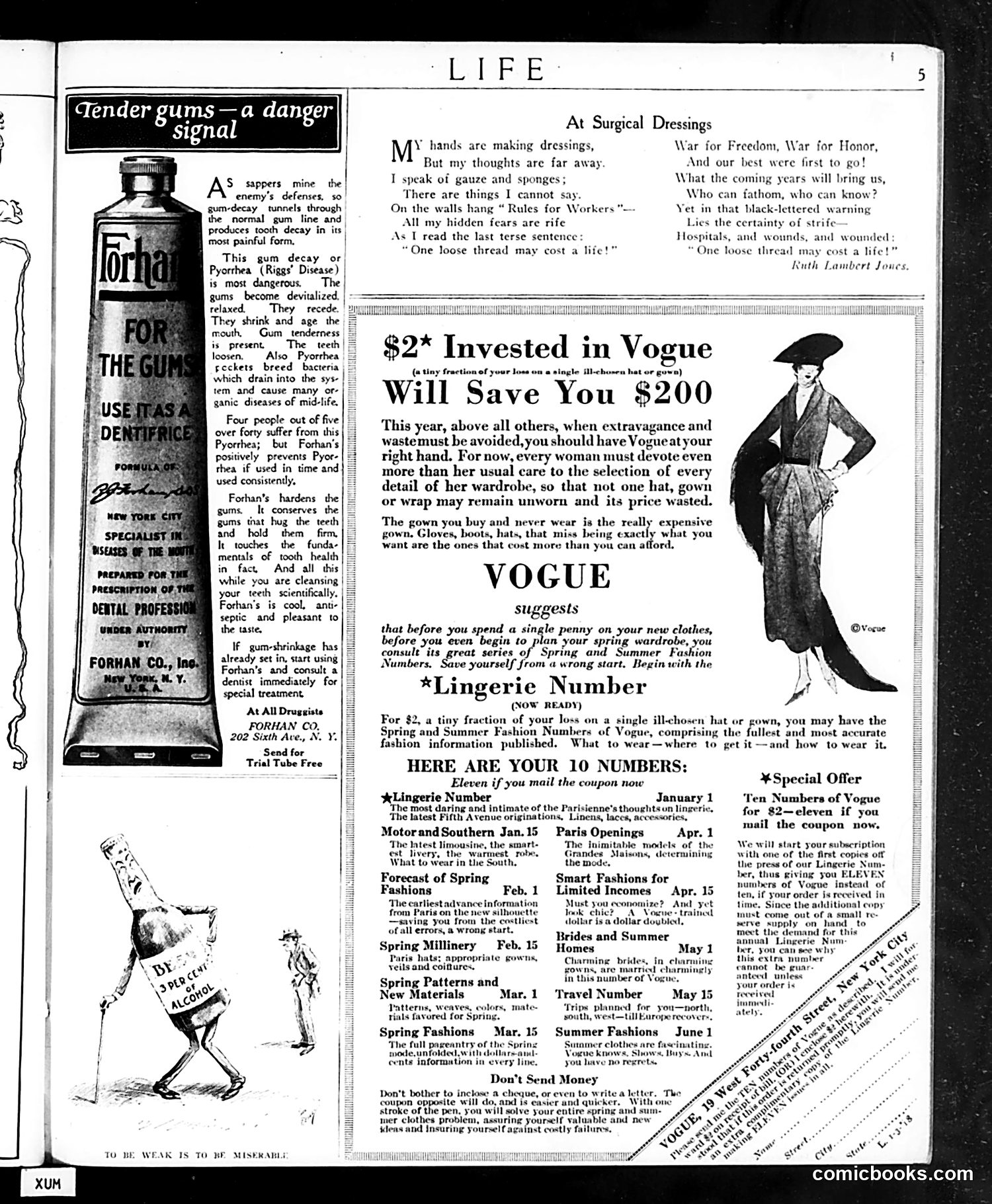
This page combines wartime content with advertising. The left side features a dentifrice advertisement for Forhan's toothpaste, emphasizing that gum disease ("pyorrhea") is dangerous and requires professional treatment—a common health concern marketing angle of the era. The right side includes a poem titled "At Surgical Dressings" about women's wartime volunteer work, followed by a Vogue fashion advertisement. The ad promotes buying a $2 Vogue magazine as economical wartime advice, arguing that one $2 investment in fashion guidance will save $200 in wasted clothing purchases during a period when "extravagance and waste must be avoided." The small cartoon at the bottom appears to be unrelated satirical illustration, though details are unclear from this image quality.
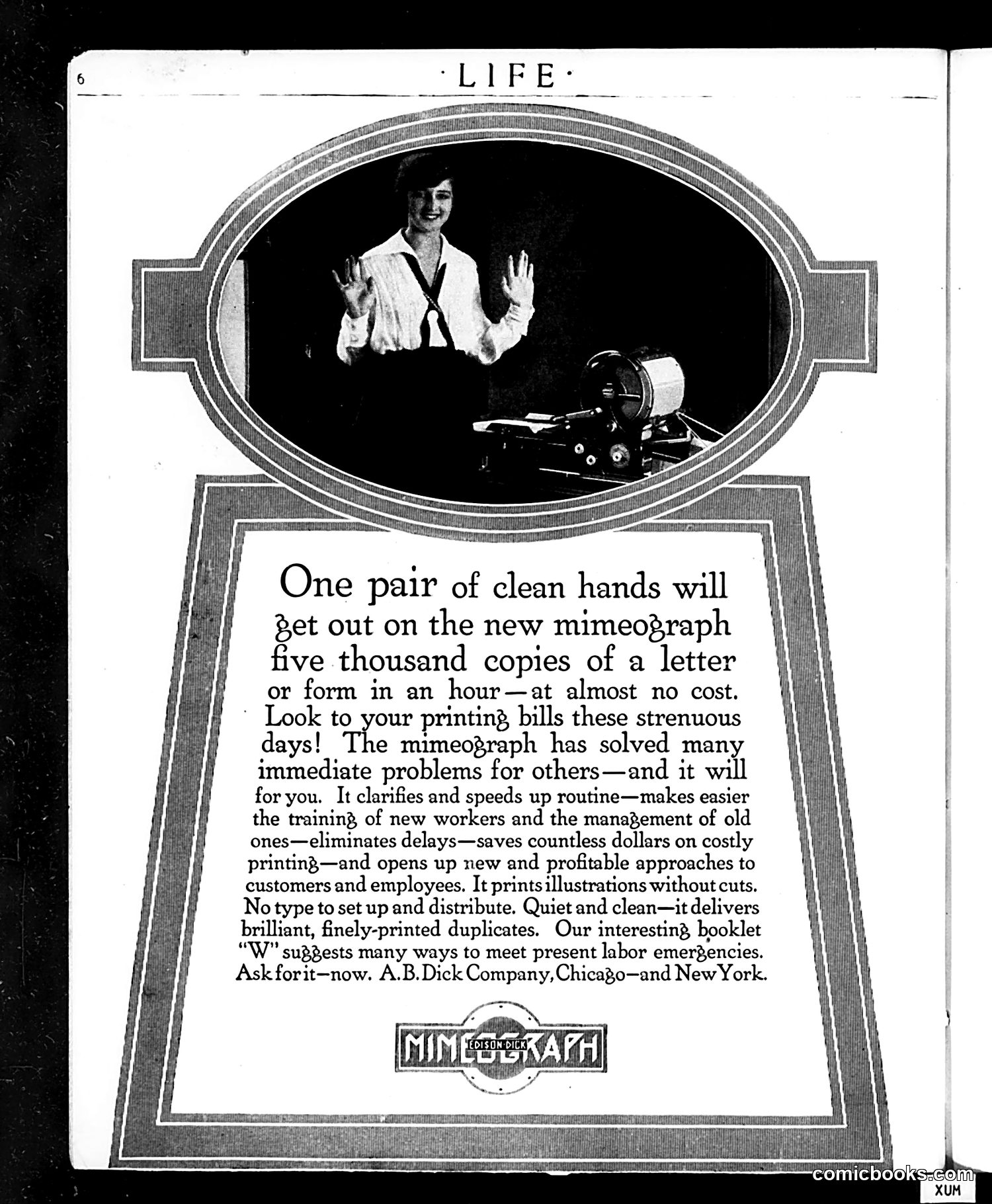
This is **not a political cartoon or satire** — it's a straightforward product advertisement from *Life* magazine for the **Mimeograph**, a copying machine made by the A.B. Dick Company (Chicago and New York). The image shows a man operating an early mimeograph machine, with text promoting its business benefits: it can produce 5,000 copies of letters or forms per hour "at almost no cost." The ad emphasizes labor-saving and cost-reduction advantages for offices and businesses during what it calls "strenuous days" — likely referencing post-WWI industrial America when efficiency improvements were commercially attractive. The advertisement offers a free instructional booklet ("W") addressing "present labor emergencies," suggesting workforce management concerns of the era.
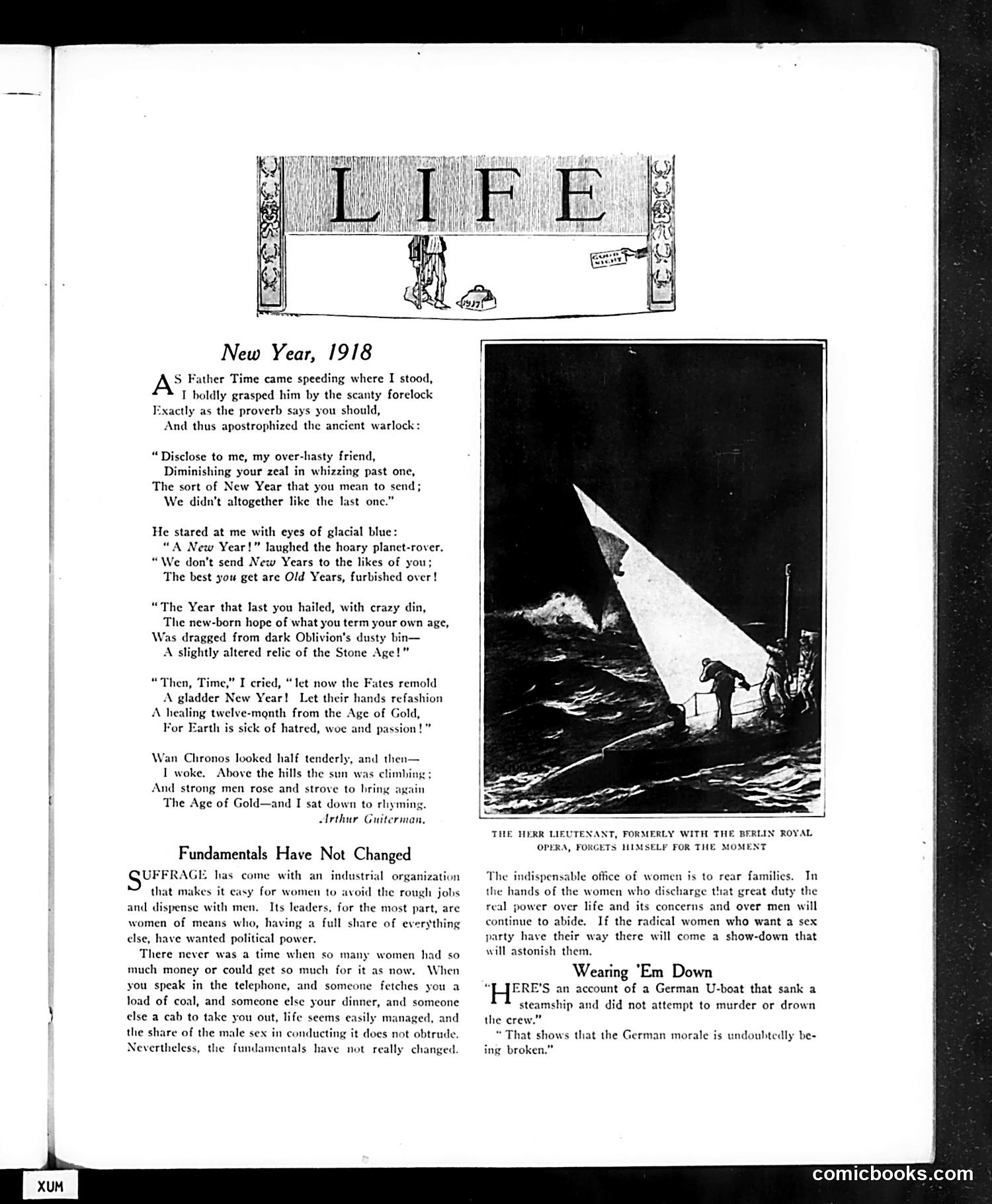
This page combines poetry with social commentary about World War I and women's rights. **"New Year, 1918"** is a poem by Arthur Guterman personifying Father Time confronting the departing year, criticizing 1917 as chaotic and hope-destroying. The speaker appeals to the Fates for a better year and "The Age of Gold." **"Fundamentals Have Not Changed"** discusses women's suffrage. The author argues that despite women gaining political power through suffrage organization, their fundamental role remains unchanged—they still manage households and rear families. The piece dismisses radical feminists demanding a "sex party," suggesting their influence won't substantially alter women's traditional domestic responsibilities. **"Wearing 'Em Down"** references a German U-boat that sank a steamship without attempting to murder survivors, interpreted as evidence of declining German military morale.
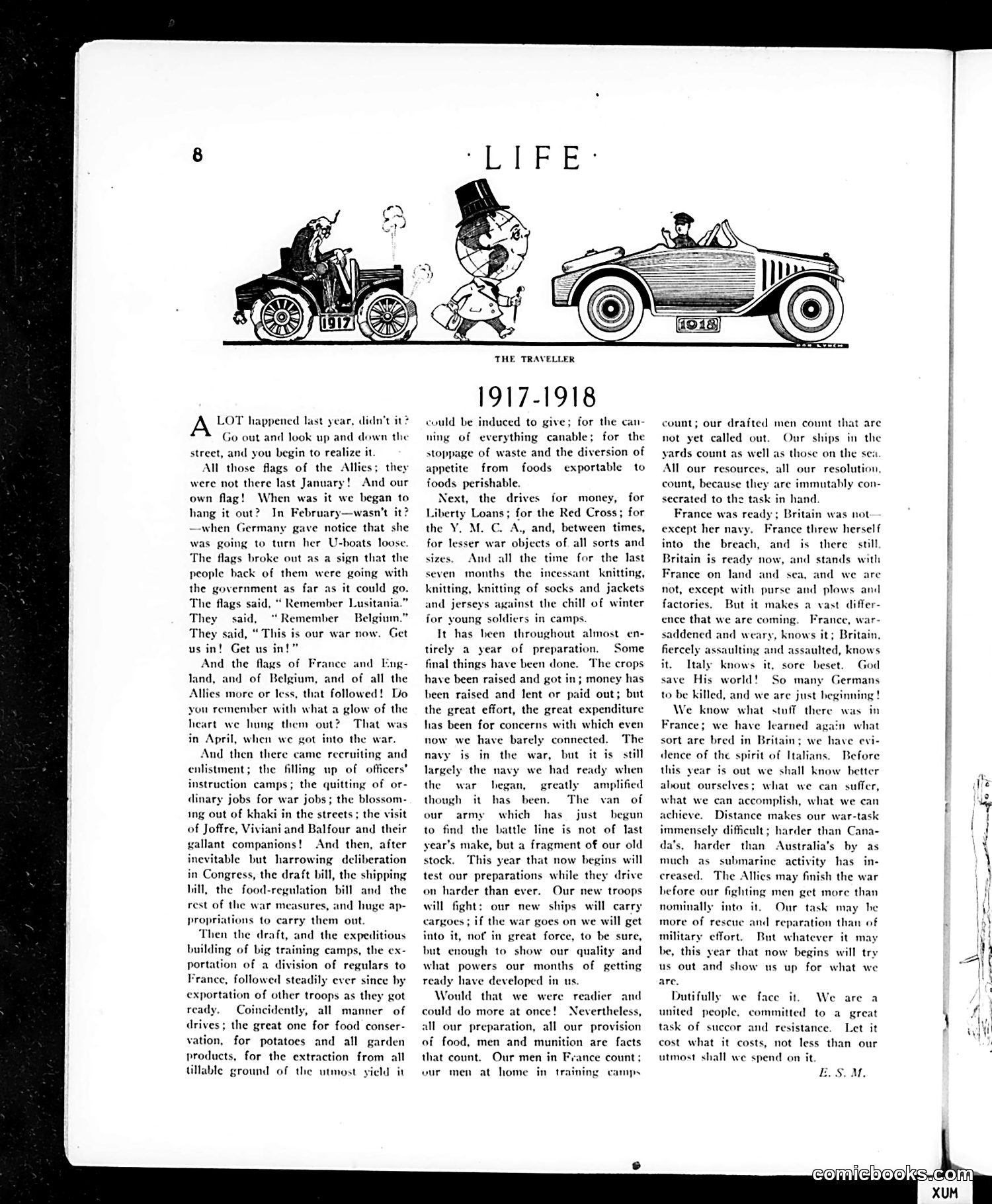
The cartoon depicts three vehicles in sequence representing transportation evolution: an old automobile (labeled 1917), a figure holding a globe in the middle, and a modern racing car (labeled 2018). The accompanying article, titled "1917-1918," reflects on America's first year of World War I participation. The author discusses war preparations, troop mobilization, food conservation efforts, and recruitment drives. The piece emphasizes American commitment to the Allied cause, celebrating military expansion and industrial output while promoting civilian sacrifice through rationing and resource management. The "Traveller" cartoon likely symbolizes humanity's progress during wartime, contrasting outdated methods with modern capability—suggesting America's industrial advancement serves the war effort.
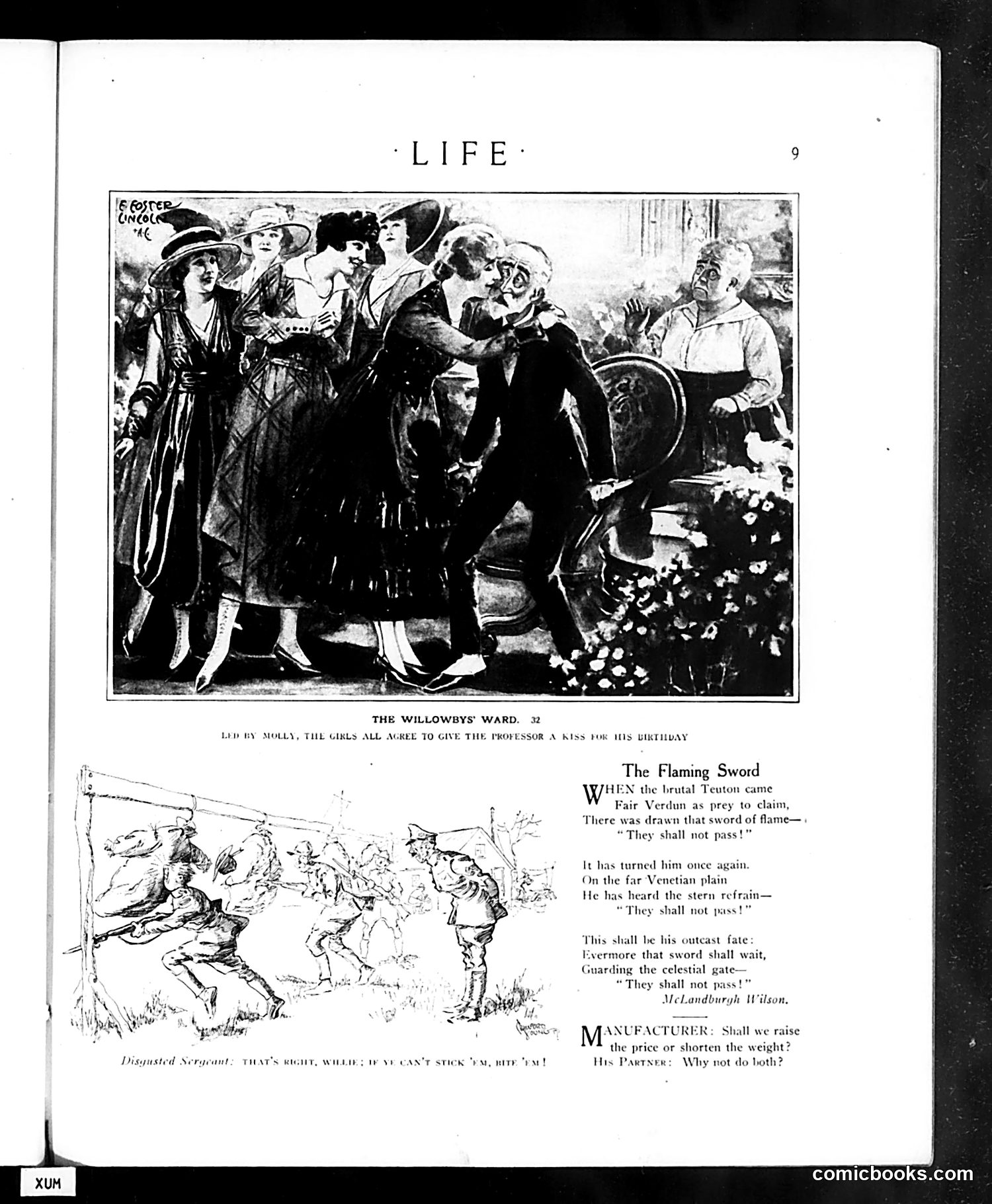
The page contains two distinct pieces: **Top image ("The Willowbys' Ward"):** A domestic scene showing well-dressed women and men gathered around what appears to be a birthday celebration. The caption indicates the girls are giving "the Professor a kiss for his birthday"—a lighthearted social comedy about etiquette and propriety in domestic settings. **"The Flaming Sword":** A poem by McClandsburgh Wilson with accompanying illustration of soldiers in combat. The verse uses medieval/religious imagery ("sword of flame," "celestial gate") as metaphor for military conflict, likely referencing World War I. **Bottom joke:** A manufacturer-and-partner exchange about raising prices versus reducing weight—a business satire presumably about wartime profiteering or product quality compromise. The page mixes domestic humor with war-related content typical of WWI-era Life magazine.
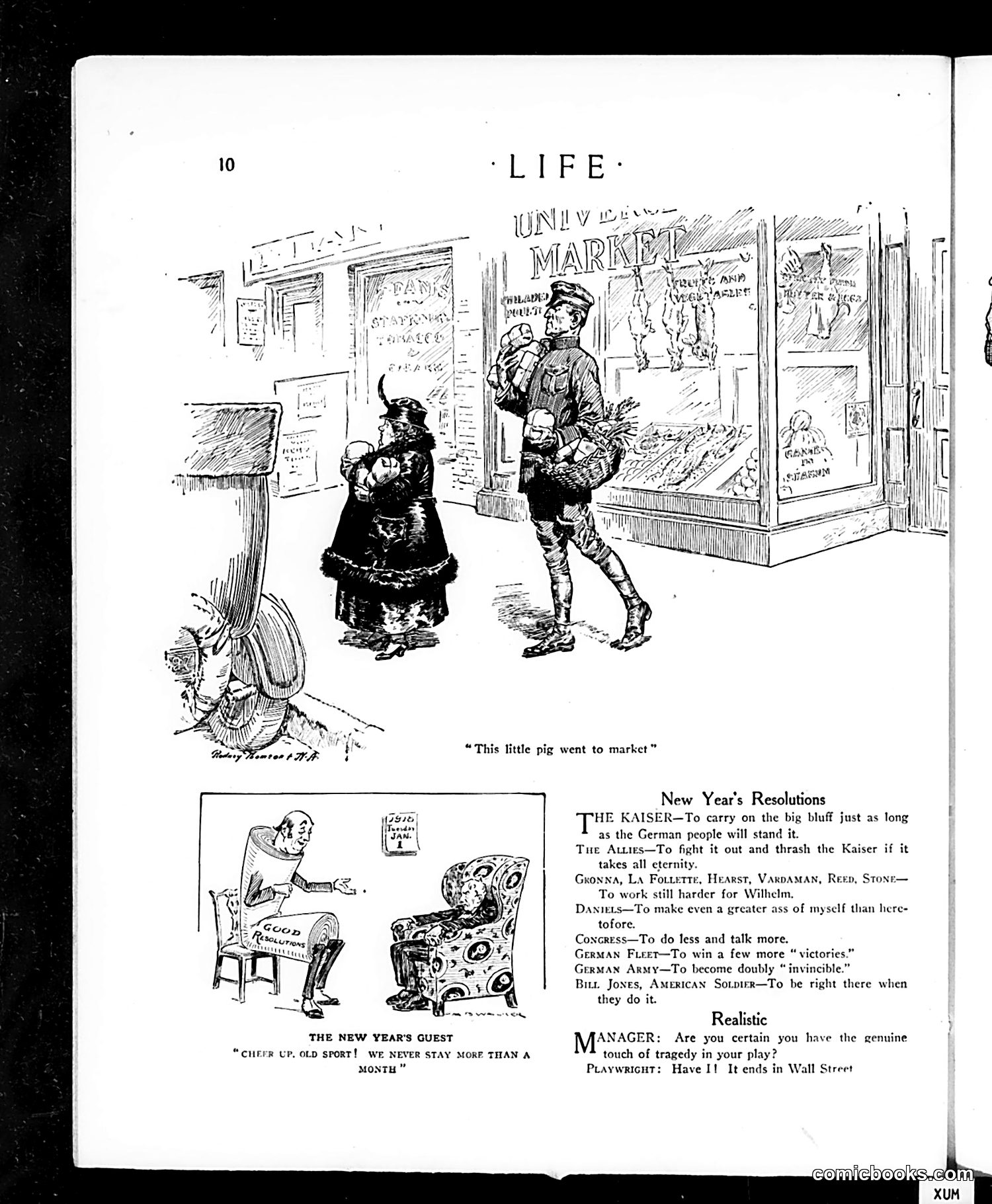
This page from *Life* magazine contains WWI-era political satire, likely from around 1917-1918. **Top cartoon** ("This little pig went to market"): Shows a soldier with a pig at a market, alluding to the nursery rhyme. The pig likely represents Germany or a defeated enemy being taken to market—a metaphor for military conquest or humiliation. **"New Year's Resolutions"**: Lists satirical pledges from various WWI figures (Kaiser Wilhelm, Allied leaders, American soldiers, etc.), mocking their war aims and personalities. The tone is darkly humorous about continuing conflict. **Bottom cartoon** ("The New Year's Guest"): Shows a figure beside an empty chair labeled "Good Cheer," with text mocking that hardship persists—suggesting 1918 brought no relief from war's deprivations despite New Year optimism. The page satirizes wartime suffering and political grandstanding.
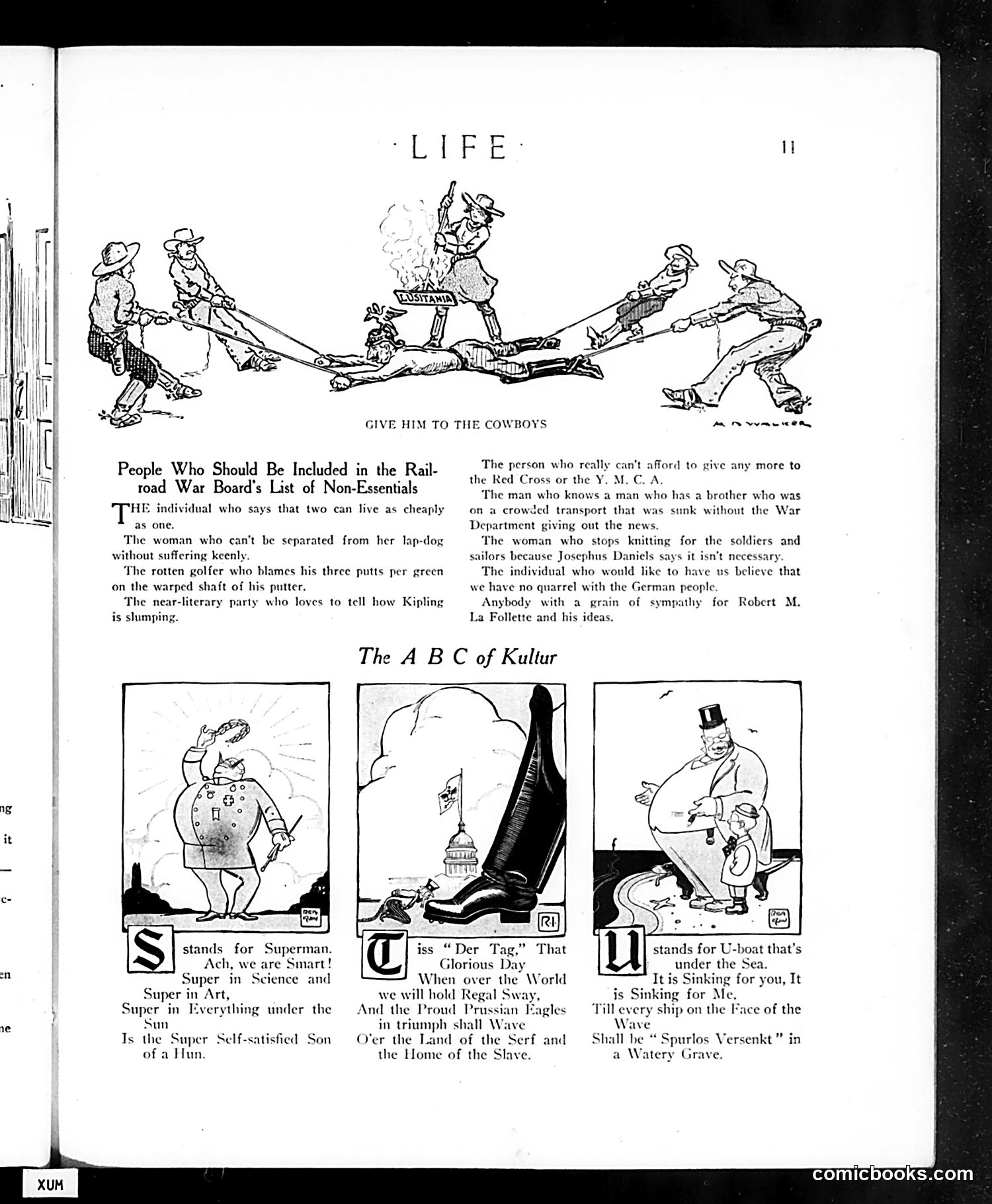
**Top Cartoon ("Give Him to the Cowboys")**: A satirical illustration showing figures in a tug-of-war over a central character labeled "AUSTRIANISM." The cowboys on either side represent opposing factions literally fighting over Austria's fate—likely referencing post-WWI disputes over Austrian territory and governance. **Main Text Section**: A wartime list of "Non-Essentials" suitable for railroad rationing—people deemed unproductive to the war effort. This includes lap-dog owners, golfers, and literary types, sarcastically suggesting who should be excluded from transportation resources during wartime scarcity. **"ABC of Kultur" Below**: Three political cartoons mocking German militarism and imperialism ("Kultur"), depicting Prussian eagles, aggressive expansion, and what appears to be German nationalist ideology as bloated, dangerous, and ultimately self-destructive.
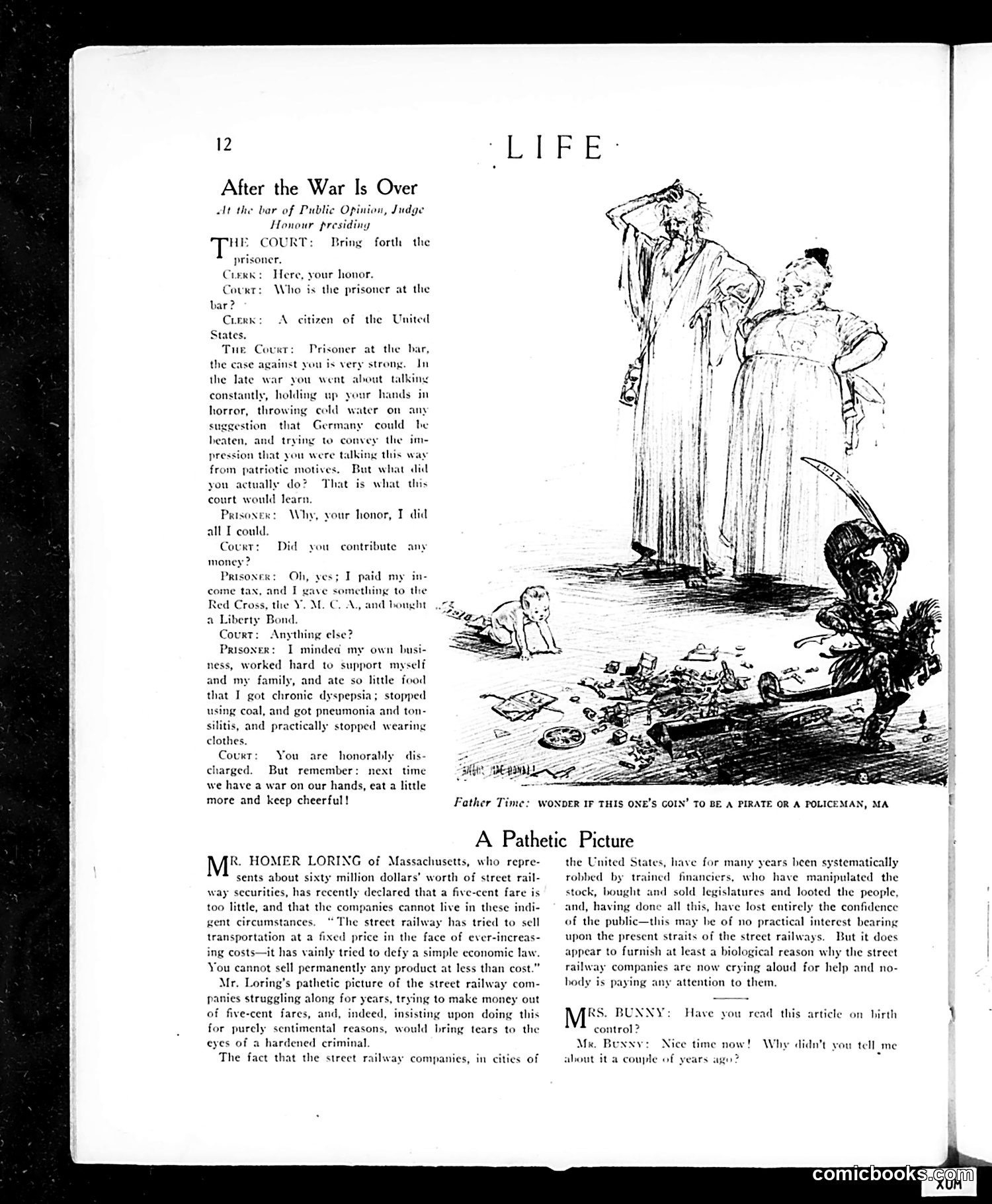
**"After the War Is Over"** depicts a courtroom scene where a judge interrogates a prisoner accused of wartime disloyalty. The prisoner claims patriotic motives while admitting minimal personal sacrifice—paying taxes, donating to Red Cross, buying bonds, and rationing. The judge skeptically dismisses him, suggesting his anti-German rhetoric masked selfish motives. **"A Pathetic Picture"** critiques street railway companies exploiting passengers through high fares while claiming financial hardship. Homer Loring of Massachusetts argues these companies manipulated stock prices and robbed the public, yet refuse to lower costs despite years of profiteering. **"Father Time"** cartoon caption appears satirical commentary on postwar society, though context is unclear from this excerpt. These pieces target wartime profiteers and those claiming patriotism while benefiting financially.
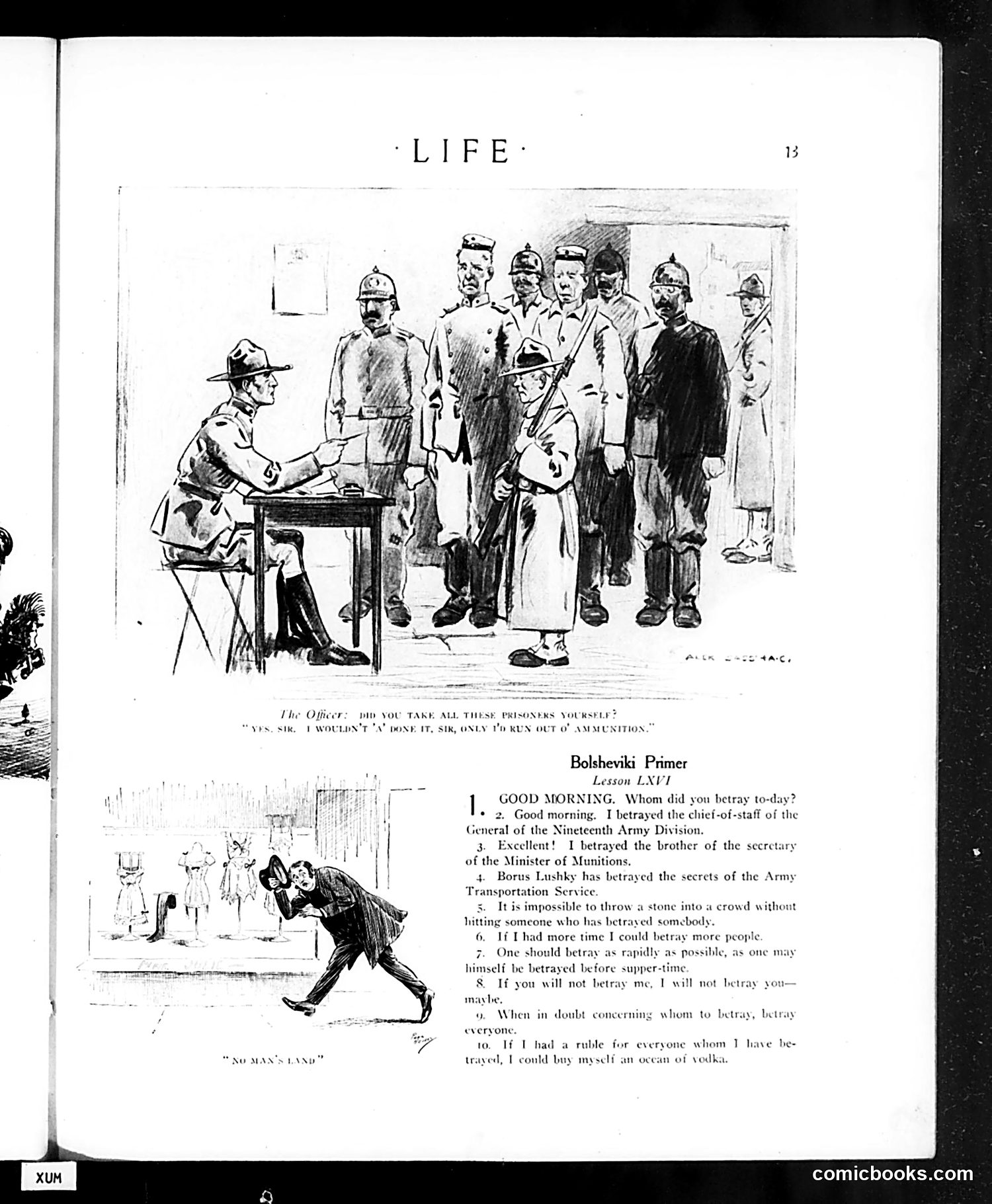
This *Life* magazine page satirizes Bolshevik betrayal during the Russian Revolution. The top cartoon shows military officers interrogating prisoners, with the caption mocking an officer's claim he wouldn't "run out of ammunition"—dark humor about executions. Below is "Bolsheviki Primer, Lesson LXVI," a cynical "lesson" listing ten rules for betrayal, culminating in the joke that if one had betrayed everyone, one could "lay myself an ocean of vodka." The cartoon "So Man's Land" (bottom) depicts a figure hurling something, likely referencing violence or betrayal. The satire targets Bolshevik ideology and practices—portraying the revolution as defined by systematic betrayal, paranoia, and casual brutality rather than noble ideals. It reflects American Cold War-era anti-Soviet sentiment.
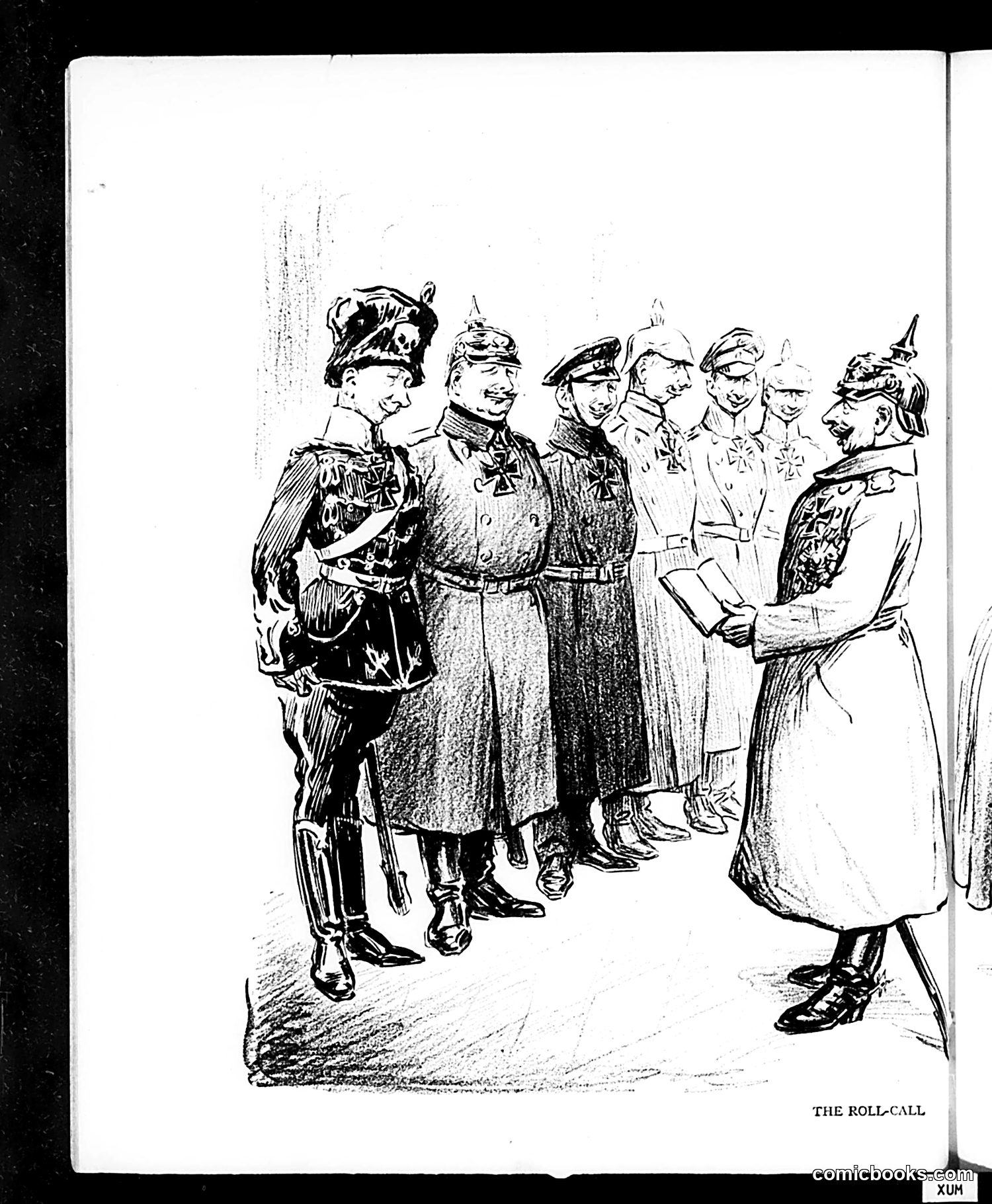
This political cartoon depicts a military roll-call or inspection scene featuring officers in German Imperial uniforms from World War I era. The figures wear distinctive spiked Prussian helmets (Pickelhaube) and ornate military dress with medals and insignia. The satire appears to critique German military leadership or conduct during WWI. The title "The Roll-Call" suggests accountability—possibly mocking a formal inspection or accounting of officers. The caricatured faces and exaggerated features are typical of period American satirical commentary on German military figures. Without additional context or captions visible on this page, the specific individuals being caricatured remain unclear, though the overall intent seems to be ridicule of German military authority and hierarchy during the war period.
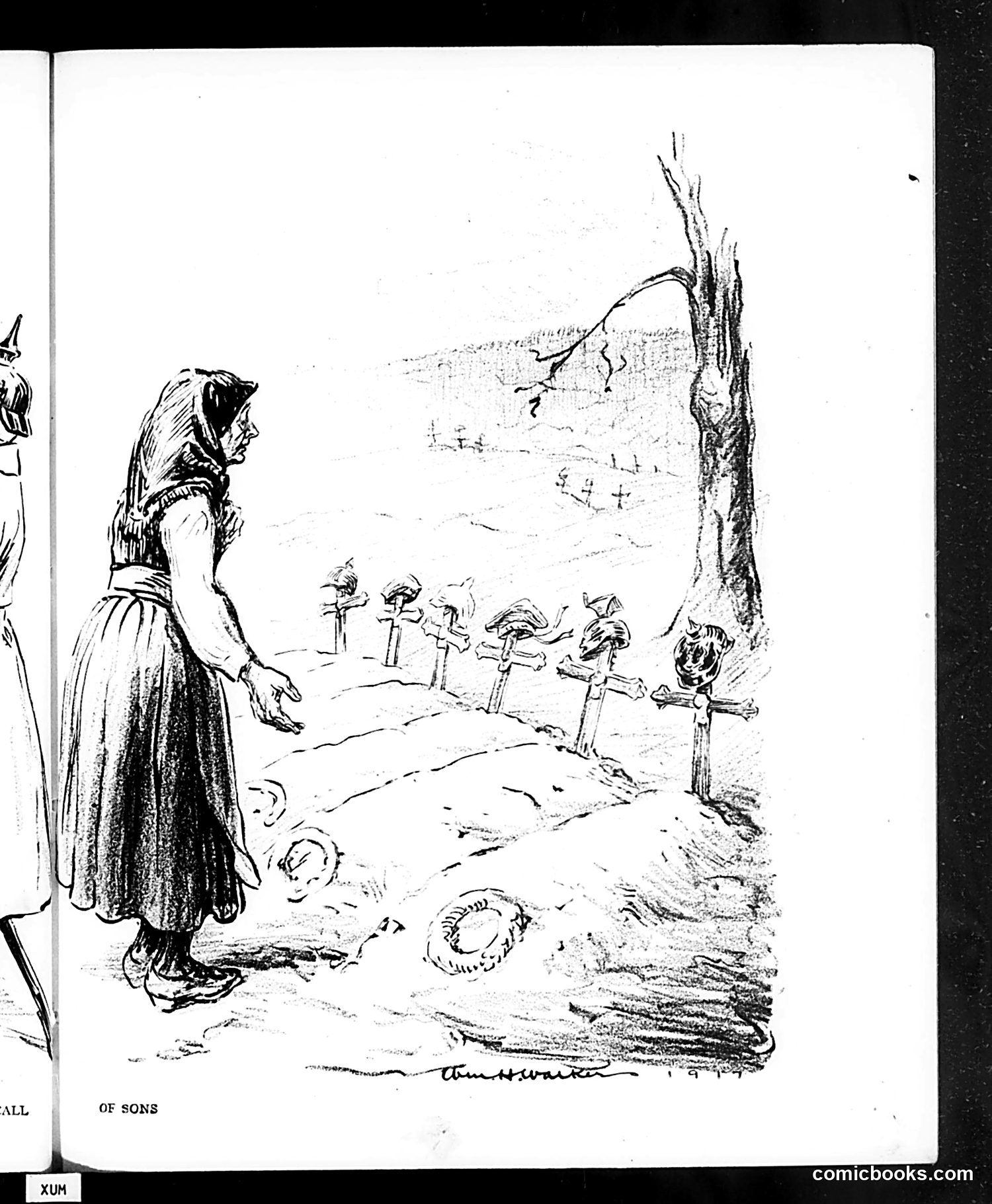
This political cartoon depicts a woman in mourning clothes standing at a military cemetery, viewing rows of crosses marking graves. The stark, sorrowful imagery—with the barren tree and scattered military markers—conveys grief over battlefield deaths. The caption reads "OF SONS," suggesting the full title references mothers losing their sons in war. This appears to be anti-war satire, likely from World War I era (based on the illustration style and comicbooks.com source dating), criticizing the human cost of military conflict. The cartoon uses emotional impact rather than caricature or named figures. It targets war itself as the subject of satire—specifically the devastating toll on families and mothers left behind. The simple, powerful composition emphasizes loss and mourning as commentary on warfare's consequences.
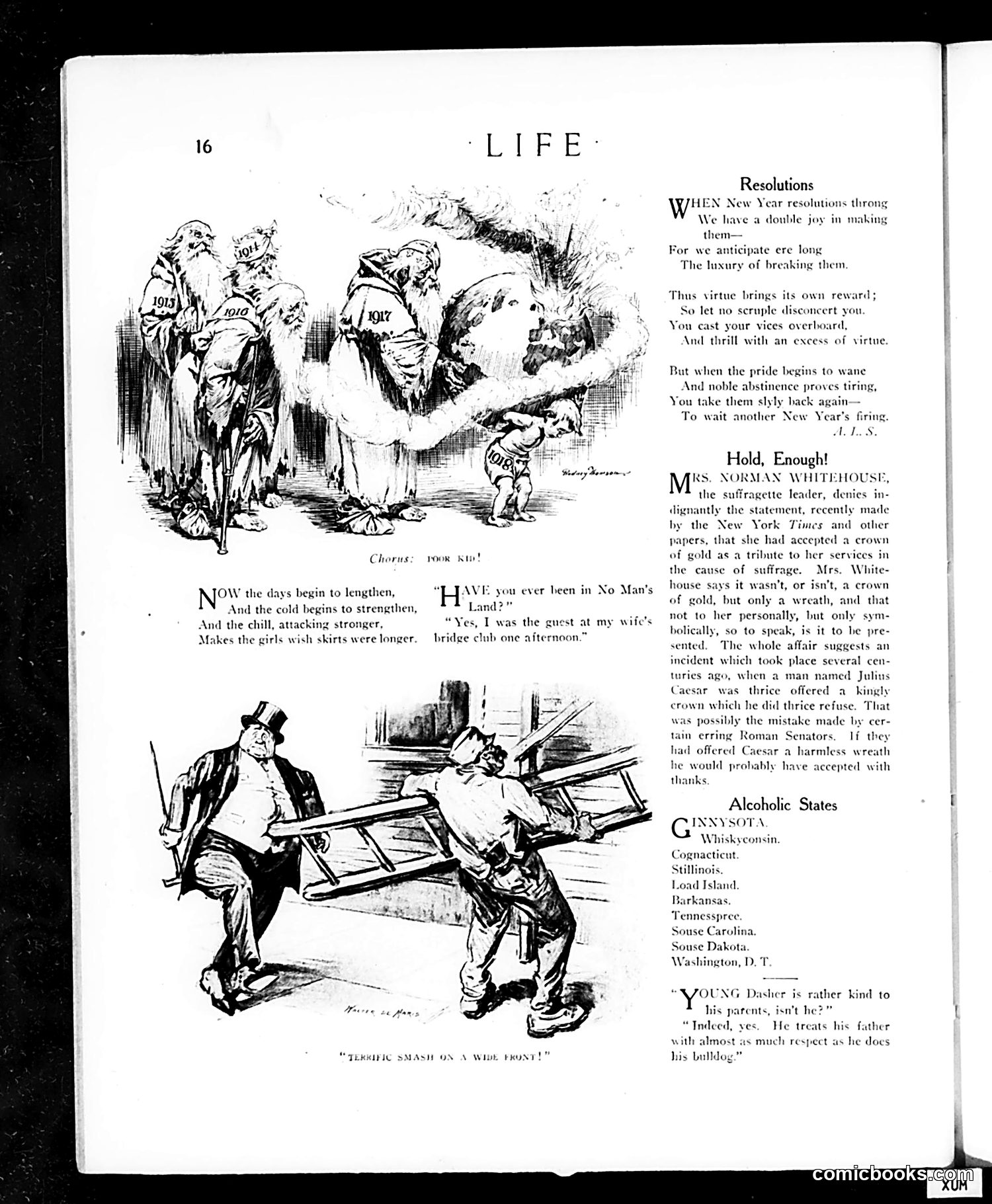
This page contains three satirical pieces from an early 20th-century American humor magazine: **Top cartoon**: A New Year's resolution joke about making—and immediately breaking—virtuous pledges. The satire mocks the hypocrisy of annual resolutions. **Middle section**: Addresses suffragette leader Norman Whitehouse's denial about accepting a gold crown. Life satirizes the controversy by comparing it to Julius Caesar, who famously refused a crown three times. The joke: if Caesar had accepted "a harmless wreath" instead, Roman senators wouldn't have stabbed him. This mocks Whitehouse's semantic distinction between "crown" and "wreath"—splitting hairs over what appears a similar honor. **Bottom cartoon**: "Terrific smash on a wide front" jokes about flirtation as warfare, with figures breaking through ice. **"Alcoholic States"**: A pun list renaming U.S. states with alcohol references (Minnesota→"Whisky-consin," Connecticut→"Cognac-ticut"), likely referencing Prohibition debates of the era. The "Young Dasher" joke makes a mild quip about respect.
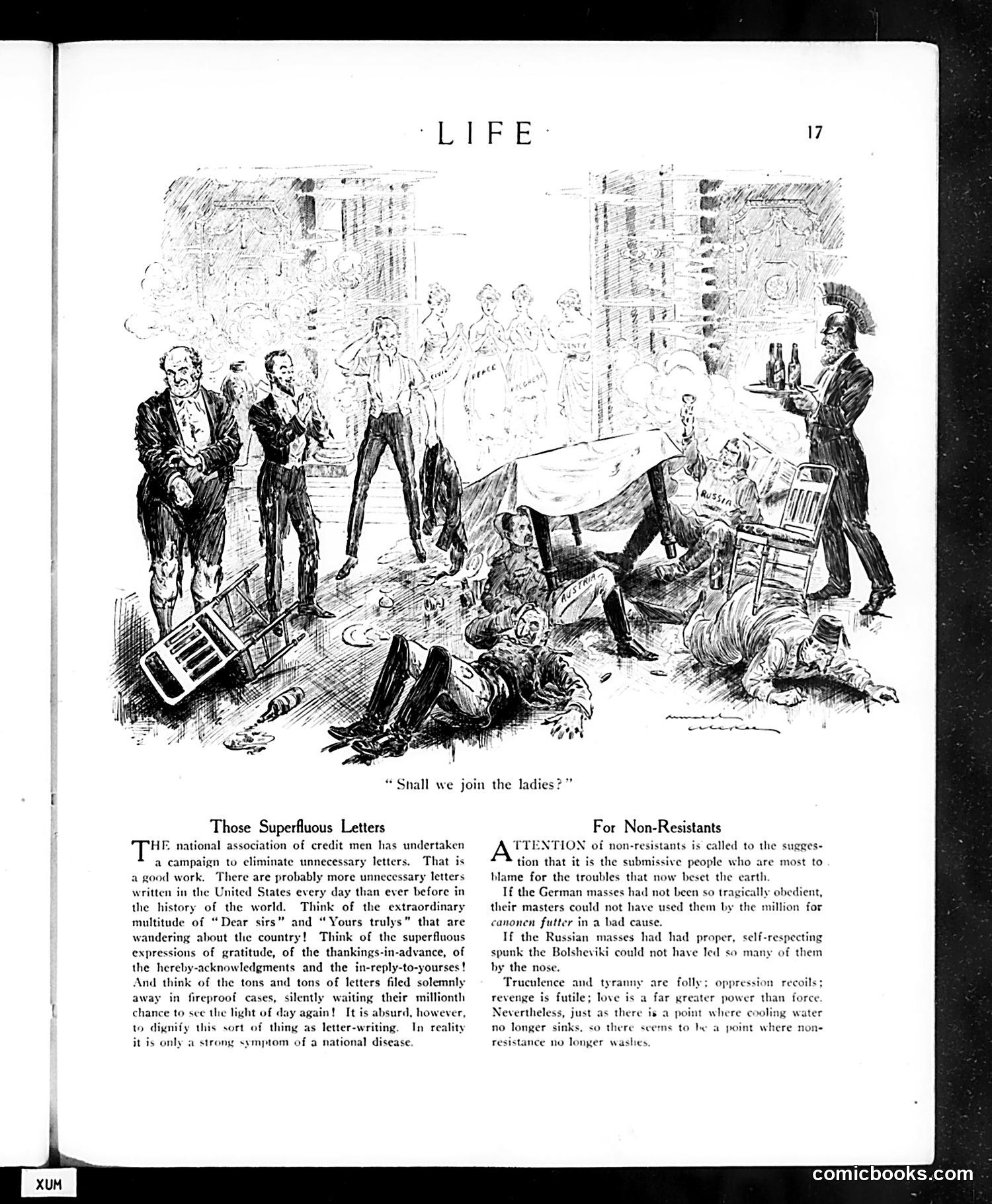
The page contains two separate satirical pieces: **"Those Superfluous Letters"** critiques American business culture's excessive formal correspondence. The accompanying cartoon shows a chaotic office scene with the caption "Shall we join the ladies?"—likely satirizing the disconnect between ornate business letters (filled with "Dear sirs," "Yours truly") and actual workplace reality. The piece argues this letter-writing epidemic reflects a "national disease." **"For Non-Resistants"** addresses pacifism and passive obedience, likely written during or after World War I (references to German masses as "cannon fodder" and the Bolshevik Revolution suggest this era). The author argues that while violence is wrong, complete non-resistance becomes ineffective—comparing it to water that stops sinking at a certain point. The piece suggests that some resistance to tyranny is justified, undercutting pure pacifist ideology. Both pieces use satire to critique contemporary American attitudes toward communication and political response.
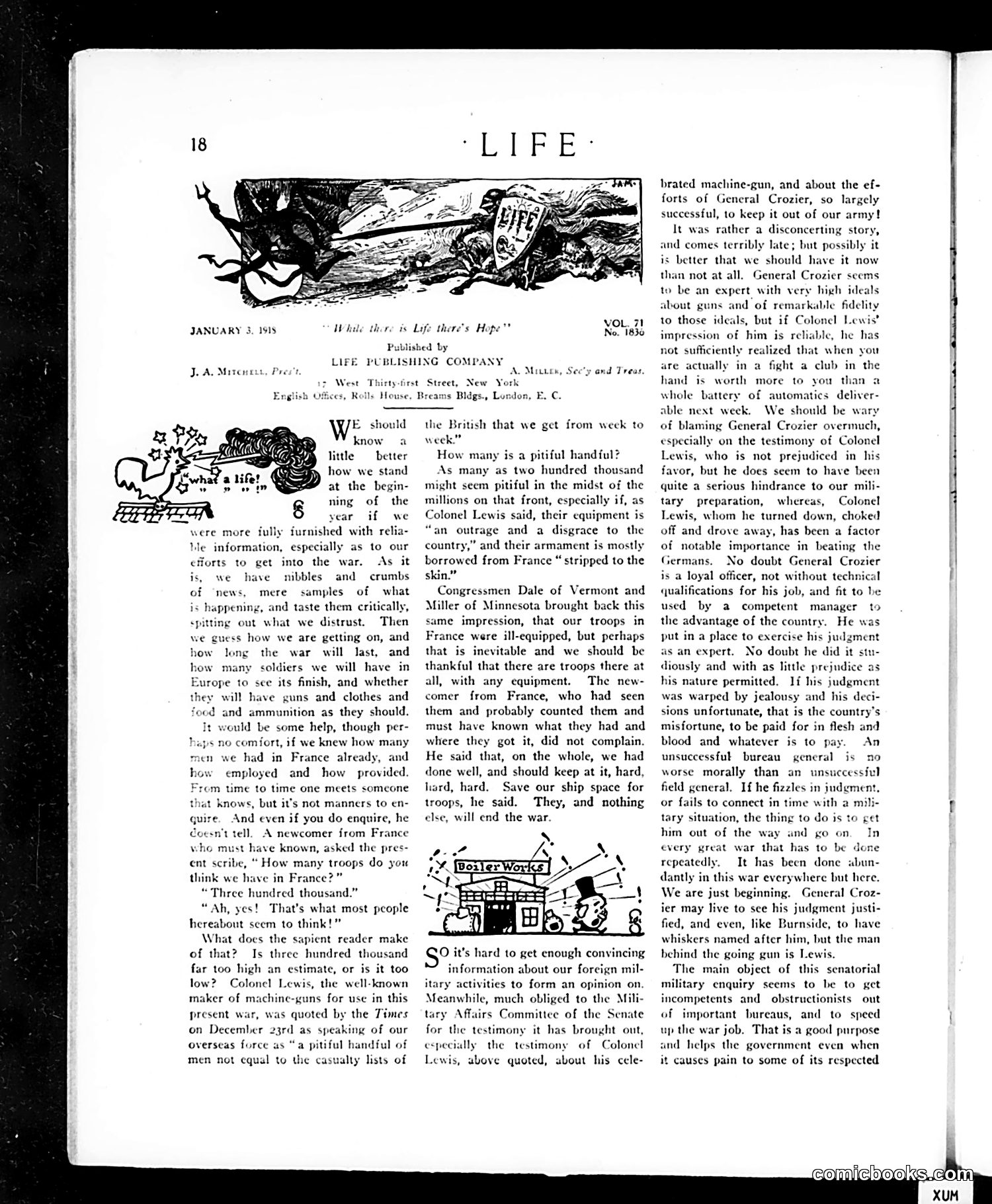
This page satirizes American military unpreparedness as the U.S. enters World War I. The cartoons mock public ignorance about troop strength—readers guess "three hundred thousand" men in France, dismissed as naive. The main target is **Colonel Lewis**, a machine-gun manufacturer, who publicly criticized General **Crozier** (Army Ordnance Chief) for allegedly keeping advanced weapons out of military use due to rigid ideals. The article suggests Crozier, though well-intentioned, prioritized bureaucratic standards over combat necessity—a "club in hand" being worth more than unavailable automatics. The satire criticizes both figures: Lewis for self-interested weapons promotion and Crozier for obstinate bureaucratic gatekeeping that hampered war preparation. The overall message: Americans lack reliable war information while military leadership fumbles equipment procurement.
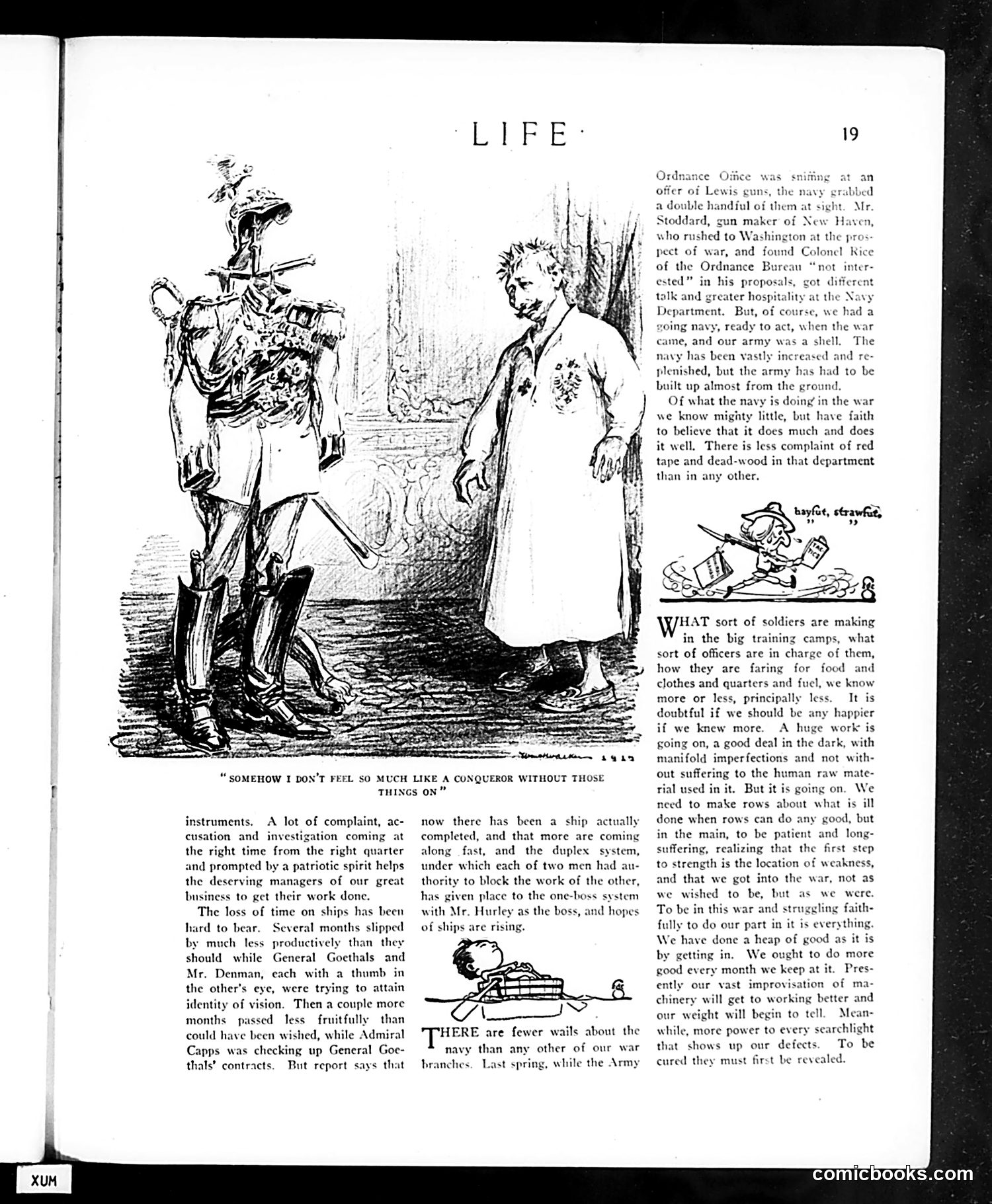
The main cartoon depicts a military officer in full dress uniform confronting a man in civilian clothes. The officer says, "Somehow I don't feel so much like a conqueror without those things on"—referring to his uniform insignia and regalia. **The satire targets** military bureaucracy and ego during World War I. The cartoon mocks how officers derive authority and confidence from external symbols (uniforms, rank) rather than competence. Without these visible markers, the officer feels powerless—suggesting the uniform is merely costume, not earned distinction. **Historical context**: The accompanying text discusses inefficiencies in ship production, mentioning General Goethals and Admiral Capps feuding over the Panama Canal shipping program. The article criticizes bureaucratic turf wars while praising the Navy's relative efficiency compared to the Army's chaotic mobilization. **The broader point**: The cartoon reinforces the text's theme—that competent management and clear authority matter more than military pageantry and inter-departmental conflicts.
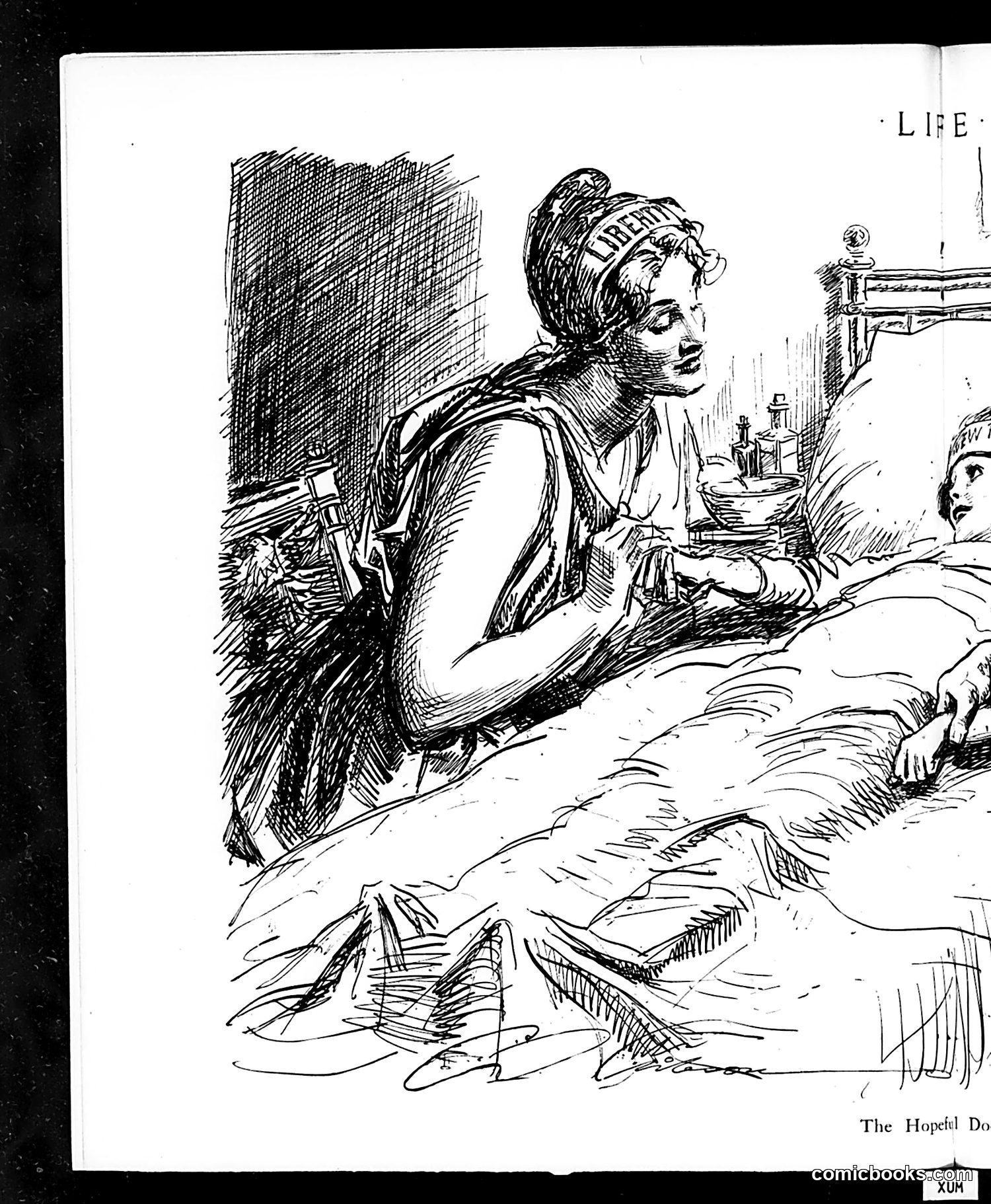
This page from *Life* magazine shows a sketch titled "The Hopeful Do" (caption partially visible at bottom). The illustration depicts a woman in profile wearing a "Liberty" headband, seated at what appears to be a vanity or dressing table with toiletries. She's drawn in a satirical style typical of early 20th-century American humor. The cartoon likely satirizes women's fashion, cosmetics, or beauty rituals of the era, possibly commenting on commercialism or vanity. The "Liberty" headband suggests commentary on patriotic or feminist themes. However, without a complete caption or date, the specific political or social reference remains unclear. The sketch's style and *Life* magazine's satirical tradition suggest it's critiquing contemporary attitudes toward women's appearance or consumerism.
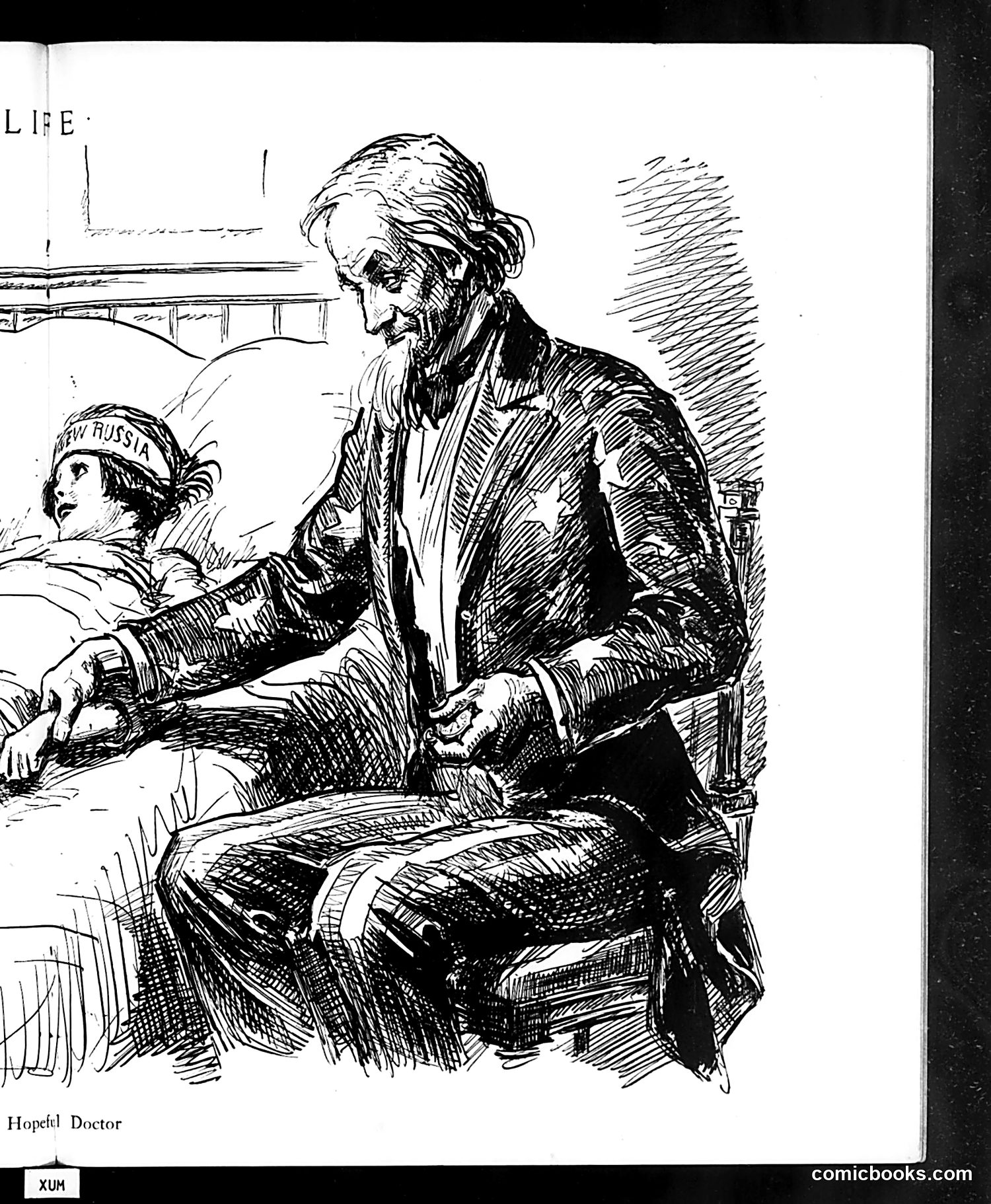
This cartoon depicts an elderly bearded doctor attending to a wounded soldier wearing a "New Russia" headband. The soldier appears gravely injured, lying in bed. The title "Hopeful Doctor" and the "New Russia" inscription suggest this is Cold War-era commentary on Soviet Russia's condition—portraying the nation as a patient in critical condition under medical care. The doctor's presence and the "hopeful" framing likely satirize either: 1. Western observers' optimistic assessments of Soviet recovery or reform, or 2. Soviet propaganda claiming to be healing the nation's wounds The cartoon uses medical metaphor to critique the actual state of the Soviet Union, suggesting that despite official "hopeful" rhetoric, Russia remained fundamentally damaged or compromised. The specific historical context—which decade this appeared—would clarify whether it references post-WWII recovery, Khrushchev-era reforms, or another period.
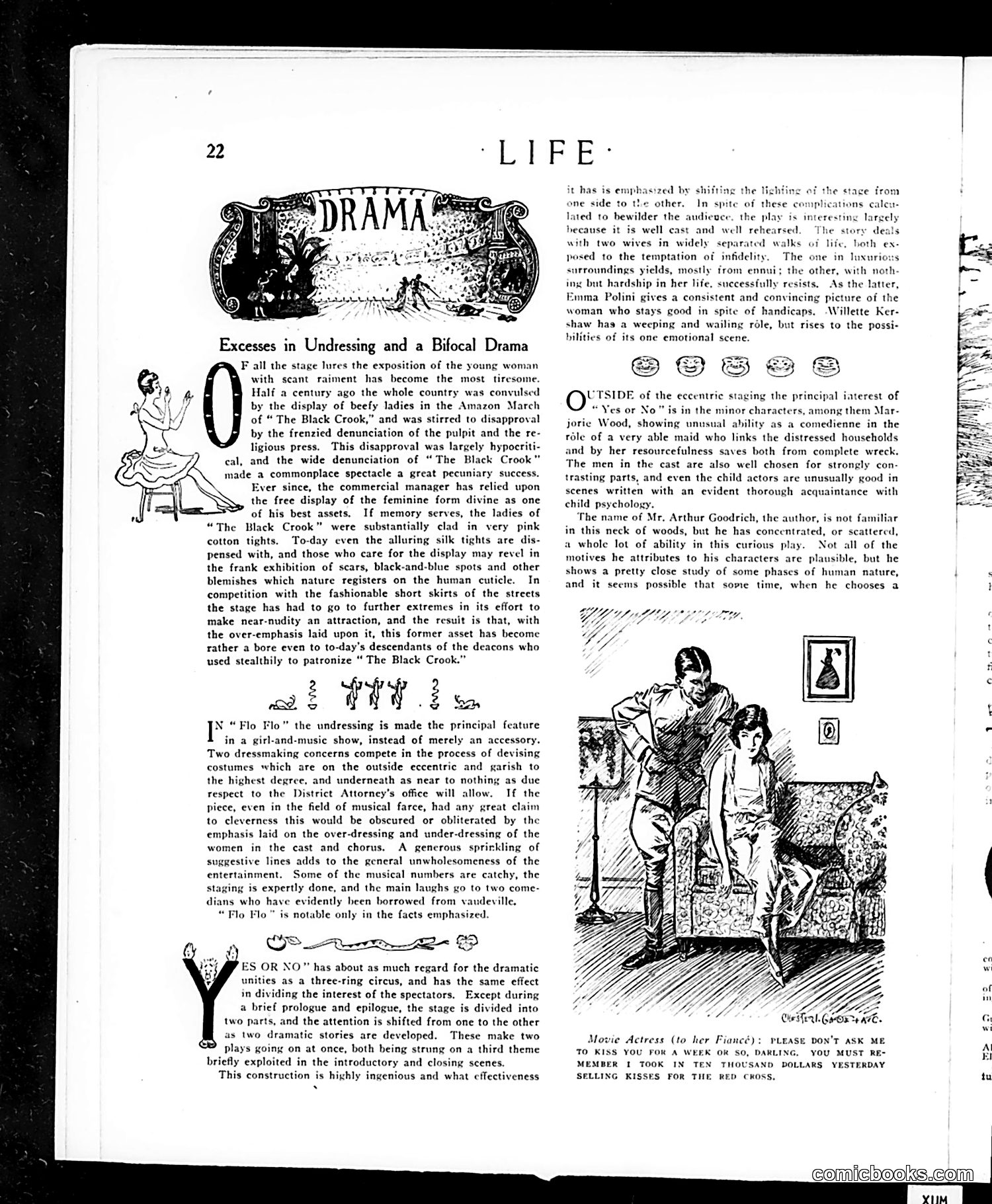
This page critiques three theatrical productions with disapproval of contemporary stage trends. **"The Black Crook" reference**: A notorious 1860s musical famous for displaying scantily-clad women—initially condemned by churches and press, yet hugely profitable. The author notes this hypocrisy: moral outrage masked prurient interest. **Current complaint**: Modern shows have escalated from pink tights to near-nudity, displaying actual bodily blemishes. The critic argues this "over-emphasis" has made nudity boring rather than titillating—a self-defeating strategy. **"Flo Flo"**: Criticized as a show where undressing IS the entire point, overshadowing music and comedy. Costumes are intentionally eccentric and revealing (within legal limits). **"Yes or No"**: Praised as more dramatically sophisticated—a bifurcated plot with two parallel stories about wives tempted by infidelity, featuring capable actresses like Emma Polini. The satire targets producers' reliance on flesh over genuine theatrical merit.
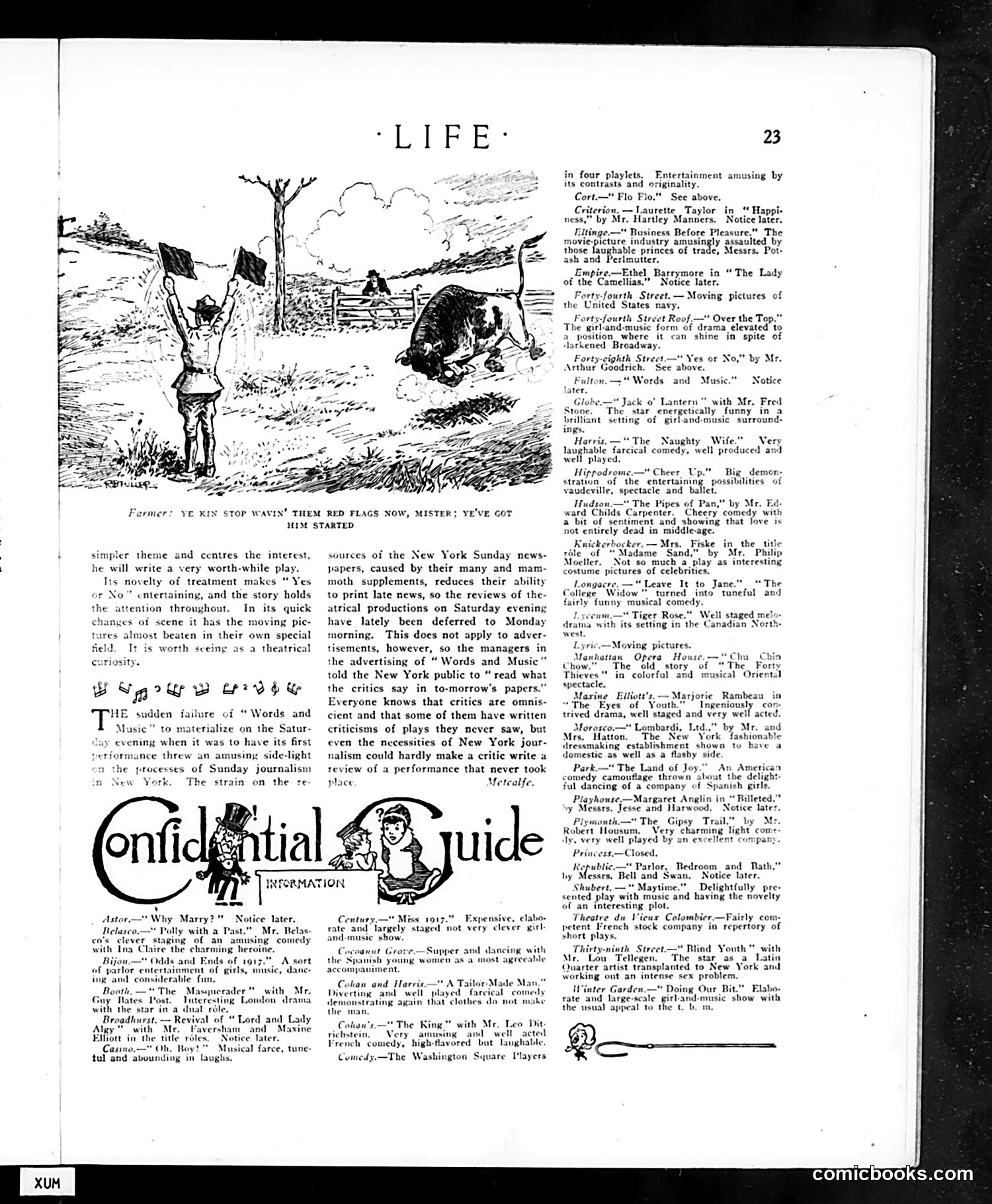
This is a theater review page from *Life* magazine featuring a political cartoon and theatrical notices. The main cartoon depicts a farmer stopping a man from waving red flags at a bull, saying "Ye kin stop wavin' them red flags now, mister; ye've got him started." **The Satire:** This is anti-labor/anti-socialist commentary. The "red flags" reference labor radicals and socialists (red being their symbolic color). The farmer represents the American public or establishment—the cartoon suggests that radical agitators have successfully "riled up" the bull (the masses or public sentiment), so further provocation isn't needed. The joke mocks both radical propagandists and implies public anger is now self-sustaining. **Context:** This reflects early 20th-century American anxiety about labor movements, socialism, and perceived revolutionary threats, particularly relevant during WWI-era tensions. The remainder is standard theater criticism for Broadway productions, listing shows with brief reviews.
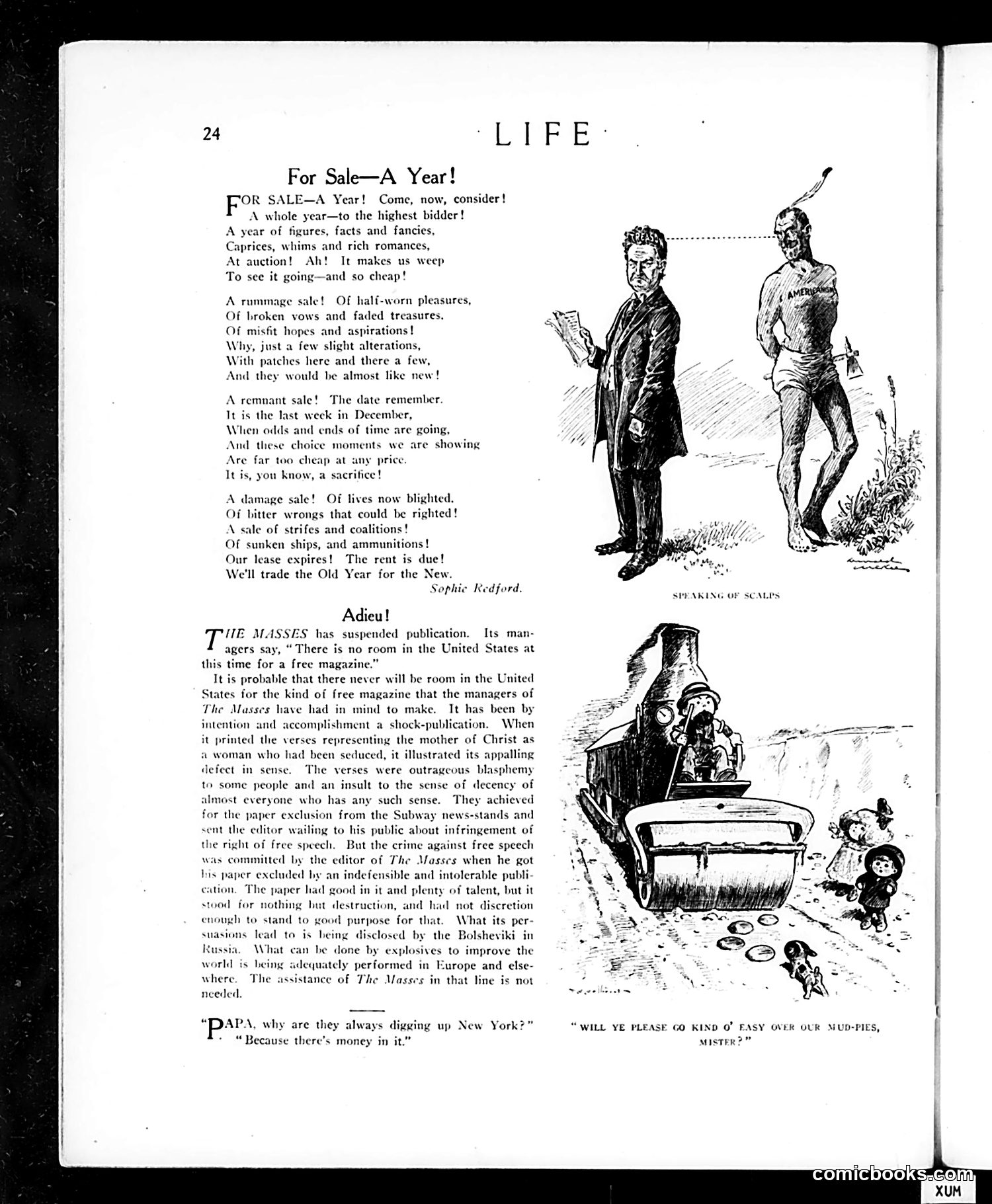
This satirical piece uses a year-end auction metaphor to mock 1918's disappointments. The poem "For Sale—A Year!" by Sophie Redford personifies the departing year as damaged goods—broken vows, failed hopes, sunken ships, and ammunition—being liquidated cheaply. It's bitter commentary on a year marked by WWI's devastation and social upheaval. The second section, "Adieu!," announces *The Masses* magazine's suspension, characterizing it as destructively radical rather than meaningfully critical. Life's editors argue the publication, which printed blasphemous content about the Virgin Mary, deserved suppression—conflating free speech infringement with Bolshevik violence in Russia. The cartoons (scale-tipping and mud-digging) appear illustrative of these themes of imbalance and excavation, though their specific references are unclear without additional context.
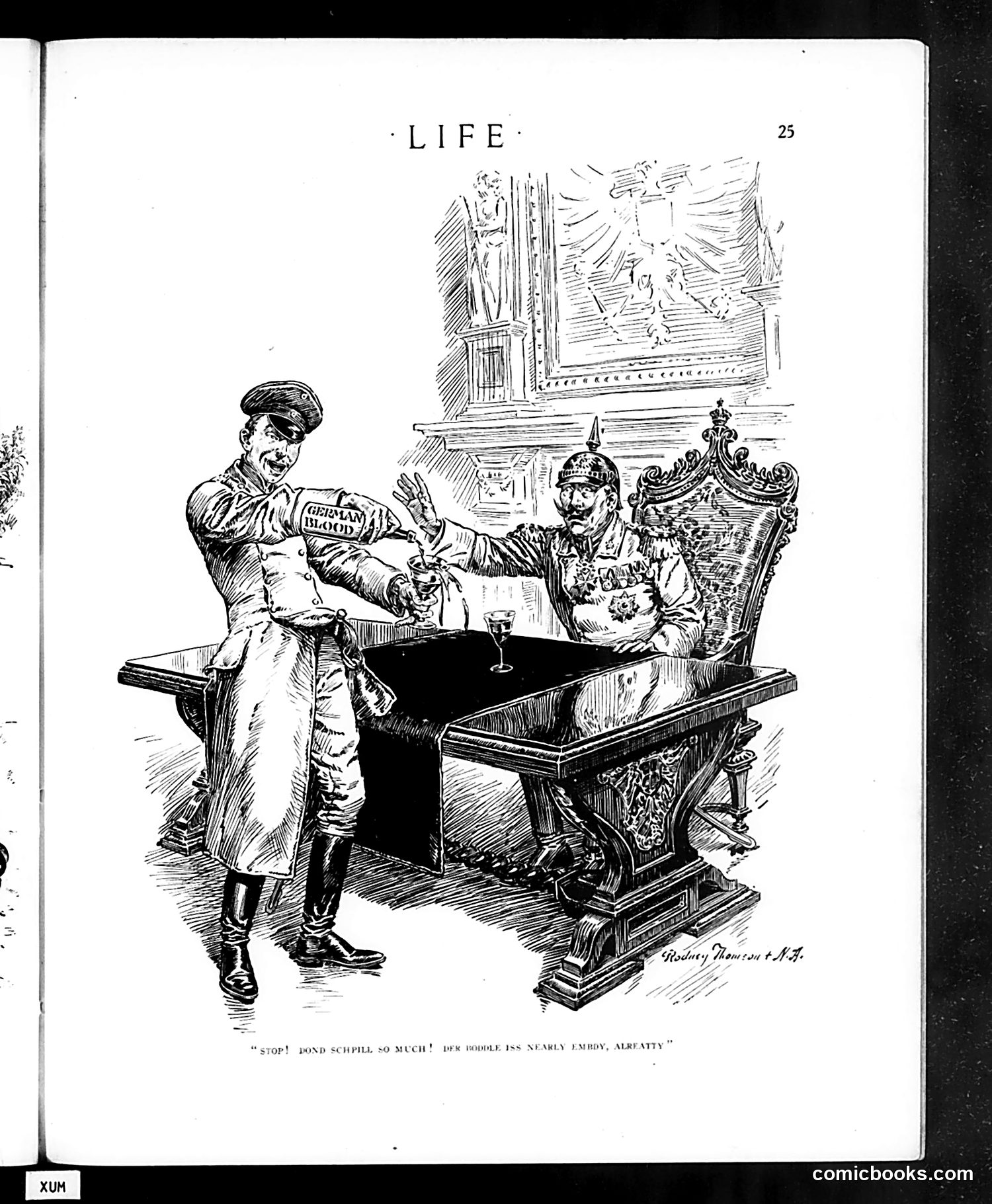
This is a satirical cartoon from *Life* magazine (page 25) depicting what appears to be a military or diplomatic scene. A uniformed figure on the left (holding what looks like a bottle labeled "GIDOLAN") gestures toward two men seated at a table—one wearing a military uniform with a spiked helmet (likely German, given the style), the other in formal dress with decorations. The caption reads: "STOP! BOND SCHNAPPS SO MUCH! DER DODDLE ISS NEARLY EMPTY, ALRFATTY" The satirical point appears to mock German military figures through exaggerated dialect and drunken behavior, likely from the World War I era when such caricatures were common in American publications. The "spiked helmet" and German-accented English suggest anti-German sentiment typical of wartime propaganda cartoons.
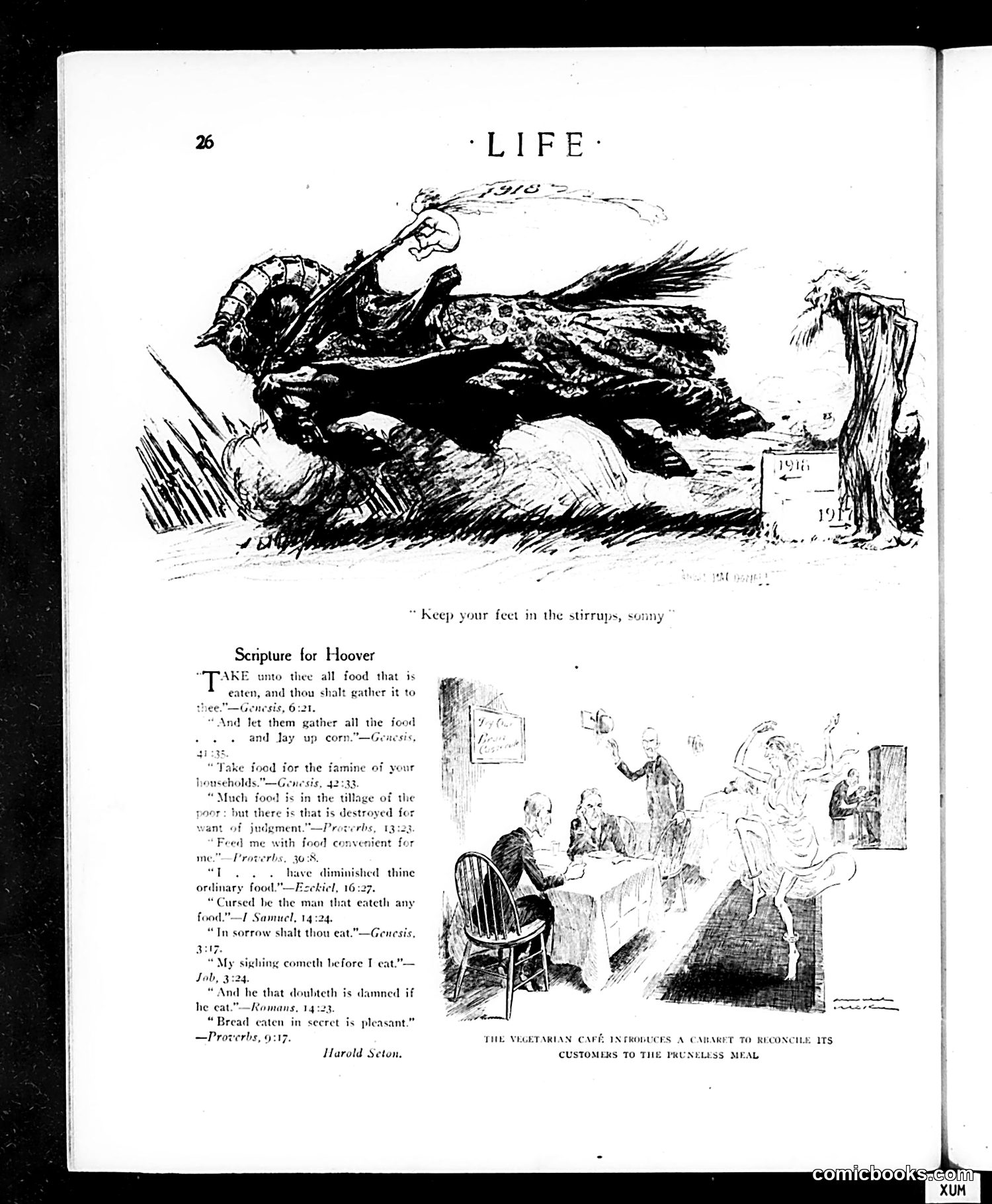
This page satirizes Herbert Hoover's food policies during what appears to be WWI-era rationing or the early Depression. The top cartoon shows a man on a horse labeled with years (1918, 1917), captioned "Keep your feet in the stirrups, sonny"—suggesting Hoover's grip on the nation's food supply. Below, "Scripture for Hoover" mocks his administration by stringing together Biblical verses about food scarcity, hunger, and deprivation—implying his policies force Americans to endure biblical-level hardship. The bottom illustration depicts "The Vegetarian Café" introducing entertainment ("cabaret") to distract customers from eating "pruneless meals"—a joke about wartime food rationing and substitutes. The satire suggests the government offers cultural distractions rather than actual nutrition. The overall message: Hoover's food management leaves Americans hungry, quoting Scripture to justify deprivation while offering only entertainment as compensation.
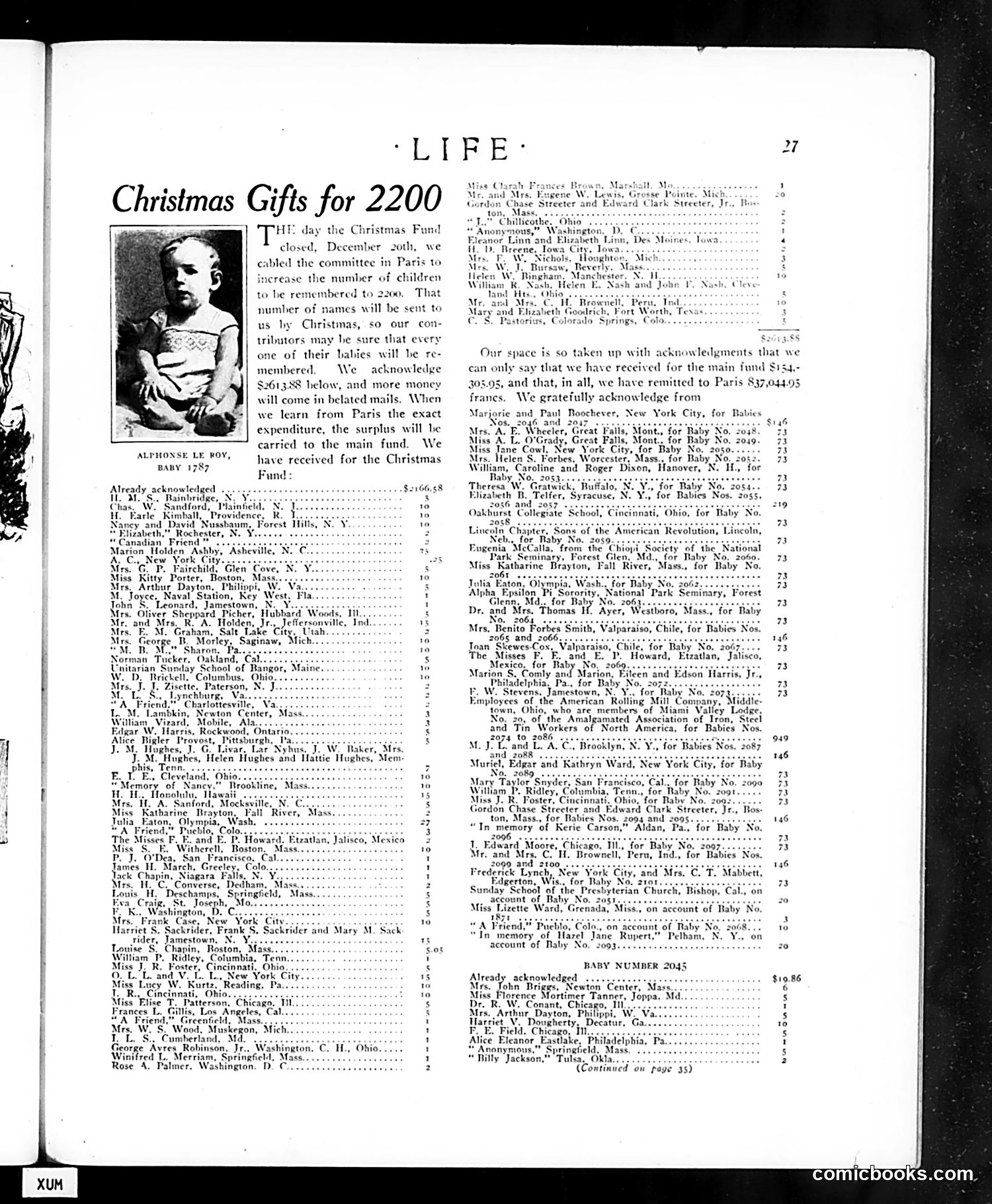
This page documents a charitable fundraising campaign by *Life* magazine to provide Christmas gifts to 2,200 children. The accompanying portrait shows **Alphonse Le Roy, a baby from 1787**—likely presented as a historical reference point, though the exact relevance is unclear from the visible text. The page is primarily a **donor acknowledgment list**, recording contributions from readers across America who donated money to the Christmas Fund. Contributors range from individuals to organizations like the Unitarian Sunday School of Bangor, Maine. The satirical thrust appears implicit: *Life* magazine, known for social commentary, uses its readership to fund charitable aid during the Gilded Age, when private philanthropic networks often filled gaps in social welfare. The juxtaposition of frivolous magazine culture with serious charitable work may represent gentle satire about American values—or straightforward advocacy for readers' generosity toward vulnerable children.
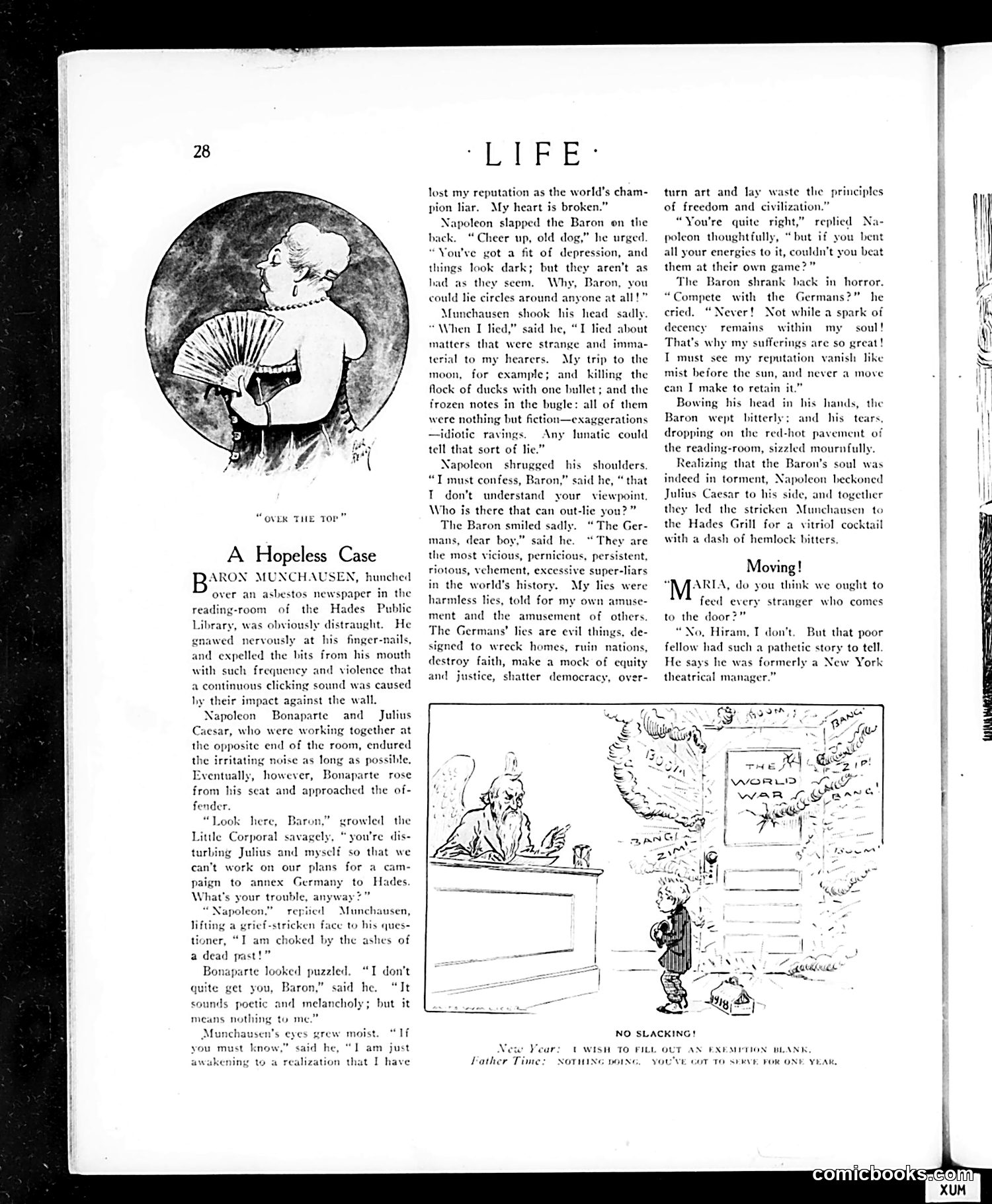
This WWI-era story uses the literary device of Hell's waiting room to satirize German propaganda. Baron Munchausen—the historical figure famous for tall tales—has lost his purpose because Germans now out-lie him with "evil" lies designed to "wreck homes, ruin nations, destroy faith, make a mock of equity and justice, shatter democracy." The satire's point: legitimate fictional exaggeration (Munchausen's inventive fantasies) is harmless entertainment, but German wartime propaganda represents moral corruption of the same tool. Even a master liar refuses to compete. The cartoon features Napoleon and Julius Caesar also in Hell, planning to "annex Germany to Hades"—a joke suggesting Germany deserves damnation. The bottom cartoon about draft exemptions reinforces the patriotic message: citizens must serve their country, not evade duty. This reflects American WWI sentiment characterizing German propaganda as particularly dishonest and destructive to civilization itself.
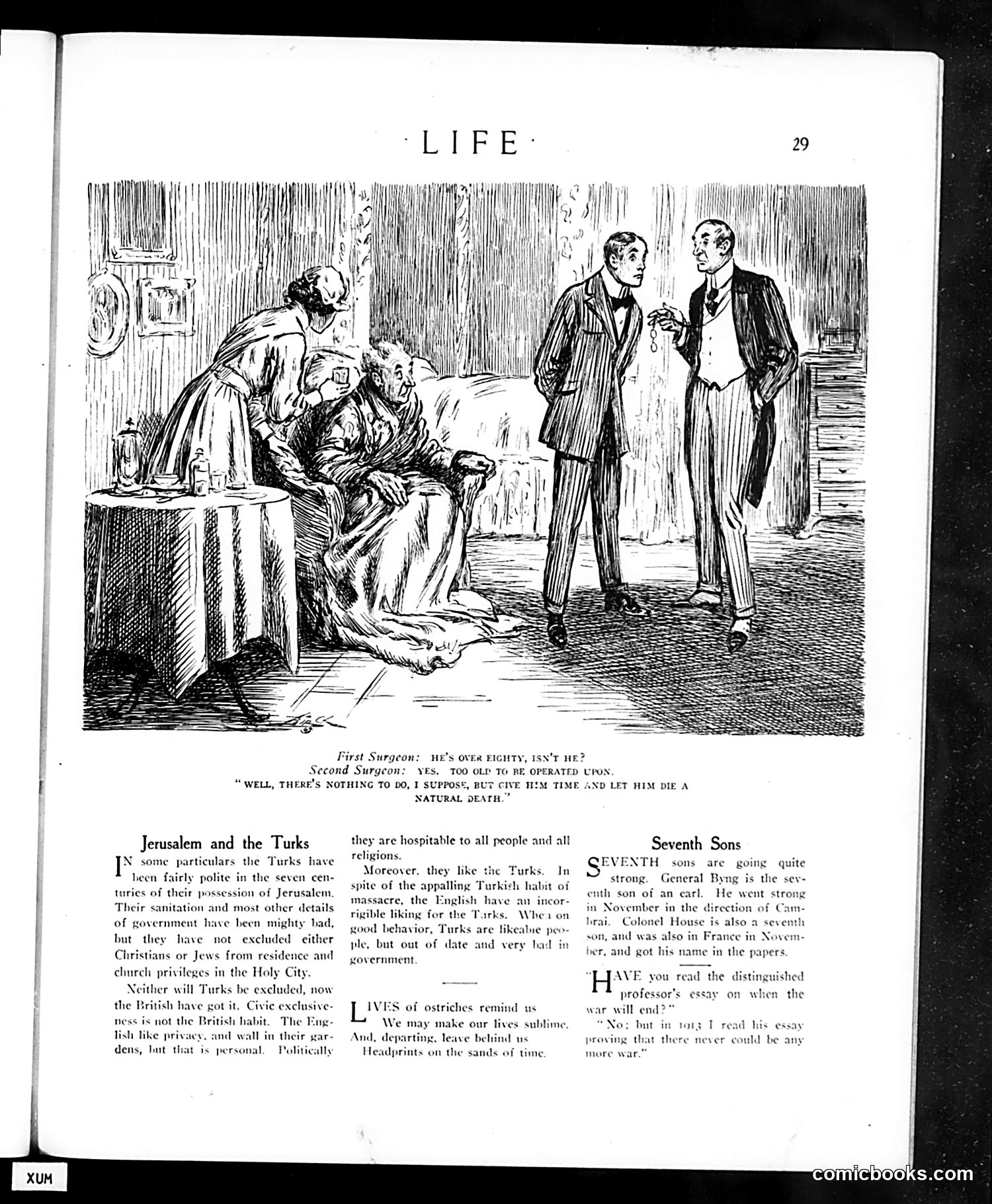
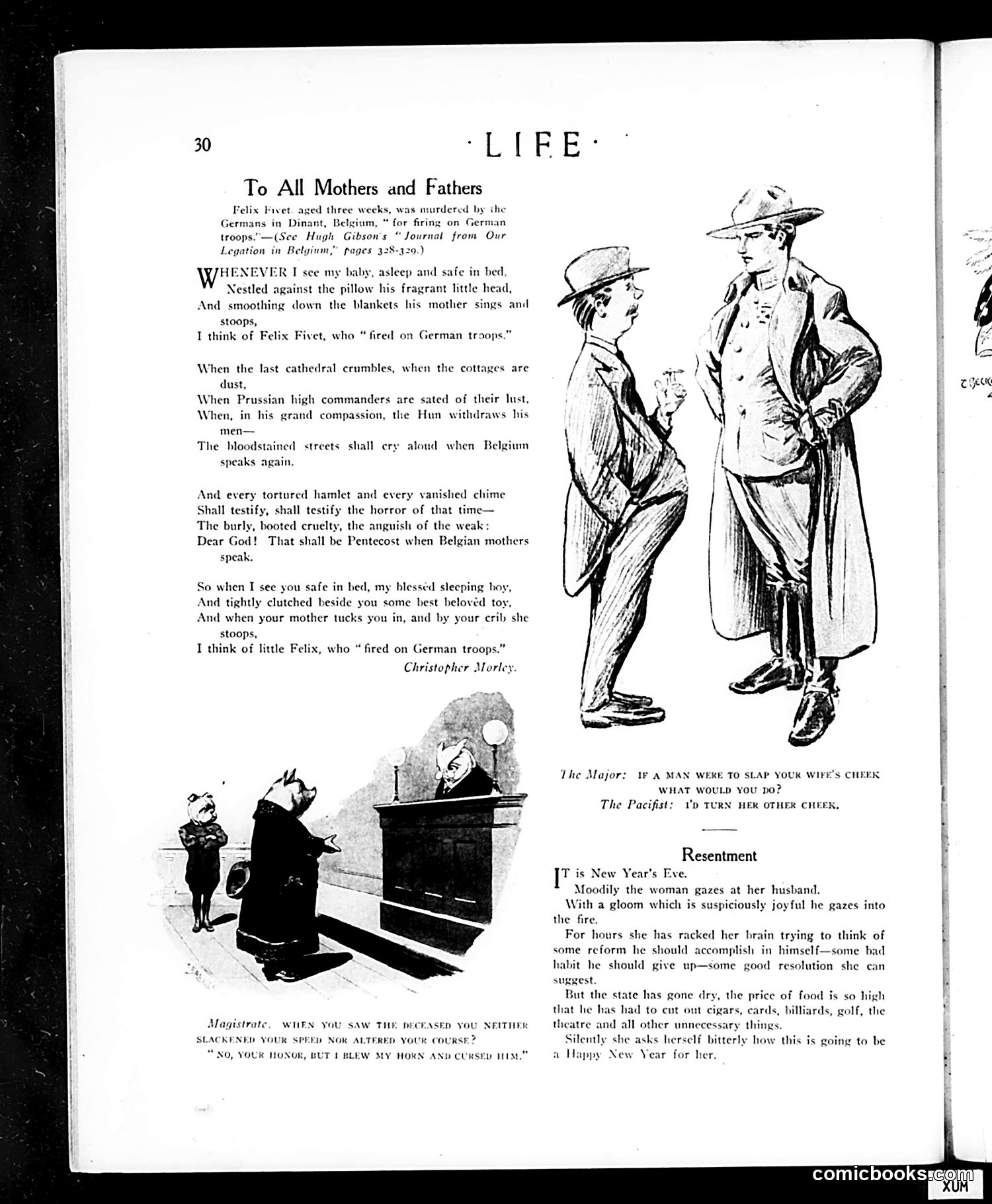
This WWI-era page combines anti-German propaganda with domestic humor. The main poem by Christopher Morley references Felix Fivet, a three-week-old Belgian infant killed by Germans in Dinant—apparently shot for his parents "firing on German troops," a propaganda allegation. The poem uses this atrocity to evoke maternal protection and future Belgian vengeance, framing German brutality against civilians as unforgivable. The cartoon jokes below address different wartime anxieties: a magistrate questions a reckless driver; a "Major" and "Pacifist" debate response to violence (the Pacifist's non-resistance is mocked). The final section, "Resentment," satirizes American home-front domesticity during Prohibition and wartime rationing. A wife resents her husband because wartime restrictions (no cigars, theater, billiards) have eliminated all bad habits she might reform him about—leaving her with no New Year's complaint. The satire targets wives' domestic grievances as trivial compared to war's actual suffering.
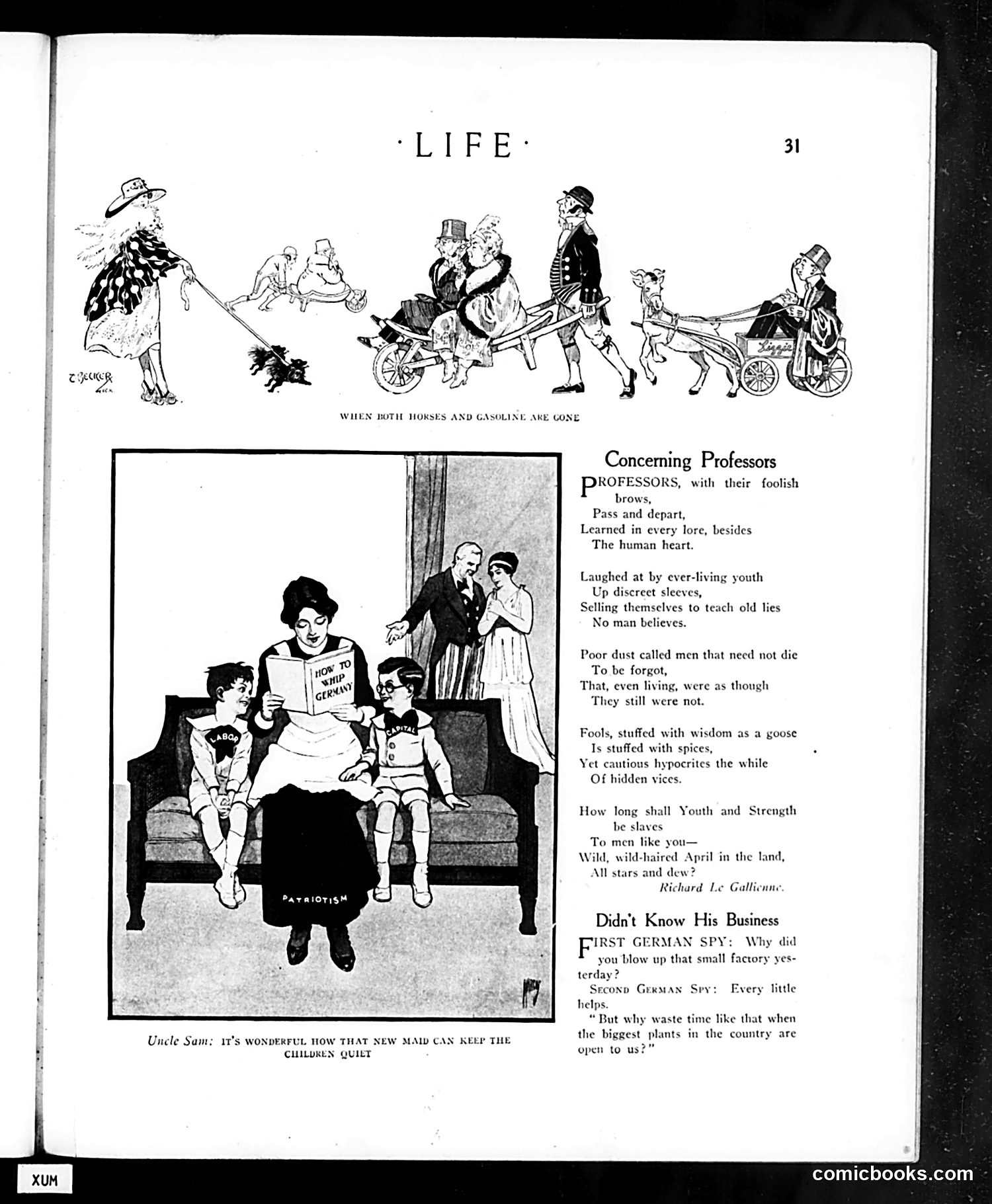
**Top Cartoon**: A humorous strip showing people attempting transportation after "both horses and gasoline are gone." It satirizes wartime fuel rationing and shortages, depicting increasingly absurd substitutes—people pulling carts, riding goats, etc. **Middle Illustration**: Titled "Uncle Sam: It's wonderful how that new maid can keep the children quiet," shows a woman reading to two children labeled "Patriotism." This appears to be WWI-era propaganda satire—mocking how patriotic messaging keeps the public docile and compliant. **"Concerning Professors" Poem**: A cynical attack on academics as foolish, hypocritical pedants who teach lies and are forgotten despite their pretensions to wisdom. Quotes Richard Le Gallienne criticizing their hold over youth. **"Didn't Know His Business" Joke**: Two German spies discuss sabotage strategy. One questions why his colleague wastes time on small factories when larger plants are "open to us"—dark humor about espionage vulnerabilities during wartime. The page reflects WWI anxieties: rationing, propaganda, intellectual criticism, and spy fears.
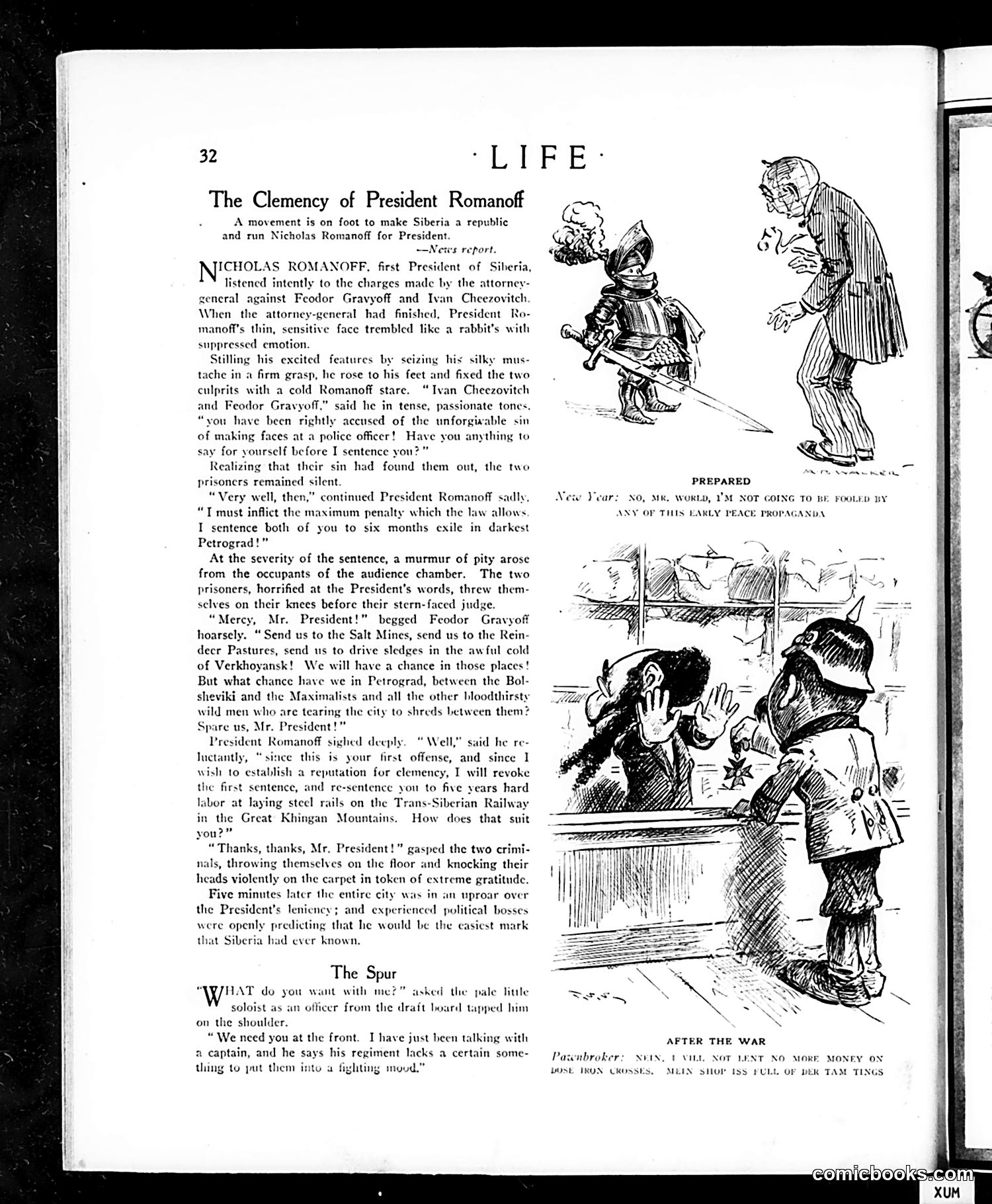
This page satirizes Tsar Nicholas II (here called "President Romanoff"), mocking the idea that he could democratically lead Siberia. The main cartoon depicts Romanoff as absurdly lenient—sentencing two men to Petrograd (considered harsher than Siberian exile) as "maximum penalty" for making faces at police. The joke: his clemency is so extreme and misjudged that political operatives immediately recognize him as easily manipulated. The satire targets the Russian Revolution's chaos. References to "Bolsheviki," "Maximalists," and violent street conflict reflect the civil war period. By portraying Romanoff as ineffectually merciful amid anarchic bloodshed, Life suggests autocratic Russia cannot function as a democracy. Secondary cartoons mock war profiteering and Jewish stereotypes (the pawnbroker refusing war bonds). The page reflects American anxiety about Russian instability during WWI and the emerging Soviet threat.
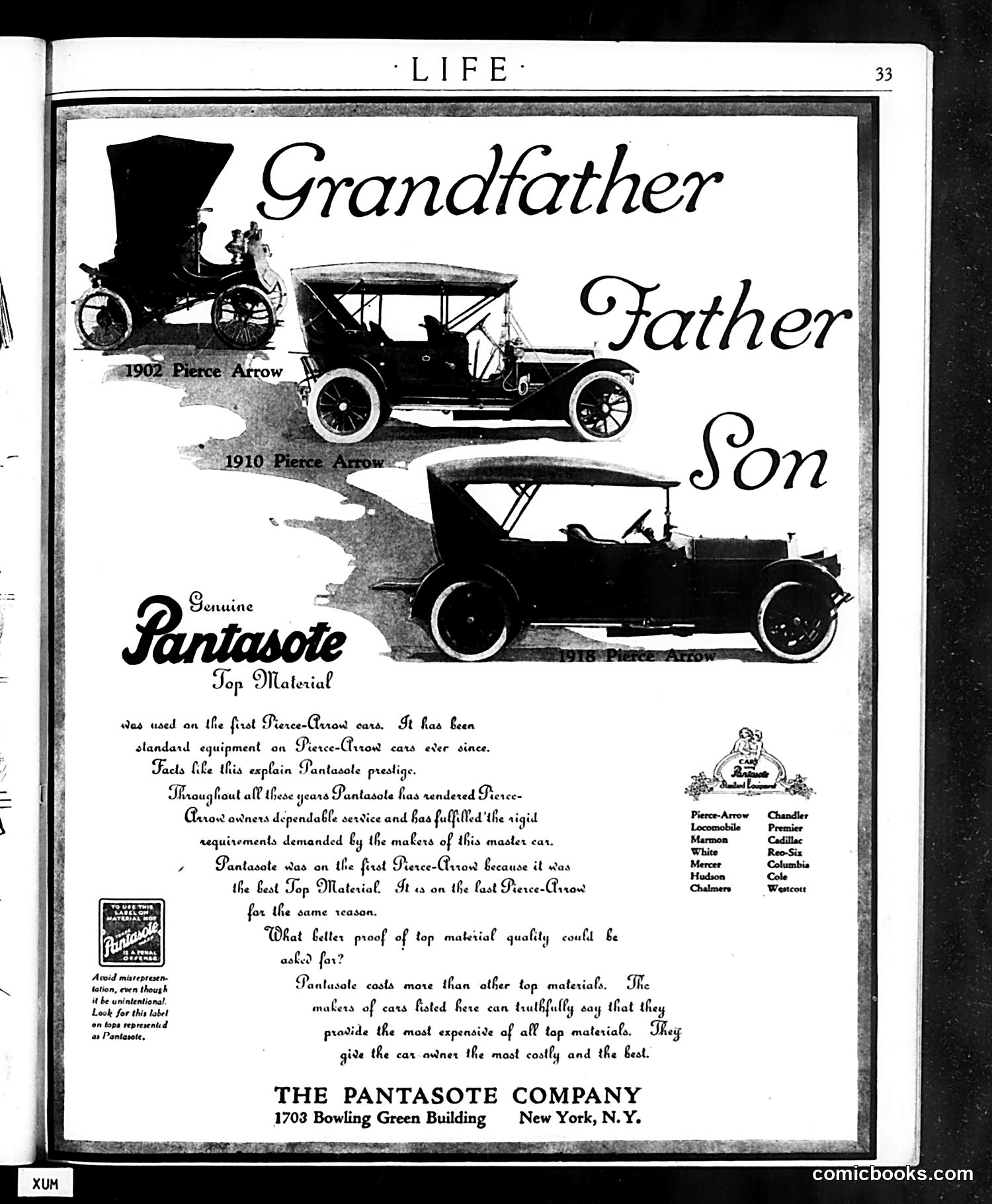
This is primarily a **product advertisement**, not political satire. The page showcases Pantasote automobile top material through a "Grandfather, Father, Son" visual metaphor—three generations of Pierce-Arrow cars spanning from 1902 to 1918, illustrating product continuity and reliability. The advertisement argues that Pantasote's use as standard equipment on Pierce-Arrow vehicles—from the earliest models to current ones—proves its quality. The text emphasizes that Pantasote costs more than competitors but delivers superior durability and prestige. The "generational" framing appeals to tradition and inherited excellence: if your grandfather trusted this material, so should you. This was a common advertising strategy of the era, linking consumer products to family legacy and social status. The small illustration showing various automobile brands (Hudson, Chandler, etc.) at page's edge reinforces that elite vehicles standardly used Pantasote, positioning it as the choice of discriminating car owners.
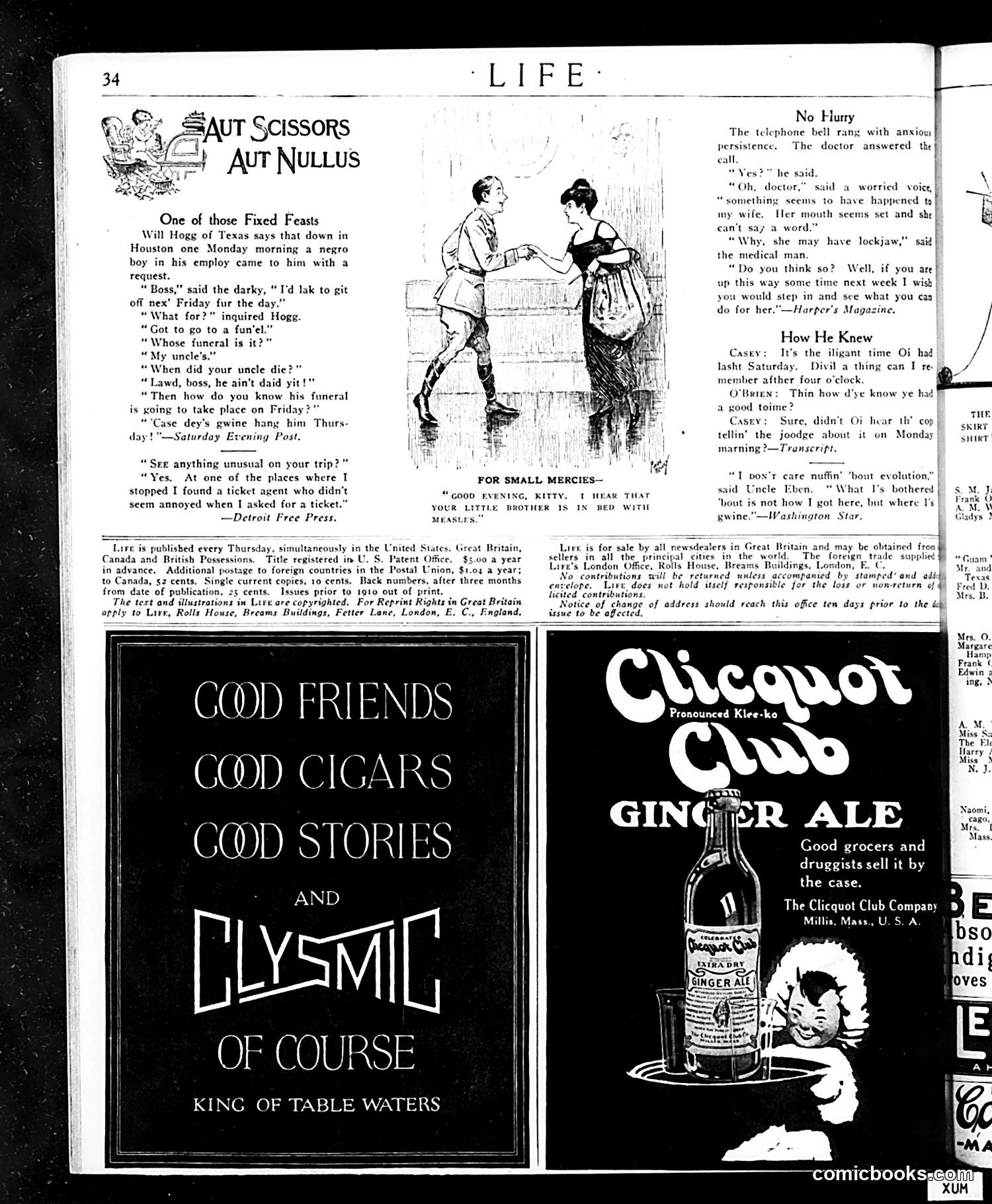
This page contains three brief humorous anecdotes typical of early 20th-century American satire: **"Aut Scissors Aut Nullus"** presents a racist dialogue where a Texas man asks his Black employee about taking time off for his uncle's funeral—only to learn the uncle hasn't died yet but will be hanged that Friday. The "joke" relies on period stereotypes about Black criminality and dialect. **"No Hurry"** depicts a doctor responding dismissively to a wife's apparent medical emergency (lockjaw), suggesting she won't recover soon enough to matter—satire of medical indifference. **"How He Knew"** uses Irish-American dialect stereotypes, with a drunk man recalling his weekend only through overhearing a police officer's court testimony. The page also features period advertisements for Clysmic ginger ale and cigars. These anecdotes reflect Life's reliance on ethnic/racial humor common to 1910s American publications, now considered offensive but historically representative of that era's casual prejudice in mainstream humor.
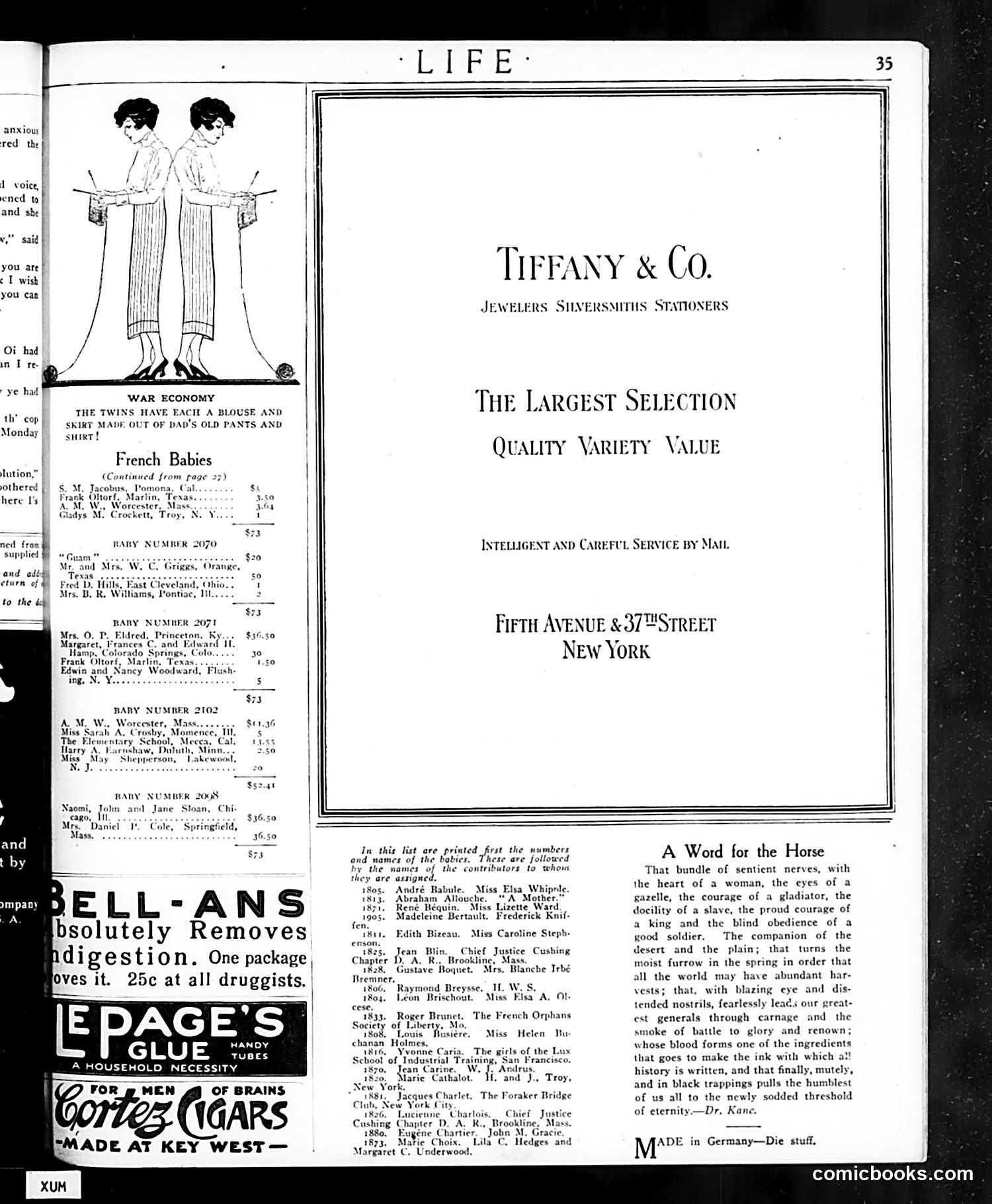
The cartoon depicts **twin babies dressed identically in blouses and skirts made from their father's old pants and shirt**—a visual joke about wartime fabric rationing and thrift. The caption "War Economy" identifies this as **WWI-era satire**. During the First World War, Americans faced material shortages and were encouraged to repurpose clothing and reduce consumption. The humor comes from the absurd application of this patriotic economy to infants: parents so committed to the rationing cause that they fashion their babies' entire wardrobes from patched men's garments. The identical twins amplify the joke—doubling the ridiculous image and suggesting a family stretching one pair of old pants to clothe multiple children. For modern readers: this reflects genuine WWI homefront sacrifice and the cultural messaging around civilian participation in the war effort through material conservation. The satire gently mocks the *extremes* to which some Americans took these official recommendations.
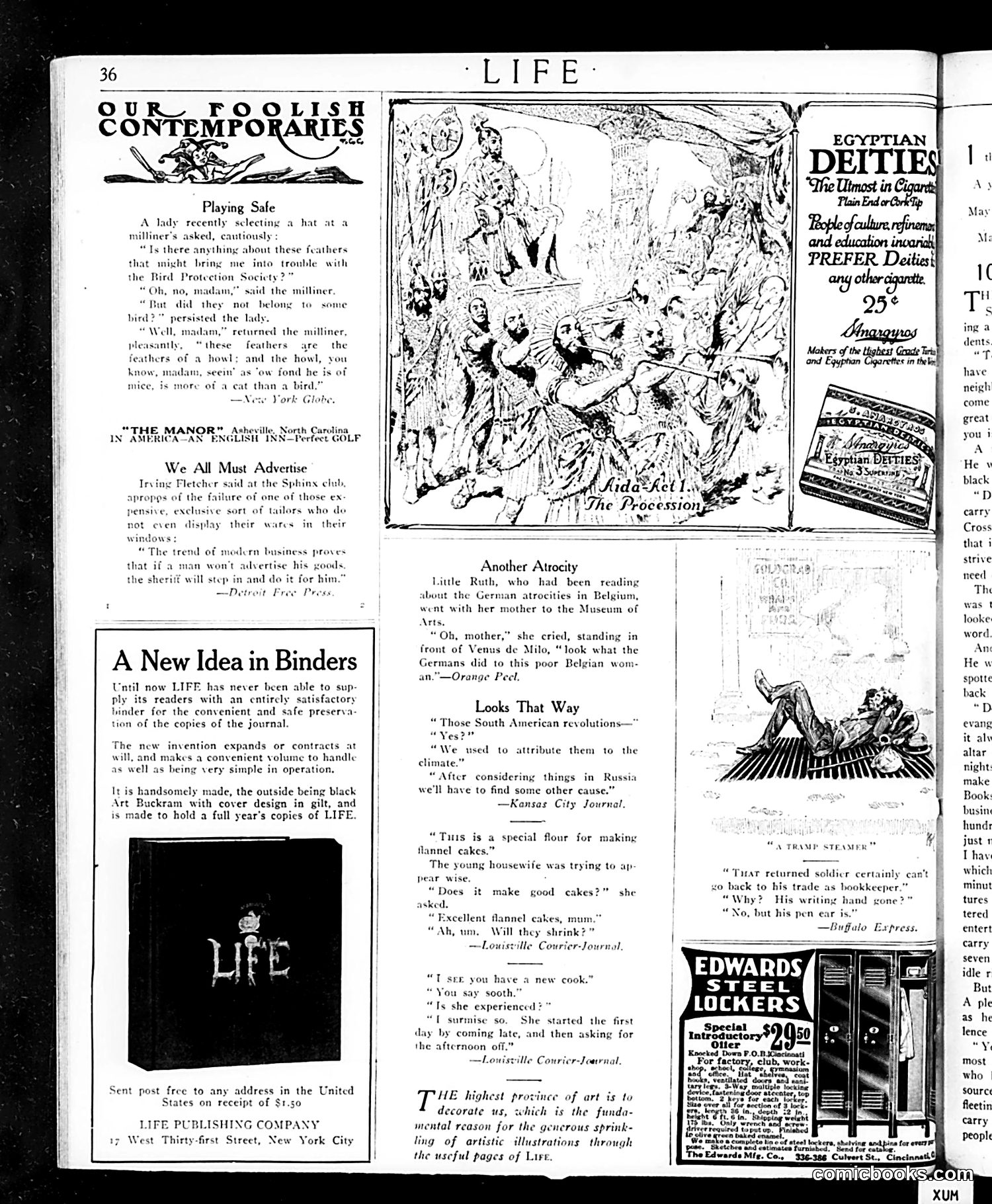
This page contains several satirical pieces typical of Life's "Our Foolish Contemporaries" column, mocking contemporary attitudes and behaviors. **"Playing Safe"** ridicules excessive caution: a woman buying hat feathers anxiously asks if they'll trouble the Bird Protection Society. The milliner's reassurance—that the feathers came from an owl, which eats mice rather than birds—represents absurd logic masquerading as expertise. **"Another Atrocity"** uses dark humor about World War I: a child viewing the armless Venus de Milo sculpture at a museum responds to her mother's earlier discussion of German atrocities in Belgium by exclaiming the Germans destroyed this "poor Belgian woman"—confusing classical art with contemporary war crimes. **"We All Must Advertise"** quotes a businessman asserting that if you won't promote your own goods, competitors will do it for you—satirizing commercial pressure and self-promotion culture. The remaining anecdotes mock various social absurdities: inexperienced servants, soldiers readjusting to civilian life, domestic mishaps. These represent Life's typical light satirical approach to middle-class American foibles.
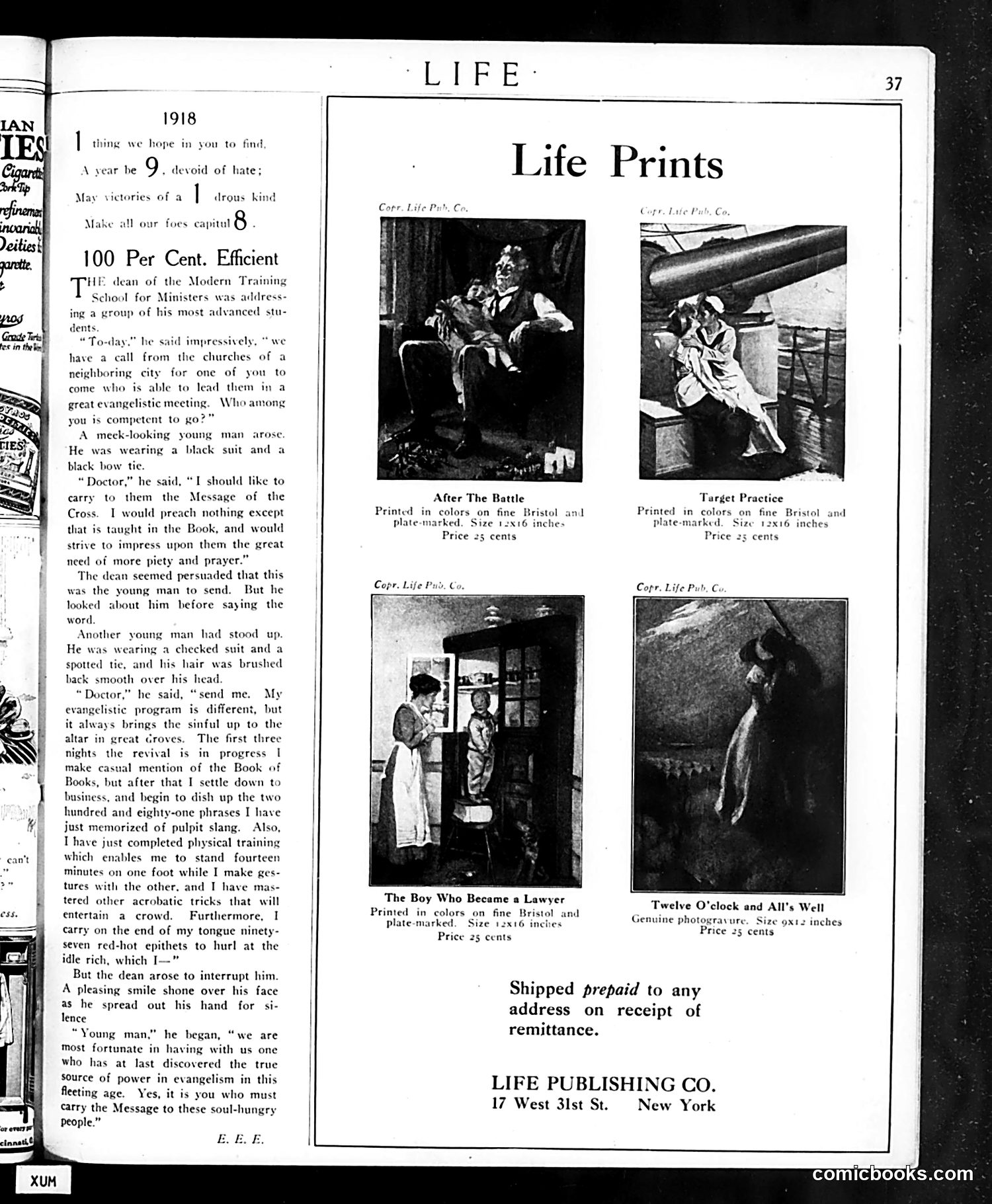
This satirical story mocks modern evangelical preaching techniques stripped of genuine spirituality. The dean of a ministerial school must choose between two candidates for a revival meeting. The first candidate—dressed conservatively, speaking humbly—promises to preach solely Biblical doctrine and emphasize prayer and piety. He represents traditional, substance-focused religion. The second candidate—flashily dressed in checked suit—openly admits his approach: he'll mention the Bible briefly, then rely on memorized "pulpit slang," physical theatrics (standing on one foot while gesturing), and emotional manipulation ("red-hot epithets"). He embodies empty showmanship. **The satire's point:** The dean chooses the second man, praising him for discovering "true power in evangelism." Life is ridiculing how 1918 American churches valued performative spectacle over genuine spiritual substance—prioritizing entertainment and crowd manipulation over authentic doctrine. Published during WWI, this reflects broader anxieties about authenticity versus superficial modernization in American institutions.
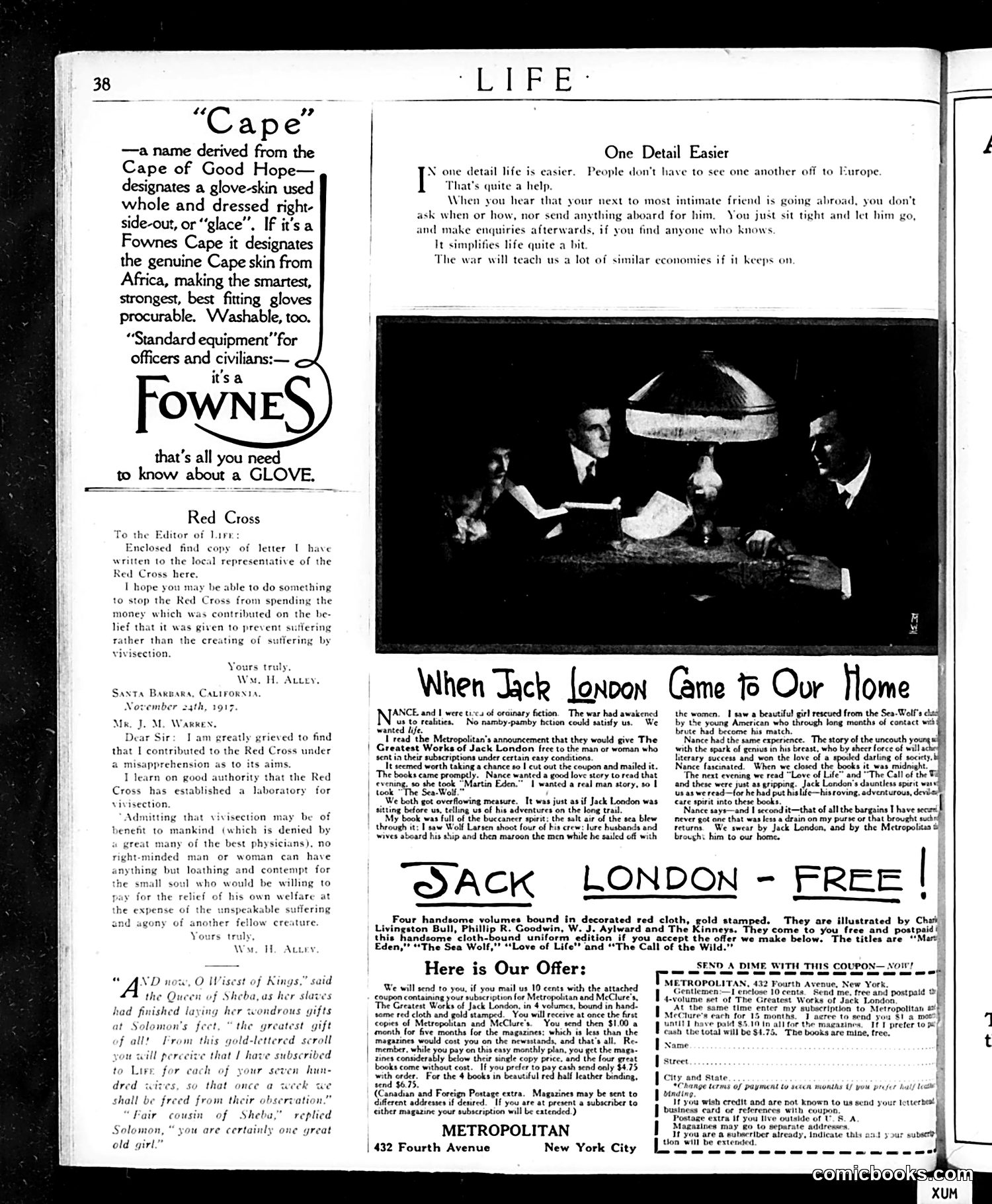
This page contains two distinct pieces of WWI-era content: **"One Detail Easier"** is satirical commentary on wartime social simplification. It mocks how people have stopped the elaborate ritual of seeing friends off to Europe—no longer asking travel details or following up afterward. The satire suggests the war has made people callously indifferent, treating departures casually rather than with proper ceremony. **"When Jack London Came to Our Home"** is advertising copy disguised as personal testimony. A couple describes how the Metropolitan Magazine's offer of free Jack London books ("The Sea-Wolf" and "Martin Eden") brought excitement and adventure into their ordinary lives during wartime. The narrative presents these books as vivid escapes—full of "buccaneer spirit" and raw emotion—exactly what readers craved instead of "namby-pamby fiction." Both pieces reflect 1917 anxieties: social disruption from war and the hunger for authentic, intense experience during uncertain times.
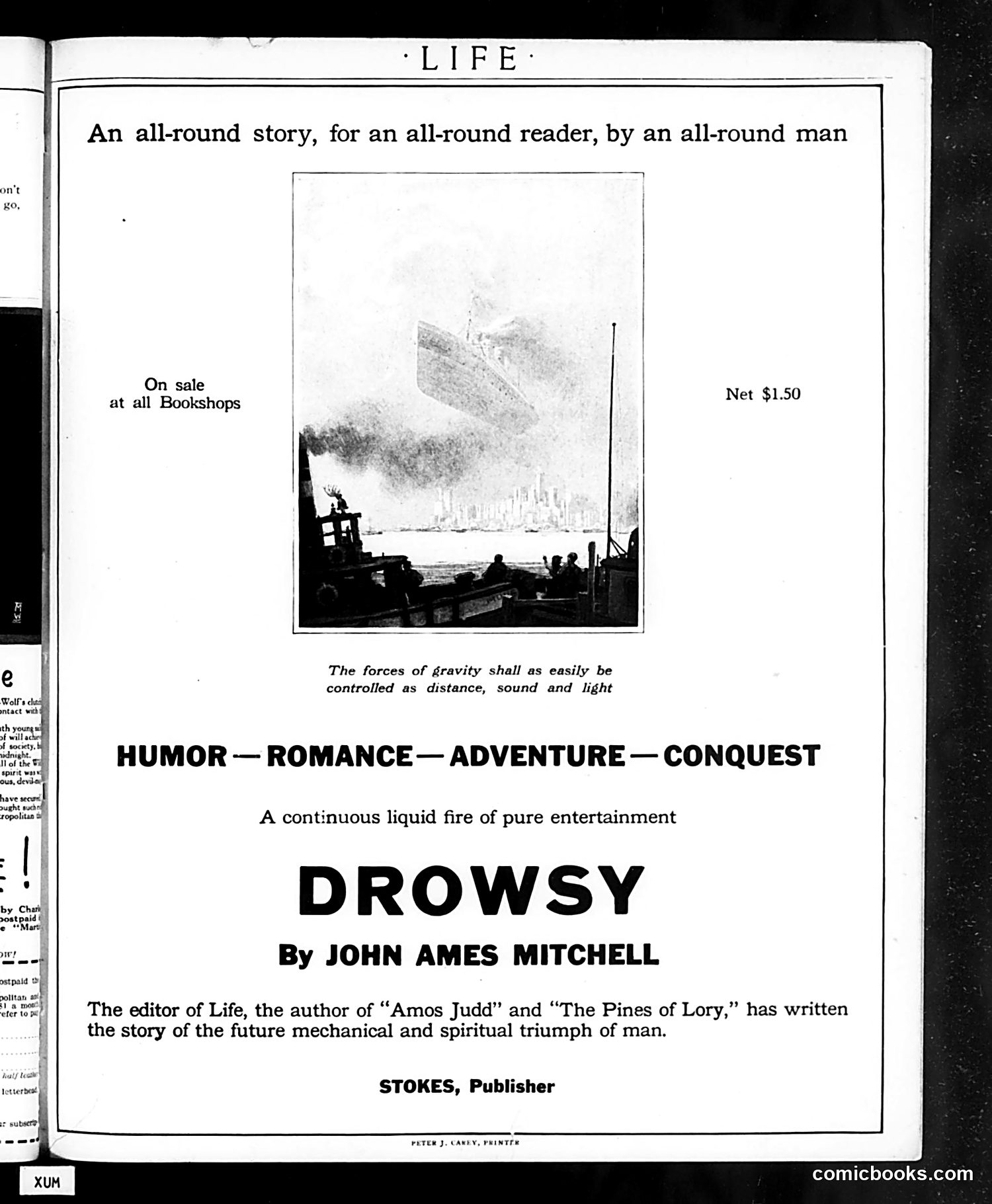
This is primarily a **book advertisement**, not a political cartoon. It promotes *Drowsy* by John Ames Mitchell, editor of Life magazine, published by Stokes. The page advertises a science fiction novel about humanity's future technological and spiritual advancement. The dramatic illustration shows what appears to be an aircraft or airship above a waterfront cityscape, visualizing the "mechanical triumph" promised in the text. The quoted line about controlling "gravity...as easily as distance, sound and light" suggests the novel's speculative fiction premise. The advertisement emphasizes entertainment value ("humor—romance—adventure—conquest") and positions Mitchell as an established literary figure. At $1.50, it targets educated, affluent readers. The tone reflects early 20th-century optimism about technological progress—a common theme in period science fiction before world wars tempered such utopian views.

This is a full-page advertisement, not a political cartoon. It promotes Victor's new 542-page music catalog, claiming it represents "the world's greatest catalog of music" after twenty years and eleven million dollars of research. The ad emphasizes Victor's market dominance by stressing the catalog's comprehensiveness—featuring the world's greatest artists and their recordings. It appeals to music lovers broadly, not just phonograph owners, suggesting widespread cultural aspiration. The final section, titled "Victor Supremacy," contains a legal warning: "Victrola" is Victor's trademarked term, and competitors using it are committing fraud. This reveals market competition—competitors were apparently copying Victor's branding to sell rival talking machines. The page reflects early 20th-century consumer culture, where branded entertainment catalogs functioned as cultural status symbols and competitive tool in the emerging phonograph industry.