
Life, 1918-01-03 · page 22 of 40
Life — January 3, 1918 — page 22: what you’re looking at
What you’re looking at
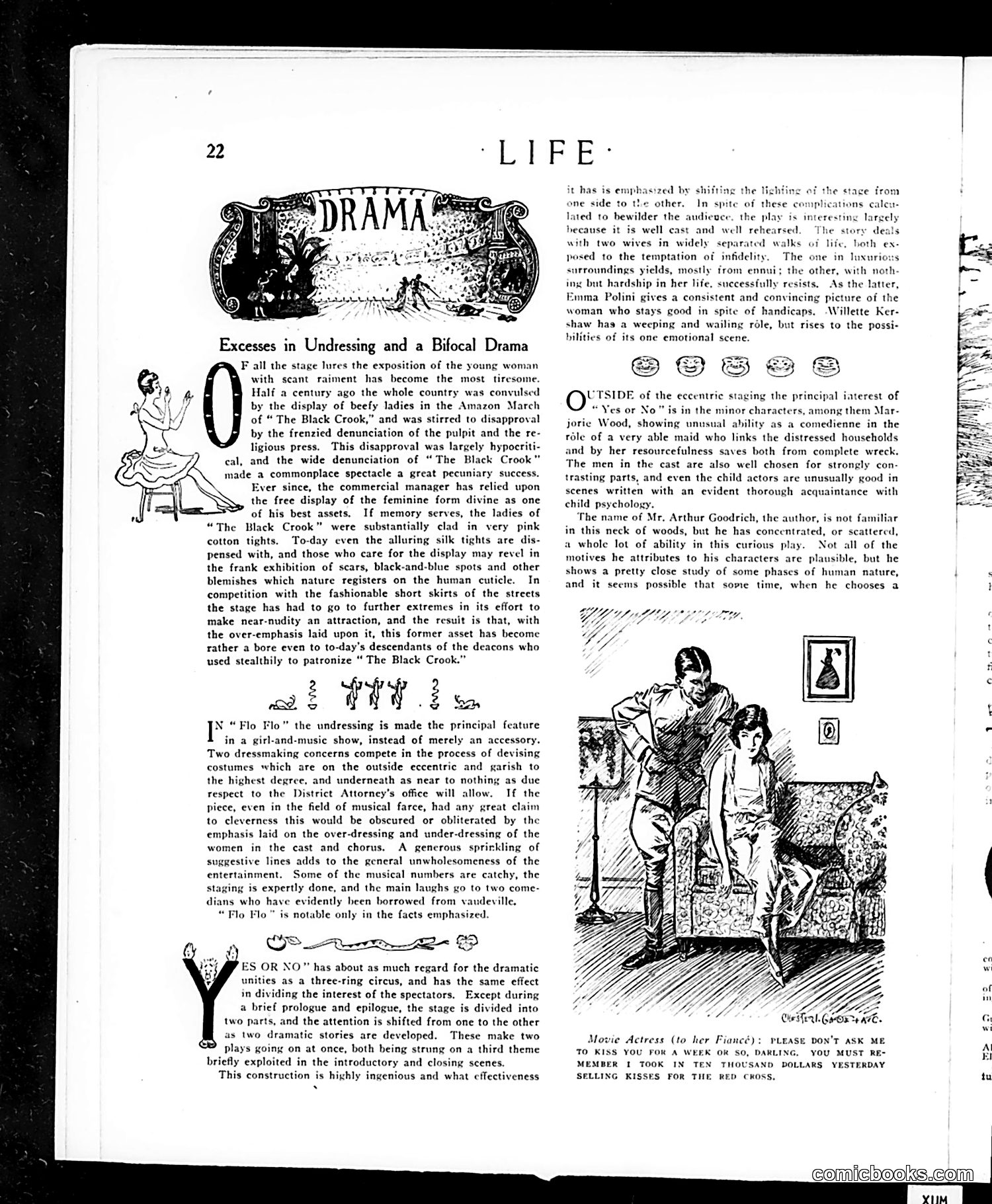
This page critiques three theatrical productions with disapproval of contemporary stage trends. **"The Black Crook" reference**: A notorious 1860s musical famous for displaying scantily-clad women—initially condemned by churches and press, yet hugely profitable. The author notes this hypocrisy: moral outrage masked prurient interest. **Current complaint**: Modern shows have escalated from pink tights to near-nudity, displaying actual bodily blemishes. The critic argues this "over-emphasis" has made nudity boring rather than titillating—a self-defeating strategy. **"Flo Flo"**: Criticized as a show where undressing IS the entire point, overshadowing music and comedy. Costumes are intentionally eccentric and revealing (within legal limits). **"Yes or No"**: Praised as more dramatically sophisticated—a bifurcated plot with two parallel stories about wives tempted by infidelity, featuring capable actresses like Emma Polini. The satire targets producers' reliance on flesh over genuine theatrical merit.
📄 Transcribed text from this page (OCR, searchable)
Machine-transcribed from the original scan — historical spelling and the odd misread are preserved.
Excesses in Undressing and a Bifocal Drama F all the stage lures the exposition of the young woman with scant raiment has become the most resome, Half a century ago the whole country was convulsed by the display of beefy ladies in the Amazon March of “ The Black Crook,” and was stirred to disapproval by the frenzied denunciation of the pulpit and the re- ligious press. This disapproval was largely hypocriti- cal, and the wide denunciation of “The Black Crook” made a commonplace spectacle a great pecuniary success. Ever since, the commercial manager has relied upon the free display of the feminine form divine as one of his best assets, If memory serves, the ladies of “The Black Crook” were substantially clad in very pink cotton tights. To-day even the alluring silk tights are dis- pensed with, and those who care for the display may revel in the frank exhibition of scars, black-and-blue spots and other blemishes which nature registers on the human cuticle. In competition with the fashionable short skirts of the streets the stage has had to go to further extremes in its effort to make near-nudity an attraction, and the resuit is that, with the over-emphasis laid upon it, this former asset has become rather a bore even to to-day’s descendants of the deacons who used stealthily to patronize “ The Black Crook.” wai THT Es I Flo Flo” the undressing is made the principal feature in a girl-and-music show, instead of merely an accessory. Two dressmaking concerns compete in the process of devising costumes which are on the outside eccentric and garish to the highest degree, and underneath as near to nothing as due respect to the District Attorney's office will allow. If the piece, even in the field of musical farce, had any great claim to cleverness this would be obscured or obliterated by the emphasis laid on the over-dressing and under-dressing of the women in the cast and chorus. A gencrous sprinkling of suggestive lines adds to the general unwholesomeness of the entertainment. Some of the musical numbers are catchy, the staging is expertly done, and the main laughs go to two come- dians who have evidently been borrowed from vaudeville, “Flo Flo” is notable only in the facts emphasized. OF At ee © 2S OR NO" has about as much regard for the dramatic unities as a three-ring circus, and has the same effect in dividing the interest of the spectators. Except during a brief prologue and epilogue, the stage is divided into two parts, and the attention is shifted from one to the other as two dramatic stories are developed. These make two plays going on at once, both being strung on a third theme briefly exploited in the introductory and closing scenes. This construction is highly ingenious and what effectiveness “LIFE- the ligh one side to the other, In spite of these co lated to bewilder the audieuce. the play is interesting largely hecause it is well cast and well rehearsed. Th with two wives in widely separated walks of life, both ex- posed to the temptation of infidelity. The one in Iuvur surroundings yields, mostly from ennui; the other, with noth ing but hardship in her life, successfully resists, As the latte Emma Polini gives a consistent and convincing picture of th woman who stays good in spite of handicaps. -Willette shaw has a weeping and wailing réle, but rises to the possi- bilities of its one emotional scene. UTSIDE of the eccentric staging the principal interest of thas is emphasized by sh iplications cale: y de: Yes or No" is in the minor characters, among them Mar- jorie Wood, showing unusual ability as a comedienne in the rile of a very able maid who links the distressed households and by her resourcefulness saves both from complete wreck. The men in the cast are also well chosen for strongly con- trasting parts, and even the child actors are unusually good in scenes written with an evident thorough acquaintance with child psychology. ‘The name of Mr, Arthur Goodrich, the author, is not familiar in this neck of woods, but he has concentrated, or scattered, a whole lot of ability in this curious play. Not all of the motives he attributes to his characters are plausible, but he shows a pretty close study of some phases of human nature, and it seems possible that some time, when he chooses a i¢ Actress (to her Fiancé): vi DON'T ASK ME TO KISS YOU FOR A WEEK OK SO, DARLING, YOU MUST RE- MEMBER I TOOK IN TEN THOUSAND DOLLARS YESTERDAY SELLING KISSES FOR THE RED CKOSS, comichooks.com mn '