
Life, 1918-01-03 · page 19 of 40
Life — January 3, 1918 — page 19: what you’re looking at
What you’re looking at
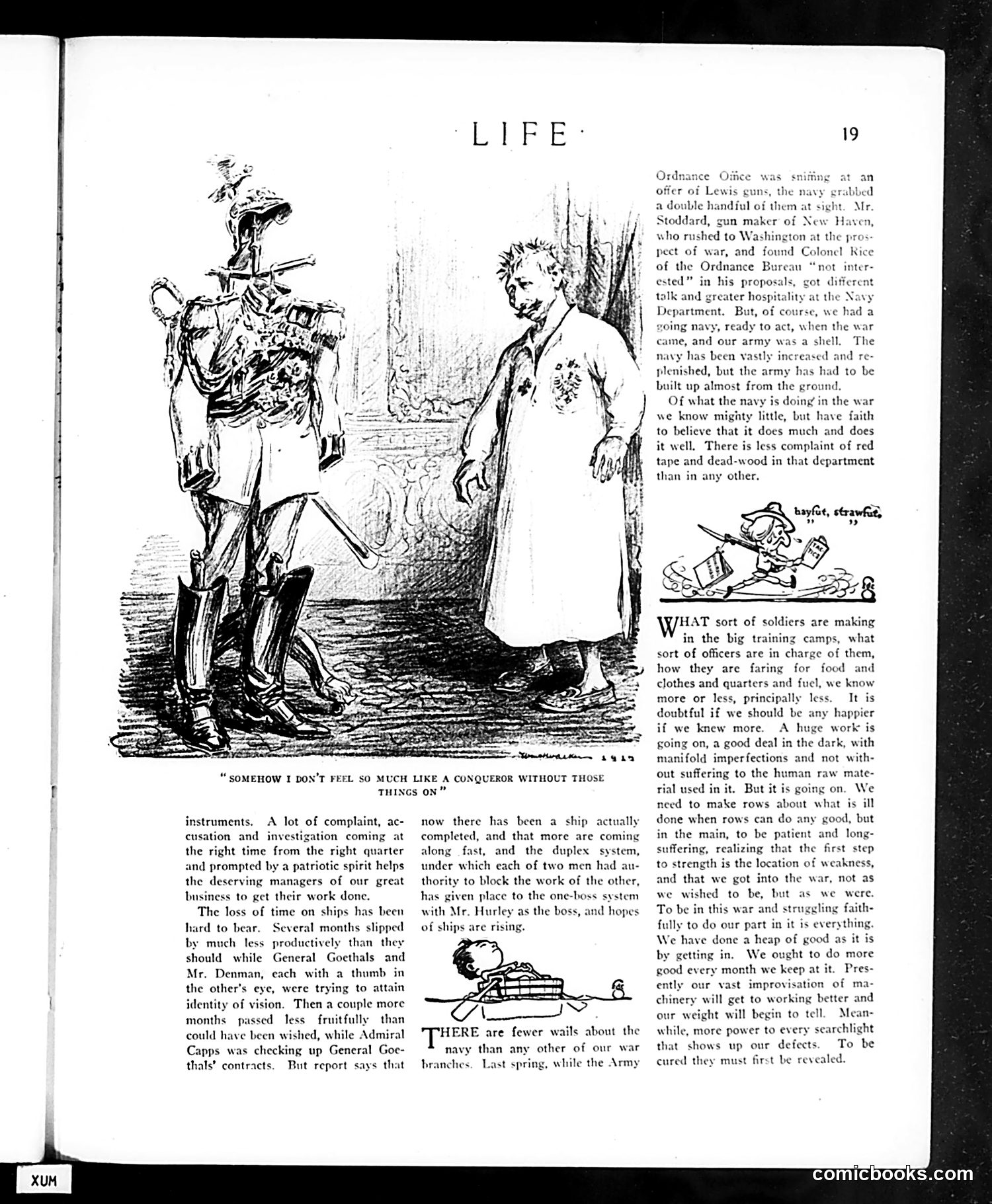
The main cartoon depicts a military officer in full dress uniform confronting a man in civilian clothes. The officer says, "Somehow I don't feel so much like a conqueror without those things on"—referring to his uniform insignia and regalia. **The satire targets** military bureaucracy and ego during World War I. The cartoon mocks how officers derive authority and confidence from external symbols (uniforms, rank) rather than competence. Without these visible markers, the officer feels powerless—suggesting the uniform is merely costume, not earned distinction. **Historical context**: The accompanying text discusses inefficiencies in ship production, mentioning General Goethals and Admiral Capps feuding over the Panama Canal shipping program. The article criticizes bureaucratic turf wars while praising the Navy's relative efficiency compared to the Army's chaotic mobilization. **The broader point**: The cartoon reinforces the text's theme—that competent management and clear authority matter more than military pageantry and inter-departmental conflicts.
📄 Transcribed text from this page (OCR, searchable)
Machine-transcribed from the original scan — historical spelling and the odd misread are preserved.
“ SOMEHOW I DON’T FEEL SO MUCH LIKE A CONQUEROR WITHOUT THOSE THINGS ON instruments. A lot of complaint, ac- cusation and investigation coming at the right time from the right quarter and prompted by a patriotic spirit helps the deserving managers of our great business to get their work done. The loss of time on ships has been d to bear. Several months slipped by much less productively than they should while General Goethals and Mr. Denman, each with a thumb in the other's eye, were trying to attain identity of vision. Then a couple more months less fruitfully than passed could have been wished, while Admiral Capps was checking up General Goe- thals’ contracts. But report says that now there has been a ship actually completed, and that more are coming along fast, and the duplex system, under which cach of two men had au- thority to block the work of the othe: has given place to the one-boss system with Mr. Hurl of ships are rising. as the boss, and hopes HERE are fewer wails about the navy than any other of our war Last spring, while the Army branches Onice 0 nee fier of Lewis ¢ Ting . the navy grabbed a double handiul of them at sight. Mr. Stoddard, gun maker of New Haven, who rushed to Washington at the p pect of war, and found Colonel Rice of the Ordnance Bureau “not in his proposal different talk and greater hospitality at the Navy Department. But, of course, we a going navy, ready to act, when the war came, and our army was a shell, The navy has been vastly increased and re- plenished, but the army has built up almost from the ground. Of what the navy is doing in the war we know mighty little, but have faith to believe that it does much and does it well. There is less complaint of red. tape and dead-wood in that department than in any other, inter- d to be HAT sort of soldiers are making in the big training camps, what sort of officers are in charge of them, how they are faring for food clothes and quarters and fucl, we know more or less, principally less. It is doubtful if we should be any happier if we knew more. A huge work is going on, a good deal in the dark, with manifold imperfections and not with- out suffering to the human raw mate- rial used in it. But it is going on. We need to make rows about what is ill done when rows can do any good, but in the main, to be patient and long- suffering, realizing that the first step to strength is the location of weakness, and that we got into the war, not as we wished to be, but as we were. To be in this war and struggling faith- fully to do our part in it is everything. We have done a heap of good as it is by getting in. We ought to do more good every month we keep at it. Pres- ently our vast improvisation of ma- chinery will get to working better and and our weight will begin to tell. Mean- while, more power to every searchlight that shows up our defects. To be cured they must first be revealed. comicbooks.com