
Life, 1918-01-03 · page 12 of 40
Life — January 3, 1918 — page 12: what you’re looking at
What you’re looking at
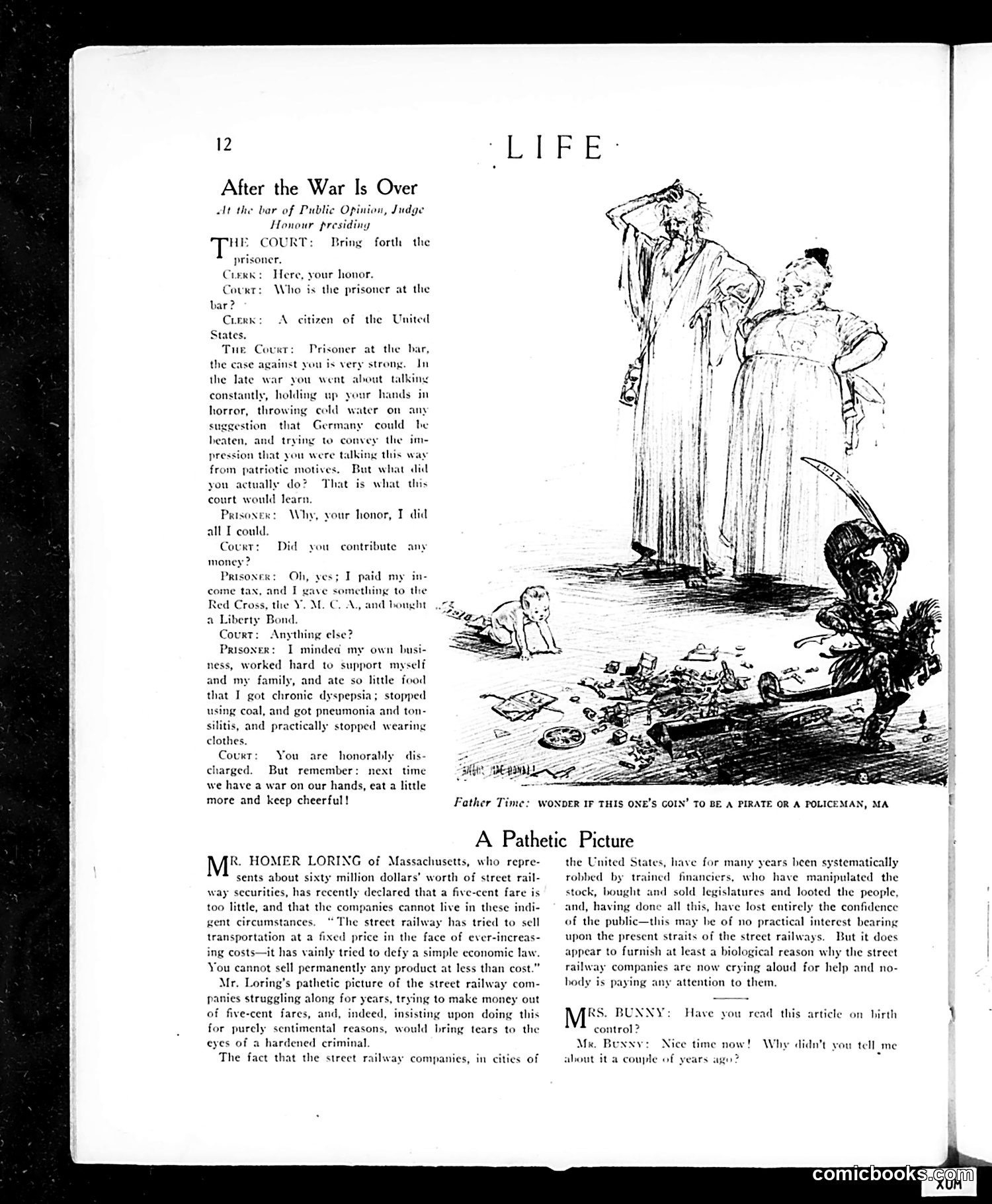
**"After the War Is Over"** depicts a courtroom scene where a judge interrogates a prisoner accused of wartime disloyalty. The prisoner claims patriotic motives while admitting minimal personal sacrifice—paying taxes, donating to Red Cross, buying bonds, and rationing. The judge skeptically dismisses him, suggesting his anti-German rhetoric masked selfish motives. **"A Pathetic Picture"** critiques street railway companies exploiting passengers through high fares while claiming financial hardship. Homer Loring of Massachusetts argues these companies manipulated stock prices and robbed the public, yet refuse to lower costs despite years of profiteering. **"Father Time"** cartoon caption appears satirical commentary on postwar society, though context is unclear from this excerpt. These pieces target wartime profiteers and those claiming patriotism while benefiting financially.
📄 Transcribed text from this page (OCR, searchable)
Machine-transcribed from the original scan — historical spelling and the odd misread are preserved.
12 After the War Is Over at the bar of Public Opinion, Judge Honour presiding HE COUR prisoner, Here, your honor. Who is the prisoner 3ring forth the Currk Court: bar? Crerk: A States. Tue Cover: the case against you is very strong. In the zen of the United Prisoner at the bar, the late war you went about: talking constantly, holding up your hands in horror, throwing cold water on any suggestion that Germany could) he beaten, and trying to convey the im- pression that you were talking this way riotic motives. But what did y do? That is what this from ps you actu: court would learn. Prisoxex: Why, your honor, I did all I could. Court: money? Prisoxex: Oh, yes; I paid my in- come tax, and I gave something to the Red Cross, the Y. M. C. A., and bought a Liberty Bond. Court: Any Prisoner: ness, worked hard to support myself and my family, and ate so little food that I got chronic dyspepsia; stopped using coal, and got pneumonia and ton- silitis, and practically stopped wearing clothes. Court: You are honorably charged. But remember: next time we have a war on our hands, eat a little more and keep cheerful! Did you contribute any hing els I minded my own busi- dis- Father Time: WONDER IF THIS ONE'S GOIN’ TO BE A PIRATE OR A POLICEMAN, MA A Pathetic Picture R. HOMER LORING of Massachusetts, who repre- sents about sixty million dollars’ worth of street rail- way securities, has recently declared that a five-cent fare is too little, and that the companies cannot live in these indi- gent circumstances, “The strect railway has tried to sell transportation at a fixed price in the face of ever-increas- ing costs—it has vainly tried to defy a simple economic law. You cannot sell permanently any product at less than cost.” Mr. Loring’s pathetic picture of the street railway com- panies struggling along for years, trying to make money out of five-cent fares, and, indeed, insisting upon doing this for purely sentimental reasons, would bring tears to the eyes of a hardened criminal The fact that the strect Iway companies, in cities of the United States, have for many years been systematically robbed by trained financiers, who have manipulated the stock, bought and sold legislatures and looted the people, and, having done all this, have lost entirely the confidence of the public—this may be of no practical interest bearing upon the present straits of the street railways. But it does appear to furnish at least a biological reason why the street companies are now crying aloud for help and no- body is paying any attention to them. BUNNY: M' control? Mk. Bunny: about it a couple of years age railw Have you read this article on birth Nice time now! Why ‘t you tell me comicbook