
Life, 1918-01-03 · page 18 of 40
Life — January 3, 1918 — page 18: what you’re looking at
What you’re looking at
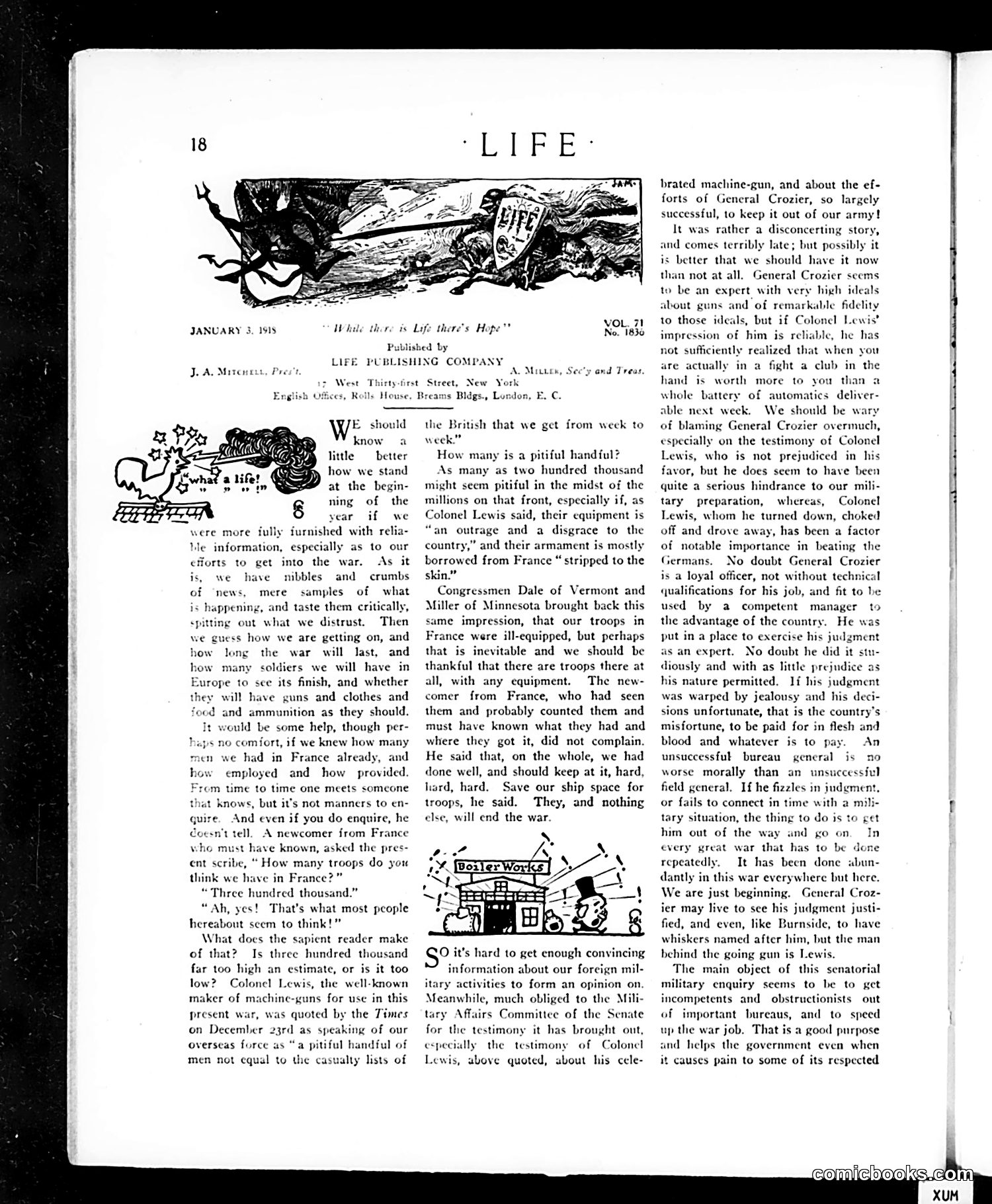
This page satirizes American military unpreparedness as the U.S. enters World War I. The cartoons mock public ignorance about troop strength—readers guess "three hundred thousand" men in France, dismissed as naive. The main target is **Colonel Lewis**, a machine-gun manufacturer, who publicly criticized General **Crozier** (Army Ordnance Chief) for allegedly keeping advanced weapons out of military use due to rigid ideals. The article suggests Crozier, though well-intentioned, prioritized bureaucratic standards over combat necessity—a "club in hand" being worth more than unavailable automatics. The satire criticizes both figures: Lewis for self-interested weapons promotion and Crozier for obstinate bureaucratic gatekeeping that hampered war preparation. The overall message: Americans lack reliable war information while military leadership fumbles equipment procurement.
📄 Transcribed text from this page (OCR, searchable)
Machine-transcribed from the original scan — historical spelling and the odd misread are preserved.
JANUARY 3. 1918 Whale thore is Life there's He NOU Published by LIFE PUBLISHING COMPANY JA. Mitentit, Pre A. Muuten, Sec’y and Treas, 7 West ty-first Street, New York cs, Rolls H ns Bldgs., London, E. C. E should know a little better how we stand at the begin- ning of the year if we were more iully iurnished with relia- Me information, especially as to our efforts to get into the war. As it is, we have nibbles and crumbs of ‘news, mere samples of what is happening, and taste them cri tting out what we distrust. we guess how we are getting on, and how long the war will Jast, and 1 many soldiers we will have in Europe to sce its finish, and whether the will have guns and clothes and and ammunition as they should. vould be some help, though pe: no comfort, if we knew how many we had in France already, and employed and how provided. om time to time one meets someone knows, but it’s not manners to en- And even if you do enquire, he ‘tell, A newcomer from France who must have known, asked the pres- ent scribe, “ How many troops do you think we have in France?” nree hundred thousand.” Ah, yes! That's what most people hereabout scem to think!” What does the sapient reader make of that? Is three hundred thousand far too high an estimate, or is it too low? Colonel Lewis, the well-known maker of machine-guns for use in this present war, was quoted by the Times on December 23rd as speaking of our overseas force as “a pitiful handful of men not equal to the casualty lists of the British that we get from week to wee How many is a pitiful handful? As many as two hundred thousand might seem pitiful in the midst of the millions on that front, especially if, as ‘olonel Lewis said, their equipment is an outrage and a disgrace to the country,” and their armament is mostly borrowed from France “ stripped to the kin.” Congressmen Dale of Vermont and Miller of Minnesota brought back this same impression, that our troops in France were ill-equipped, but perhaps that is inevitable and we should be thankful that there are troops there at all, with any equipment. The new- comer from France, who had seen them and probably counted them and must have known what they had and where they got it, did not complain. He said that, on the whole, we had done well, and should keep at it, hard, lard, hard. Save our ship space for troops, he said. They, and nothing else, will end the war. S° it’s hard to get enough convincing information about our foreign mil- ary activities to form an opinion on. Meanwhile, much obliged to the Mili- tary Affairs Committee of the Senate for the testimony it has brought out, the of Colonel Lewis, above quoted, about his ccle- especially testimony brated machine-gun, and about the ef- forts of General Crozier, so largely successful, to keep it out of our army! It was rather a disconcerting story, late; but possibly it is better that we should have it now than not at all. General Crozier seems to be an expert with very high ideals about guns and of remarkable fidelity to those ideals, but if Colonel Lewis’ impression of him is reliable, he has not sufficiently realized that when you are actually in a fight a club in the hand is worth you than 2 whole battery of automatics deliver- able next week. We should be wary f blaming General Crozier overmuch, especially on the testimony of Colonel Lewis, who is not prejudiced in his favor, but he does seem to have been quite a serious hindrance to our mili- tary preparation, whereas, Colonel Lewis, whom he turned down, choked off and drove away, has been a factor of notable importance in beating the Germans. No doubt General Crozier loyal officer, not without technic qualifications for his job, and fit to be used by a competent manager to the advantage of the country. He v put in a place to exercise his judgment as an expert. No doubt he did it diously and with as little prejudice as his nature permitted. If his judgment s warped by jealousy and his deci- sions unfortunate, that is the country’s misfortune, to be paid for in flesh and blood and whatever is to pay. An unsuccessful’ bureau general is no worse morally than an unsuccessful field general. If he fizzles in judgment, or fails to connect in time with a mili- tary situation, the thing to do is to get him out of the way und go on. In and comes terribly more to 1 every great war that has to be done repeatedly, It has been done «bun- dantly in this war everywhere but here. We are just beginning. General Croz- ier may live to sce his judgment justi- fied, and even, like Burnside, to have whiskers named after him, but the man behind the going gun is Lewis. The main object of this senatorial military enquiry seems to be to get incompetents and obstructionists out of important bureaus, and to speed up the war job. That is a good purpose and helps the government even when it causes pain to some of its respected