
Life, 1918-01-03 · page 7 of 40
Life — January 3, 1918 — page 7: what you’re looking at
What you’re looking at
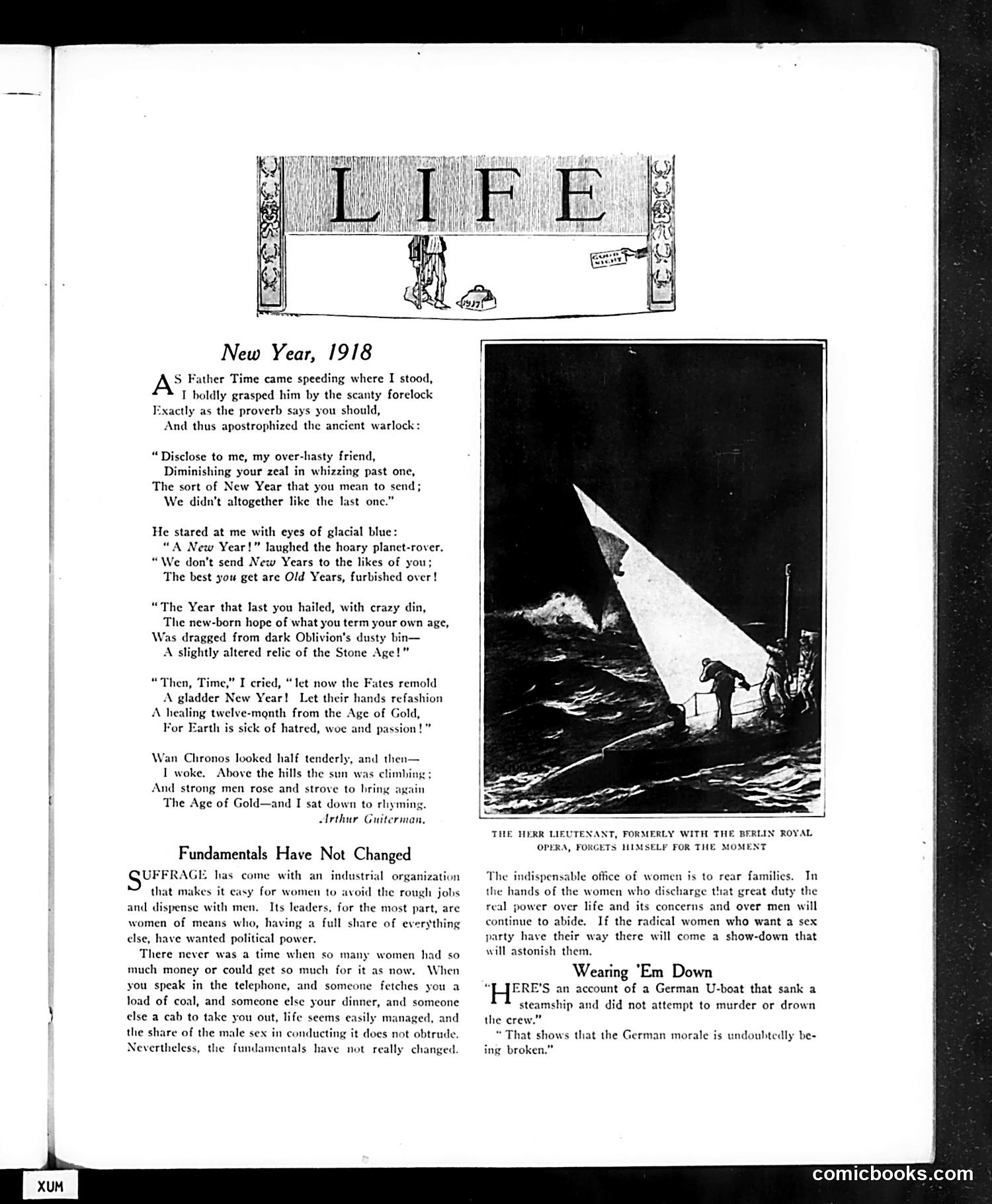
This page combines poetry with social commentary about World War I and women's rights. **"New Year, 1918"** is a poem by Arthur Guterman personifying Father Time confronting the departing year, criticizing 1917 as chaotic and hope-destroying. The speaker appeals to the Fates for a better year and "The Age of Gold." **"Fundamentals Have Not Changed"** discusses women's suffrage. The author argues that despite women gaining political power through suffrage organization, their fundamental role remains unchanged—they still manage households and rear families. The piece dismisses radical feminists demanding a "sex party," suggesting their influence won't substantially alter women's traditional domestic responsibilities. **"Wearing 'Em Down"** references a German U-boat that sank a steamship without attempting to murder survivors, interpreted as evidence of declining German military morale.
📄 Transcribed text from this page (OCR, searchable)
Machine-transcribed from the original scan — historical spelling and the odd misread are preserved.
New Year, 1918 A ‘ather Time came speeding where I stood, I boldly grasped him by the scanty forelock E actly as the proverb says you should, And thus apostrophized the ancient warlock: “Disclose to me, my over-hasty friend, Diminishing your zeal in whizzing past one, The sort of New Year that you mean to send; We didn’t altogether like the last onc.” He stared at me with eyes of glacial blue: “A New Year!” laughed the hoary planct-rover. “We don’t send New Years to the likes of you; The best you get are Old Years, furbished over! “The Year that last you hailed, with crazy din, The new-born hope of what you term your own age, Was dragged from dark Oblivion’s dusty bin— A slightly altered relic of the Stone Age!" “Then, Time,” I cried, “let now the Fates remold A gladder New Year! Let their hands refashion A healing twelve-manth from the Age of Gold, For Earth is sick of hatred, woe and passion!” Wan Chronos looked half tenderly, and then— I woke. Above the hills the sun was clim), And strong men rose and strove to bring The Age of Gold—and I sat down to rhyming. <Irthur Guiterman, Fundamentals Have Not Changed UFFRAGE has come with an industrial organization that makes it casy for women to avoid the rough jobs Its leaders, for the most having a full share of everything and dispense with mei rt, are women of means who, else, have wanted political power. There never was a time when so many women had so much money or could get so much for it as now. When you speak in the telephone, and someone fetches you a load of coal, and someone else your dinner, and someone else a cab to take you out, life seems easily managed, and the share of the male sex in conducting it does not obtrude. Nevertheless, the fundamentals have not really changed. THE HERR LIEUTENANT, FORMERLY WITH THE BERLIN ROYAL OPERA, FORGETS HIMSELF FOR THE MOMENT The indispensable office of women is to rear families. In the hands of the women who discharge that great duty the real power over life and its concerns and over men will continue to abide. If the radical women who want a sex party have their way there will come a show-down that will astonish them, Wearing ‘Em Down . ERE’S an account of a German U-boat that sank a steamship and did not attempt to murder or drown the crew.” “That shows that the German morale is undoubtedly be- ing broken.” comicbooks.com