
Life, 1918-01-03 · page 8 of 40
Life — January 3, 1918 — page 8: what you’re looking at
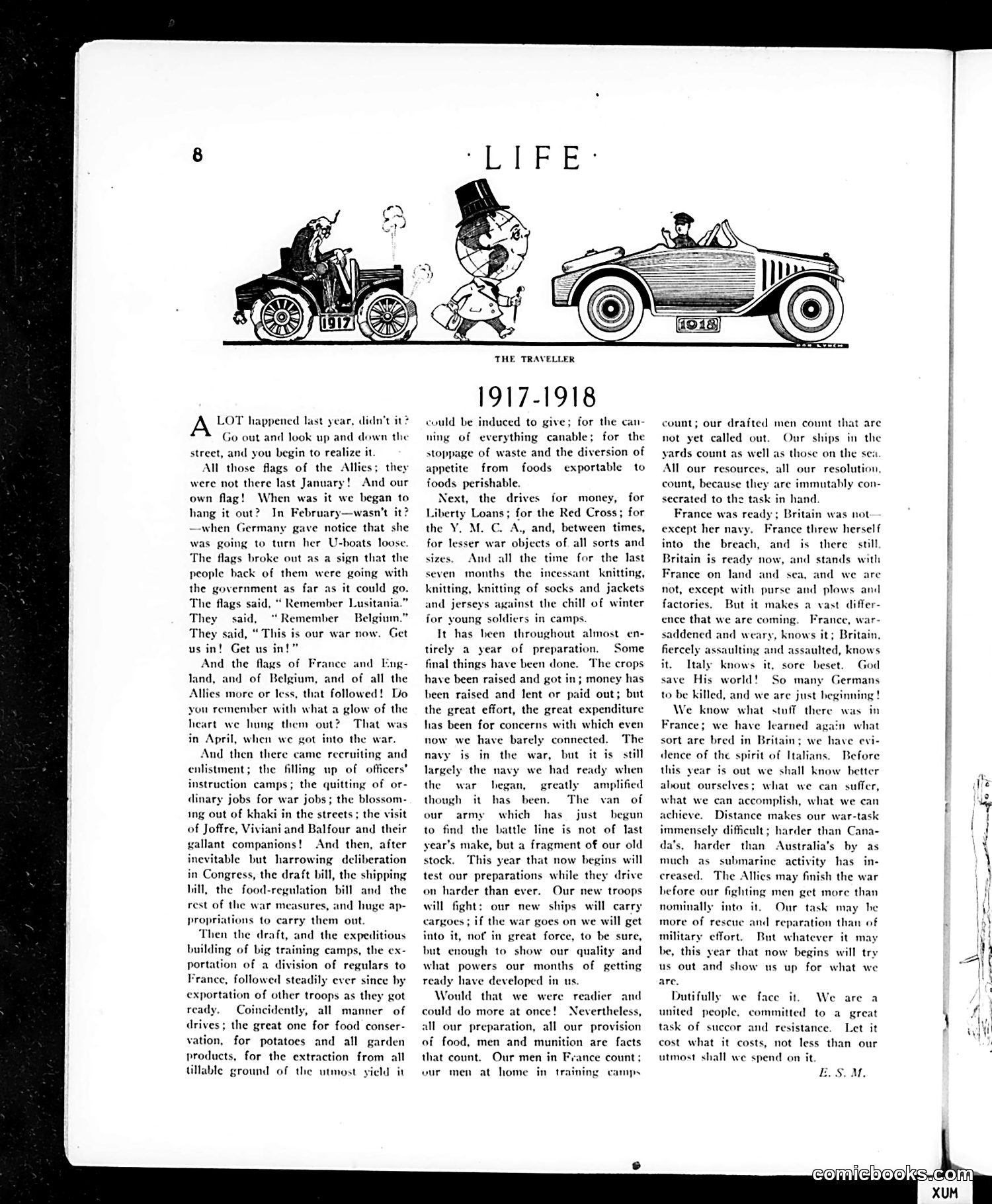
What you’re looking at
The cartoon depicts three vehicles in sequence representing transportation evolution: an old automobile (labeled 1917), a figure holding a globe in the middle, and a modern racing car (labeled 2018). The accompanying article, titled "1917-1918," reflects on America's first year of World War I participation. The author discusses war preparations, troop mobilization, food conservation efforts, and recruitment drives. The piece emphasizes American commitment to the Allied cause, celebrating military expansion and industrial output while promoting civilian sacrifice through rationing and resource management. The "Traveller" cartoon likely symbolizes humanity's progress during wartime, contrasting outdated methods with modern capability—suggesting America's industrial advancement serves the war effort.
📄 Transcribed text from this page (OCR, searchable)
Machine-transcribed from the original scan — historical spelling and the odd misread are preserved.
A LOT happened last year, didn’t it? Go out and look up and down the street, and you begin to realize it. All those flags of the Allies; they were not there last January! And our own flag! When was it we began to hang it out?) In February—wasn’t it? —when Germany ve notice that she was going to turn her U-boats loose, The flags broke out as a sign that the people back of them were going with the government as as it could go. The flags said, “ Remember Lusitania.” They said, “Remember Belgium.” They said, “This is our war now. Get us in! Get us in!” And the flags of France and Eng- land, and of Belgium, and of all the Allies more or less, that followed! Do you remember with what a glow of the heart we hung them out? That was in April, when we got into the war. And then there came recruiting and enlistment; the filling up of officers’ instruction camps; the quitting of or- dinary jobs for war jobs ; the blossom- ing out of khaki in the streets ; the visit of Joffre, Viviani and Balfour and their lant companions! And then, after inevitable but harrowing deliberation in Congress, the draft bill, the shipping bill, the food-regulation bill and the rest of the war measures, and huge ap- propriations to carry them out. Then the draft, and the expeditious building of big training camps, the eo portation of a division of regulars to France, followed steadily ever since by exportation of other troops as they got ready. Coincidently, all manner of drives; the great one for food conser- vation, for potatoes and all garden products, for the extraction from all tillable ground of the utmost yield it THE TRAVELLER 1917-1918 could be induced to give; for the can ning of everything canable; for the stoppage of waste and the diversion of appetite from foods exportable to foods perishable. Next, the drives for money, for Liberty Loans; for the Red Cross; for the Y. M. C. A, and, between times, for lesser war objects of all sorts and sizes. And all the time for the last seven months the incessant’ knitting, knitting, knitting of socks and jackets and jerseys against the chill of winter for young soldiers in camps. It has heen throughout almost en- tirely a year of preparation. Some final things have been done. The crops have been raised and got in; money has heen raised and lent or paid out; but the great effort, the great expenditure has been for concerns with which even now we have barely connected. The navy is in the war, but it is still largely the navy we had ready when the war began, greatly amplified though it has been, The van of our army which has just begun to find the battle line is not of last year's make, but a fragment of our old stock. This year that now begins will test our preparations while they drive on harder than ever. Our new troops will fight: our new ships will carry cargoes ; if the war goes on we will get into it, nof in great force, to be sure, but enough to show our quality and what powers our months of getting ready have developed in us. Would that we were readier and could do more at once! Nevertheless, all our preparation, all our provision of food, men and munition are facts that count. Our men in France count; vur men at home in training ca count; our drafted men count that are not yet called out. Our ships in the yards count as well as those on the se All our resources, all our resolution count, because they are immutably con- secrated to the task in hand France was ready ; Britain was not except her navy. France threw herself into the breach, and is there still Britain is ready now, and stands with France on land and sea, and we are not, except with purse and plows and factories. But it makes a vast differ- France, war- ence that we are coming, saddened and weary, knows it; Britain, fiercely assaulting and assaulted, knows it. Italy knows it, sore beset. God save His world! So many Germans to be killed, and we are just beginning ! We know what stuff there was in France; we have learned again what sort are bred in Britain; dence of the spirit of Italians. Before this year is out we shall know better we have evi- about ourselves; what we can suffer, what we can accomplish, what we can hieve. Distance makes our war-task immensely difficult; harder than Cana- da’s, harder than Australia’s by as much as submarine activity has in- creased. The Allies may finish the war hefore our fighting men get more than Our task may be more of rescue and reparation than of military effort. But whatever it may be, this year that now begins will try us out and show us up for what we are, nominally into it. Dutifully we face it. We are a united people, committed to a great task of succor and resistance. Let it cost what it costs, not less than our utmost shall we spend on it £..