
A complete issue · 40 pages · 1917
Life — October 11, 1917
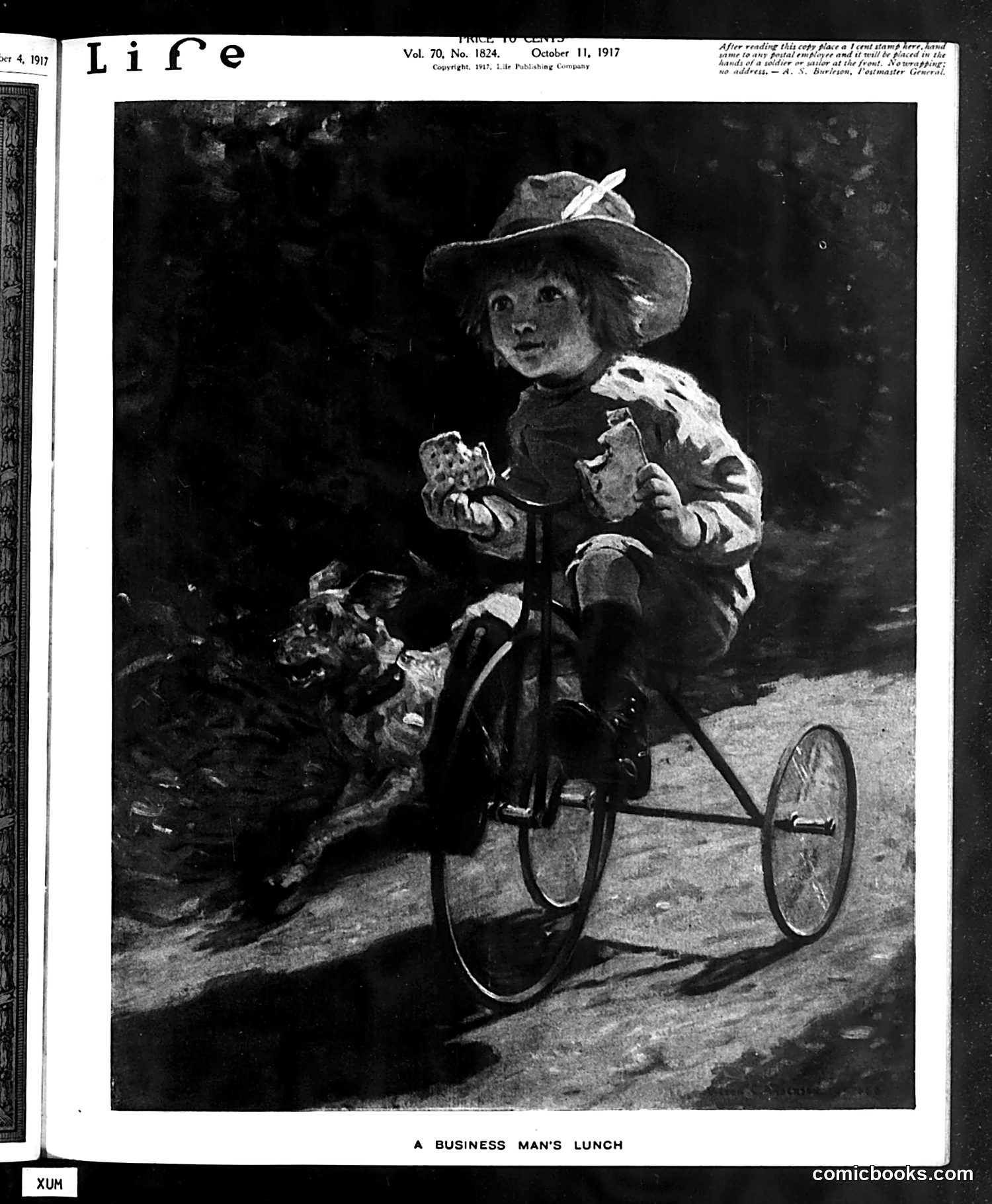
This October 1917 *Life* cartoon satirizes the contrast between wartime privation and continued indulgence. The well-dressed man in a business suit and hat sits on a tricycle (appearing childish or unstable), holding what appears to be sandwiches or provisions while eating heartily. A dog accompanies him on the left. The satire likely targets wealthy businessmen or profiteers who maintained comfortable lifestyles and adequate food supplies during World War I rationing, when ordinary Americans faced food shortages and restrictions. The tricycle suggests precariousness or absurdity—his "business" prosperity rests on unstable wheels. The caption "A Business Man's Lunch" emphasizes the irony: while ordinary citizens struggled with rationed meals, privileged men of commerce continued feasting, potentially profiting from wartime conditions.
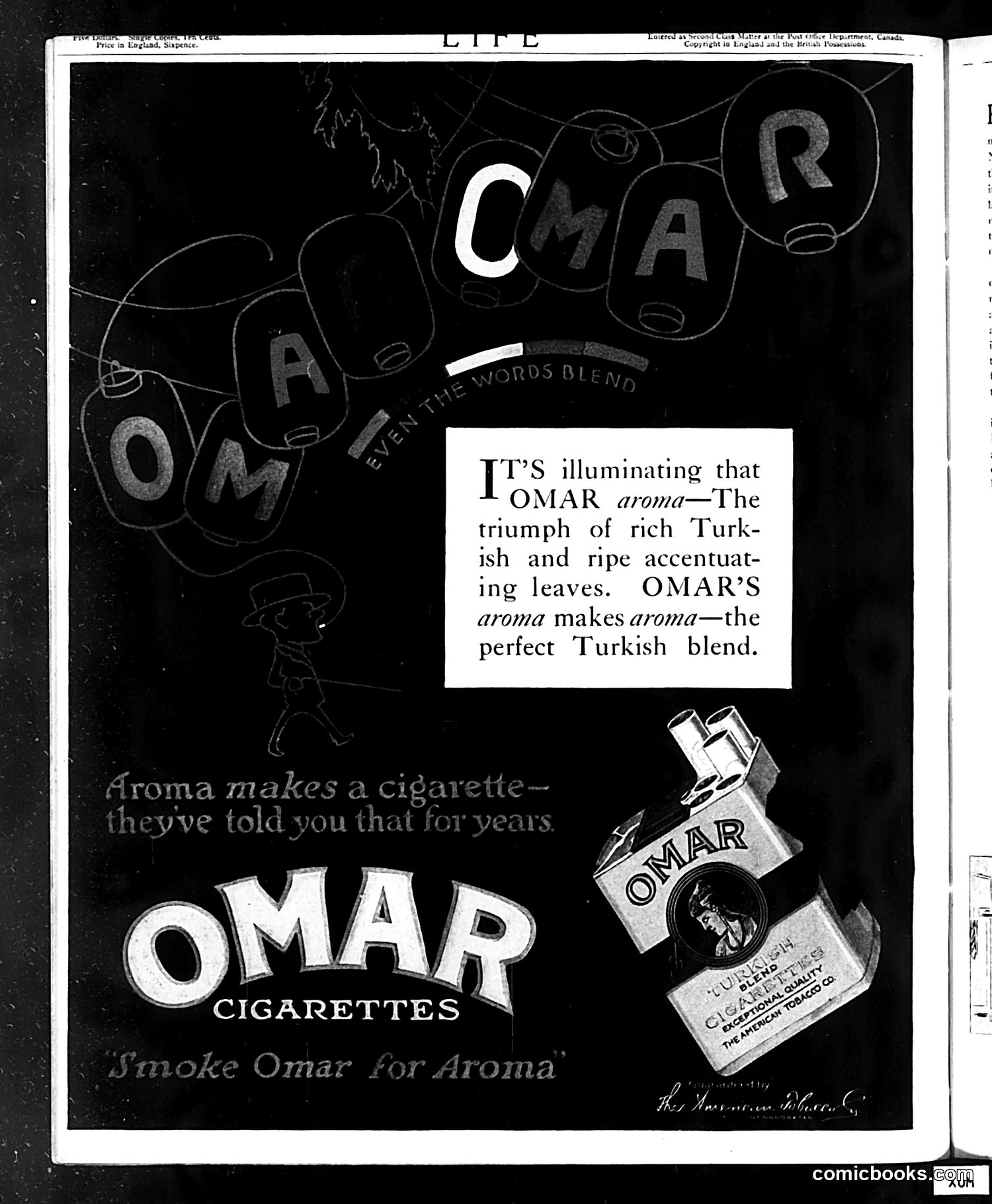
This page is primarily a **cigarette advertisement** for Omar brand, not political satire. The visual wordplay depicts letters spelling "OMAR" as anthropomorphized objects or characters floating above a small figure, illustrating the advertising tagline "Aroma makes a cigarette." The ad emphasizes Omar's "aroma" through repetition—the headline, body copy, and tagline all stress this quality. The product is marketed as a "perfect Turkish blend" featuring "rich Turkish and ripe accentuating leaves." The phrase "Smoke Omar for Aroma" is the central sales message. There is **no political cartoon or satire** on this page—it's straightforward commercial advertising typical of early-to-mid 20th-century magazine promotions, when cigarettes were openly advertised in mainstream publications.
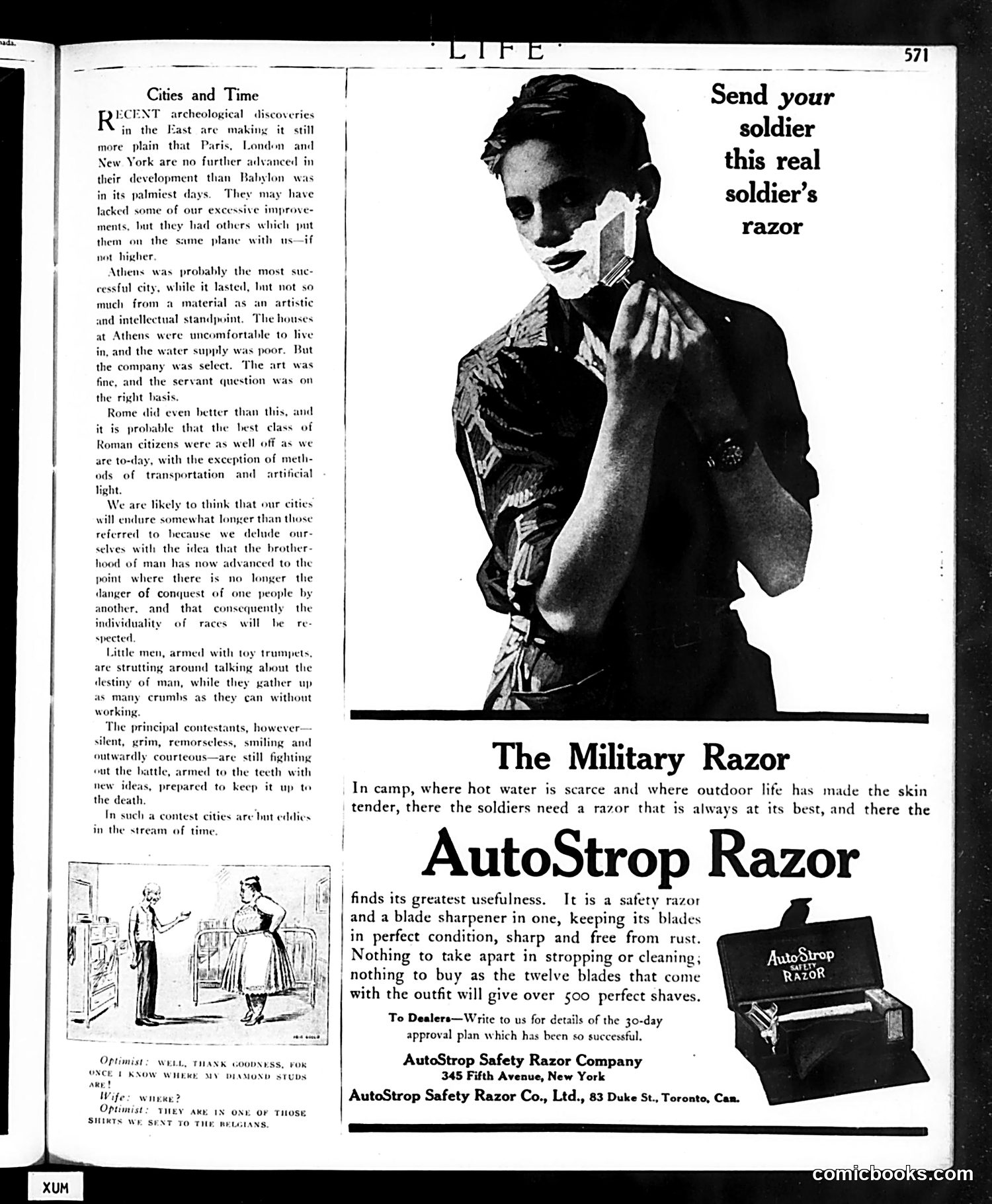
This page is primarily an **advertisement for AutoStrop Safety Razors**, not political satire. The main image shows a soldier in military uniform shaving with the product, captioned "Send your soldier this real soldier's razor." The ad emphasizes the razor's durability for military use—claiming it works well in camp conditions where "hot water is scarse" and outdoor life makes skin tender. It promises the blade stays sharp and rust-free without requiring disassembly for cleaning. The small cartoon below appears unrelated to the ad, showing a domestic scene with dialogue about shirt buttons—likely part of Life magazine's regular humor content. This reflects WWI-era marketing targeting families sending care packages to soldiers.
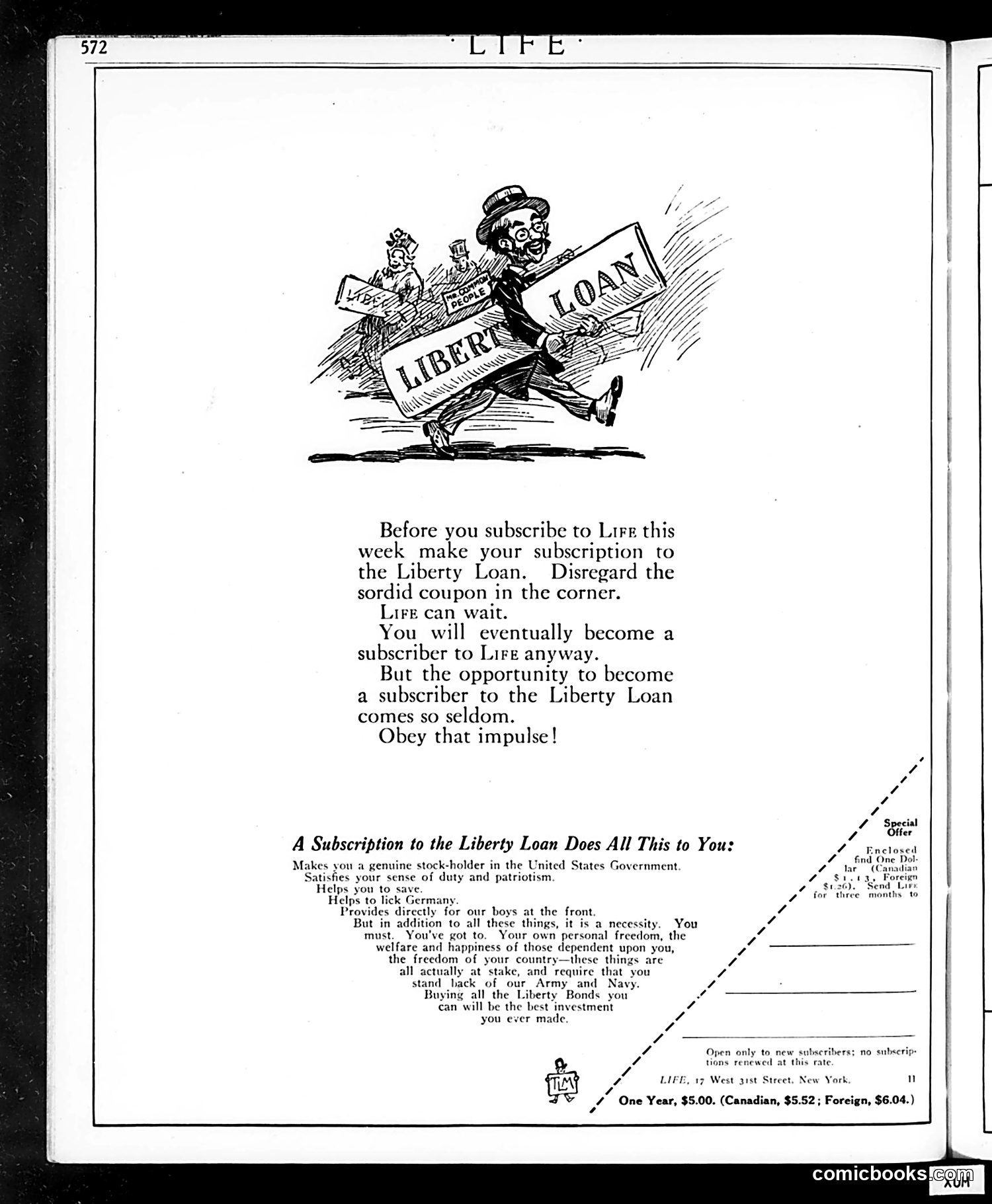
This is a **subscription advertisement for Life magazine**, not a political cartoon. The page promotes subscribing to Life instead of purchasing Liberty Loan bonds. The illustration shows a caricatured figure (likely representing the average American) juggling both "Liberty" and "Loan" documents while running, visually representing the competing financial demands on readers. The text urges readers to **prioritize Liberty Loan bonds** over Life subscriptions, framing bond purchases as patriotic duty supporting the U.S. Army and Navy against Germany. The ad emphasizes that while Life subscriptions will remain available, the opportunity to support Liberty Loans "comes so seldom." This appears to be **WWI-era propaganda**, when the U.S. government aggressively promoted war bonds. The irony—Life magazine asking readers *not* to subscribe—serves as clever reverse-psychology marketing while demonstrating patriotic deference to government financing needs.
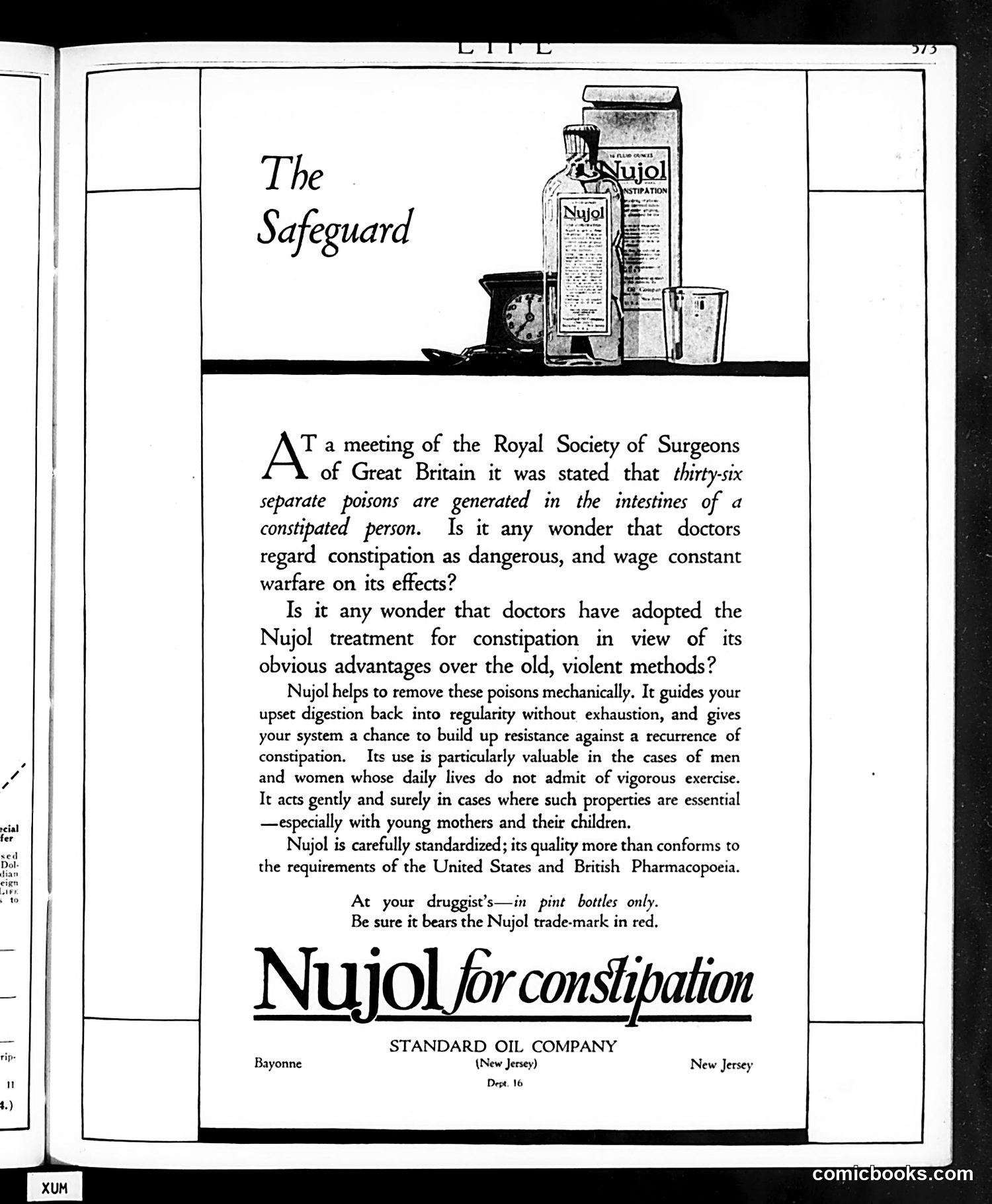
This page is primarily **advertising, not satire or political commentary**. It's a full-page ad for Nujol, a laxative product manufactured by Standard Oil Company (New Jersey). The "Safeguard" headline and accompanying medical claim reflect early 20th-century marketing practices. The ad cites a Royal Society of Surgeons meeting about intestinal poisons from constipation to establish medical credibility. It then promotes Nujol as a gentler alternative to "old, violent methods" of treatment. The visual shows a Nujol bottle with product packaging. This represents routine commercial advertising from Life magazine's era, when laxative ads were commonplace and made explicit medical claims that would later be restricted by the FDA.
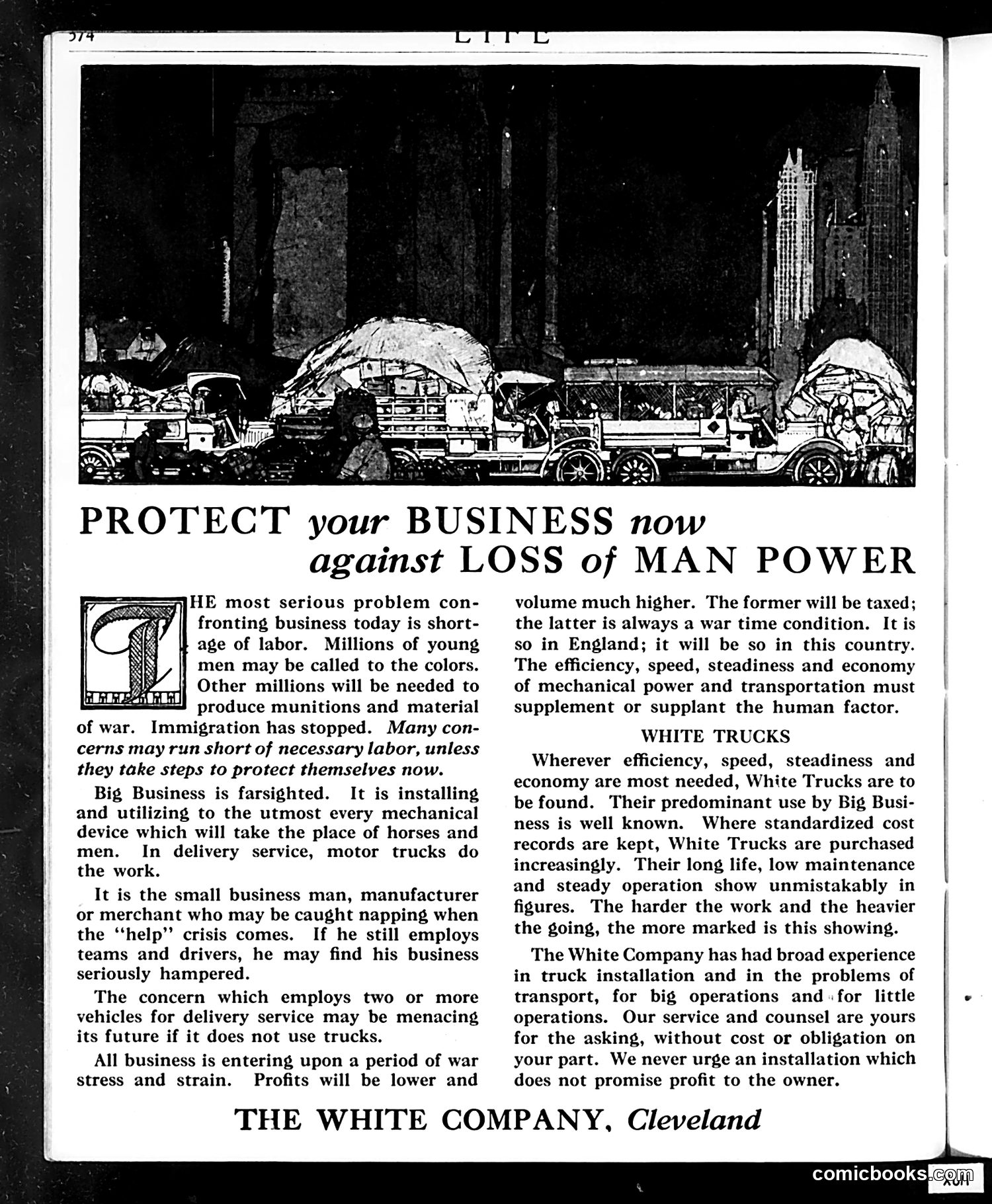
This page is primarily **advertising, not satire or editorial content**. It's a White Company truck advertisement from Cleveland disguised as business advice. The ad uses **WWI-era labor anxiety** as its sales pitch. The headline warns small business owners that young men will be drafted for military service, creating a labor shortage. The solution: replace human workers with White trucks for delivery services. The illustration shows delivery trucks laden with cargo in an urban setting with skyscrapers visible. The text exploits genuine **wartime concerns**—immigration restrictions, military conscription, and labor shortages—to convince manufacturers and merchants that motorized trucks aren't luxuries but necessities to maintain productivity when workers unavailable. This is **propaganda-style advertising**, leveraging patriotic anxiety to drive commercial sales.
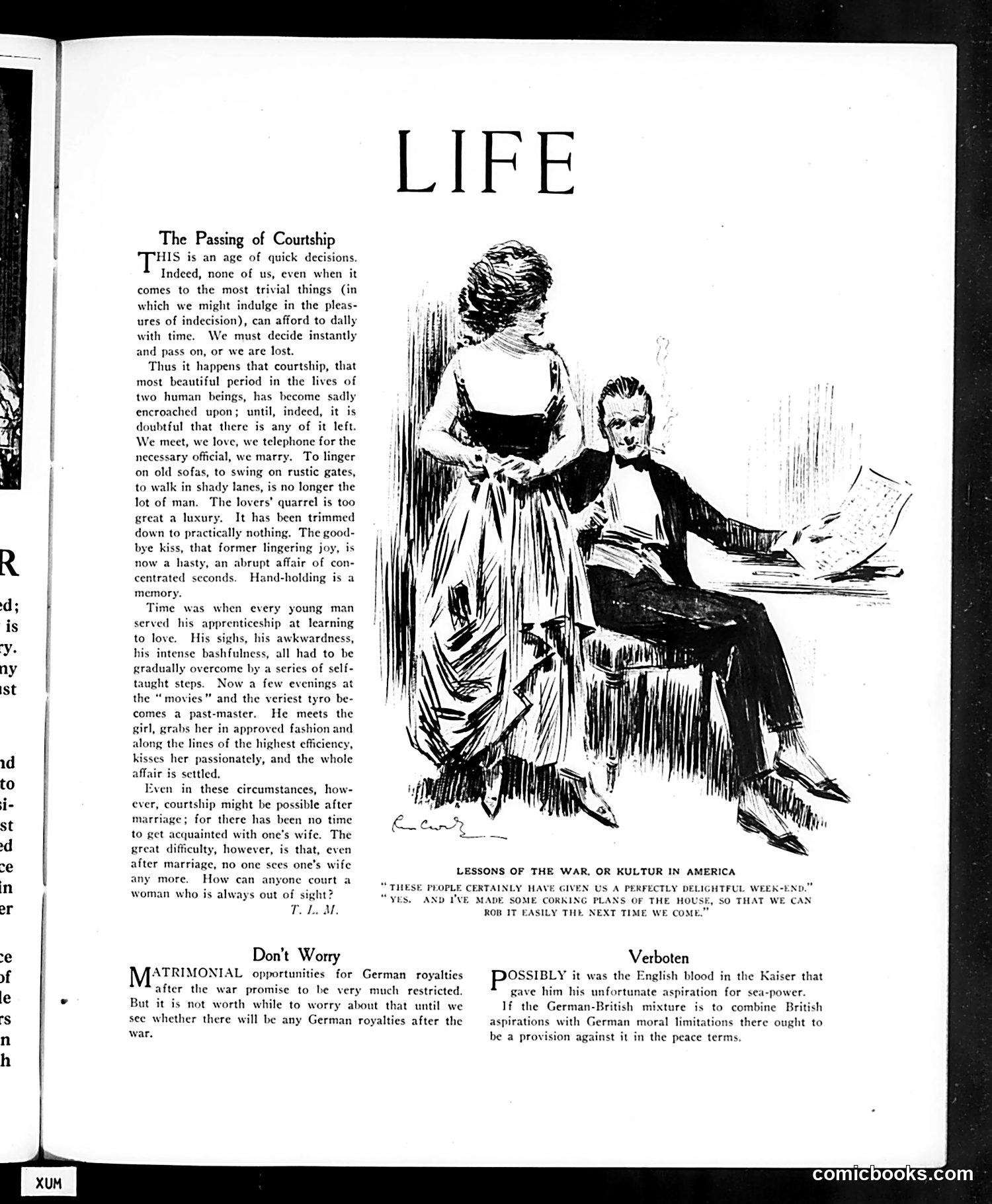
This page satirizes the decline of romantic courtship in modern American life. The main illustration shows a couple where the woman stands while the man sits reading what appears to be a newspaper or document—suggesting romantic attention has been replaced by domestic indifference. The accompanying text laments how courtship has become "encroached upon" and "trimmed down to practically nothing." It contrasts the past, when young men had to earnestly court women through patient steps, with the present where casual movie dates replace passionate pursuit. The satire suggests modernity has killed romance: once couples marry, they no longer see each other, making courtship itself pointless. The caption's joke about wartime "kultur" implies women's liberation has further accelerated courtship's demise.
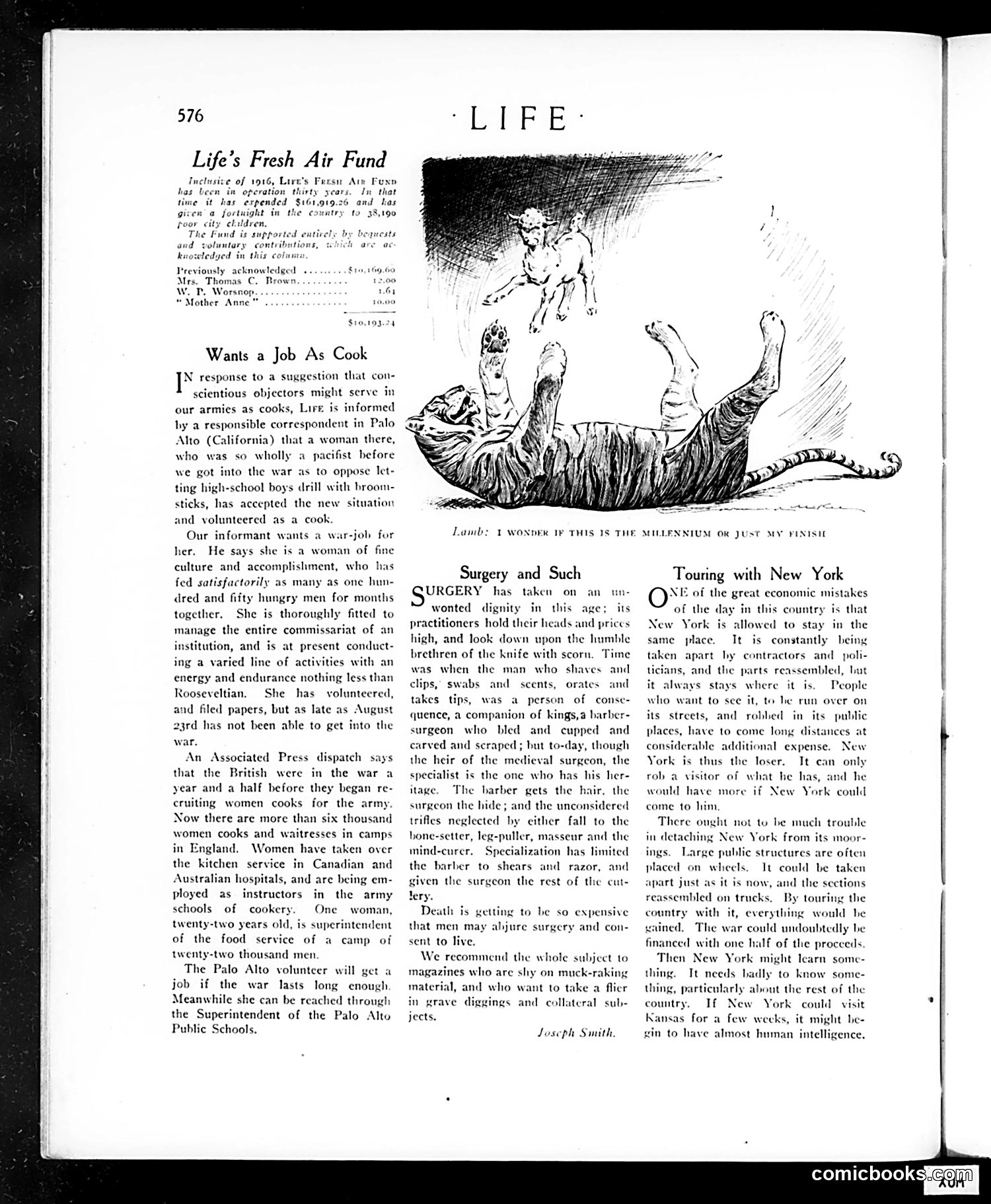
This page contains three separate articles with one prominent illustration. The main cartoon depicts a lamb lying on its back with its legs in the air, captioned "I WONDER IF THIS IS THE MILLENNIUM OR JUST MY FINISH." The cartoon appears to be dark satire about a pacifist woman from Palo Alto who volunteered as a cook for the military—a contradiction to her stated principles. The lamb imagery suggests sacrifice or slaughter, likely mocking either her naiveté about war's realities or the irony of a pacifist supporting military efforts. The other articles discuss women entering traditionally male roles (cooking, surgery) during wartime, and critique New York's infrastructure problems. The page reflects WWI-era social commentary on changing gender roles and war-related contradictions.
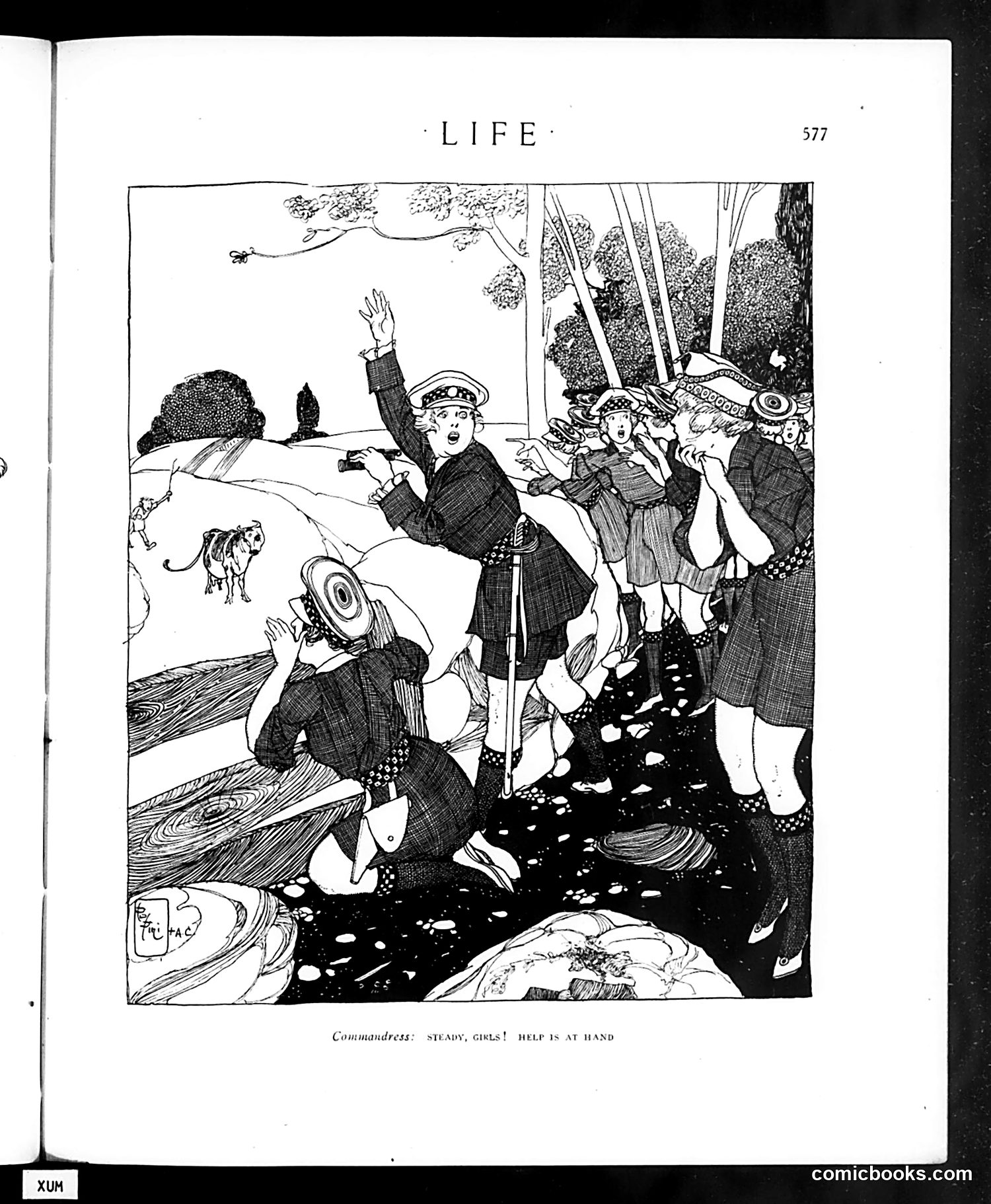
This is a satirical illustration from *Life* magazine (page 577) titled "Commandress: STEADY, GIRLS! HELP IS AT HAND." The cartoon depicts a military or naval commandress directing a group of women in what appears to be a chaotic outdoor scene. The women are dressed in uniforms or structured clothing, and the composition suggests them responding to orders during some kind of emergency or crisis situation. The satire likely mocks women's military or quasi-military involvement—possibly referencing World War I-era women's auxiliary services, suffragette militancy, or contemporary debates about female participation in traditionally male-dominated institutions. The exaggerated panic and the "commandress" figure suggest the cartoonist is ridiculing either women's capability in leadership roles or the absurdity of organizing women in military fashion.
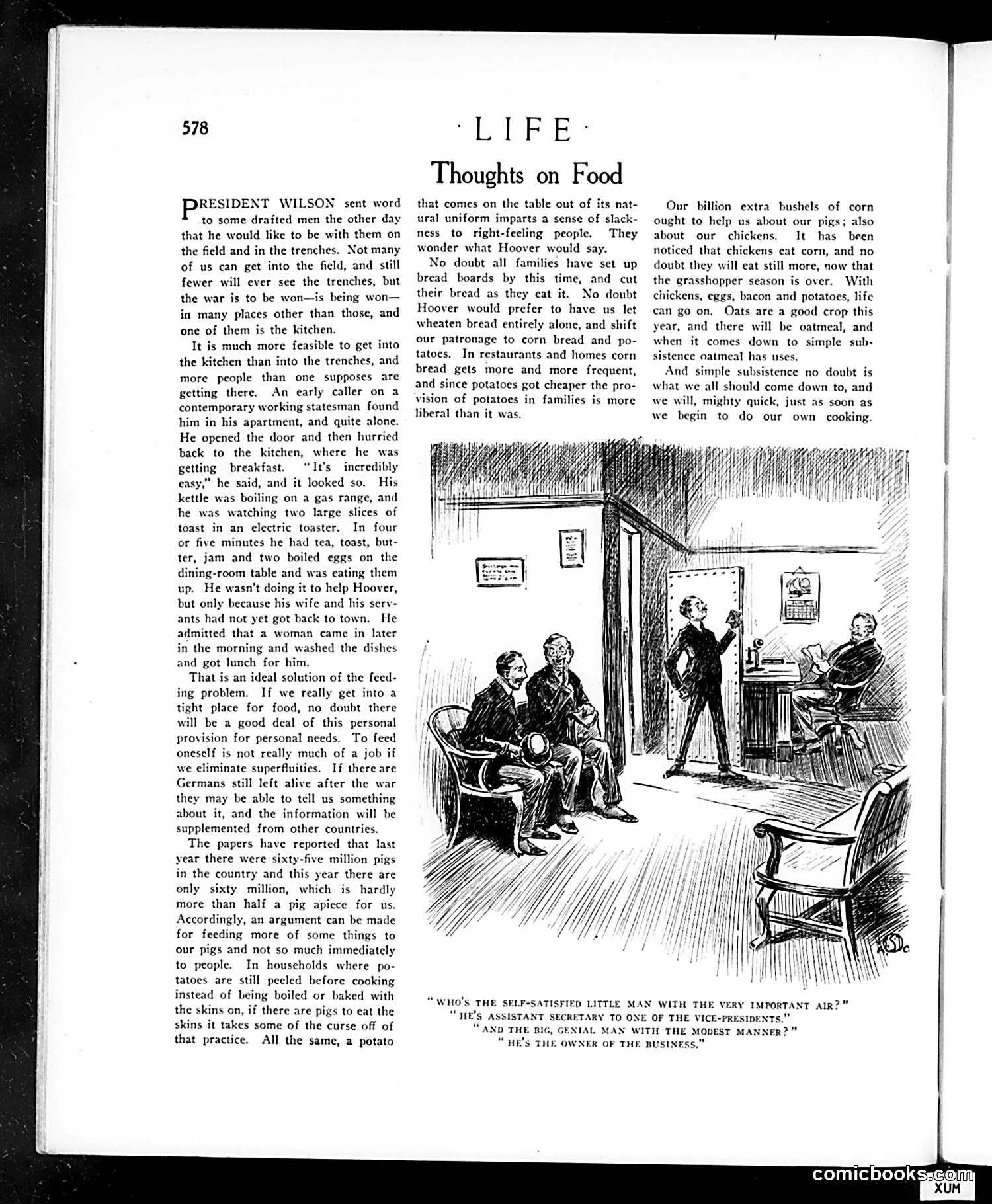
This 1918 *Life* magazine page discusses wartime food rationing and conservation during World War I. The article "Thoughts on Food" references President Wilson's efforts to encourage food economy, noting that bread boards and corn-based foods have become commonplace as substitutes for scarcer items. The cartoon below depicts three men in an office setting. According to the caption, they represent three social classes: a self-satisfied businessman, an assistant secretary to a vice-president, and a business owner. The satire appears to mock the pretensions and social hierarchies of office workers during wartime austerity—contrasting their comfortable indoor positions with soldiers in trenches (mentioned in the article), while all supposedly share the burden of food rationing.
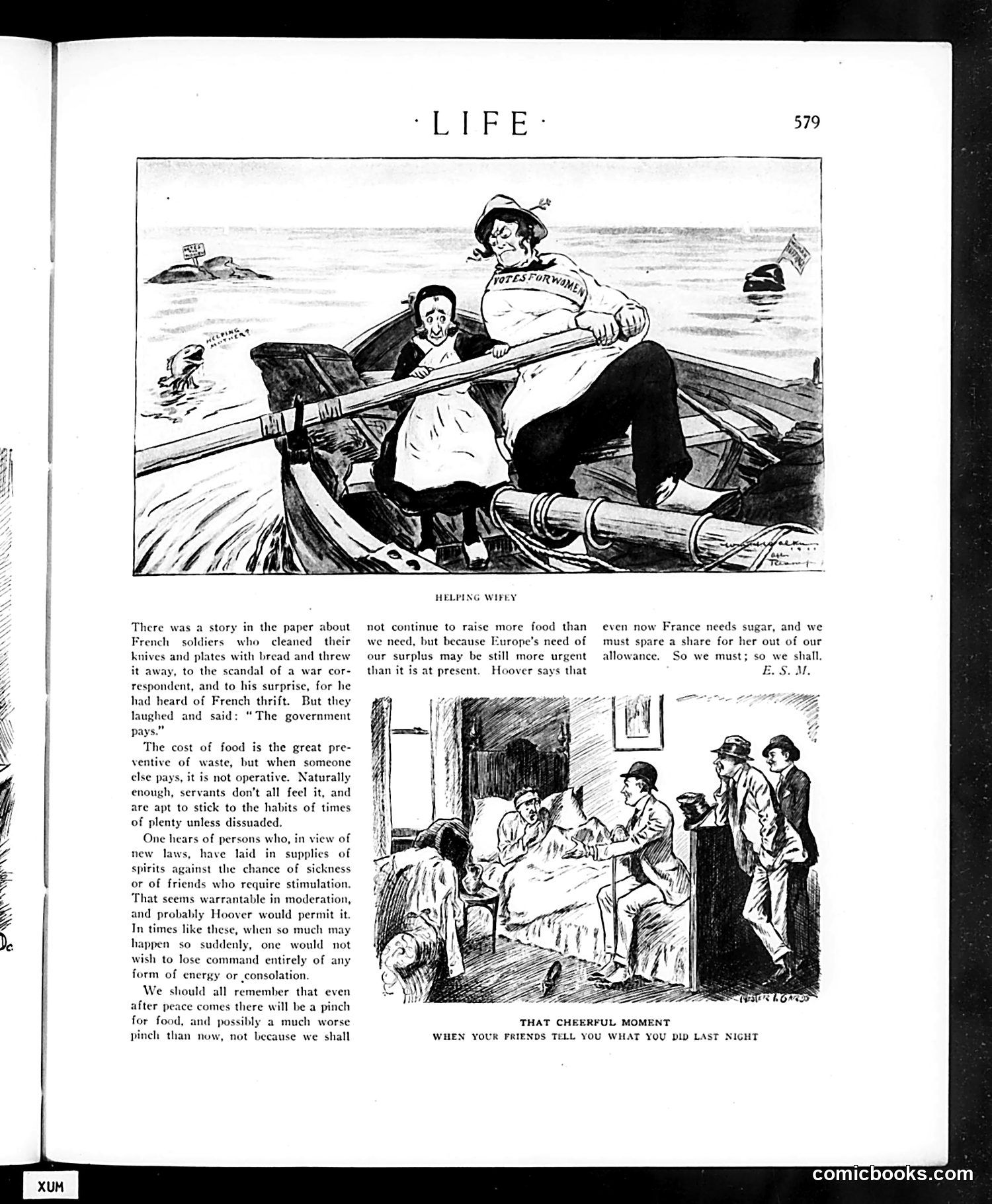
This page contains two editorial cartoons about World War I food rationing and sacrifice. The top cartoon, "Helping Wifey," depicts a woman at an oar in a boat labeled "To Starve" while a man helps row. The accompanying text discusses French soldiers cleaning their knives with bread—a dark joke about severe food shortages—and argues that Americans must voluntarily accept rationing to help feed Europe. The bottom cartoon, "That Cheerful Moment When Your Friends Tell You What You Did Last Night," shows people gathered around a hospital bed, likely referencing alcohol prohibition and its effects on social behavior. Both cartoons use humor to promote wartime sacrifice and compliance with government food conservation policies, addressing American civilians' responsibility during the ongoing conflict.
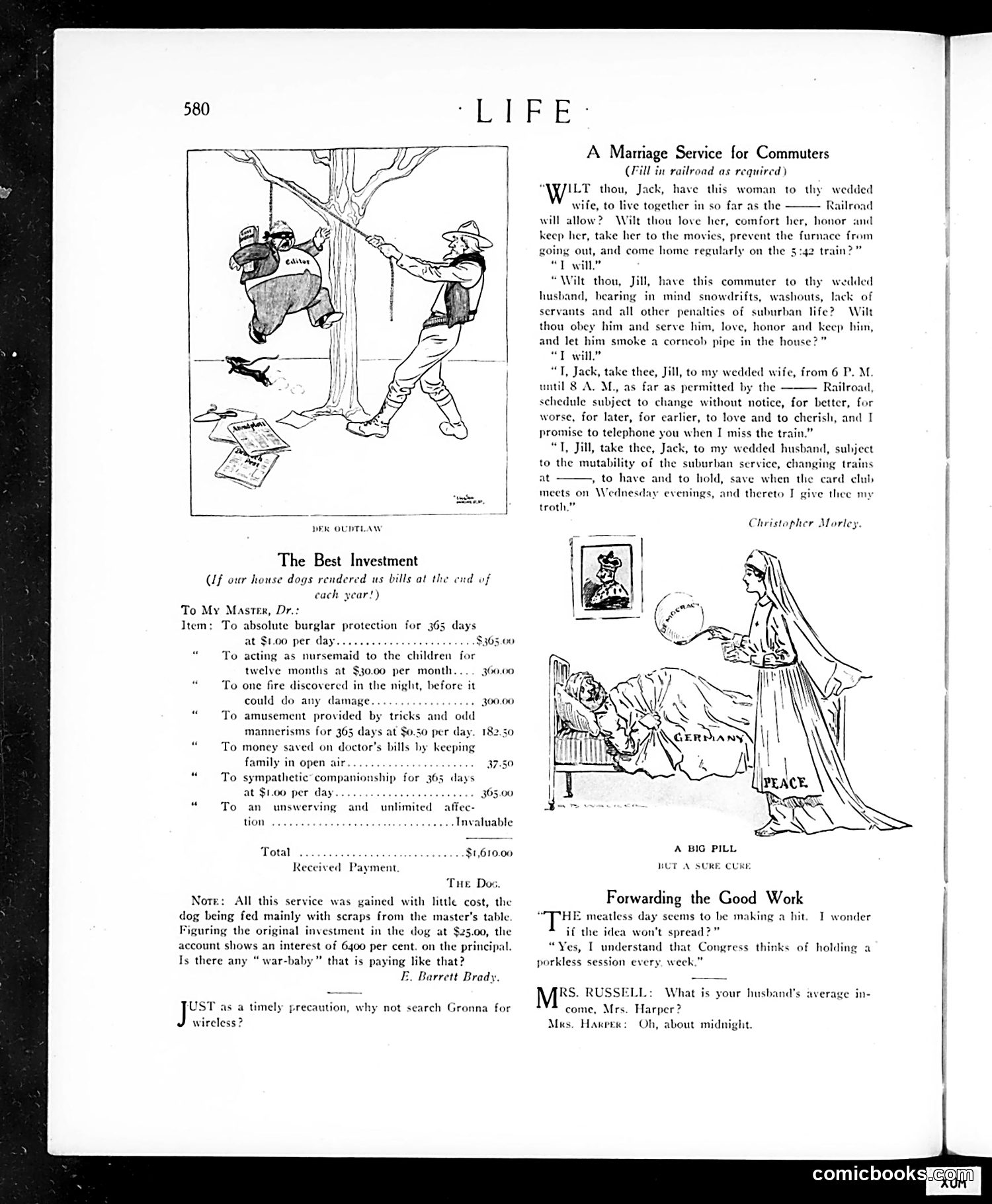
**Top Cartoon ("Joe Outlaw"):** Two men swing from a tree branch over papers on the ground, depicting commuters in an absurd "marriage service" scenario. The satire mocks railroad commuters' minimal free time—men who must rush home to suburban wives, arriving so late they barely see their families. The vows humorously reference railroad schedules and "missing the train," reflecting early 20th-century commuter frustrations. **"The Best Investment":** A humorous bill of services for a master, listing domestic protections and family care, totaling $1,610. The note reveals a dog earned this "investment" through practical service—satirizing what humans actually pay for these conveniences. **Bottom items** include brief satirical pieces about wireless precautions and Congressional pork-barrel spending, reflecting period concerns about technological adoption and government waste.
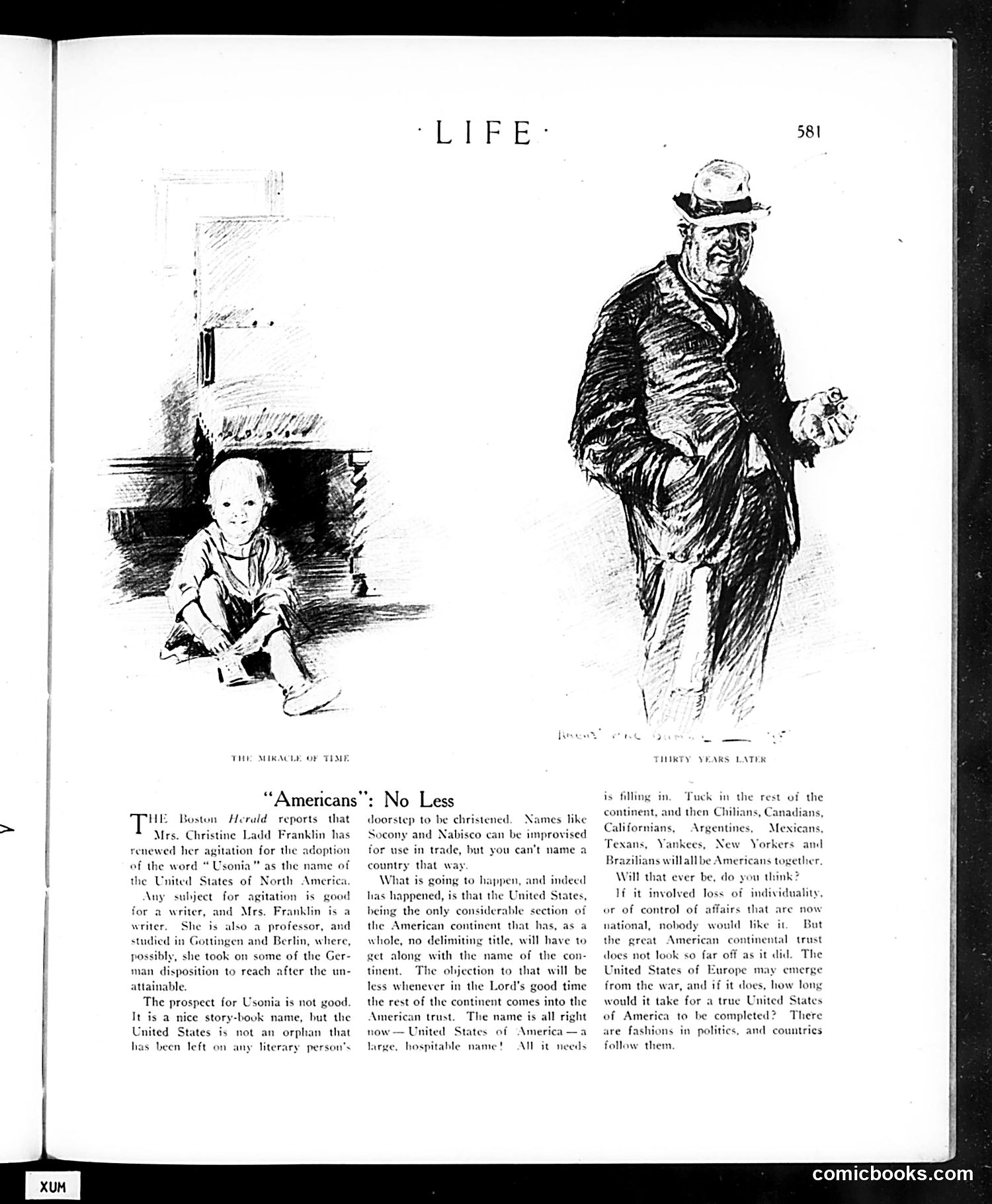
This page satirizes a proposal to rename the United States of America to "Usonia." The Boston Herald reports that Mrs. Christine Ladd-Franklin (a real mathematician and suffragist) advocated changing the national name because "American" is too broad—it includes people from Canada, South America, and other nations. The two sketches illustrate the absurdity: a baby christened at birth ("The Miracle of Time") and the same person thirty years later ("Thirty Years Later"), suggesting the impracticality of renaming an established nation. The text argues that while "Usonia" sounds nice, the U.S. has no literary claim to it and the name "United States of America" is already "large, hospitable" and adequate. The satire mocks renaming efforts as pedantic and unnecessary.
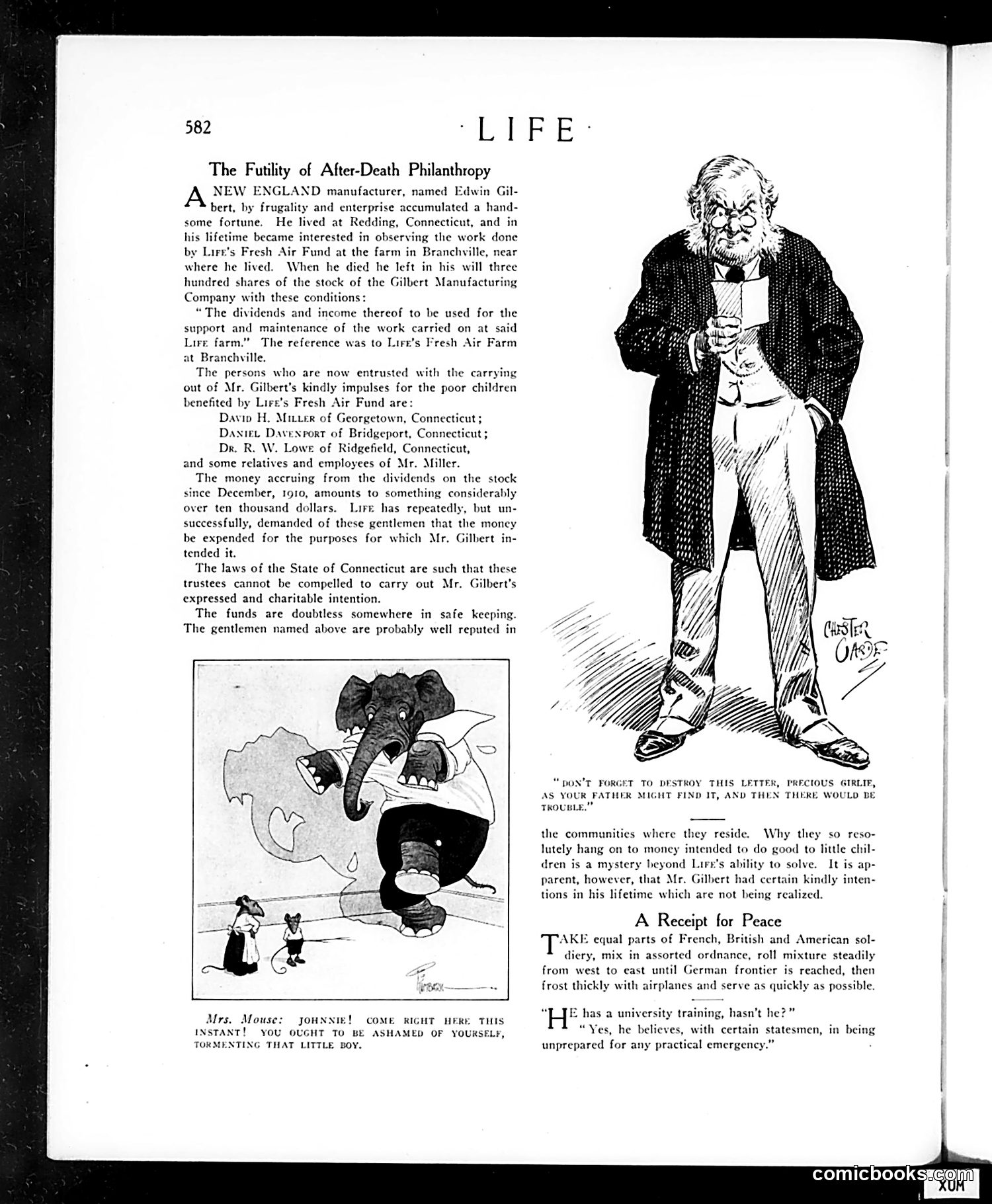
This page satirizes the futility of wealthy philanthropists' charitable intentions. The main article "The Futility of After-Death Philanthropy" describes Edwin Gilbert, a Connecticut manufacturer, who died leaving stock dividends to Lirr's Fresh Air Farm for poor children. However, the trustees (named gentlemen from Connecticut) have failed to spend the money as intended—over $10,000 has accumulated unused. The cartoon depicts an elephant (likely representing the unwieldy charitable bureaucracy or mismanagement) crushing small mice, illustrating how large institutional structures harm the vulnerable people they claim to help. The caption satirizes this disconnect. The piece critiques how well-intentioned bequests become trapped in legal and administrative systems, never reaching their intended beneficiaries—a commentary on the gap between philanthropic ideals and actual charitable results.
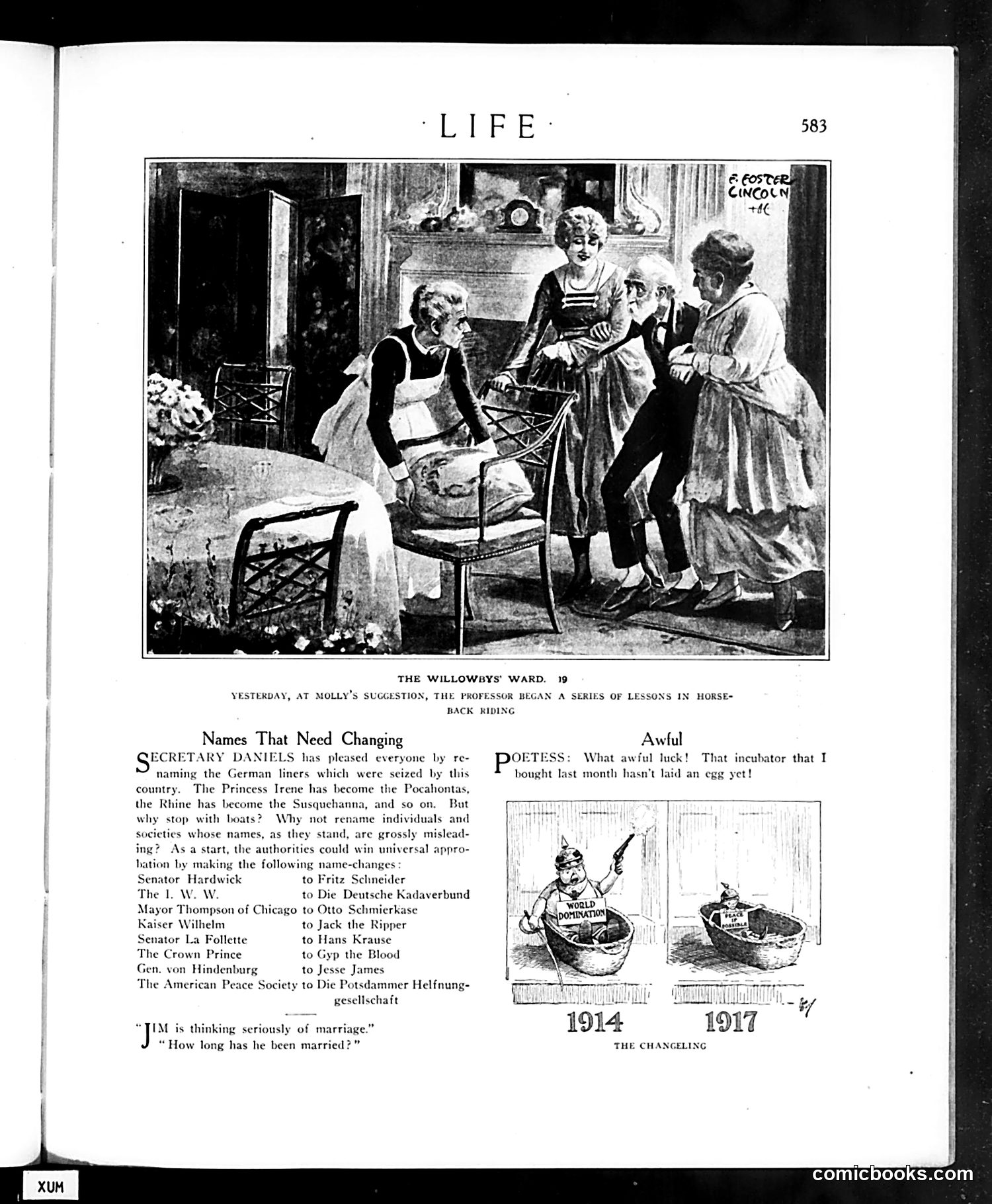
**Top Image**: "The Willowbys' Ward" illustrates a domestic scene where a professor begins horseback-riding lessons, likely from a serialized comic strip. **"Names That Need Changing"**: Secretary Daniels (U.S. Secretary of the Navy) humorously proposes renaming German places and organizations to less German-sounding alternatives—part of WWI-era American sentiment against German culture. Examples include renaming "Kaiser Wilhelm" to "Jack the Ripper" and "The Crown Prince" to "Gop the Blood." **"The Changeling" Cartoon**: Shows "World Domination" in a cradle, comparing a 1914 vs. 1917 infant—referencing Germany's diminished military prospects after America's 1917 entry into World War I. The satire mocks Germany's failed ambitions for global conquest.
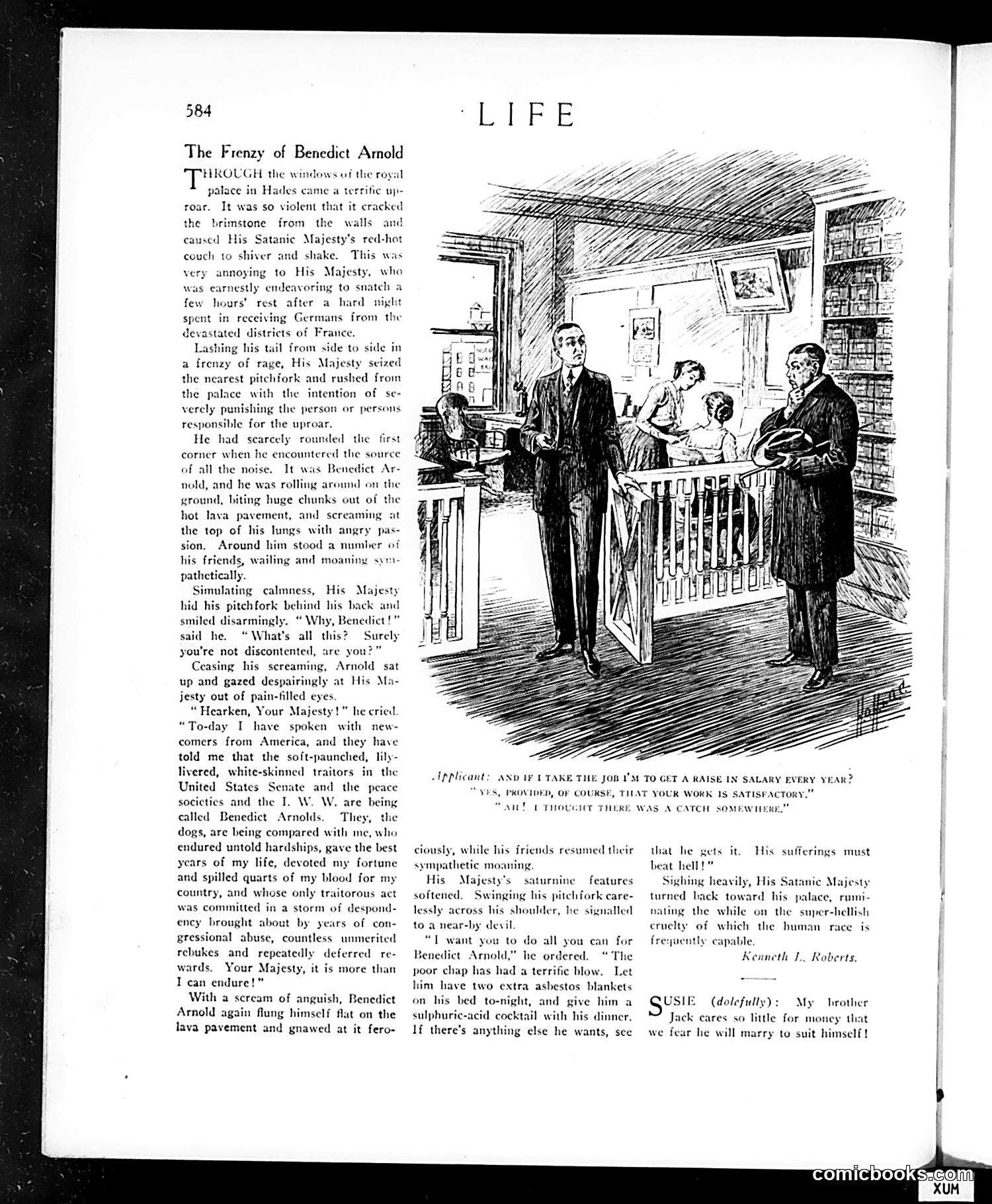
This satirical piece uses hell as a metaphor to mock American pacifists and anti-war activists during World War I. The historical Benedict Arnold—the American Revolutionary traitor—complains to Satan that his name is now being applied to contemporary figures opposing the war: U.S. Senators, peace societies, and the I.W.W. (Industrial Workers of the World, a radical labor organization). The satire's point: the author views these anti-war activists as far worse traitors than Arnold himself. Arnold claims he at least sacrificed for his country before betraying it, whereas these modern "traitors" actively undermine the war effort without comparable service. Satan, moved by Arnold's anguish, orders him special comforts—a dark joke suggesting even hell sympathizes with Arnold's complaint. The piece reflects pro-war sentiment and hostility toward domestic anti-war movements during WWI, portraying pacifists as comparable to history's greatest American traitor.
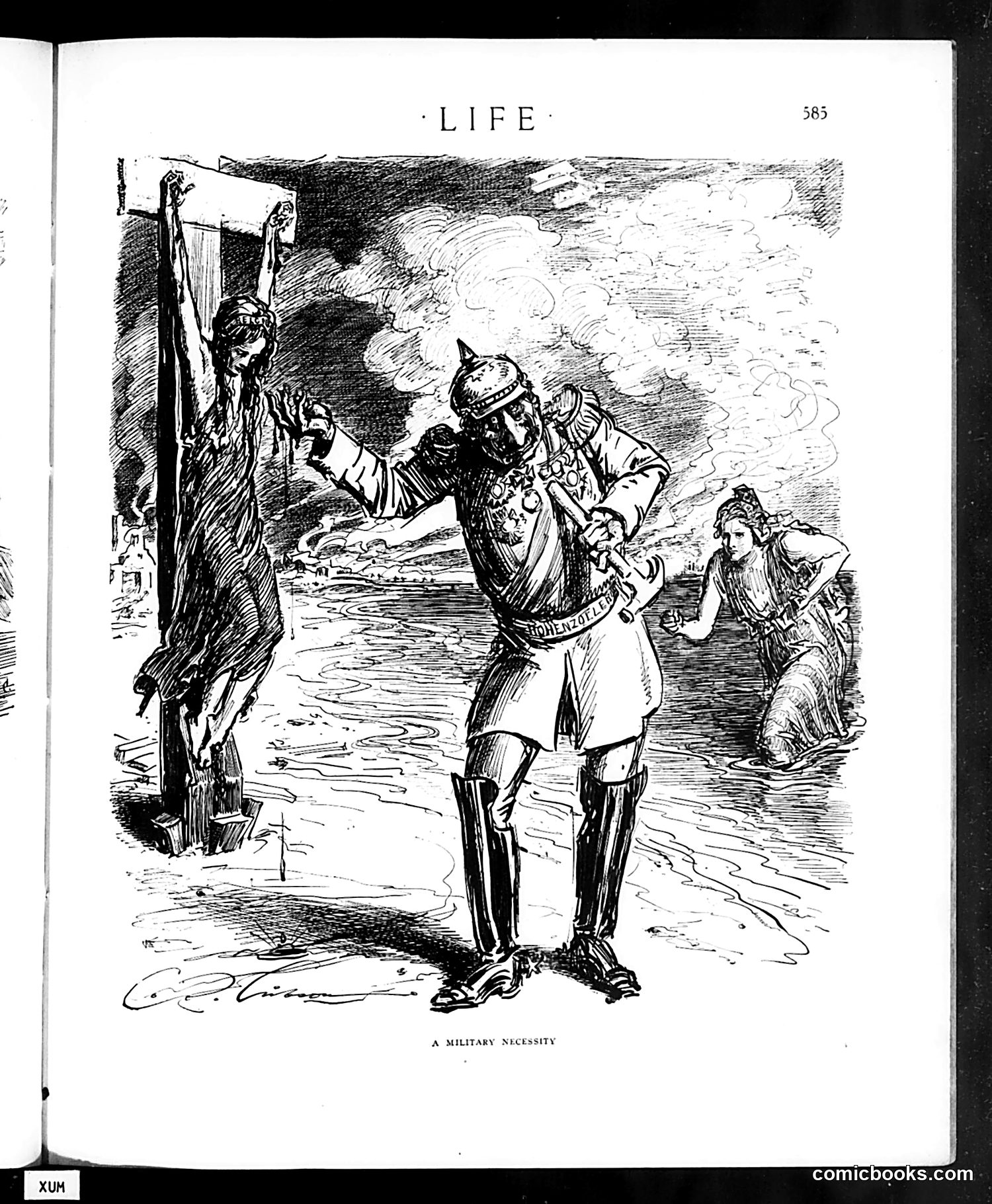
This satirical cartoon depicts a German military officer (identifiable by the spiked Prussian helmet and uniform) directing civilians—including women and children—at gunpoint. The caption "A Military Necessity" sarcastically comments on German military justifications for civilian violence. The cartoon likely critiques German conduct during World War I, particularly their treatment of Belgian and French civilians, or their defense of such actions as militarily required. The image presents this claimed "necessity" as obviously brutal and indefensible—armed soldiers coercing helpless noncombatants. The satire works by quoting German military rhetoric while showing its consequences: the gap between military justification and human cruelty becomes starkly visible. This represents Life magazine's anti-German editorial stance during WWI.
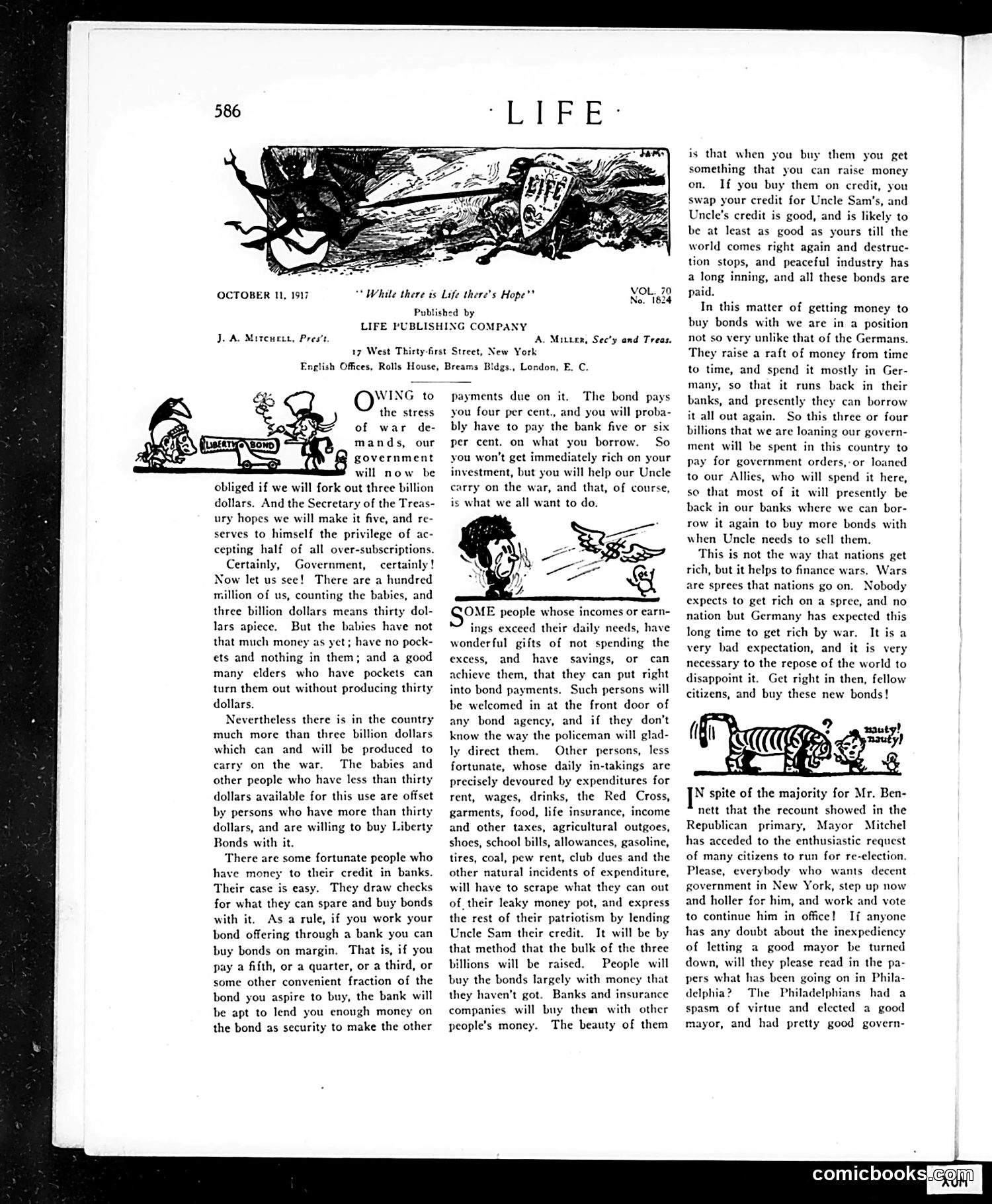
This page discusses U.S. Liberty Bond drives during World War I. The government seeks $3 billion (later $5 billion) to finance the war effort—approximately $30 per American citizen. The editorial explains the mechanics of bond purchasing: wealthy individuals with savings can buy bonds outright or on margin (paying a fraction upfront, borrowing the rest from banks). Poorer citizens, whose income is entirely consumed by living expenses (rent, food, taxes, insurance, fuel), must purchase bonds "on credit"—leveraging their personal creditworthiness to swap it for Uncle Sam's credit. The author acknowledges this system mirrors German war financing: both nations borrow heavily domestically, spending money mostly within their own countries, expecting repayment after victory. The satirical point appears to be accepting—even endorsing—this financial necessity while gently mocking the government's optimism about collecting over-subscriptions and the convenient fiction that poorer citizens can meaningfully contribute through credit.
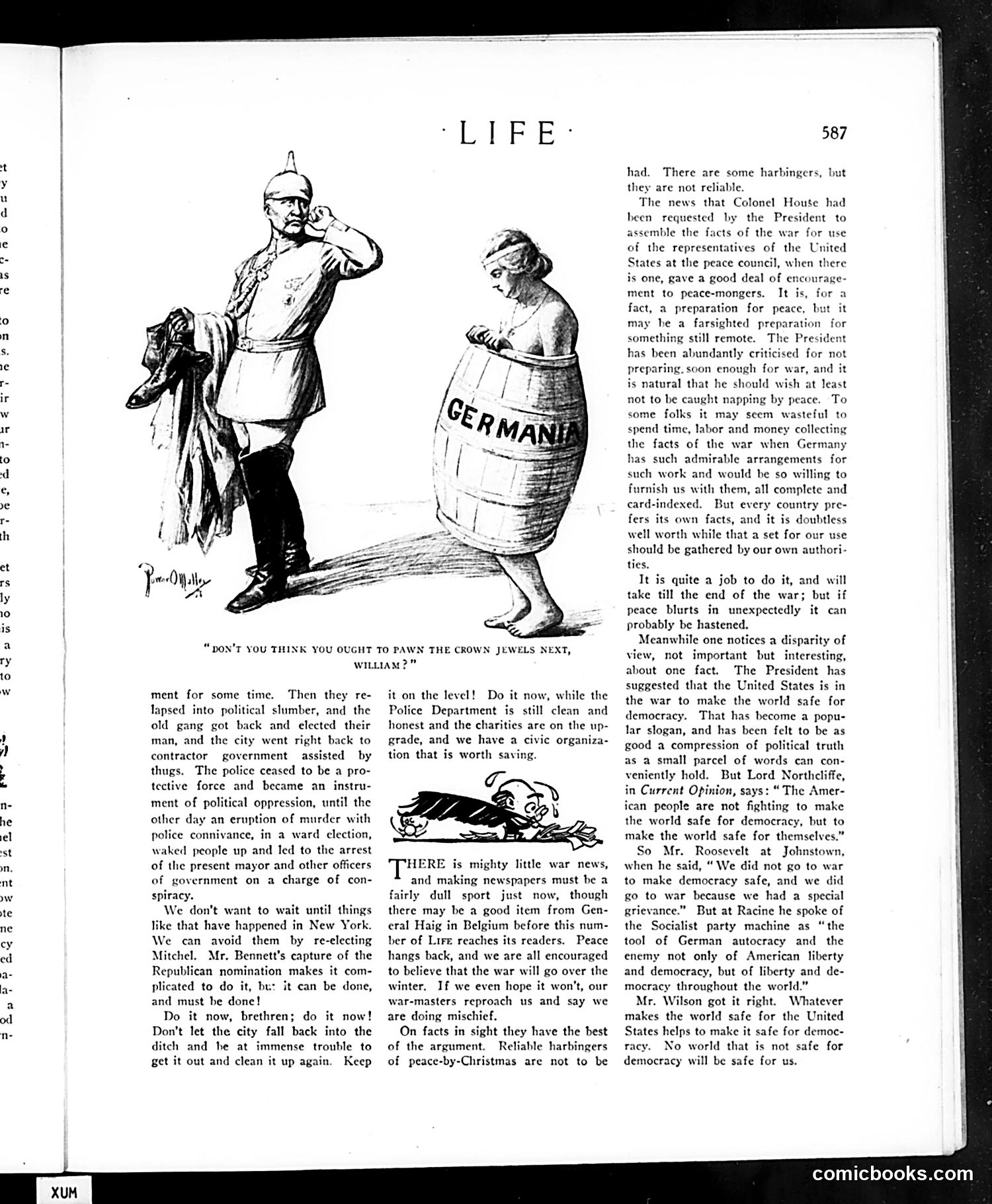
This cartoon depicts **Kaiser Wilhelm II of Germany** (left, in military uniform with spiked helmet) addressing **"Germania,"** the female personification of Germany (right, shown as a barrel labeled "GERMANIA"). The satire mocks Germany's depleting resources during World War I. Wilhelm suggests pawning the crown jewels—implying Germany is so financially exhausted by prolonged war that it must liquidate national treasures to survive. The cartoon suggests Germany cannot sustain the war effort indefinitely. The surrounding editorial discusses peace negotiations and America's war aims. The timing (page 587 of *Life*) indicates this is from America's WWI period, when debates raged about whether peace was possible and whether the war would "go over the winter." The joke: Germany, despite Wilhelm's confident military posture, faces economic collapse—a grim prediction of eventual defeat.
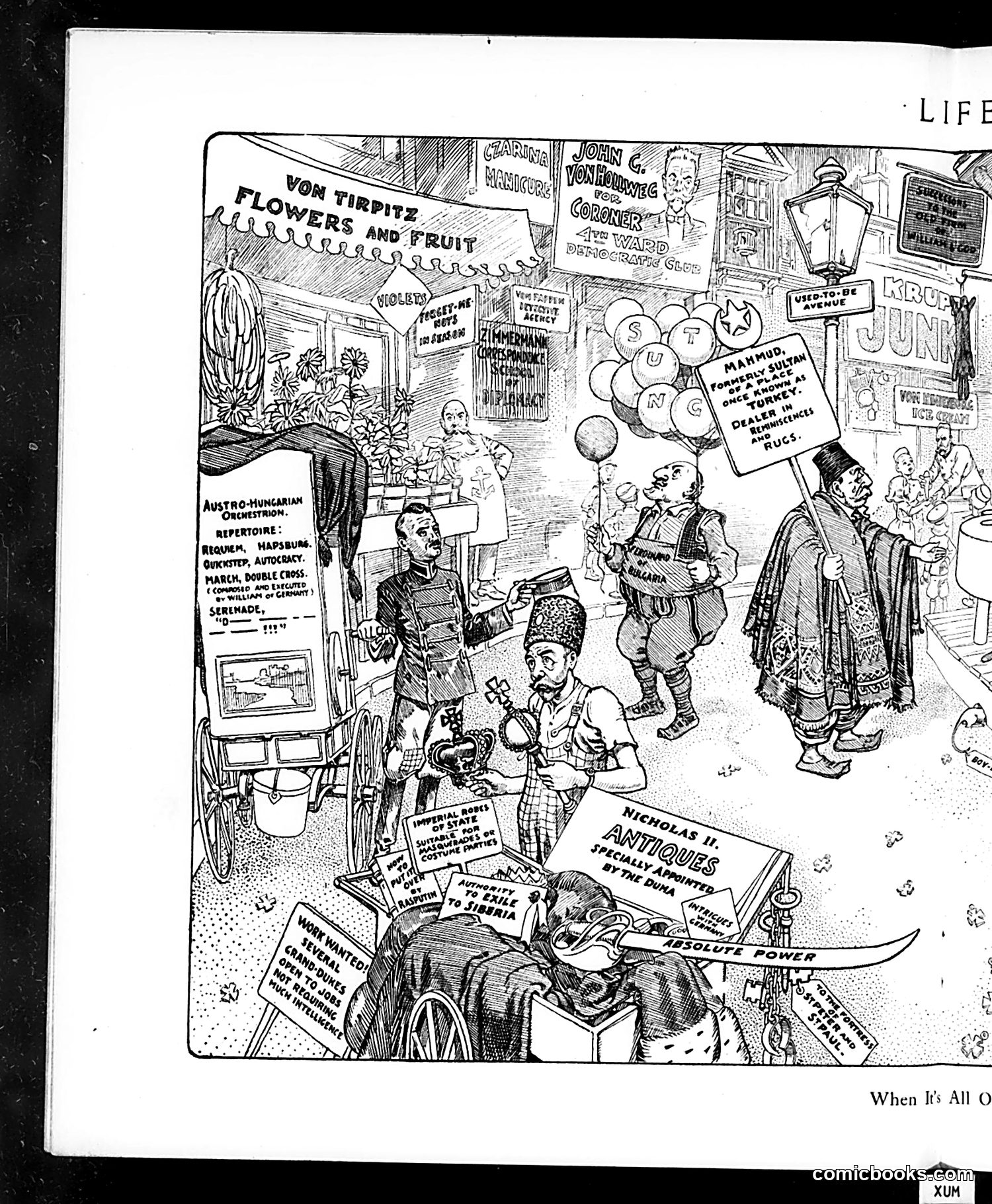
This Life magazine satirical cartoon depicts a street scene with various European vendors and performers, likely mocking early 20th-century European immigration or cultural stereotypes in America. The visible shop signs reference European establishments: "Von Tirpitz Flowers and Fruit" (German), "John Von Hindenburg" (German military figure), and "Nicholas Jr. Antiques" (Russian imperial reference). There are also signs advertising Austrian-Hungarian orchestra performances and what appears to be references to European political figures. The cartoon appears to satirize how European immigrants—particularly from German, Austro-Hungarian, and Russian empires—established businesses and communities in America, often maintaining their national identities and cultural references. The crowded, detailed street scene suggests commentary on immigrant neighborhoods or the visible presence of foreign cultures in American cities during this period.
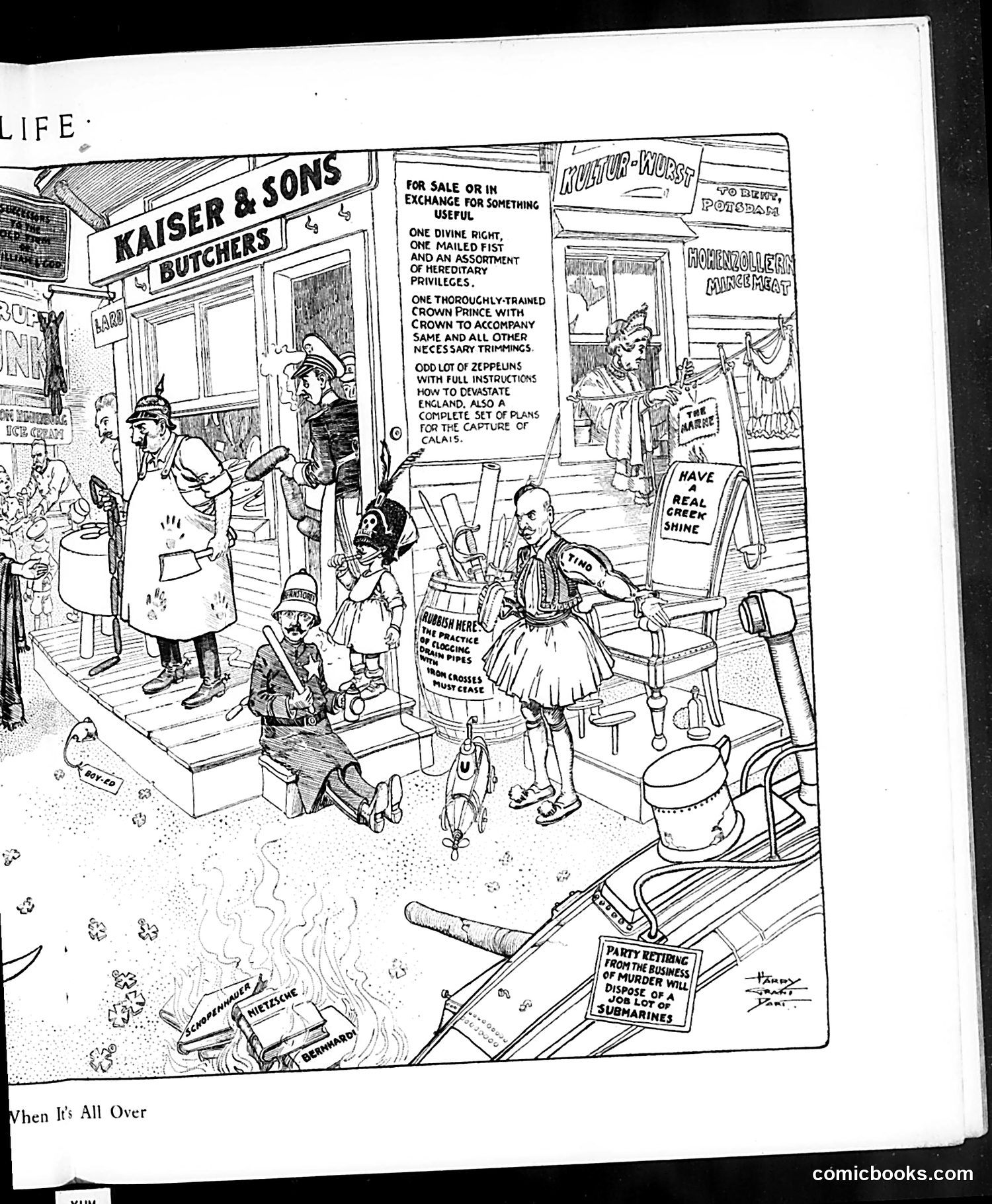
This WWI-era Life magazine cartoon satirizes Germany's anticipated defeat. The scene shows a German butcher shop ("Kaiser & Sons") with absurdist "for sale" advertisements listing items Germany expects to liquidate after losing the war: - The Kaiser's "divine right" and "mailed fist" (authoritarian power) - A trained crown prince - Zeppelins with instructions for attacking England - Plans for capturing Calais (France) The humor mocks German militarism and imperial pretensions by treating them as worthless inventory to be pawned off. Soldiers and civilians browse these "goods" like bargain merchandise. The burning ship at bottom references naval warfare. The cartoon expresses Allied confidence in eventual German defeat while ridiculing German autocracy and aggressive ambitions—reflecting American wartime propaganda and satirical commentary on German imperialism.
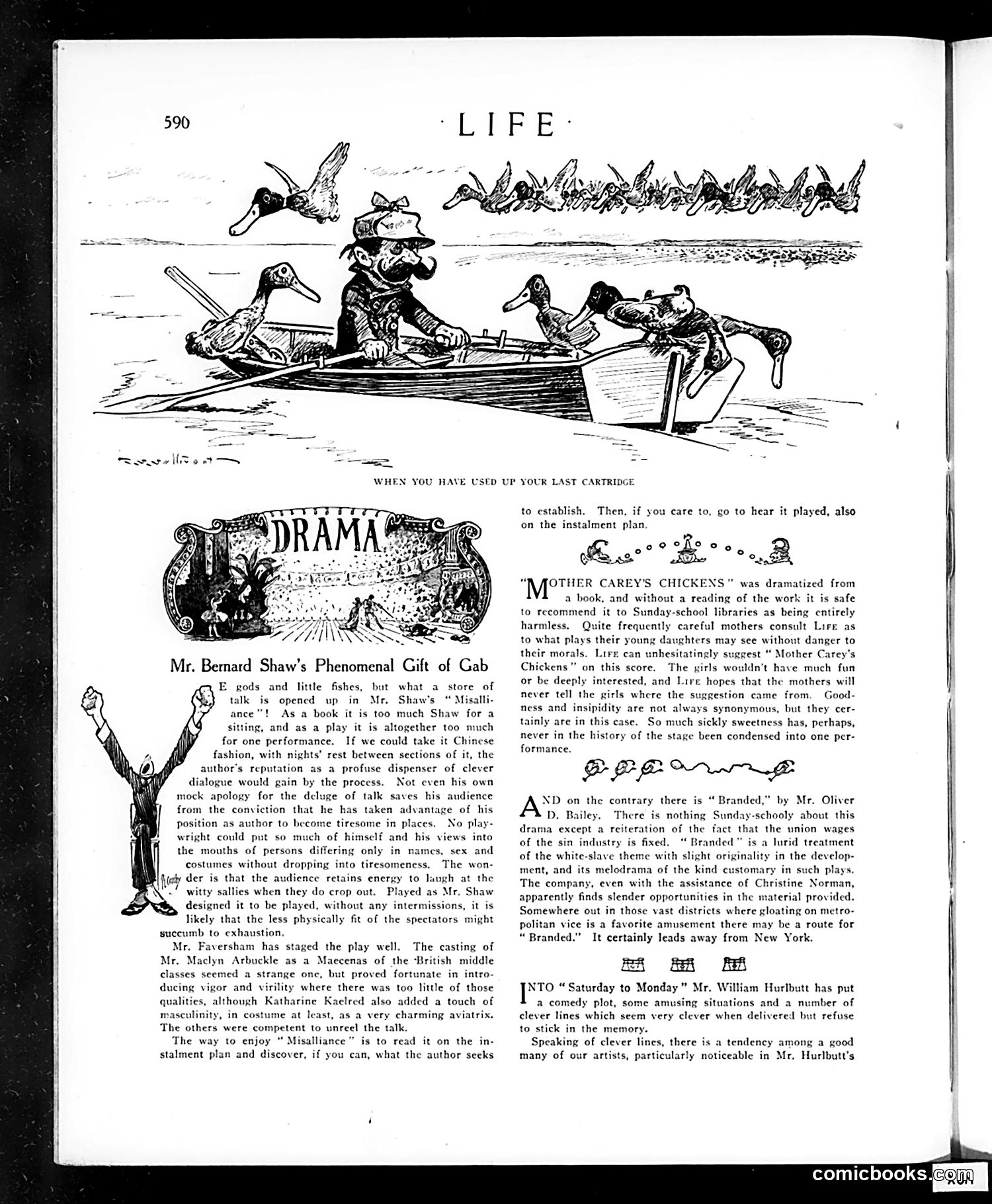
This page reviews several theatrical productions. The top cartoon depicts a hunter with ducks, captioned "When You Have Used Up Your Last Cartridge"—likely a visual metaphor for exhaustion, connecting to the review below about Bernard Shaw's play *Misalliance*. The text criticizes Shaw's play as excessively talky and tedious despite its clever dialogue. The reviewer suggests reading it in installments rather than enduring a full performance, arguing the author has indulged his position to become "tiresome in places." Other reviews follow: *Mother Carey's Chickens* is dismissed as sickeningly sweet and harmless—suitable only for Sunday schools; *Branded* is condemned as lurid melodrama exploiting white-slave themes; and *Saturday to Monday* praised for clever lines that unfortunately don't linger in memory. The page represents typical early 20th-century theater criticism emphasizing dialogue quality, moral propriety, and entertainment value for audiences.
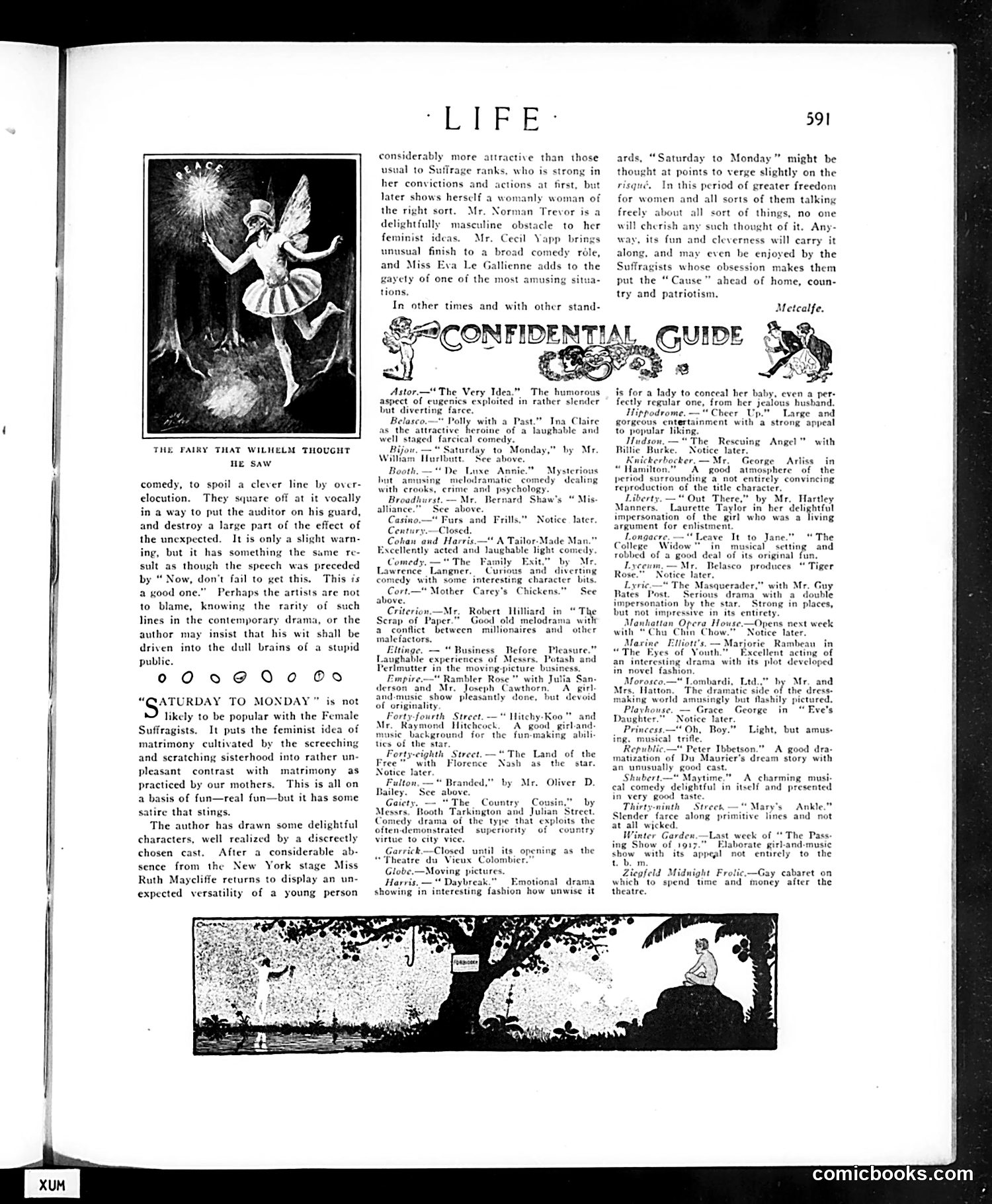
This is a theater review page from Life magazine. The main illustration shows a fairy figure — likely referencing German Kaiser Wilhelm II's famous statement about seeing a fairy at the German court. The caption sarcastically invokes this to mock Wilhelm. The bulk of the page reviews Broadway productions, including "Saturday to Monday," which the text notes appeals to female suffragists by contrasting modern feminist ideas about marriage with traditional matrimony. The review contains gentle satire about women's liberation — a topical issue of the era (appears to be pre-1920s based on suffrage references). Other theatrical reviews mention comedies, farces, and dramas of the period. The "Confidential Guide" section provides capsule summaries of various shows currently running in New York theaters, evaluating their merits and casting choices.
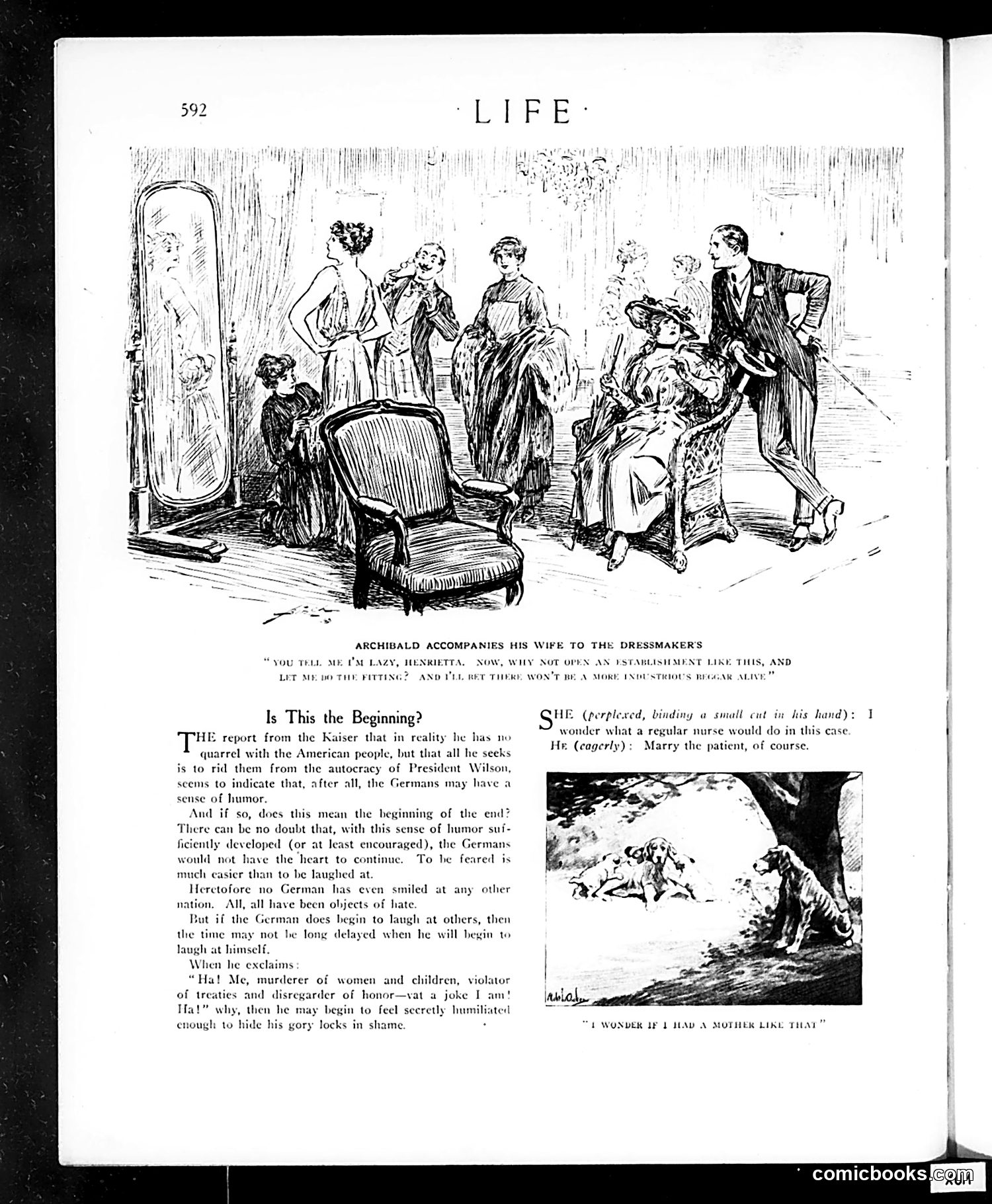
This page contains WWI-era commentary on German leadership. The main text, "Is This the Beginning?", responds to a Kaiser report claiming he has no quarrel with American citizens, only with President Wilson's "autocracy." The author argues sarcastically that if Germans develop a sense of humor—something previously absent from their national character—they might eventually laugh at themselves. This self-awareness could lead to shame about their wartime atrocities ("murderer of women and children, violator of treaties"), potentially hastening their defeat. The satirical point: German militarism relies on humorlessness and pride. Humor and self-reflection are weapons against such regimes. The domestic cartoon above depicts a couple (Archibald and Henrietta) visiting a dressmaker. Archibald suggests opening a similar establishment himself, promising to be an industrious worker—likely satirizing either male incompetence at "women's work" or wealthy leisure-class pretensions to labor.
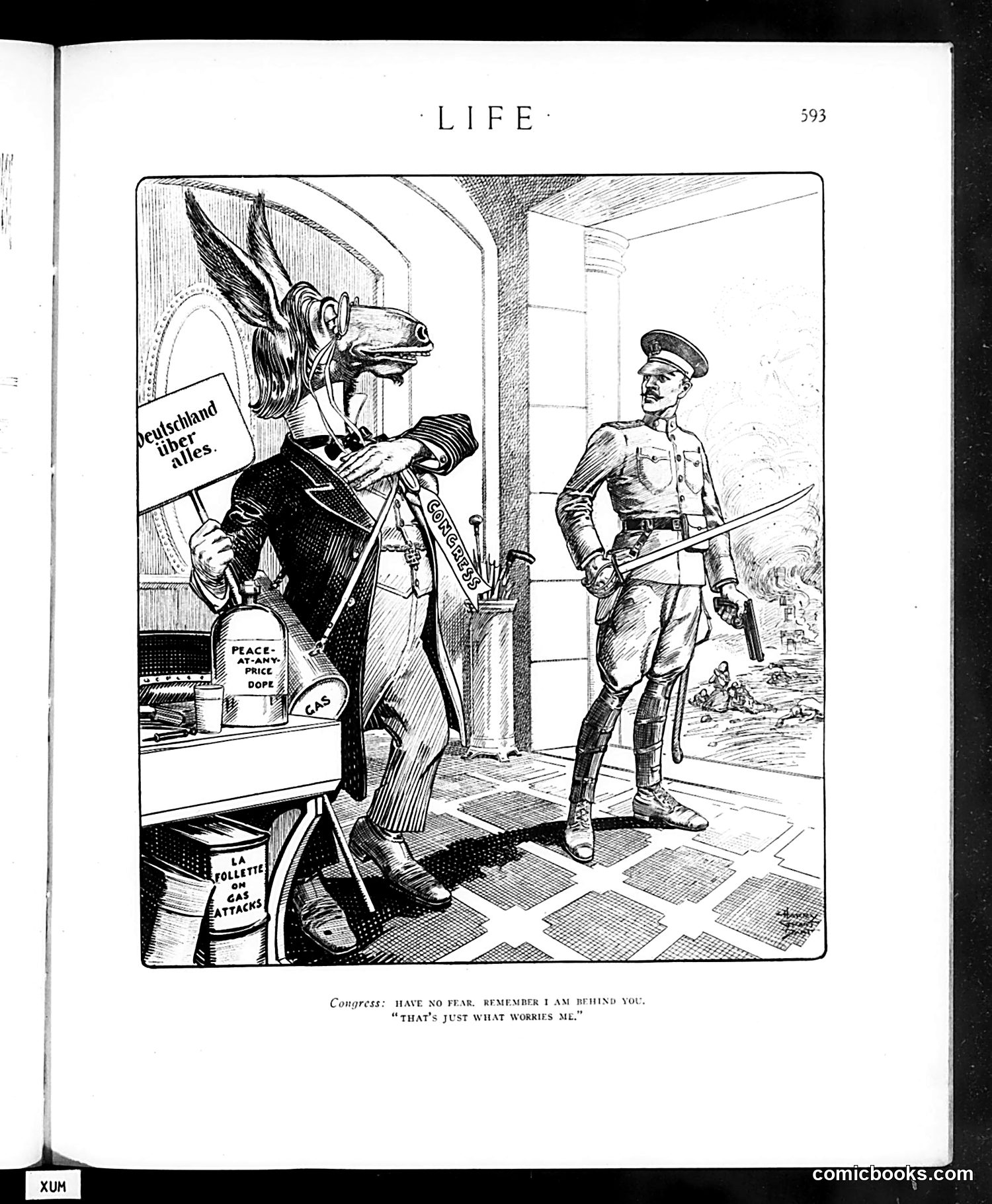
This is a WWI-era satirical cartoon showing a soldier labeled "Congress" speaking with a figure representing "Deutschland Über Alles" (Germany's imperial ambitions). The German figure holds containers labeled "Peace-Price Dope" and "La Follette on Gas Attacks," referencing Senator Robert La Follette's pacifist opposition to the war. The joke's dark humor: Congress reassures the soldier "I'm behind you," but the soldier replies "That's just what worries me"—suggesting Congress cannot be trusted to support the war effort. The cartoon mocks Congressional opposition to American involvement, portraying pacifists like La Follette as effectively aiding Germany. This reflects American public opinion circa 1917-1918, when anti-war sentiment was viewed as dangerous defeatism.
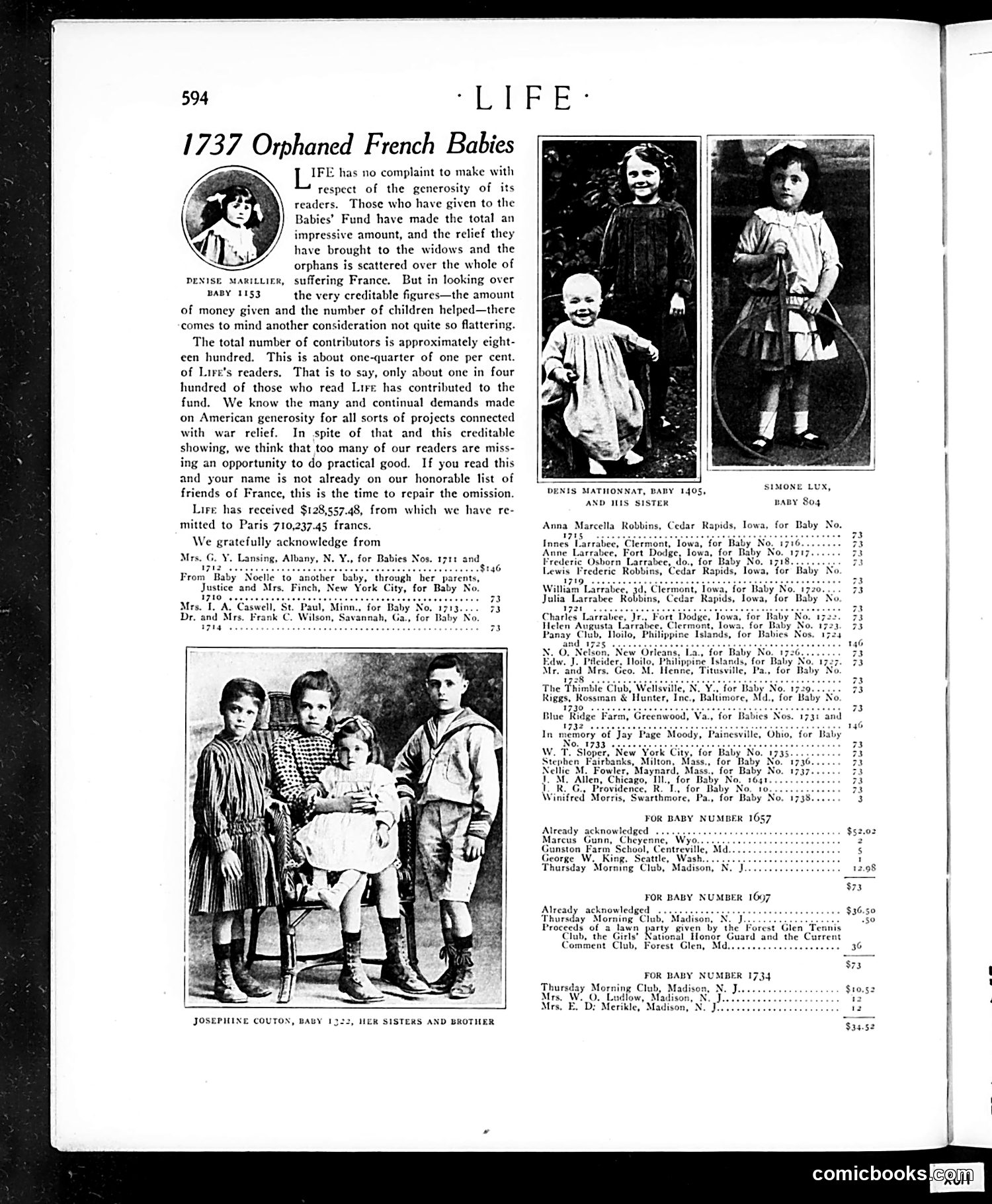
This page documents Life magazine's charitable fundraising campaign for French war orphans during World War I. The editorial text, alongside photographs of sponsored children, appeals to readers' generosity. The key point is **criticism masked as gratitude**: while Life praises the $128,557.48 raised, it scolds readers for insufficient participation. Only about 1 in 400 Life readers contributed—approximately one-quarter of one percent. The magazine argues that despite multiple competing war-relief appeals, readers are "missing an opportunity to do practical good" and should add their names to the "honorable list of friends of France." The accompanying photographs—including "Josephine Couton, Baby 1322, her sisters and brother" and other identified French children—personalize the appeal by showing specific beneficiaries of donations. This represents early-20th-century philanthropic messaging: combining moral pressure with emotional appeal through child photographs to encourage charitable giving.
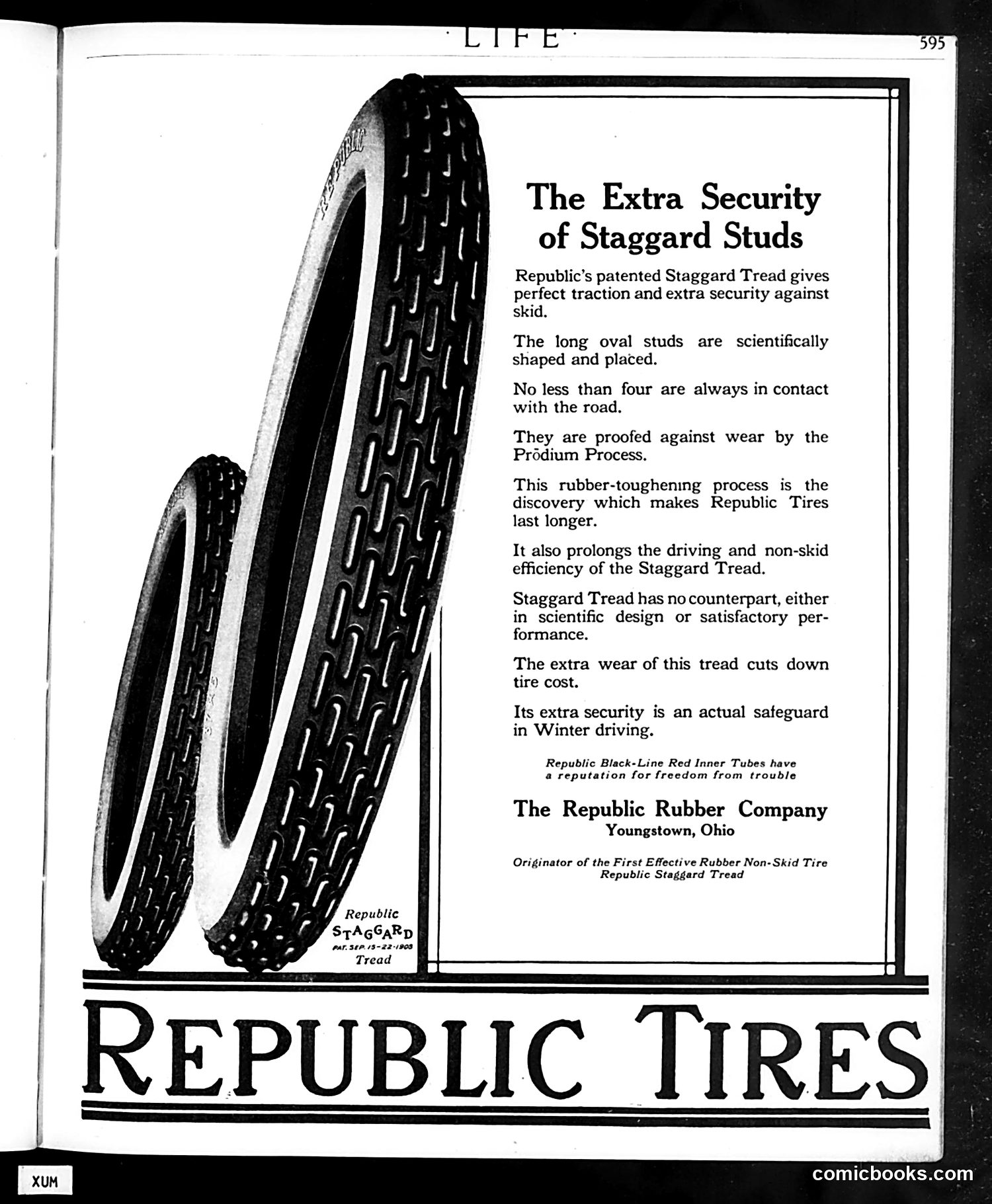
This page is **not a cartoon or satire** — it's a straightforward **automobile tire advertisement** from Life magazine (page 595). The Republic Rubber Company promotes their "Staggard Tread" tire, emphasizing safety features relevant to early-20th-century driving: - **"Studs"** (metal protrusions) on the tread for winter traction and skid prevention - A **"Prodium Process"** for rubber durability - Claims of superior design with "no counterpart" - Emphasis on winter driving safety The image shows two tires side-by-side, highlighting the tread pattern's distinctive oval studs. The ad targets practical motorists concerned about winter safety and tire longevity—genuine concerns before modern tire technology. This reflects the era when tire safety was a genuine selling point and winter driving genuinely hazardous. There is no political or satirical content here.
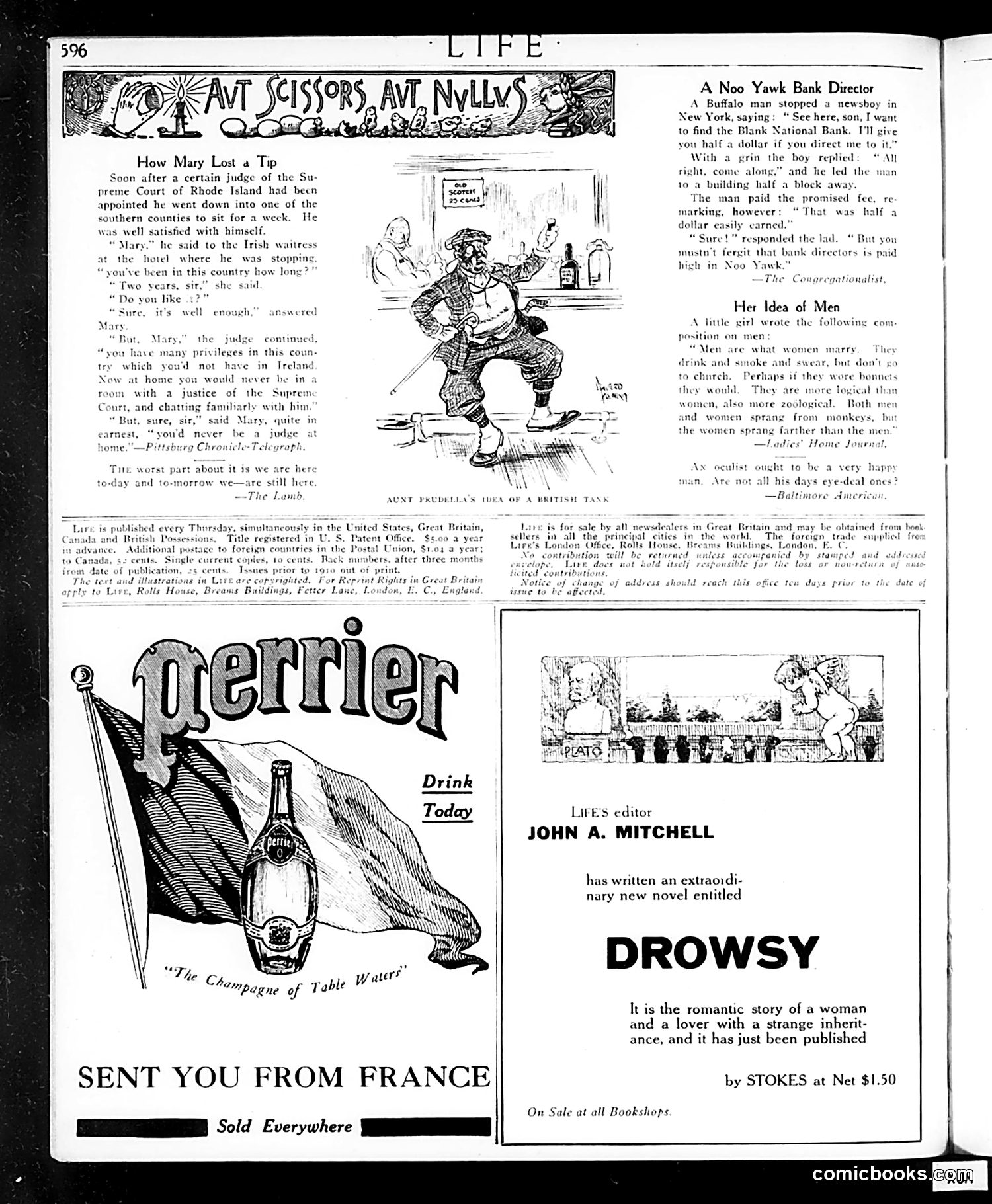
This page contains three brief humorous anecdotes satirizing American social pretensions and Irish immigrant perspectives: **"How Mary Lost a Tip"**: An Irish waitress named Mary serves a newly appointed Rhode Island Supreme Court judge who's pleased with himself. When he mentions his new position, Mary deflates his pride by noting that bank directors in New York earn far more—implying his judicial status is unremarkable. **"A Noo Yawk Bank Director"**: A Buffalo businessman tips a newsboy half a dollar to direct him to a bank. The boy reflects that the tip was "easily earned," but the man notes it was actually half a dollar—a modest sum for directing someone nearby. The humor mocks New York banking prestige. **"Her Idea of Men"**: A young girl's essay defines men as creatures who "drink and smoke and swear, but don't go to church" and are "more zoological" than women. She suggests they're more evolved than monkeys but barely. The cartoon "Aunt Prudella's Idea of a British Tank" (visible) appears to depict a World War I-era tank misunderstanding. These pieces mock American social climbing, banking vanity, and gender stereotypes through working-class and immigrant Irish perspectives.
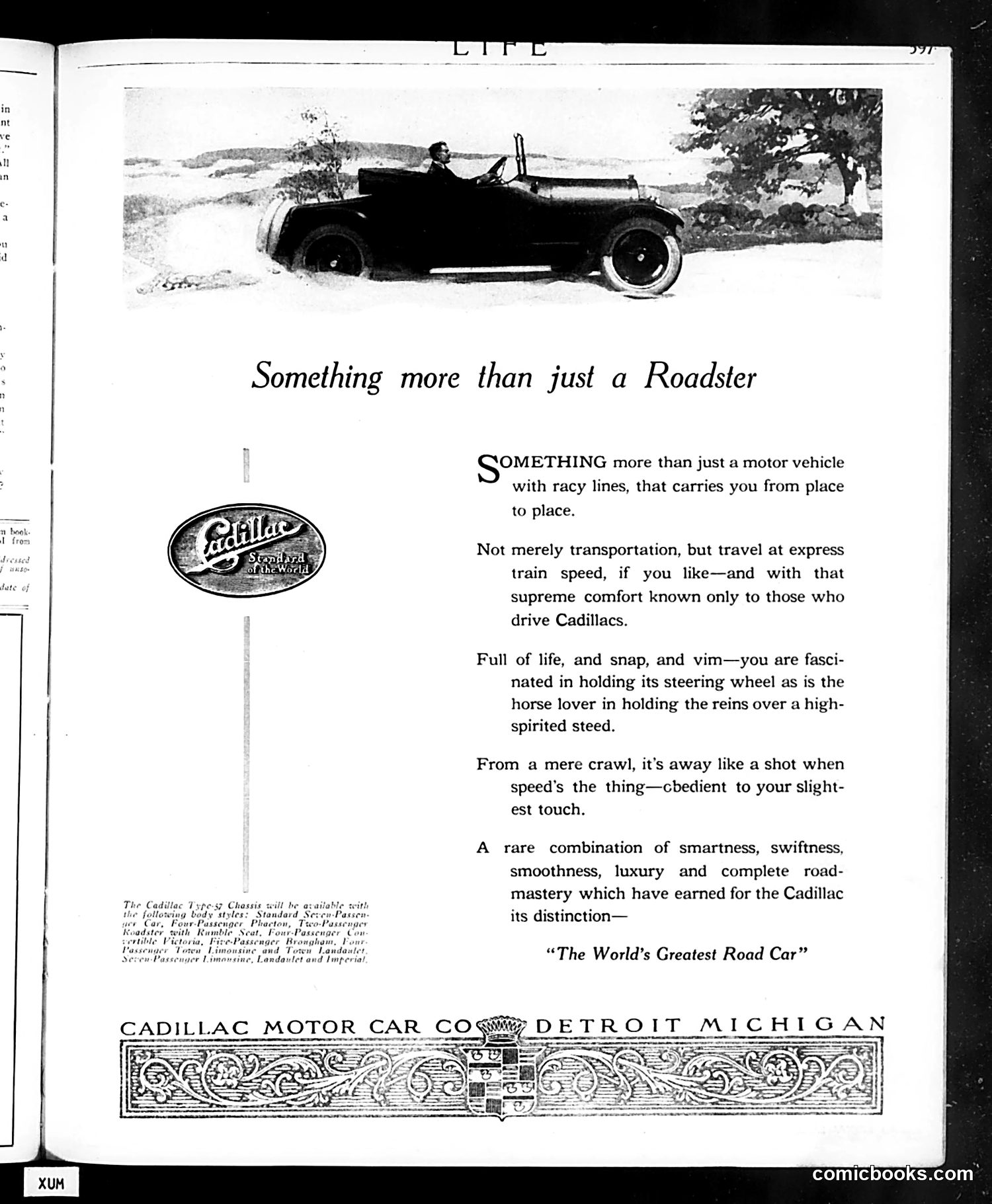
This is not a political cartoon but a **full-page automobile advertisement** for Cadillac Motor Car Company (Detroit, Michigan). The page features a stylized illustration of a 1920s Cadillac roadster with a driver against a scenic landscape. The ad copy uses elaborate, flowery language typical of the era, employing metaphors comparing driving a Cadillac to horseback riding ("holding the reins over a high-spirited steed") to appeal to wealthy consumers accustomed to luxury and control. The advertisement emphasizes speed, comfort, and exclusivity—claiming Cadillac offers "express train speed" and comfort "known only to those who drive Cadillacs." It concludes with the slogan "The World's Greatest Road Car." This represents early twentieth-century luxury automobile marketing aimed at affluent readers of *Life* magazine, emphasizing prestige and performance rather than practical utility.
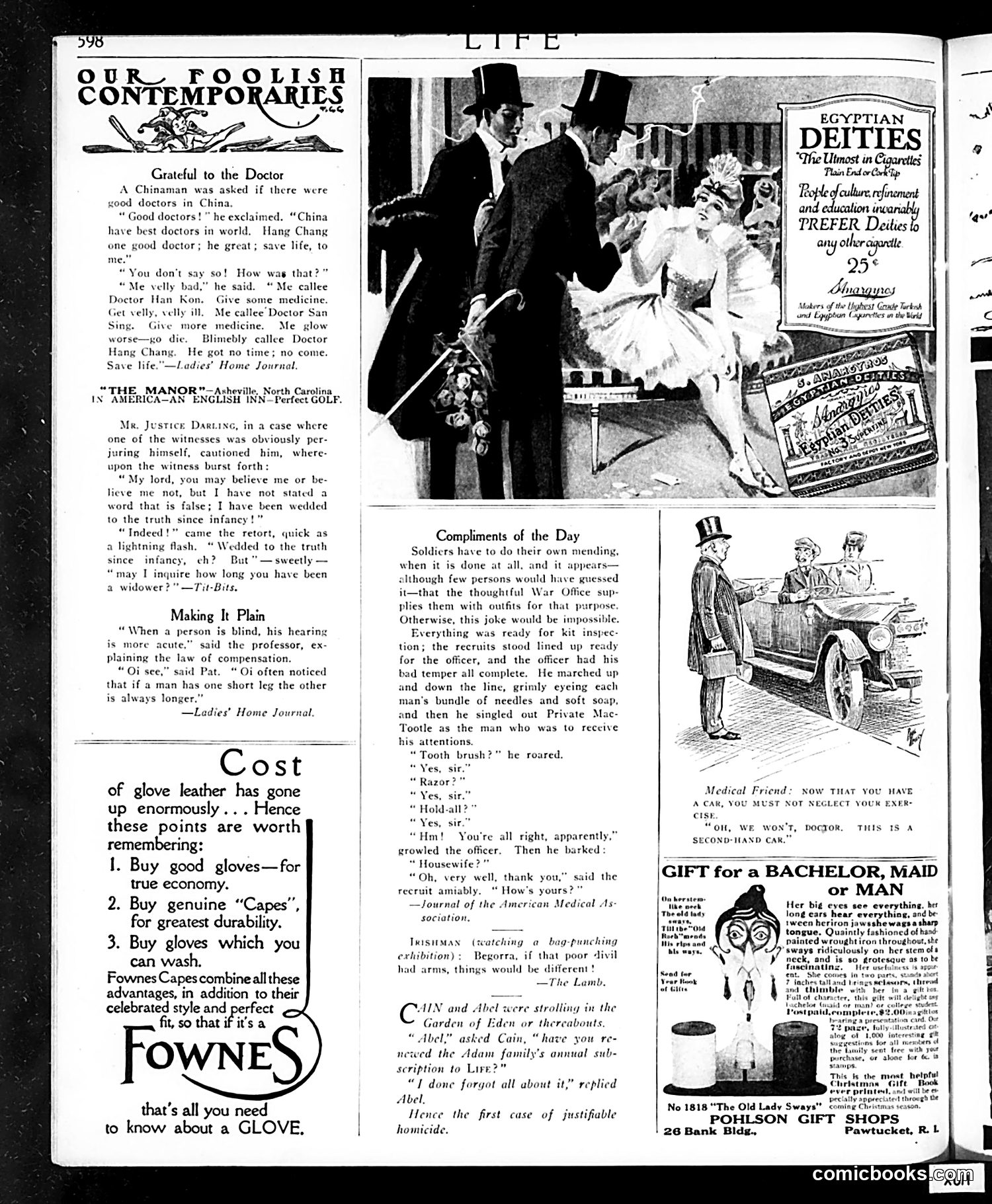
This page from **Life** magazine (a satirical publication) contains several humor pieces mocking contemporary foibles: **"Our Foolish Contemporaries"** features four brief satirical anecdotes: 1. A Chinese man's tale of progressively calling worse doctors until one never arrives—mocking both ethnic stereotypes and medical incompetence. 2. A judge catching a perjurer who claims lifelong truthfulness, retorting with a quip about widowhood—exposing obvious lies. 3. A professor's "law of compensation" (blind people hear better) challenged by an Irishman's absurd observation about short legs—satirizing pseudo-scientific reasoning. 4. A recruit's kit inspection where an officer discovers the soldier lacks a "housewife" (sewing kit), then mockingly asks about *his own* housewife—military humor about supplies and officers' temper. The page also contains **advertisements** (Fownes gloves, Egyptian Deities cigarettes, Pohlson gift shops) typical of 1920s magazine content. The "Compliments of the Day" anecdote and "Cain and Abel" joke continue the satirical tone, poking fun at human absurdity across social classes and situations.
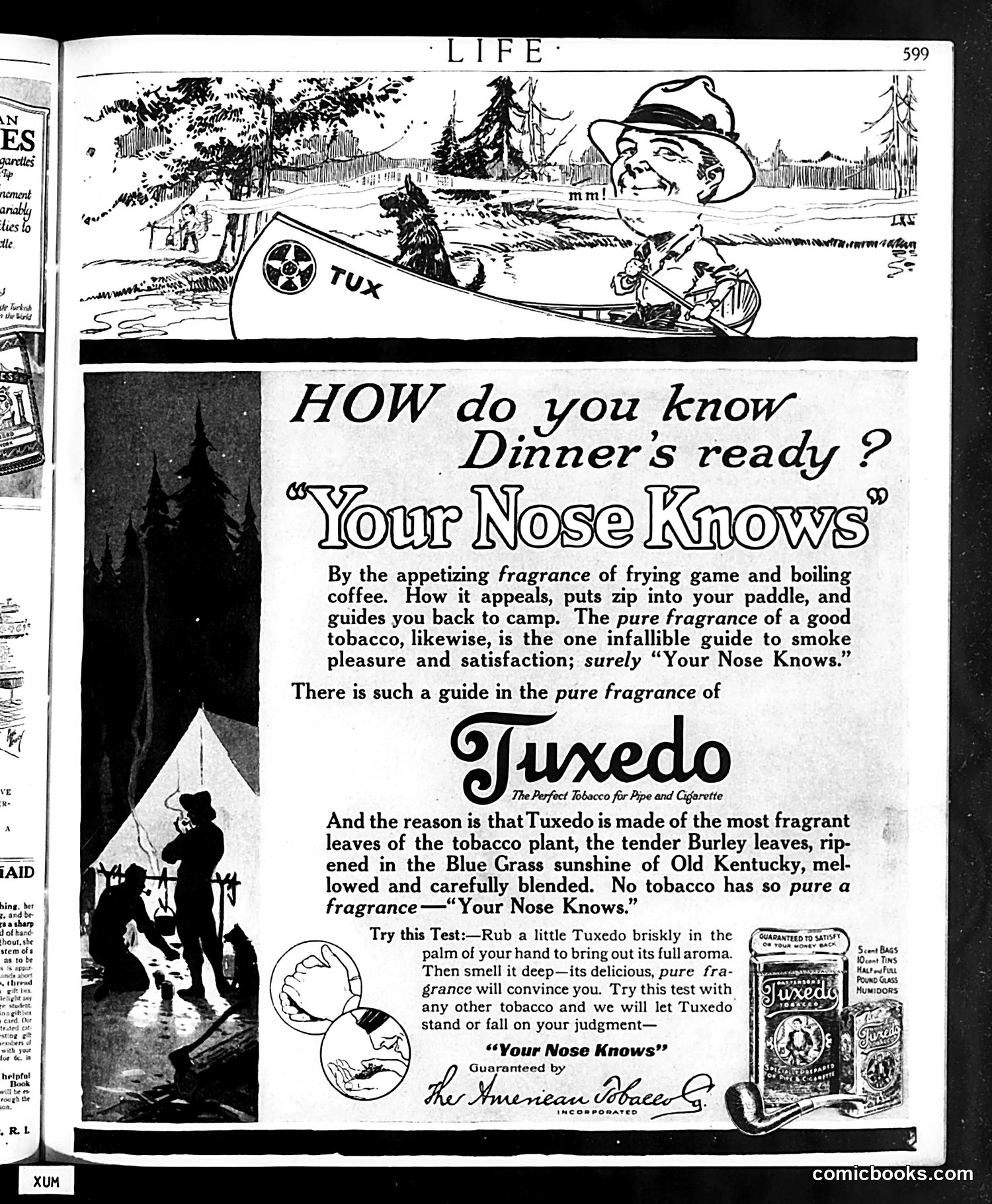
This page is **primarily a tobacco advertisement**, not satire or political commentary. It advertises Tuxedo brand tobacco, marketed as "The Perfect Tobacco for Pipe and Cigarette." The ad uses the slogan **"Your Nose Knows,"** playing on the idea that fragrance is an infallible guide to quality. It compares choosing tobacco to how a camper's sense of smell guides him back to camp when dinner is cooking. The imagery includes a outdoorsman/camping scene (top) and a nighttime camping vignette (left), establishing a rugged, masculine brand identity. The ad emphasizes the tobacco's "pure fragrance," claiming it's made from premium Kentucky Burley leaves. There is **no evident satire or political content**—this is straightforward early 20th-century product marketing using appeals to nature, masculinity, and sensory experience.
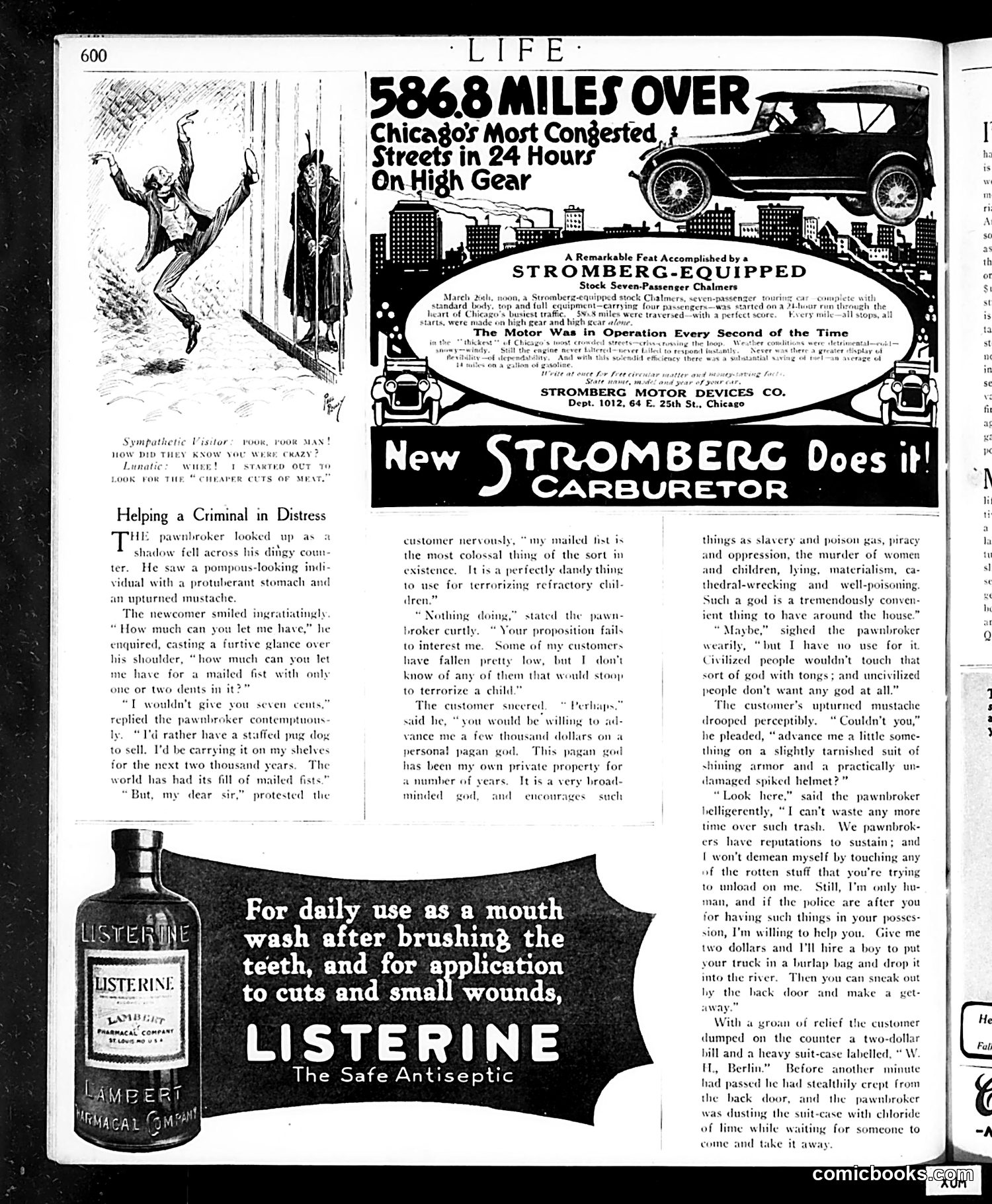
This page contains two distinct pieces of satire: **Top Advertisement:** A Stromberg carburetor ad celebrates a car's feat of driving 5,868 miles over Chicago's congested streets in 24 hours. This is straightforward automotive advertising with no apparent satirical intent. **"Helping a Criminal in Distress" Story:** This appears to be post-WWI satire criticizing German militarism. A suspicious customer tries to pawn increasingly absurd items—a "mailed fist," a "personal pagan god" that encourages slavery, poison gas, and war crimes, and finally "shining armor and a spiked helmet"—all transparently representing German imperial aggression and culture. The pawnbroker refuses until explicitly identifying the suit-case as marked "W.H., Berlin," revealing the customer as German. The punchline: the pawnbroker agrees to help by dumping it in the river. The satire mocks Germany's militaristic values and suggests they belong in the river—a pointed critique reflecting post-WWI American attitudes toward German nationalism.
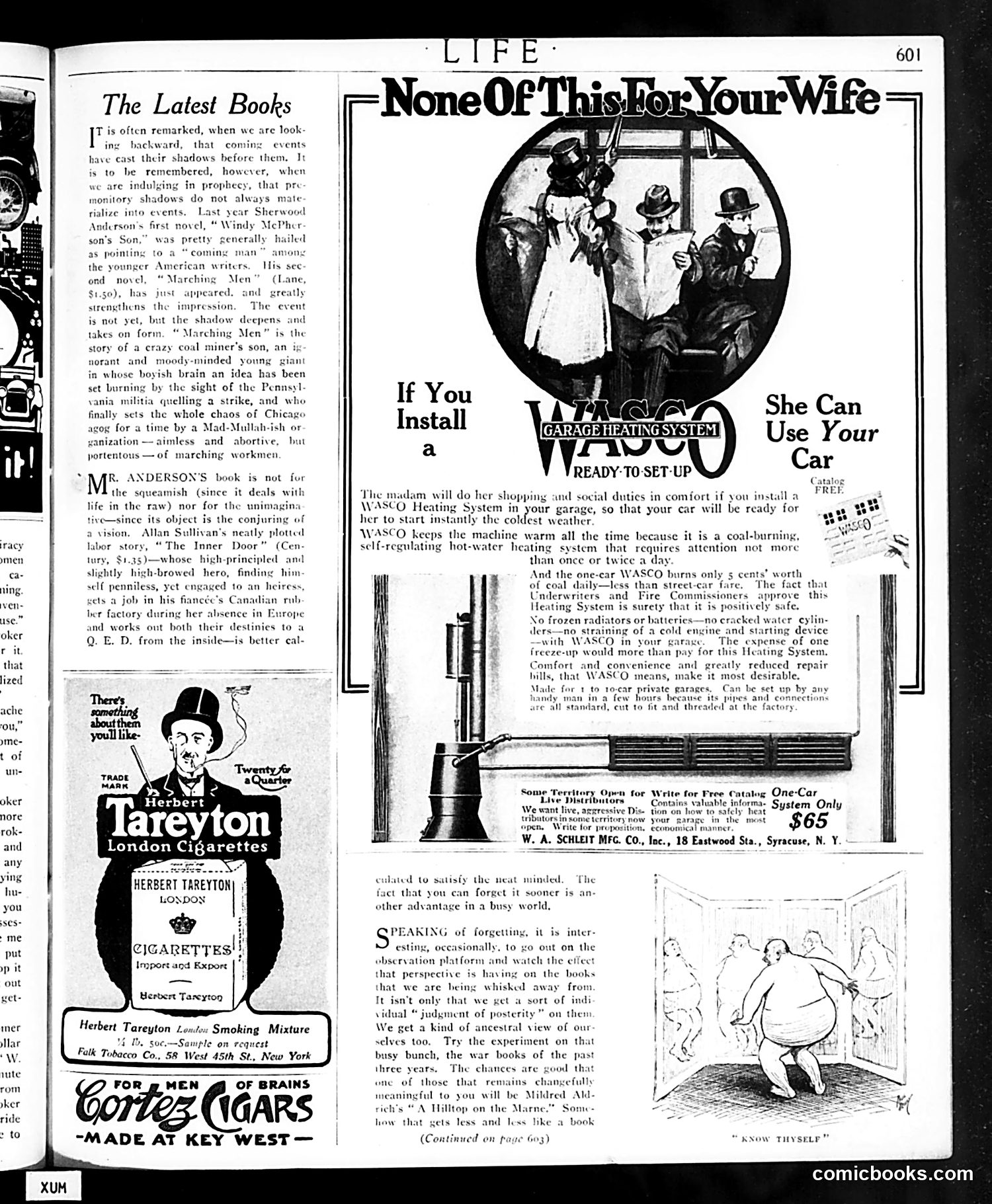
This page combines book reviews with advertisements, primarily featuring a **WASCO garage heating system ad** (center-right). ## The Advertisement's Social Context The WASCO ad's headline—"None Of This For Your Wife"—uses gendered messaging typical of 1920s marketing. It depicts a woman unable to use her car in winter, positioning the heating system as a solution enabling wives to conduct "shopping and social duties" independently. This reflects post-WWI attitudes about women's expanding mobility and consumer roles, while the paternalistic framing ("for your wife") maintains traditional gender hierarchies. The ad emphasizes the system's safety and minimal maintenance—selling convenience and domestic comfort. ## Book Reviews Section The left column reviews recent novels by Sherwood Anderson, including *Marching Men*—described as depicting a coal miner's son inspired by Pennsylvania militia suppressing strikes. This references real labor unrest of the era, positioning Anderson's work as socially conscious fiction addressing class conflict and worker organization. ## Surrounding Advertisements Period cigarette and cigar ads (Tareyton, Cortez) occupy bottom space—standard for early-20th-century magazines before tobacco advertising restrictions.
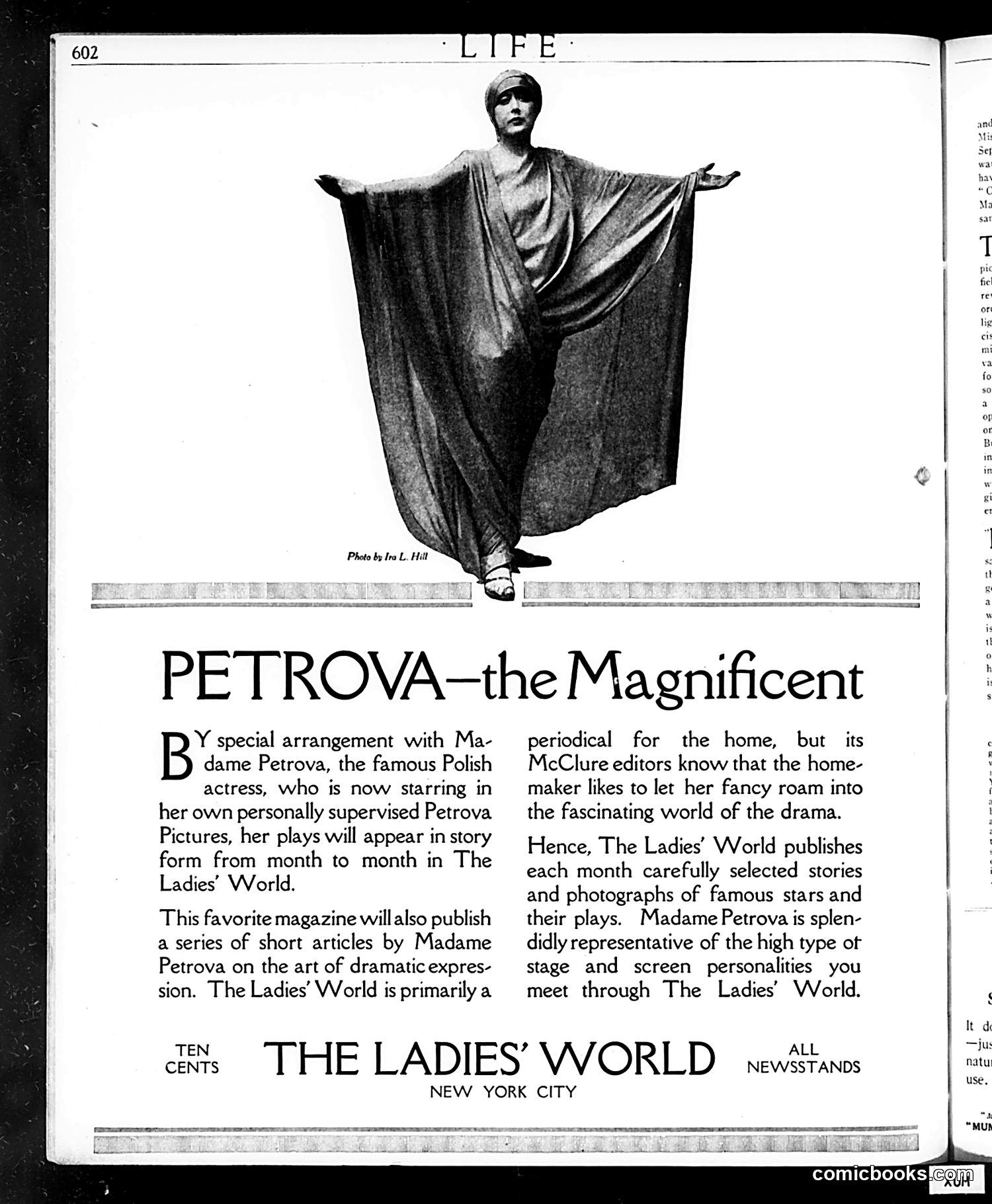
This is primarily **advertising**, not political satire. The page promotes *The Ladies' World* magazine through an endorsement deal with Madame Petrova, a Polish actress and film producer of the silent era. The dramatic photograph shows Petrova in theatrical costume with flowing robes and sunglasses, striking an expansive pose—meant to convey glamour and artistic sophistication. The text emphasizes that *The Ladies' World* will publish her film stories monthly and her articles on "dramatic expression." The "joke" (if any) is gentle: the magazine acknowledges its readers are homemakers but recognizes they enjoy escapism through celebrity gossip and theater. By featuring famous actresses like Petrova, the magazine positions itself as offering working women access to the glamorous world of stage and screen. This reflects early 1900s celebrity culture and the emerging film industry's use of star endorsements. Petrova's involvement lends prestige; her participation is presented as an exclusive arrangement for readers.
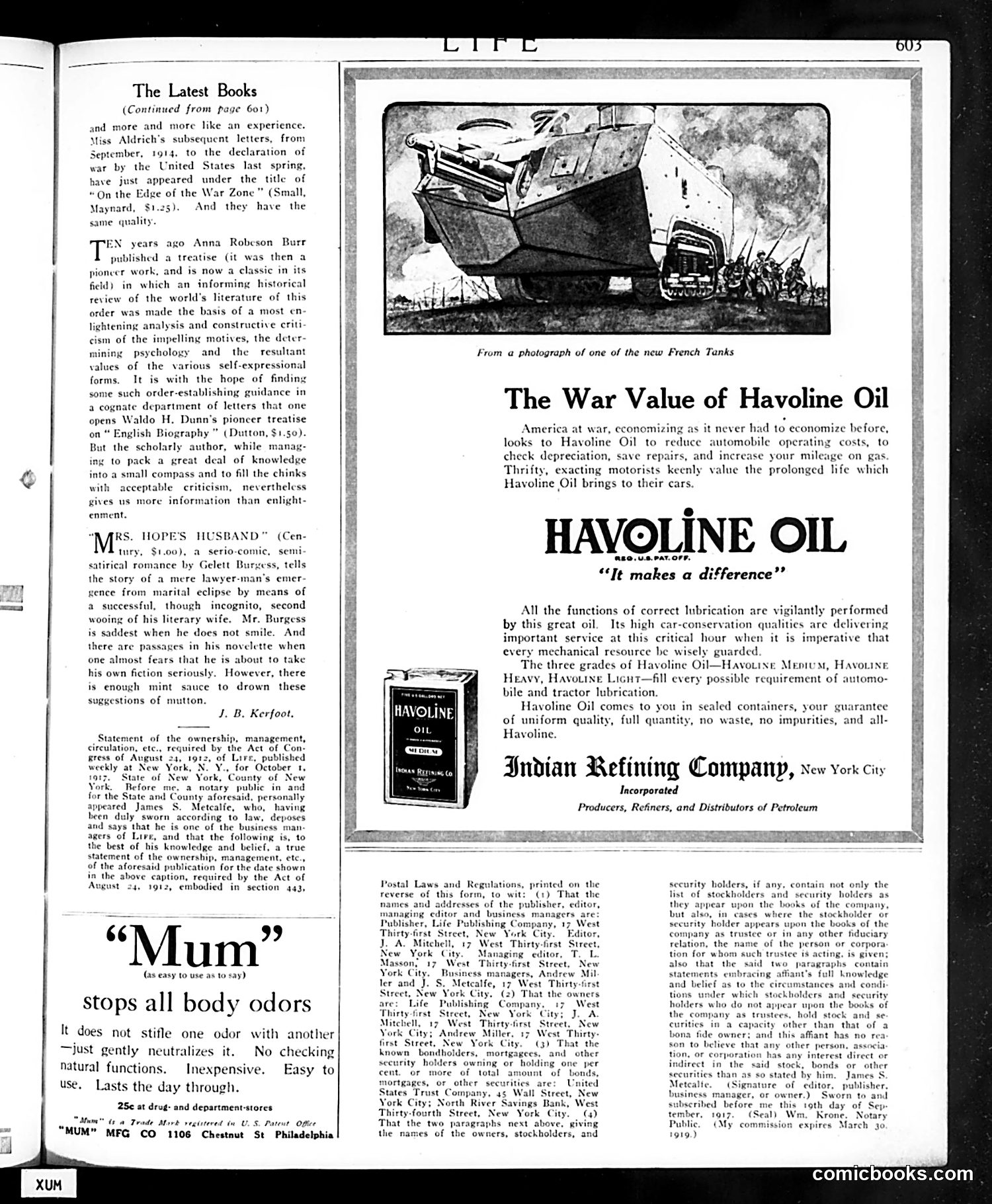
This page contains book reviews and advertisements rather than political cartoons. The main visual element is a photograph of a French tank from World War I, used to advertise Havoline Oil. The advertisement frames petroleum products as essential to America's wartime economy, arguing that proper lubrication helps conserve automobiles and extends their operational life—framed as patriotic duty during WWI. The tagline "It makes a difference" suggests using Havoline is a contribution to the war effort. The book reviews discuss literary works, including Anna Robeson Burr's historical analysis and a semi-comic novel by Gelett Burgess. A separate advertisement for "Mum" deodorant appears at bottom left. The page is primarily commercial content aimed at wartime readers, using patriotic messaging to market consumer goods as war-related necessities.
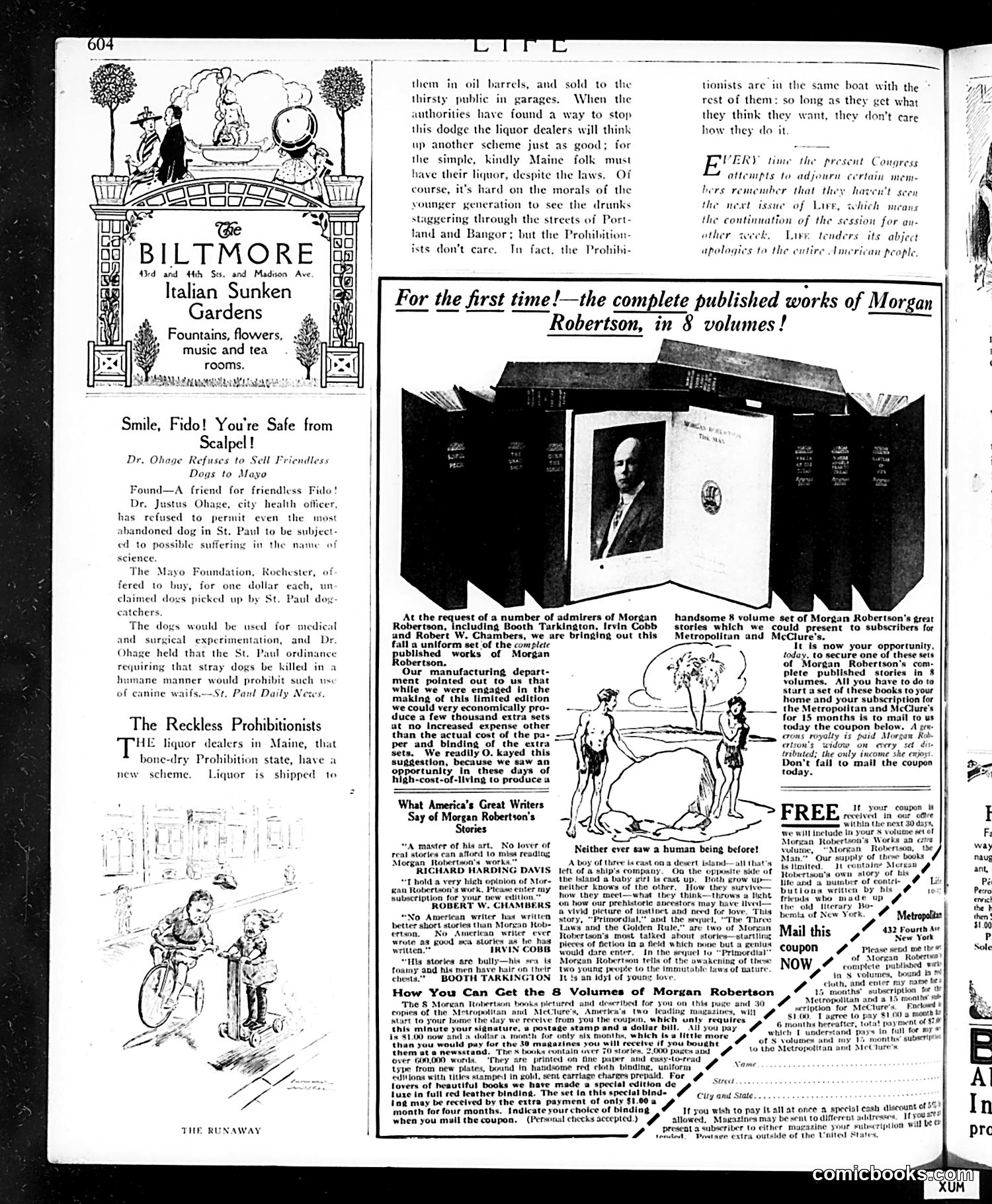
This page from *Life* magazine contains satirical commentary and advertisements from the Prohibition era (1920s-early 1930s). **"The Reckless Prohibitionists"** cartoon mocks Maine's strict "bone-dry" Prohibition laws. It satirizes liquor dealers' scheme to evade authorities by shipping alcohol in oil barrels and selling it through garages. The joke targets both the ineffectiveness of Prohibition enforcement and the hypocrisy of "Prohibition states"—the laws fail because citizens still demand alcohol regardless of legality, and enforcement proves impossible. The text notes that even the strict Maine population ignores the moral arguments, caring only about obtaining liquor. **"Smile, Fido!"** reports on Dr. Justus Ohage, a St. Paul health officer who refused to allow the Mayo Foundation to purchase abandoned dogs for medical experimentation, citing humane treatment concerns. The remainder consists largely of advertisements, including a substantial promotion for an 8-volume collected works of author Morgan Robertson, endorsed by notable writers like Richard Harding Davis and Booth Tarkington.
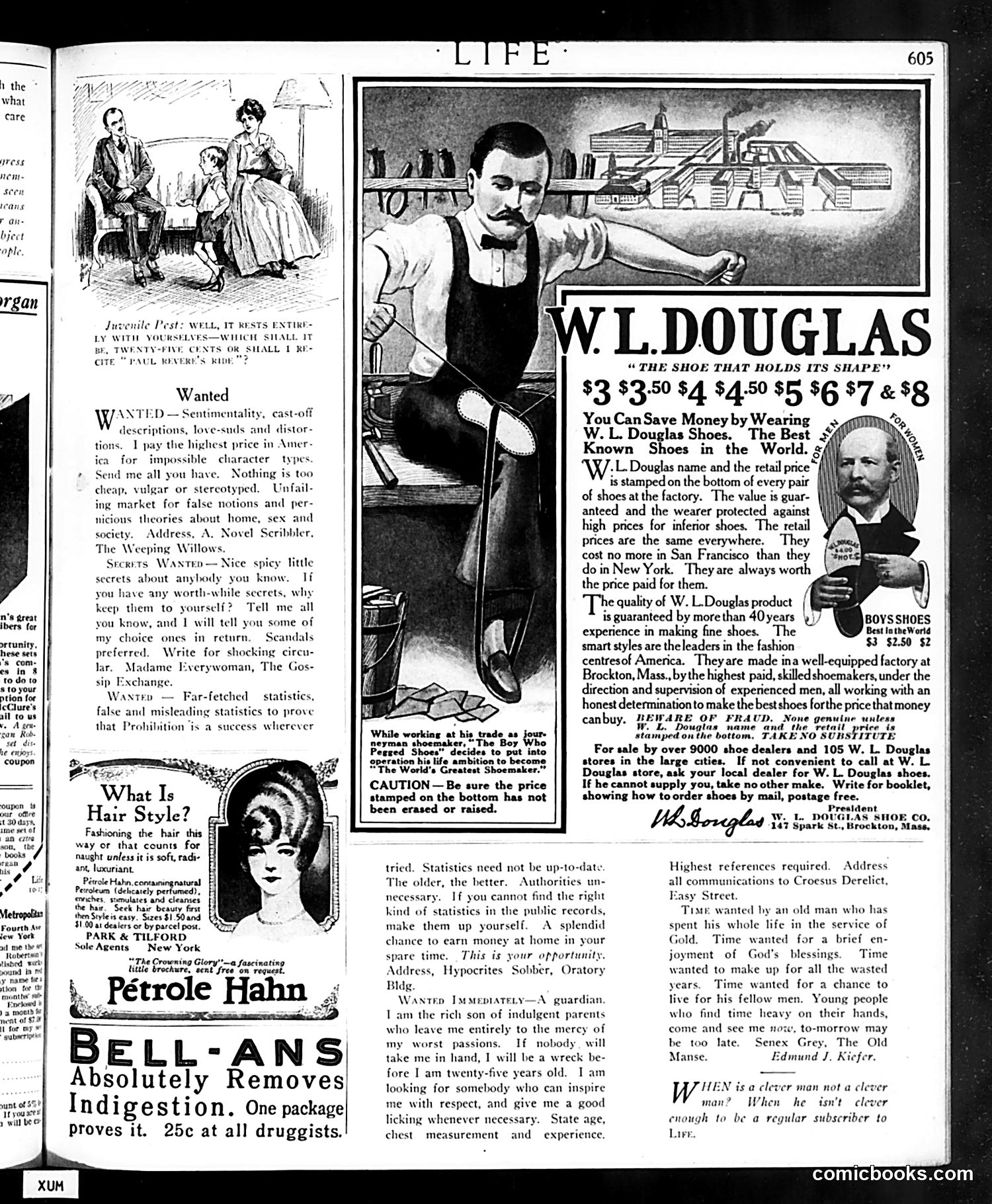
This page contains mostly **advertisements and classified "Wanted" listings** rather than political cartoons. The dominant image is a **W.L. Douglas shoe advertisement** featuring a shoemaker at work, promoting shoes at various price points ($3-$8). The small satirical content appears in the classified section: humorous fake "Wanted" listings mocking contemporary society. One seeks "sentimentality" and "false notions" about home and society from a "Novel Scribbler." Another satirizes journalism by requesting "false and misleading statistics to prove that Prohibition is a success"—**mocking propagandistic use of statistics to support Prohibition**, which was contentious in this era. The "Juvenile Pest" cartoon at top-left depicts a child demanding payment or threatening to recite poetry—a gentle joke about childhood extortion. The page reflects 1920s consumer culture and skepticism toward promotional claims and government messaging.
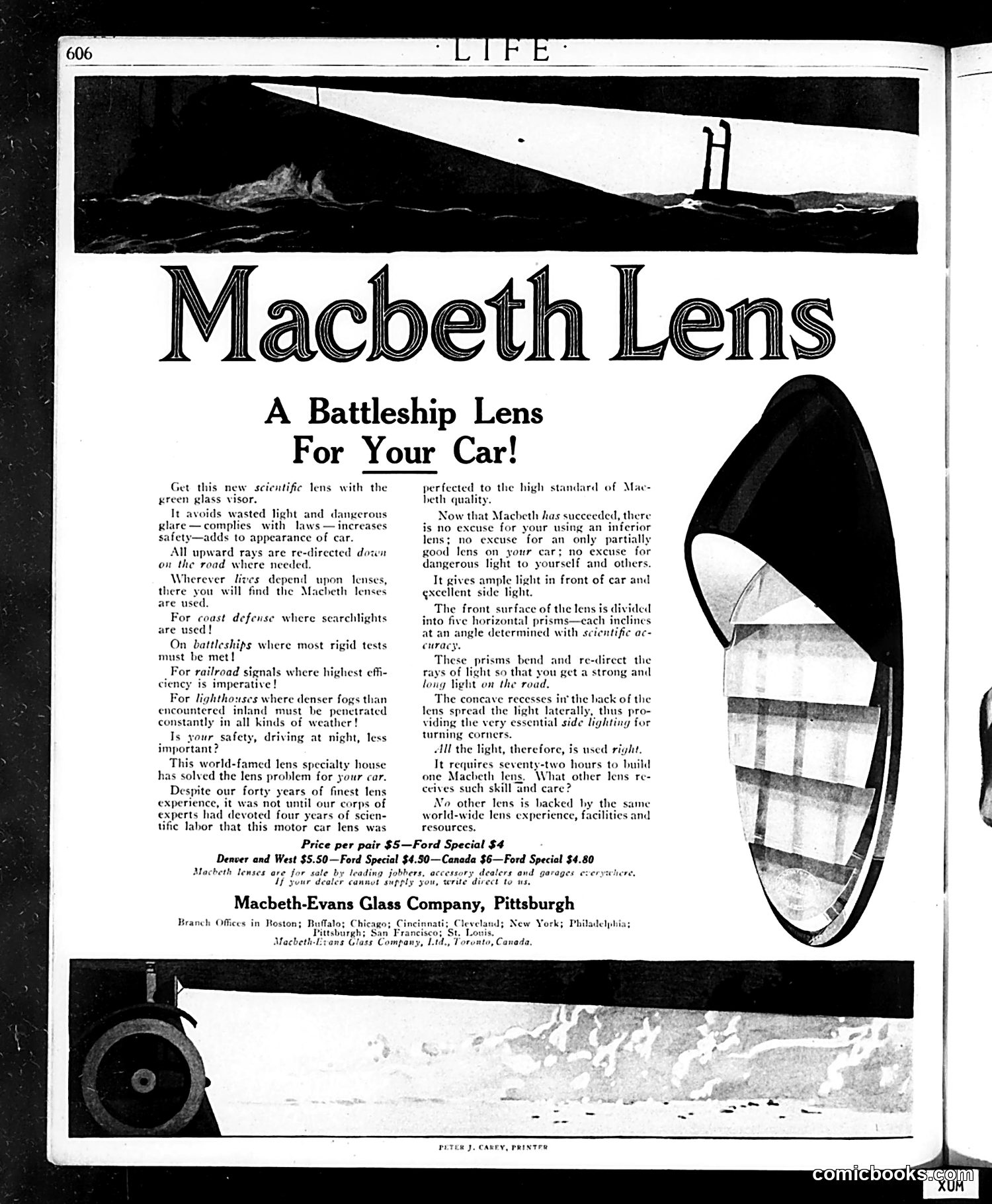
This is **not a cartoon or satire**—it's a straightforward product advertisement for automobile headlight lenses manufactured by Macbeth-Evans Glass Company. The ad promotes a new "scientific" car headlight lens with a green-tinted visor designed to reduce glare and improve road lighting. It employs common early-20th-century advertising strategy by invoking military/industrial credibility: the lens technology derives from applications in **battleships, lighthouses, and railroad signals**, establishing the product's reliability and precision. The marketing pitch emphasizes safety compliance with driving laws while appealing to car owners' vanity (appearance) and practicality. The illustration shows the lens's internal prism structure. Pricing varies by location and vehicle type (Ford models listed separately at reduced cost). This represents typical automotive accessory marketing from the 1920s-1930s era, when headlamp regulations were becoming standardized and manufacturers competed on technical sophistication.
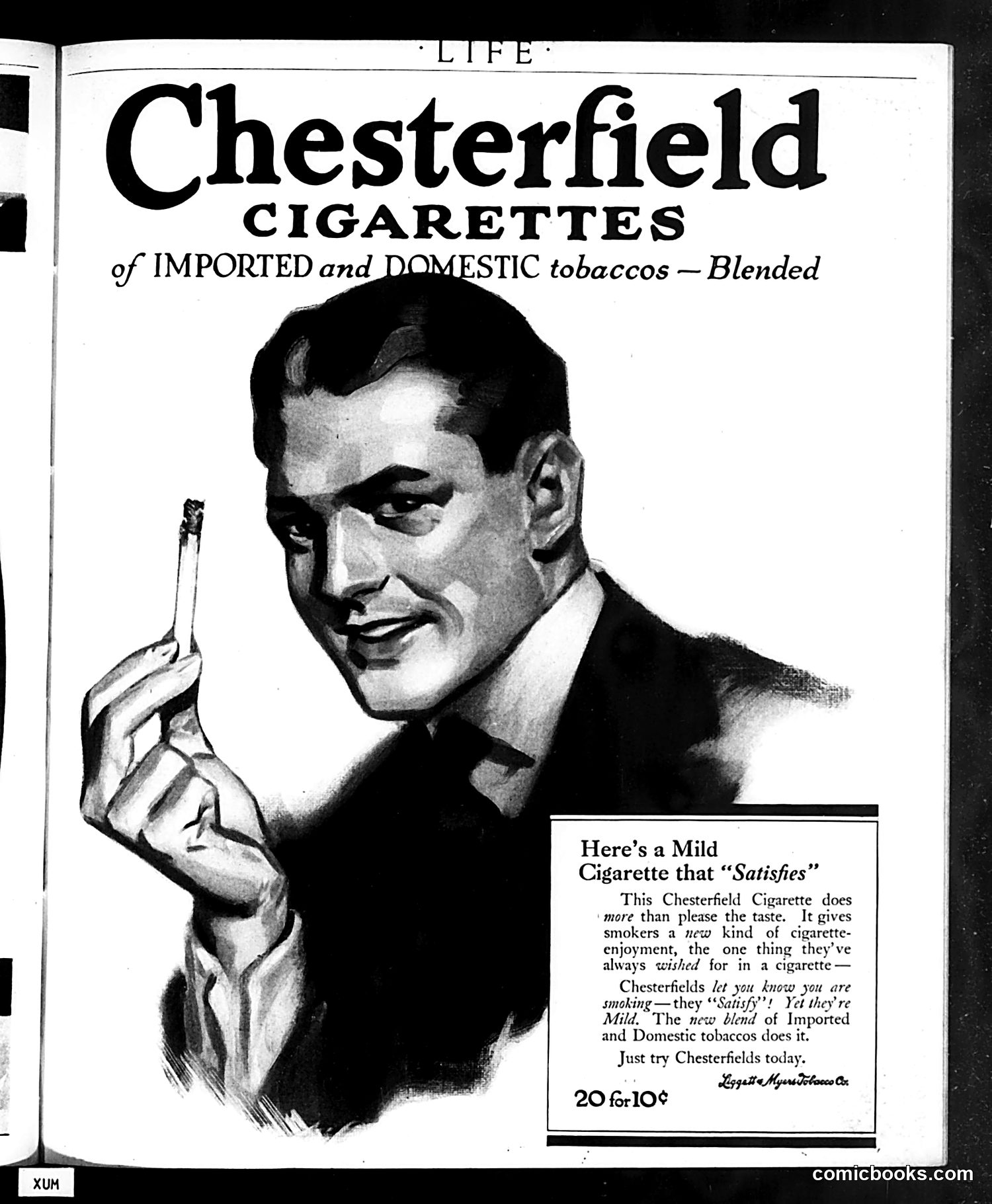
This is a **cigarette advertisement**, not satire or political commentary. It features a well-dressed man in formal attire holding two cigarettes, presented as an aspirational figure to appeal to consumers. The ad promotes Chesterfield cigarettes as a "mild" blend combining imported and domestic tobaccos. The key selling points emphasized are that they "satisfy" while remaining mild—a claim addressing smokers' desire for flavor without harshness. The price ("20 for 10¢") indicates this is from the early 20th century when cigarettes were very affordable. **For modern readers**: This represents pre-regulation tobacco advertising that made health and satisfaction claims now prohibited. The sophisticated male imagery reflects common mid-century marketing targeting adult consumers. There's no satire here—*Life* magazine carried straightforward commercial advertisements alongside its editorial content.
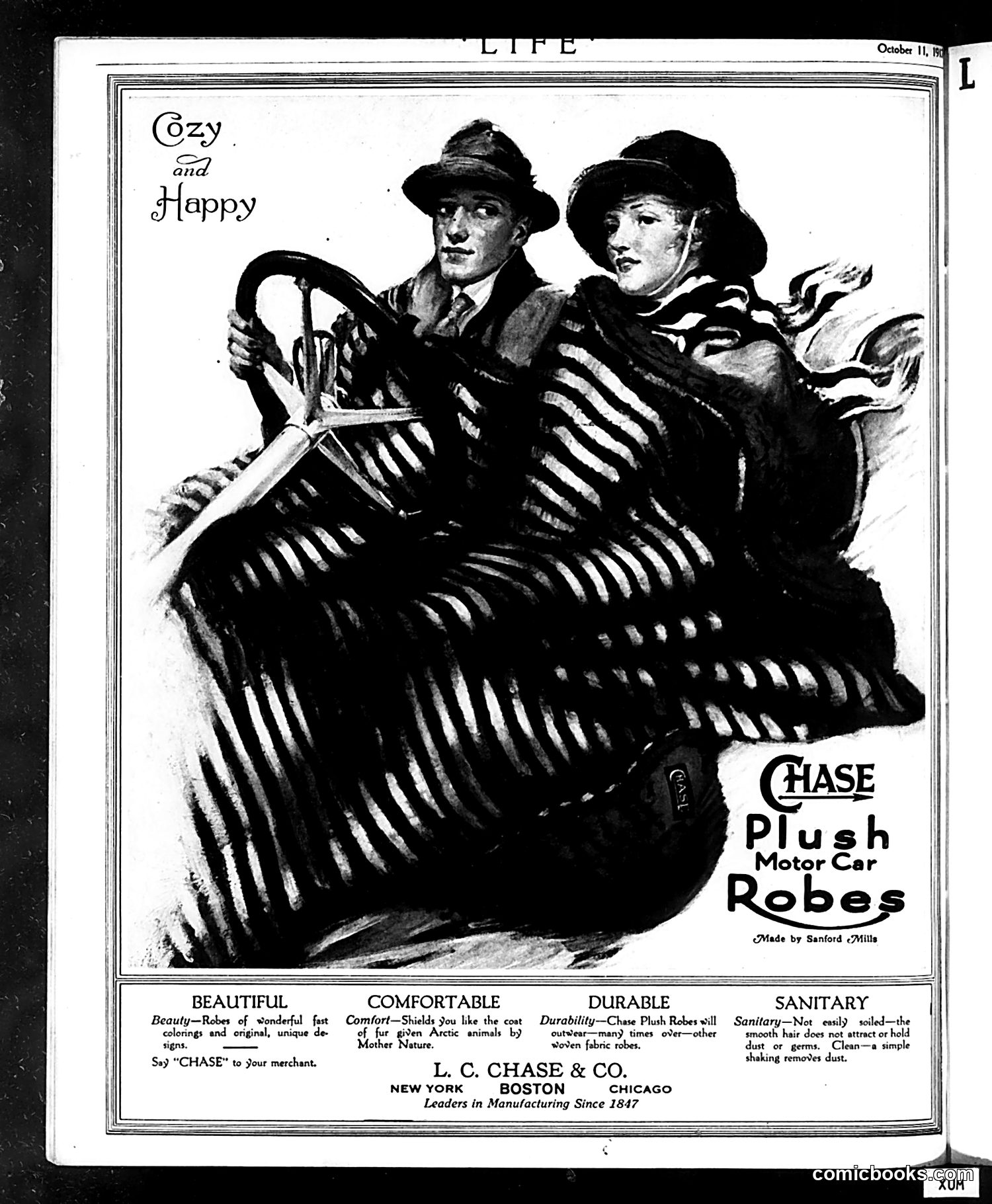
This is primarily a **product advertisement**, not political satire. It advertises Chase Plush Motor Car Robes—blankets or lap coverings for automobile passengers, made by L.C. Chase & Co. The illustration depicts two people in an open-air motorcar with a decorative striped robe across their laps. The title "Cozy and Happy" emphasizes consumer comfort. The four text sections below promote product qualities: beauty (distinctive design), comfort (protection like fur), durability (long-lasting woven fabric), and sanitation (resists dust/germs). The phrase "Made by Sanford Mills" indicates manufacturing details. This reflects early 20th-century automotive culture when heated cars were rare, and lap robes were essential accessories for cold-weather driving. **No political commentary is present**—this is straightforward commercial promotion in Life magazine.