
Life, 1917-10-11 · page 14 of 40
Life — October 11, 1917 — page 14: what you’re looking at
What you’re looking at
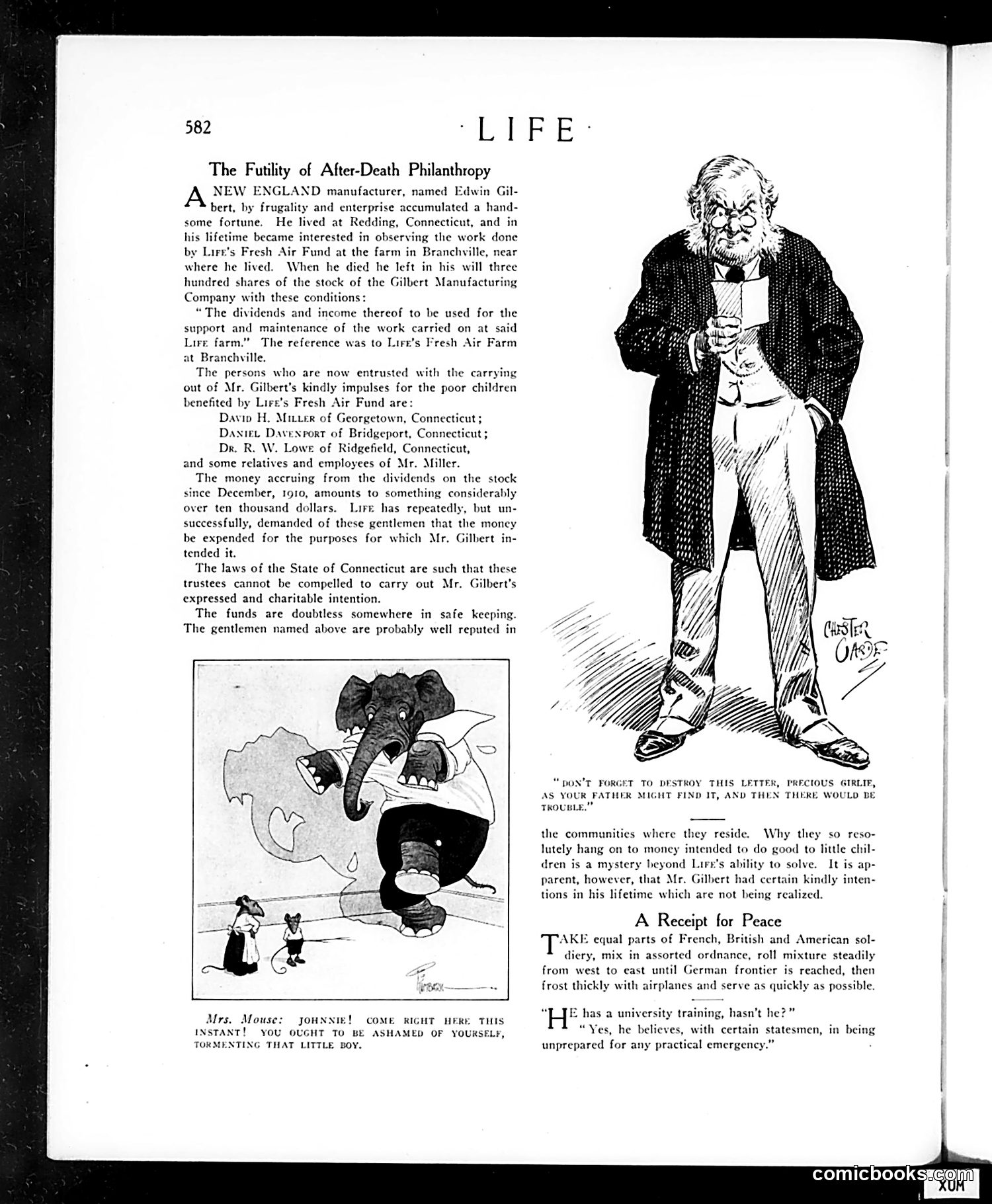
This page satirizes the futility of wealthy philanthropists' charitable intentions. The main article "The Futility of After-Death Philanthropy" describes Edwin Gilbert, a Connecticut manufacturer, who died leaving stock dividends to Lirr's Fresh Air Farm for poor children. However, the trustees (named gentlemen from Connecticut) have failed to spend the money as intended—over $10,000 has accumulated unused. The cartoon depicts an elephant (likely representing the unwieldy charitable bureaucracy or mismanagement) crushing small mice, illustrating how large institutional structures harm the vulnerable people they claim to help. The caption satirizes this disconnect. The piece critiques how well-intentioned bequests become trapped in legal and administrative systems, never reaching their intended beneficiaries—a commentary on the gap between philanthropic ideals and actual charitable results.
📄 Transcribed text from this page (OCR, searchable)
Machine-transcribed from the original scan — historical spelling and the odd misread are preserved.
582 LIFE * The Futility of After-Death Philanthropy A W GLAND manufacturer, bert, by frugality and enterprise accumulated a hand- some fortune. He lived at Redding, Connecticut, and in his lifetime became interested in observing the work done by Lire’s Fresh Air Fund at the farm in Branchville, near where he lived. When he died he left in his will three hundred shares of the stock of the Gilbert Manufacturing Company with these conditions: “The dividends and income thereof to be used for the support and maintenance of the work carried on at said Lire farm.” The reference was to Lire’s Fresh Air Farm at Branchville. The persons who are now entrusted with the carrying out of Mr. Gilbert's kindly impulses for the poor children benefited by Lire’s Fresh Air Fund are: Davin H. Mitrer of Georgetown, Connecticut ; Dante. Davenport of Bridgeport, Connecticut; Dr. R. W. Lowe of Ridgefield, Connecticut, and some relatives and employees of Mr. Miller. The money accruing from the dividends on the stock since December, 1910, amounts to something considerably over ten thousand dollars. Lire has repeatedly, but un- successfully, demanded of these gentlemen that the money be expended for the purposes for which Mr. Gilbert in- tended it. The laws of the State of Connecticut are such that these trustees cannot be compelled to carry out Mr. Gilbert's expressed and charitable intention. The funds are doubtless somewhere in safe keeping. The gentlemen named above are probably well reputed in named Edwin Gil- Alrs, Mouse: JouNNie! COME RIGHT HERE THIS INSTANT! YOU OUGHT TO BE ASHAMED OF YOURSELF, TORMENTING THAT LITTLE BOY. “DON’T FORGET TO DESTROY THIS LETTER, PRECIOUS GIRLIF, AS YOUR FATHER MIGHT FIND IT, AND THEN THERE WOULD BE. TROUBLE. the communities where they reside. Why they so reso- lutely hang on to money intended to do good to little chil- dren is a mystery beyond Lire’s ability to solve. It is ap- parent, however, that Mr. Gilbert had certain kindly inten- tions in his lifetime which are not being realized. A Receipt for Peace AKE equal parts of French, British and American sol- diery, mix in assorted ordnance, roll mixture steadily from west to east until German frontier is reached, then frost thickly with airplanes and serve as quickly as possible. he believes, with certain statesmen, in being unprepared for any practical emergency.” comicbook