
Life, 1917-10-11 · page 22 of 40
Life — October 11, 1917 — page 22: what you’re looking at
What you’re looking at
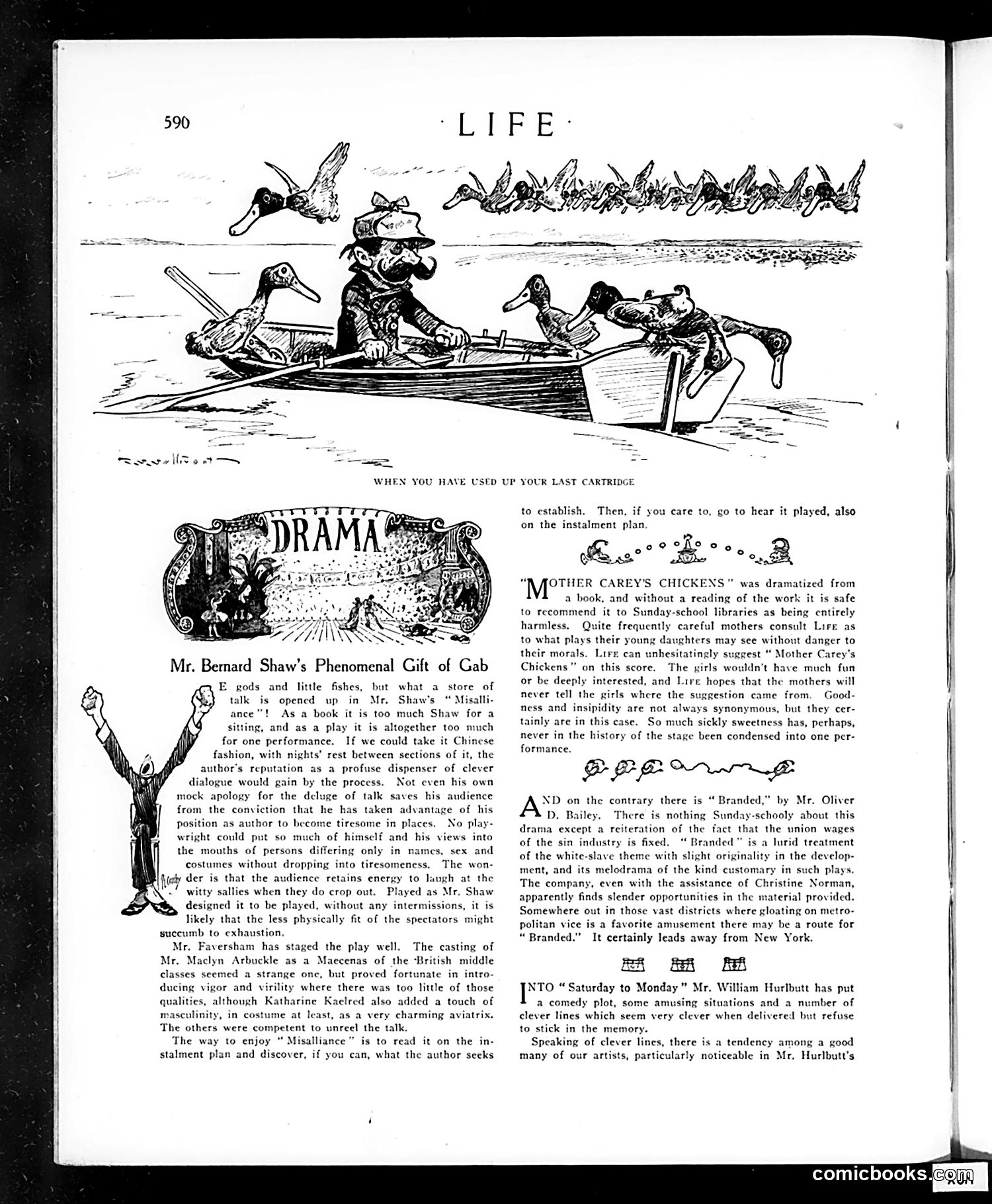
This page reviews several theatrical productions. The top cartoon depicts a hunter with ducks, captioned "When You Have Used Up Your Last Cartridge"—likely a visual metaphor for exhaustion, connecting to the review below about Bernard Shaw's play *Misalliance*. The text criticizes Shaw's play as excessively talky and tedious despite its clever dialogue. The reviewer suggests reading it in installments rather than enduring a full performance, arguing the author has indulged his position to become "tiresome in places." Other reviews follow: *Mother Carey's Chickens* is dismissed as sickeningly sweet and harmless—suitable only for Sunday schools; *Branded* is condemned as lurid melodrama exploiting white-slave themes; and *Saturday to Monday* praised for clever lines that unfortunately don't linger in memory. The page represents typical early 20th-century theater criticism emphasizing dialogue quality, moral propriety, and entertainment value for audiences.
📄 Transcribed text from this page (OCR, searchable)
Machine-transcribed from the original scan — historical spelling and the odd misread are preserved.
47, WHEN You Mr. Bernard Shaw's Phenomenal Gift of Gab E gods and little fishes, but what a store of talk is opened up in Mr. Shaw's “ Misalli- ance"! As a book it is too much Shaw for a ng, and as a play it is altogether too much for one performance. If we could take it Chinese fashion, with nights’ rest between sections of it, the author's reputation as a profuse dispenser of clever ialogue would gain by the process. Not even his own apology for the deluge of talk saves his audience from the conviction that he has taken advantage of his position as author to become tiresome in places. No play- wright could put so much of himself and his views into the mouths of persons differing only in names, sex and costumes without dropping into tiresomeness, The won- (edy der is that the audience retains energy to laugh at the ~/ witty sallies when they do crop out. Played as Mr. Shaw designed it to be played, without any intermissions, it is likely that the less physically fit of the spectators might succumb to exhaustion. Mr. Faversham hi: ed the play well. The casting of Mr. Maclyn Arbuckle as a Maecenas of the ‘British middle classes seemed a strange onc, but proved fortunate in intro- ducing vigor and virility where there was too little of those qualities, although Katharine Kaelred also added a touch of masculinity, in costume at least, as a very charming aviatrix. The others were competent to unreel the talk. The way to enjoy “ Misalliance” is to read it on the in- stalment plan and discover, if you can, what the author seeks HAVE USED UP YOUR LAST CARTRIDGE to establish. Then, if you care to, go to hear it played, also on the instalment plan. oRo o Cx °° ° ee Pe 2B S nad ? ‘S" was dramatized from “N OTHER CAREY'S CHICKE a book, and without a reading of the work it is safe to recommend it to Sunday-school libraries as being entirely harmless. Quite frequently careful mothers consult Lire as to what plays their young daughters may see without danger to their morals. Lire can unhesitatingly suggest “ Mother Carey’s Chickens" on this score. The girls wouldn't have much fun or be deeply interested, and Lire hopes that the mothers will never tell the girls where the suggestion came from. Good- ness and insipidity are not always synonymous, but they cer- tainly are in this case. So much sickly sweetness has, perhaps, never in the history of the stage been condensed into one per- formance. PLLA ND on the contrary there is “Branded,” by Mr. Oliver D. Bailey. There is nothing Sunday-schooly about this drama except a reiteration of the fact that the union wages of the sin industry is fixed. “ Branded” is a lurid treatment of the white-slave theme with slight originality in the develop- ment, and its melodrama of the kind customary in such plays. The company, even with the assistance of Christine Norman, apparently finds slender opportunities in the material provided. Somewhere out in those vast districts where gloating on metro- politan vice is a favorite amusement there may be a route for “Branded.” It certainly leads away from New York. NTO “Saturday to Monday” Mr. William Hurlbutt has put a comedy plot, some amusing situations and a number of clever lines which seem very clever when delivered but refuse to stick in the memory. Speaking of clever lines, there is a tendency among a good many of our artists, particularly noticeable in Mr. Hurlbutt’s comicbooks