
Life, 1917-10-11 · page 23 of 40
Life — October 11, 1917 — page 23: what you’re looking at
What you’re looking at
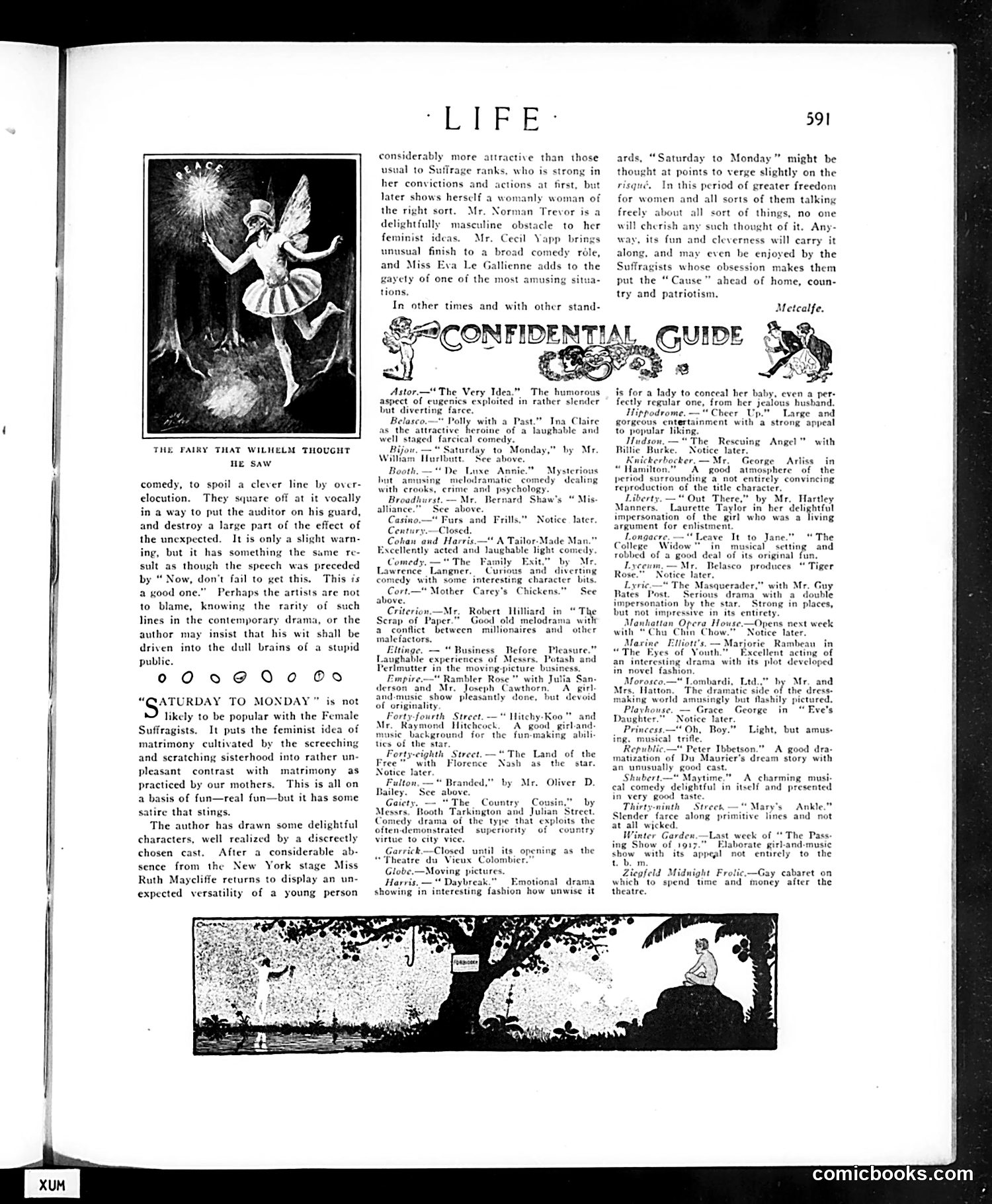
This is a theater review page from Life magazine. The main illustration shows a fairy figure — likely referencing German Kaiser Wilhelm II's famous statement about seeing a fairy at the German court. The caption sarcastically invokes this to mock Wilhelm. The bulk of the page reviews Broadway productions, including "Saturday to Monday," which the text notes appeals to female suffragists by contrasting modern feminist ideas about marriage with traditional matrimony. The review contains gentle satire about women's liberation — a topical issue of the era (appears to be pre-1920s based on suffrage references). Other theatrical reviews mention comedies, farces, and dramas of the period. The "Confidential Guide" section provides capsule summaries of various shows currently running in New York theaters, evaluating their merits and casting choices.
📄 Transcribed text from this page (OCR, searchable)
Machine-transcribed from the original scan — historical spelling and the odd misread are preserved.
—— THE FAIRY THAT WILHELM THOUGHT NE SAW comedy, to spoil a clever line by over- clocution. They square off at it vocally in a way to put the auditor on his guard, and destroy a large part of the effect of the unexpected. It is only a slight warn- ing, but it has something the same re- sult as though the speech was preceded by “Now, don’t fail to get this. This is a good one.” Perhaps the artists are not to blame, knowing the rarity of such lines in the contemporary drama, or the author may insist that his wit shall be driven into the dull brains of a stupid public. 009099800 09 “QATURDAY TO MONDAY likely to be popular with the Female Suffragists. It puts the feminist idea of matrimony cultivated by the screeching and scratching sisterhood into rather un- pleasant contrast’ with matrimony as practiced by our mothers. This is all on a basis of fun—real fun—but it has some satire that stings. The author has drawn some delightful characters, well realized by a discreetly chosen cast. After a considerable ab- sence from the New York stage Miss Ruth Maycliffe returns to display an un- expected versatility of a young person is not *LIFE : considerably more attractive than those usual to ‘age ranks, who is strong in her convictions and actions at fir: later shows herself a womanly woman of the right sort. Mr. delightfully masculine obstacle to her orman Trevor is a feminist ideas. Mr. Cecil Yapp brings unusual finish to a broad comedy role, and Miss Eva Le Gallienne adds to the tions, In other times and with other stand- cly of one of the most amusing situa- Re) SPO CONFIDENTIAL <i . Astor-—" The Very Ides aspect of eugenics exploited but diverting farce. Belasco. Polly as the attractive he well stage farcical comed: Bijou. —“ Saturday to Monda Willfam’ Hurtbutt. | See above. The humorous 1 rather slender Past.” Ina Claire of a laughable and by Mr. Booth. — “De Luxe Anni Mysterious but) amusing me tic comedy dealing with crooks, crime and psychology. Mr. Bernard Shaw's “ Mis. hove. Casino.—" Furs and Frills.” Notice later. Century.—Closed. Cohan and Harris—" A Tailor-Made Man.” Excellently acted and laughable light Comedy. —" The Family Exit.” by Lawrence Langner. Curious and diverting comedy with some interesting character bits. jCort—" Mother Carey's Chickens.” See above. Criterion. —Me, Robert Hilliard Scrap of Paper.” Good old melodr: a conflict between millionaires and other malefactors. Itinge. — “ Business Before Pleasur Laughable experiences of Messrs. Potash a Ferlmutter in the moving-picture busi Empire.—" Rambler Rose” with Julia San- derson and Mr. Joseph Cawthorn! A. gir and-music show’ pleasantly done, but devoid of originality Forty-fourth Street. —" Mitch Mr. Raymond Hitchcock, Ag music background for the fun: ties of the star Forty-cighth Street. —“ The Land of the Free with Florence Nash as the star. Notice later. Fulton. Koo." and od girland abili “Branded,” by Mr. Oliver D. Bailey. See above. Gaicty. — “The Country Cousin,” by Messrs. Booth Tarkington and Julian Stre Comedy drama of the type that exploits t oftendemonstrated — superio of country virtue to city vice. Garrick —Closed until “Theatre du Vieux Colo Globe.—Moving pictures Harris, —“ Daybreak.” Emotional drama showing in interesting fashion how unwise it 591 ards, “Saturday to Monday” might be thought at points to verge slightly on the risqué. In this period of greater freedom for women and all sorts of them talking freely t all sort of things, no one will cherish any such thought of it. Any- way, its fun and cleverness will carry it along, and may even be enjoyed by the Suffragists whose obsession makes them put the “Cause” ahead of home, coun- try and patriotism, GUIDE Metcalfe. is for a lady to conceal her baby, even a per- fectly regular one, from her jealous husband, Hippodr “Cheer Up." Large and gorgeous tainment with a strong” appeal to popular liking. Hudson, —“ The Rescuing Angel with Bill Burke. Notice later. ocker.—Mr. George Arliss in A good atmosphere of the period surrounding a not entirely convincing reproduction of the character. Liberty. —“ Out There,” by Mr. Hartley Manners. Laurette Taylor in her delightful ersonation of the girl who was a living argument for enlistment Longacre. —“ Leave It to Jane." “The College Widow in musical setting and “ Hamilton, robbed of a good deal of its original {ui Lyceum, —Mr. Telasco produces“ Tiger Rose.” Notice later. Lyric.—* The Masquerader,” with Mr. Guy s drama’ with a double impersonation by the star. Strong in places, Dut not impressive in its entirety. Manhattan Opera House.—Opens next week with "Chu Chin Chow.” Notice later. Marine Ellic Marjor oF “The Eyes of Youth.” Excelle 6 an interesting drama with its plot develope in novel fashion Rates Post. Seric Morosco.— V.ombardi, Ltd..” by Mr. and Mrs. Hatton. The dramatic side of the dress- making world amusingly but flashily pictured. Playhouse. — Grace George in “ Eve's Daugh| Notice later, Princess.—" Oh, Boy.” Light, but amus- ical trifle. public.—" Peter Thbetson. matization of Du Maurier’s d an unusually good cast Shubert.—" Maytime.” A. charming musi cai comedy delightful in itself and presented in very good tast Thirty-ninth —Stre “Mary's Ankle Slender farce along primitive lines and not at all wicked Winter G Last week of “* The Pass: ing Show of 1917.” “Elaborate girl-and-music show with its” appeal not entirely to the tbo m gfeld Midnight Frotic.—Gay cabaret on which to spend time and’ money after the theatre. good dra- am story with comicbooks.com