
A complete issue · 44 pages · 1917
Life — September 13, 1917
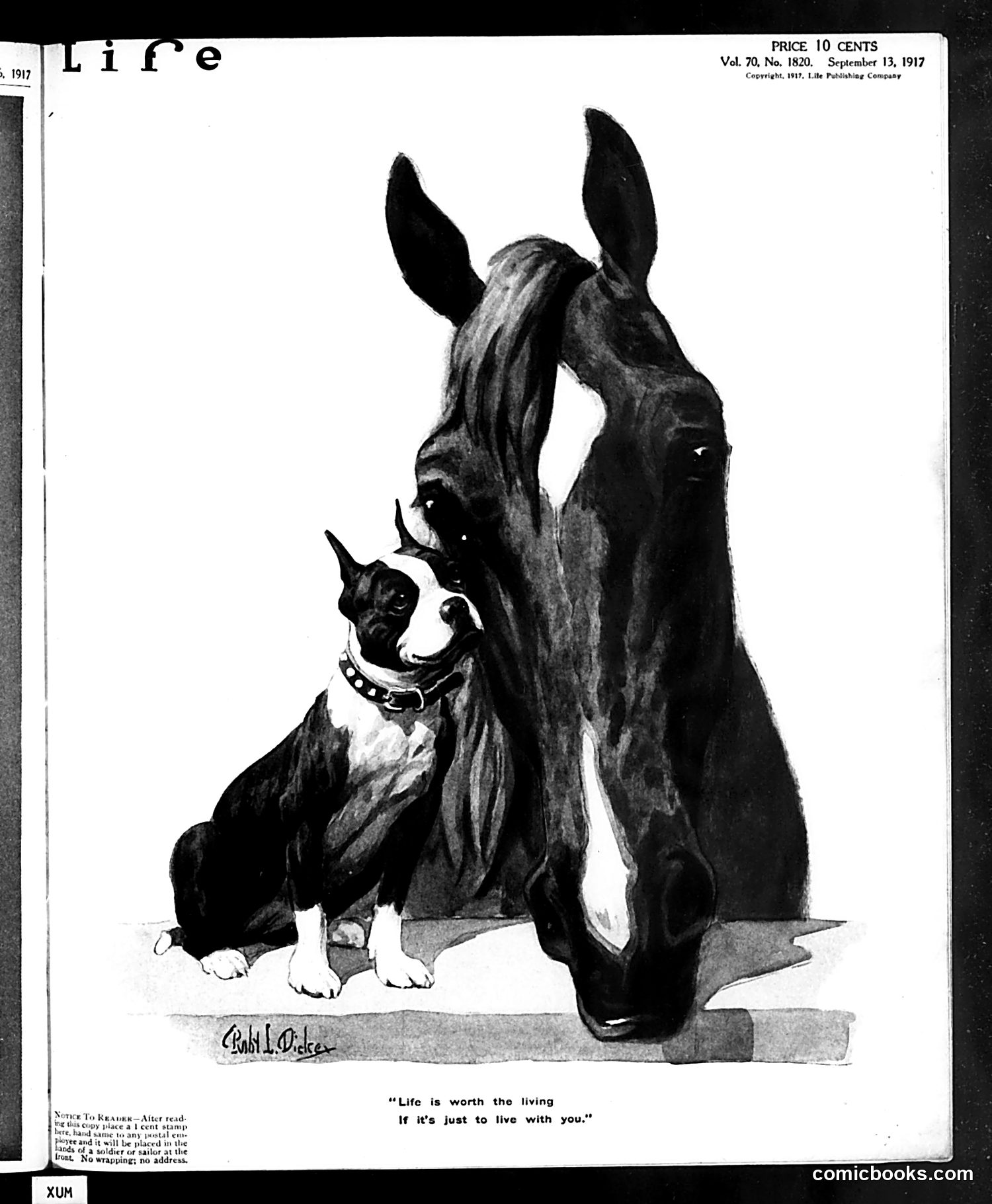
This illustration depicts a horse and small dog with the caption: "Life is worth the living / If it's just to live with you." The cartoon appears to be sentimental rather than political satire. It presents a touching domestic scene showing companionship between animals—likely commenting on the emotional bonds between pets and their owners. The artist's signature reads "Ralph Barton." Given the 1917 publication date during World War I, this may offer an emotional counterpoint to wartime anxieties by celebrating simple domestic contentment. However, the image itself contains no clear political messaging, propaganda, or social satire—it functions as a warmhearted statement about loyalty and affection in everyday life.
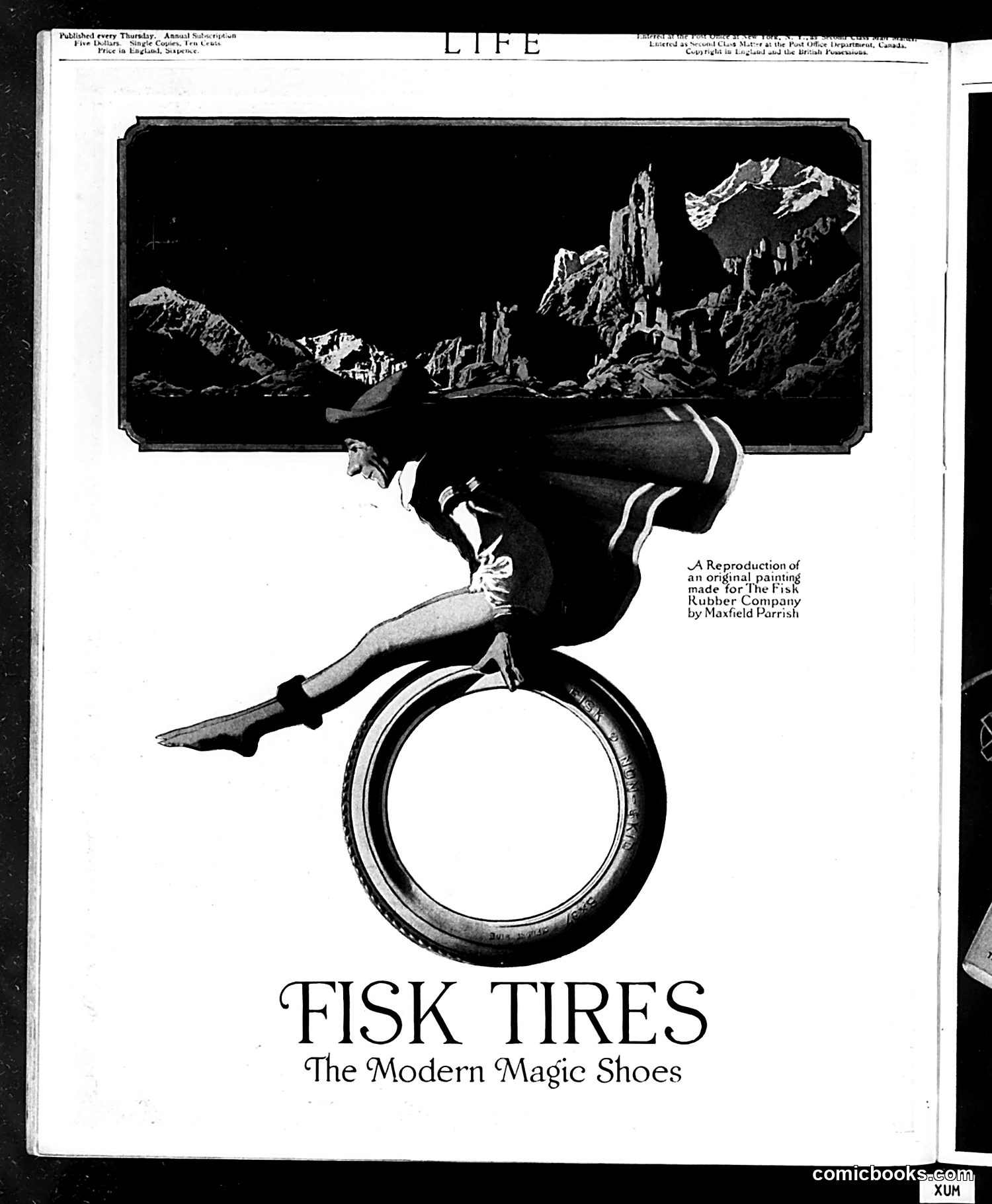
This page is primarily an **advertisement for Fisk Tires**, not political satire. The artwork, by Maxfield Parrish, depicts a classical female figure (likely representing Mercury or a similar mythological character) balanced acrobatically on a tire. She holds aloft a fantastical landscape painting showing dramatic mountains and a castle. The tagline "The Modern Magic Shoes" is advertising copy, comparing tires to magical footwear that enables impossible feats. The acrobatic pose and mythological imagery suggest the tires provide superior performance and reliability—allowing drivers to accomplish extraordinary things. This reflects early 20th-century advertising strategy: using artistic prestige (Parrish was famous for commercial illustrations) and classical mythology to elevate mundane products into symbols of modernity and wonder.
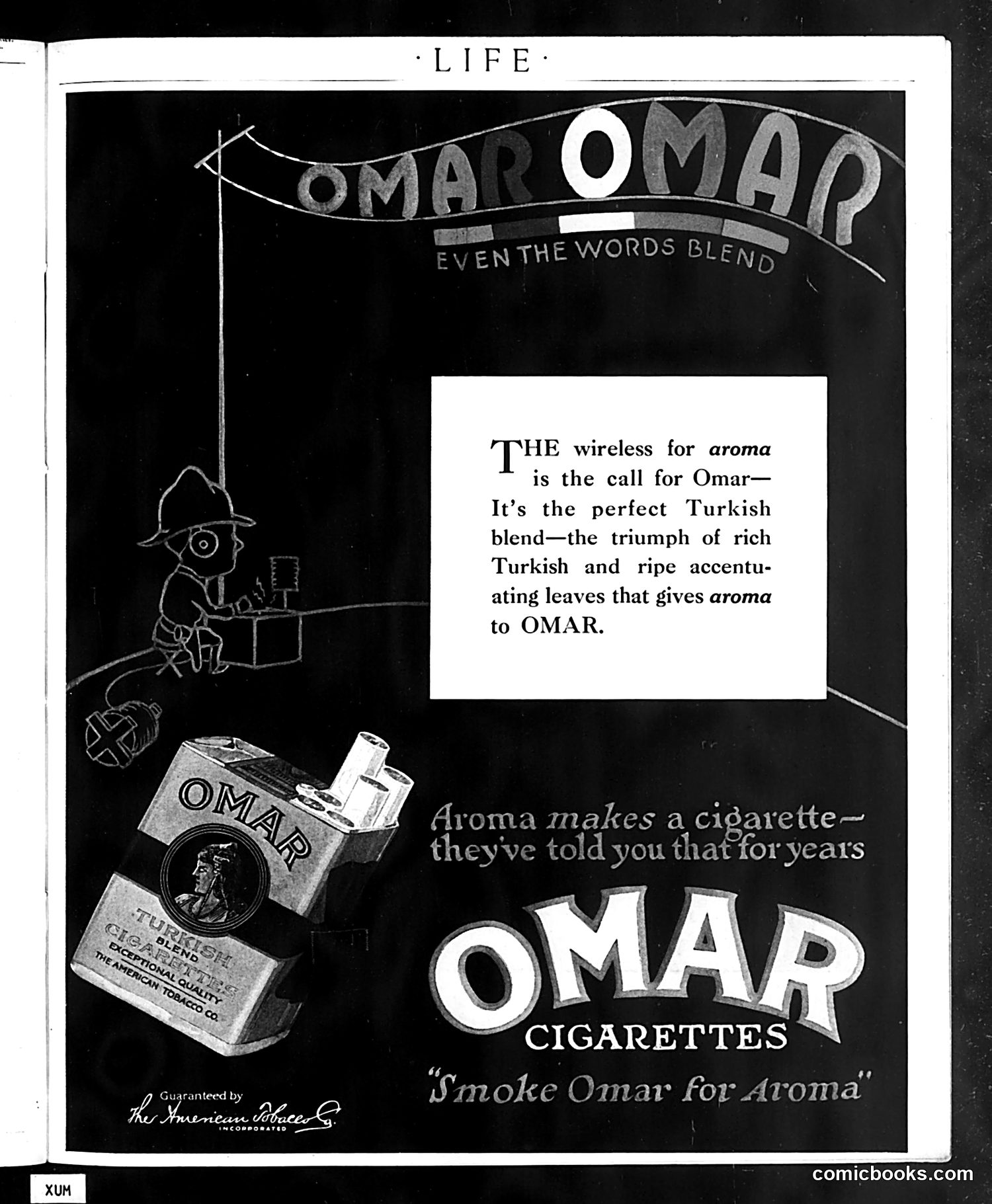
This page is primarily a **cigarette advertisement** for Omar brand cigarettes, not satire or political commentary. The ad emphasizes "aroma" as Omar's key selling point, claiming it's "the perfect Turkish blend" made from "rich Turkish and ripe accentuating leaves." The tagline reads "Smoke Omar for Aroma." The visual includes a cartoon figure (appears to be a stereotypical representation, possibly Turkish-inspired given the "Omar" branding) fishing with a cigarette package displayed prominently. The phrase "Even the words blend" suggests the name itself evokes the product's appeal. This reflects early 20th-century advertising practices emphasizing exotic origins and sensory experiences to market cigarettes, before modern health warnings existed.
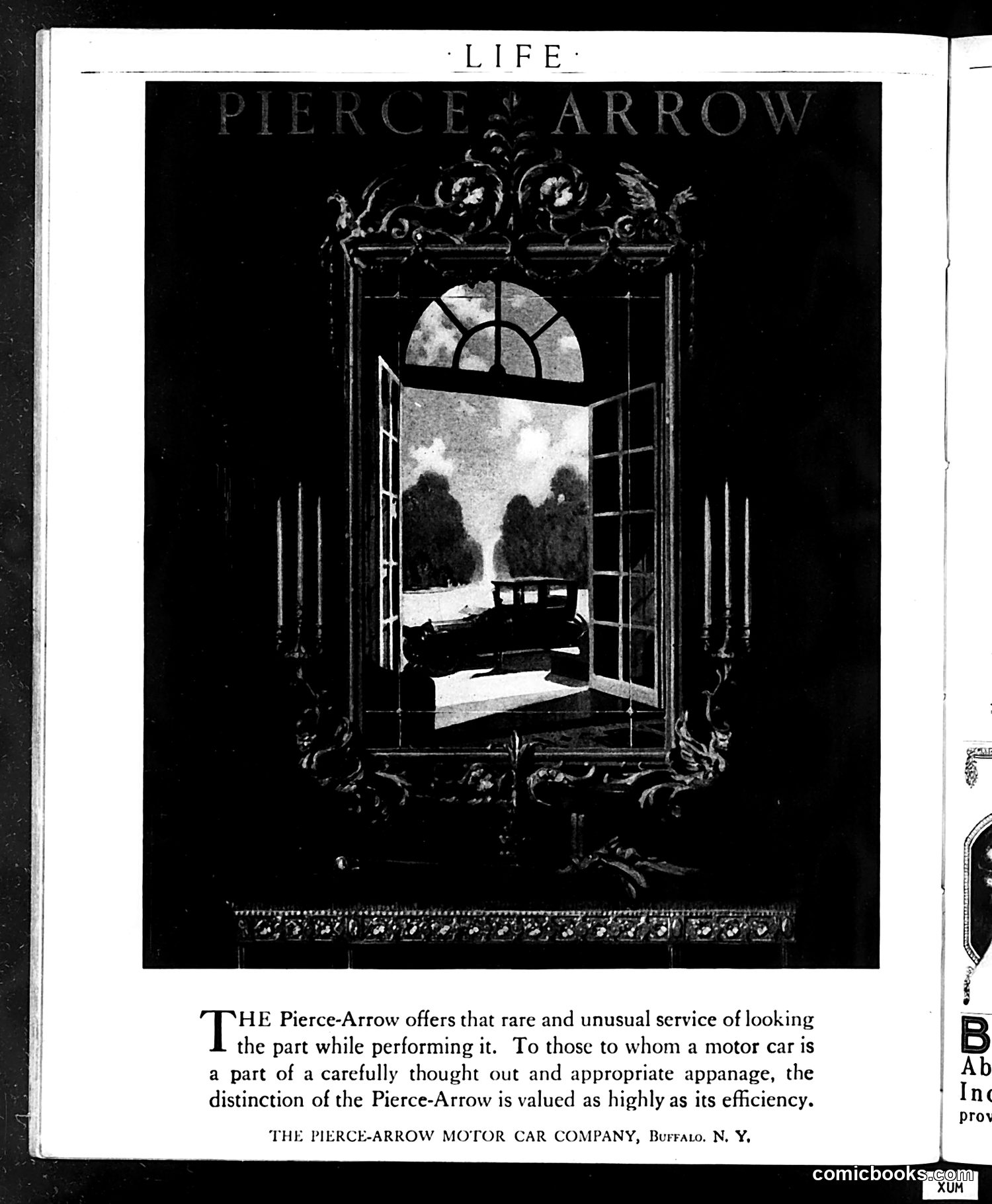
This is a **luxury automobile advertisement**, not political satire. The image shows an ornate doorway or window frame opening onto a scenic landscape with trees and sky—a romantic, aspirational vista. The ad copy emphasizes that Pierce-Arrow motor cars offer "rare and unusual service" and "distinction" alongside efficiency. The ornate framing and theatrical composition suggest elegance and refinement. This targets wealthy buyers for whom automobiles represented status symbols and carefully curated personal image. The ad appeals to aesthetic sensibility rather than practical transportation needs—the car as part of one's social presentation. This reflects early 20th-century advertising strategy: positioning luxury goods as markers of taste and sophistication rather than mere functionality.
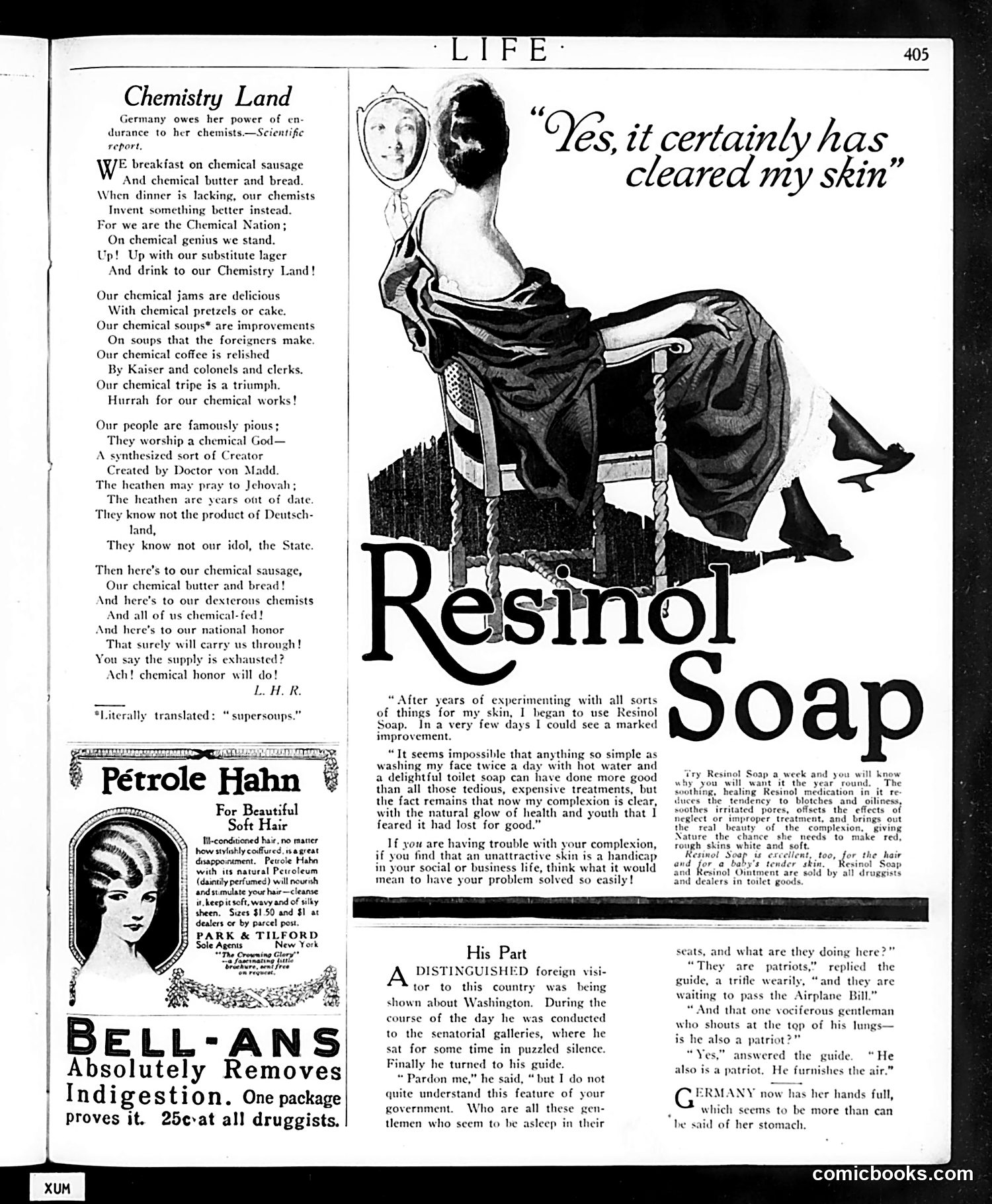
This 1910s-era Life magazine page is primarily **advertising**, not editorial satire. The main content consists of three product advertisements: 1. **"Chemistry Land"** (left): A patriotic poem celebrating German chemical industry, reflecting pre-WWI American admiration for German science and manufacturing prowess. 2. **Resinol Soap** (center): Features a woman admiring her complexion, promoting the product as a cure for skin problems. The testimonial quote emphasizes social/business advantages of clear skin. 3. **Pétrole Hahn & Bell-Ans** (bottom): Hair and indigestion remedies using typical period advertising tropes. The smaller article "His Part" discusses a foreign visitor observing American government, but appears unrelated to the advertisements. **Context for modern readers**: These ads reflect early-20th-century consumerism, when beauty products and chemical innovations were marketed as solutions to social acceptance and success.
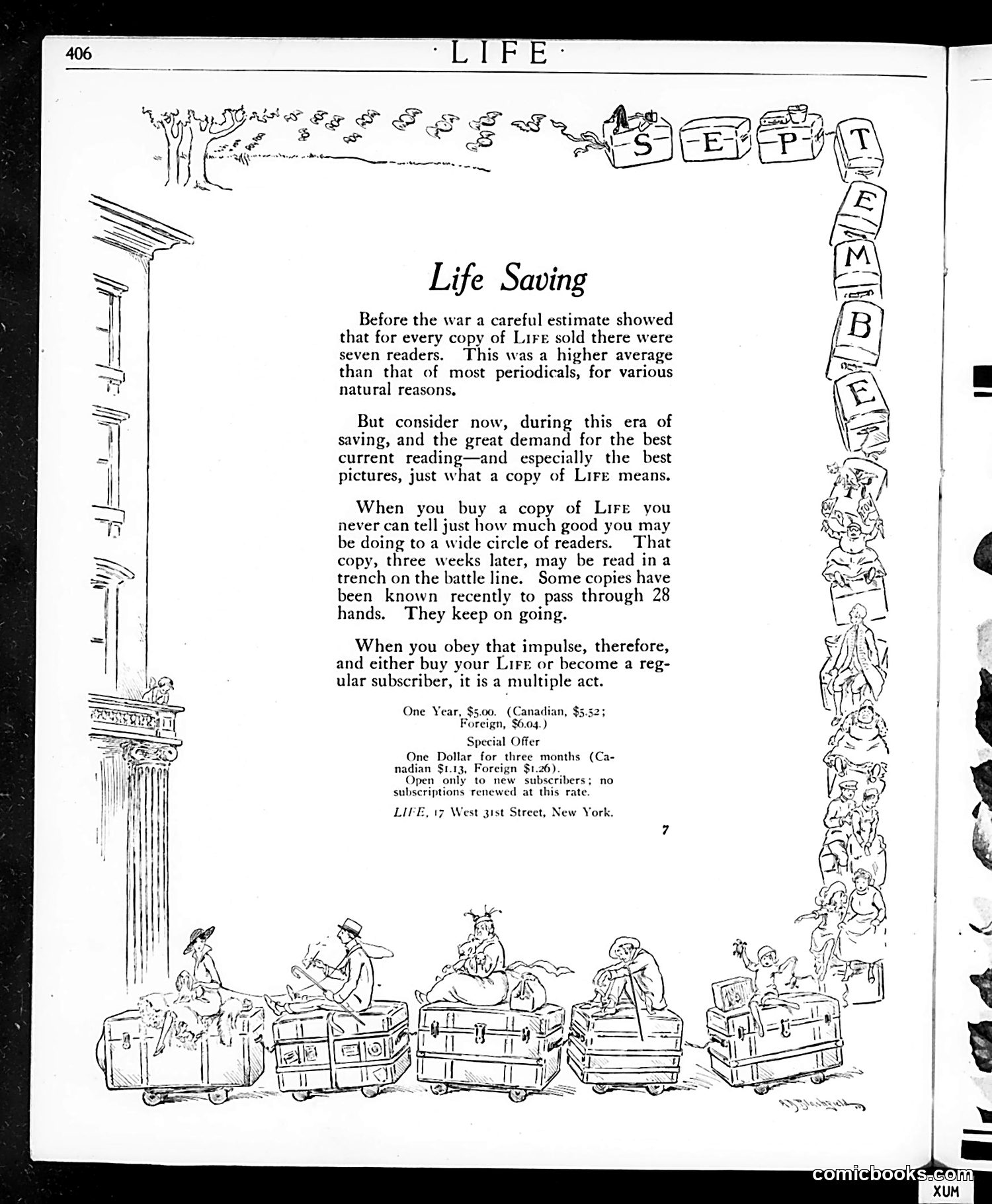
This is a **subscription advertisement** for *Life* magazine, not a political cartoon. The page uses satire to promote magazine subscriptions during wartime ("this era of saving"). **The argument:** Before the war, each *Life* copy reached seven readers on average. Now, during heightened demand for quality reading and pictures, a single copy circulates even more widely—reportedly through 28 hands. The ad presents this as socially beneficial: buying one subscription becomes a "multiple act" of generosity. **The satire:** The bottom illustration shows people passing magazines through luggage/trunks, visually parodying the claim that copies travel extensively. This humorously exaggerates the magazine's circulation reach. **The pitch:** One dollar for three months of subscriptions, positioning *Life* as an economical, socially responsible purchase during wartime rationing.
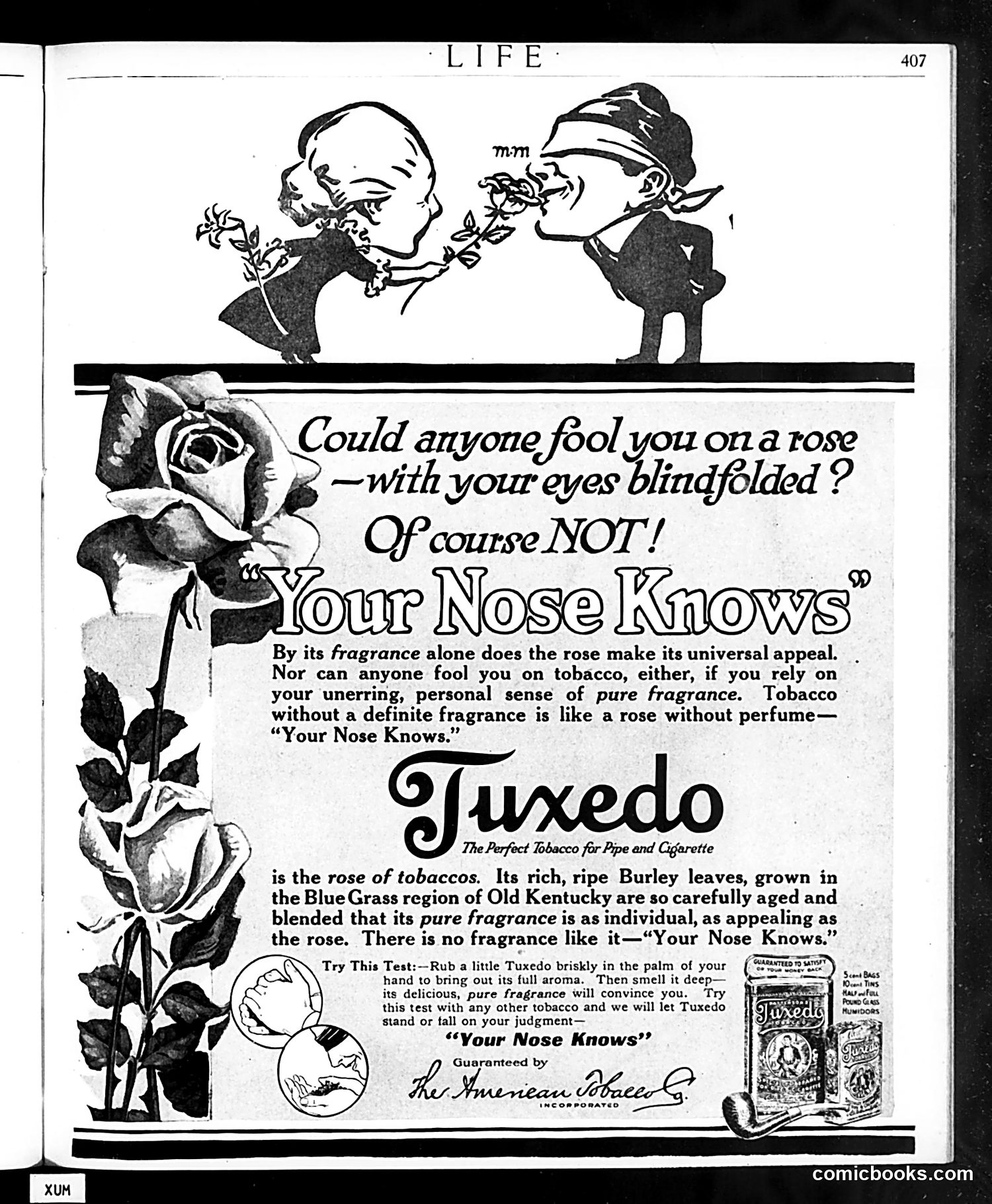
This is primarily a **tobacco advertisement**, not political satire. The page shows a vintage ad for Tuxedo brand pipe and cigarette tobacco, using the slogan "Your Nose Knows." The cartoon at the top depicts two figures engaged in what appears to be a kiss or close interaction with flowers/plants between them, illustrating the ad's central claim: that fragrance alone determines quality—you cannot be fooled even blindfolded. The ad compares tobacco to a rose, arguing that Tuxedo's "pure fragrance" from Kentucky Burley leaves is so distinctive it's identifiable by smell alone, making deception impossible. The rose imagery emphasizes natural appeal and superiority through scent rather than appearance. This reflects early 20th-century advertising strategy: emphasizing sensory qualities and purity to market tobacco products before health warnings existed.
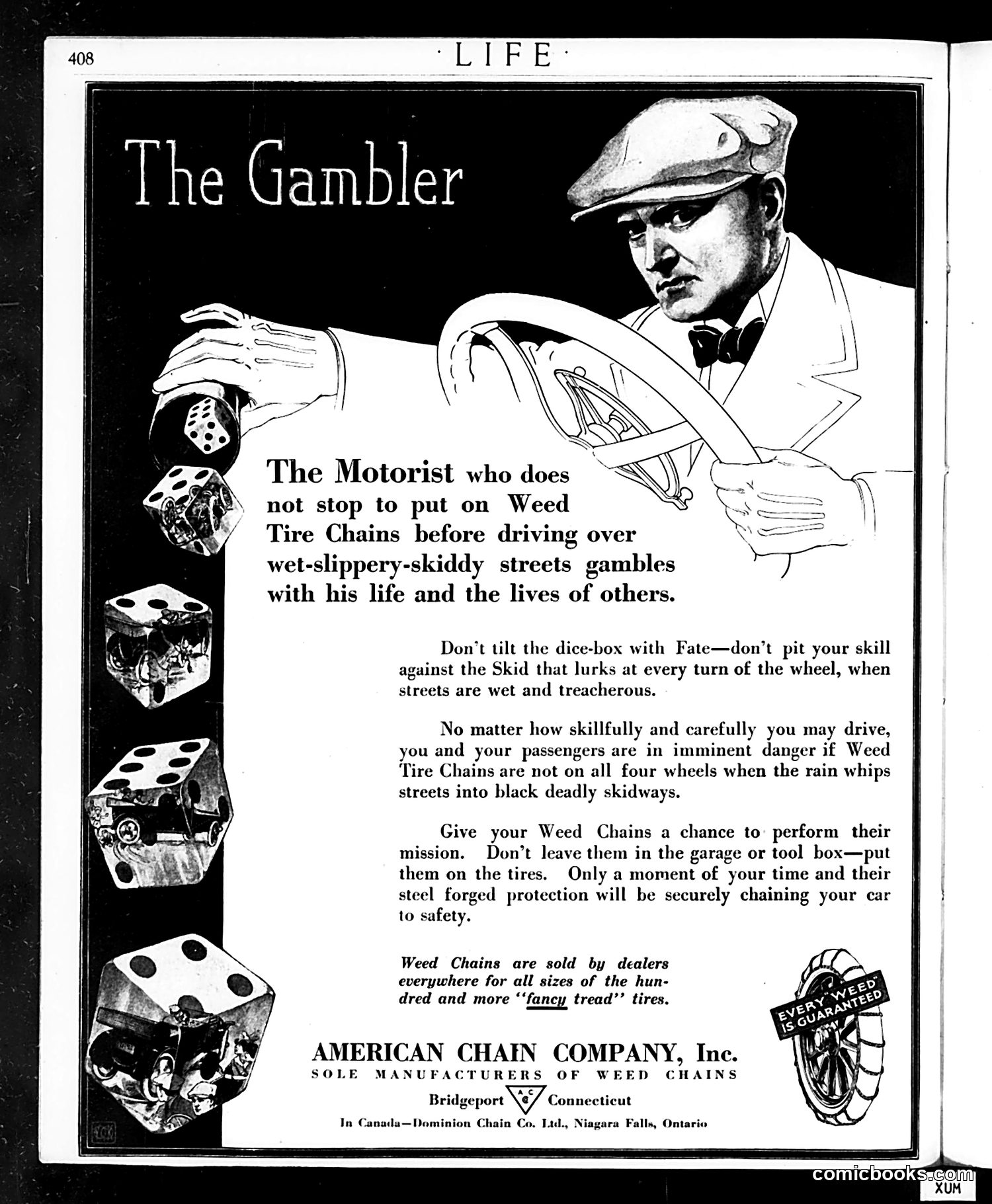
This is a **safety advertisement disguised as moral commentary**. The "gambler" is any motorist who drives in wet conditions without tire chains. The dice imagery (left side) represents the element of chance—comparing unsafe driving to gambling with lives. The ad's message: installing Weed Tire Chains before rain isn't optional caution; it's a moral imperative. The gambler "pits skill against the Skid," but skill alone cannot prevent accidents on slippery roads. Only tire chains provide genuine safety. This reflects early 20th-century automotive anxiety: cars were still relatively new, roads unpaved or poorly maintained, and winter driving genuinely dangerous. The advertiser frames chain installation as a responsibility to passengers and other road users, using shame and morality rather than convenience as the sales pitch.
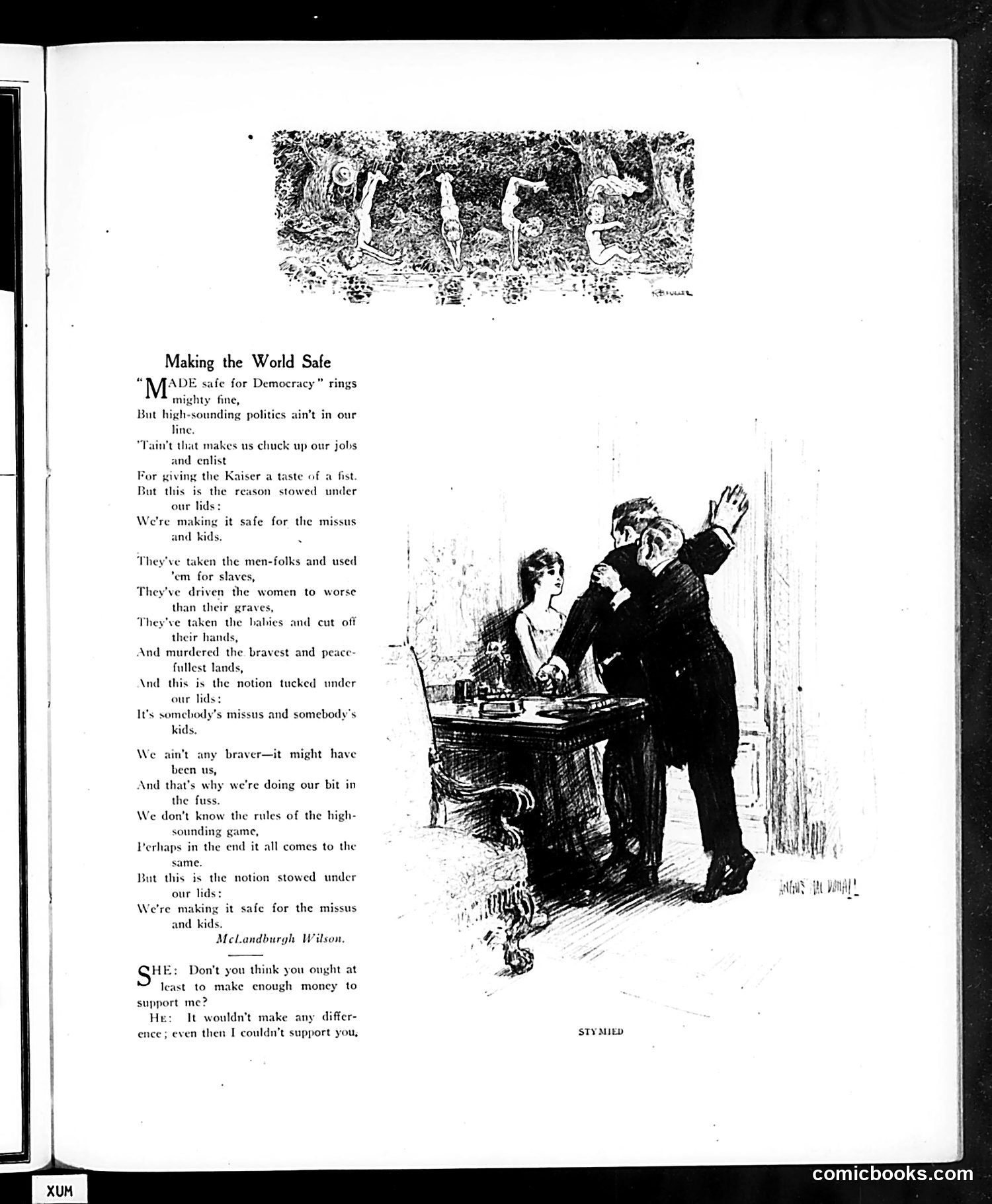
This page contains a poem titled "Making the World Safe" by McLandburgh Wilson, satirizing WWI-era justifications for American intervention. The poem mocks the phrase "made safe for Democracy"—the official rationale for U.S. entry into World War I. Wilson's poem argues this is hollow propaganda: while politicians claim noble motives, the actual consequences are devastating: men conscripted, women impoverished, children orphaned, and the "bravest" killed. The accompanying illustration labeled "Stymied" shows a woman and man at a desk in apparent marital conflict, satirizing how war's economic hardship strains domestic life. The dialogue at bottom reinforces the theme: financial struggle makes supporting a family impossible, even in peacetime. The satire targets political rhetoric divorced from human reality—a common Life magazine critique of government wartime claims.
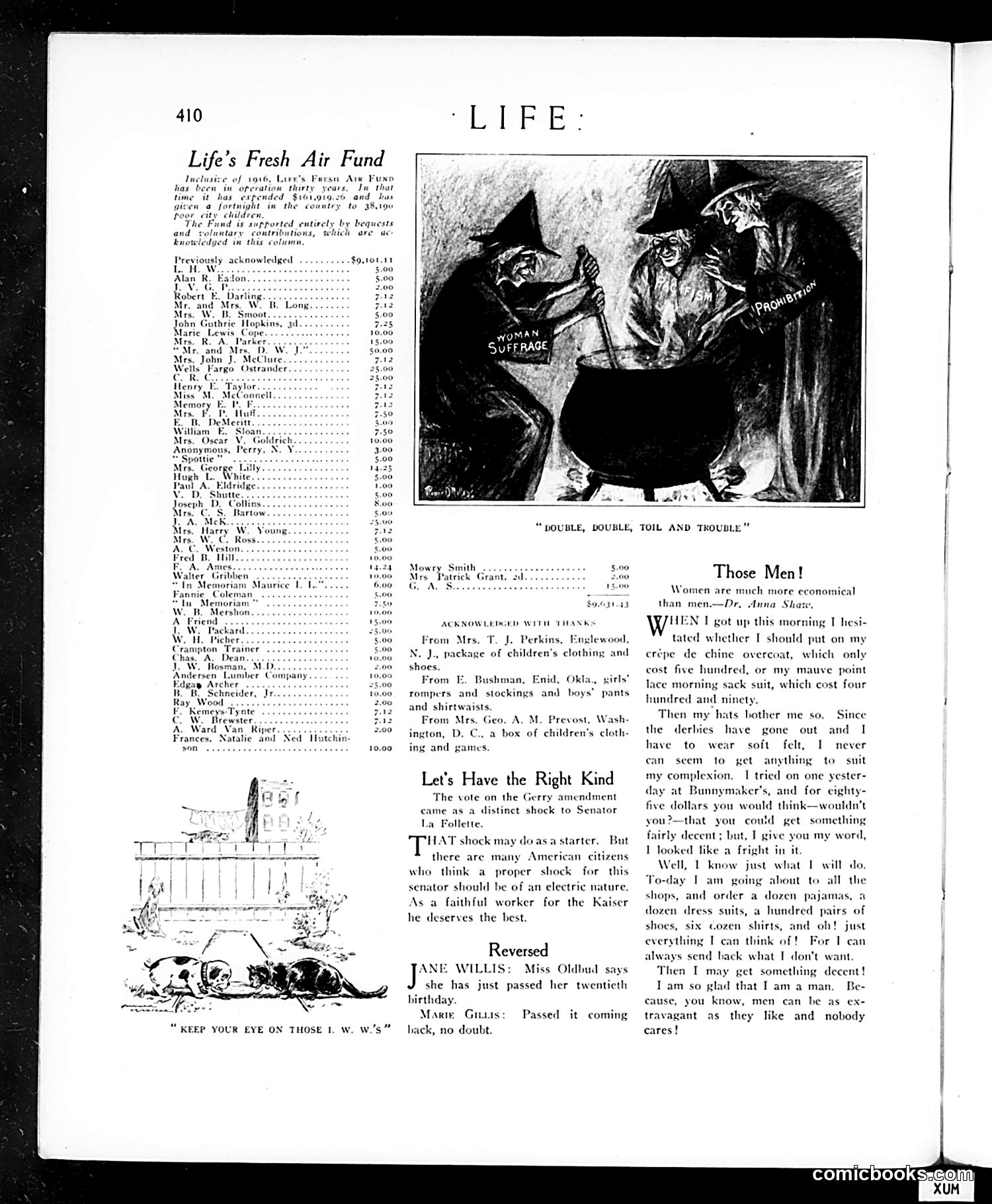
This cartoon depicts three witches stirring a cauldron, referencing Shakespeare's *Macbeth*. The caption and context—appearing alongside a piece titled "Let's Have the Right Kind" discussing Senator La Follette and a Gerry amendment vote—suggests political satire about controversial legislative actions. The witches represent political figures or forces engaged in what the magazine views as sinister political scheming or manipulation. The Shakespearean reference implies their actions are dark, deceptive, or ominous. Without identifying specific individuals in the caricatures, the cartoon criticizes what *Life* deemed improper political maneuvering during this period. The accompanying text discusses whether such political shock tactics are justified, indicating contemporary debate over legislative conduct.
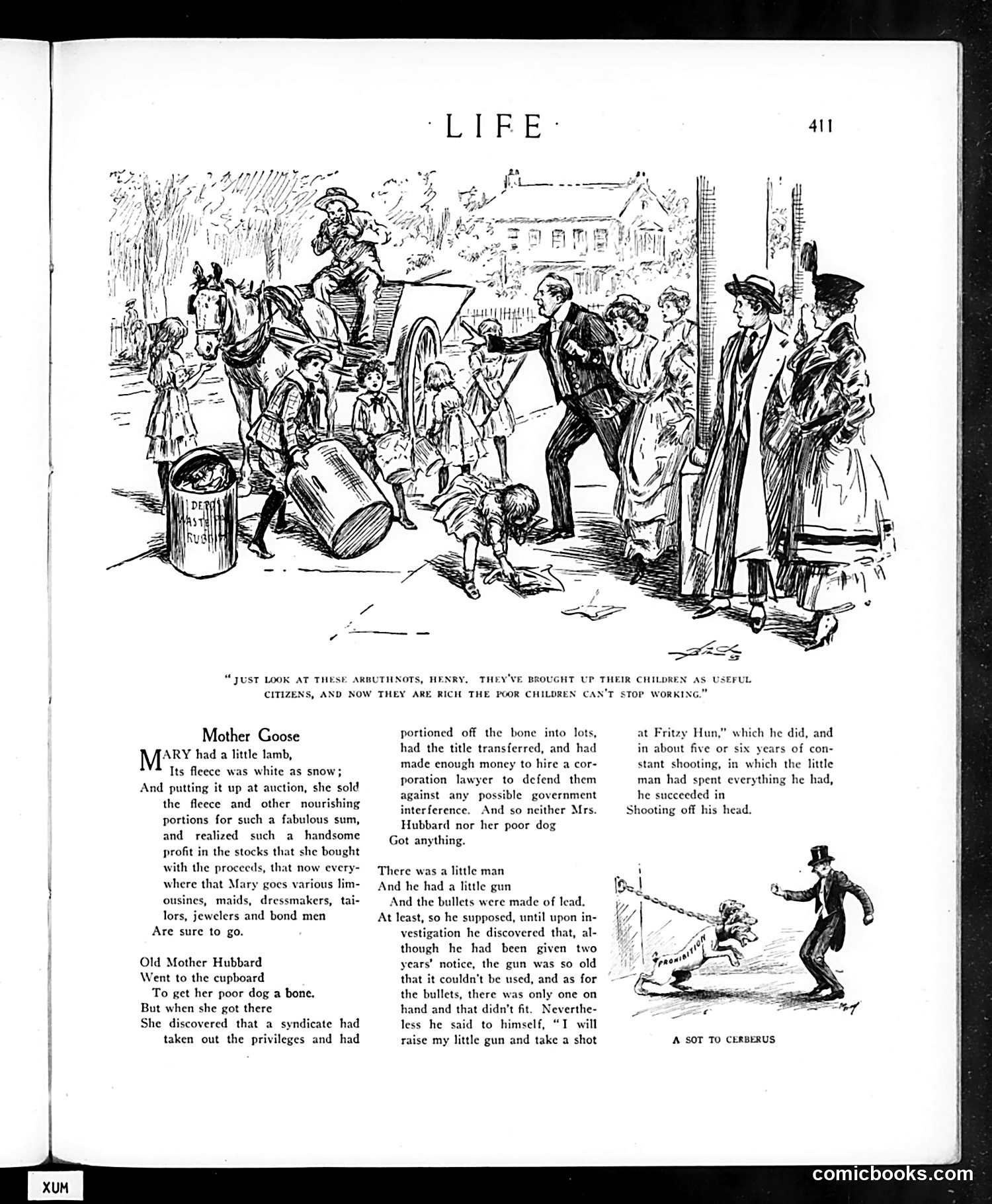
The top illustration satirizes wealthy industrialists' hypocrisy regarding child labor. The caption quotes a gentleman praising "arbuthnos" (likely a fictional wealthy family) for raising children as "useful citizens," while noting these same rich children "can't stop working"—a sarcastic jab at how the wealthy exploit poor children's labor while their own offspring remain idle. The Mother Goose and Old Mother Hubbard verses below appear to be satirical retellings mocking economic inequality and poverty. The "little man" story references someone attempting to use an old, non-functional gun—possibly satirizing the desperate circumstances of the poor. The small illustration labeled "A SOT TO CERBERUS" appears to reference classical mythology, though its specific satirical meaning is unclear without additional context.
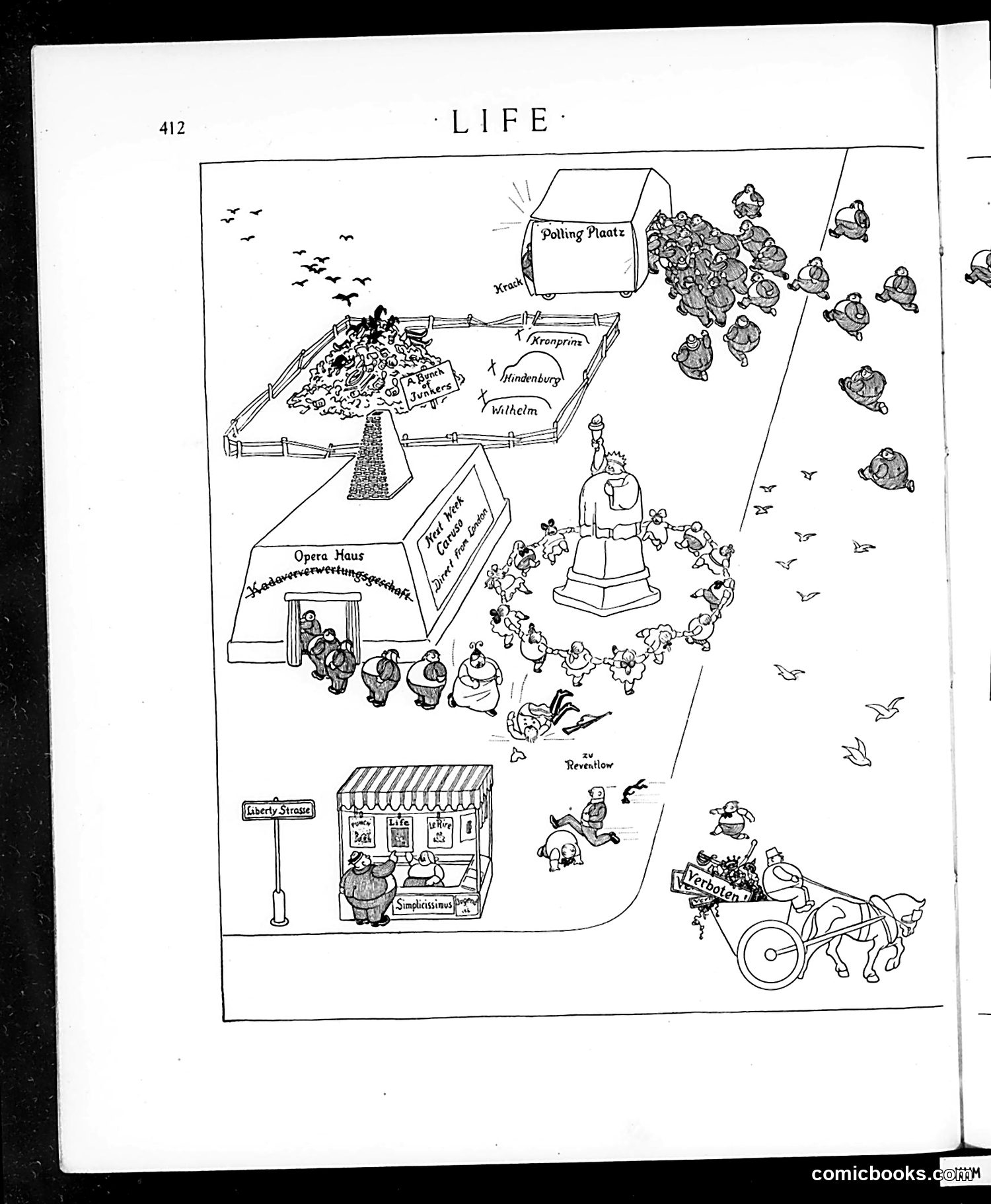
This is a satirical map of what appears to be a German city, likely from the early 20th century. The cartoon labels various locations with German names (Polling Platz, Krach, Kronprinz, Hindenberg, Wilhelm, Travelplatz, etc.) and depicts crowds of caricatured figures. Key features include: - An "Opera Haus" and administrative building - A monument or statue surrounded by crowds - A street labeled "Liberty Strasse" - A shop with a striped awning - A horse-drawn cart on the right The satire appears to mock German political and social life, with the crowds and labeled locations suggesting commentary on contemporary political figures or institutions, though specific identifications require additional historical context about Life magazine's publication date and political stance.
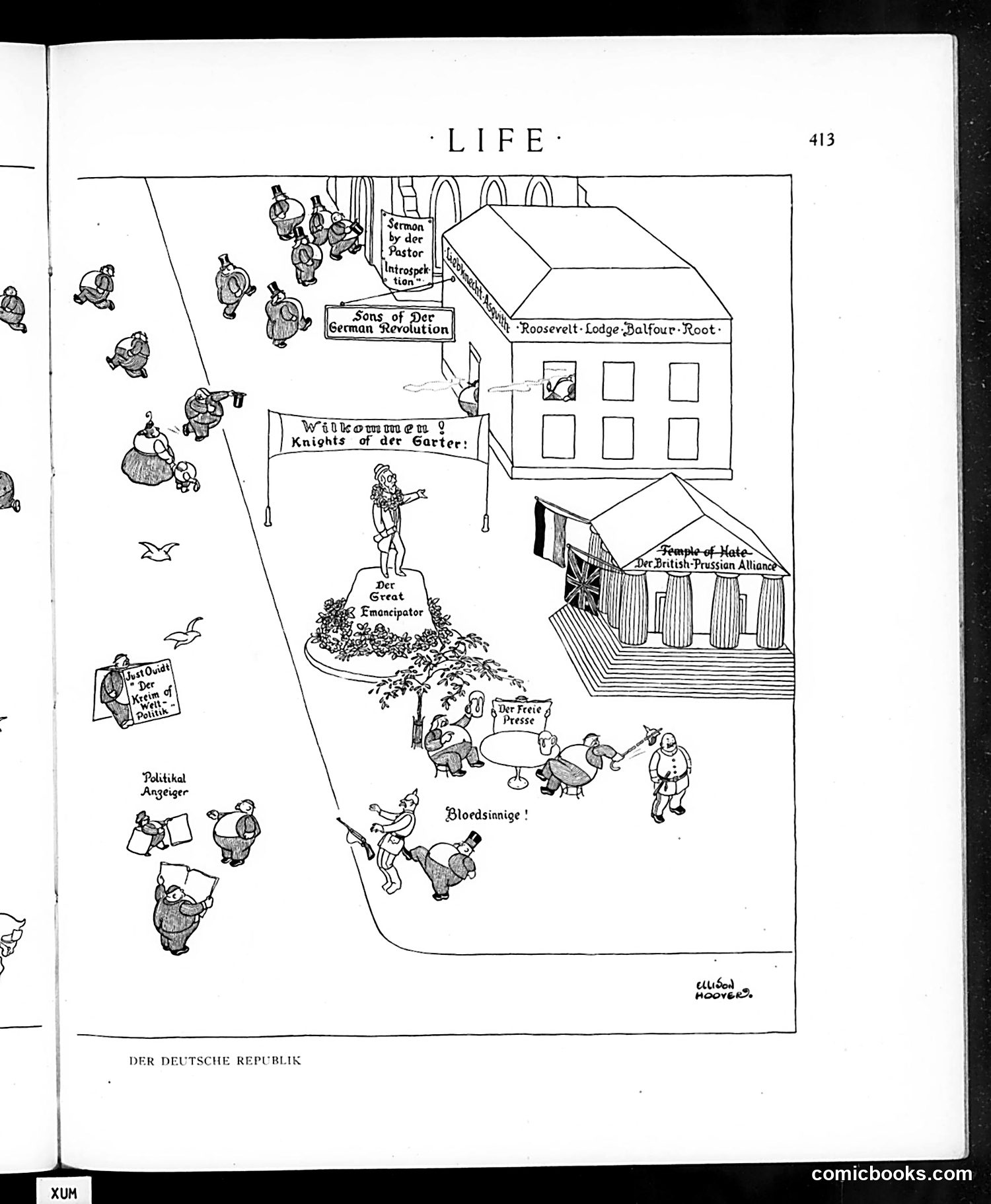
This satirical map of the Weimar German Republic depicts the political chaos of 1920s Germany through labeled locations representing different political factions and movements: - **"Sons of the German Revolution"** and **"Knights of the Garter"** represent competing political organizations - **"Roosevelt-Lodge, Balfour-Root"** references American and British political figures, suggesting foreign influence - **"Temple of Hate for British-Prussian Alliance"** critiques international relations - **"The Great Emancipator"** (on a pedestal) appears to mock revolutionary ideals - **"Die Freie Presse"** (Free Press) and **"Blutsinige!"** (Bloodthirsty!) reference press and radical violence - **"Politital Anzeiger"** (Political Announcer) figures on the left suggest propaganda The cartoon satirizes the fractured political landscape, radical extremism, and propagandistic chaos characterizing the unstable Weimar period.
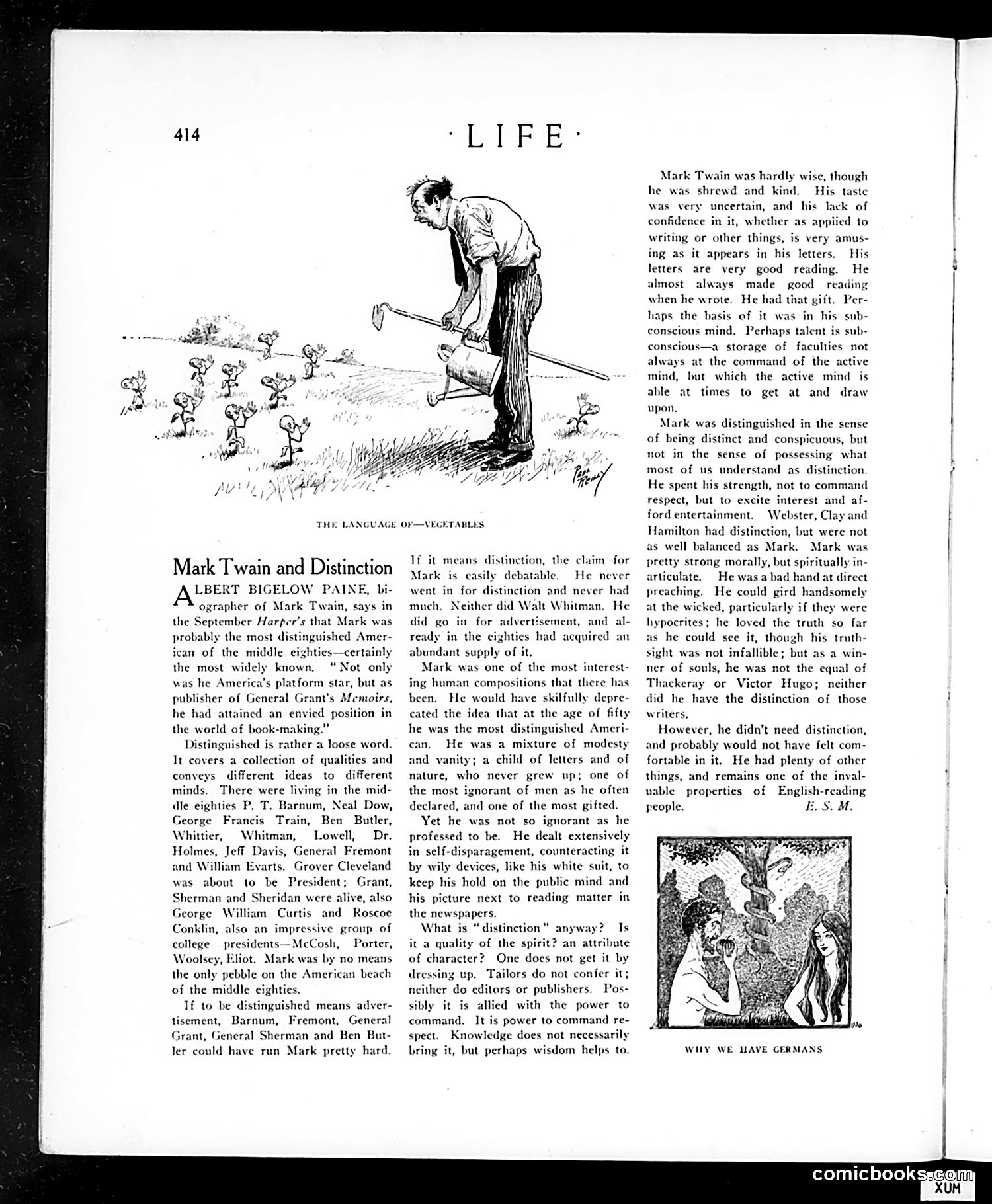
The top cartoon depicts a man wielding a hoe among small plants, titled "The Language of Vegetables." The satire likely comments on the difficulty of communicating with or understanding nature/farming. The main article discusses Mark Twain's character and literary merit. The author (Albert Bigelow Paine, Twain's biographer) argues that Twain possessed distinction not through formal elegance but through moral strength and authentic voice. The piece compares him favorably to other prominent figures like Grant and Sherman, suggesting Twain deserved recognition as a major American literary figure despite lacking the pretense of "distinguished" writers. This appears to defend Twain against critics who questioned his literary legitimacy.
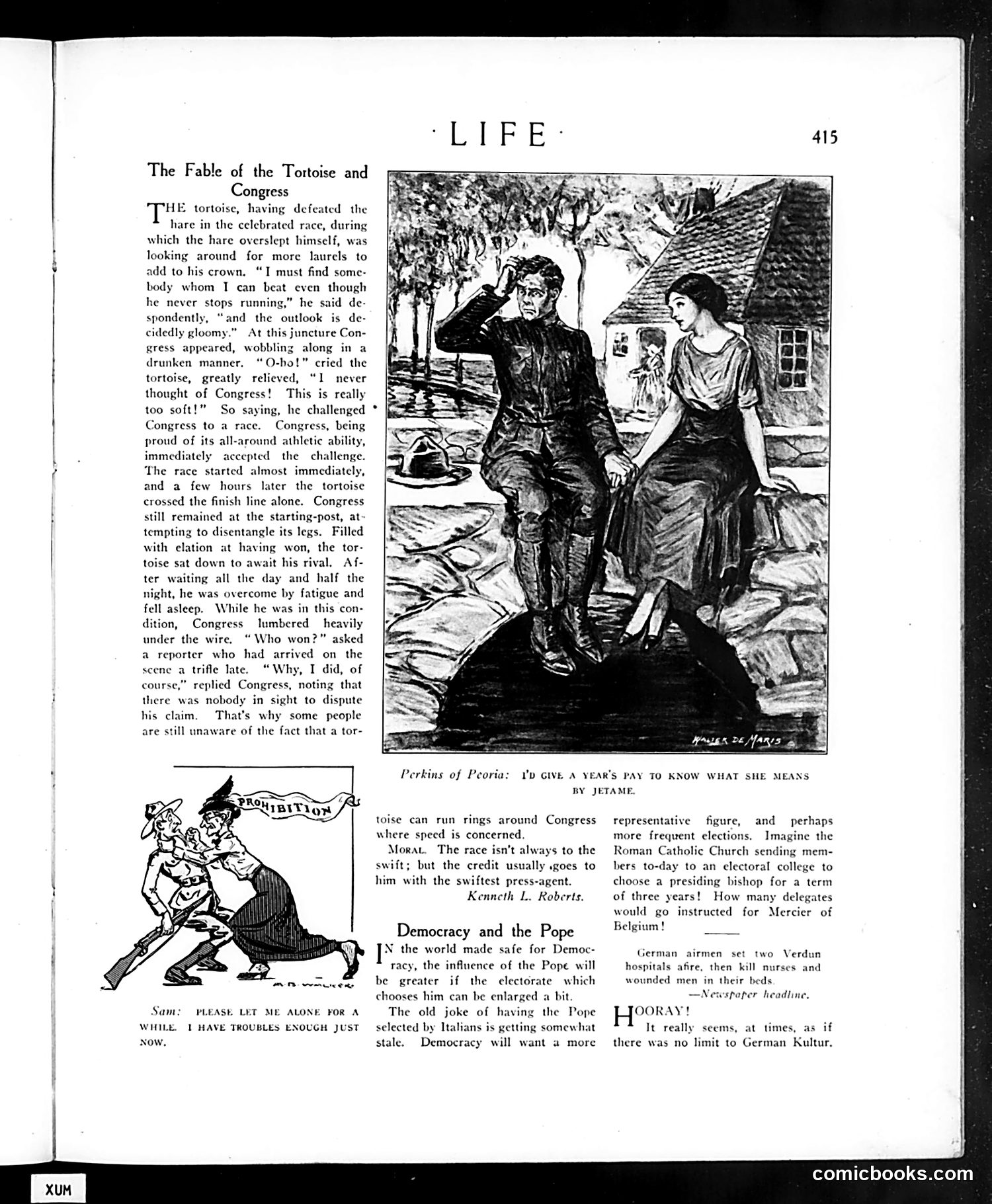
**"The Fable of the Tortoise and the Hare" (top left):** This is a modern political adaptation of Aesop's fable. Congress, portrayed as the overconfident hare, accepts a race challenge from the tortoise, then falls asleep mid-competition while the tortoise steadily wins. The satire criticizes Congress as lazy and ineffectual—boastful about athletic ability but unable to follow through on commitments. **"Perkins of Peoria" (top right illustration):** Depicts a man speaking with a woman. The caption suggests witty social commentary about understanding women's true meaning. **"Democracy and the Pope" (bottom section):** This brief commentary jokes about the Pope being selected by Italians and suggests Democracy would prefer an enlarged electoral college—satirizing both papal selection methods and democratic processes.
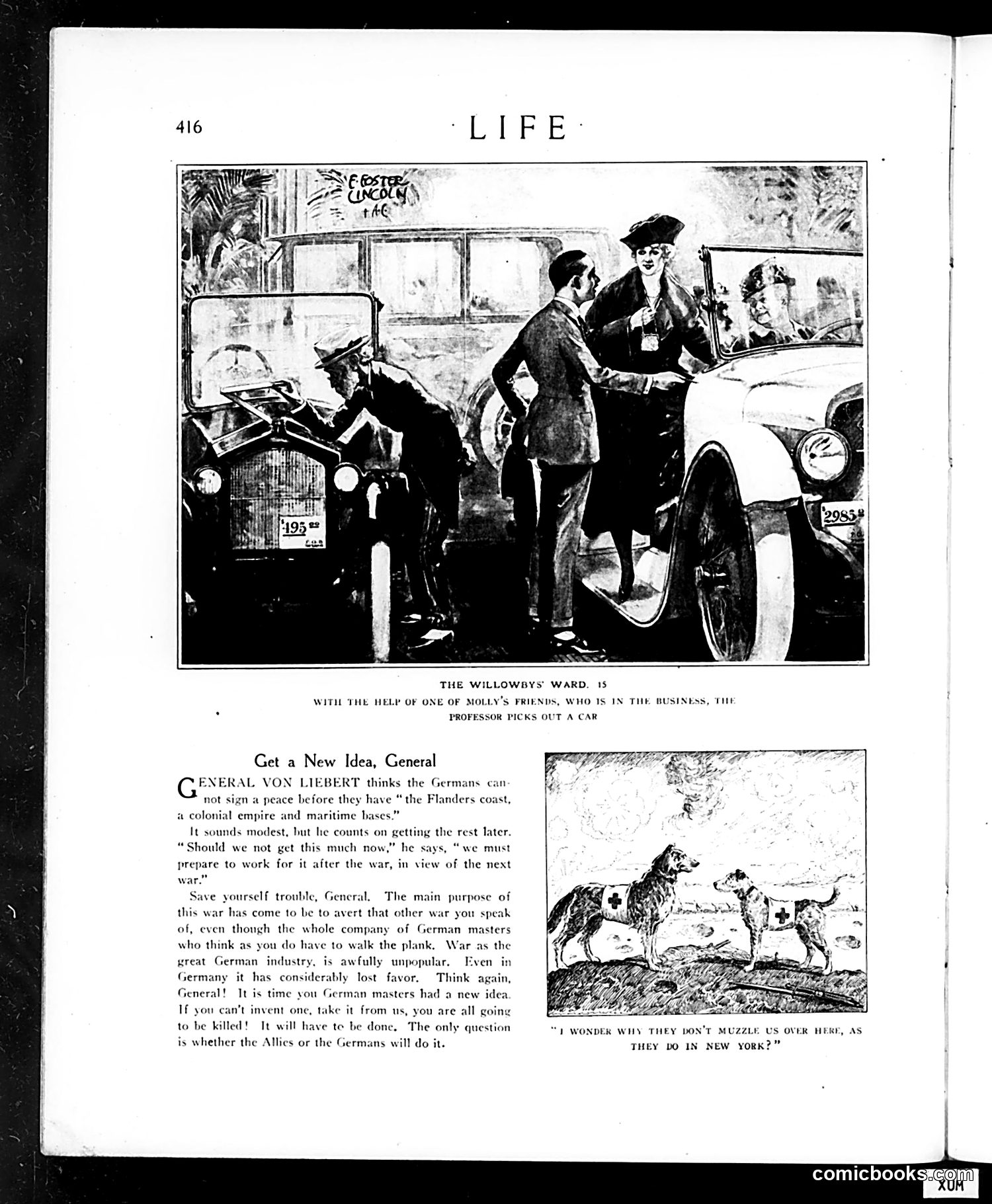
This page contains two distinct pieces of satirical content: **Top cartoon**: "The Willowbys' Ward" depicts a domestic scene where characters select a car, likely a humorous subplot from a serialized comic strip unrelated to the political content below. **Main article**: "Get a New Idea, General" directly attacks German General von Liebert's post-war ambitions. Von Liebert reportedly demanded Germany secure the Flanders coast, colonial territories, and naval bases before peace—with plans to pursue further conquests later. Life's satire is brutal: it argues Germany's militaristic expansionism caused WWI specifically to *prevent* such future wars. The magazine sarcastically suggests if Germany won't abandon these imperial ambitions voluntarily, the Allies will eliminate German leadership entirely ("walk the plank," "killed"). The bottom caption's ironic reference to censorship (contrasting American and New York restrictions) reinforces Life's position as a voice of free criticism against militarism. **Context**: This reflects American WWI-era rhetoric portraying German imperial aggression as the war's root cause.
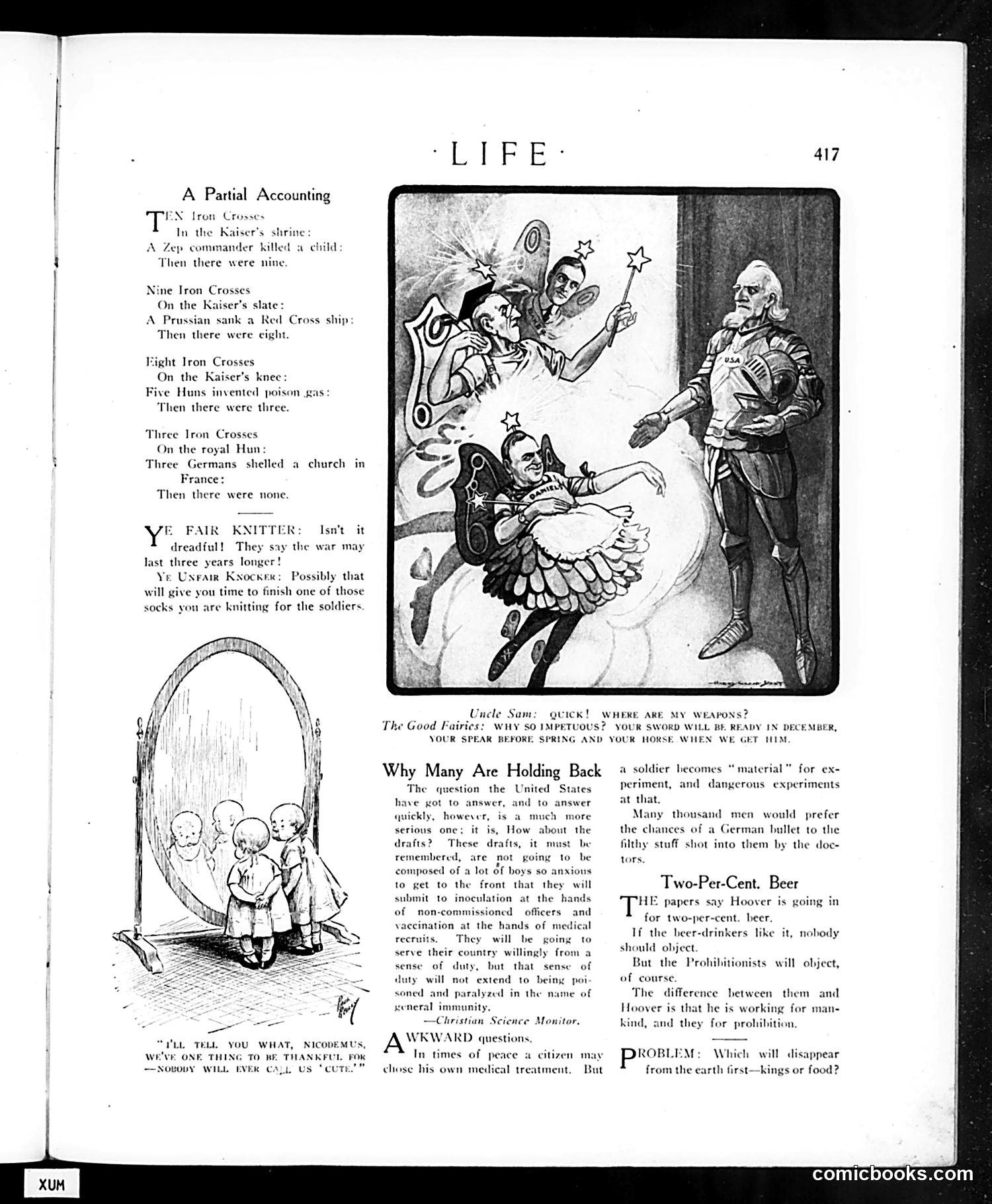
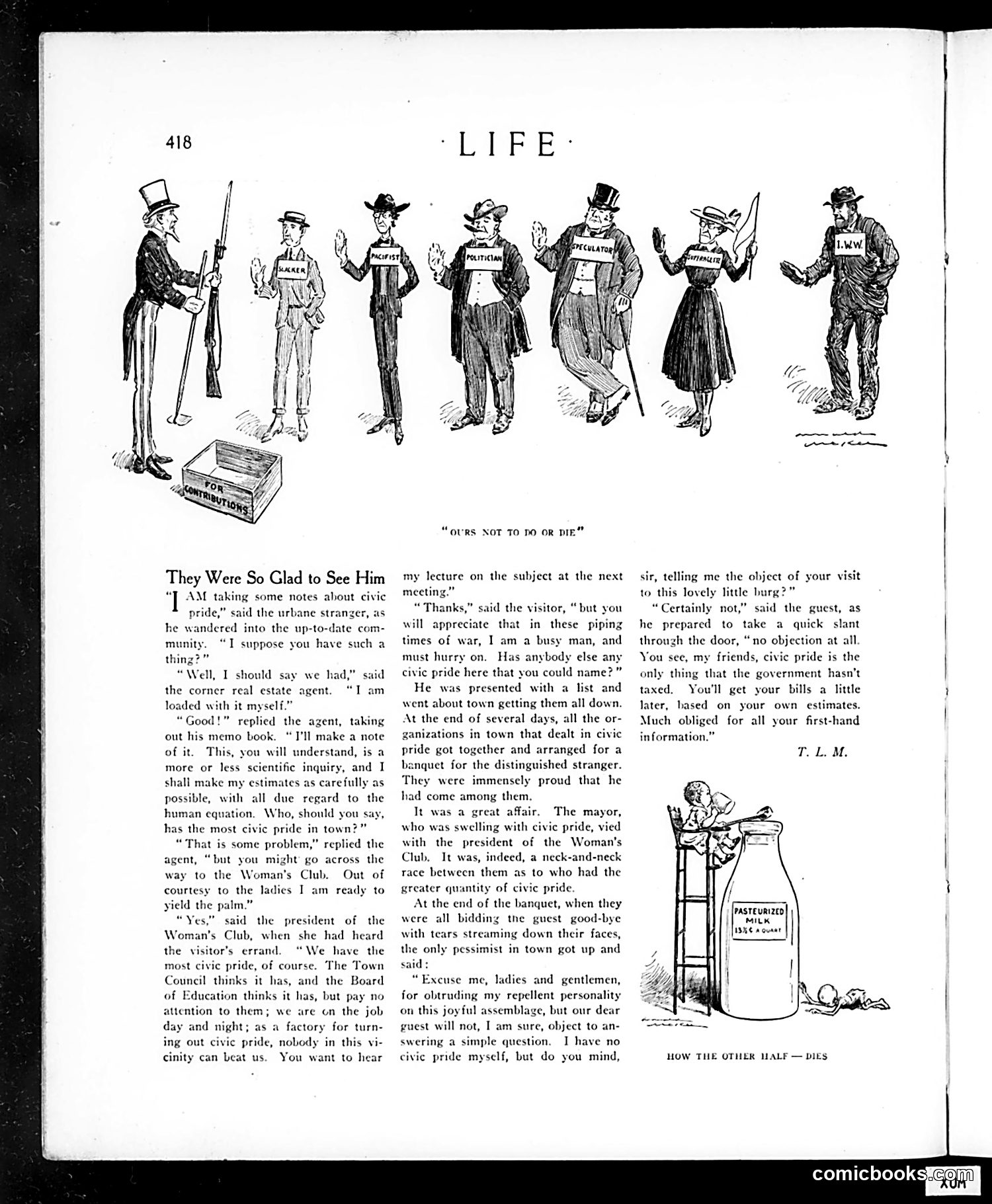
This satirical story mocks small-town civic pride during World War I (referenced as "piping times of war"). A visiting stranger claims to study "civic pride," prompting various community organizations—the real estate agent, Woman's Club, mayor, and Board of Education—to boast they possess the most. Each group competes to demonstrate their civic virtue. The punchline reveals the con: the visitor is a tax assessor. He's gathered detailed information about the town's prosperity under the guise of research, which will be used to calculate property taxes. The final line—"civic pride is the only thing that the government hasn't taxed"—exposes the joke: the townspeople's boastfulness about their community's success has inadvertently provided evidence justifying higher taxation. The cartoon at top shows various civic-minded figures (labeled) presenting themselves. The satire targets both small-town pretentiousness and the government's wartime revenue needs.
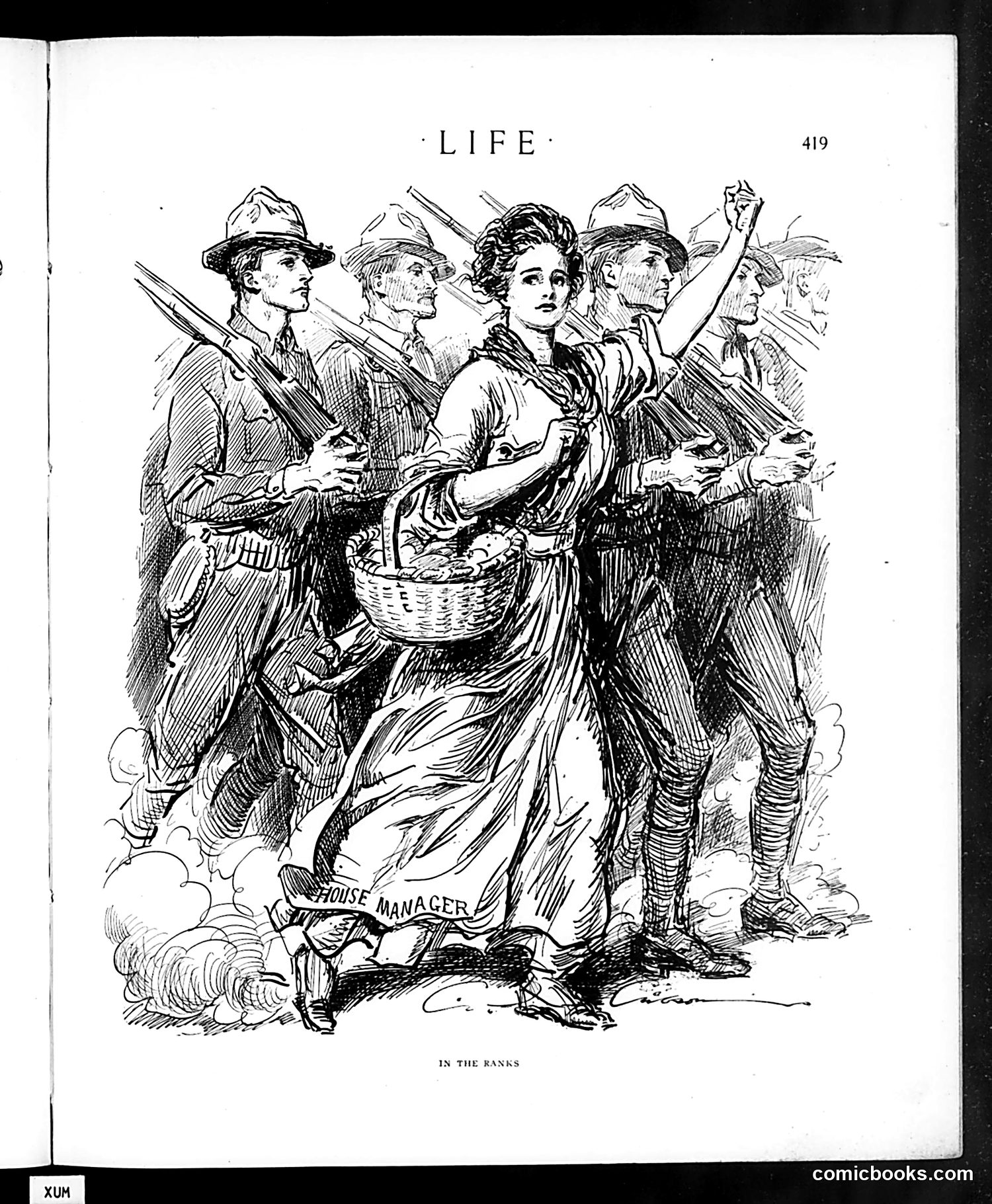
This political cartoon depicts a woman labeled "House Manager" at the center, surrounded by four armed soldiers in military uniforms and campaign hats. She holds a basket and raises her fist triumphantly while the soldiers stand at attention with rifles. The satire appears to comment on women's domestic authority or the "home front" during wartime—likely World War I era based on the uniform style. The "House Manager" is portrayed as commanding military-like obedience from soldiers, suggesting either: (1) that women managing households exercise power comparable to military command, or (2) ironic commentary on women's limited actual authority despite their essential home-management roles during wartime. The visual hierarchy and triumphant pose emphasize the satirical point about domestic power dynamics.
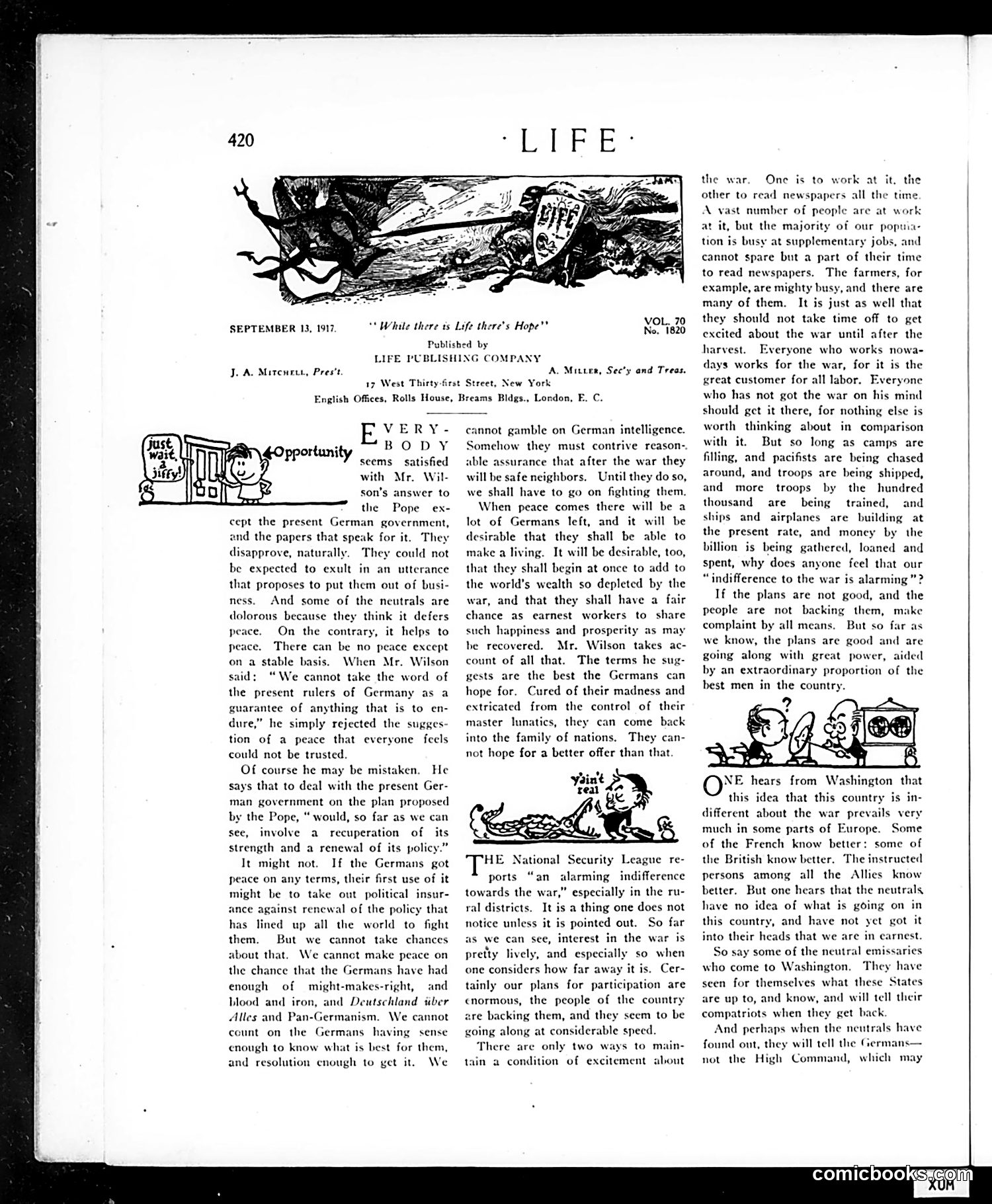
This page critiques President Wilson's rejection of Pope Benedict XV's peace proposal. The main editorial defends Wilson's position that Germany cannot be trusted—the current German government's word is worthless as a peace guarantee. The cartoon (upper left) labeled "Opportunity" appears to satirize those satisfied with Wilson's response, contrasting with German disapproval. A secondary cartoon shows a caricatured figure labeled "Paint is real"—likely mocking false optimism about war progress. The editorial argues Germans must be thoroughly defeated before peace, as they might use any ceasefire to prepare for renewed conflict. However, it acknowledges postwar Germany should have fair economic opportunities. The final section addresses the National Security League's complaint about "alarming indifference towards the war," particularly in rural areas. Life dismisses this, noting farmers are legitimately busy with harvests and that widespread war support exists—people work for "the great customer for all labor": the war effort itself.
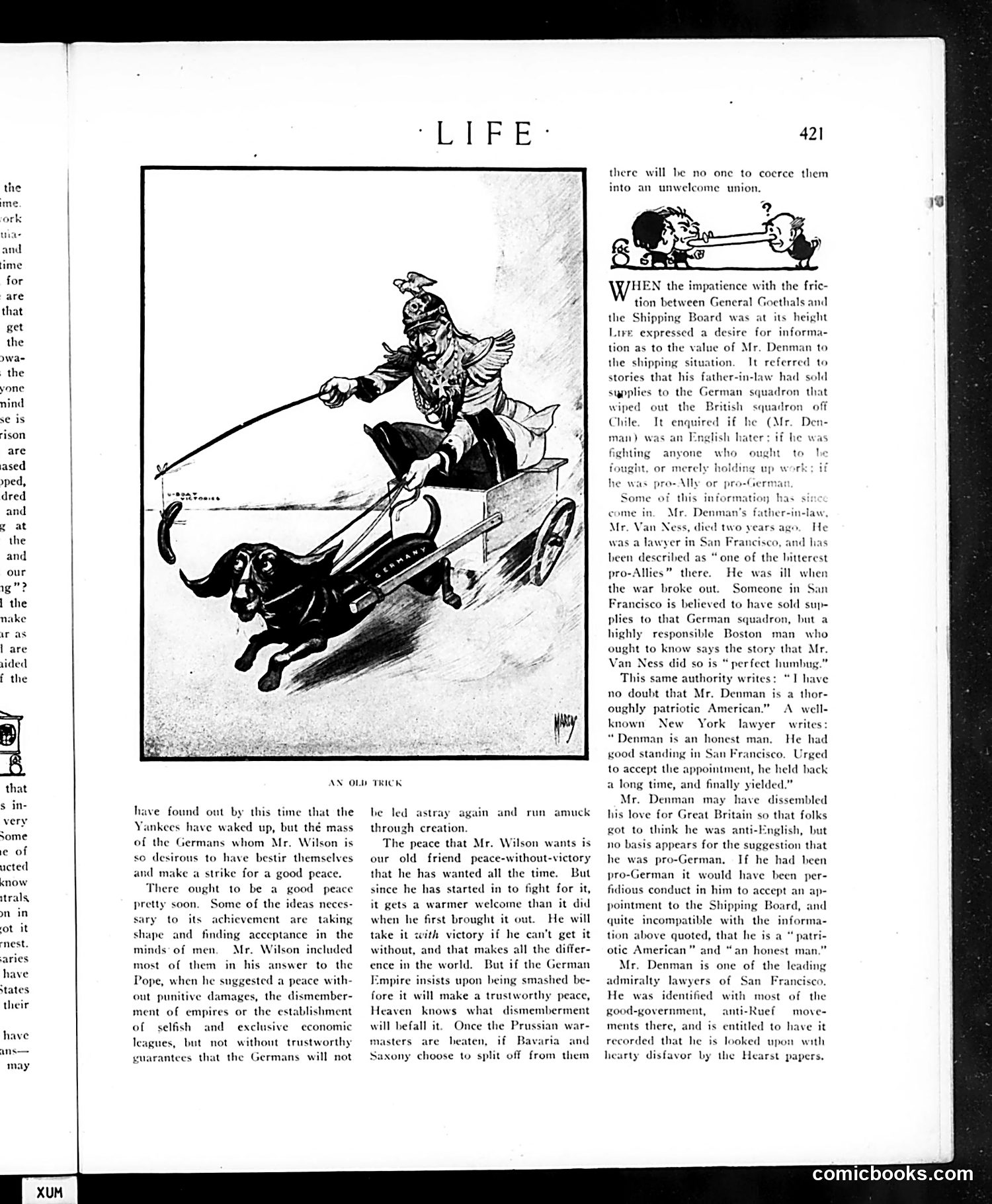
This WWI-era cartoon satirizes Kaiser Wilhelm II (identifiable by his distinctive spiked helmet and exaggerated facial features) as a charlatan performing an "old trick"—manipulating a dog-drawn cart. The image suggests Germany's peace proposals are deceptive maneuvers rather than genuine gestures. The accompanying article defends shipping administrator Daniel Denman against allegations that he was pro-German or unpatriotic. The text addresses rumors that Denman's father-in-law sold supplies to German naval forces and questions whether Denman harbored anti-British sentiment. Multiple testimonials vouch for Denman's patriotism and integrity. The page reflects wartime anxieties about hidden German sympathies among American officials. By pairing the Kaiser cartoon with Denman's defense, Life suggests that accusations of disloyalty were sometimes unfounded—an "old trick" of suspicion and innuendo rather than substantiated fact.
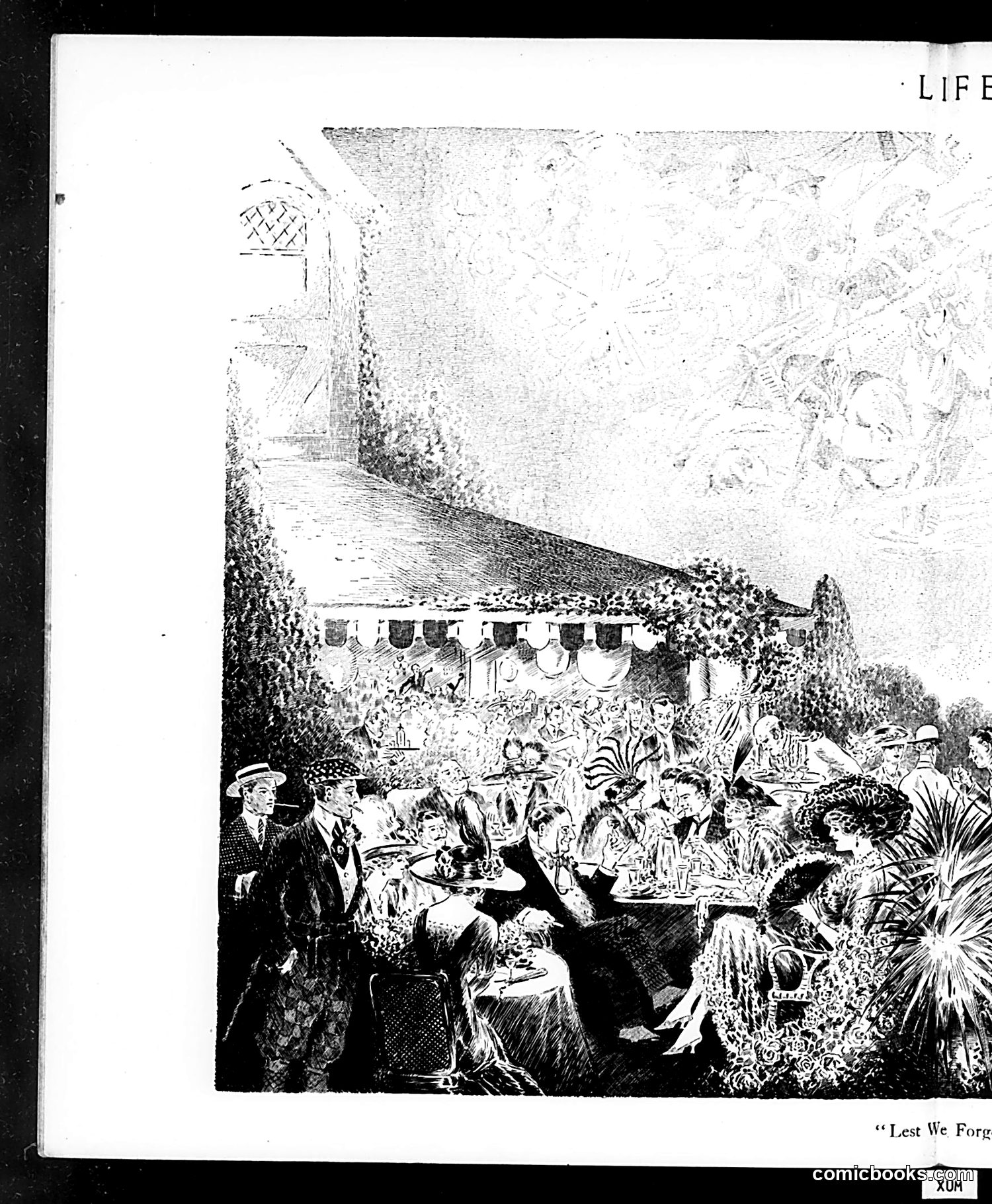
This page from *Life* magazine features a satirical illustration titled "Lest We Forg[et]" (partially visible at bottom). The cartoon depicts an elegant outdoor garden party or social gathering, with well-dressed guests dining and socializing beneath ivy-covered walls and a mansion. The satire appears to mock upper-class indulgence and social frivolity, likely contrasting wealthy leisure with serious concerns of the era (the title's reference to "forgetting" suggests criticism of social amnesia). The detailed cross-hatching and line work emphasize the elaborate, ornate nature of the scene. Without the complete title or date, the specific historical reference remains unclear, though the artistic style and subject matter suggest early-to-mid 20th century social commentary on class disparity or wartime contrasts between civilian luxury and broader national concerns.
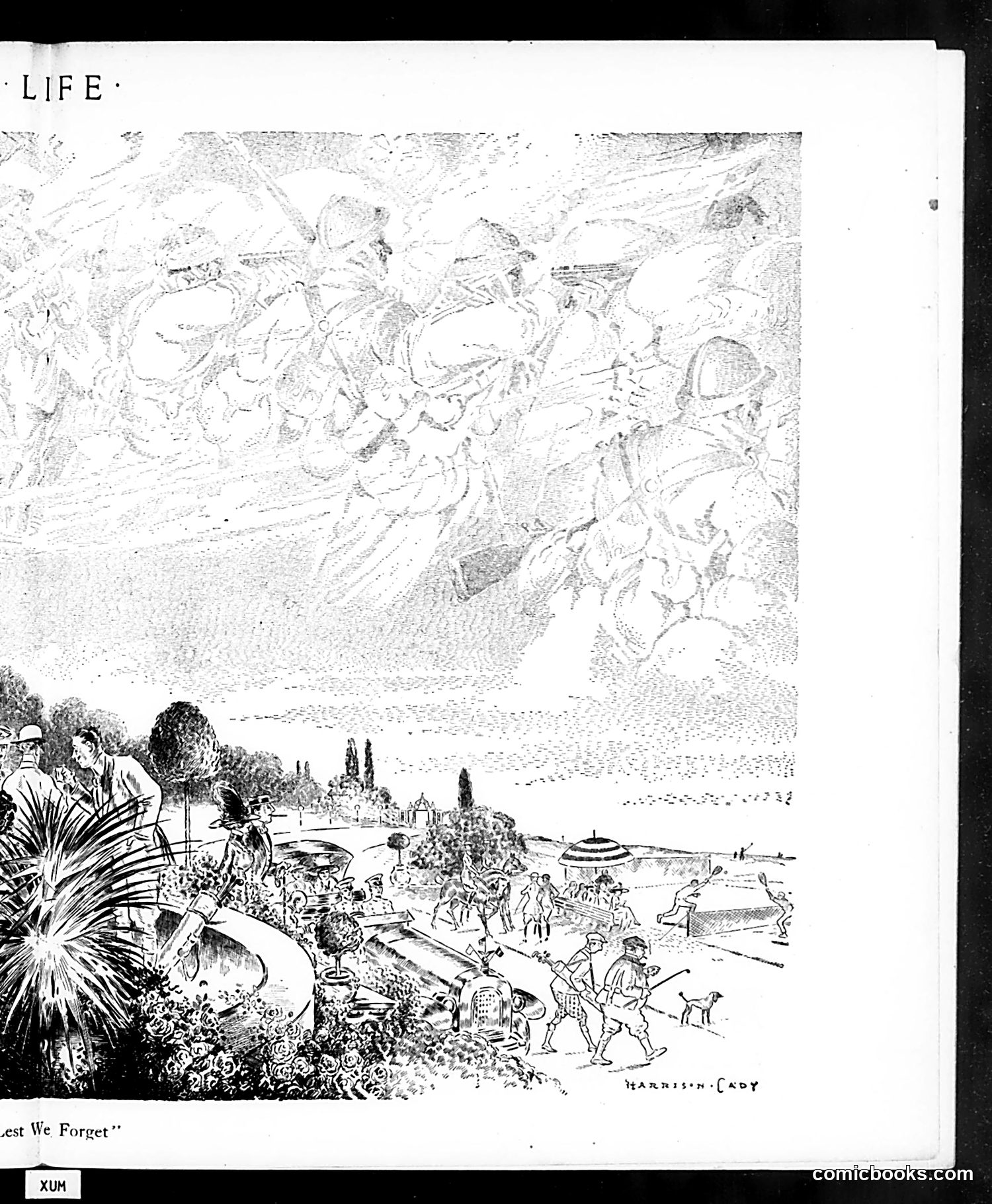
This appears to be a Life magazine cover or illustration page titled "Lest We Forget" (a phrase commonly invoking memory of historical tragedy or sacrifice). The artwork, credited to "Harrison Cady," depicts an idealized leisure scene: well-dressed figures enjoying a beach or waterside resort with parasols, boats, tropical vegetation, and distant architecture. The satire likely critiques the contrast between comfortable, carefree upper-class leisure and something the title suggests society should remember—possibly war casualties, economic hardship, or social injustice contemporaneous with publication. The phrase "Lest We Forget" ironically accompanies a scene of people apparently doing exactly that: forgetting serious matters while enjoying privilege. However, without the publication date or additional context, the specific historical reference remains unclear.
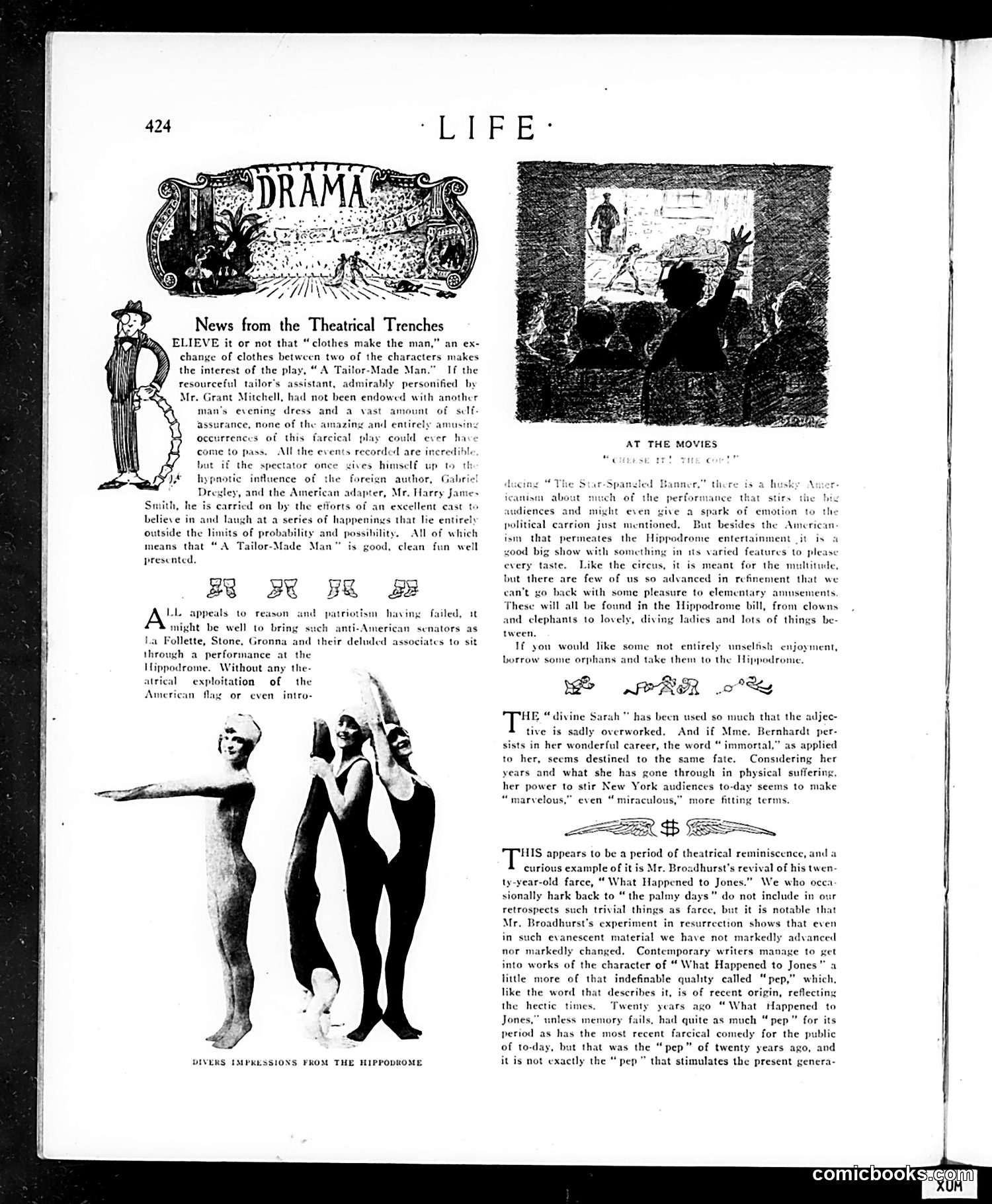
This page reviews theatrical productions from around 1920. The main content discusses: **"A Tailor-Made Man"**: A farce where a character's borrowed evening dress drives the entire plot. The reviewer notes the play succeeds through an excellent cast (Grant Mitchell noted) and clean humor, though it stretches probability. **Anti-American Senators Reference**: A satirical jab suggesting senators like La Follette, Stone, and Gronna—who opposed American military involvement (likely WWI)—should attend the Hippodrome show instead of debating patriotism, as the spectacle is more their speed. **Hippodrome Review**: Praised as family entertainment (the text humorously suggests borrowing orphans to attend), featuring circus-like acts with clowns, divers, and elephants. **Sarah Bernhardt**: Notes the aging French actress's continued ability to move New York audiences, though critics have overused descriptors like "divine" and "immortal." **"What Happened to Jones"**: A revival of a 20-year-old farce, examining whether theatrical "pep" (energy/vitality) remains timeless or merely reflects its era.
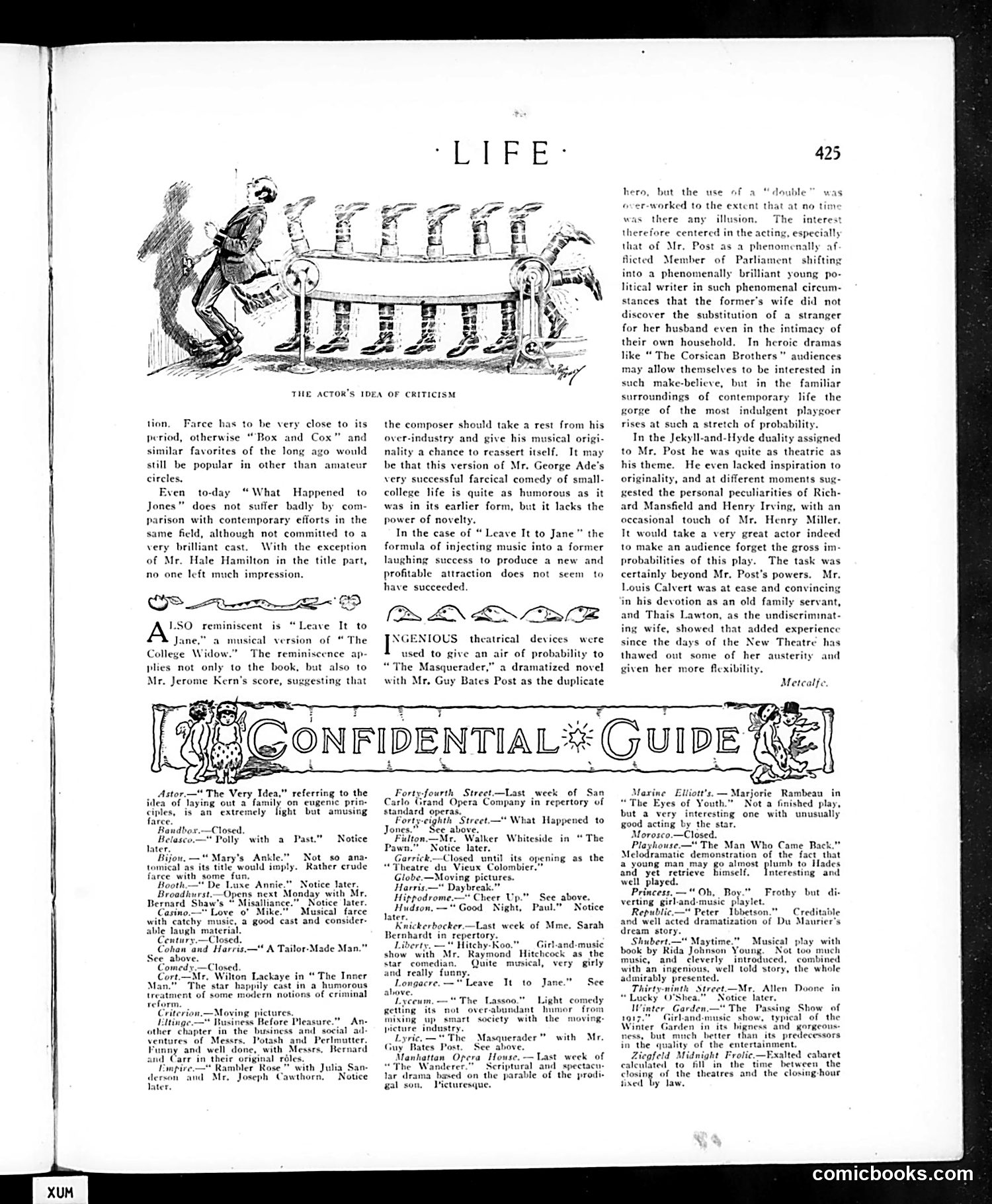
The cartoon depicts a theatrical critic as a mechanical device—a printing press or stamp machine—with an actor operating it. This satirizes theater critics as mere mechanical reproducers of conventional opinions rather than thoughtful analysts. The accompanying text reviews contemporary Broadway productions, discussing "What Happened to Jones," "Leave It to Jane" (a musical adaptation), and "The Masquerader" starring Guy Bates Post. The critique suggests that adapting older comedies with new music (like Jerome Kern's score) fails to capture the original's appeal through novelty alone. The "Confidential Guide" section lists current theater offerings with brief notices—many shows "closed," others receiving lukewarm assessments. The overall tone mocks both theatrical trends and critical conventions of the era, suggesting critics operated formulaically rather than offering genuine insight into performances.
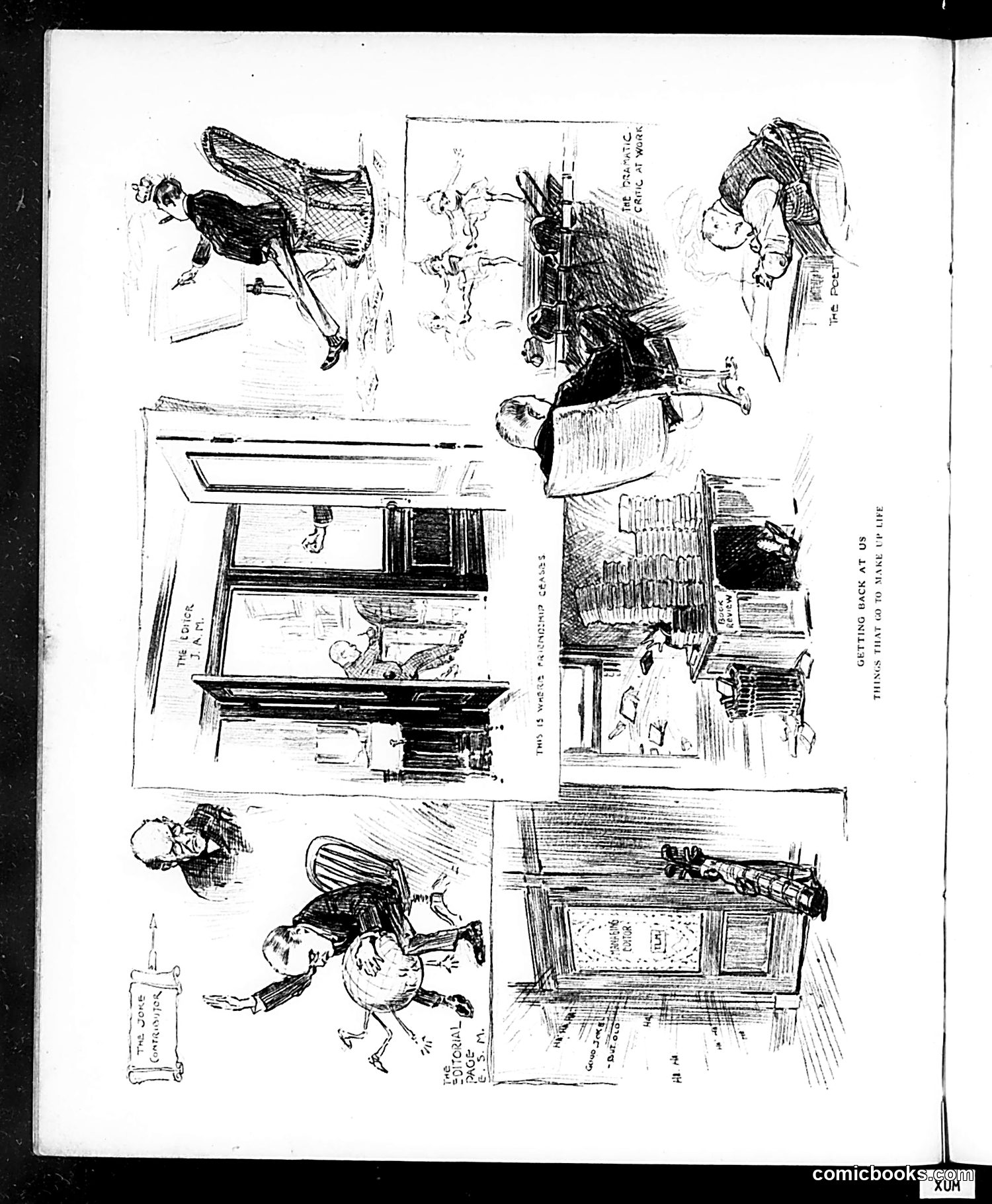
I can see this page contains multiple sketch-style illustrations arranged in a comic layout, but the OCR text is too corrupted to read clearly. The drawings appear to be satirical scenes depicting various domestic or social situations with exaggerated character expressions typical of early-to-mid 20th century Life magazine humor. However, without legible text labels or captions identifying the specific figures, events, or social commentary being referenced, I cannot reliably explain what political or social satire is intended. The image quality and OCR errors prevent me from confidently identifying either the subjects of ridicule or the historical context of the jokes. To accurately explain these cartoons' meaning to a modern reader, I would need clearer source text or additional contextual information about the publication date and Life magazine's coverage during that period.
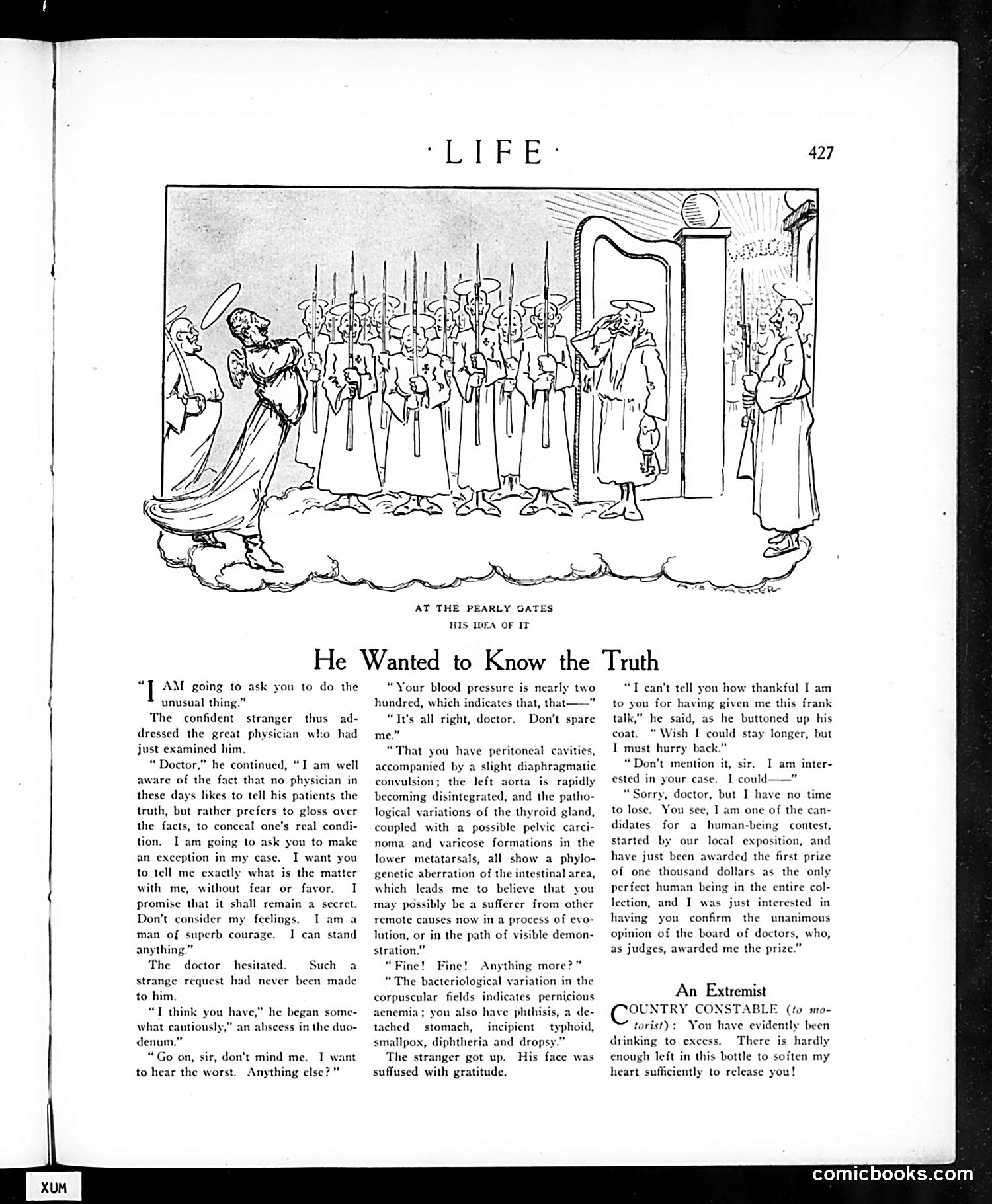
This page contains two satirical pieces from *Life* magazine: **"He Wanted to Know the Truth"** mocks doctors who avoid honest diagnoses. A patient demands a physician tell him his actual condition without sugar-coating. The doctor reluctantly lists an absurdly comprehensive catalog of serious ailments (duodenal abscess, high blood pressure, peritoneal cavities, etc.). Rather than being devastated, the patient is grateful—he reveals he's won a "perfect human being" contest prize, confirming doctors' reluctance to deliver bad news is warranted. The satire targets early 20th-century medical practice: physicians' tendency to obscure diagnoses to avoid alarming patients, and the irony that brutal honesty would destroy confidence in medical judgment. **"An Extremist"** is a brief cartoon joke about a corrupt rural police officer willing to release a drunk driver in exchange with a bottle of liquor—satirizing rural law enforcement corruption and bribery. Both pieces reflect Progressive Era skepticism toward professional institutions and authority figures.
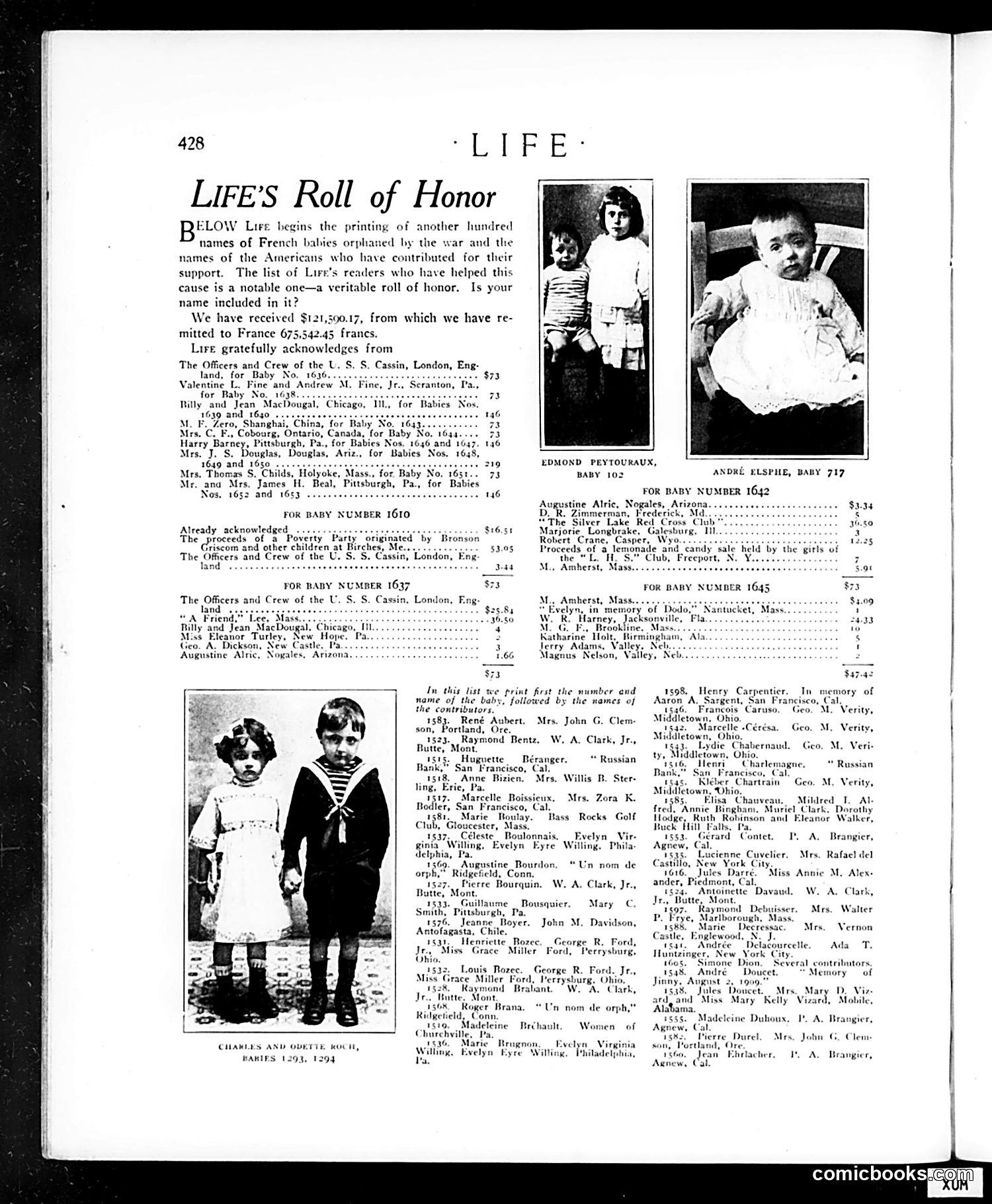
This page documents **Life magazine's fundraising campaign for French war orphans** during World War I. The publication solicited donations from American readers to support French babies orphaned by the war. The page displays photographs of two French children (Edmond Peytouraux and André Elsphe) receiving aid, along with a list of American donors and their contributions. At bottom left, a photograph shows two American children (Charles and Odette Koch) who apparently participated in fundraising. The "Roll of Honor" framing—comparing donors to military heroes—uses patriotic language to encourage American charitable giving toward European war victims. By printing donors' names alongside the babies they sponsored, Life appealed to readers' sense of civic duty and international responsibility during wartime. The campaign raised over $121,000, with funds remitted to France in francs.
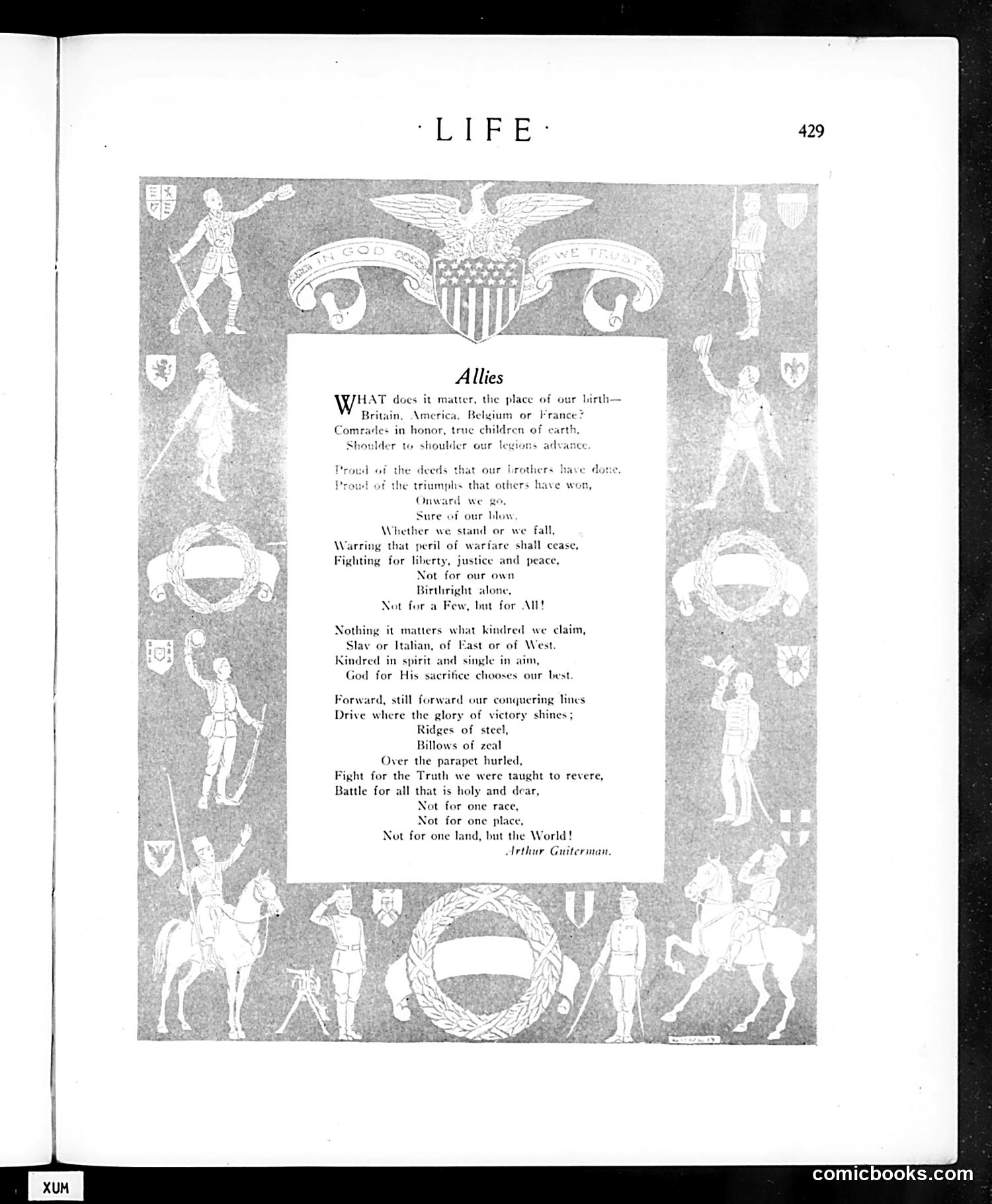
This is a patriotic poem by Arthur Guiterman, not a political cartoon. The decorative border features military and allegorical figures (soldiers, knights, heraldic shields, an eagle), framing an appeal for Allied unity during World War I. The poem's message: soldiers from Britain, America, Belgium, and France—regardless of ethnicity (mentioning Slavs and Italians)—fight together for universal principles: "liberty, justice and peace" and "Truth," not narrow national interests. The refrain "Not for one land, but the World!" emphasizes idealistic internationalism. This reflects WWI propaganda positioning the conflict as a moral crusade for humanity, not territorial gain. The emphasis on diverse nationalities united by shared values represents the Allied coalition's public messaging about their cause's righteousness and broad support.
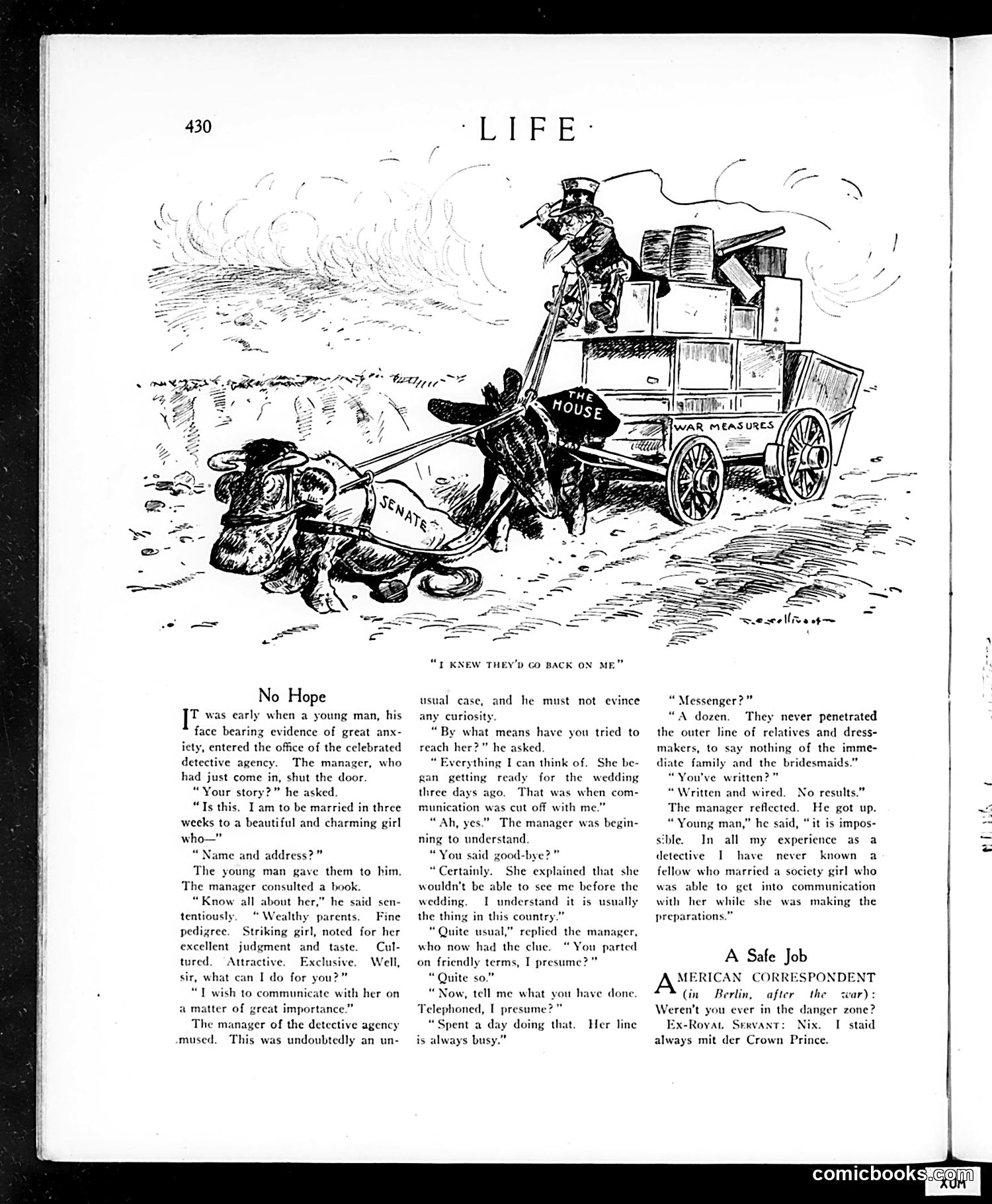
This page contains two satirical pieces from Life magazine. **"No Hope"** (main story with cartoon): A young man visits a detective agency seeking help contacting his fiancée before their wedding in three weeks. The detective quickly realizes the situation is hopeless—the bride is unavailable because she's absorbed in wedding preparations, surrounded by relatives and bridesmaids. The joke satirizes upper-class wedding culture: once engaged to a wealthy society girl, a man loses all access to her until after the ceremony. The cartoon depicts the Senate and House as broken-down donkeys struggling to pull a cart labeled "War Measures," captioned "I Knew They'd Go Back on Me"—suggesting Congress abandons wartime cooperation. **"A Safe Job"** (brief item): An American correspondent interviews an ex-royal servant in post-WWI Berlin about avoiding danger. The servant claims safety came from staying with the Crown Prince—dark humor implying the Crown Prince (Germany's heir) faced no danger because Germany lost the war, making proximity to him paradoxically safe.
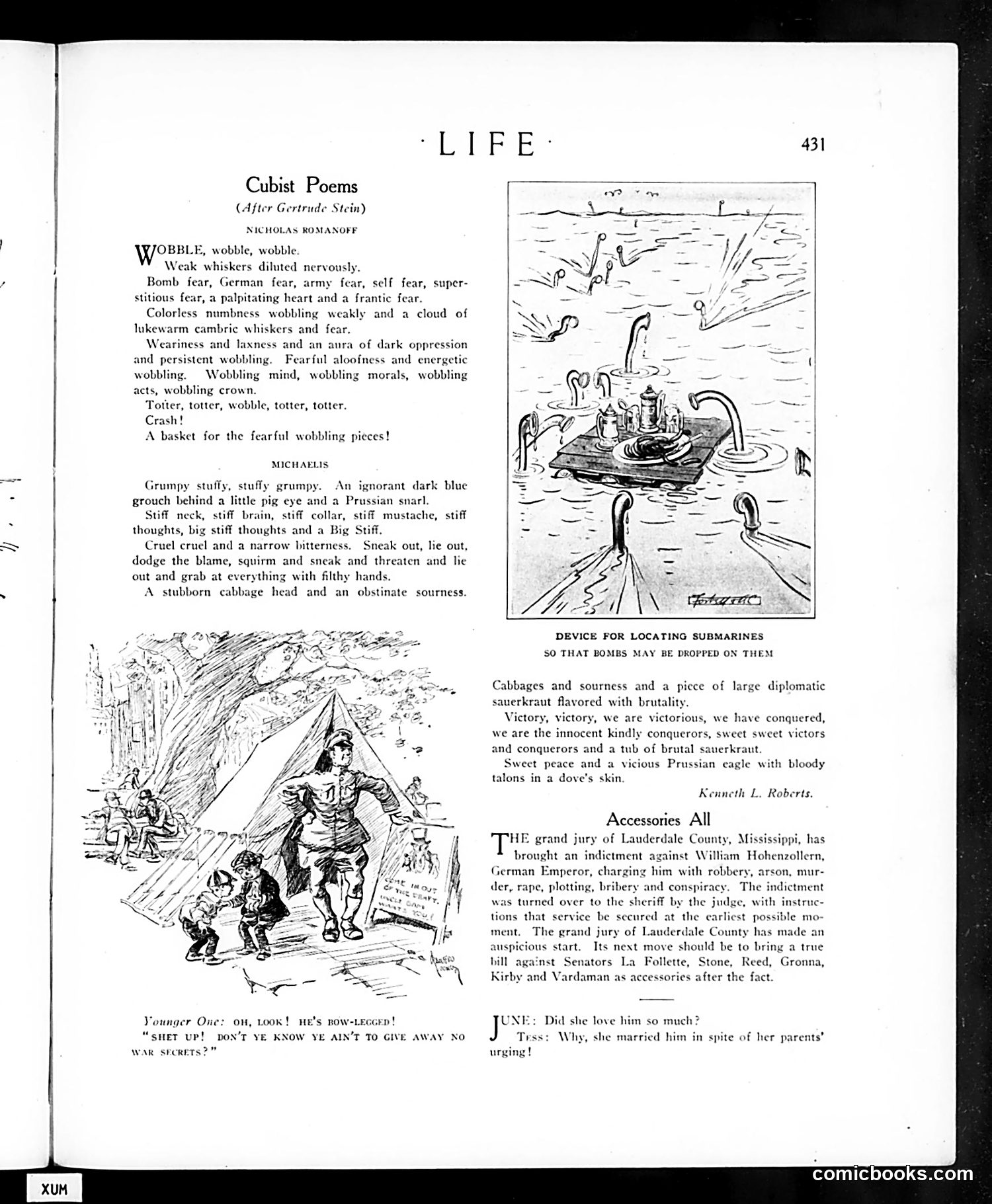
This page satirizes **German militarism and American anti-German sentiment during World War I**. The "Cubist Poems" mock **Gertrude Stein's experimental writing style** while using fragmented language to caricature German character traits—the first poem depicts fear and instability ("wobble, totter, crash"), while the second brutally describes a "Prussian" figure as crude, deceptive, and brutal ("stubborn cabbage head"). The cartoon illustration shows a submarine detection device with tentacle-like sensors in water—a contemporary WWI military innovation. "Accessories All" sarcastically suggests indicting **Kaiser Wilhelm II** for war crimes, then pivots to mock American **anti-war senators** (La Follette, Stone, Reed, Gronna, Kirby, Vardaman) as "accessories after the fact"—accusing them of complicity by opposing U.S. war involvement. The bottom dialogue jokes about wartime security concerns. Overall, this reflects **American pro-war propaganda and disdain for German culture and pacifist politicians** circa 1917-1918.
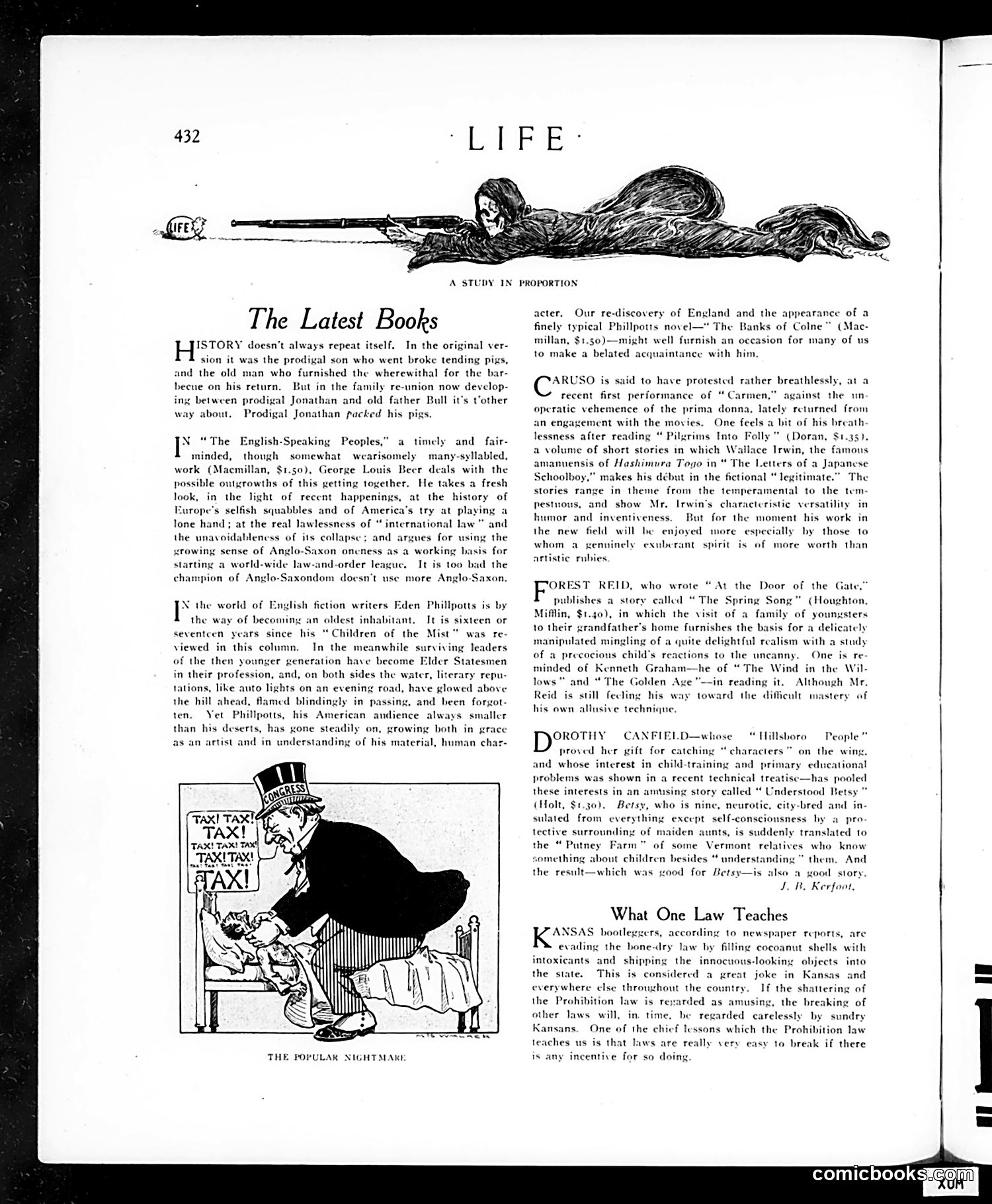
This page combines book reviews with one political cartoon titled "The Popular Nightmare." **The Cartoon's Satire:** The illustration depicts a taxi driver overwhelmed by passengers demanding rides—his cab labeled repeatedly with "TAXI" appears under siege. This satirizes the "taxi problem" of the 1920s, when unlicensed cabs and chaotic street transportation plagued American cities. The cartoon mocks both the proliferation of taxis and drivers' inability to manage demand. **Book Reviews Context:** The "Latest Books" section reviews contemporary literature, including works on Anglo-Saxon relations and English fiction. One review mentions "The English-Speaking Peoples," discussing international law and Anglo-Saxon cooperation—likely referencing post-WWI discussions about American-British relations. **The Opening Metaphor:** The page's header uses the prodigal son parable, suggesting America ("prodigal Jonathan") and Britain ("father Bull") reconciling after America's independent foreign policy—a timely 1920s reference to renewed transatlantic cooperation. The cartoon and text together reflect 1920s urban anxieties and geopolitical realignment following World War I.
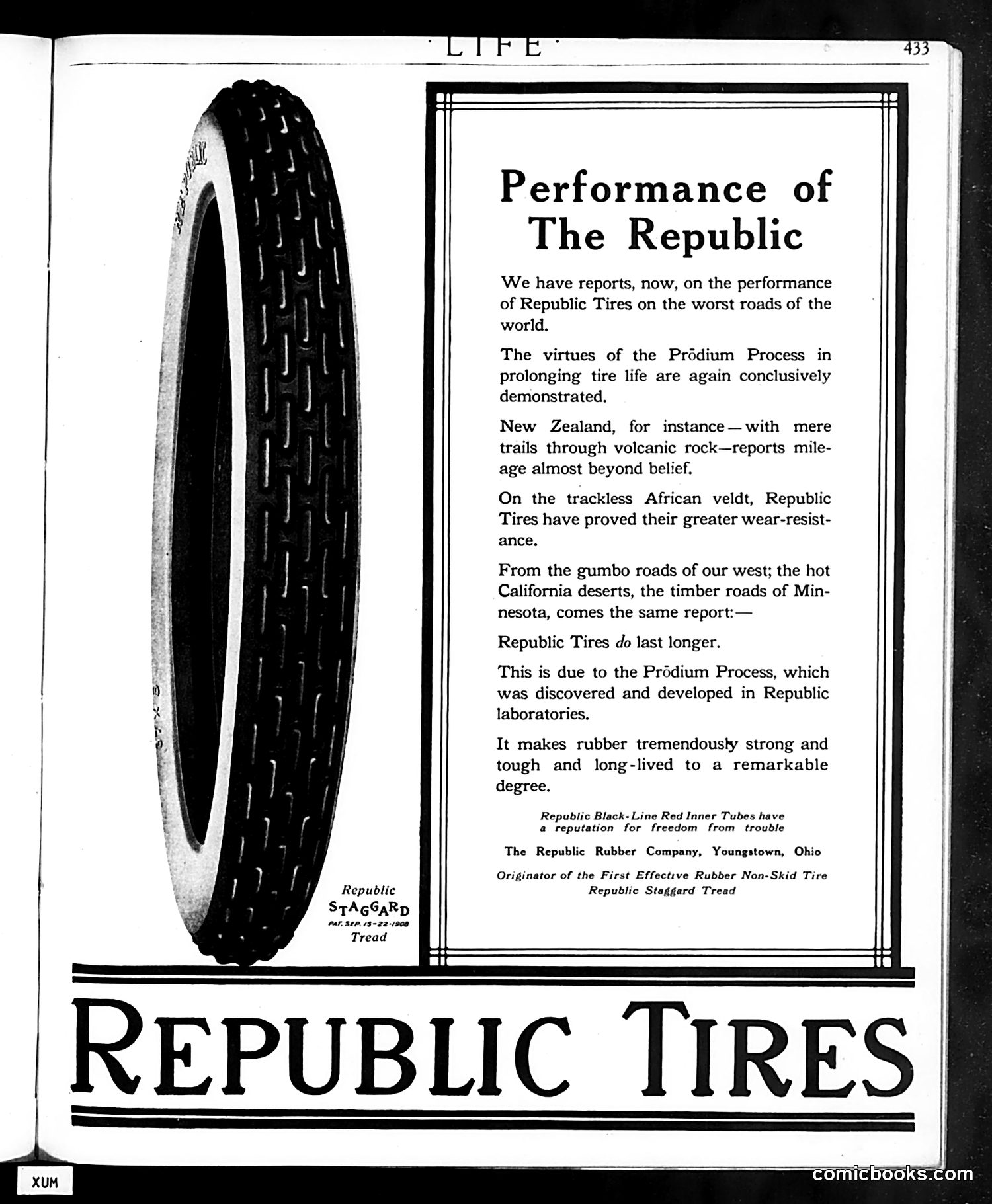
This is a **tire advertisement**, not satire or political commentary. It's a straightforward commercial for Republic Tires, published in *Life* magazine (page 433). The ad promotes Republic brand automobile tires using the "Prödium Process," claiming superior durability tested worldwide—New Zealand volcanic roads, African terrain, American desert and timber roads. The company emphasizes their tires "last longer" due to this proprietary rubber treatment. The page features an image of the "Staggard Tread" tire design on the left. Republic Rubber Company, based in Youngstown, Ohio, claims to have invented the first effective rubber non-skid tire and highlights their "Black-Line Red Inner Tubes." There is **no cartoon or satire here**—this is simply period advertising using testimonial-style claims about real-world tire performance to market their product to consumers.
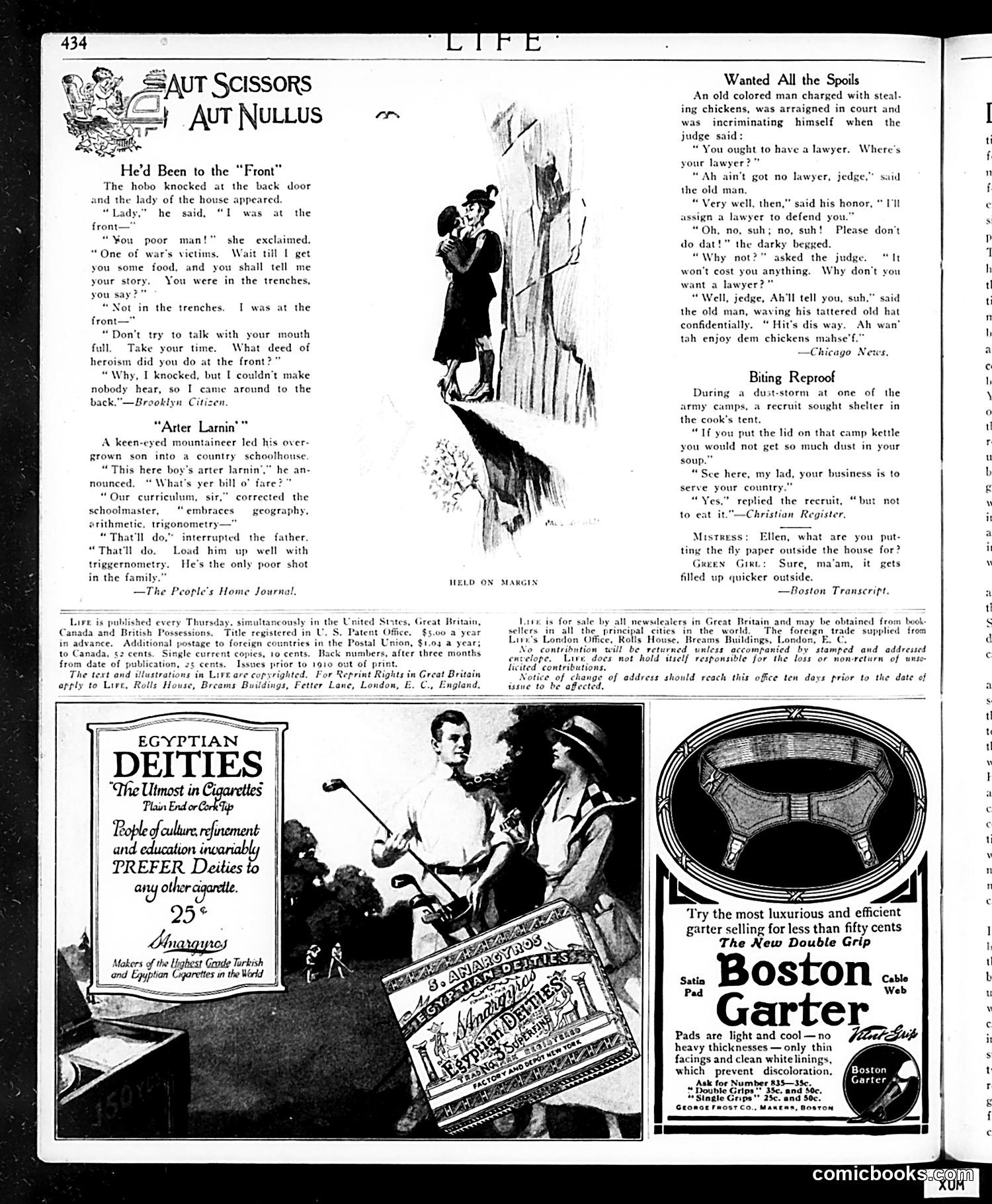
This page contains three humorous short stories satirizing American social types: **"He'd Been to the Front"**: A hobo tricks a sympathetic lady by claiming WWI service. When she offers him food, he reveals his "heroism" was simply knocking on a back door—satirizing both false war heroics and vagrant panhandling. **"After Larnin'"**: A rural mountaineer enrolls his son in school, asking what subjects are taught. When the teacher mentions trigonometry, the father requests the boy be "loaded up well" with it—the joke being he's mispronounced it as "trigger-nometry" and wants his son trained as a good shot, not educated. This mocks rural anti-intellectualism. **"Wanted All the Spoils"**: An elderly Black defendant charged with stealing chickens refuses a court-appointed lawyer, explaining he wants to enjoy the chickens himself—a crude racial stereotype joke portraying Black criminality and appetite. The remaining content is period advertising (Egyptian Deities cigarettes, Boston Garter).
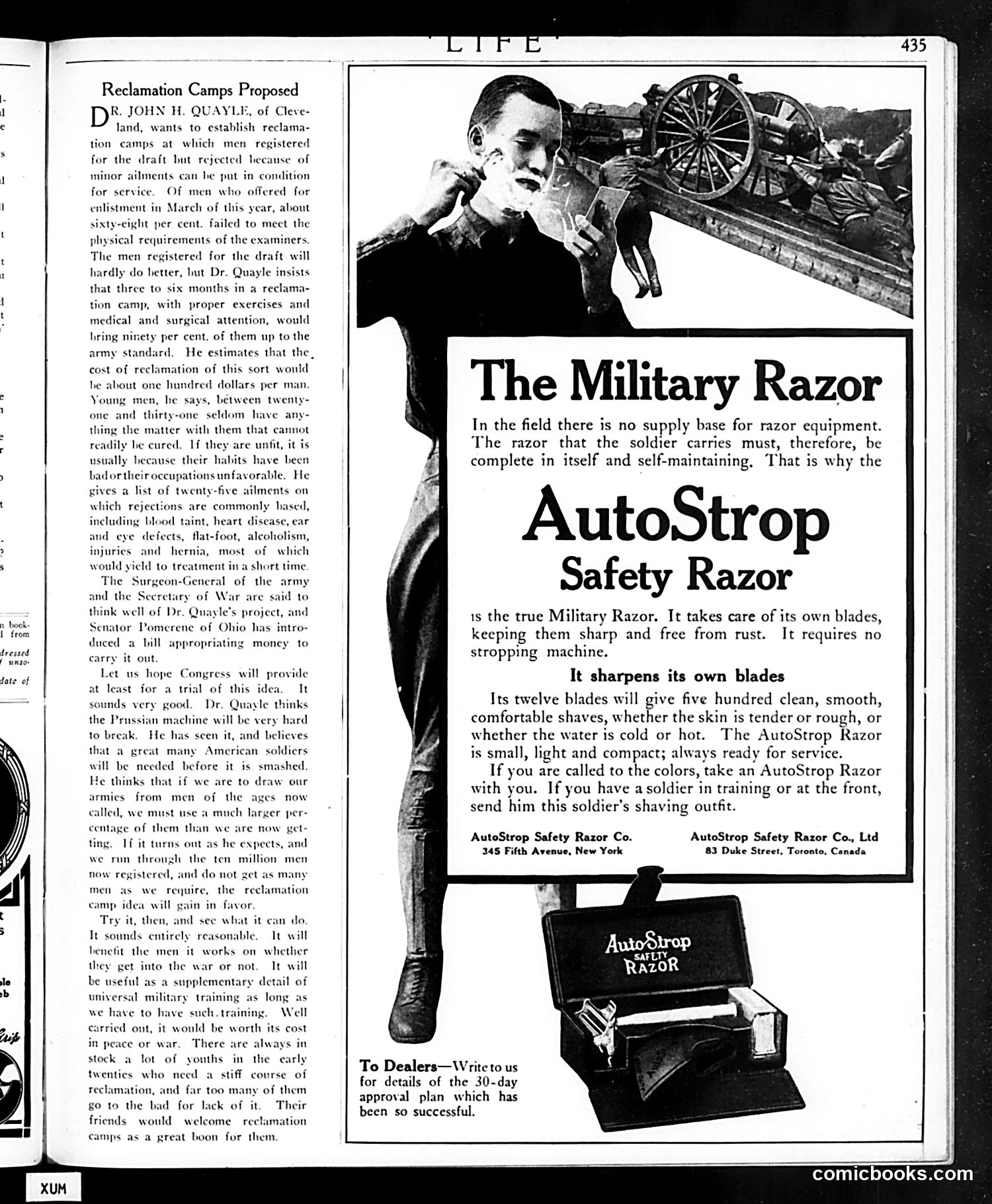
This page combines editorial content with advertising, both addressing military preparedness during World War I. **Left Column - Editorial Content:** The article discusses Dr. John H. Quayle's proposal for "reclamation camps" to rehabilitate draft-registered men rejected for minor physical ailments. Approximately 68% of March enlistees failed physical exams. Quayle argues three to six months of exercise and medical treatment could bring 90% up to Army standard at roughly $100 per man. The writer endorses the idea as reasonable and efficient, noting it would help the many young men who fail due to poor habits or unfavorable occupations rather than incurable conditions. **Right Side - Advertisement:** An AutoStrop Safety Razor ad capitalizes on military interest by marketing the product as "the true Military Razor"—self-sharpening, compact, and requiring no external equipment, making it ideal for soldiers in the field. The ad explicitly targets soldiers and those sending care packages to the front. Both elements reflect 1917-1918 anxieties about American military capacity and the physical fitness of the draft pool.
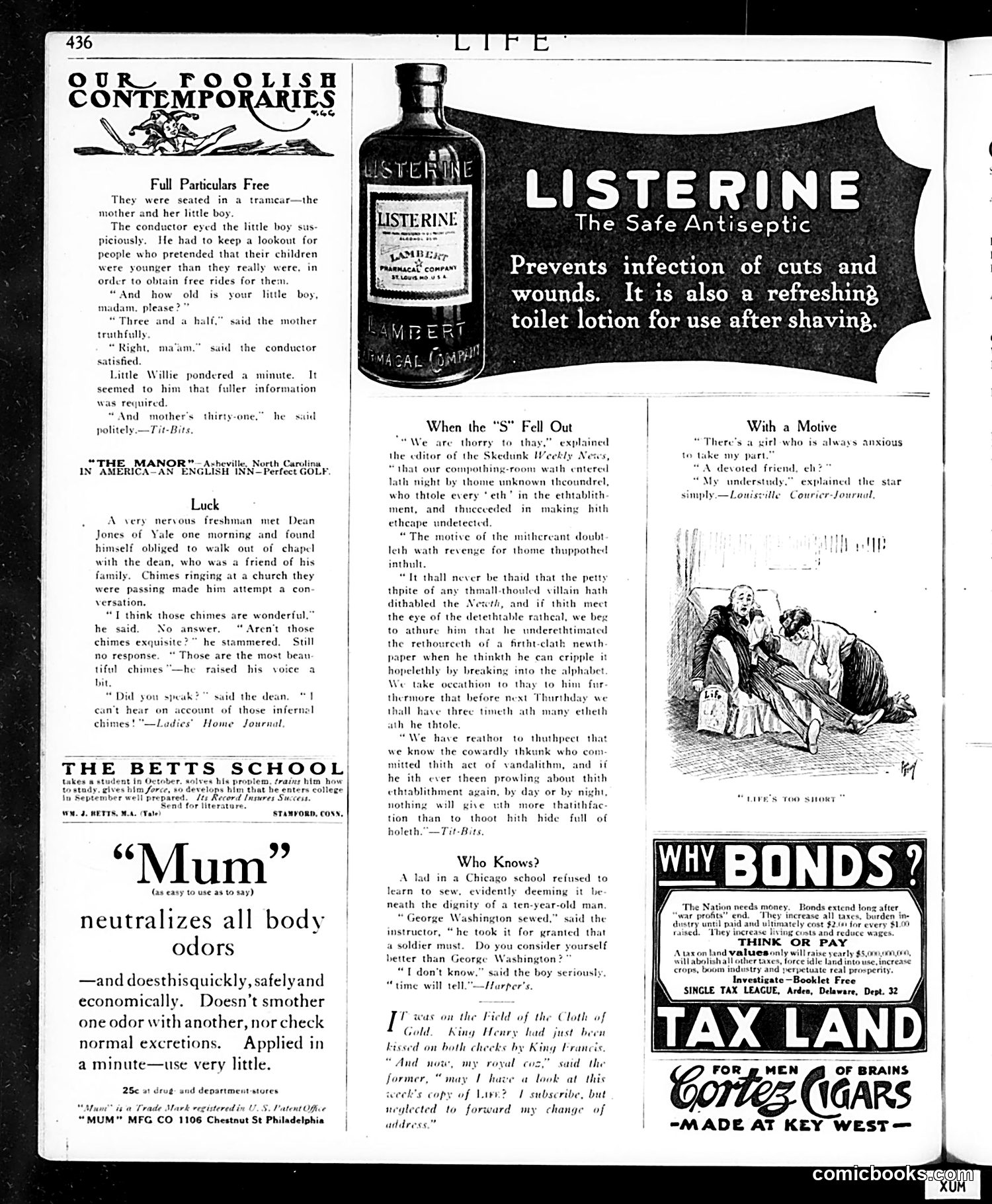
This page from *Life* magazine contains several short humorous anecdotes typical of early 20th-century satirical journalism: **"Our Foolish Contemporaries"** presents brief comedic stories mocking human behavior. One anecdote satirizes parents falsifying children's ages to avoid paying tramcar fares. Another mocks a socially awkward Yale freshman's failed attempts at conversation with a deaf dean. A third ridicules a newspaper editor whose typesetting room was robbed of all the letter "S," forcing him to write in an exaggerated lisp. **"Who Knows?"** jokes about a boy who refuses to learn sewing, claiming he needn't follow George Washington's example—implying he may surpass Washington's accomplishments. The final anecdote plays on misunderstanding: a woman who "always takes my part" is revealed to be a romantic interest, not a loyal friend. These pieces rely on wordplay, situational irony, and gentle mockery of pretension and social awkwardness—common themes in *Life*'s humor.
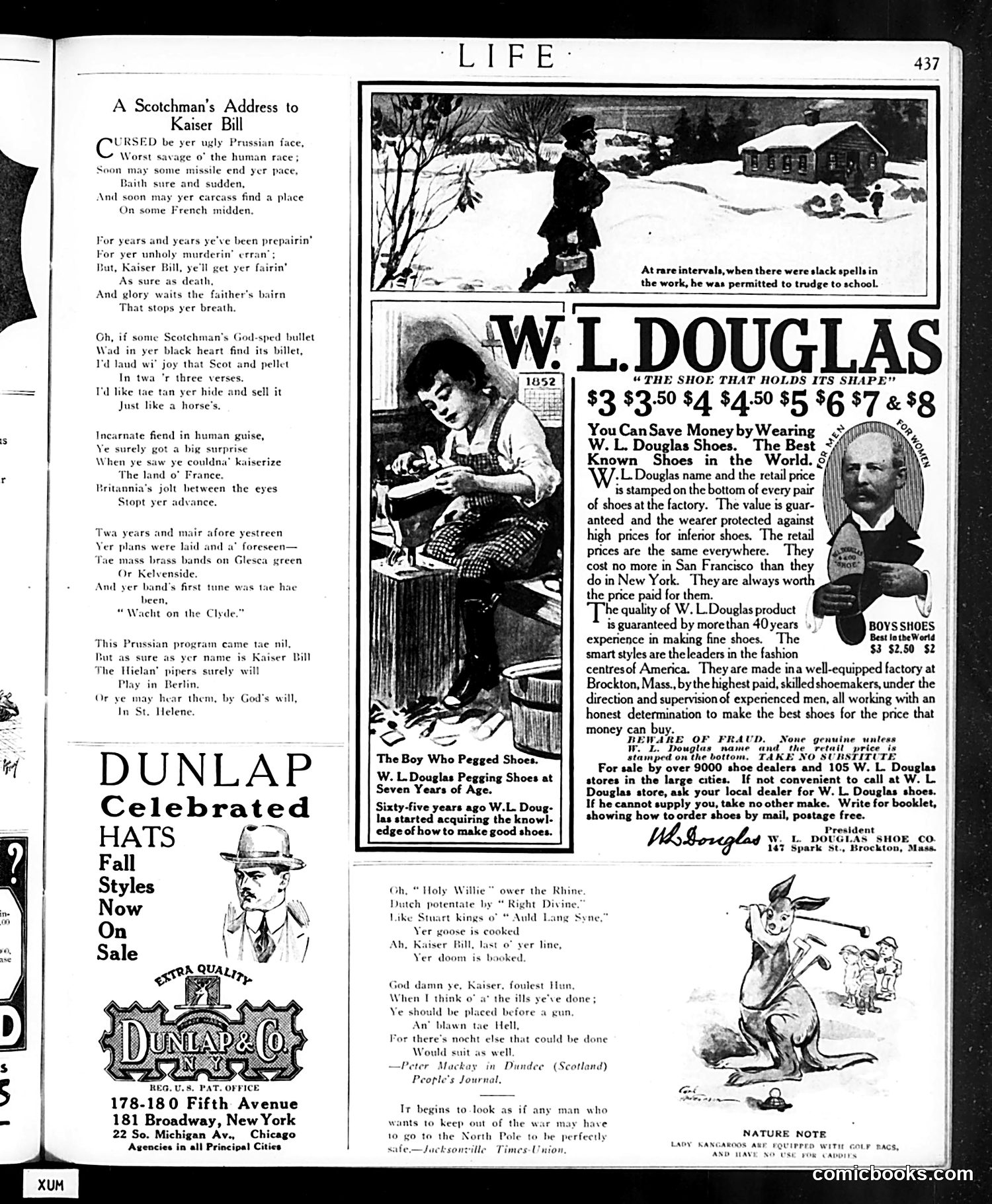
This page contains **anti-German World War I propaganda** disguised as editorial and advertising content. **The Main Poem:** "A Scotchman's Address to Kaiser Bill" is a scathing Scottish-dialect curse against Kaiser Wilhelm II of Germany. It celebrates his anticipated death and promises Scottish soldiers will play bagpipes victoriously in Berlin. Written for a British/Allied audience, it mocks the Kaiser as a "Prussian" villain who planned invasion and threatens divine retribution. **The Accompanying Cartoon:** Shows a young boy ("The Boy Who Pegged Shoes") at work—illustrating W.L. Douglas shoe advertisements. The caption notes he attended school "when there were slack spells in the work," evoking sympathy for child labor while selling shoes. **The Satire:** Life magazine uses patriotic war sentiment to sell consumer goods. The shoe ad claims Douglas shoes are the "best known shoes in the world," while the poem whips up anti-Kaiser fervor. The juxtaposition suggests buying American products supports the war effort. This represents how wartime propaganda infiltrated mainstream American publications during WWI.
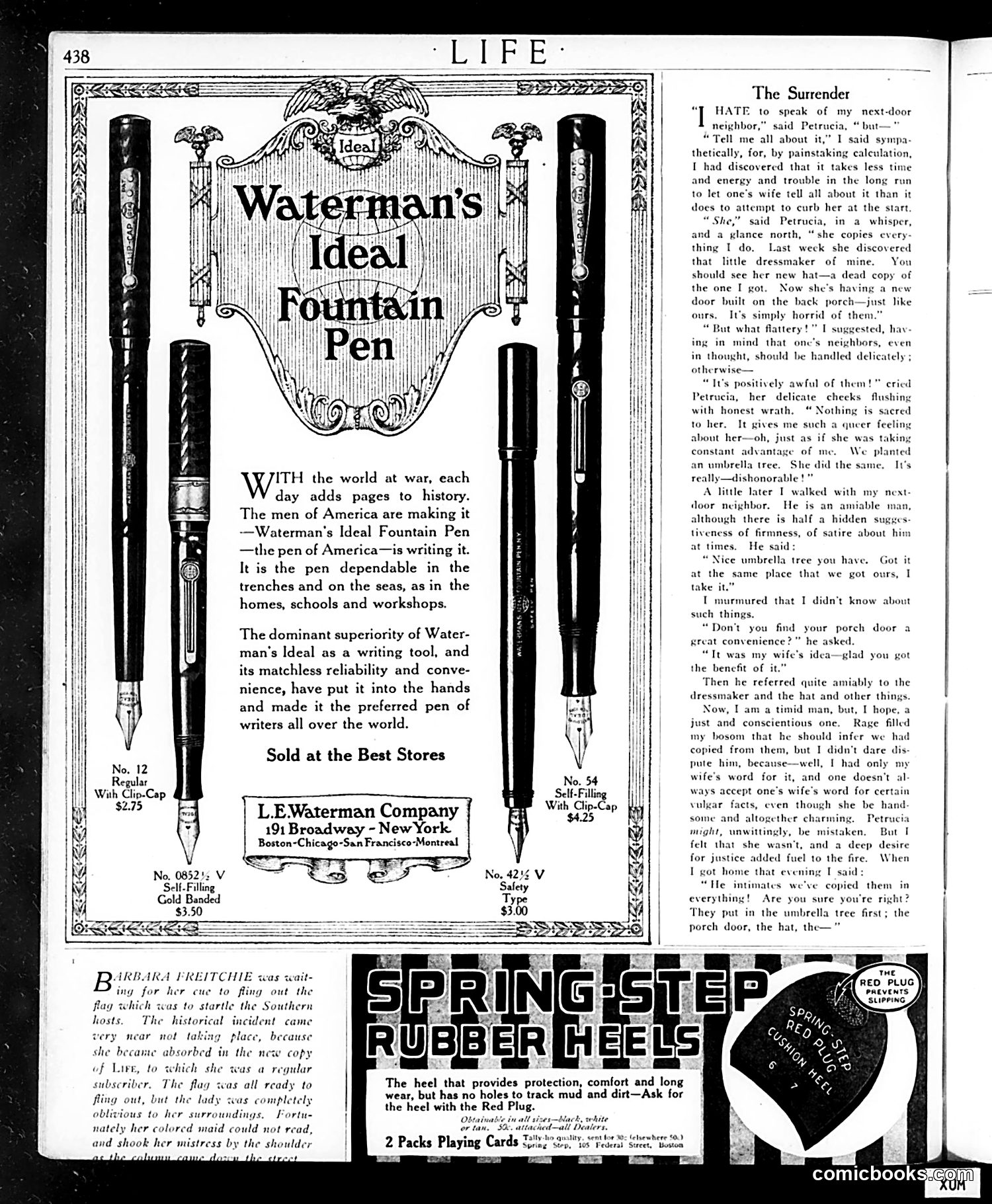
This page contains **advertisements and a short story**, not political cartoons. **The Advertisements:** - **Waterman's Ideal Fountain Pen**: A wartime ad emphasizing American soldiers use this pen in trenches and at sea. The copy appeals to patriotism during WWI ("with the world at war"). - **Spring-Step Rubber Heels**: Promotes a heel design that doesn't track mud indoors. **"The Surrender" Story:** A domestic humor piece about a woman (Petrucia) whose neighbor copies everything she does—her dressmaker, hat, umbrella tree, and back-porch door. When the narrator confronts the male neighbor, he claims *they* copied *him*. The story satirizes domestic rivalry between neighbors and marital miscommunication: the narrator can't verify his wife's claims but suspects she might be wrong, yet won't challenge her directly. The "surrender" title suggests the narrator's resignation to accepting his wife's version despite doubt—a common trope of 1910s-20s domestic humor mocking hen-pecked husbands.
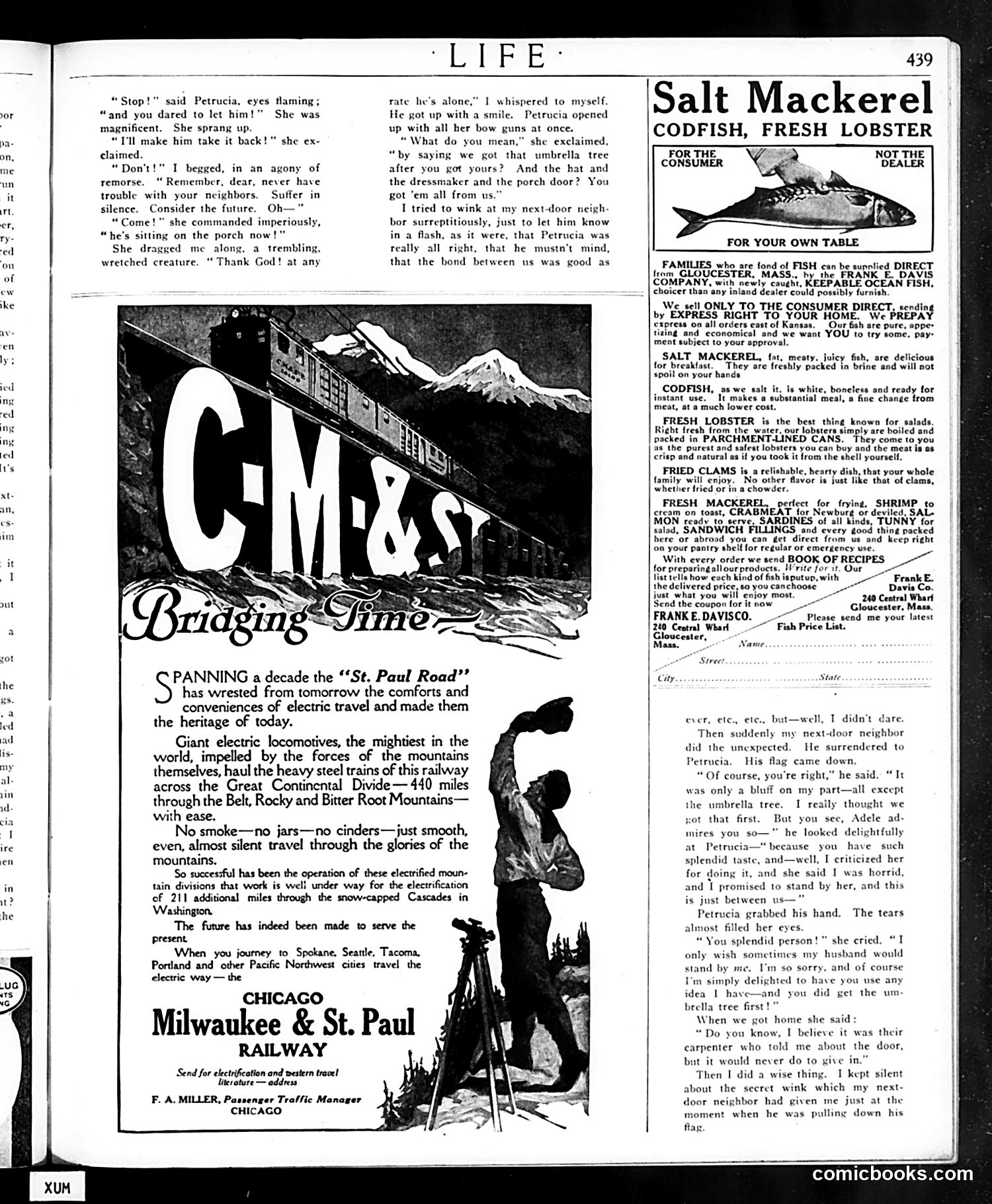
This page contains a serialized domestic comedy narrative (left column) about a marital dispute over neighbors' possessions, followed by a railroad advertisement and fish-product ads (right side). **The Narrative's Point:** The story satirizes suburban neighbor rivalry and one-upmanship—a common post-WWI American social anxiety. The protagonist's wife Petrucia aggressively confronts their neighbor over who acquired household items first (an umbrella tree, hat, dressmaker access, porch door). The husband attempts peacekeeping through embarrassed silence, but the neighbor ultimately "surrenders," admitting the dispute was a bluff except for the umbrella tree. **The Satire:** The piece mocks status-conscious materialism and competitive domesticity among the middle class, while also gently ridiculing masculine conflict-avoidance when wives assert dominance. The "bridging" theme—shown in the mountain locomotive illustration—metaphorically connects to resolving social divides. The surrounding advertisements (fish products, railroad travel) represent the commercial conveniences defining modern American leisure and consumption.
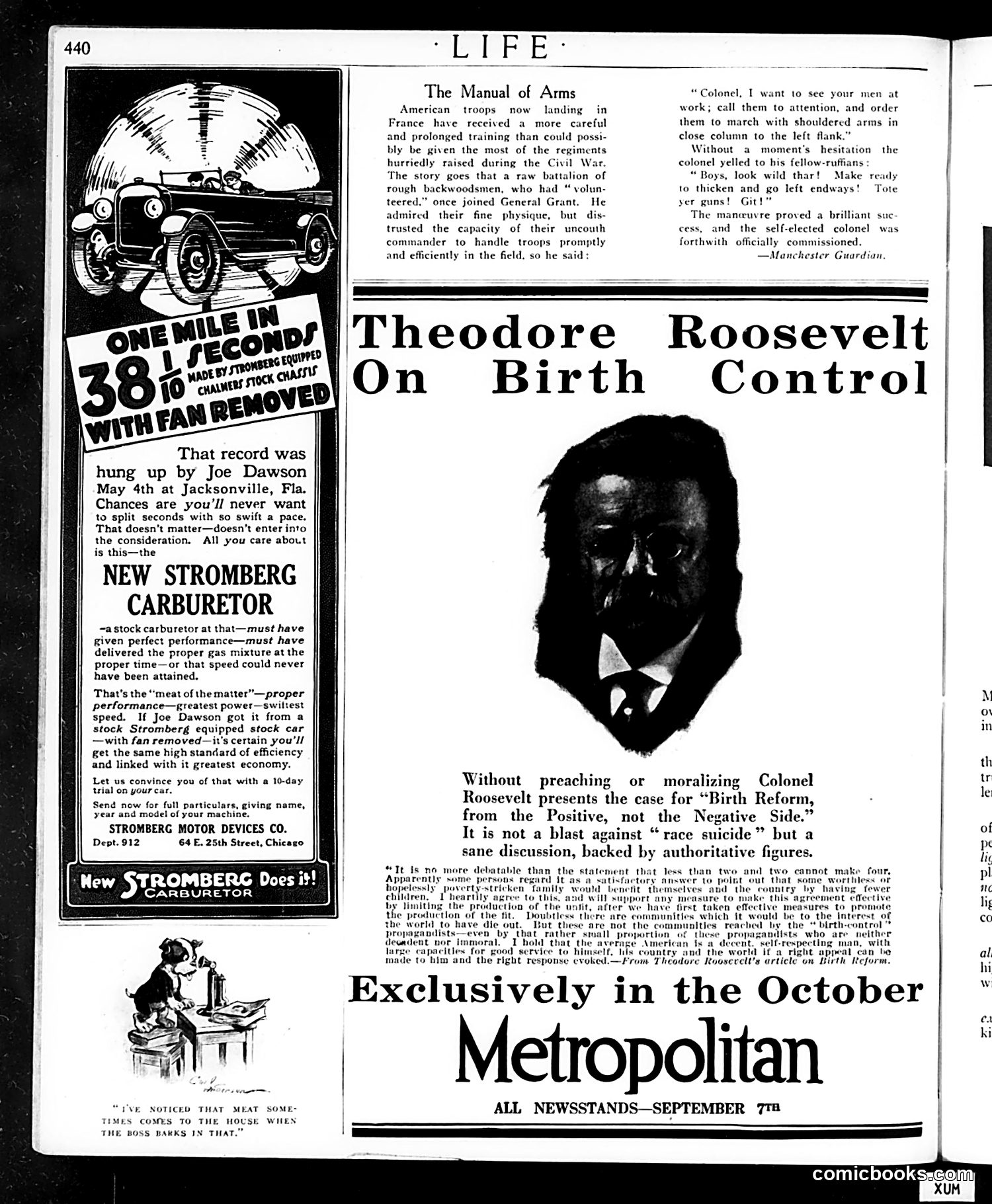
This page mixes automobile advertising with political/social commentary typical of *Life* magazine's satirical style. **The Advertisements:** The Stromberg Carburetor ad prominently features a speed record (Joe Dawson, May 4th, Jacksonville), using automotive performance as a selling point—standard early 1900s marketing. **The Editorial Content:** The main feature announces Theodore Roosevelt's article on "Birth Control" in the upcoming *Metropolitan* magazine. The accompanying portrait and text frame this as a reasoned, data-driven discussion of family planning "from the Positive, not the Negative Side"—presented as progressive and factual rather than moralistic. **Historical Context:** This appears to address Roosevelt's post-presidency advocacy for controlled reproduction, framed here as rational policy discussion. The emphasis on "authoritative figures" and avoiding "race suicide" rhetoric suggests an attempt to present birth control as scientific rather than radical—a notable position for the era. The page primarily advertises the upcoming article rather than satirizing it directly.
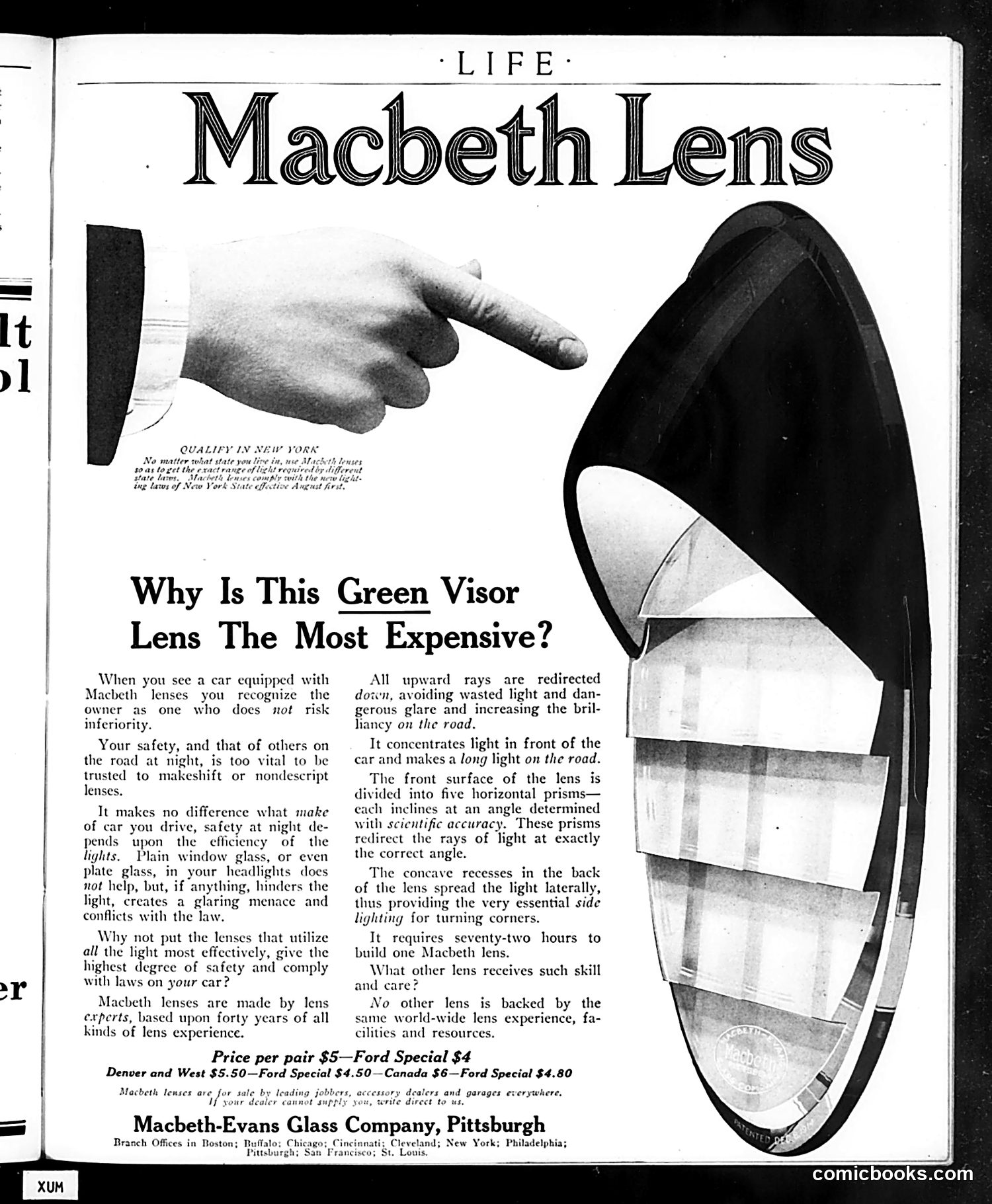
This is **not a cartoon or satire**—it's a straightforward product advertisement for automobile headlight lenses from the Macbeth-Evans Glass Company of Pittsburgh. The page promotes premium "green visor" lenses for car headlights, targeting safety-conscious drivers. The image shows the lens design and a hand pointing to demonstrate quality. The ad argues that ordinary window or plate glass in headlights creates dangerous glare and is legally problematic, while Macbeth lenses—engineered with five prismatic surfaces and taking 72 hours to manufacture—properly direct light downward and laterally for safe nighttime driving. The sales pitch equates purchasing Macbeth lenses with avoiding "inferiority" and demonstrates social status. Pricing varied by car model (Ford Special priced lower). This reflects early-20th-century automotive safety marketing, when quality headlight equipment was still a luxury concern rather than a standard feature.
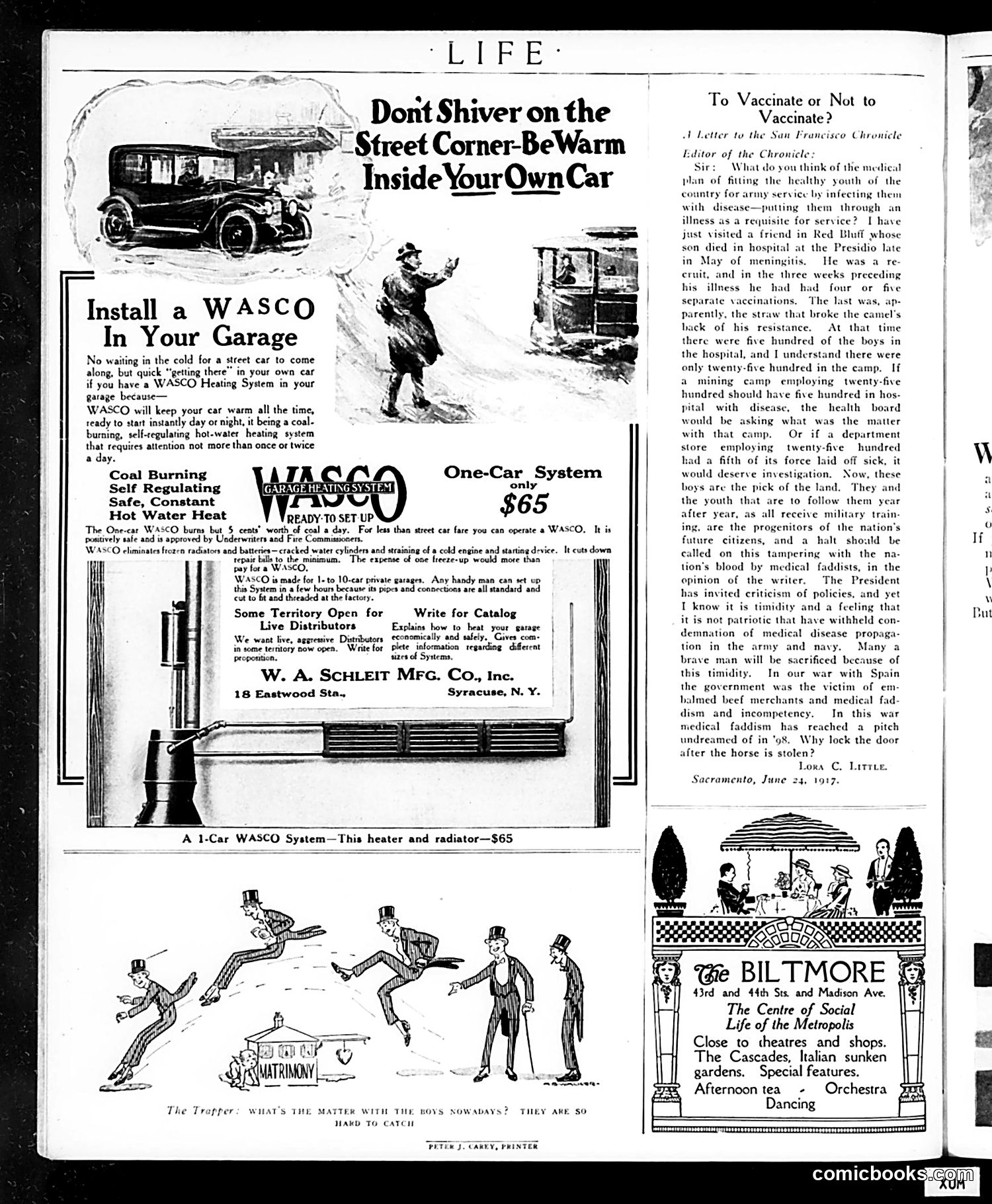
This page mixes advertising with social commentary circa 1917. The main advertisement promotes the WASCO car heating system ($65), promising warmth without waiting at street corners. The substantive content is a letter debating mandatory military vaccinations. The writer, Lora C. Little from Sacramento, criticizes the practice of vaccinating healthy young recruits, claiming it causes illness rather than prevents it. She cites a friend's son who died of meningitis at the Presidio after receiving multiple vaccinations, and notes that 500 of 2,500 soldiers in a camp were hospitalized. Little argues this medical policy is reckless and unpatriotic, comparing it unfavorably to incompetence during the Spanish-American War. She invokes President Wilson's call for criticism of policies, suggesting withholding such criticism itself constitutes disloyalty. The cartoon at bottom ("The Trapper") appears unrelated—a humorous illustration about difficulty catching boys. The historical context: This reflects anti-vaccination sentiment during WWI military mobilization, before modern understanding of vaccines' mechanisms.
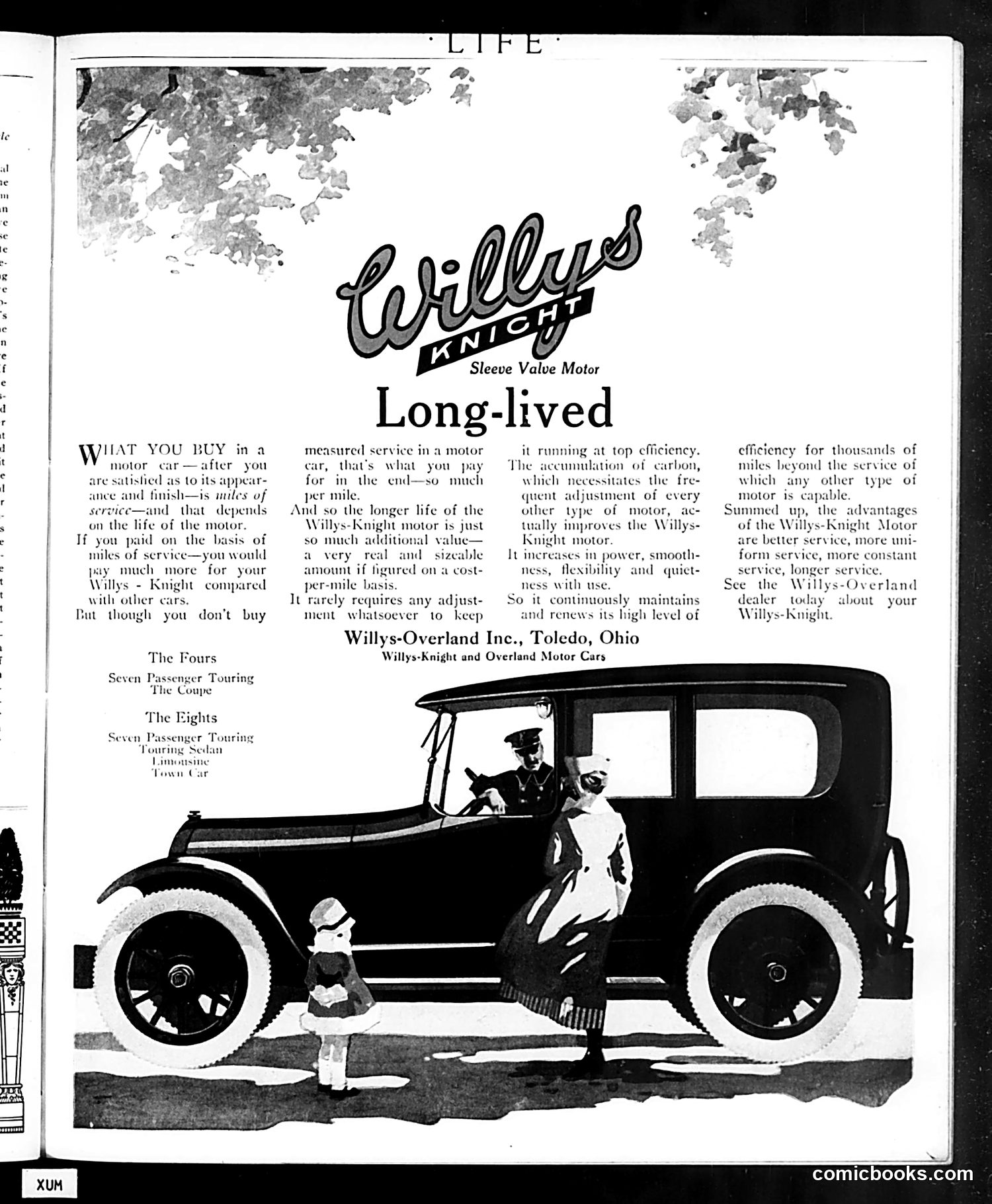
This is **not a political cartoon or satire**—it's a straightforward automobile advertisement for Willys-Knight motor cars, published in *Life* magazine. The page promotes the Willys-Knight's "Sleeve Valve Motor," emphasizing its longevity and cost-efficiency. The argument is that while buyers don't directly pay per mile of service, the Willys-Knight's longer motor life represents exceptional value compared to competitors. The illustration shows a well-dressed chauffeur helping a woman and child into a Willys-Knight touring car, depicting the vehicle as reliable, family-safe, and respectable—typical marketing imagery of the 1920s era. There is no satire or political commentary here. This represents *Life*'s substantial advertising revenue from major manufacturers during this period.
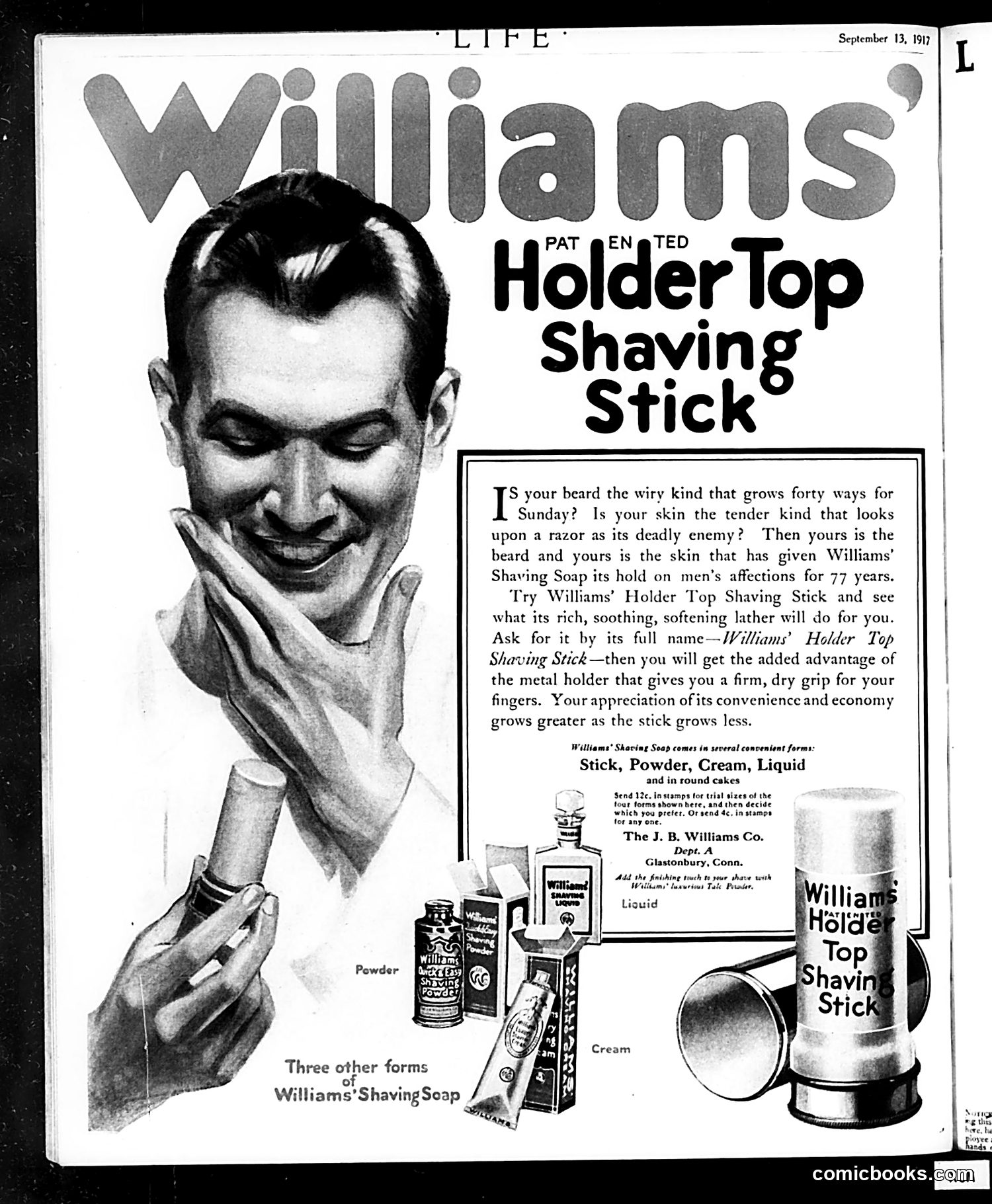
This is **not a cartoon or satire—it's a straightforward advertisement** for Williams' Holder Top Shaving Stick, published in *Life* magazine on September 13, 1917. The page features a large photograph of a man with his hands near his face in a satisfied expression, promoting the shaving product. The ad copy addresses common grooming concerns of the era: difficult beards and sensitive skin prone to razor irritation. It emphasizes the product's 77-year history and highlights the convenience of the metal holder that provides a firm grip as the stick diminishes. The ad lists multiple product forms (stick, powder, cream, liquid) and offers trial sizes for interested consumers. While *Life* was known for satire and humor, **this particular page is purely commercial product advertising**—typical of early 20th-century magazine marketing, which often occupied significant space alongside editorial content.