
Life, 1917-09-13 · page 25 of 44
Life — September 13, 1917 — page 25: what you’re looking at
What you’re looking at
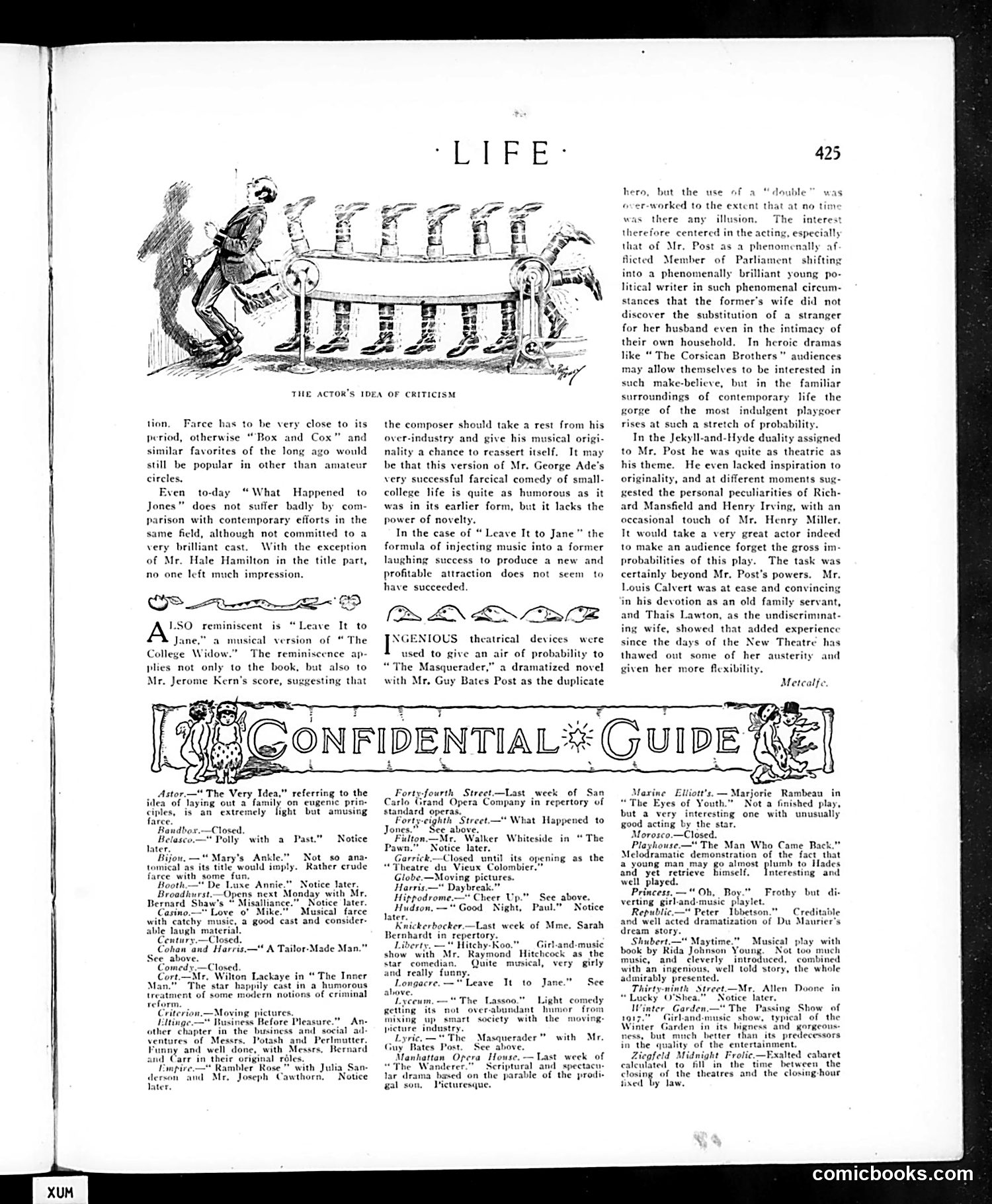
The cartoon depicts a theatrical critic as a mechanical device—a printing press or stamp machine—with an actor operating it. This satirizes theater critics as mere mechanical reproducers of conventional opinions rather than thoughtful analysts. The accompanying text reviews contemporary Broadway productions, discussing "What Happened to Jones," "Leave It to Jane" (a musical adaptation), and "The Masquerader" starring Guy Bates Post. The critique suggests that adapting older comedies with new music (like Jerome Kern's score) fails to capture the original's appeal through novelty alone. The "Confidential Guide" section lists current theater offerings with brief notices—many shows "closed," others receiving lukewarm assessments. The overall tone mocks both theatrical trends and critical conventions of the era, suggesting critics operated formulaically rather than offering genuine insight into performances.
📄 Transcribed text from this page (OCR, searchable)
Machine-transcribed from the original scan — historical spelling and the odd misread are preserved.
XUM THE ACTOR'S IDEA OF CRITICISM tion, Farce has to be very close to its period, otherwise “Box and Cox” and similar favorites of the long still be popular in other than amateur circles. Even to-day “What Happened to Jones” does not suffer badly by com- parison with contemporary efforts in the same field, although not committed to a very brilliant cast. With the exception of Mr. Hale Hamilton in the title part, no one left much impression. OP 4 ee OD. fis? reminiscent is “Leave It to Jane.” a musical version of “ The College Widow.” The reminiscence ap- plies not only to the book, but also to Mr. Jerome Kern's score, suggesting that go would Astor.—" The Very Ide: referring to the idea of laying out a family on eugenic prin- ciples, is an extremely fight but amusing arce. Bandbox.—Closed, as Belasco.—" Polly with a Past." Notice later. ".—" Mary's Ankle.” Not so ana- s its title would imply. Rather crude ce with some fun. Booth.—" De Luxe Annie.” Notice later Broadhurst.—Opens next Monday with Mr. Bernard Shaw's “ Misalliance.” Notice later. Casino." Love 0’ Mike.” Musical farce with catchy music, a good cast and consider- able laugh material. Century.—Closed. Cohan and Harris,— A Tailor-Made Man.” See above. Comedy. —Closed. Cort.—Mr, Wilton Lackaye in “ The Inner Man." The star happily cast_in a humorous treatme: odern notions of criminal pictures. ; ness Refore Pleasure.” | An- other chapter in the business ventures of Messrs, Potash and Perlmutter. Ki 1 well done, with Messrs, Rernard and Carr in their original réles. Empire-—* Rambler Rose.” with Julia San- derson and Mr, Joseph Cawthors, Notice later. the composer should take a rest from his over-industry and give his musical origi- nality a chance to reassert itself. It 1 be that this version of Mr. George Ade’s very successful farcical comedy of small- college life is quite as humorous as it was in its earlier form, but it lacks the power of novelty. In the case of “ Leave It to Jane” the formula of injecting music into a former laughing success to produce a new and profitable attraction does not seem to have succeeded. NGENIOUS theatrical devices were used to give an air of probability to “The Masquerade: a dramatized novel with Mr, Guy Bates Post as the duplicate NFIDENTIAL* GUIDE Forty-fourth Street—Last week of San Carlo Grand Opera Company in repertory of standard opera: Forty-eighth Street—" What Happ 8.” See abov ilton.—Mr. Walker W! Pawn.” Notice later. Garrick.—Closed until its. openi “Theatre du Vieux Colombier.” Globe,—Moving pictures. Harris.—" Daybreak.” Hippodrome.—* Cheer Up." See abo ad itdson. =" Good Night, Paul.” ater. Knickerbocker.—Last week of Mme, Sarah Bernhardt in repertory. Liberty. —** Hitchy-Koo.” Girl-and-music show with Mr, Raymond Hitchcock as the star comedian. Quite musical, very girly and really funi Longacre. —""Leave It to L ©." See The Lasoo.” Light comedy getting its not over-abundant humor from mixing up smart society with the moving picture industry Lyric. — "The Masquerader” with Mr. Guy Bates Post. § above. Manhattan Opera House, —Last week of “The Wanderer.” Scriptural and spectaca- Jar drama based on the parable of the prodi- gal son, Victuresque. 425 hero, but the use of a “double” was over-worked to the extent th “ he interest therefore centered in the acting ally that of Mr, Post as a phenomenally af flicted Member of Parliament shifting into a phenomenally brilliant young po- litical writer in such phenomenal circum- stances that the former's wife did not discover the substitution of a stranger for her husband even in the intimacy of their own household. In heroic dramas like “ The Corsican Brothers” audiences may allow themselves to be interested in such make-believe, but in the fam surroundings of contemporary life the gorge of the most indulgent playgoer rises at such a stretch of probability. In the Jekyll-and-Hyde duality assigned to Mr, Post he was quite as theatric as his theme. He even lacked inspiration to originality, and at different moments sug- xested the personal peculiarities of Rich- ard Mansfield and Henry Irving, with an occasional touch of Mr. Henry Miller. It would take a very great actor indeed to make an audience forget the gross im- probabilities of this play. The task was certainly beyond Mr. Post's powers. Mr. Louis Calvert was at ease and convincing in his devotion as an old family servant, and Thais Lawton, as the undiscrimimat- ing wife, showed that added experience since the days of the New Theatre has thawed out some of her austerity and given her more flexibility. s there any illusion, esp Metcalfe. Marine Elliott's. — Marjorie Rambeau in “The Eyes of Youth.” Not a finished play, but a very interesting one with unusually good acting by the star. Morosco.—Closed. Playhouse.—" The Man Who Came Back. Melodramatic demonstration of the fact that a young man may go almost plumb to Hades and yet retrieve himself. Interesting and well played. Princess, —“ Ob, Boy." verting girl-and-music playlet. Republic.—* Peter Ibbetson." Cre and ‘well acted dramatization of Du Maurier's dream story ubert,—" Maytime.”” Musical p! book by Rida Johnson Young. Not t music, and cleverly introduced, co: with an ingenious, well told story, the whole admirably presented. Thirty-ninth Street—Mr, Allen Doone in “Lucky O'Shea.” Notice iater Winter Garden.—* The Passing Show of 1917." Girkand-music show, typical of Winter Garden in its bigness and gorgeous: ness, but much better than its predecessors in the quality of the entertainment, Ziegfeld Midnight Frolic.—Exalted cabaret lated to fill in the time between the closing of the theatres and the closing-hour fixed by law. Frothy but di- comicbooks.com