
Life, 1917-09-13 · page 18 of 44
Life — September 13, 1917 — page 18: what you’re looking at
What you’re looking at
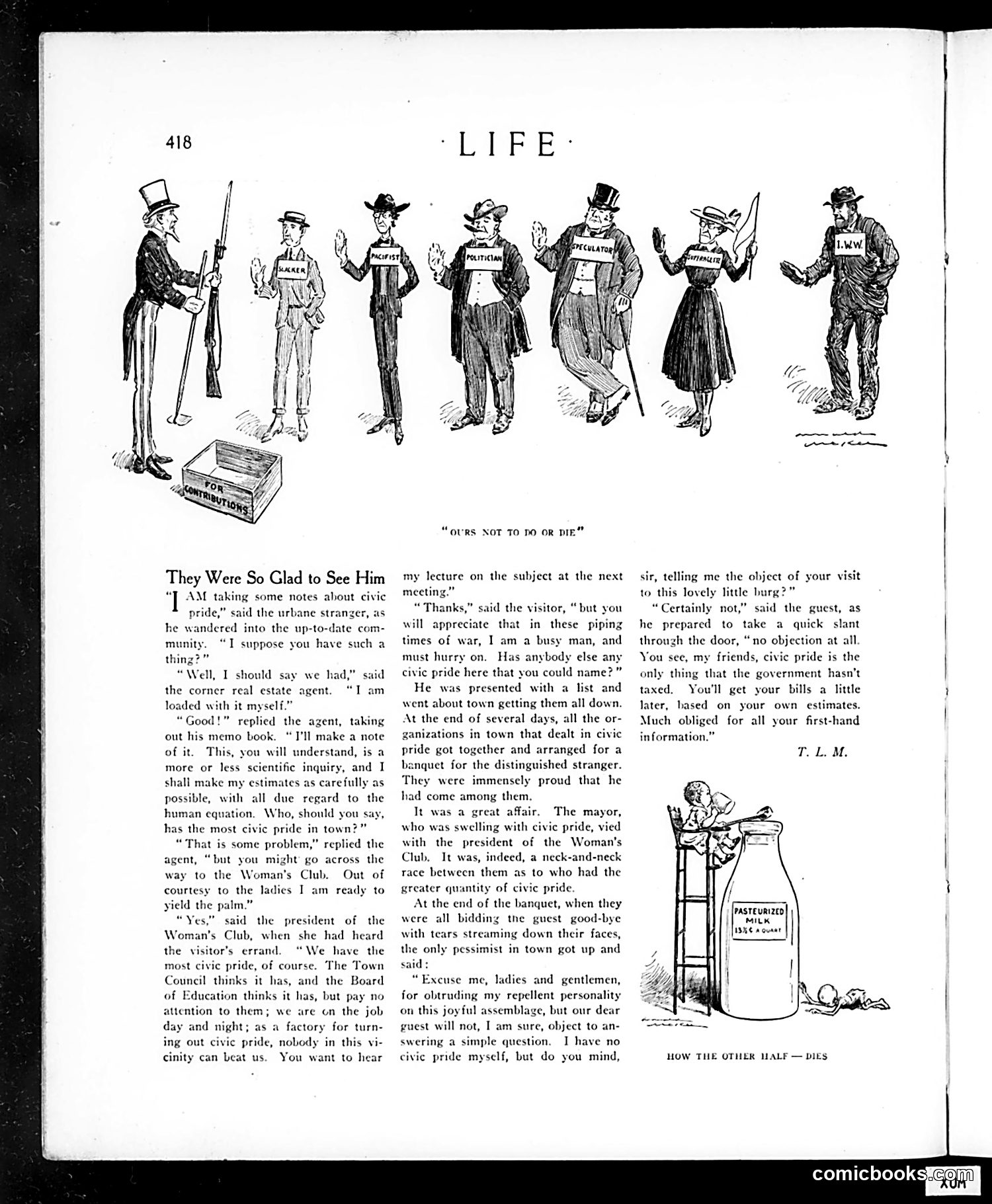
This satirical story mocks small-town civic pride during World War I (referenced as "piping times of war"). A visiting stranger claims to study "civic pride," prompting various community organizations—the real estate agent, Woman's Club, mayor, and Board of Education—to boast they possess the most. Each group competes to demonstrate their civic virtue. The punchline reveals the con: the visitor is a tax assessor. He's gathered detailed information about the town's prosperity under the guise of research, which will be used to calculate property taxes. The final line—"civic pride is the only thing that the government hasn't taxed"—exposes the joke: the townspeople's boastfulness about their community's success has inadvertently provided evidence justifying higher taxation. The cartoon at top shows various civic-minded figures (labeled) presenting themselves. The satire targets both small-town pretentiousness and the government's wartime revenue needs.
📄 Transcribed text from this page (OCR, searchable)
Machine-transcribed from the original scan — historical spelling and the odd misread are preserved.
They Were So Glad to See Him “T AM taking some notes about civic pride,” said the urbane stranger, as he wandered into the up-to-date com- munity. “I suppose you have such a thing? “Well, I should say we had,” said the corner real estate agent. “I am loaded with it myself.” “Good!” replied the agent, taking out his memo book. “I'll make a note of it. This, you will understand, is a more or less scientific inquiry, and I shall make my estimates as carefully as possible, with all due regard to the human equation. Who, should you say, has the most civic pride in town? “That is some problem,” replied the agent, “but you might go across the way to the Woman's Club. Out of courtesy to the ladies I am ready to yield the palm.” “Yes,” said the president of the Woman's Club, when she had heard the visitor’s errand. “We have the most civic pride, of course. The Town Council thinks it has, and the Board of Education thinks it has, but pay no tention to them; we are on the job day and night; as a factory for turn- ing out civic pride, nobody in this vi- cinity can beat us. You want to hear “OURS NOT TO DO OR DIE” my lecture on the subject at the next meeting.” “Thanks,” said the visitor, “but you will appreciate that in these piping times of war, I am a busy man, and must hurry on. Has anybody else any civic pride here that you could name?” He was presented with a list and went about town getting them all down. At the end of several day 1 the or- ganizations in town that dealt in civic pride got together and arranged for a banquet for the distinguished stranger. They were immensely proud that he had come among them, It was a gr fair. The mayor, who was swelling with civic pride, vied with the president of the Woman's Club. It was, indeed, a neck-and-neck race between them as to who had the greater quantity of civic pride. At the end of the banquet, when they were all bidding the guest good-bye with tears streaming down their faces, the only pessimist in town got up and id: “Excuse me, ladies and gentlemen, for obtruding my repellent personality on this joyful assemblage, but our dear guest will not, I am sure, object to an- swering a simple question. I have no civic pride myself, but do you mind, sir, telling me the object of your visit to this lovely little burg?” id the guest, as quick slant “Certainly not,” s: he prepared to take through the door, “no objection at all You see, my friends, civic pride is the only thing that the government hasn't taxed. You'll get your bills a_ little later, based on your own estimates. Much obliged for all your first-hand information.” T. L. M. HOW THE OTHER MALF — bles comicbookseanay