
Life, 1917-09-13 · page 24 of 44
Life — September 13, 1917 — page 24: what you’re looking at
What you’re looking at
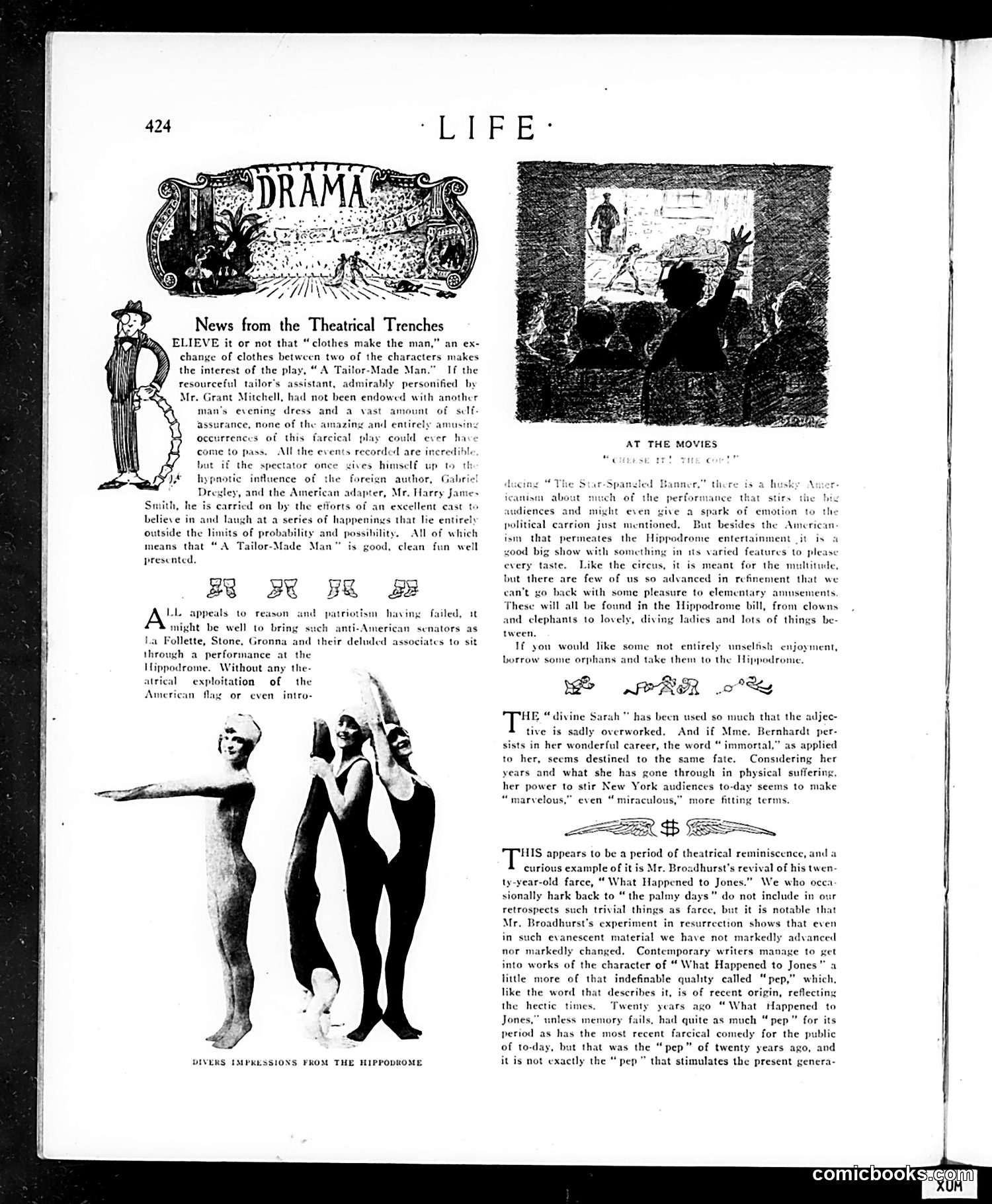
This page reviews theatrical productions from around 1920. The main content discusses: **"A Tailor-Made Man"**: A farce where a character's borrowed evening dress drives the entire plot. The reviewer notes the play succeeds through an excellent cast (Grant Mitchell noted) and clean humor, though it stretches probability. **Anti-American Senators Reference**: A satirical jab suggesting senators like La Follette, Stone, and Gronna—who opposed American military involvement (likely WWI)—should attend the Hippodrome show instead of debating patriotism, as the spectacle is more their speed. **Hippodrome Review**: Praised as family entertainment (the text humorously suggests borrowing orphans to attend), featuring circus-like acts with clowns, divers, and elephants. **Sarah Bernhardt**: Notes the aging French actress's continued ability to move New York audiences, though critics have overused descriptors like "divine" and "immortal." **"What Happened to Jones"**: A revival of a 20-year-old farce, examining whether theatrical "pep" (energy/vitality) remains timeless or merely reflects its era.
📄 Transcribed text from this page (OCR, searchable)
Machine-transcribed from the original scan — historical spelling and the odd misread are preserved.
News from the Theatrical Trenches ELIEVE it or not that “clothes make the man,” an ex- change of clothes between two of the characters makes the interest of the play, “A Tailor-Made Man.” If the ful tailor's assistant, admirably personified by Grant Mitchell, had not been endowed with another man’s evening dress and a vast self assurance, none of the amazing and entirely amusins occurrences of this farcical play could ¢ All the events recorded are the spectator one: influence of the foreign author, and the American adapter, Mr. Harry Jar ed on by the efforts of an excellent cast t 1 at a series of happenings that lie entirels nits of probability and possibility. All of which A Tailor-Made Man" is good, clean fun well 23 Sk PR SB LL appeals to reason ba Mt might be well to bring such anti-American senators as La Follette, Stone, Gronna and their deluded associ: amount of er have cred ives himself up to th 10 pass. Gabriel hypaot Dresle: . he is car believe in and laug Smit outside the 1 means that presented. riotism having fail sto sit through a performance at the Hippodrome. Without any the- atrical exploitation of — the American flag or even intro- DIVERS IMPRESSIONS FROM THE HIPPODROME “The Star-Sp: ee” there isa hi about much of performance that stirs uudiences and might even give a spark of emotion to the Jes the Hippodrome entertainment it isa ut be: American political carrion just mentioned, permea xood big show w ng in its varied features to please Like the circus, it is meant the multitude, but there are few of us so advanced in refinen can’t go back with some pleasure to elementary These will all be found in the Hi and clephants to lovely, diving lad} ism that es the h someth every taste. ent that we musements, podrome bill, from clowns es and lots of things be- tween, If yon would like some not entirely unselfish enjoyment, borrow some orphans and take them to the Hippodrome, HE, “divine Sarah” has been used so much that the adjec- tive is sadly overworked, And if Mme. Bernhardt per- ists in her wonderful career, the word " immortal,” as applied to her, seems destined to the same fate. Considering her years and what she has gone through in physical sufferin her power to stir New York audiences to-day seems to make = more fitting terms. narvelous,” even “ miraculous,” HIS appears to be a period of theatrica curi example of it is Mr. Broadhurst’s revival of his twen- ty-year-old farce, “ What Happened to Jones.” We who occa sionally hark back to “the palmy days” do not include in our retrospects such trivial things as farce, but it is notable that Mr. Broadhurst’s experiment in resurrcetion shows that even in such evanescent nor markedly changed. into works of the character of “ What Happened to Jones” a little more of that indefinable quality called “pep,” which, like the word that describes it, is of recent origin, reflecting erial we have not markedly advanced Contemporary writers manage to get the hectic times. ‘Twenty years ago “What Happened to Jones,” unless memory fails, had quite as much “ pep” for its period as has the most recent farcical comedy for the public of to-day, but that was the “pep” of twenty years ago, and it is not exactly the “ pep” that stimulates the present genera- comicbook