
Life, 1917-09-13 · page 20 of 44
Life — September 13, 1917 — page 20: what you’re looking at
What you’re looking at
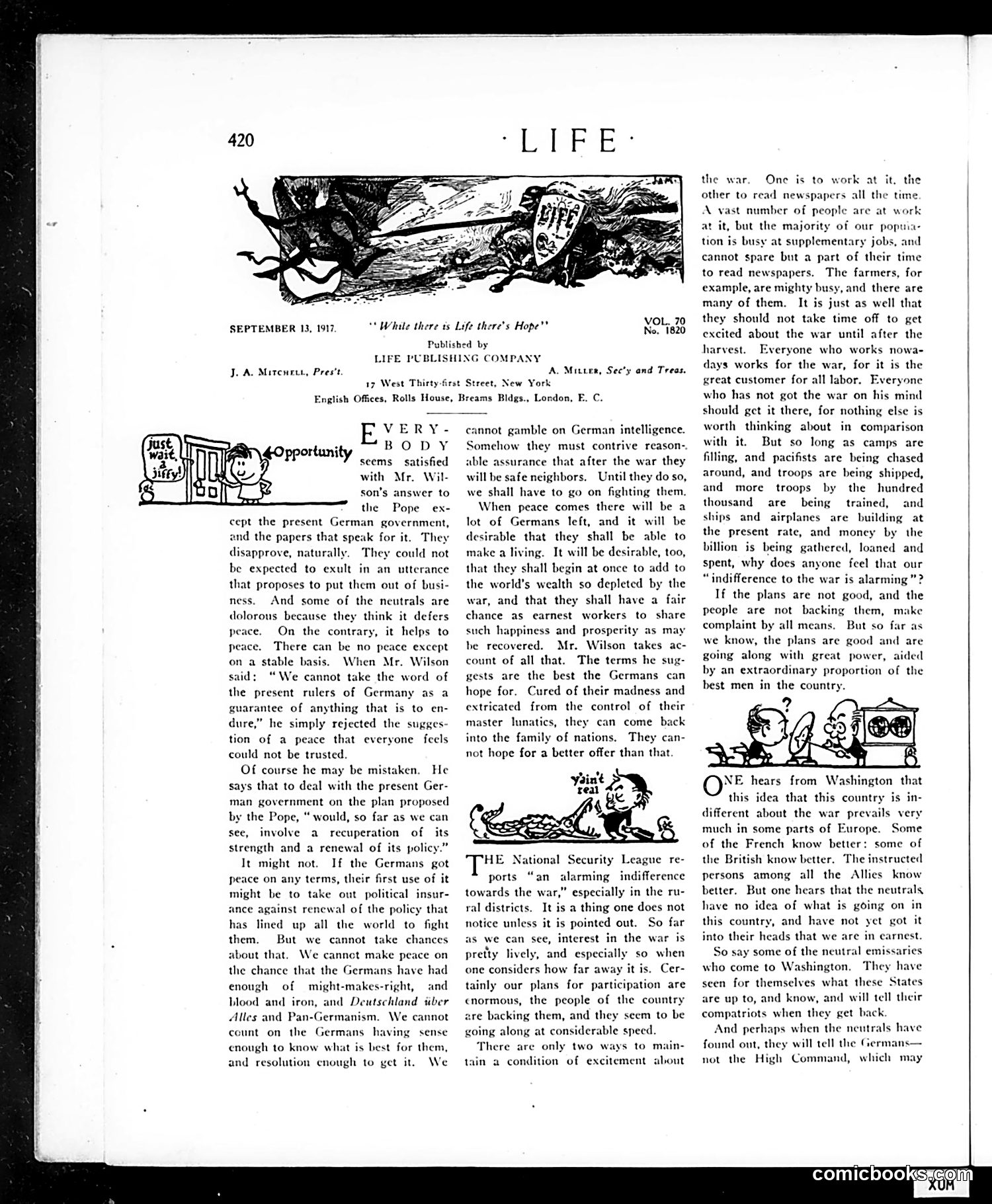
This page critiques President Wilson's rejection of Pope Benedict XV's peace proposal. The main editorial defends Wilson's position that Germany cannot be trusted—the current German government's word is worthless as a peace guarantee. The cartoon (upper left) labeled "Opportunity" appears to satirize those satisfied with Wilson's response, contrasting with German disapproval. A secondary cartoon shows a caricatured figure labeled "Paint is real"—likely mocking false optimism about war progress. The editorial argues Germans must be thoroughly defeated before peace, as they might use any ceasefire to prepare for renewed conflict. However, it acknowledges postwar Germany should have fair economic opportunities. The final section addresses the National Security League's complaint about "alarming indifference towards the war," particularly in rural areas. Life dismisses this, noting farmers are legitimately busy with harvests and that widespread war support exists—people work for "the great customer for all labor": the war effort itself.
📄 Transcribed text from this page (OCR, searchable)
Machine-transcribed from the original scan — historical spelling and the odd misread are preserved.
SEPTEMBER 13, 1917. “Whale there ts Life there's Hope” VOL..70 No, 1820 Published by LIFE PUBLISHING COMPANY J. A. Mitcnrtt, Pres’t. A. Miter, Sec’y and Treas. 17 West Thirty-first Street, New York English Offices, Rolls House, Breams Bldgs., London, FE. C. VERY- BODY seems satisfied with Mr. W: son's answer to the Pope cept the present German government, and the papers that speak for it. They disapprove, naturally. They could not be expected to exult in an utterance that proposes to put them out of busi- ness. And some of the neutrals are dolorous because they think it defers peace. On the contrary, it helps to peace. There can be no peace except on a stable basis. When Mr. Wilson said: “We cannot take the word of the present rulers of Germany as a guarantee of anything that i: dure,” he simply rejected the sugges- tion of a peace that everyone feels could not be trusted. Of course he may be mistaken. He says that to deal with the present Ger- man government on the plan proposed by the Pope, “ would, so far as we can recuperation of its strength and a renewal of its policy.” It might not. If the Germans got peace on any terms, their first use of it might be to take out political insur- ance inst renewal of the policy that has lined up all the world to fight them. But we cannot take chances about that. We cannot make pi the chance that the Germans have had enough of might-makes-right, and Llood and iron, and Deutschland tiber Alles and Pan-Germanism. We cannot count on the Germans h: enough to know what is best for them, We 40 pportunity ex- to en- see, involve a ‘ace on ing sense and resolution cnough to get it. cannot gamble on German intelligence. Somehow they must contrive reason- able assurance that after the war they will he safe neighbors. Until they do so, we shall have to go on fighting them. When peace comes there will be a lot of Germans left, and it will be desirable that they shall be able to make a living. It will be desirable, too, that they shall begin at once to add to the world’s wealth so depleted by the war, and that they shall have a fair chance as earnest workers to share such happiness and prosperity as may be recovered. Mr. Wilson takes ac- count of all that. The terms he sug- gests are the best the Germans can hope for. Cured of their madness and extricated from the control of their master lunatics, they can come back into the family of nations. They can- not hope for a better offer than that. Yaint is real “THE National Security League re- ports “an alarming indifference towards the war,” especially in the ru- ral districts. It is a thing one does not notice unless it is pointed out. So far as we can see, interest in the war is pretty lively, and especially so when one considers how far away it Cer- tainly our plans for participation are cnormous, the people of the country are backing them, and they seem to be going along at considerable speed. There are only two ways to main- tain a condition of excitement about One is to work at it, the other to read newspapers all the time \ vast number of people at it, but the majority of our popuia- tion is busy at supplementary jobs, and cannot spare but a part of their time The farmers, for example, are mighty busy, and there are many of them. It is just as well that they should not take time off to get excited about the war until after the harvest. Everyone who works nowa- days works for the war, for it is the great customer for all labor. Everyone who has not got the war on his mind should get it there, for nothing else is worth thinking about in comparison with it. But so long as camps are filling, and pacifists are being chased around, and troops are being shipped, and more troops by the hundred thousand are being trained, and ships and airplanes are building at the present rate, and moncy by the billion is being gathered, loaned and spent, why does anyone feel that our “indifference to the war is alarming”? If the plans are not good, and the people are not backing them, make complaint by all me But so far as we know, the plans are good and are going along with great power, aided by an extraordinary proportion of the best men in the country. the war. re at work to read newspapers. NE hears from Washington that this idea that this country is in- different about the war prevails very much in some parts of Europe. Some of the French know better: some of the British know better. The instructed persons among all the Allies know better. But one hears that the neutrals have no idea of what is going on in this country, and have not yet got it into their heads that we are in earnest. So say some of the neutral emis: who come to Washington. Thi seen for themselves what these States are up to, and know, and will tell their compatriots when they get back. And perhaps when the neutrals have found out, they will tell the Germans— not the High Command, which may have comicbooks Som