
Life, 1917-09-13 · page 32 of 44
Life — September 13, 1917 — page 32: what you’re looking at
What you’re looking at
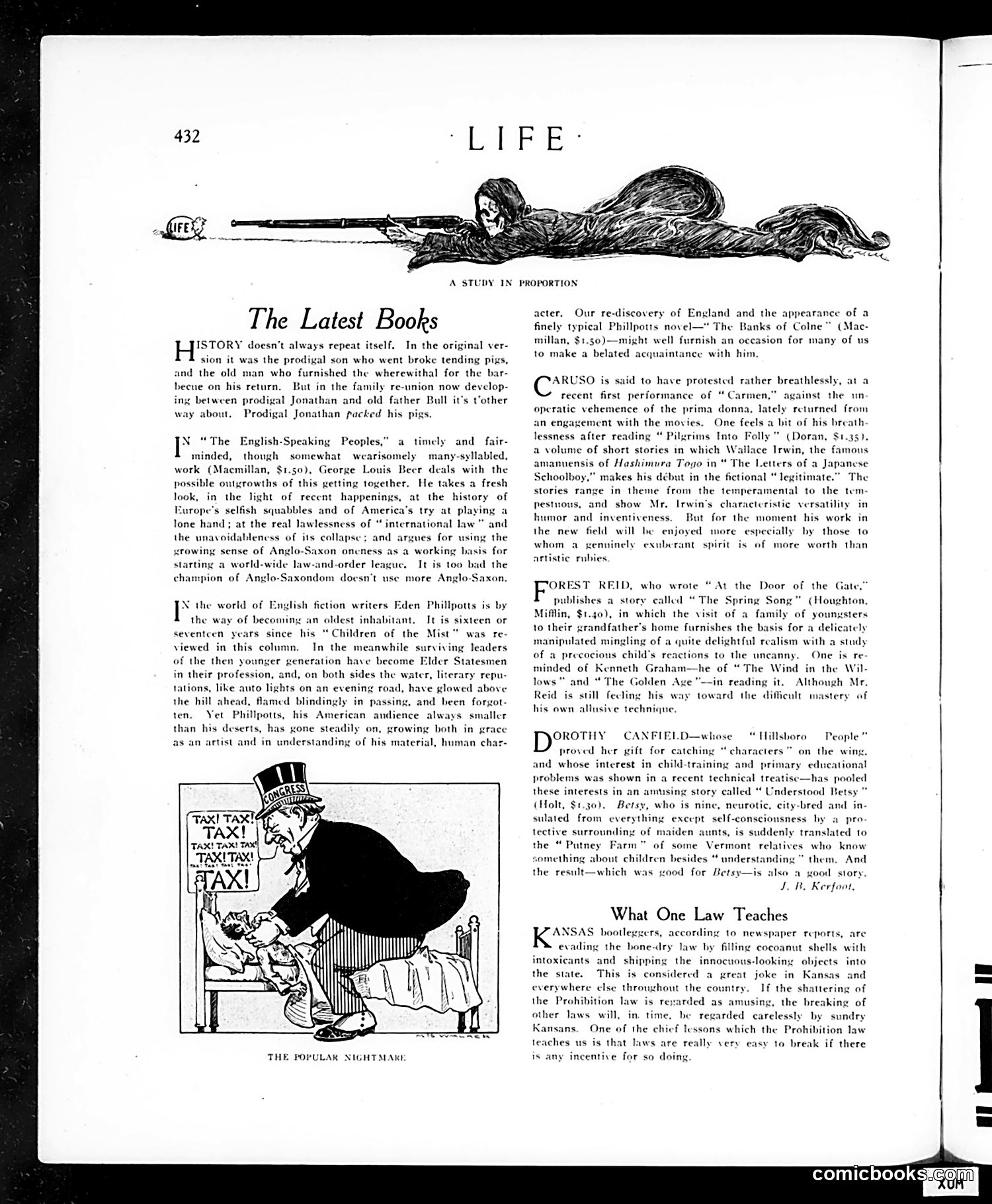
This page combines book reviews with one political cartoon titled "The Popular Nightmare." **The Cartoon's Satire:** The illustration depicts a taxi driver overwhelmed by passengers demanding rides—his cab labeled repeatedly with "TAXI" appears under siege. This satirizes the "taxi problem" of the 1920s, when unlicensed cabs and chaotic street transportation plagued American cities. The cartoon mocks both the proliferation of taxis and drivers' inability to manage demand. **Book Reviews Context:** The "Latest Books" section reviews contemporary literature, including works on Anglo-Saxon relations and English fiction. One review mentions "The English-Speaking Peoples," discussing international law and Anglo-Saxon cooperation—likely referencing post-WWI discussions about American-British relations. **The Opening Metaphor:** The page's header uses the prodigal son parable, suggesting America ("prodigal Jonathan") and Britain ("father Bull") reconciling after America's independent foreign policy—a timely 1920s reference to renewed transatlantic cooperation. The cartoon and text together reflect 1920s urban anxieties and geopolitical realignment following World War I.
📄 Transcribed text from this page (OCR, searchable)
Machine-transcribed from the original scan — historical spelling and the odd misread are preserved.
A STUDY The Latest Books ISTORY doesn't always repeat itself. In the original ver- sion it was the prodigal son who went broke tending pix and the old man who furnished the wherewithal for the bar- becue on his return, But in the family re-union now develop- ing between prodigal Jonathan and old father Bull it’s t’other way about, Prodigal Jonathan packed his pigs. I “The English-Speaking Peoples,” a timely and fair- minded, though somewhat many-syllabled, work (Macmillan, $1.50), George Louis Beer deals with the possible outgrowths of this getting together. He takes a fresh look, in the light of recent happenings, at the history of Europe's selfish squabbles and of America’s try at playing a lone hand; at the real lawlessness of “international law” and psc; and argues for using the wearisomely the unavoidableness of its col nx sense of Anglo-Saxon oneness as a working basis for xrow! starting a world-wide law-and-order league. champion of Anglo-Saxondom doesn't use more Anglo-Saxon. It is too bad the N the world of English fiction writers Eden Phillpotts is by the way of be: est inhabitant, seventeen years since his “Children of the Mist” was re- viewed in this column. of the then younger generation have become Elder Statesmen in their profession, and, on both sides the water, literary repu- tations, like auto lights on an evening road, have glowed above the hill ahead, flamed blindingly in passing, and by ten, Yet Phillpotts, his American audience always smaller It is sixteen or ming an ¢ In the meanwhile surviving leaders en forgot- than his deserts, has gone steadily on, growing both in grace as an artist and in understanding of his material, human char- THE POPULAR NIGHTMAKE 1N PROPORTION acter. Our re-discovery of England and the appearance of a finely typical Phillpotts novel—* The Banks of Colne” (Mac- millan, $1.50)—might well furnish an occasion for many of us to make a belated acquaintance with him. RUSO is s: recent first performance of “Carmen,” against the in operatic vehemence of the prima donna, lately returned: from an engagement with the movies. One feels a bit of his breath lessness after reading “ Pilgrims Into Folly" (Doran, $1.35). a volume of short stories in which Wallace Irwin, the famous manuensis of Hashimura Togo in “ The Letters of a Japanese Schoolboy,” makes his début in the fictional “legitimate.” The stories range in theme from the temperamental to the tem nd show Mr. Irwin's characteristic versatility in humor and inventiveness. But for the moment his work in ially by those 10 whom a genuinely exuberant spirit is of more worth than id to have protested rather breathlessly, at a pestuous, the new field will be enjoyed more espe tic rubies OREST REID, who wrote “At the Door of the Gate.” publishes a_ story Miflin, $1.40), in which the visit of a to their grandfather's home furnishes the basis for a delicately pulated mingling of a quite delightful realism with a study of a precocious child’s reactions to the uncanny, One is re minded of Kenneth Graham—he of “The Wind in the Wil- lows" and “ The Golden Age Although Mr. Reid is still feeling his way toward the difficult mastery of his own allusive technique (Houghton, mily of youngsters called “ The Spring Song” ‘in reading it. OROTHY CANFIELD—whose “Hillsboro proved her gift for catching “ characters” and whose interest in child-training and primary educational problems was shown in a recent techni People” on the wing, treatisc—has pool these interests in an amusing story called “ Understood Betsy" (Holt, $1.30). Betsy sulated from everything except self-conscionsness by a pro who is nine, neurotic, city-bred and in- lective surrounding o the something about children besides maiden aunts, is suddenly translated to “Putney Farm” of some Vermont relatives who know ‘understanding “ them. And the result—which was ood for Betsy—is also a yood story. JR, Kerfoot, What One Law Teaches kK*s AS bootleggers, according to newspaper reports, are evading the bone-dry law by filling cocoanut shells with intoxicants and. sh the state. This is considered a great joke in Kan shout the country. the Prohibition law is resarded as amusin; ping the innocuous-looking objects into sand ig of the breaking of other Jaws will, in. time, be regarded carelessly by sundry Kansans. One of the chief lessons which the Prohibition law teaches us is that laws are really very easy to break if there doing everywhere else thro If the shatter is any incentive for comicbookseara]