
Life, 1917-09-13 · page 14 of 44
Life — September 13, 1917 — page 14: what you’re looking at
What you’re looking at
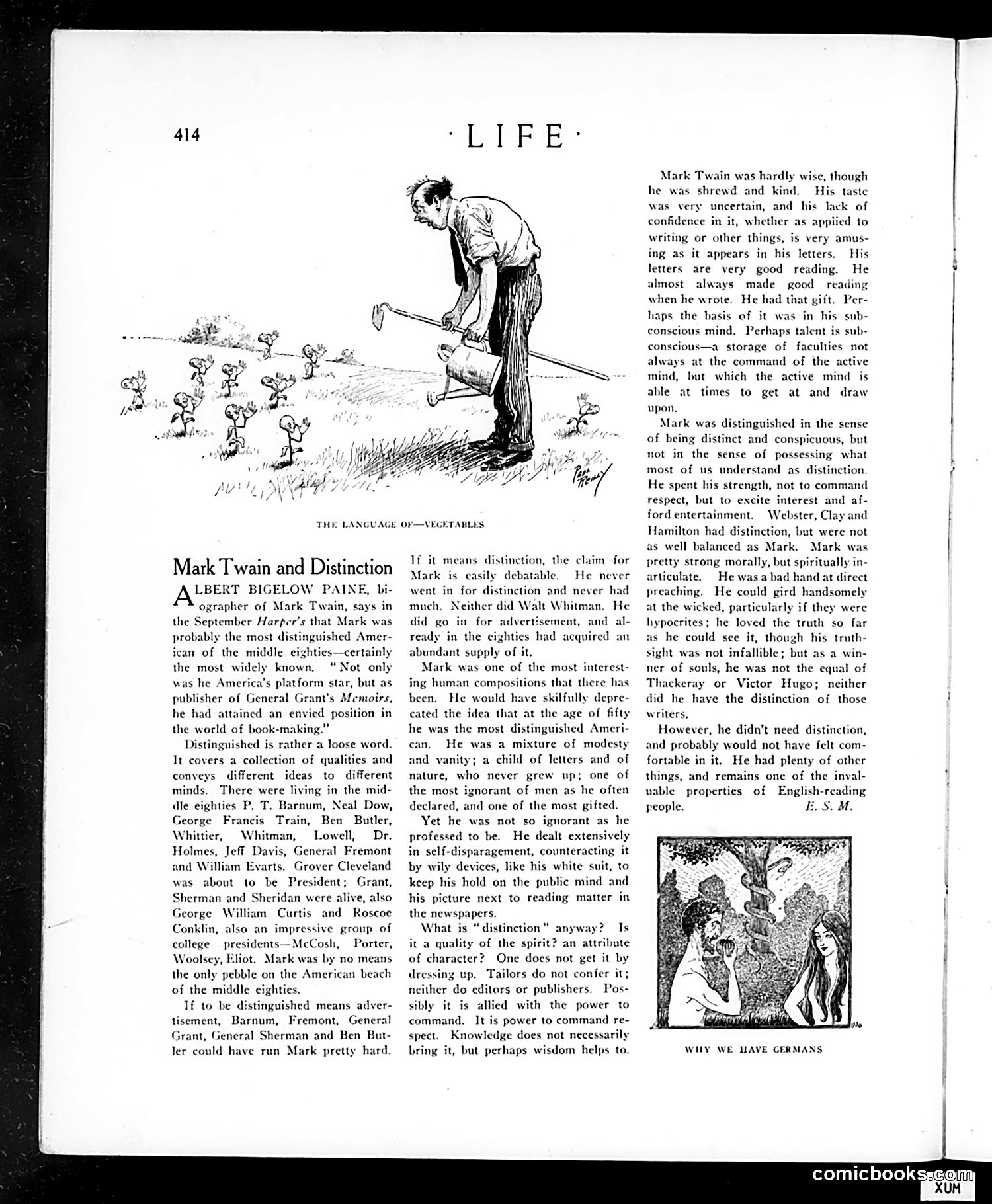
The top cartoon depicts a man wielding a hoe among small plants, titled "The Language of Vegetables." The satire likely comments on the difficulty of communicating with or understanding nature/farming. The main article discusses Mark Twain's character and literary merit. The author (Albert Bigelow Paine, Twain's biographer) argues that Twain possessed distinction not through formal elegance but through moral strength and authentic voice. The piece compares him favorably to other prominent figures like Grant and Sherman, suggesting Twain deserved recognition as a major American literary figure despite lacking the pretense of "distinguished" writers. This appears to defend Twain against critics who questioned his literary legitimacy.
📄 Transcribed text from this page (OCR, searchable)
Machine-transcribed from the original scan — historical spelling and the odd misread are preserved.
ge Wipe THE LANGUAGE OF VEGETABLES, Mark Twain and Distinction LBERT BIGELOW PAINE, bi- ographer of Mark Twain, says in the September Harper's that Mark was probably the most distinguished Amer- ican of the middle ecighties—certainly the most widely known. “Not only was he America’s platform star, but as publisher of General Grant’s Memoirs, he had attained an envied position in the world of book-making.” Distinguished is rather a loose word. It covers a collection of qualities and conveys different ideas to different minds. There were living in the mid- dle eighties P. T. Barnum, Neal Dow, George Francis Train, Ben Butler, Whittier, Whitman, — Lowell, — Dr. Holmes, Jeff Davis, General Fremont and William Evarts. Grover Cleveland was about to be President; Grant, Sherman and Sheridan were alive, also George William Curtis and Roscoe Conklin, also an impressive group of college presidents—McCosh, Porter, Woolsey, Eliot. Mark was by no means ly pebble on the American beach of the middle eighties. If to be distinguished means adver- tisement, Barnum, Fremont, General Grant, General Sherman and Ben But- ler could have run Mark pretty hard. lf it means distinction, the claim for Mark is easily debatable. He never went in for distinction and never had much, Neither did Walt Whitman. He did go in for advertisement, and al- ready in the cighties had 3 abundant supply of it. Mark was one of the most interest- ing human compositions t there has been. He would have skilfully depre- cated the idea that at the age of fifty he was the most distinguished Ameri- can. He was a mixture of modesty and vanity; a child of letters and of nature, who never grew up; one of the most ignorant of men as he often declared, and one of the most gifted. Yet he was not so ignorant as he professed to be. He dealt extensively in self-disparagement, counteracting it by wily devices, like his white suit, to keep his hold on the public mind and his picture next to reading matter in the newspapers. What is “distinction” anyw Is it a quality of the spirit? an attribute of character? One does not get it by dressing up. Tailors do not confer it; neither do editors or publishers. Pos- sibly it is allied with the power to command, It is power to command re- spect. Knowledge does not necessarily bring it, but perhaps wisdom helps to. quired an Mark Twain was hardly wise, though he was shrewd and kind. His taste was very uncertain, and his lack of confidence in it, whether as applied to writing or other things, is very amus ing as it appears in his letters. His letters are very good reading. He almost always made good reading when he wrote. He had that gift. Per- haps the basis of it was in his sub- conscious mind. Perhaps talent is sub- conscious—a storage of faculties not always at the command of the active mind, but which the active mind is able at times to get at and draw upon. Mark was distinguished in the sense of being distinct and conspicuous, but not in the sense of possessing what most of us understand as distinction. He spent his strength, not to command respect, but to excite interest and af- ford entertainment. Webster, Clay and Hamilton had distinction, but were not as well balanced as Mark. Mark was pretty strong morally, but spiritually in- ticulate. He was a bad hand at direct preaching. He could gird handsomely at the wicked, particularly if they were hypocrites; he loved the truth so far he could see it, though his truth- sight was not infallible; but as a win- ner of souls, he was not the equal of Thackeray or Victor Hugo; neither did he have the distinction of those writers, However, he didn’t need distinction, and probably would not have felt com- fortable in it. He had plenty of other things, and remains one of the inval- uable properties of English-reading people. E.S.M. a WHY WE HAVE GERMANS comicbooksseems