
A complete issue · 40 pages · 1917
Life — July 19, 1917
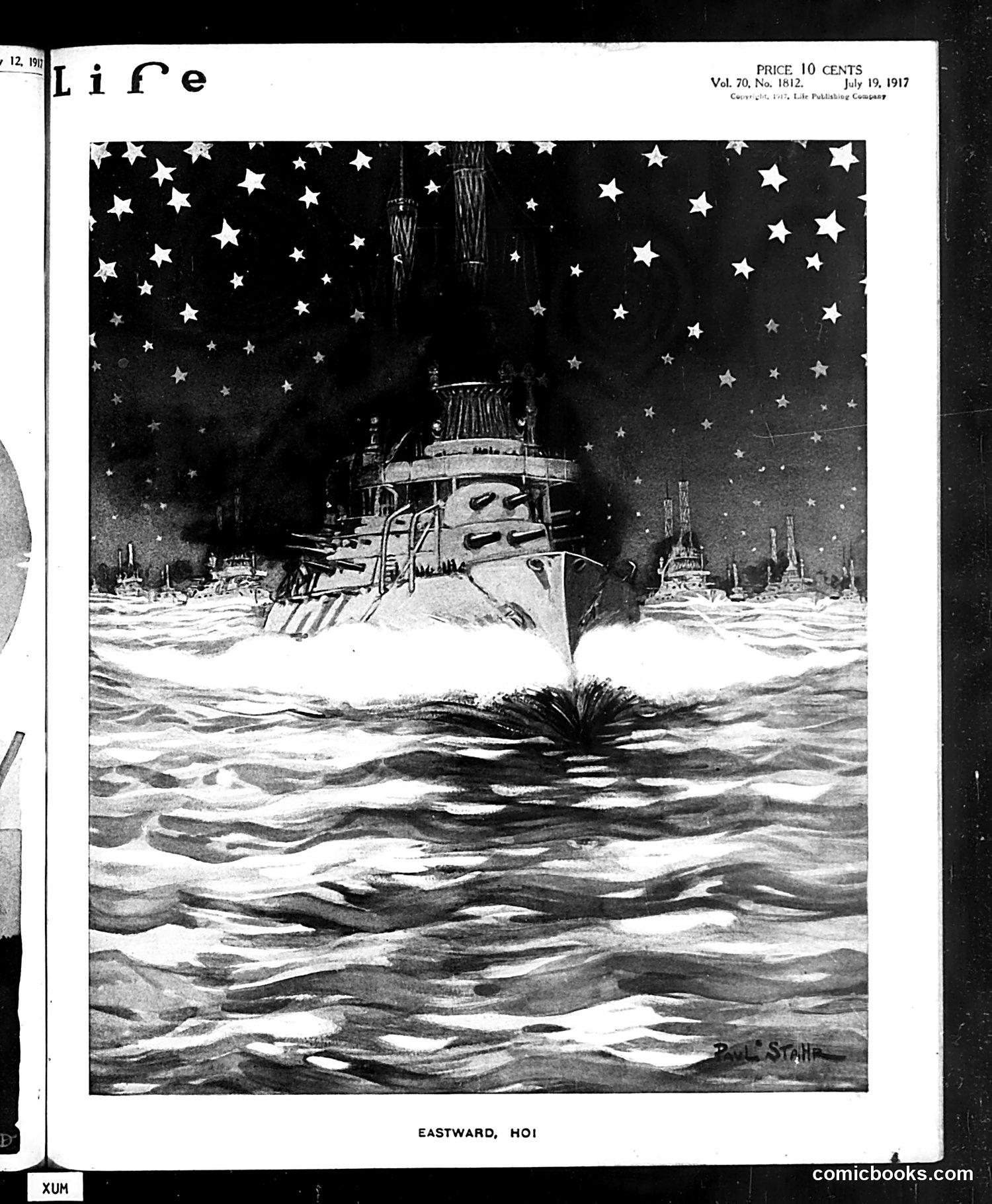
This July 1917 *Life* cartoon depicts an American battleship heading eastward across a starry night sea, with naval vessels visible on the horizon. The title "Eastward, Ho!" references the direction toward Europe. Given the 1917 date, this almost certainly alludes to America's entry into World War I (April 1917). The cartoon celebrates American military deployment to Europe to support Allied forces against Germany. The starry sky, nighttime setting, and convoy of ships suggest the journey across the Atlantic—a passage fraught with danger from German U-boats, which killed numerous American soldiers and sailors during troop transport. The illustration expresses patriotic optimism about American military intervention in the European conflict.
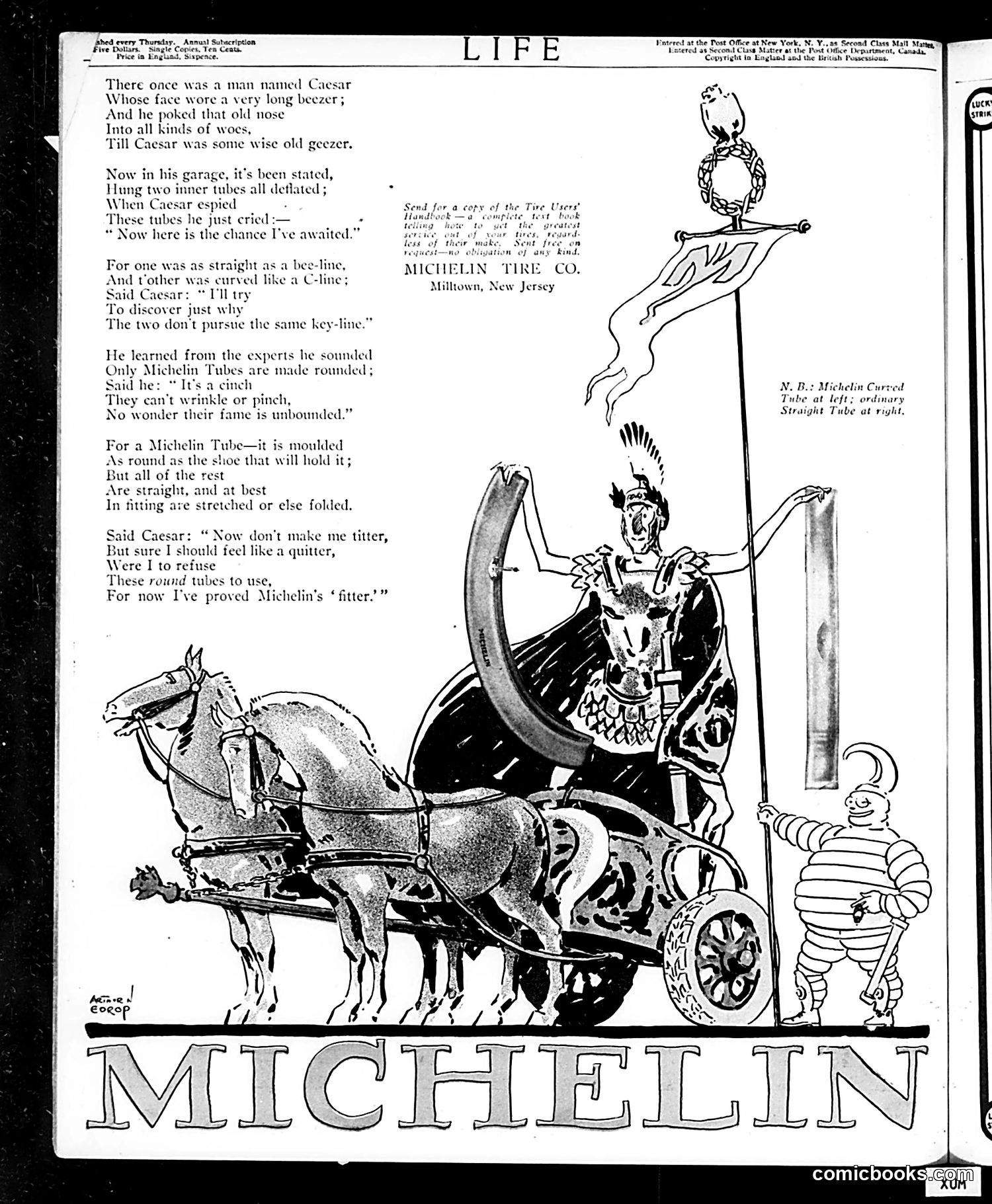
This is a **Michelin Tire Company advertisement** disguised as humorous verse and illustration, not political commentary. The poem tells a story about a man named Caesar with a long beard who experiments with tire tubes in his garage. The satire is **commercial, not political**: it humorously demonstrates Michelin's competitive advantage—their tubes are "rounded" and "moulded," preventing wrinkles and pinches, unlike competitors' "straight" tubes. Caesar becomes a satisfied customer ("I've proved Michelin's fitter"), riding triumphantly in a chariot pulled by a horse. The Michelin Man mascot appears at right. The joke relies on personification and mock-heroic language to make tire manufacturing sound dramatically important—typical early 20th-century advertising exaggeration.
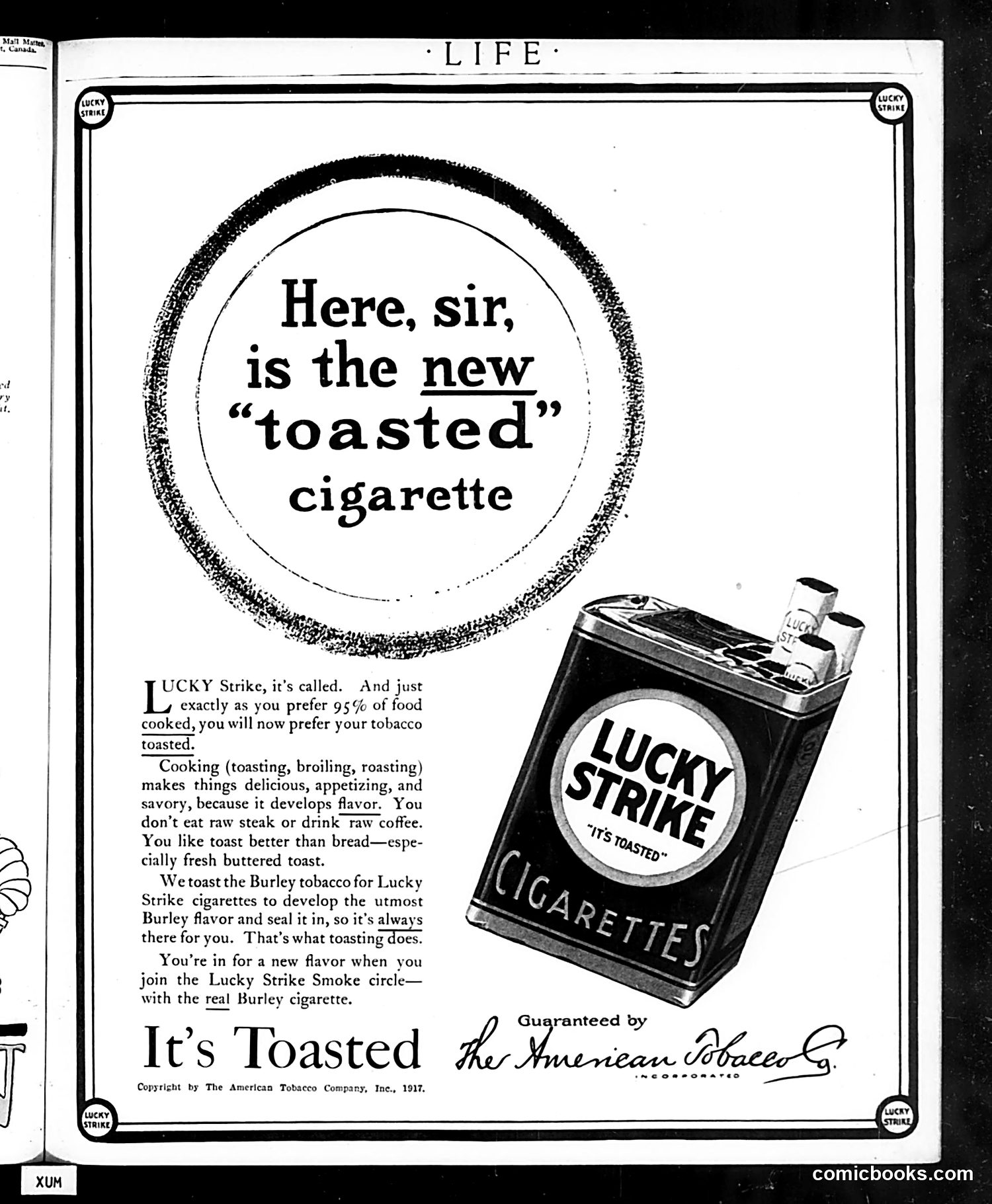
This is a **cigarette advertisement**, not satire or political commentary. Lucky Strike marketed their "toasted" cigarettes by drawing a parallel to cooking: just as people prefer cooked food to raw, they should prefer toasted tobacco to untoasted. The ad claims toasting develops superior "Burley flavor" and appeals to consumer preference for processed foods. It uses straightforward marketing logic rather than humor or caricature. **Modern context**: This predates widespread knowledge of smoking's health dangers. The "toasting" claim was a genuine selling point in early-twentieth-century advertising. The ad's comparison of tobacco processing to food preparation was typical marketing strategy of the era.
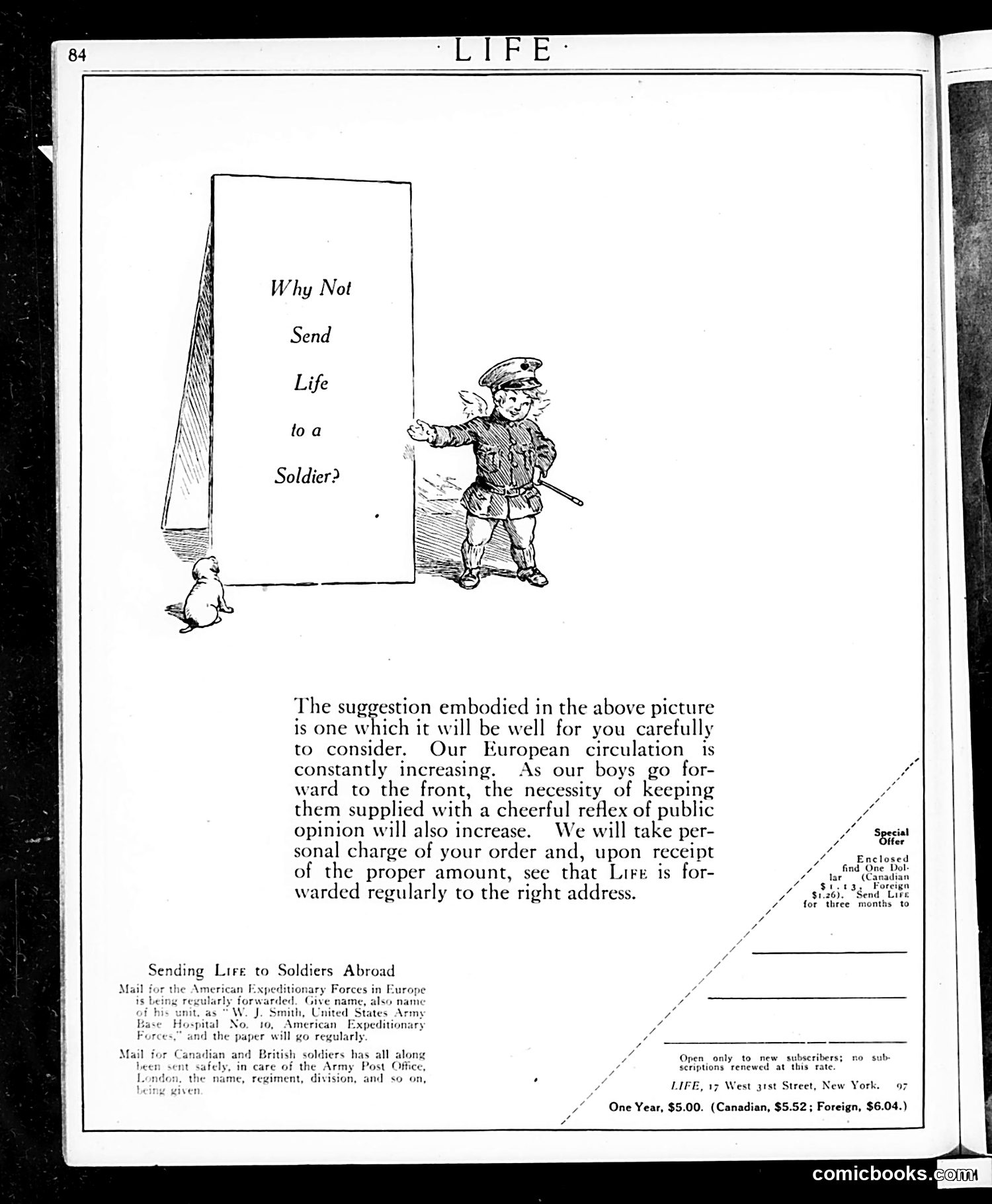
This is primarily a **subscription advertisement** for *Life* magazine, using satirical imagery to encourage sending subscriptions to soldiers abroad during World War I. The cartoon depicts a small cherub or child figure presenting a large sword to a uniformed soldier, with text asking "Why Not Send Life to a Soldier?" The **satire** works on two levels: (1) the absurdity of substituting a magazine for an actual weapon, and (2) the implicit claim that *Life*'s humor and commentary provide morale and intellectual sustenance comparable to military equipment. The cherub figure adds ironic whimsy to this proposition. The advertisement promotes sending subscriptions to American Expeditionary Forces in Europe, offering special rates for Canadian and foreign addresses. The pitch emphasizes that *Life* provides "cheerful reflex of public opinion" to troops. This reflects WWI-era patriotic marketing strategies.
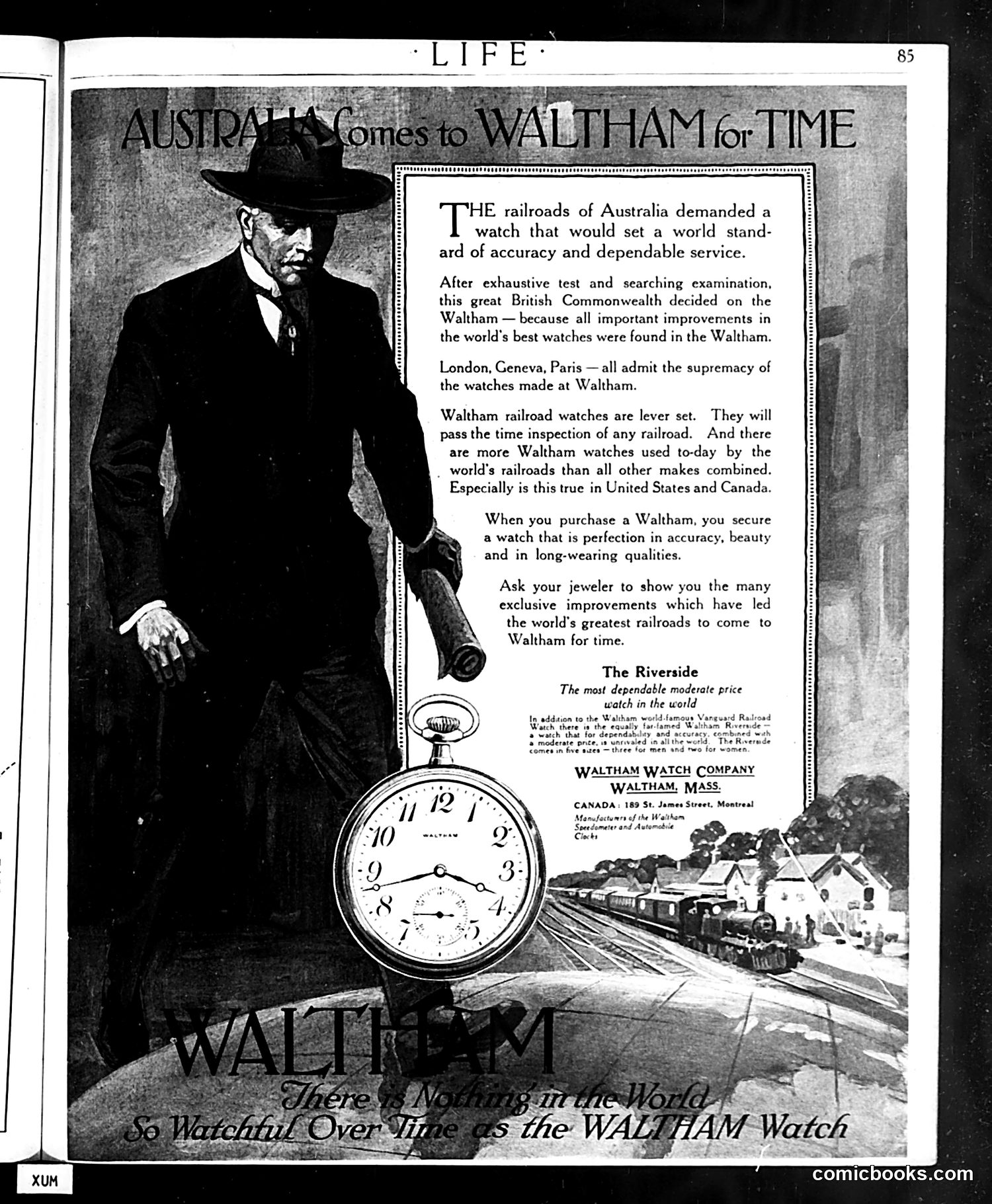
This page is primarily **advertising, not satire or political commentary**. It's a Waltham Watch Company advertisement disguised as editorial content—a common early 20th-century marketing technique. The ad features a man in formal attire (likely representing a railroad official or conductor) holding a pocket watch, alongside copy claiming Waltham watches are the world's finest timepieces, preferred by railroads globally, especially in the US and Canada. The illustrated train scene reinforces the railroad theme. The tagline—"There is Nothing in the World So Watchful Over Time as the WALTHAM Watch"—is a pun playing on accuracy and vigilance. **This is branded content marketing Australia's connection to Waltham, not political satire.**
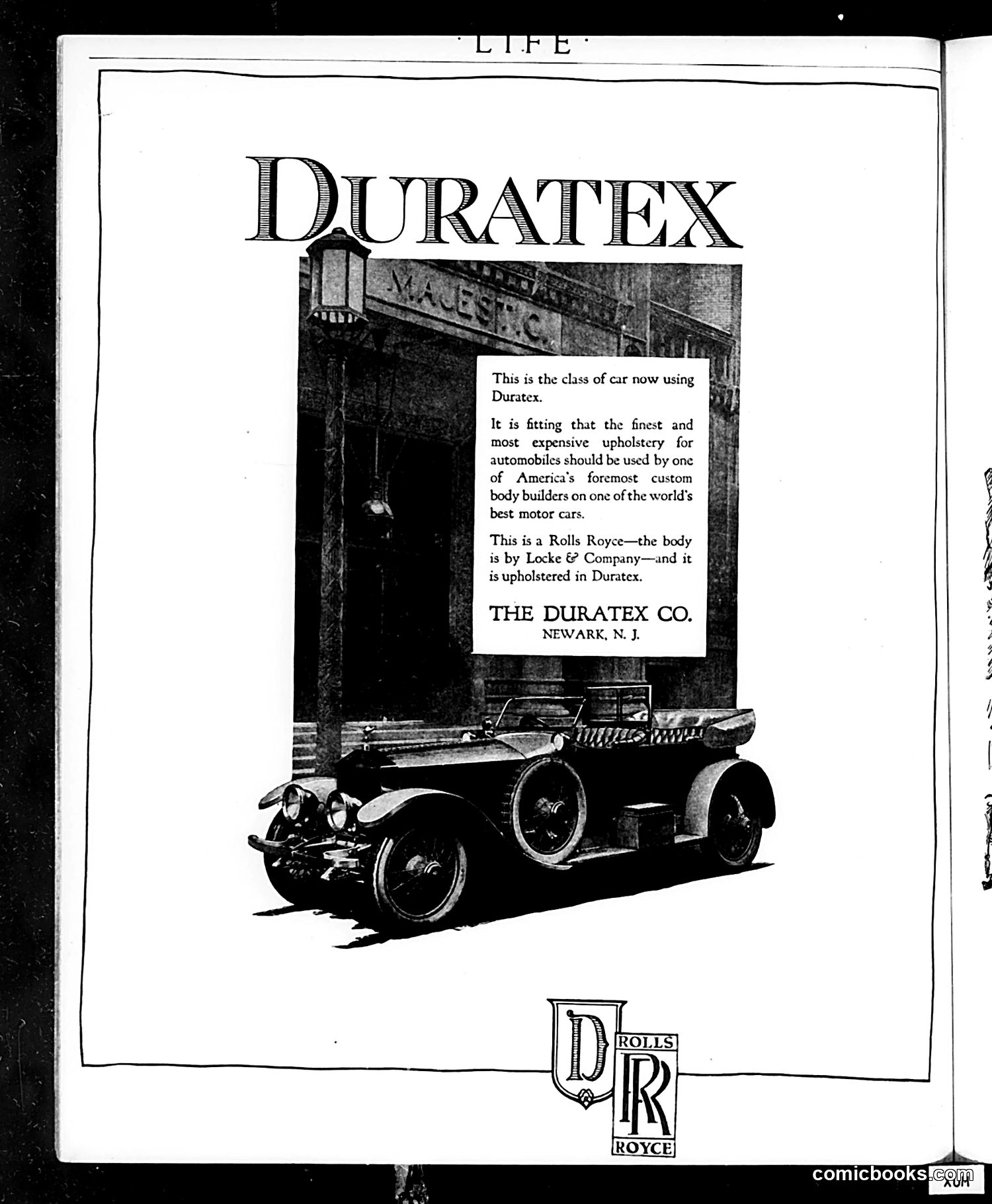
This is not a political cartoon or satire—it's a **straightforward advertisement** for Duratex upholstery material and Rolls-Royce automobiles. The ad shows a luxury Rolls-Royce car parked beneath a storefront (appears to be a Macy's department store based on visible signage). The text explains that Duratex upholstery is used by Locke & Company, a prestigious custom body builder for Rolls-Royce vehicles. The copy emphasizes that this finest, most expensive upholstery is appropriate for "one of America's foremost custom body builders" and "one of the world's best motor cars." This is period product placement targeting wealthy consumers, positioning Duratex as the premium choice for luxury automobile interiors. There is no satirical content present.
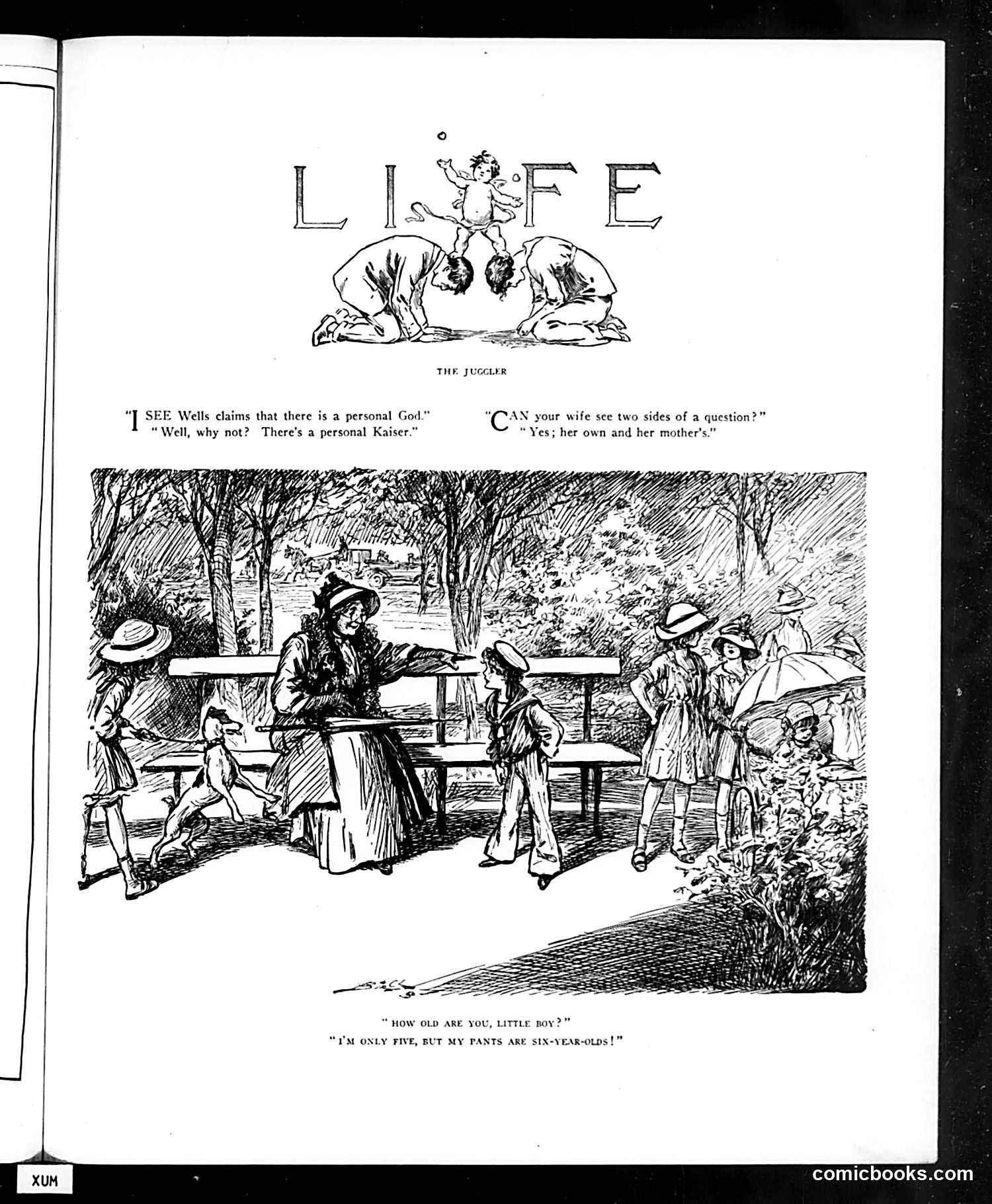
This page presents humorous vignettes about life's absurdities under the title "LIFE." **Top section:** Two brief jokes about perspective and relativism—one about Wells's claim of a "personal God" (likely H.G. Wells, the famous writer), countered with "there's a personal Kaiser" (German Emperor Wilhelm II, referenced during WWI era when Life was anti-German). **Main illustration:** Shows a woman at a picnic with children and adults in a park setting. The joke at bottom plays on dual meanings: when asked a child's age, the woman responds that while the *boy* is five years old, his *pants* are six years old—humor about worn clothing and economic constraints, likely reflecting post-WWI economic hardship or general working-class struggles of the period. The satire targets pretension, materialism, and social observation common to Life's satirical approach.
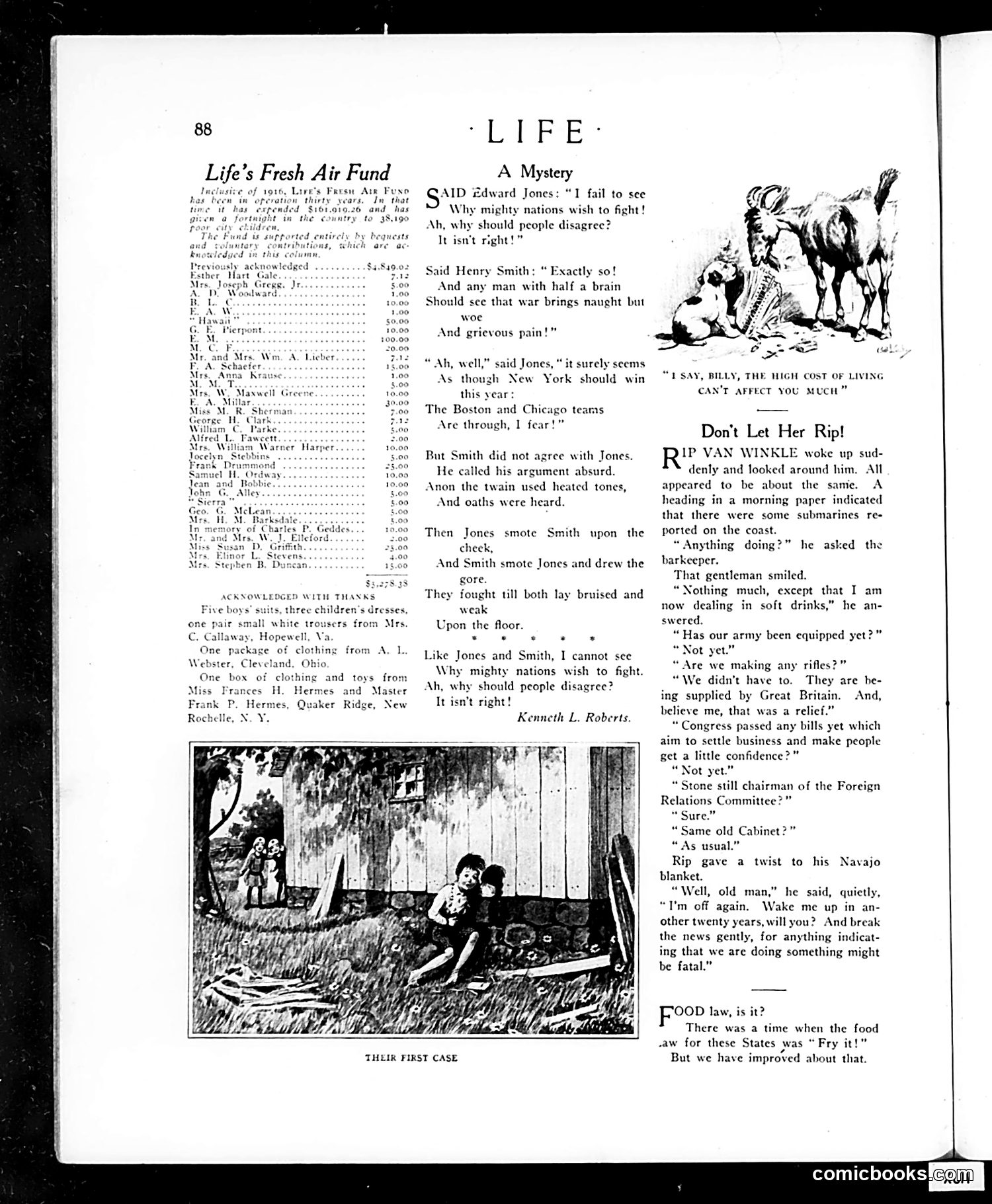
This page contains a short story titled "Don't Let Her Rip" featuring a character named Rip Van Winkle who has awakened after a long sleep. The dialogue reflects post-World War I concerns about military readiness and submarine threats. The story depicts Rip questioning a barkeeper about current events, learning that submarines have been reported on the coast. The barkeeper's responses suggest anxiety about American military preparedness—specifically whether the army has been equipped and whether rifles are being manufactured. The upper section includes "A Mystery," a satirical poem by Kenneth L. Roberts questioning why nations fight wars and suffer needless pain. The illustration labeled "THEIR FIRST CASE" shows what appears to be a domestic scene, though its connection to the surrounding text is unclear from this page alone.
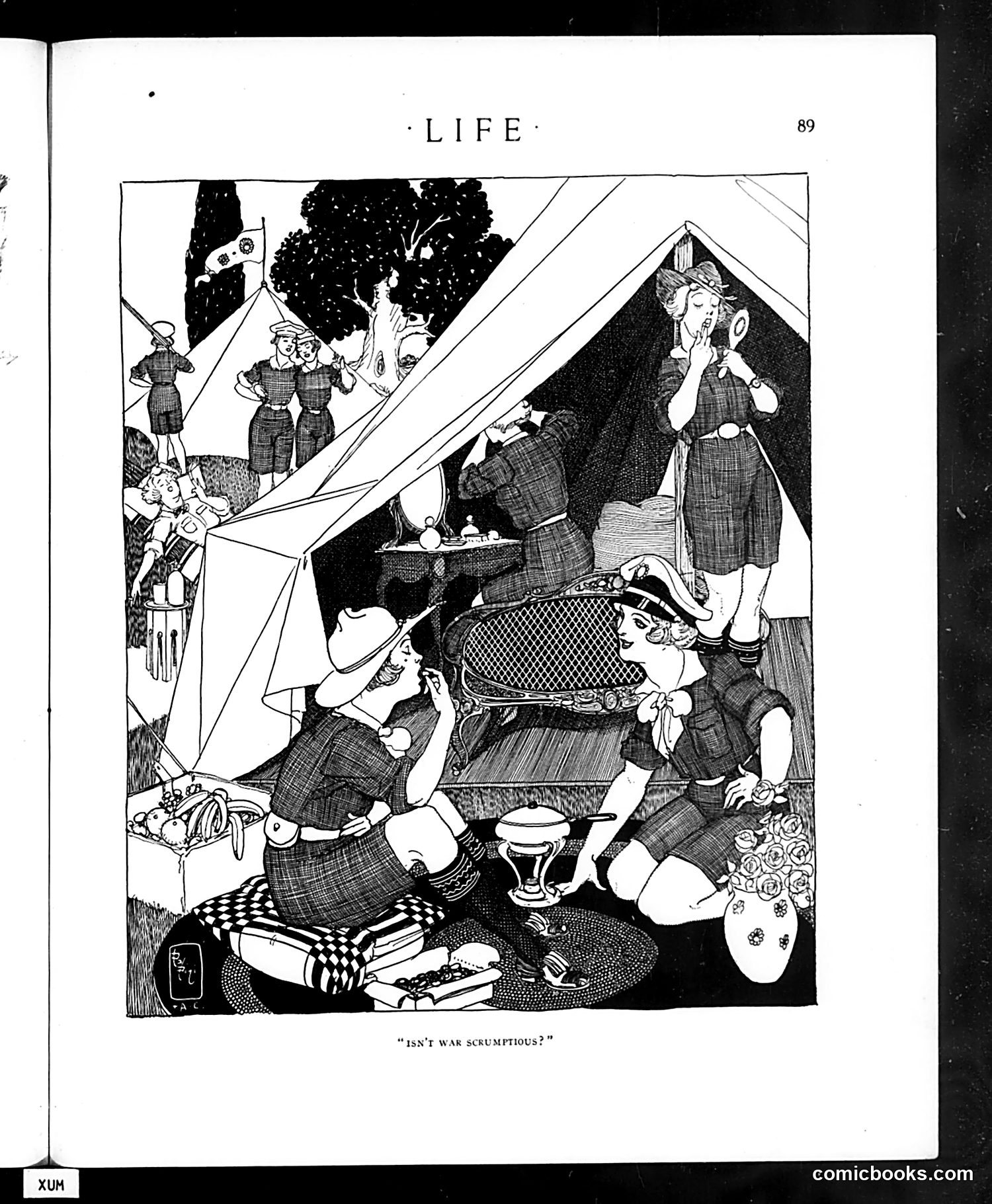
This satirical cartoon depicts a Girl Scout camping scene—identifiable by the uniforms, tent, and outdoor setting. The caption's dark humor suggests the Girl Scouts are engaged in war preparations or military activities rather than traditional camping. The satire appears to critique the militarization of youth organizations, possibly during wartime (likely WWI or WWII era based on Life's publication period). By showing Girl Scouts in a mock-military context with the caption questioning whether "war" is "scrumptious" (delicious), the cartoon sarcastically mocks: - The romanticization of war among civilians - Youth indoctrination into military culture - The contradiction between innocent girlhood activities and warfare The juxtaposition of wholesome scouting imagery with war references creates ironic commentary on how conflict permeates society.
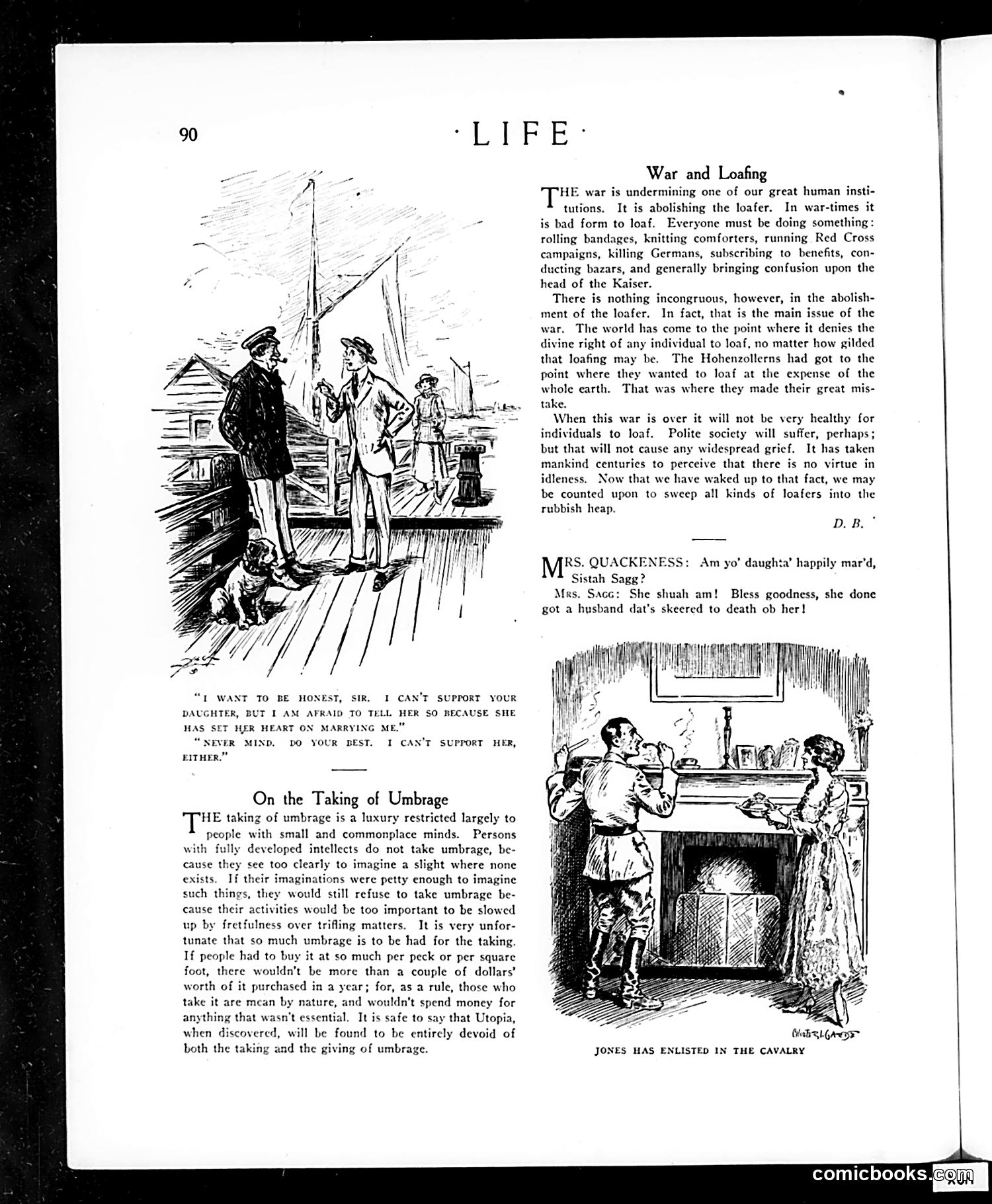
This page contains three distinct pieces: 1. **"War and Loafing"** (essay by D.B.): A World War I-era commentary arguing that warfare is eliminating idleness from society. The author contends that loafing—previously considered acceptable among the upper classes—has become socially unacceptable during wartime, when everyone must contribute productively. 2. **"Mrs. Quackeness" dialogue**: A brief humorous exchange where a woman questions whether her daughter is happily married, receiving the reply that the daughter's husband has died in war. 3. **"On the Taking of Umbrage"**: An essay criticizing people who take offense easily, arguing that truly intelligent people avoid such pettiness and that umbrage-taking is economically wasteful. 4. **"Jones Has Enlisted in the Cavalry"**: A domestic illustration showing what appears to be a farewell scene, complementing the wartime themes throughout.
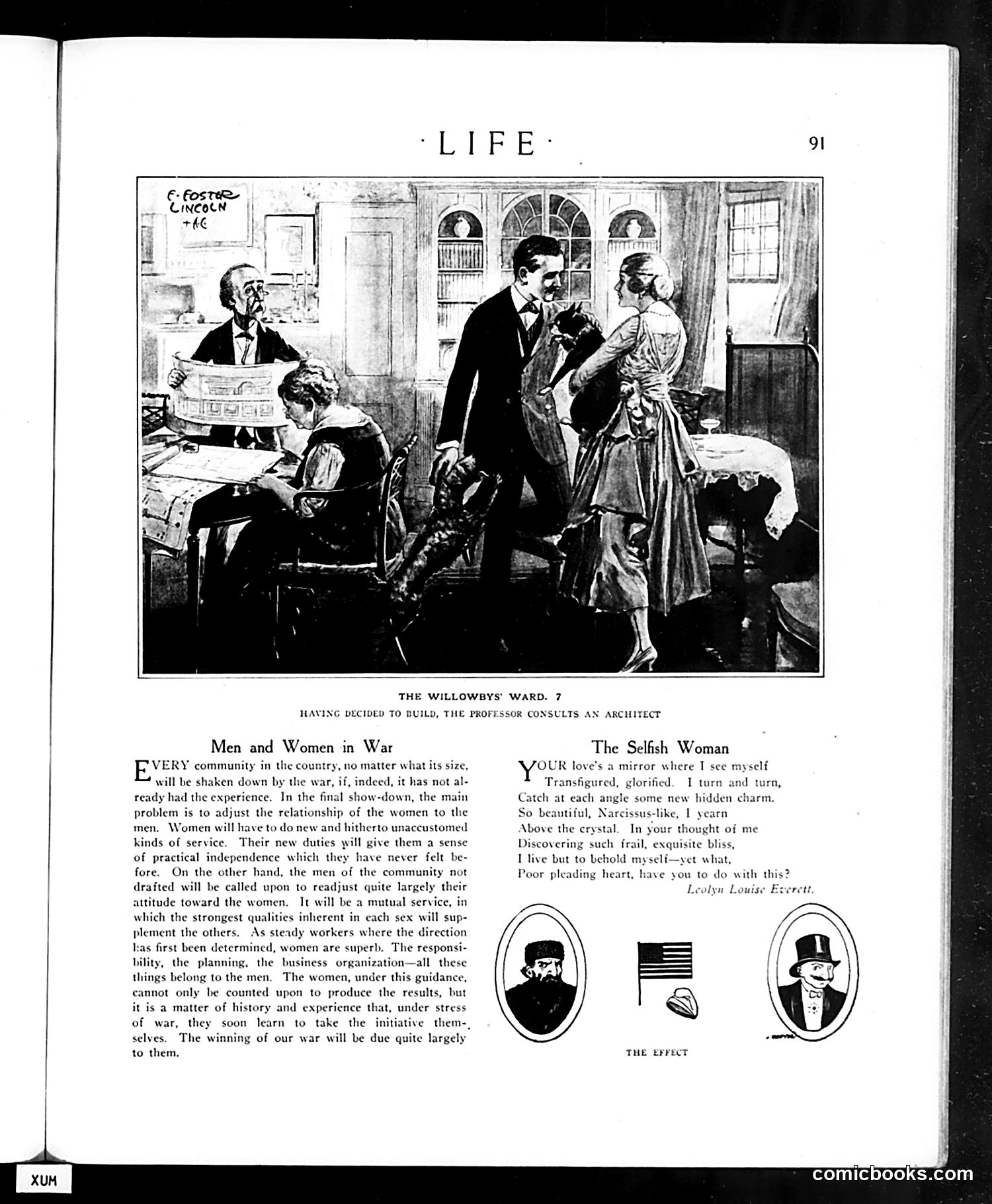
**The Main Illustration** ("The Willowbys' Ward") depicts a domestic scene where a professor consults an architect about building plans, while women observe. This appears to satirize wartime gender dynamics. **"Men and Women in War"** argues that communities must reorganize women's roles during wartime. The text insists men must lead strategic planning while women execute tasks under male direction—framing this as "mutual service" where women's "initiative" will emerge under stress, and their contributions will win the war. **"The Selfish Woman"** is a poem by Evelyn Louise Evcrett criticizing women who prioritize personal beauty and vanity over wartime duties. **The Context**: This reflects WWI-era debates about women's wartime responsibilities while maintaining traditional male authority and female subordination.
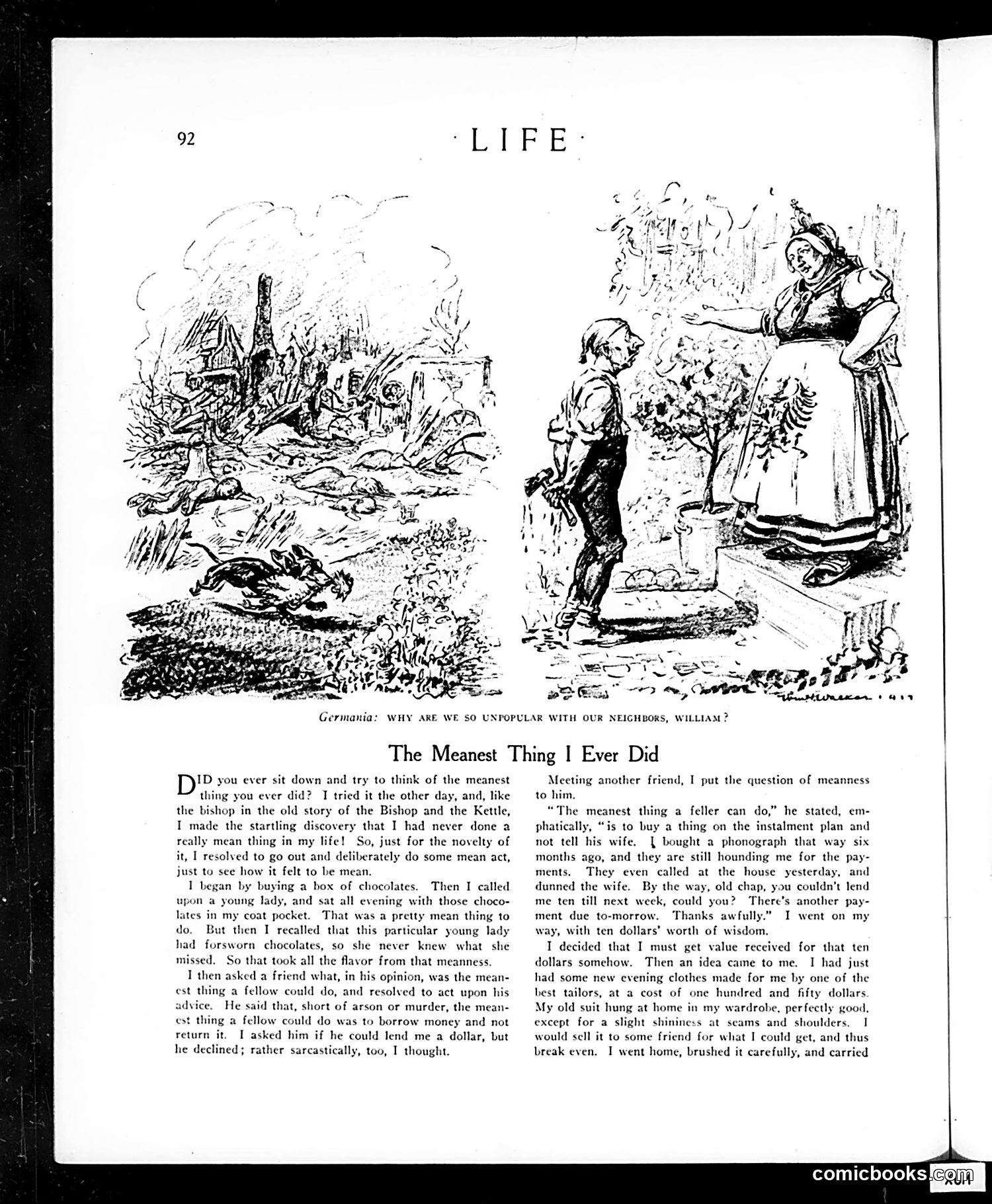
**The Cartoon:** The illustration shows a woman scolding a young boy, with the caption "Germania: WHY ARE WE SO UNPOPULAR WITH OUR NEIGHBORS, WILLIAM?" **The Political Reference:** This is a satirical commentary on German-American relations, depicting "Germania" (personified Germany) questioning "William" (likely Kaiser Wilhelm II) about Germany's unpopularity with neighboring nations. The cartoon likely critiques German foreign policy and aggressive behavior that isolated Germany diplomatically in Europe. **The Context:** Published in Life (an American satirical magazine), this reflects early 20th-century American attitudes toward German imperial expansion and conduct. The domestic scene—a stern mother figure disciplining a wayward child—uses family metaphor to mock Germany's position among European powers. **The Joke:** The satire suggests Germany's diplomatic isolation was self-inflicted through poor behavior, much like a misbehaving child earning disapproval.
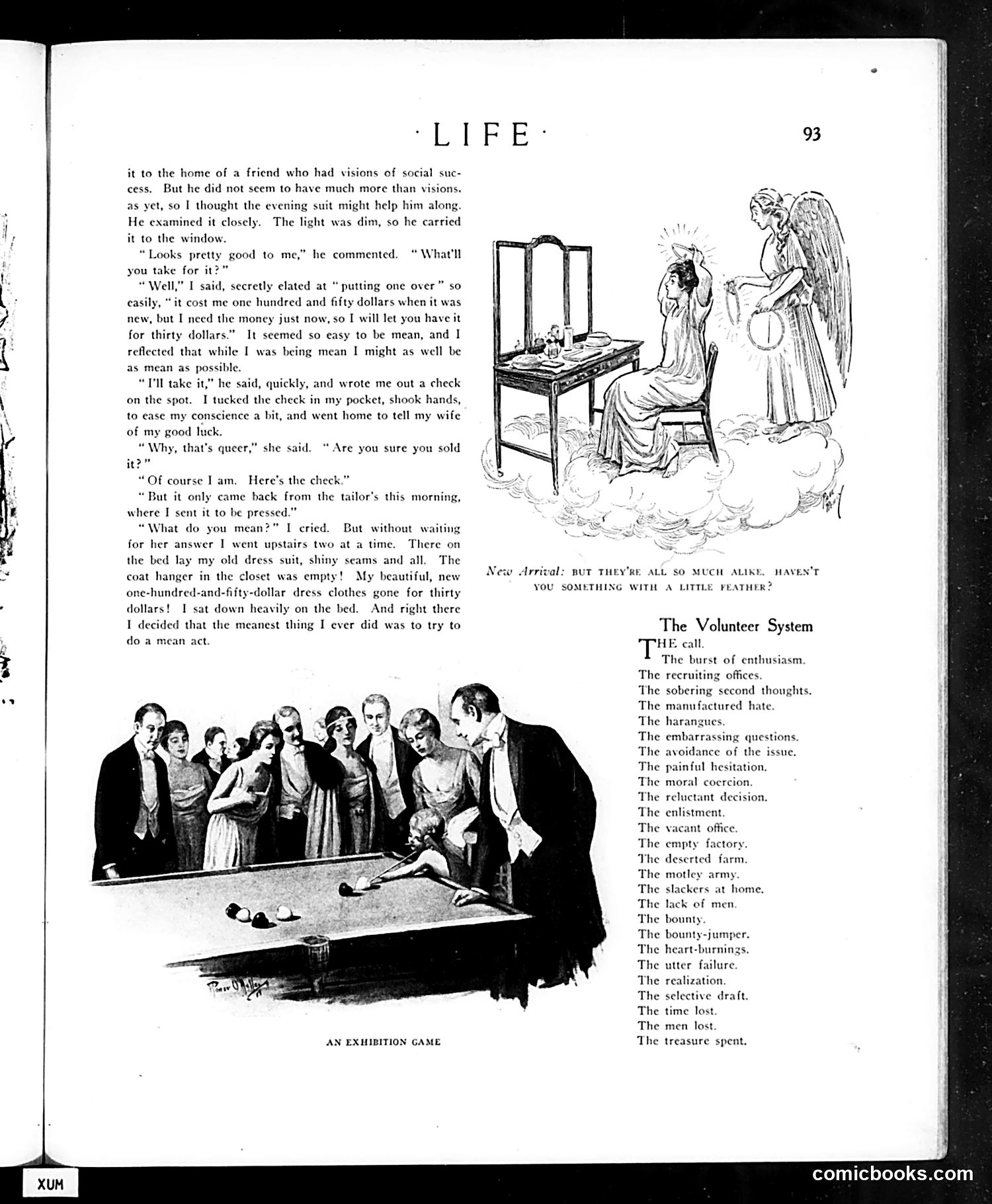
This page contains two distinct illustrations satirizing American military recruitment during what appears to be WWI era. **"An Exhibition Game"** (lower illustration): Shows a dead soldier on a pool/billiards table surrounded by well-dressed civilians and military officers. The morbid title suggests the war is being treated as entertainment or sport by the home front establishment—a bitter critique of how those profiting from or managing the war remain detached from its human cost. **"New Arrival"** (upper illustration): Depicts heavenly figures (appearing to be angels) greeting a newly deceased soldier, with a sarcastic caption about lacking "a little feather"—darkly joking about the inadequate compensation or recognition given to fallen soldiers. **"The Volunteer System"** (right): A lengthy list itemizing the various propaganda, coercion, and emotional manipulation tactics used to recruit soldiers—from manufactured patriotism to moral pressure—suggesting volunteerism was anything but voluntary.
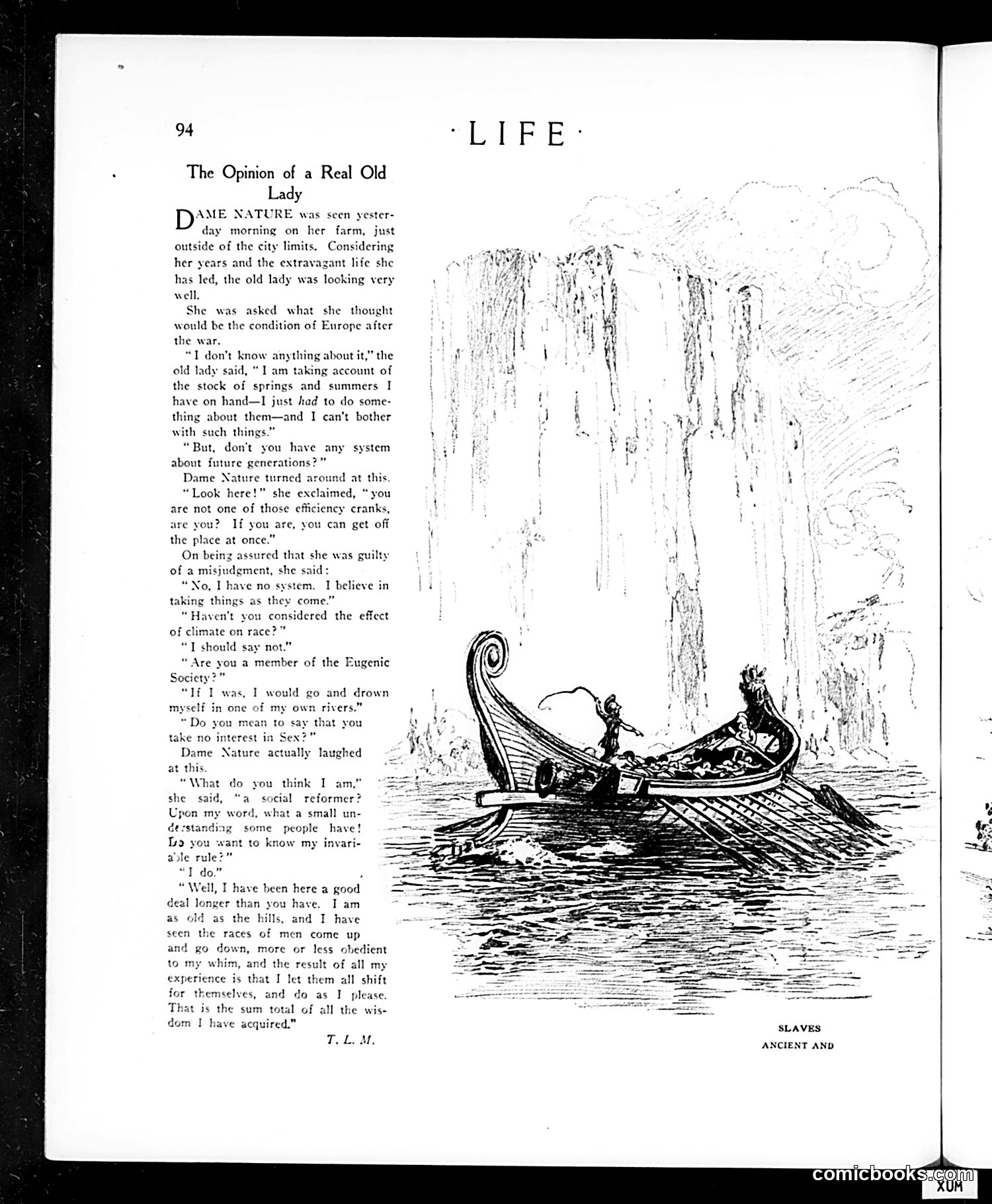
This satirical piece features a dialogue between "Dame Nature" and an unnamed old woman. The old lady, presented as practical and unpretentious, dismisses concerns about future generations and social progress. When questioned about her views on climate, eugenics, and whether she cares about "Sex," she responds dismissively. The satire targets early 20th-century reform movements—particularly eugenics and social progressivism—by contrasting them with the common sense of traditional rural life. Dame Nature "laughs" at the old woman's lack of system, but the lady's final response suggests that long experience and practical wisdom ("let them all shift for themselves") trumps fashionable social theories. The illustration shows classical river scenery, emphasizing Nature's timelessness against modern ideological concerns.
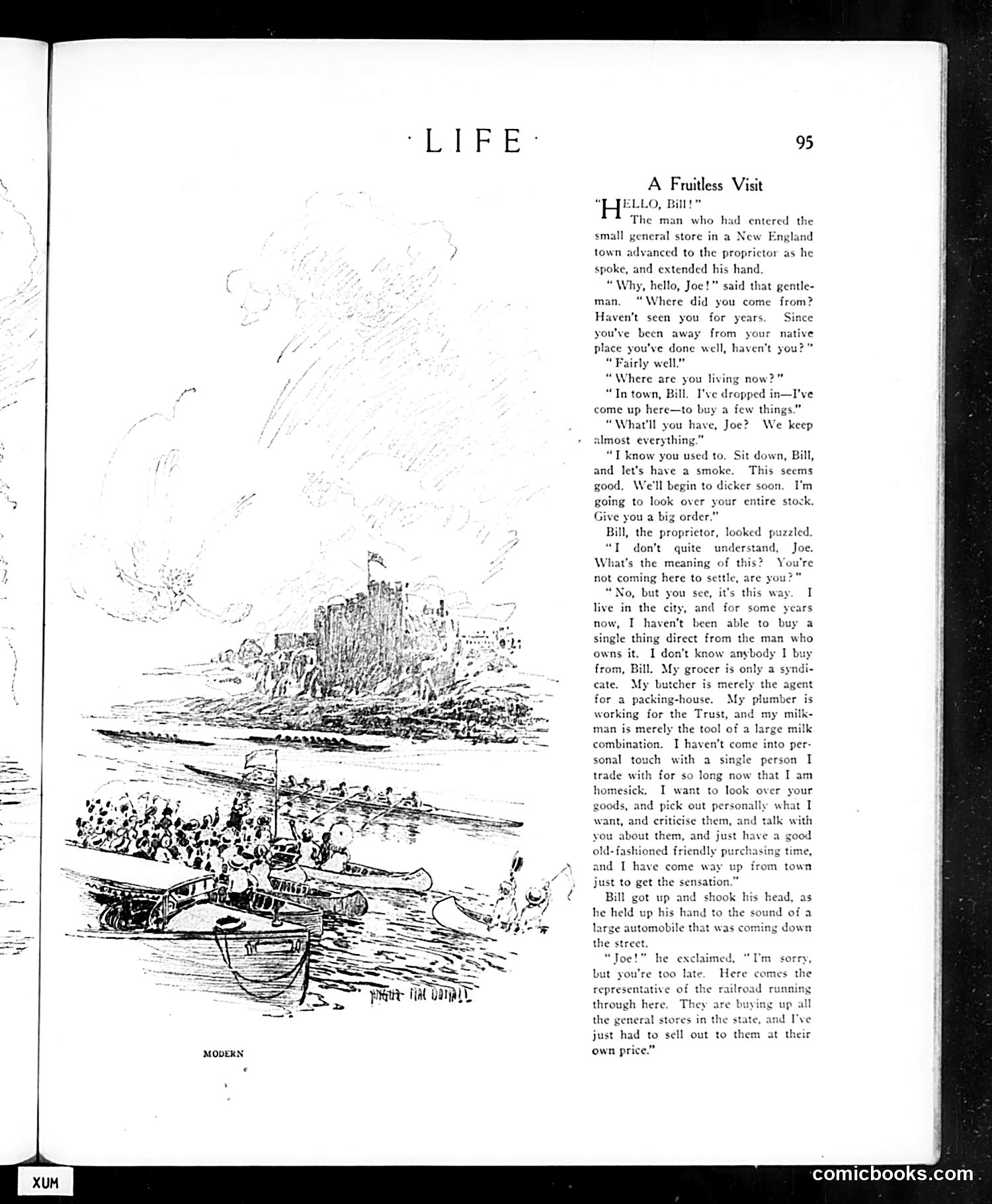
This satirical story depicts a small-town New England general store proprietor named Bill rejecting a customer named Joe. Joe, visiting from the city, attempts to purchase goods directly from Bill's store, explaining he's been unable to buy anything locally because all businesses are syndicated chains—his grocer is a syndicate, his butcher works for a packing house, his plumber for a trust, and his milk man for a large milk combination. The satire targets **corporate consolidation and chain business dominance** in early 20th-century America. Joe represents the frustrated consumer unable to patronize independent merchants. The cartoon (showing a crowded, industrialized landscape) visualizes how modern corporate structures have replaced small business, making personal, "old-fashioned friendly purchasing" impossible—the "fruitless visit" of the title.
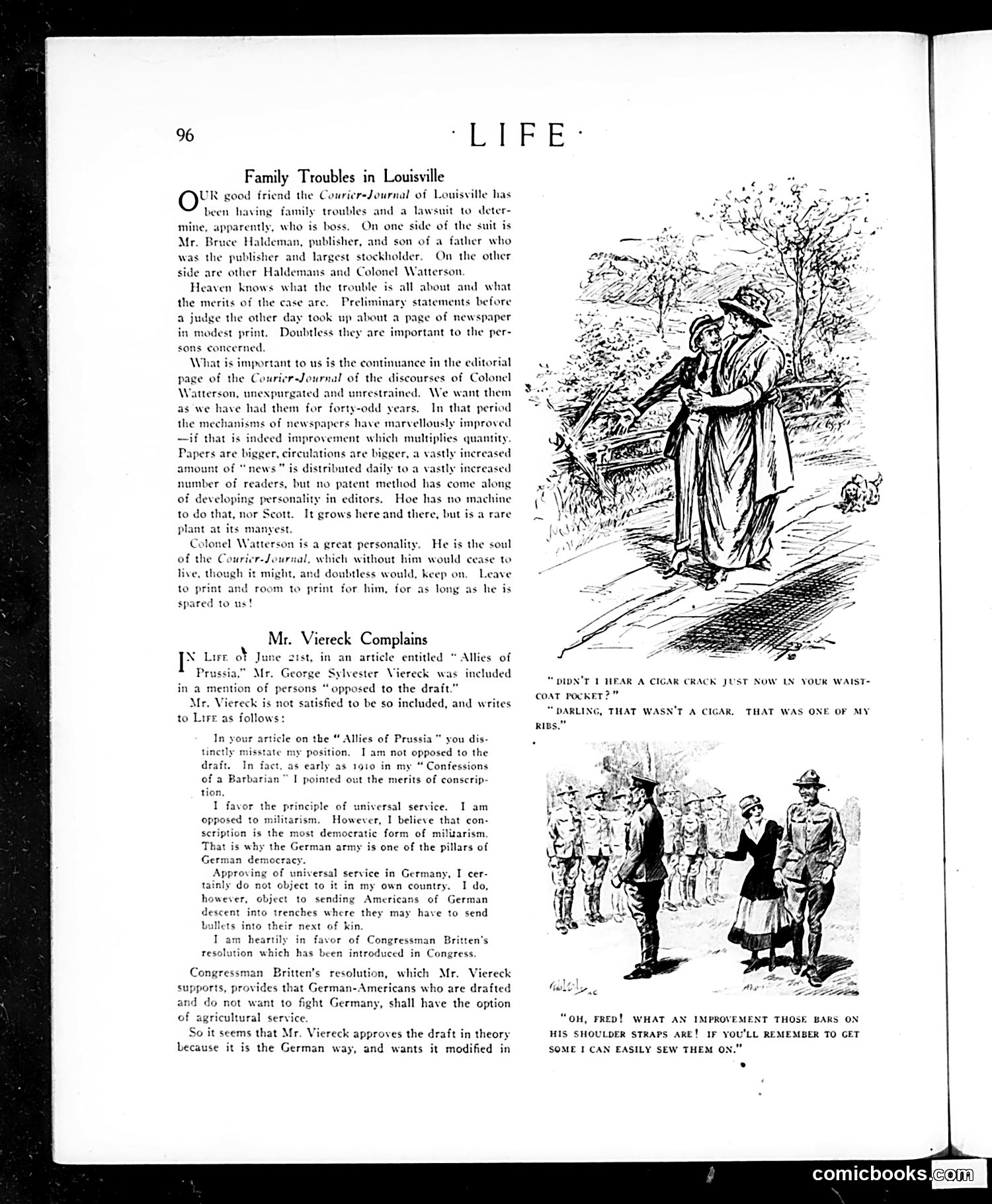
**"Family Troubles in Louisville"**: This section discusses an internal lawsuit at the *Courier-Journal* newspaper between publisher Bruce Haldeman and other family members, with Colonel Watterson involved. Life's point: the magazine cares less about who wins than that Colonel Watterson—described as the editorial "soul" of the paper—retains freedom to write his opinions unrestrained. It's a plea for editorial continuity during family business conflict. **"Mr. Viereck Complains"**: George Sylvester Viereck, a German-American writer, objects to being labeled "opposed to the draft" in Life's June 21st article. He claims he supports conscription *in theory* but opposes sending German-Americans to fight Germany specifically. The satire mocks his contradictory position: he wants the draft modified to protect his ethnic group—revealing self-interest masked as principle during WWI debates over German-American loyalty. The cartoons illustrate both pieces with contemporary domestic and military scenes.
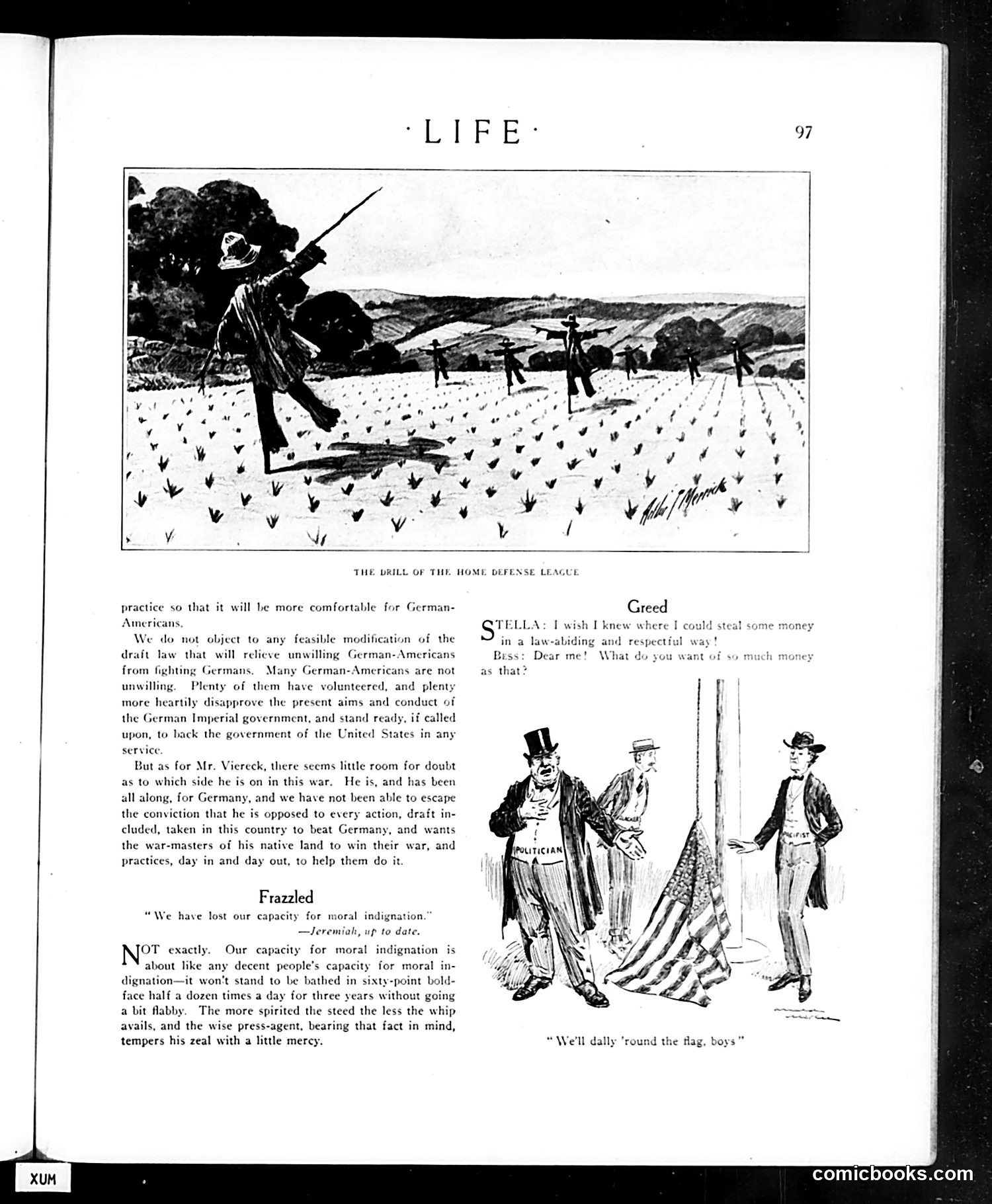
**Top cartoon "The Drill of the Home Defense League"** depicts armed civilians (the Home Defense League) drilling in a field. This references WWI-era concerns about German-American loyalty and preparedness, mocking the notion of organizing German-Americans into defensive militia units. **The text below discusses German-American draft resistance**, specifically referencing "Mr. Viereck" (likely George Sylvester Viereck, a known German propagandist during WWI). Life argues against exempting unwilling German-Americans from military service, asserting most German-Americans actually support the U.S. cause against Germany. **Bottom cartoon "Greed"** shows a politician and two other figures discussing theft, satirizing political corruption and self-interest during wartime. **"Frazzled" section** criticizes overuse of moral outrage in propaganda, suggesting constant emotional appeals through bold headlines exhaust public attention—a meta-commentary on Life's own satirical medium and wartime messaging saturation.
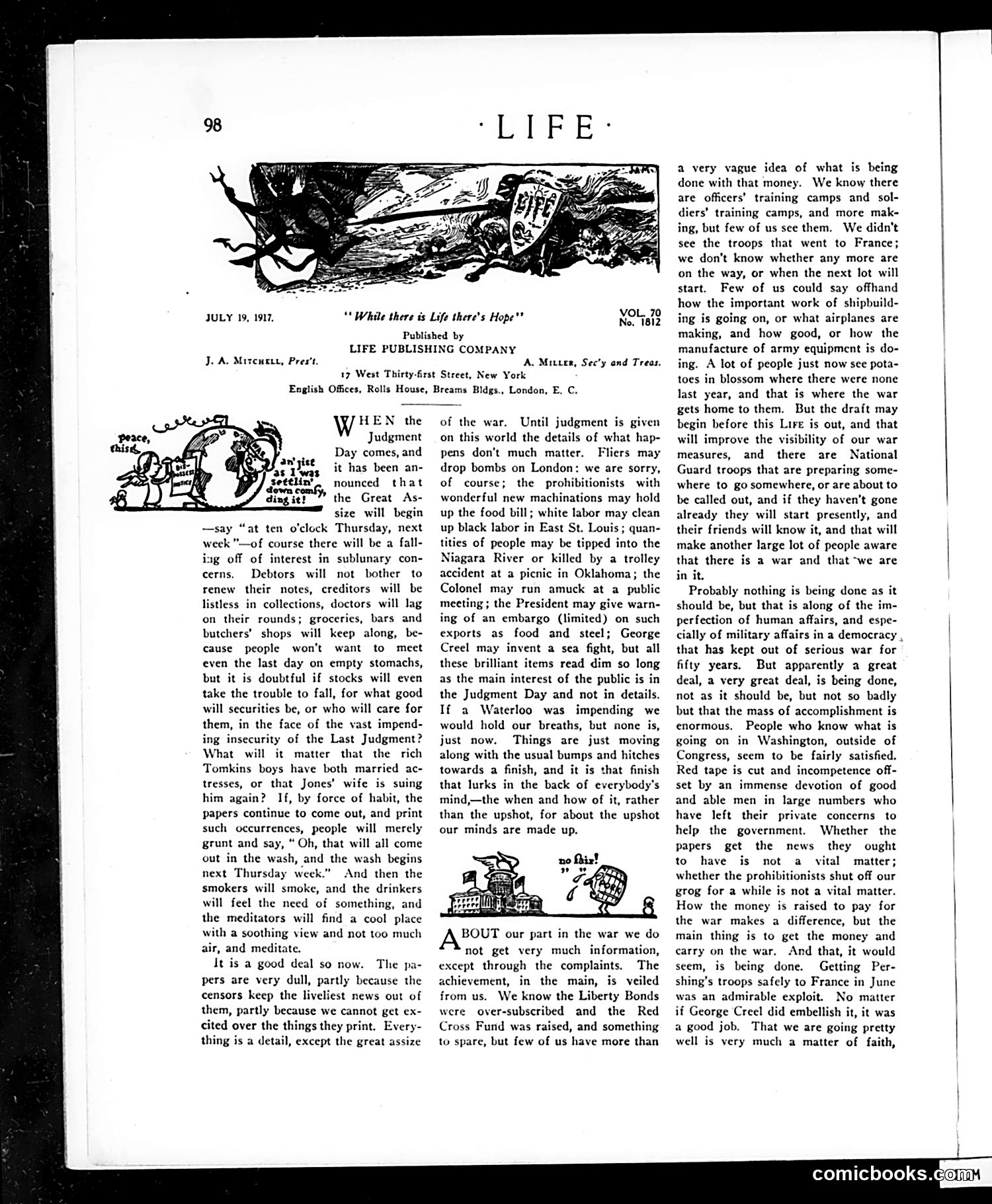
This satirical editorial uses the metaphor of Judgment Day to critique American public apathy toward World War I. The author argues that Americans treat the war as so momentous—a kind of "Last Judgment"—that all mundane concerns (stocks, lawsuits, daily news) seem trivial by comparison. This paralysis of interest renders newspapers dull. The piece then shifts to concrete complaint: the government severely restricts war information through censorship. Americans know Liberty Bonds succeeded and soldiers trained, but remain ignorant about shipbuilding progress, aircraft production, troop deployments to France, and equipment manufacturing. The cartoons (showing a fallen soldier and domestic scenes) reinforce the disconnect between the massive war effort and the information vacuum reaching civilians. The satire suggests this information blackout leaves the public both anxious and disengaged.
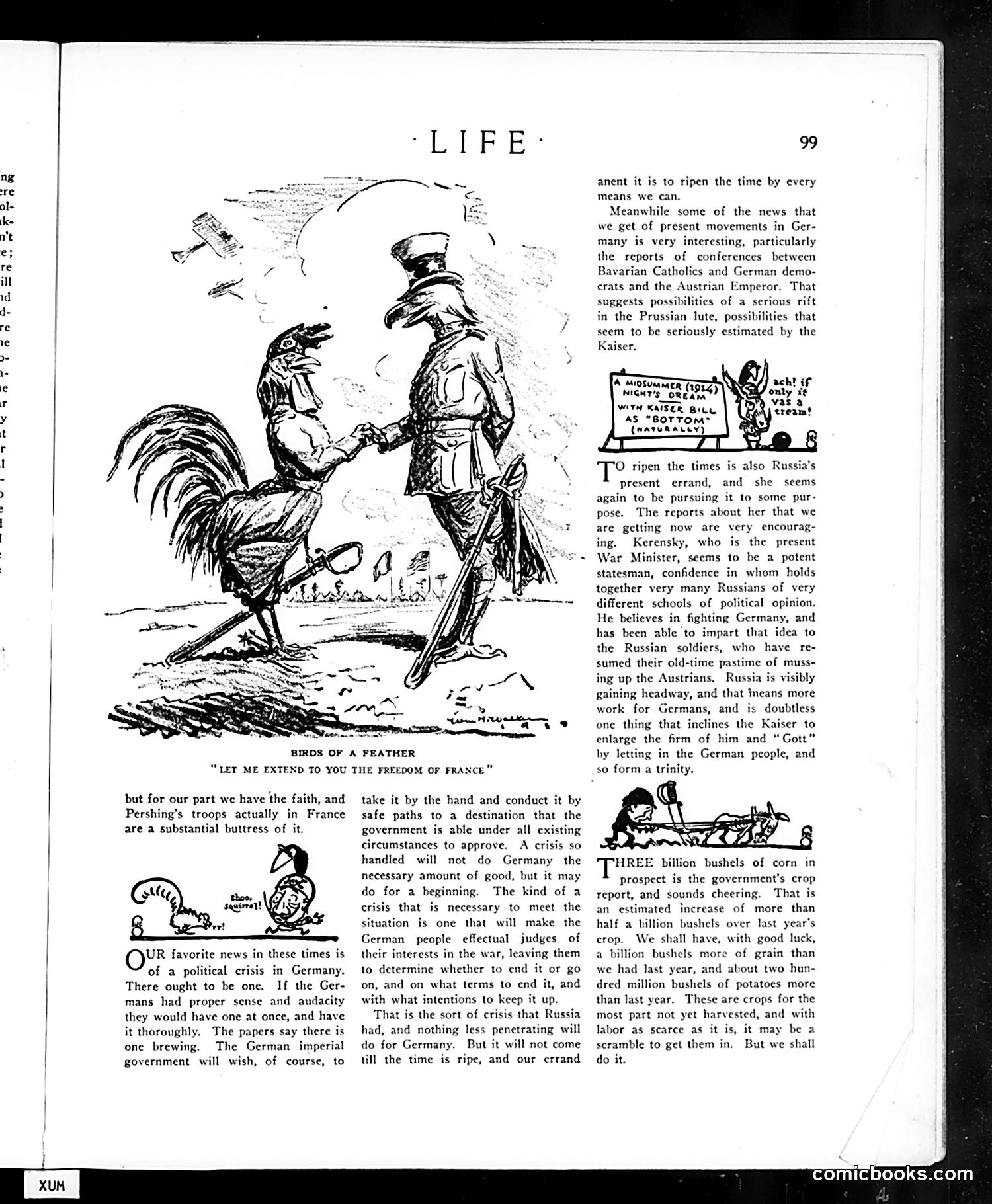
This page from *Life* magazine satirizes WWI-era European politics. The main cartoon, "Birds of a Feather," depicts a rooster (France) offering "freedom" to a German military officer—likely mocking an alliance or negotiation between them, with the visual pun suggesting they're similar creatures despite being enemies. The text discusses internal German political crisis, hoping it will weaken Germany's war effort. It mentions Russian War Minister Kerensky and suggests Russia is gaining military momentum against Austria. The small inset cartoon references Shakespeare's "A Midsummer Night's Dream," with "Bottom" (the character transformed into a donkey) representing the Kaiser—a crude insult suggesting German leadership is foolish or bestial. The final section praises American agricultural output as a resource advantage in the war effort. The overall message: Allied nations should exploit German internal divisions while American resources strengthen their position against Central Powers.
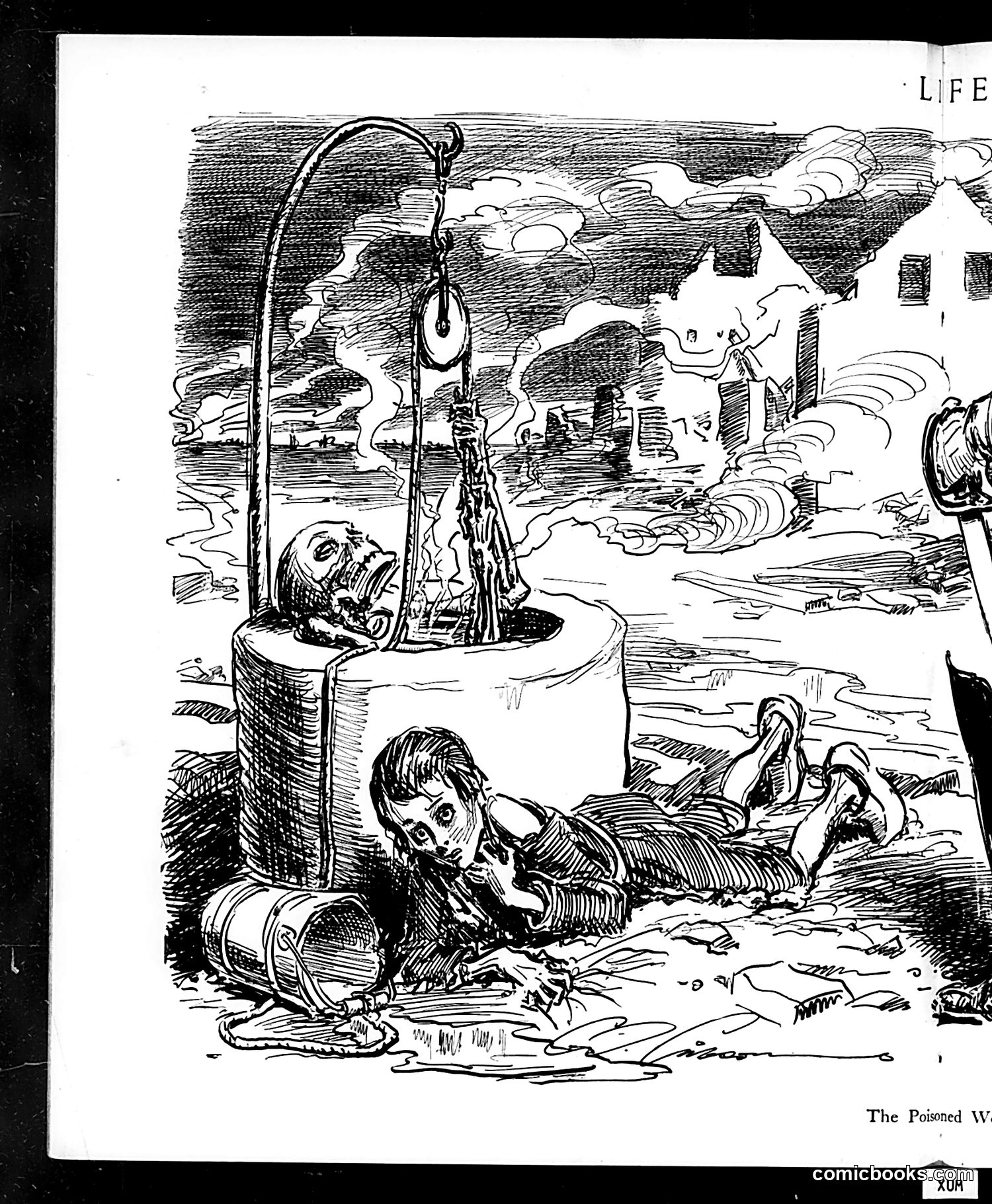
This Life magazine illustration depicts a poisoned water well as a metaphor for contaminated public resources or institutions. A skeletal figure emerges from the well's depths while a man lies poisoned on the ground, spilling liquid from an overturned bucket. Figures in the background appear to be affected or fleeing. The cartoon likely critiques corruption, pollution, or poisoning of a vital public good—possibly referring to contaminated water supplies, corrupt governance, or ideological "poisoning" of society. The well as a central community resource makes it an apt symbol for widespread harm affecting entire populations. Without the complete caption or publication date visible, the specific historical context remains unclear, though the composition suggests early-to-mid 20th century American political satire addressing public health or institutional corruption.
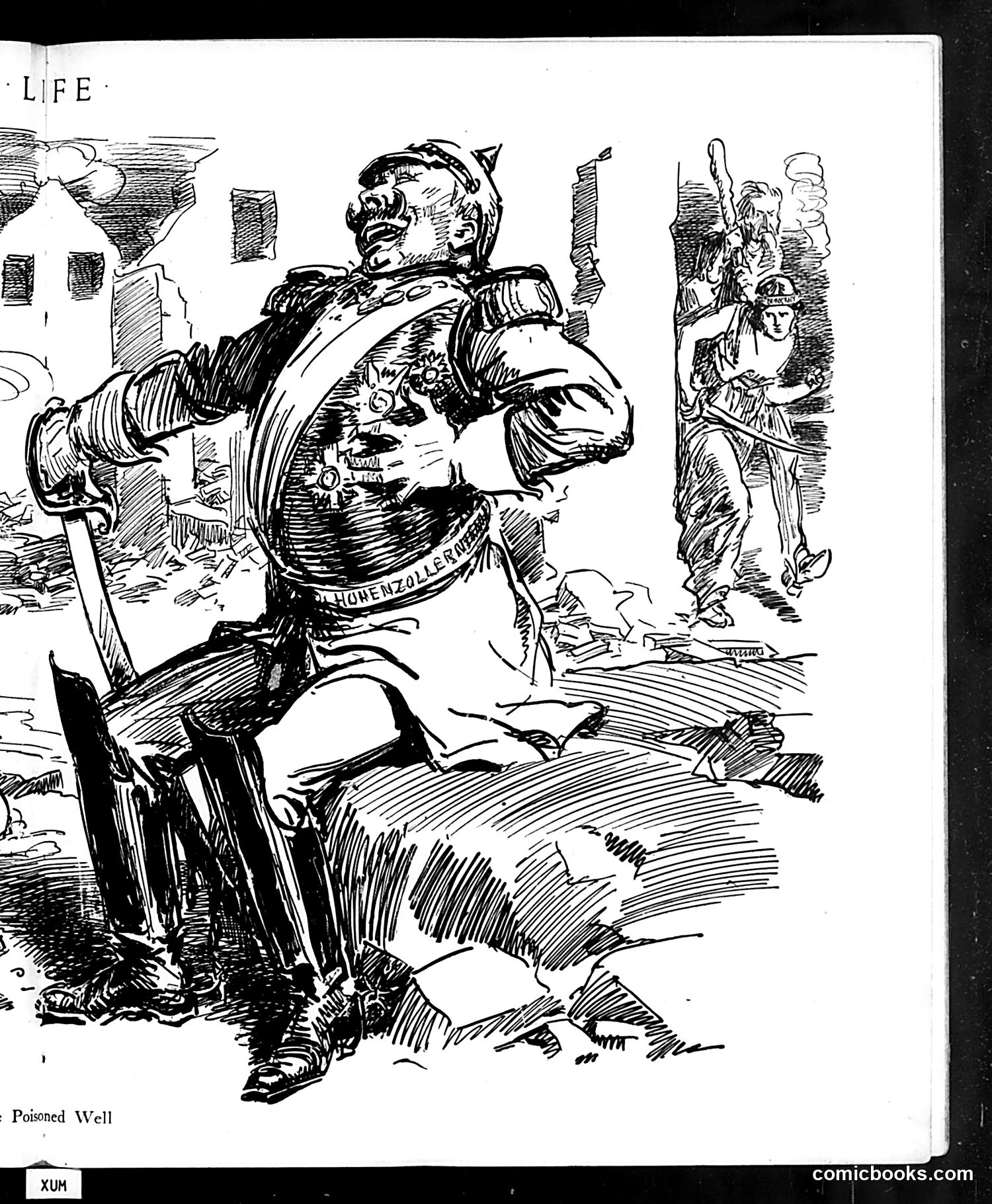
This political cartoon depicts a heavily decorated military officer (likely a German general, suggested by the "Hohenzollern" text visible on his uniform—referencing the German royal house) standing at what appears to be a poisoned well. The figure represents militarism or German military leadership contaminating a water source, a metaphor for poisoning society or civilization itself. Civilians on the right observe the scene, suggesting the public witnessing the damage caused by military aggression. The cartoon likely critiques German militarism's destructive influence on European society, probably from the World War I era when Life magazine regularly published anti-German satire. The "poisoned well" represents how military power corrupts and harms the common good.
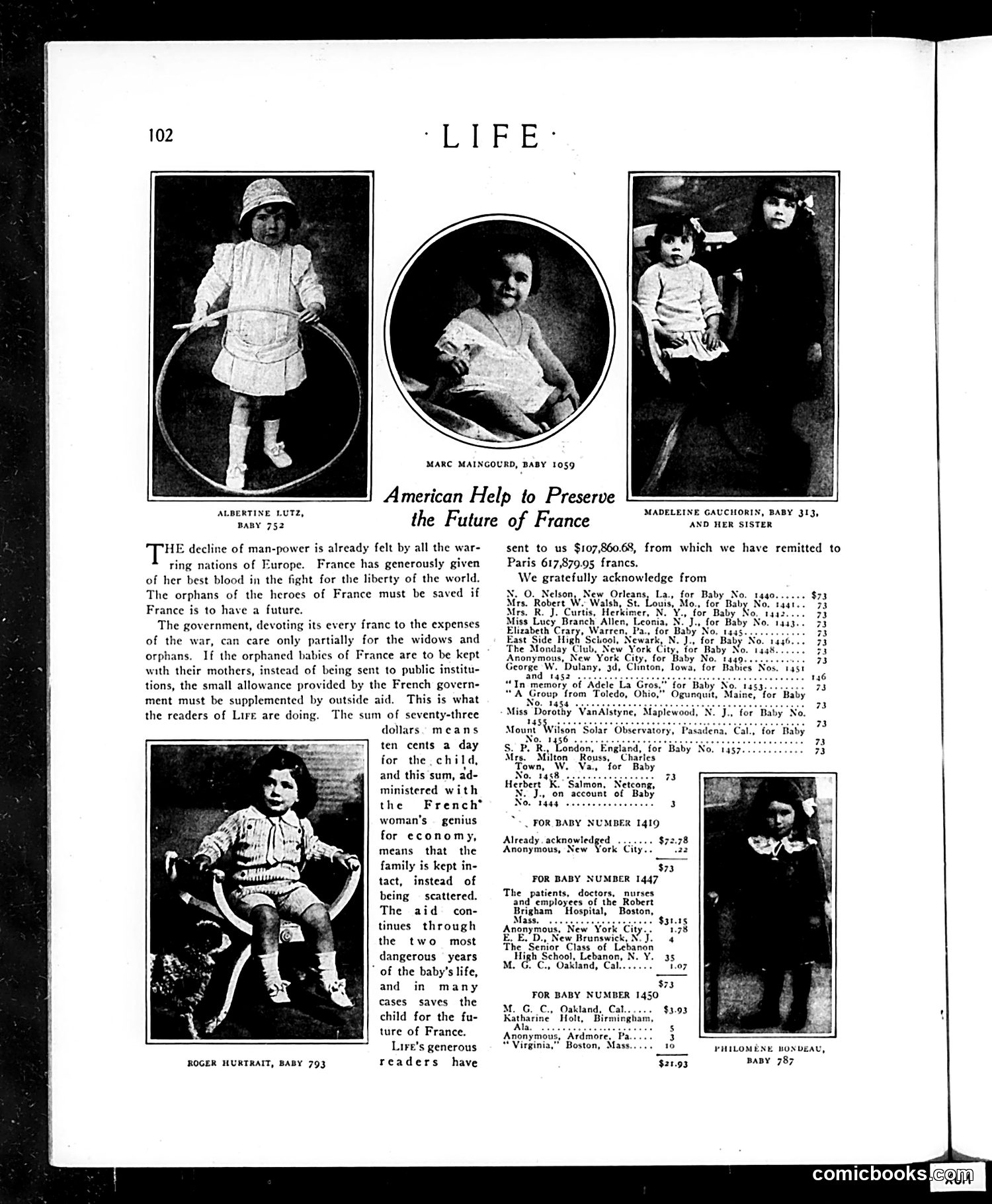
This is a fundraising appeal, not satire. During World War I, *Life* magazine solicited donations from American readers to support French war orphans and their mothers. The page features photographs of French babies and children being sponsored through the program. The text argues that France—depleted of manpower by the war—cannot fully support orphans, so American charitable contributions ($73 per child annually, or ten cents daily) allow families to stay together rather than be institutionalized. The accompanying donor list documents contributions from American organizations and individuals, with amounts remitted to Paris. This represents American civilian support for France during the war, framed as preserving France's future by keeping the next generation alive and with their mothers. It's a straightforward philanthropic campaign rather than political commentary.
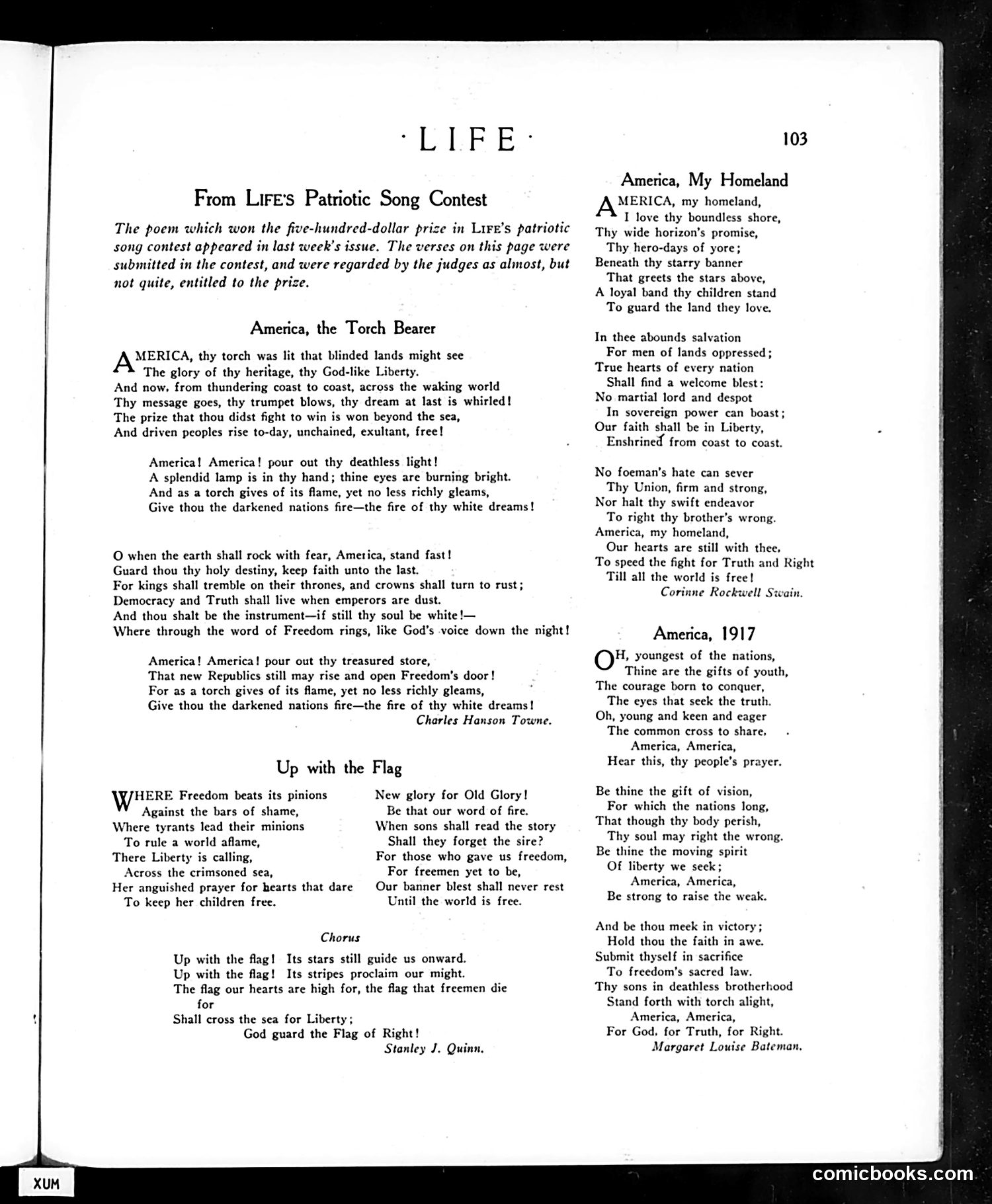
This page presents poems submitted to Life magazine's patriotic song contest during World War I. The contest winners appear on the previous week's issue; these runners-up poems are "almost, but not quite" prize-worthy. The poems share common themes reflecting American entry into WWI (1917): America as a beacon of liberty spreading democracy globally, appeals to national unity and sacrifice, and idealization of American values. Phrases like "darkened nations" and "fire of thy white dreams" express the era's paternalistic view of America's civilizing mission. Notable is "America, 1917," explicitly dated to reference current events, imploring the nation to use its "youth" and "courage" for global justice—a direct reference to American participation in the Great War. The content reveals early-20th-century American nationalism, wartime propaganda aesthetics, and the era's racial and imperial assumptions embedded in patriotic rhetoric—elements modern readers should recognize as historically significant but problematic.
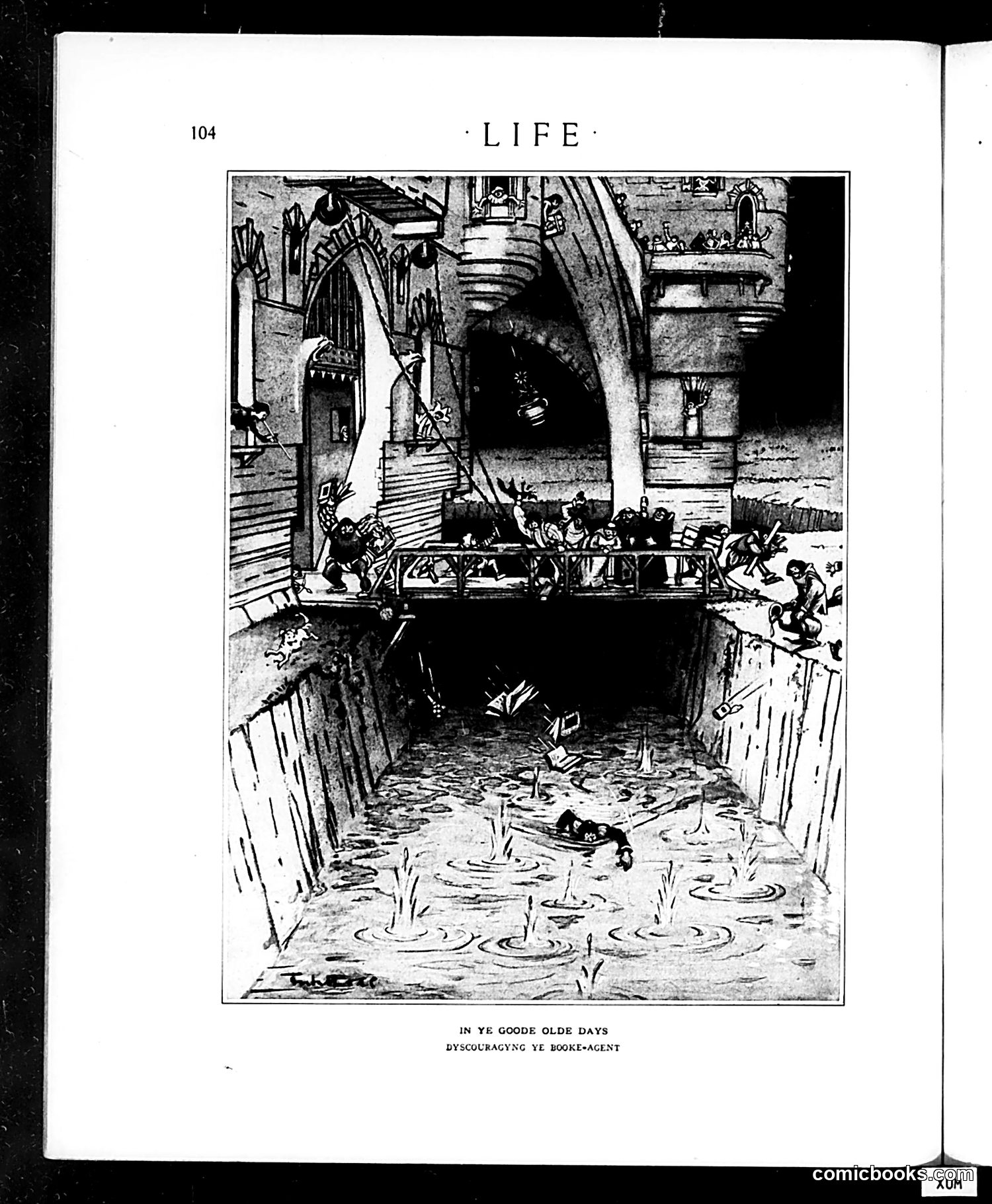
This is a satirical cartoon depicting a medieval or fantasy setting where a "book-agent" (likely a publisher's representative or salesman) is being actively discouraged—apparently by townspeople throwing objects at him from a bridge while he wades through water below. The satire mocks book agents/publishers of the era by suggesting that even in "ye goode olde days," such figures were universally unwelcome and faced public hostility. The joke implies that book agents were so annoying or aggressive in their sales tactics that they would have been rejected even in romanticized historical settings. This reflects early 20th-century American satirical commentary on the publishing industry's pushy commercial practices, presented through whimsical pseudo-archaic language and period-fantasy imagery for humorous effect.
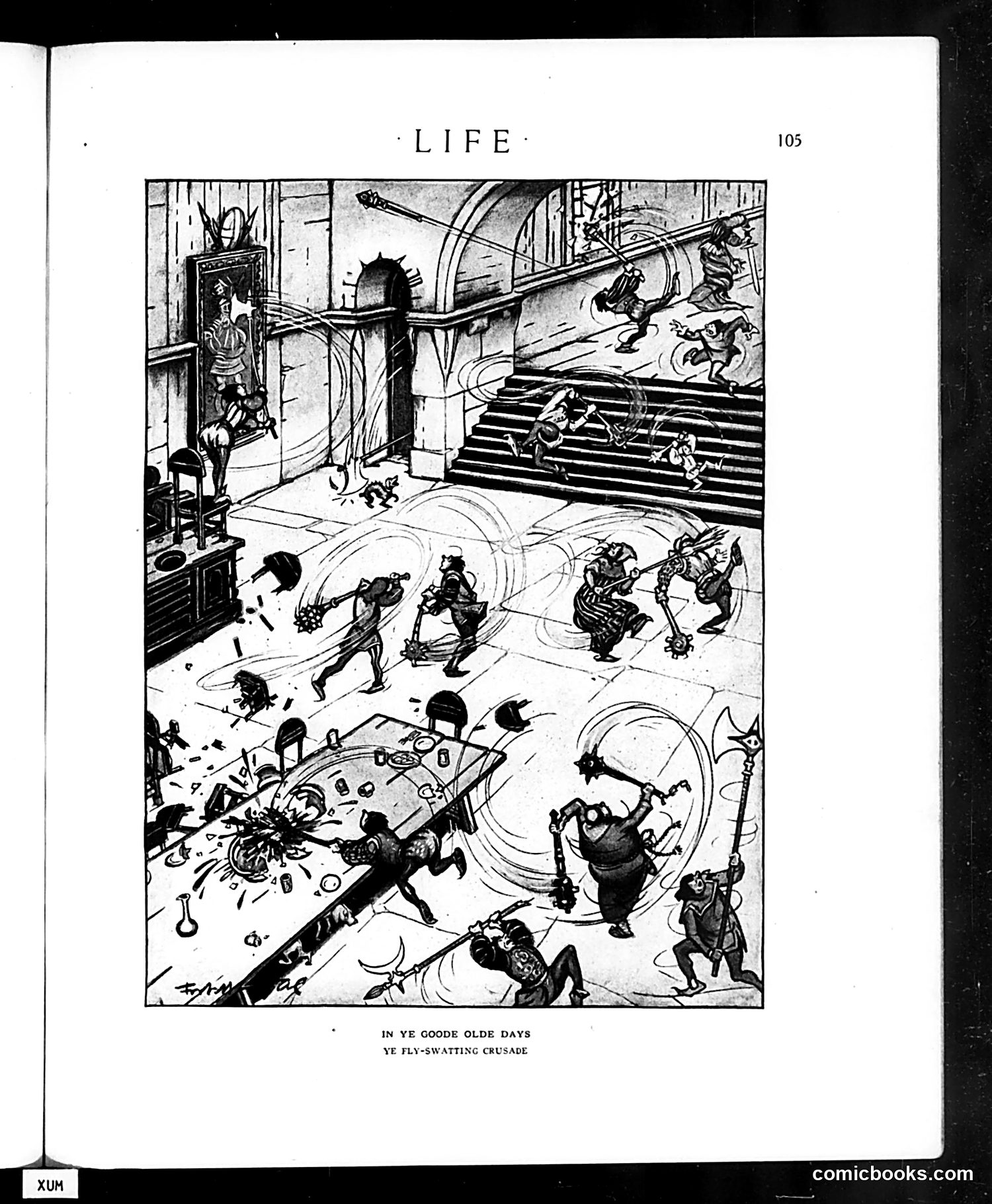
This satirical cartoon depicts "ye fly-swatting crusade" — a public health campaign from the early 1900s promoting the use of fly swatters to kill disease-carrying flies. The image shows a chaotic medieval-style battle scene where common people and nobility engage in an exaggerated crusade against flies using various weapons and tools. The satire mocks how seriously Americans took this public health initiative, treating pest control like a noble medieval crusade. The anachronistic mixing of modern domestic scenes with knightly imagery emphasizes the humorous overwrought nature of the campaign. This reflects Life magazine's characteristic mockery of contemporary social movements and health trends, presenting ordinary disease prevention as grandiose historical drama to highlight its perceived absurdity or excessive enthusiasm among the public.
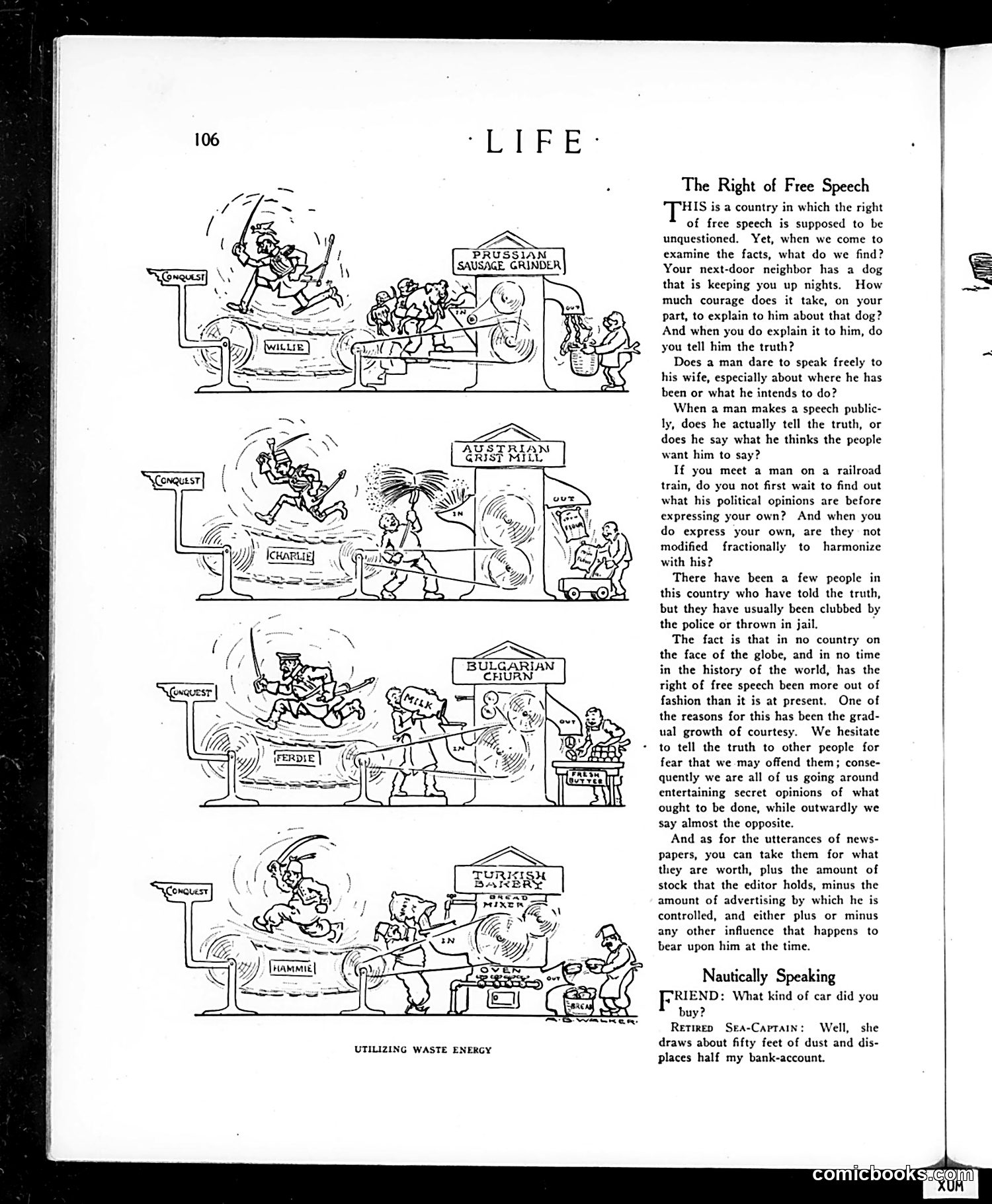
This four-panel cartoon satirizes conquest and colonial exploitation. Each panel shows a conquering power (labeled Prussian, Austrian, Bulgarian, and Turkish) operating machinery that extracts resources from conquered territories—represented by figures being ground through industrial equipment like sausage mills or grinders. The title "Utilizing Waste Energy" is the joke: the conquering nations treat defeated peoples as "waste energy" to be mechanically exploited for profit and power. The cartoon appears to reference European imperial expansion and the Balkan conflicts of the early 20th century. The accompanying essay "The Right of Free Speech" argues that despite America's supposed commitment to free speech, people routinely self-censor—avoiding uncomfortable truths with neighbors, spouses, and strangers out of fear of offense. Newspapers too are compromised by financial interests and advertisers. The "Nautically Speaking" joke at bottom is unrelated wordplay about a car that "draws" (nautical term) dust instead of water.
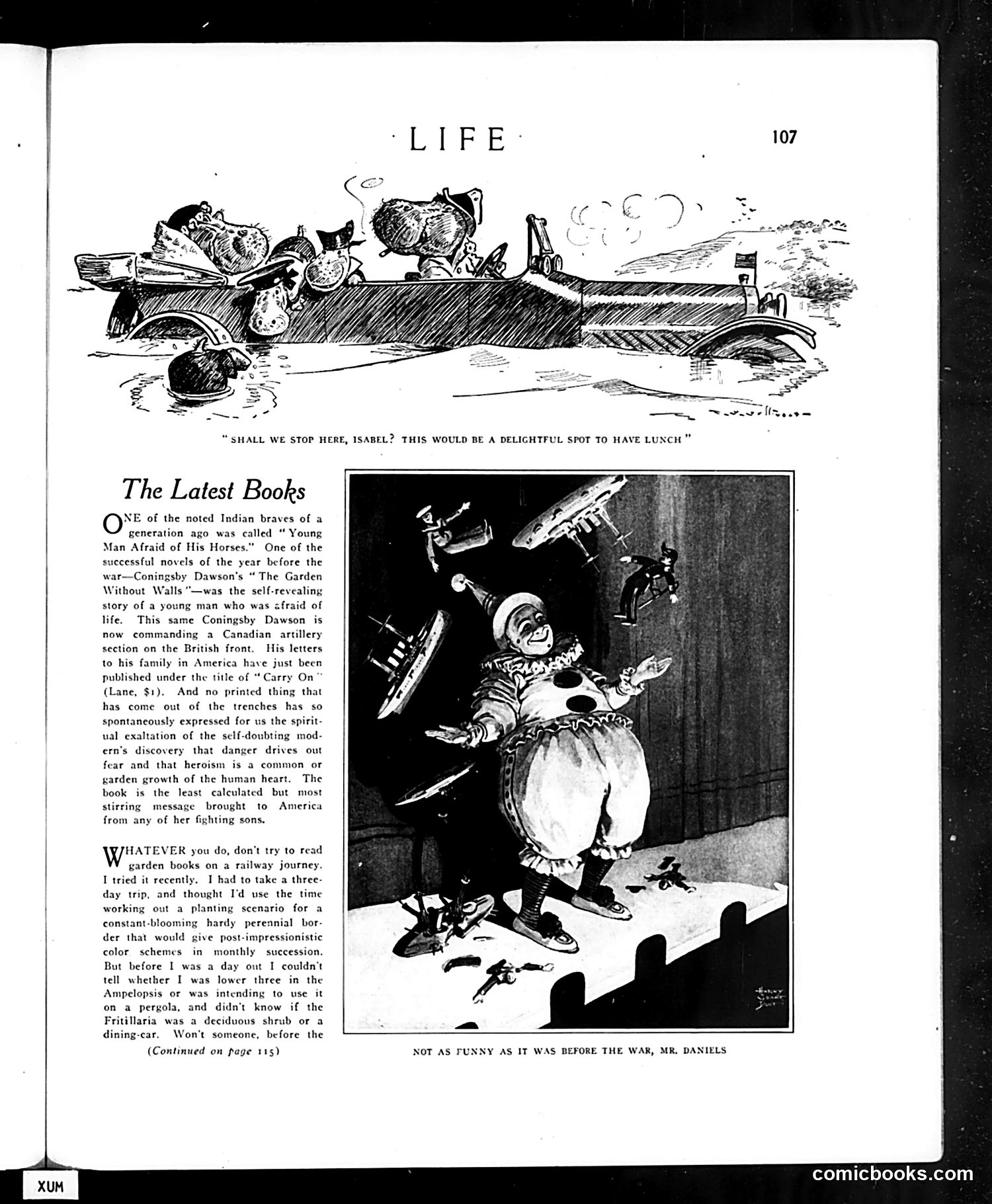
**Top Cartoon:** A humorous sketch showing an overloaded automobile filled with household items and provisions, with the caption "Shall we stop here, Isabel? This would be a delightful spot to have lunch." The joke satirizes the emerging automobile culture and leisure travel—the vehicle is so packed with belongings that stopping for a simple picnic seems absurd. **Lower Image & Caption:** Titled "Not As Funny As It Was Before the War, Mr. Daniels," this appears to show a rotund, comic figure amid wreckage or debris. The caption references how wartime has diminished the appeal of pre-war humor, likely critiquing how WWI's gravity has made light entertainment seem inappropriate or tone-deaf. "Mr. Daniels" likely refers to Josephus Daniels, Secretary of the Navy during WWI. **Book Review Section:** Discusses Coningsby Dawson's letters from the trenches ("Carry On"), praising how combat transformed a formerly fearful young man into a hero—reflecting contemporary WWI narratives about war's character-building effects.
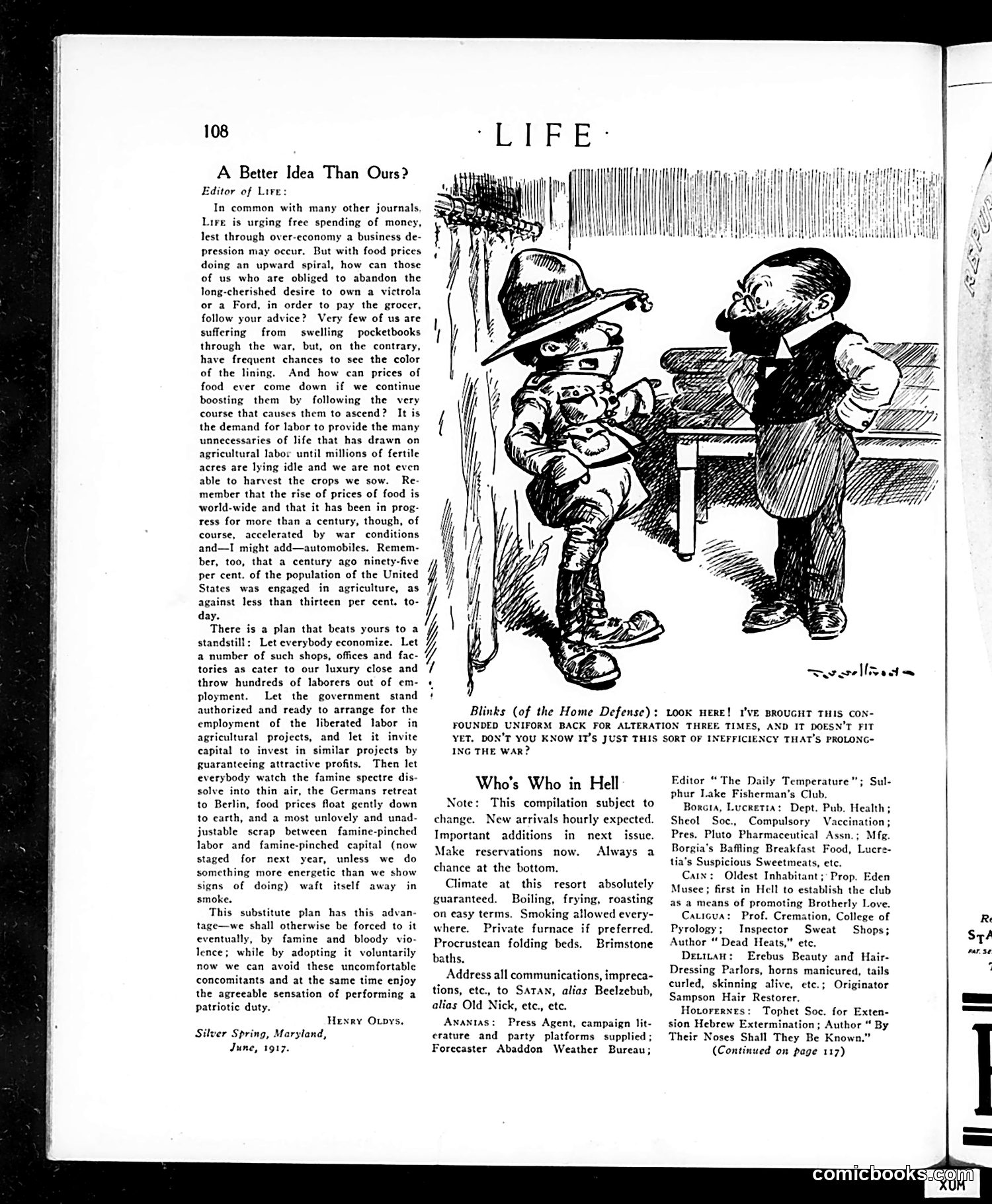
This page from *Life* magazine (June 1917, during WWI) contains a letter criticizing the magazine's advice to spend freely during wartime economic concerns. The writer argues that high food prices make such spending impossible for ordinary people, and proposes instead that the government redirect unemployed luxury-industry workers into agricultural labor to increase food production and lower prices. The cartoon "Blinks" shows a soldier complaining that his military uniform doesn't fit properly despite three alterations, sarcastically blaming this incompetence for prolonging the war—a joke mocking both bureaucratic inefficiency and civilian complaints that seem trivial compared to actual wartime problems. "Who's Who in Hell" is a satirical directory listing prominent political figures (Awanias, Borgia, Cain) assigned to Hell, poking fun at contemporary politicians and historical villains in darkly humorous fashion.
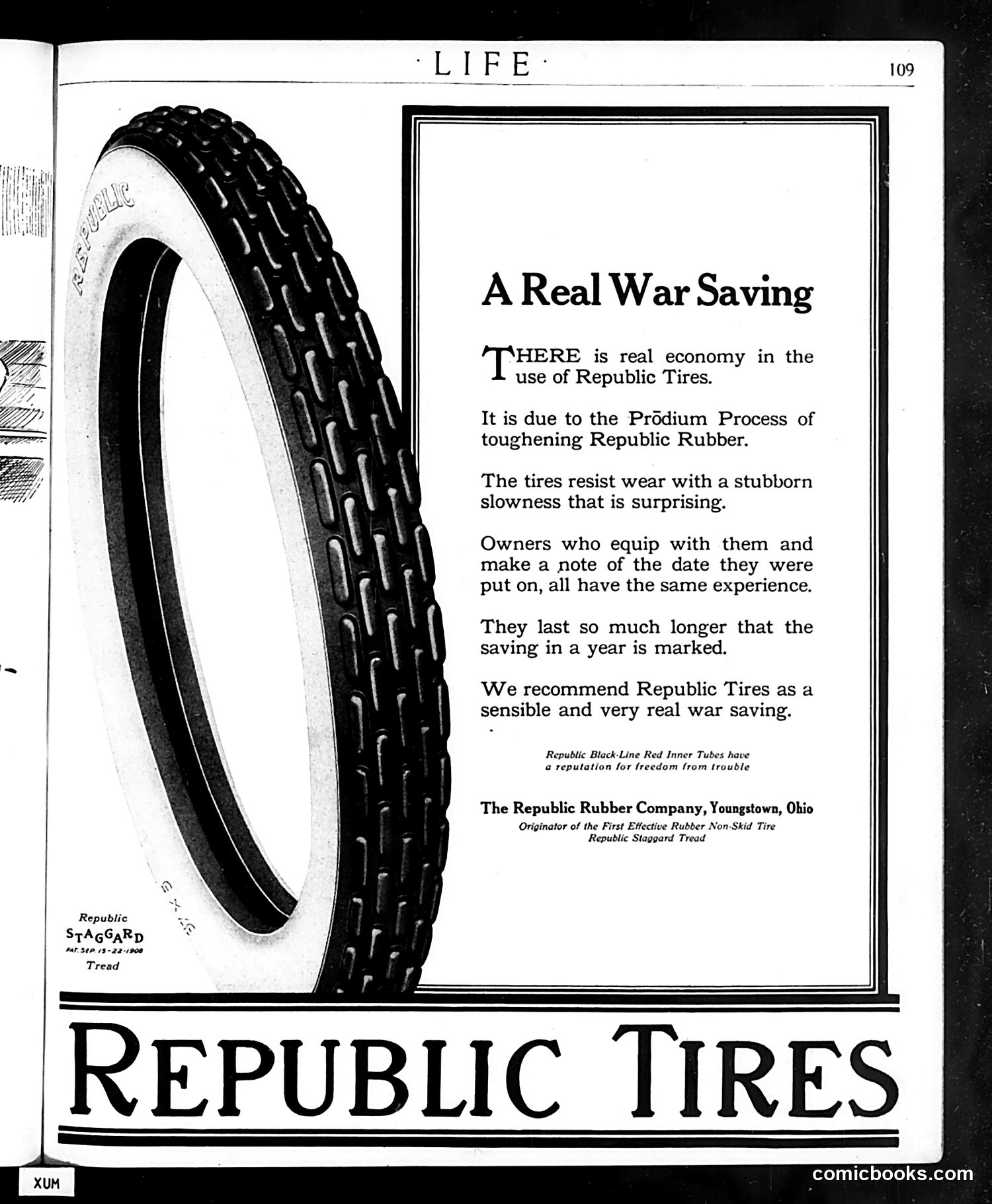
This page is primarily **advertising, not political satire**. It's a Republic Tires advertisement from *Life* magazine, likely from around 1918 (the OCR date suggests 1900, but the "war saving" language indicates WWI era). The ad features a large photograph of a tire with white sidewalls and the "Staggard Tread" design. The marketing pitch emphasizes durability and economy during wartime—promising that Republic Tires last exceptionally long, making them a practical "war saving" for consumers facing resource constraints. The headline "A Real War Saving" is patriotic messaging typical of WWI-era advertising, positioning tire purchases as economically responsible civilian contribution during the war effort. The ad appeals to practical-minded owners who track tire longevity. There is no political cartoon or satire present on this page—it's straightforward commercial promotion using contemporary wartime vocabulary to sell rubber tires.
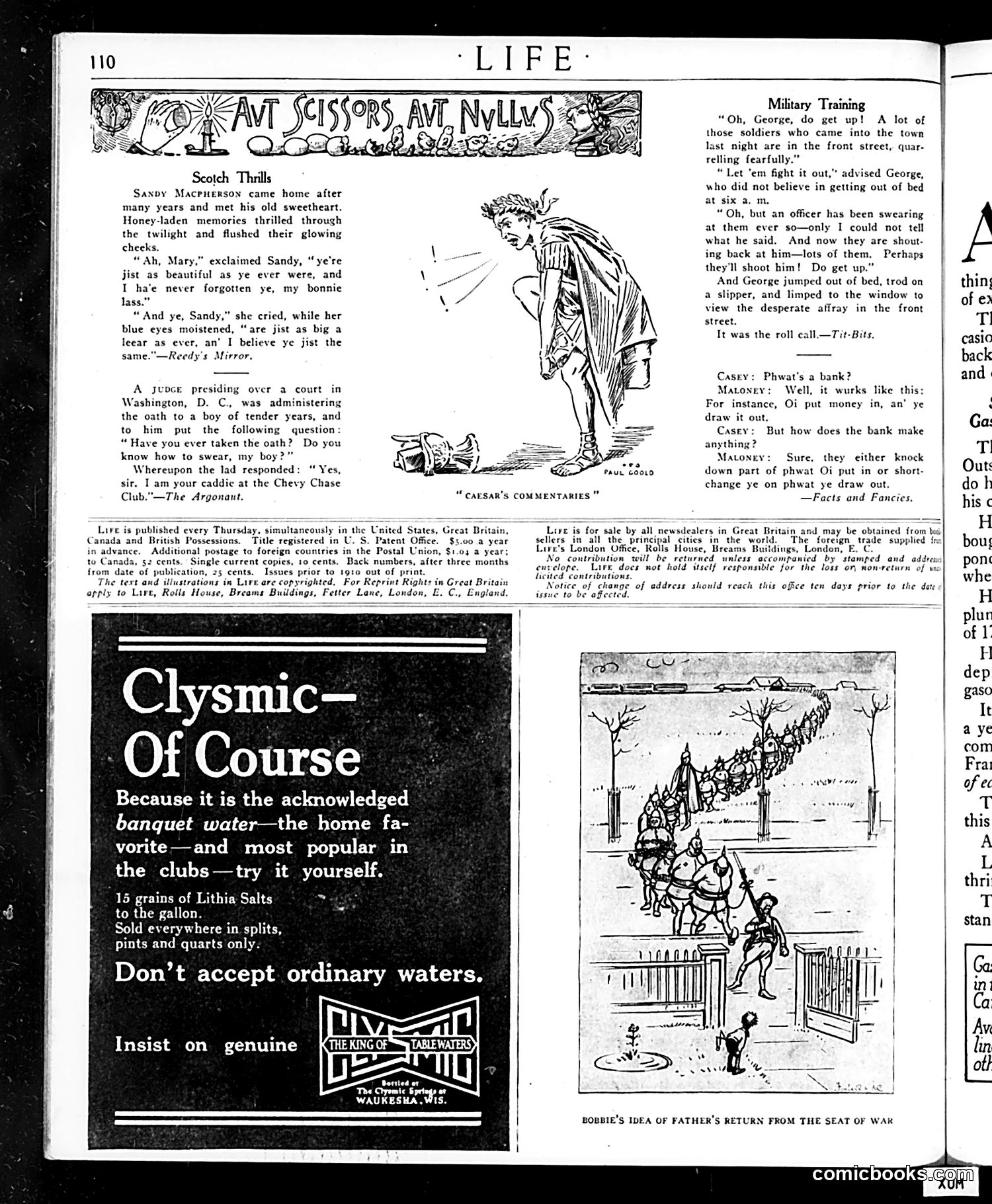
This page contains three separate humor pieces typical of early 20th-century Life magazine: 1. **"Scotch Thrills"**: A sentimental reunion between old sweethearts plays on Scottish dialect humor. The joke: Sandy rhapsodizes about never forgetting his "bonnie lass," but Mary reminds him he's still the same liar he always was—undercutting the romance with cynicism. 2. **"Military Training"**: A domestic scene where George dismisses his wife's alarm about soldiers quarreling in the street, only to discover it's merely a military roll call. The satire mocks masculine indifference to apparent conflict. 3. **Casey/Maloney banking joke**: An Irish-dialect exchange where Maloney explains a bank's profit model: they either short-change deposits or overcharge withdrawals—satirizing banking practices as inherently dishonest. The page also includes a Clysmic water advertisement and an illustration captioned "Bobbie's Idea of Father's Return from the Seat of War," likely referencing WWI. The humor relies on period-specific dialects, gender stereotypes, and cynicism about institutions.
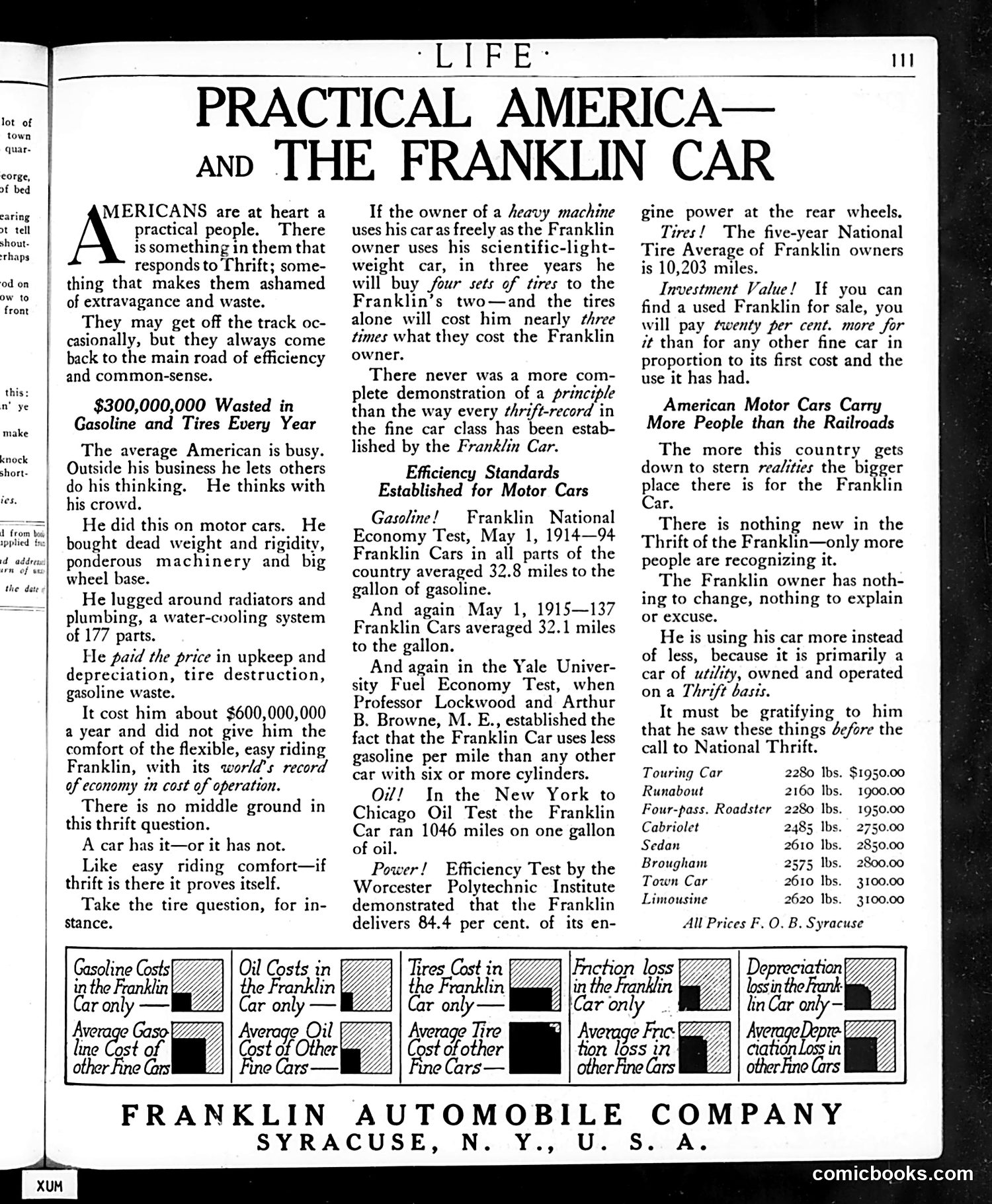
This is a **Franklin automobile advertisement**, not a political cartoon. It appeared in *Life* magazine during the early 1910s. The ad appeals to American values of **thrift and practicality** by arguing that Franklin cars are superior to competitors (implied to be heavier, luxury vehicles). The text contrasts wasteful "dead weight" cars—which cost Americans "$300,000,000" yearly in fuel and tires—against Franklin's lightweight, efficient design. The advertisement presents scientific test data (fuel economy tests, tire durability, power output) to establish Franklin's superiority. It aims at the practical American businessman, suggesting that choosing a Franklin demonstrates both intelligence and virtue. The accompanying bar charts visually compare Franklin's costs favorably to unnamed "other fine cars" in gasoline, oil, tires, friction loss, and depreciation categories. This represents early automotive advertising that weaponized **efficiency and economy** as moral virtues, targeting the aspirational middle-class driver.
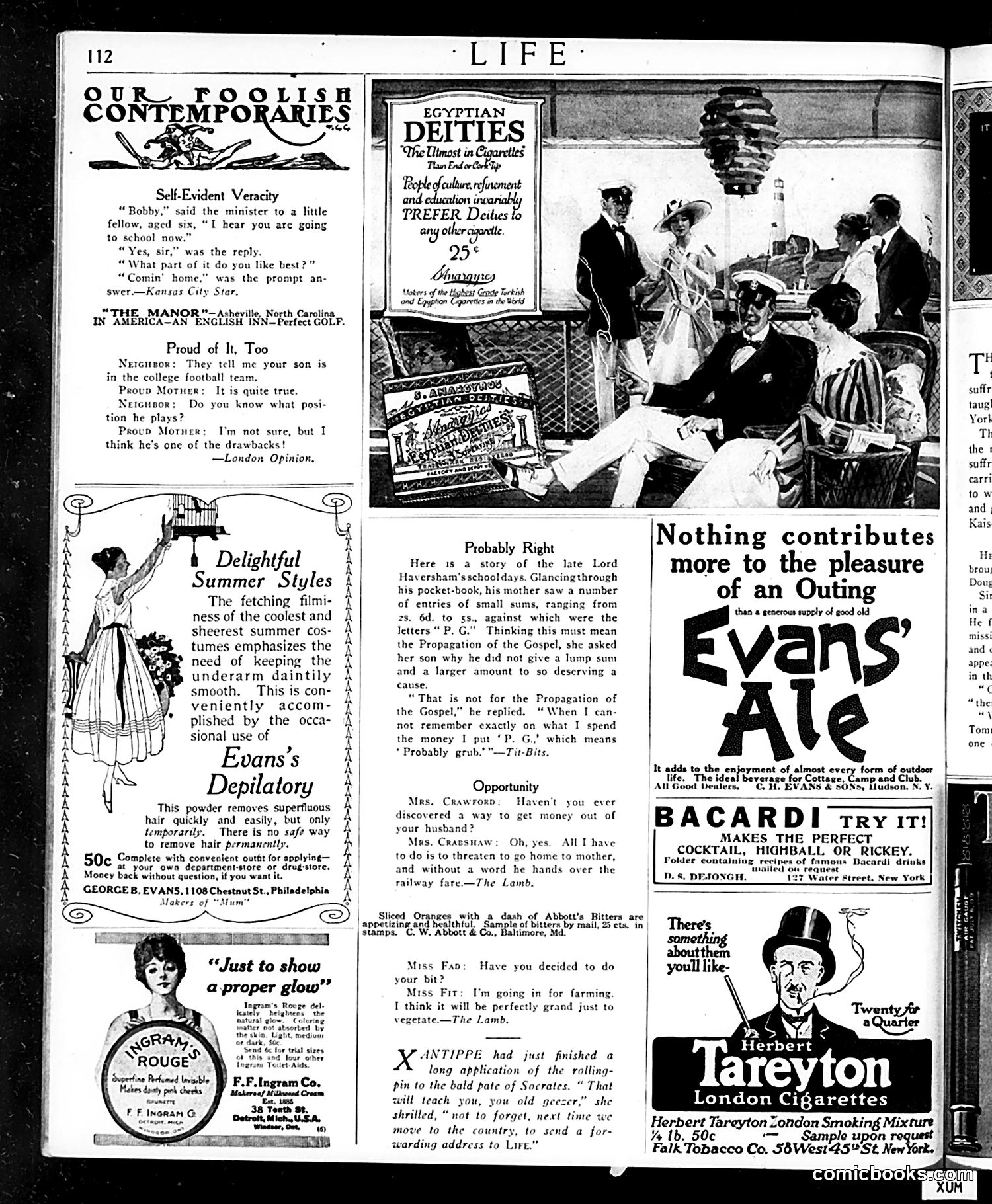
This page combines brief humorous anecdotes with period advertisements. The cartoons satirize contemporary social attitudes: **"Self-Evident Veracity"** mocks a child's honest answer—he prefers school only because it means going home. The joke plays on adults' self-deception about education's appeal. **"Proud of It, Too"** ridicules a mother's ignorance of her son's college football position, with the punchline that he's a "drawback" (a weak player). It satirizes parental pride disconnected from actual understanding. **"Probably Right"** uses a wealthy lord's cryptic notebook entries to joke about vague spending habits—"P.G." means "probably grub" rather than charitable giving, mocking both aristocratic carelessness with money and hypocrisy about charity. **Minor anecdotes** include jokes about marital dynamics ("threaten to go home to mother") and female grooming standards. The advertisements—for hair removal, cigarettes, ale, and depilatory products—reflect period consumer culture and beauty standards. The page is primarily **humorous filler content** rather than political satire in the modern sense.
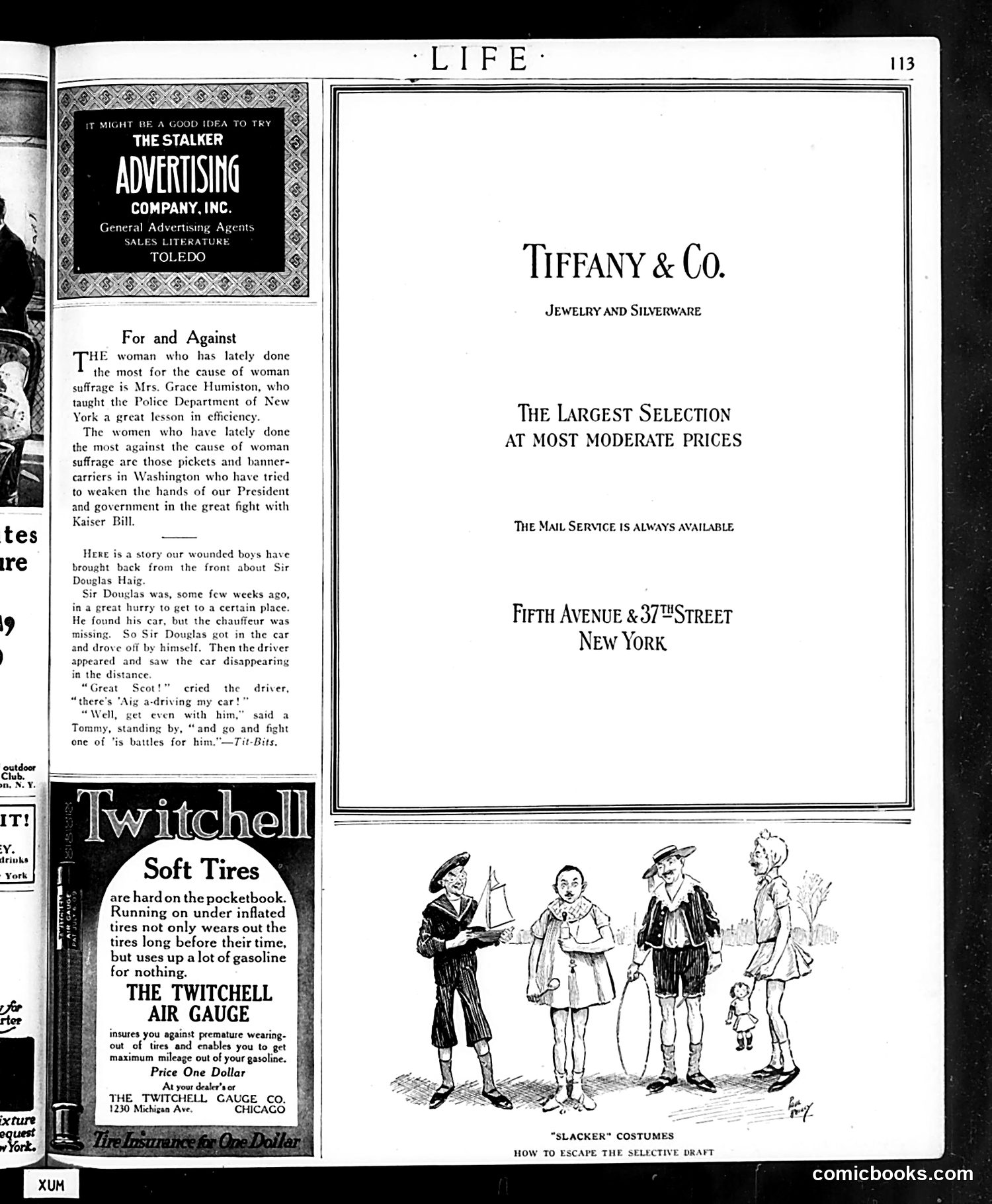
This page mixes advertisements with editorial commentary about World War I-era social debates. The main cartoon, captioned "Slacker Costumes: How to Escape the Selective Draft," depicts five figures in various disguises (appearing to wear women's clothing and exaggerated outfits). It satirizes young men attempting to evade military conscription through cross-dressing or other deceptions during America's WWI draft. "Slacker" was contemporary slang for draft dodgers. The editorial "For and Against" praises suffragist Grace Humiston while criticizing anti-war female picketers in Washington, framing opposition to the war effort as harmful to women's suffrage cause. The Douglas Haig anecdote mocks absent military leadership. The page reflects 1917-1918 wartime anxiety: support for the war effort, contempt for draft evasion, and complicated views on women's activism—supporting suffragists but opposing pacifist women as obstacles to war success.
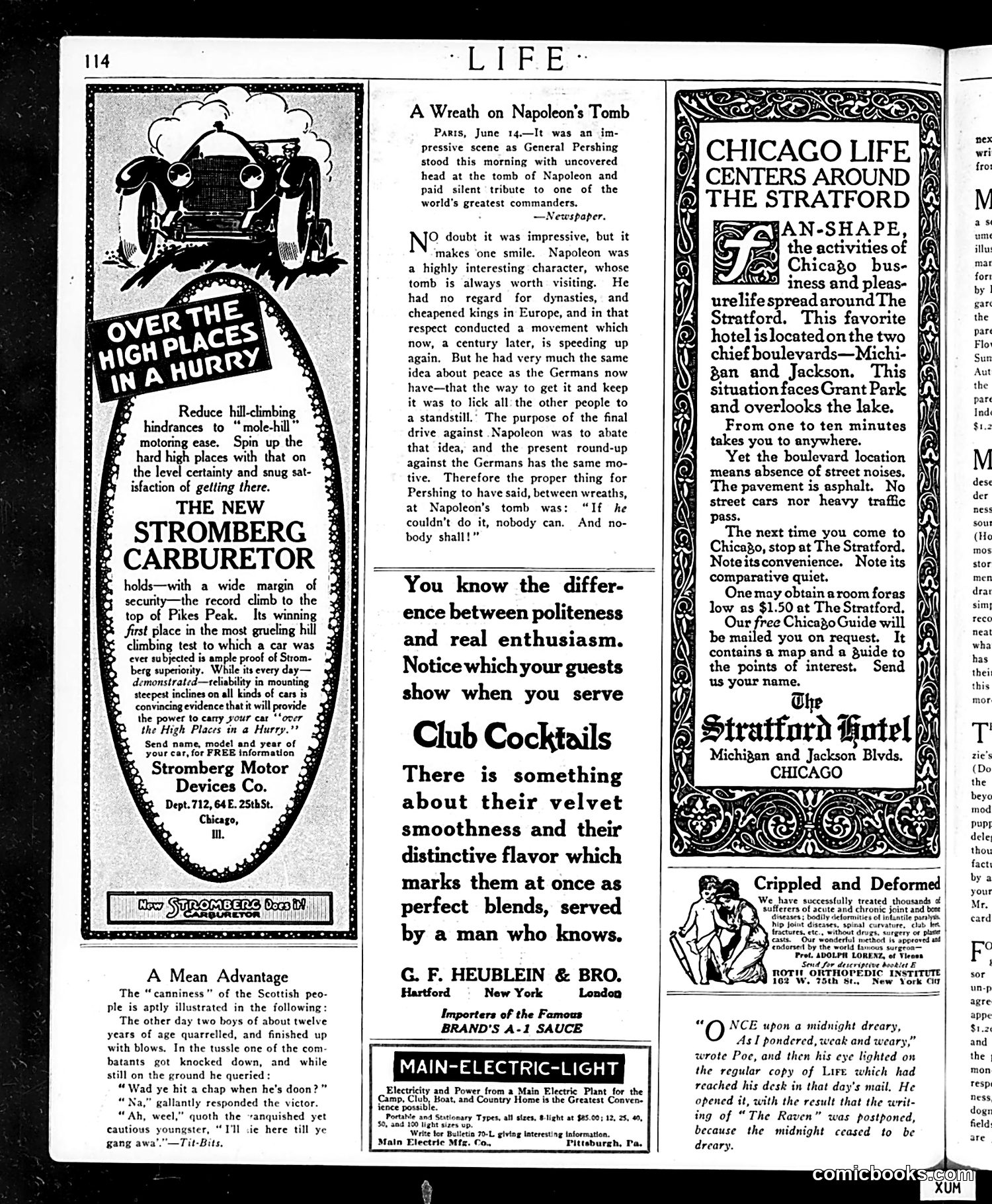
This page contains three distinct pieces of content: **"A Wreath on Napoleon's Tomb"** (center-left): A satirical commentary on General Pershing's solemn tribute at Napoleon's tomb in Paris. The joke: the writer finds it amusing that Pershing honored Napoleon—a man who "cheapened kings" and pursued conquest through war—while simultaneously fighting Germans with similar imperial ambitions. The satire suggests the irony of honoring a military aggressor while opposing another. Pershing should have said Napoleon couldn't achieve his goals, "And nobody shall!"—mocking the apparent contradiction. **"A Mean Advantage"** (lower-left): A brief Scottish humor anecdote about two boys fighting; the loser claims foul play, boasting he'd have won otherwise. It plays on the stereotype of Scottish thriftiness/cunning. The remainder consists of period advertisements (Stromberg Carburetor, Club Cocktails, Stratford Hotel, etc.), typical of *Life* magazine's mixed editorial-advertising format.
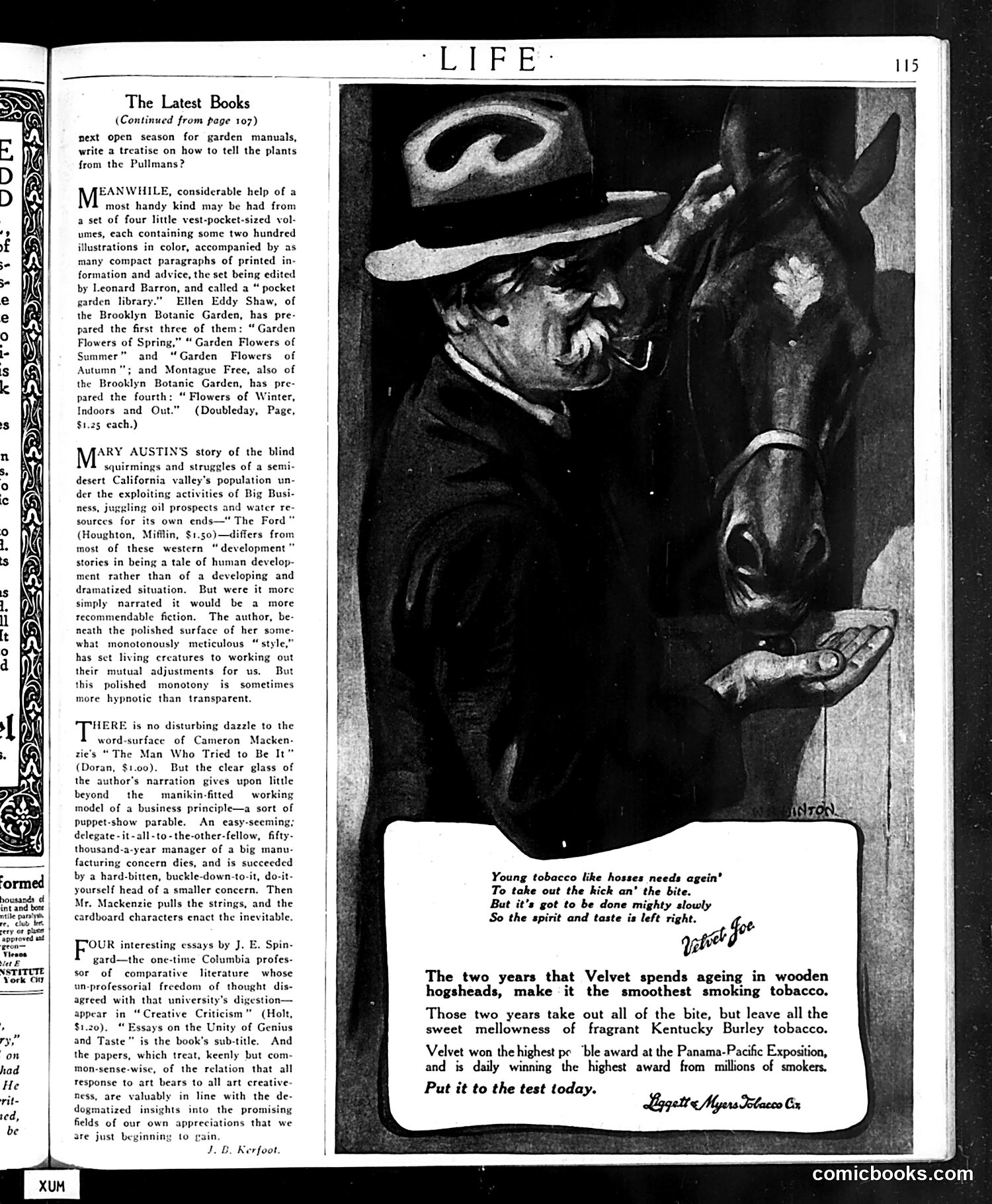
This page is primarily a **book review section** with an **embedded tobacco advertisement**, not a political cartoon. **The Book Reviews:** The text discusses recent publications including garden guides, Mary Austin's novel "The Ford" (about California oil/water exploitation), Cameron Mackenzie's business parable "The Man Who Tried to Be It," and J.E. Spingarn's essays on aesthetics. Reviewer J.B. Kerfoot critiques these works' literary merits. **The Advertisement:** The large lower section features **Velvet tobacco** with a folksy poem about aging tobacco like aging horses. The copy claims two years of wooden hogshead aging removes harshness while preserving flavor, and asserts Velvet won awards at the Panama-Pacific Exposition. **Context for Modern Readers:** This represents pre-health-warning tobacco advertising, when cigarettes were marketed as quality consumer goods with pseudo-scientific aging claims. The "ageing" metaphor positions tobacco as a craft product deserving patience and appreciation—a common early-20th-century advertising strategy before tobacco's health dangers became widely acknowledged.
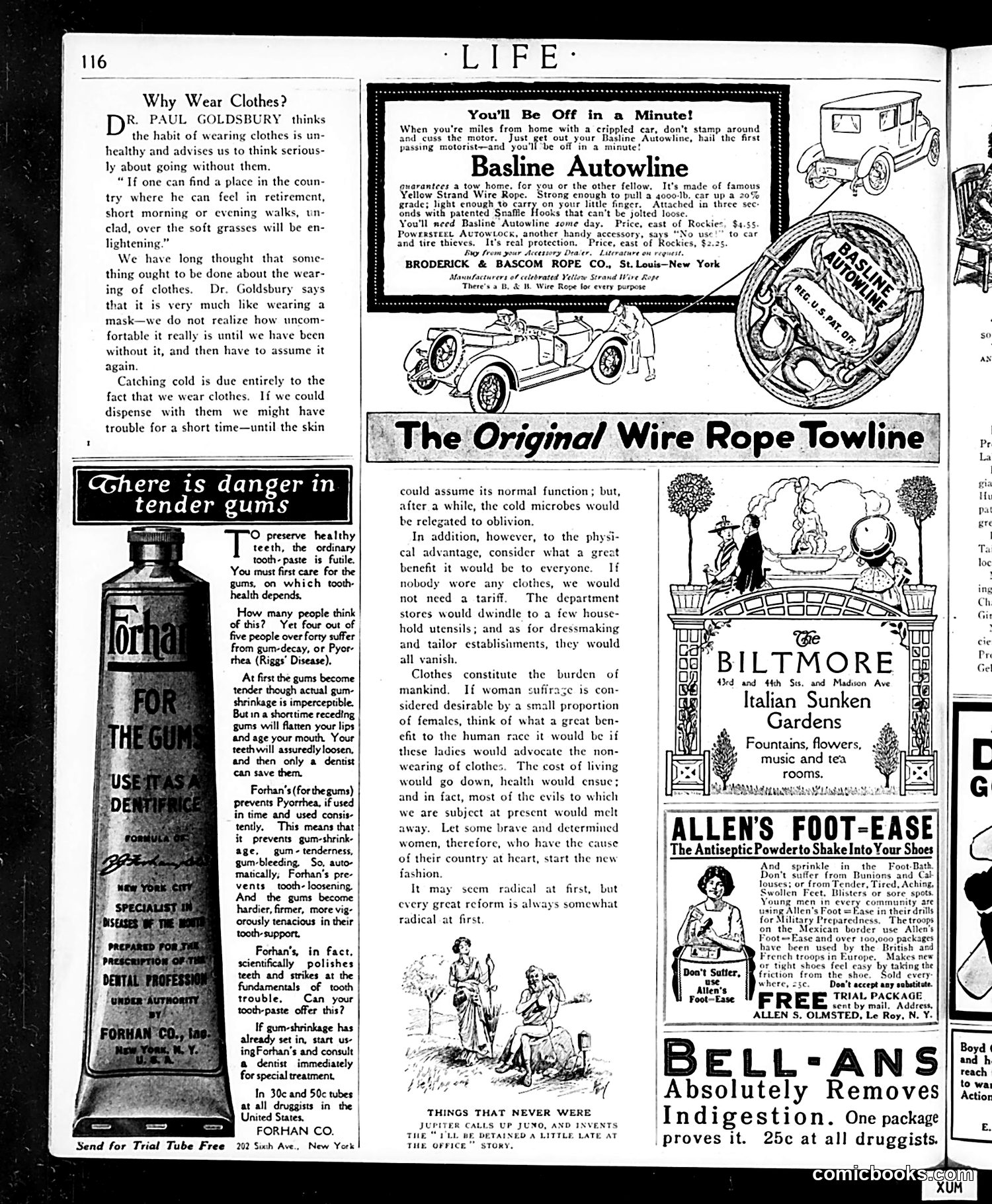
This page is primarily **advertisements and articles**, not political satire. The main content includes: **"Why Wear Clothes?"** - An article citing Dr. Paul Goldsbury's argument that clothing is unhealthy and economically burdensome. He suggests going unclad would eliminate the need for tariffs, department stores, and tailoring industries. This reflects early 20th-century health fads promoting naturism/nudism as beneficial, though the piece appears somewhat tongue-in-cheek. **Advertisements** dominate the page: Forhan's toothpaste (addressing gum disease), Basline Autowline (a towing rope), The Biltmore restaurant, Allen's Foot-Ease powder, and Bell-Ans indigestion remedy—typical period products. **"Things That Never Were"** - A small illustration captioned about Jupiter and the office—unclear without full context. The page reflects 1920s consumer culture and pseudoscientific health claims common to that era. There is **no political cartoon** present.
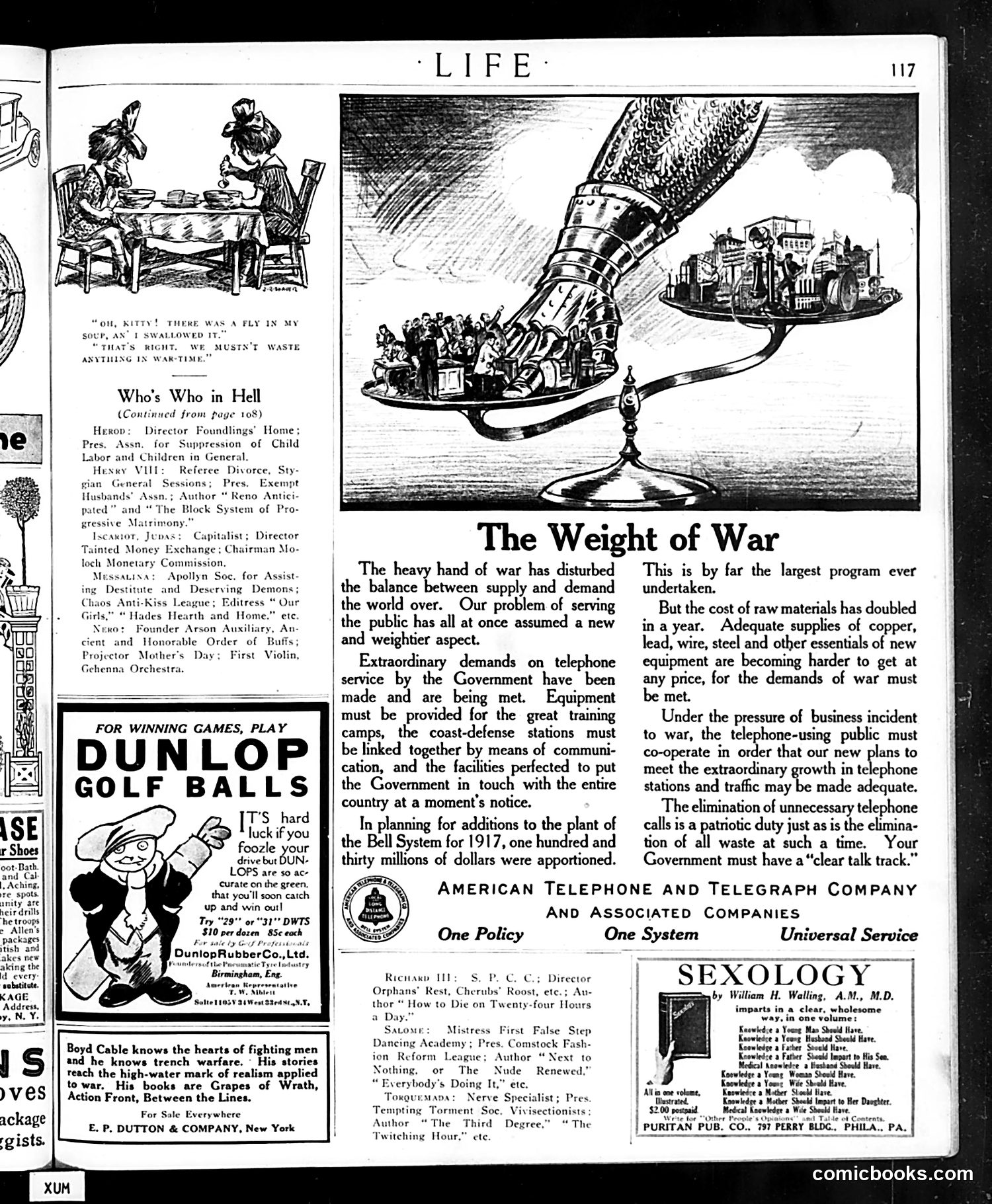
This Life magazine page from 1917 (likely) features a satirical cartoon titled "The Weight of War" showing a giant hand labeled with military/industrial symbols pouring two cities full of civilians into a balance scale—depicting war as literally weighing down civilian life and disrupting normal supply-demand economics. The accompanying text is an AT&T advertisement framed as patriotic messaging: it acknowledges wartime material shortages (copper, steel, etc.) and appeals to telephone users to eliminate "unnecessary" calls as a patriotic duty, freeing up infrastructure for military needs. This represents corporate wartime propaganda. The left column's "Who's Who in Hell" satirizes various societal figures (directors of orphanages, divorce advocates, etc.) in bitter, sardonic style—typical Life magazine social satire targeting hypocrisy and moral corruption. The ads for Dunlop Golf Balls and other consumer products contrast sharply with the wartime sacrifice messaging.
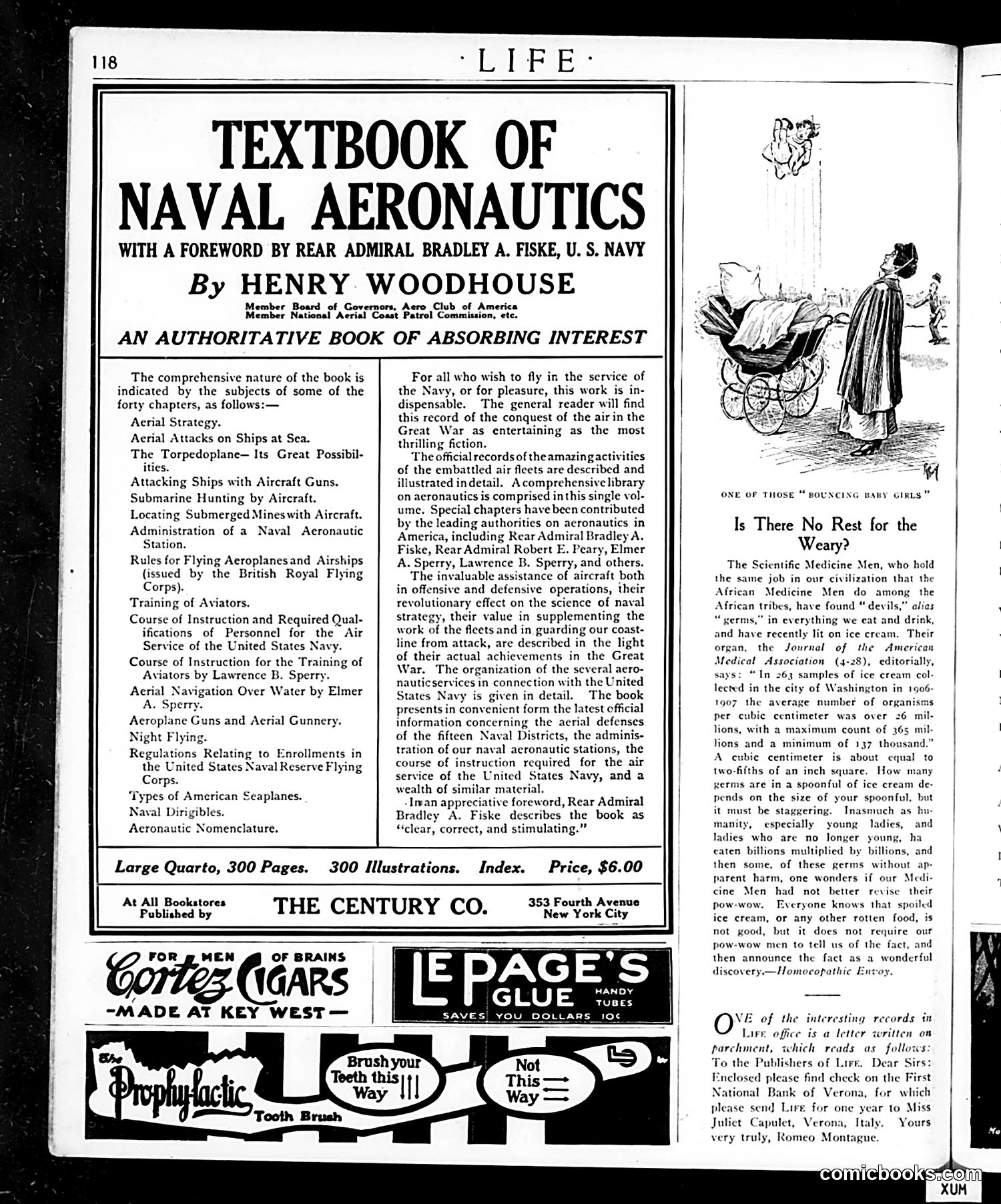
This page is primarily a **book advertisement** for "Textbook of Naval Aeronautics" by Henry Woodhouse, endorsed by Rear Admiral Bradley A. Fiske. The detailed listing of forty chapters emphasizes aviation's military applications during World War I—submarine hunting, aerial gunnery, naval strategy—reflecting contemporary concerns about aerial warfare's revolutionary impact on naval combat. The right column contains a satirical article titled **"Is There No Rest for the Weary?"** that mocks medical authorities and their alarmism. It references the "Scientific Medicine Men" (presumably doctors and health officials) who, like "African Medicine Men," spread fear by discovering "devils" or germs in everyday foods. The piece ridicules a 1906-1907 Journal of the American Medical Association study documenting high bacterial counts in ice cream samples, treating the medical profession's findings as overwrought panic rather than legitimate health concerns. The satire suggests Life's skepticism toward contemporary health scares and expert warnings, presenting them as hysteria rather than science.
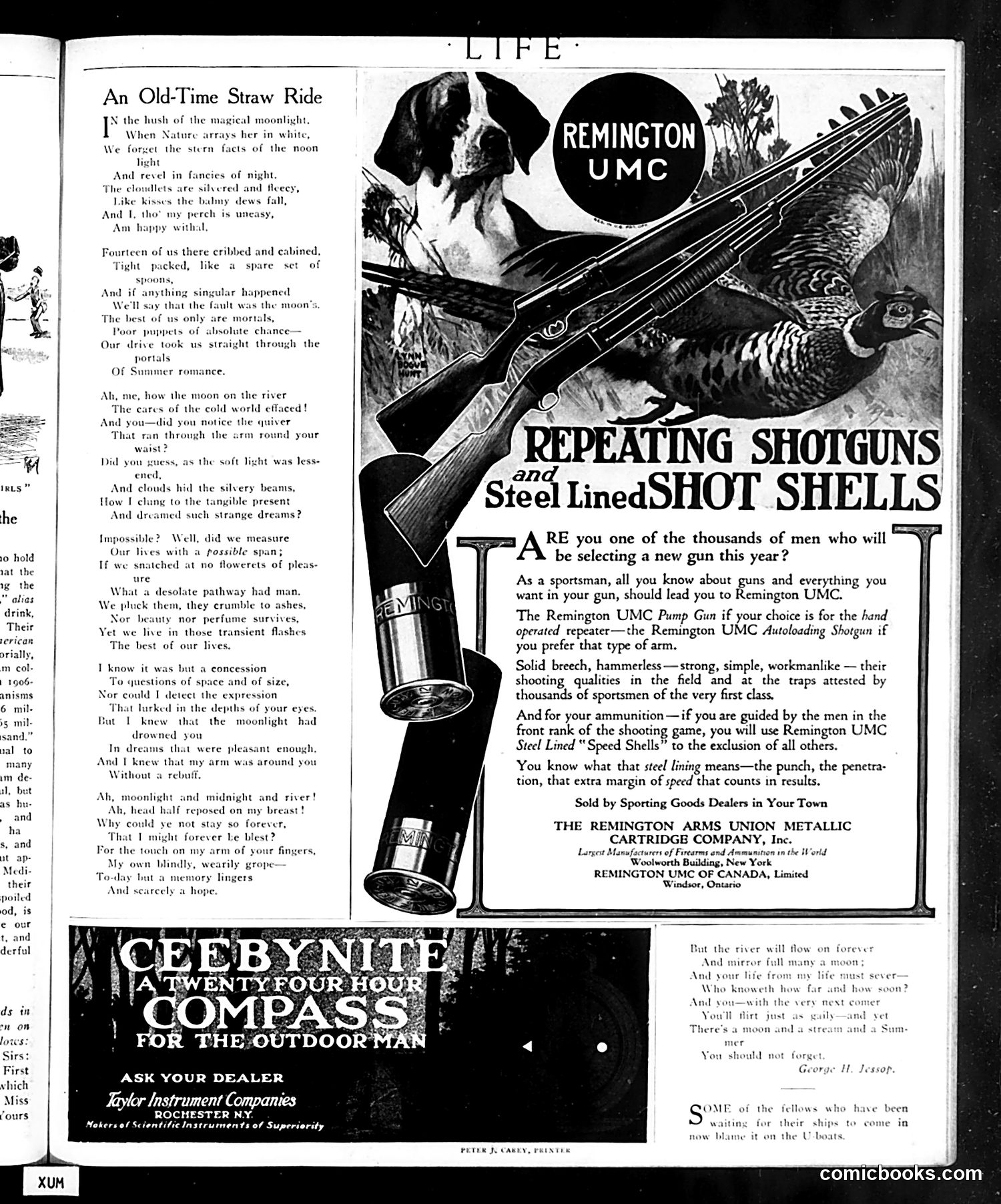
This page contains a **sentimental romantic poem** titled "An Old-Time Straw Ride" alongside **advertisements**, not political satire. The poem romanticizes a moonlit hayride with fourteen young people packed together, celebrating youthful romance and physical attraction under the guise of moonlight's magic. It playfully suggests that moonlight excuses improper behavior ("the fault was the moon's") and ends wistfully, contrasting fleeting romantic moments against life's brevity. **Advertisements** dominate the right and bottom portions: Remington UMC shotguns and ammunition target sportsmen; Ceebynite compasses appeal to outdoorsmen. **For modern readers:** This reflects early 20th-century attitudes toward courtship—romantic, physically suggestive yet euphemistic, and nostalgic about "old-time" rural entertainments. The juxtaposition of romance with hunting/outdoor gear advertising was typical for Life's male-oriented readership. There is **no political cartoon or satire** present on this page.

This is a **beauty product advertisement**, not political satire. It promotes Woodbury's Facial Soap as "the most famous skin treatment ever formulated." The page features a portrait photograph of a woman with her hands to her face in a contemplative pose—a visual convention meant to suggest the product's transformative effect on skin quality. The tagline promises "a skin you love to touch," appealing to feminine beauty standards of the 1917 era. The text provides detailed instructions for use: daily cleansing with the soap, massage techniques, rinsing with progressively colder water, and finishing with ice. It emphasizes the product's antiseptic properties. The advertisement offers samples and includes ordering information for customers in the United States and Canada. A bar of Woodbury's soap is shown in the lower right corner. This reflects early 20th-century advertising's focus on scientific-sounding skincare claims and the emerging consumer culture around personal grooming products.