
Life, 1917-07-19 · page 38 of 40
Life — July 19, 1917 — page 38: what you’re looking at
What you’re looking at
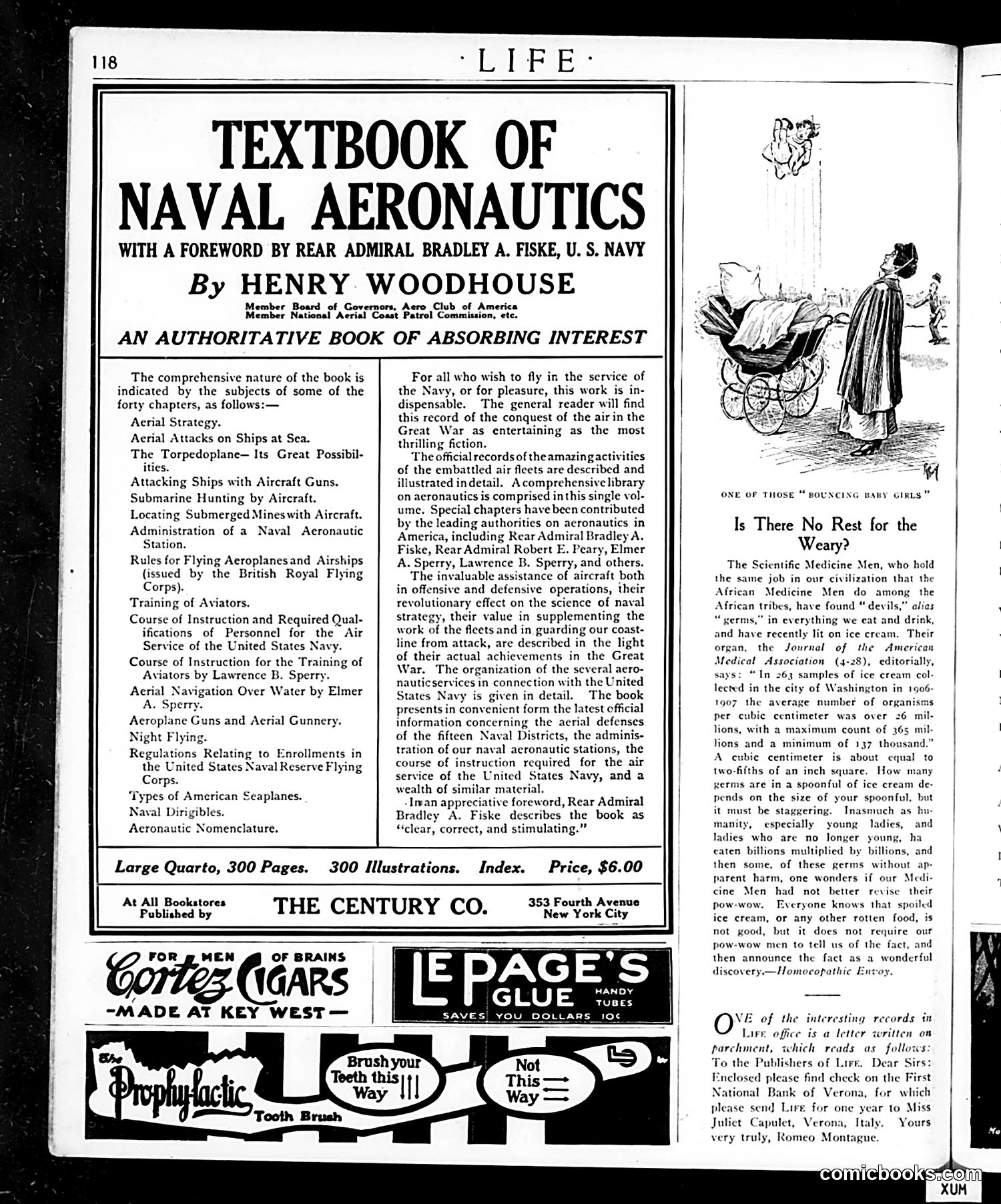
This page is primarily a **book advertisement** for "Textbook of Naval Aeronautics" by Henry Woodhouse, endorsed by Rear Admiral Bradley A. Fiske. The detailed listing of forty chapters emphasizes aviation's military applications during World War I—submarine hunting, aerial gunnery, naval strategy—reflecting contemporary concerns about aerial warfare's revolutionary impact on naval combat. The right column contains a satirical article titled **"Is There No Rest for the Weary?"** that mocks medical authorities and their alarmism. It references the "Scientific Medicine Men" (presumably doctors and health officials) who, like "African Medicine Men," spread fear by discovering "devils" or germs in everyday foods. The piece ridicules a 1906-1907 Journal of the American Medical Association study documenting high bacterial counts in ice cream samples, treating the medical profession's findings as overwrought panic rather than legitimate health concerns. The satire suggests Life's skepticism toward contemporary health scares and expert warnings, presenting them as hysteria rather than science.
📄 Transcribed text from this page (OCR, searchable)
Machine-transcribed from the original scan — historical spelling and the odd misread are preserved.
TEXTBOOK OF NAVAL AERONAUTICS WITH A FOREWORD BY REAR ADMIRAL BRADLEY A. FISKE, U. S. NAVY By HENRY WOODHOUSE Member Board of Governors, Aero Club of America Member National Aerial Coast Patrol Commissi eo AN AUTHORITATIVE BOOK OF ABSORBING INTEREST For all who wish to fly in the service of the Navy, or for pleasure, this work is in- dispensable. The general reader will find this record of the conquest of the air in the Great War as entertaining as the most thrilling fiction. The official records of the amazingactivities of the embattled air ficets are described and illustrated indetail. Acomprehensive library on aeronautics is comprised inthis single vol- ume. Special chapters have been contributed by the leading authorities on aeronautics in America, including Rear Admiral Bradley A. Fiske, Rear Admiral Robert E. Peary, Elmer A. Sperry, Lawrence B. Sperry, and others. The invaluable assistance of aircraft both in offensive and defensive operations, their revolutionary effect on the science of naval strategy, their value in supplementing the work of the ficets and in guarding our coast- line from attack, are described in the light of their actual achievements in the Great War. The organization of the several aero- nauticservices in connection with the United States is given in detail. The book presents in convenient form the latest official information concerning the aerial defenses of the fifteen Naval Districts, the adminis- tration of our naval aeronautic stations, the course of instruction required for the air service of the United States Navy, and a wealth of similar material. -Inan appreciative foreword, Rear Admiral Bradley A. Fiske describes the book as “clear, correct, and stimulating.” The comprehensive nature of the book is indicated by the subjects of some of the forty chapters, as follows: — Aerial Strategy. Aerial Attacks on Ships at Sea. The Torpedoplane— Its Great Possibil- itie: Attacking Ships with Aircraft Guns. Submarine Hunting by Aircraft. Locating Submerged Mineswith Aircraft. Administration of a Naval Acronautic Station. Rules for Flying Aeroplanesand Airships (issued by the British Royal Flying Corps). Training of Aviators. Course of Instruction and Required Qual- ifications of Personnel for the Air Service of the United States Navy. Course of Instruction for the Training of Aviators by Lawrence B. Sperry. Aerial Navigation Over Water by Elmer A. Sperry. Aeroplane Guns and Aerial Gunnery. Night Flying. Regulations Relating to Enrollments in the United States Naval Reserve Flying Corps. ‘Types of American $ Naval Dirigibles. Acronautic Nomenclature. ONE OF THOSE “ BOUNCING BABY GIRLS” Is There No Rest for the Weary? The Scientific Medicine Men, who hold the same job in our civilization that the African Medicine Men do among the African tribes, have found “devils,” olias “ germs,” in everything we eat and drink, and have recently lit on ice cream. Their organ, the Journal of the American Medical Association (4-28), editorially, says: “In 263 samples of ice cream col- lected in the city of Washington in 1906- 1907 the average number of organisms per cubic centimeter was over 26 mil- lions, with a maximum count of 365 mil- lions and a minimum of 137 thousand.” A cubic centimeter is about cqual to two-fifths of an inch square. How many xerms are in a spoonful of ice cream de- pends on the size of your spoonful, but | it must be staggering. Inasmuch as hu- manity, especially young ladies, and ladies who are no longer young, ha caten billions multiplied by billions, and then some, of these germs without ap- parent harm, one wonders if our Medi- cine Men had not better revise their pow-wow. Everyone knows that spoiled ice cream, or any other rotten food, is not good, but it does not require our — pow-wow men to tell us of the fact, and Fo OF BRAINS all then announce the fact as a wonderful 1G | discovery.—Homocopathic Envoy. IGARS | a E xe | —_ TUBES “MADE AT KEY, WEST— f __ SAVES! You boLtLaRrs VE of the interesting records in | Lire. office is a letter written on parchment, which reads as follows: To the Publishers of Lire. Dear $ Enclosed please find check on the First National Bank of Verona, for which please send Lire for one year to Miss | Juliet Caputet, Verona, It Yours |” Very truly, Romeo Montague. aplanes. Large Quarto, 300 Pages. 300 Illustrations. Index. Price, $6.00 At All Becutoree = ‘THE CENTURY CO. ——