
Life, 1917-07-19 · page 31 of 40
Life — July 19, 1917 — page 31: what you’re looking at
What you’re looking at
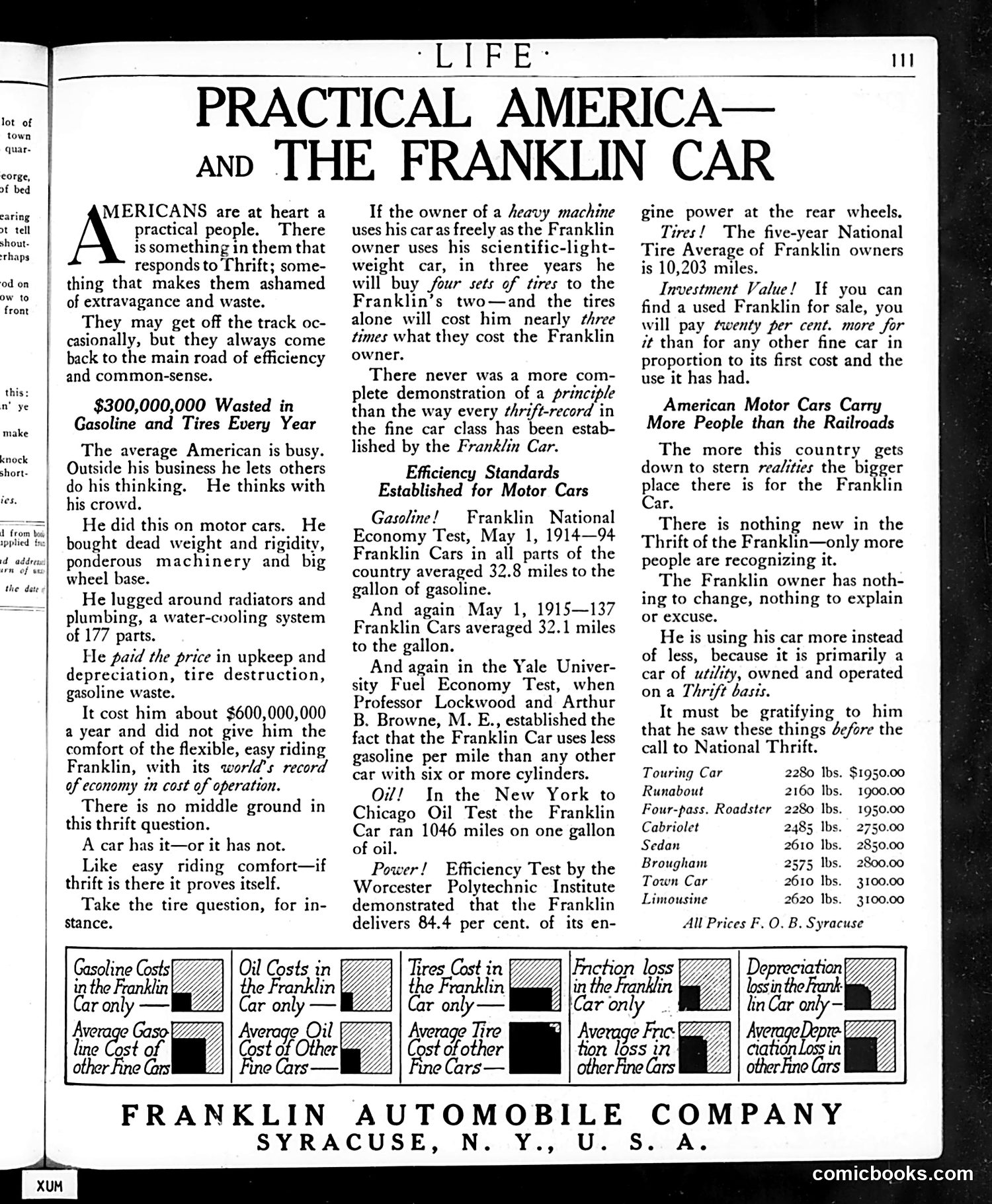
This is a **Franklin automobile advertisement**, not a political cartoon. It appeared in *Life* magazine during the early 1910s. The ad appeals to American values of **thrift and practicality** by arguing that Franklin cars are superior to competitors (implied to be heavier, luxury vehicles). The text contrasts wasteful "dead weight" cars—which cost Americans "$300,000,000" yearly in fuel and tires—against Franklin's lightweight, efficient design. The advertisement presents scientific test data (fuel economy tests, tire durability, power output) to establish Franklin's superiority. It aims at the practical American businessman, suggesting that choosing a Franklin demonstrates both intelligence and virtue. The accompanying bar charts visually compare Franklin's costs favorably to unnamed "other fine cars" in gasoline, oil, tires, friction loss, and depreciation categories. This represents early automotive advertising that weaponized **efficiency and economy** as moral virtues, targeting the aspirational middle-class driver.
📄 Transcribed text from this page (OCR, searchable)
Machine-transcribed from the original scan — historical spelling and the odd misread are preserved.
lot of town quar- corge, of bed caring ot tell shout- sthaps od on ow to front this: n’ ye make knock short- ies. 1 from bo ipplied fs id address rm of 615 the dete “PIRRAE™ Ww PRACTICAL AMERICA— ano THE. FRANKLIN CAR MERICANS are at heart a practical people. There is something in them that responds to Thrift; some- thing that makes them ashamed of extravagance and waste. They may get off the track oc- casionally, but they always come back to the main road of efficiency and common-sense. $300,000,000 Wasted in Gasoline and Tires Every Year The average American is busy. Outside his business he lets others do his thinking. He thinks with his crowd. He did this on motor cars. He bought dead weight and rigidity, ponderous machinery and big wheel base. He lugged around radiators and plumbing, a water-cooling system of 177 parts. He paid the price in upkeep and depreciation, tire destruction, gasoline waste. It cost him about $600,000,000 a year and did not give him the comfort of the flexible, easy riding Franklin, with its world’s record of economy in cost of operation. There is no middle ground in this thrift question. A car has it—or it has not. Like easy riding comfort—if thrift is there it proves itself. Take the tire question, for in- stance. fol eet in) Oil Costs i Hd the Frank Gr ey — Car rane a Avera soZ Average Oil line Cost fae = other Fine Grs Cost of | Pane Cars— ‘a If the owner of a heavy machine uses his car as freely as the Franklin owner uses his scientific-light- weight car, in three years he will buy four sets of tires to the Franklin’s two—and the tires alone will cost him nearly three times what they cost the Franklin owner. There never was a more com- plete demonstration of a principle than the way every thrift-record in the fine car class has been estab- lished by the Franklin Car. Efficiency Standards Established for Motor Cars Gasoline! Franklin National Economy Test, May 1, 1914—94 Franklin Cars in all parts of the country averaged 32.8 miles to the gallon of gasoline. And again May 1, 1915—137 Franklin Cars averaged 32.1 miles to the gallon. And again in the Yale Univer- sity Fuel Economy Test, when Professor Lockwood and Arthur B. Browne, M. E., established the fact that the Franklin Car uses less gasoline per mile than any other car with six or more cylinders. Oi! In the New York to Chicago Oil Test the Franklin Car ran 1046 miles on one gallon of oil. Power! Efficiency Test by the Worcester Polytechnic Institute demonstrated that the Franklin delivers 84.4 per cent. of its en- Bros Cost in WA me the Fon Car only — Average Tire Ce stcothor ine Cars — Averag rete Ried inthe egnth in a | U \Car only hon ib loss in other Fine Cars gine power at the rear wheels. Tires! The five-year National Tire Average of Franklin owners is 10,203 miles. Investment Value! Vf you can find a used Franklin for sale, you will pay twenty per cent. more for 7t than for any other fine car in proportion to its first cost and the use it has had. American Motor Cars Carry More People than the Railroads The more this country gets down to stern realities the bigger place there is for the Franklin Car. There is nothing new in the Thrift of the Franklin—only more people are recognizing it. The Franklin owner has noth- ing to change, nothing to explain or excuse. He is using his car more instead of less, because it is primarily a car of utility, owned and operated ona Thrift basis. It must be gratifying to him that he saw these things defore the call to National Thrift. Touring Car 2280 Ibs. $1950.00 Runabout 2160 Ibs. 1900.00 Four-pass. Roadster 2280 lbs. 1950.00 Cabriolet 2485 Ibs. 2750.00 Sedan 2610 Ibs. 2850.00 Brougham 2575 lbs. 2800.00 Town Car 2610 Ibs. 3100.00 Limousine 2620 Ibs. 3100.00 All Prices F. O. B. Syracuse Depreciation lossin the Frank in Car only — Average Depre 7Z/ ciation Loss in other ine Cars FRANKLIN AUTOMOBILE COMPANY SYRA CUSE, N. Y., U. S. A. comicbooks.com