
Life, 1917-07-19 · page 26 of 40
Life — July 19, 1917 — page 26: what you’re looking at
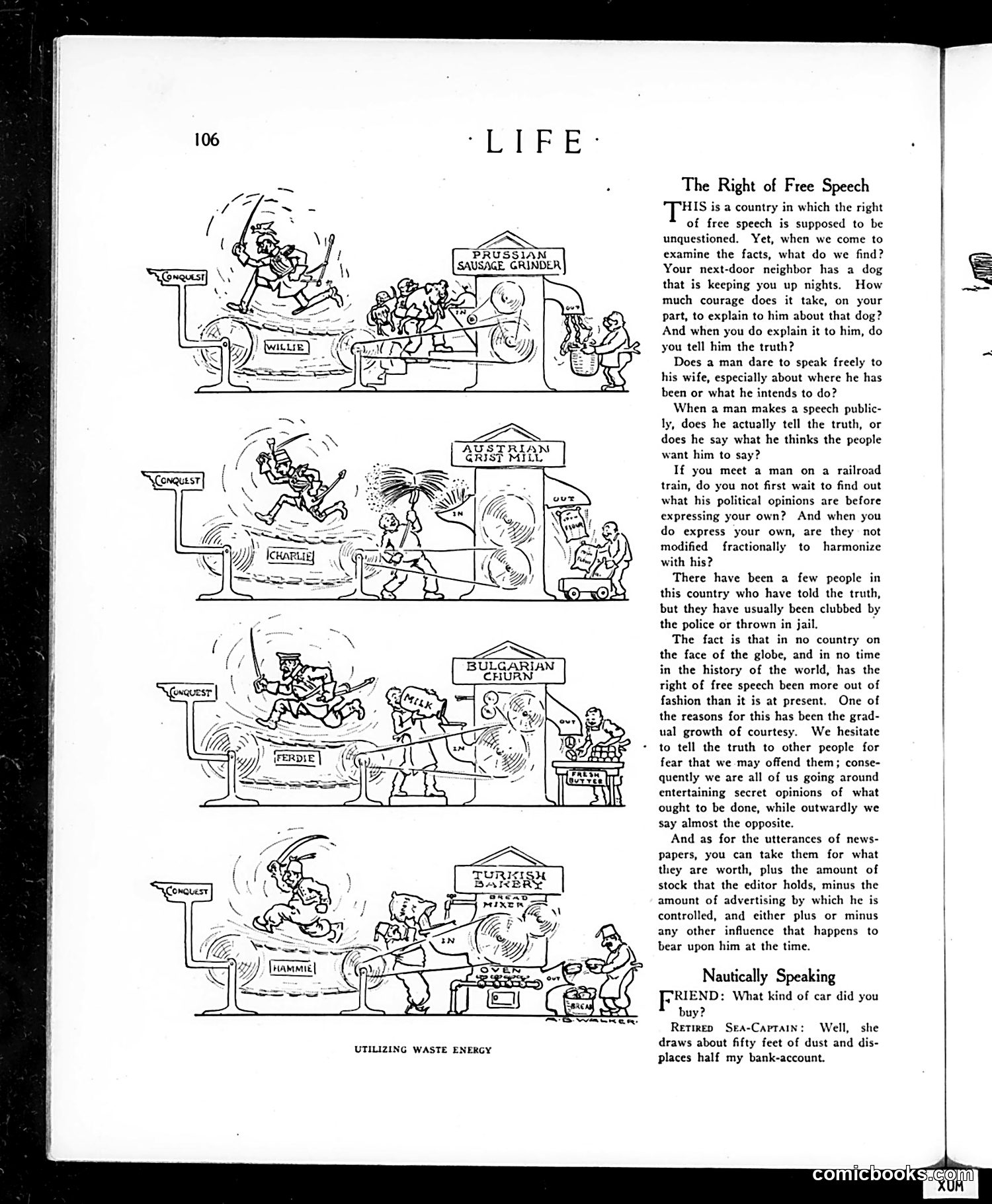
What you’re looking at
This four-panel cartoon satirizes conquest and colonial exploitation. Each panel shows a conquering power (labeled Prussian, Austrian, Bulgarian, and Turkish) operating machinery that extracts resources from conquered territories—represented by figures being ground through industrial equipment like sausage mills or grinders. The title "Utilizing Waste Energy" is the joke: the conquering nations treat defeated peoples as "waste energy" to be mechanically exploited for profit and power. The cartoon appears to reference European imperial expansion and the Balkan conflicts of the early 20th century. The accompanying essay "The Right of Free Speech" argues that despite America's supposed commitment to free speech, people routinely self-censor—avoiding uncomfortable truths with neighbors, spouses, and strangers out of fear of offense. Newspapers too are compromised by financial interests and advertisers. The "Nautically Speaking" joke at bottom is unrelated wordplay about a car that "draws" (nautical term) dust instead of water.
📄 Transcribed text from this page (OCR, searchable)
Machine-transcribed from the original scan — historical spelling and the odd misread are preserved.
TURICISH BARE eae UTILIZING WASTE ENERGY The Right of Free Speech 'HIS is a country in which the right of free speech is supposed to be unquestioned. Yet, when we come to examine the facts, what do we find? Your next-door neighbor has a dog that is keeping you up nights. How much courage does it take, on your part, to explain to him about that dog? And when you do explain it to him, do you tell him the truth? Does a man dare to speak freely to his wife, especially about where he has been or what he intends to do? When a man makes a speech public- ly, does he actually tell the truth, or does he say what he thinks the people want him to say? If you meet a man on a railroad train, do you not first wait to find out what his political opinions are before expressing your own? And when you do express your own, are they not modified fractionally to harmonize with his? There have been a few people in this country who have told the truth, but they have usually been clubbed by the police or thrown in jail. ‘ The fact is that in no country on the face of the globe, and in no time in the history of the world, has the right of free speech been more out of fashion than it is at present. One of the reasons for this has been the grad- ual growth of courtesy. We hesitate to tell the truth to other people for fear that we may offend them; conse- quently we are all of us going around entertaining secret opinions of what ought to be done, while outwardly we say almost the opposite. And as for the utterances of news- papers, you can take them for what they are worth, plus the amount of stock that the editor holds, minus the amount of advertising by which he is controlled, and either plus or minus any other influence that happens to bear upon him at the time. Nautically Speaking FRIEND: What kind of car did you buy? Retirep Sea-Cartain: Well, she draws about fifty feet of dust and dis- places half my bank-account.