
Life, 1917-07-19 · page 35 of 40
Life — July 19, 1917 — page 35: what you’re looking at
What you’re looking at
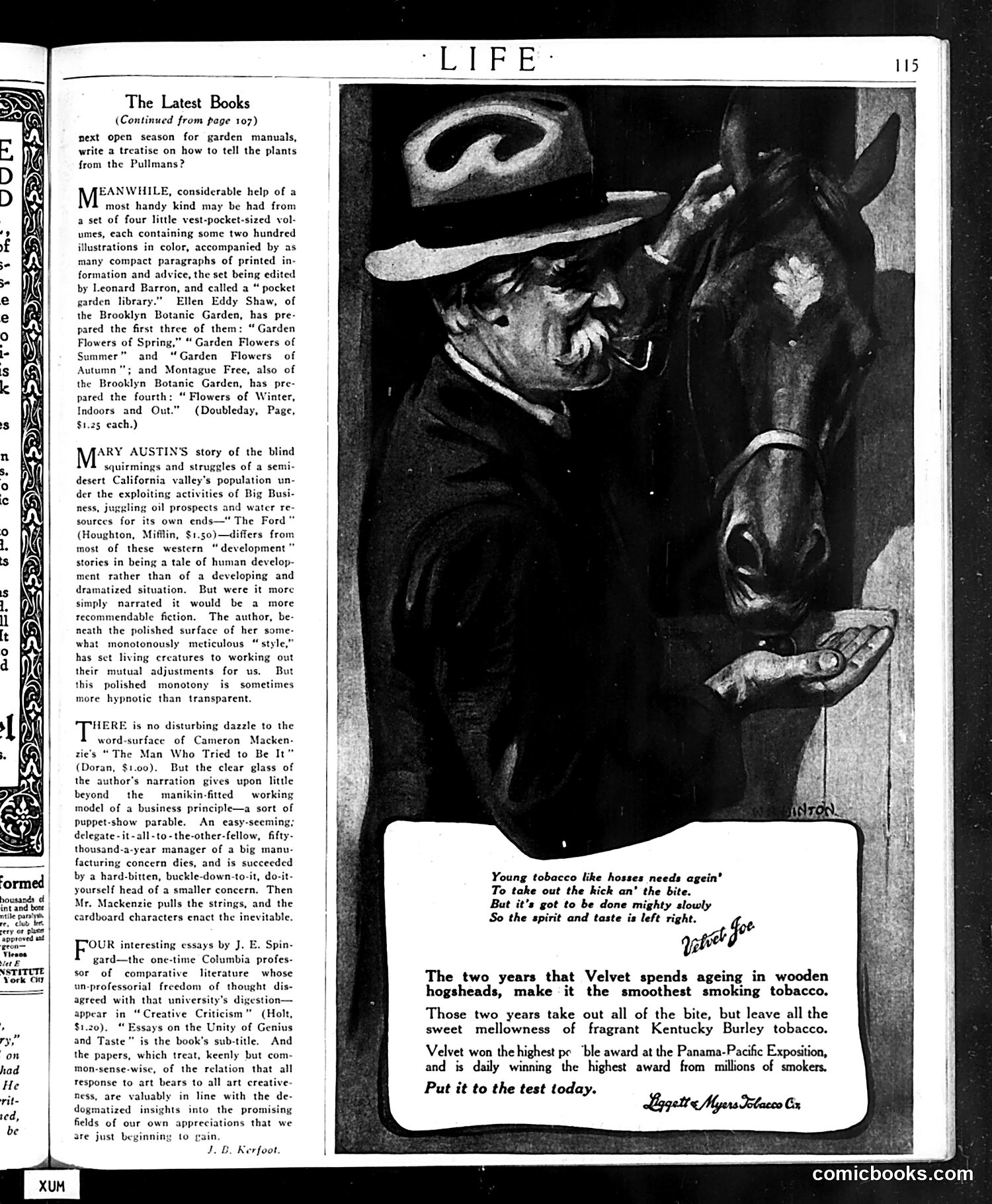
This page is primarily a **book review section** with an **embedded tobacco advertisement**, not a political cartoon. **The Book Reviews:** The text discusses recent publications including garden guides, Mary Austin's novel "The Ford" (about California oil/water exploitation), Cameron Mackenzie's business parable "The Man Who Tried to Be It," and J.E. Spingarn's essays on aesthetics. Reviewer J.B. Kerfoot critiques these works' literary merits. **The Advertisement:** The large lower section features **Velvet tobacco** with a folksy poem about aging tobacco like aging horses. The copy claims two years of wooden hogshead aging removes harshness while preserving flavor, and asserts Velvet won awards at the Panama-Pacific Exposition. **Context for Modern Readers:** This represents pre-health-warning tobacco advertising, when cigarettes were marketed as quality consumer goods with pseudo-scientific aging claims. The "ageing" metaphor positions tobacco as a craft product deserving patience and appreciation—a common early-20th-century advertising strategy before tobacco's health dangers became widely acknowledged.
📄 Transcribed text from this page (OCR, searchable)
Machine-transcribed from the original scan — historical spelling and the odd misread are preserved.
ety oF pst approved at re Vieaoe The Latest Books (Continued from page 107) next open season for garden manuals, write a treatise on how to tell the plants from the Pullmans? EANWHILE, considerable help of a most handy kind may be had from a set of four little vest-pocket-sized vol- umes, each containing some two hundred illustrations in color, accompanied by many compact paragraphs of printed in- formation and advice, the set being edited by Leonard Barron, and called a “ pocket garden library.” Ellen Eddy Shaw, of the Brooklyn Botanic Garden, has pre- pared the first three of them: “ Garden Flowers of Spring,” “ Garden Flowers of Summer” and “Garden Flowers of Autumn"; and Montague Free, also of the Brooklyn Botanic Garden, has pre- pared the fourth: “ Flowers of Winter, Indoors and Out.” (Doubleday, Page, $1.25 each.) RY AUSTIN'S story of the blind squirmings and struggles of a semi- desert California valley’s population un- der the exploiting activities of Big Busi ness, juggling oil prospects and water re- sources for its own ends— The Ford” (Houghton, Mifflin, $1.50)—differs from most of these western “development” stories in being a tale of human develop- ment rather than of a developing and dramatized situation. But were it morc simply narrated it would be a more recommendable fiction. The author, be- neath the polished surface of her some- what monotonously meticulous “ style,” has set living creatures to working out their mutual adjustments for us. But this polished monotony is sometimes more hypnotic than transparent. HERE is no disturbing dazzle to the word-surface of Cameron Macken- zie’s “The Man Who Tried to Be It” (Doran, $1.00). But the clear glass of the author's narration gives upon little beyond the —manikin-fitted — working model of a business principle—a sort of Puppet-show parable. An easy-seeming delegate-it-all-to-the-other-fellow, fifty thousand-a-year manager of a big manu- facturing concern dies, and is succeeded by a hard-bitten, buckle-down-to-it, do-it- yourself head of a smaller concern, Then Mr. Mackenzie pulls the strings, and the cardboard characters enact the inevitable. ‘OUR interesting essays by J. E. Spin- gard—the one-time Columbia profes- of comparative literature whose sorial freedom of thought dis- digestion— appear in ive Criticism” (Holt, $1.20). “Essays on the Unity of Genius and Taste” is the book's sub-title. And the papers, which treat, keenly but com- mon-sense-wise, of the relation that all response to art bears to all art creative hess, are valuably in line with the de- dogmatized insights into the promisi fields of our own appreciations that we are just beginning to gain. J.B. Kerfoot. Young tobacco like hosses needs agein” To take out the kick an’ the bite. But it’s got to be done mighty slowly So the spirit and taste is left right. pv j The two years that Velvet spends ageing in wooden hogsheads, make it the smoothest smoking tobacco. Those two years take out all of the bite, but leave all the sweet mellowness of fragrant Kentucky Burley tobacco. Velvet won the highest pe ‘ble award at the Panama-Pacific Exposition, and is daily winning the highest award from millions of smokers. Put it to the test today. comicbooks.com