
Life, 1917-07-19 · page 12 of 40
Life — July 19, 1917 — page 12: what you’re looking at
What you’re looking at
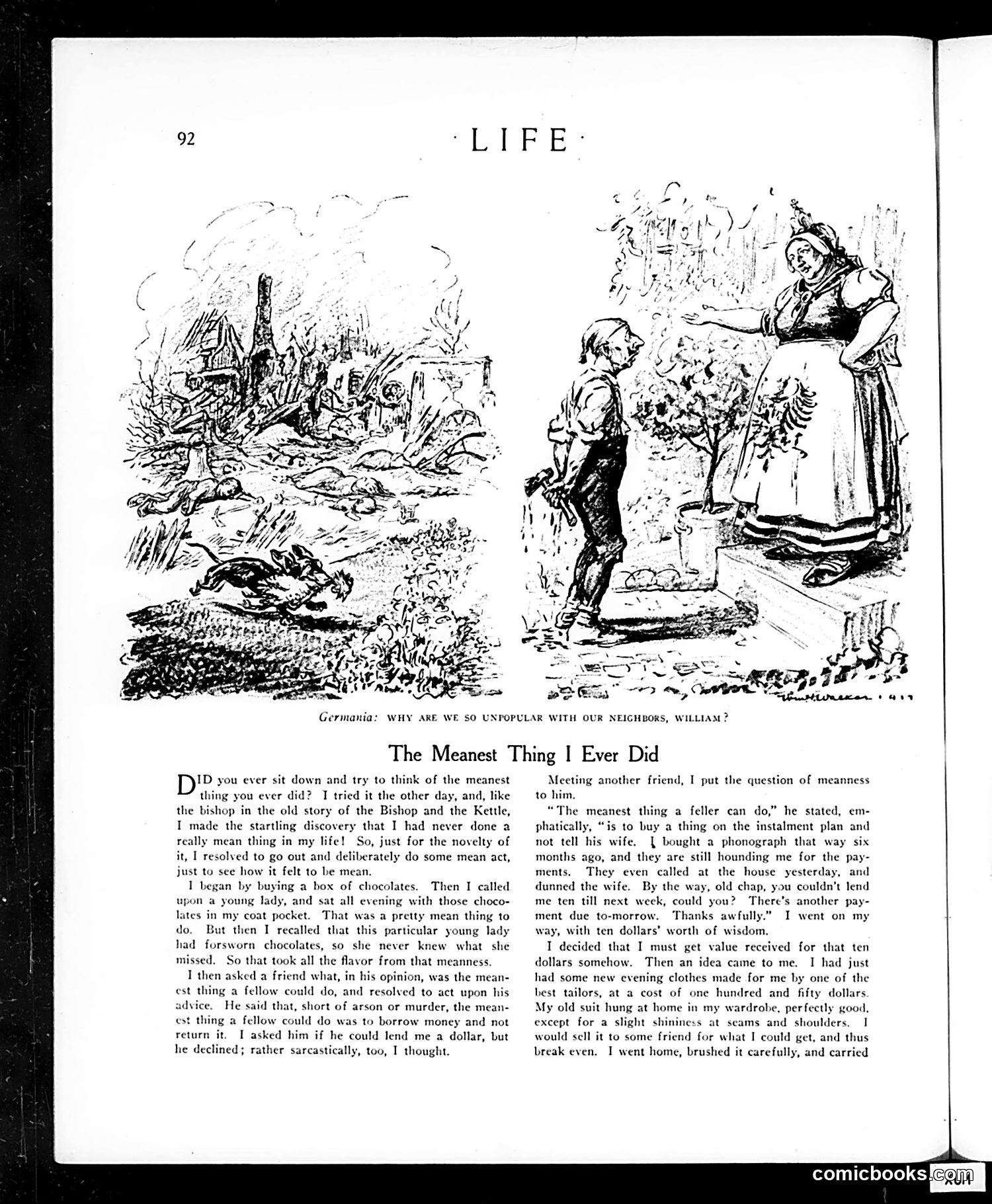
**The Cartoon:** The illustration shows a woman scolding a young boy, with the caption "Germania: WHY ARE WE SO UNPOPULAR WITH OUR NEIGHBORS, WILLIAM?" **The Political Reference:** This is a satirical commentary on German-American relations, depicting "Germania" (personified Germany) questioning "William" (likely Kaiser Wilhelm II) about Germany's unpopularity with neighboring nations. The cartoon likely critiques German foreign policy and aggressive behavior that isolated Germany diplomatically in Europe. **The Context:** Published in Life (an American satirical magazine), this reflects early 20th-century American attitudes toward German imperial expansion and conduct. The domestic scene—a stern mother figure disciplining a wayward child—uses family metaphor to mock Germany's position among European powers. **The Joke:** The satire suggests Germany's diplomatic isolation was self-inflicted through poor behavior, much like a misbehaving child earning disapproval.
📄 Transcribed text from this page (OCR, searchable)
Machine-transcribed from the original scan — historical spelling and the odd misread are preserved.
‘ermania: WHY ARE WE SO UNPOPULAR WITH OUR NEIGHBORS, WILLIAM ? The Meanest Thing I Ever Did ID you ever sit down and try to think of the meanest thing you ever did? I tried it the other day, and, like the bishop in the old story of the Bishop and the Kettle, I made the startling discovery that I had never done a really mean thing in my life! , just for the novelty of it, I resolved to go out and deliberately do some mean act, just to see how it felt to be mean. I began by buying a box of chocolates. Then I called upon a young lady, and sat all evening with those choco- lates in my coat pocket. That was a pretty mean thing to do, But then TI recalled that this particular young lady what she So that took all the flavor from that meanness. I then asked a friend what, in his opinion, was the mean- est thing a fellow could do, and resolved to act upon his advice. He said that, short of arson or murder, the mean- est thing a fellow could do was to borrow money and not return it. I asked him if he could lend me a dollar, but he declined; rather sarcastically, too, I thought. had forsworn chocolates, so she never knew missed. Meeting another friend, I put the question of meanness to him. “The meanest thing a feller can do,” he stated, em- phatically, “is to buy a thing on the instalment plan and not tell his wife. [ bought a phonograph that way six months ago, and they are still hounding me for the pay- ments, They even called at the house yesterday, and dunned the wife. By the way, old chap, you couldn't lend me ten till next week, could you? There's another pay- ment due to-morrow. Thanks awfully.” I went on my way, with ten dollars’ worth of wisdom, I decided that I must get value received for that ten dollars somehow. Then an idea came to me. I had just had some new evening clothes made for me by one of the best tailors, at a cost of one hundred and fifty dollars. My old suit hung at home in my wardrobe, perfectly good, except for a slight shininess at seams and shoulders. I would sell it to some friend for what I could get, and thus break even. I went home, brushed it carefully, and carried comicbooks Bam